What is Moldovan Covor Kilim?
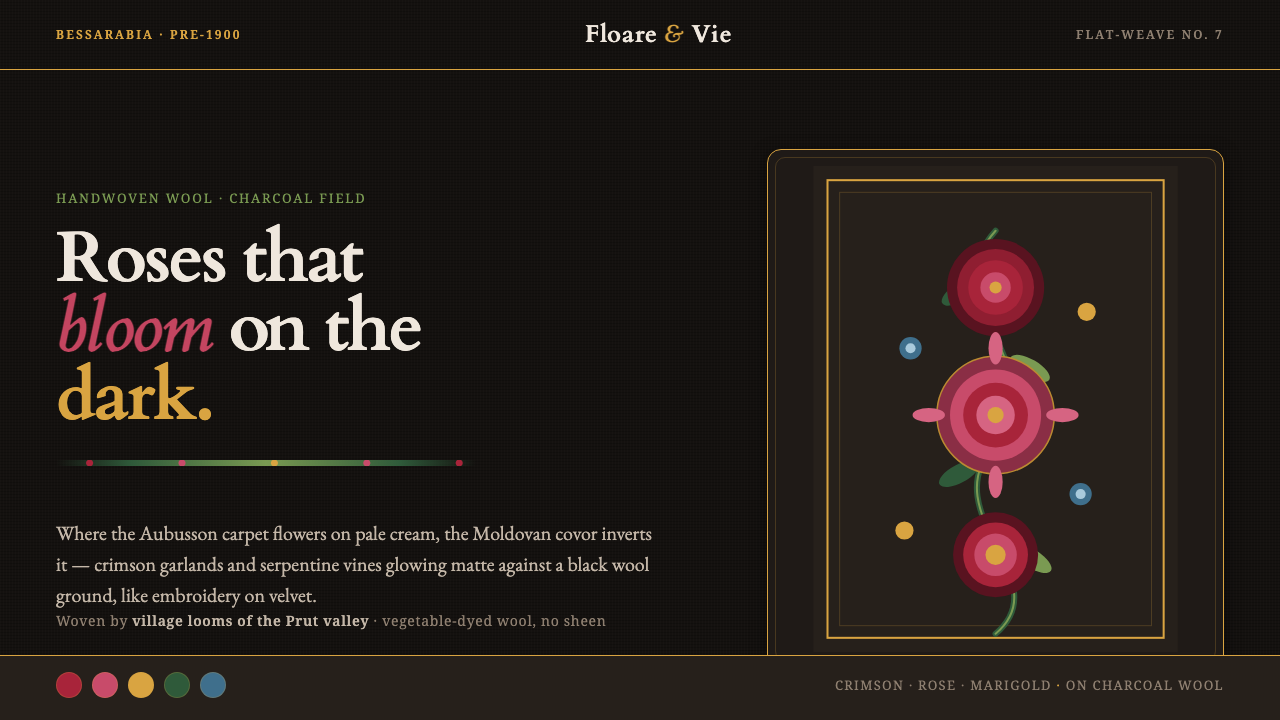
Moldovan covor kilim lets roses bloom after dark — crimson garlands, trailing vines, and gold-fringed warmth held against a charcoal wool field.
Moldovan Covor Kilim in brief
The Moldovan covor is a handwoven wool flat-weave associated with pre-1900 Bessarabia, in the Eastern European cultural landscape of Moldova, historic Bessarabia, and Romania. Its defining image is not a small repeating motif but an expansive botanical field: large naturalistic crimson roses, serpentine vines, and forest-green foliage set against charcoal-black wool.
Its dark ground reverses the expectation established by pale floral carpets such as Aubusson examples. Instead of flowers dissolving into a light decorative field, saturated rose, sky-blue, and marigold-gold blooms emerge from darkness with the visual richness of embroidery on velvet. The result is decorative, but never weightless; the composition feels anchored by wool, shadow, and the slow labor implied by a flat weave.
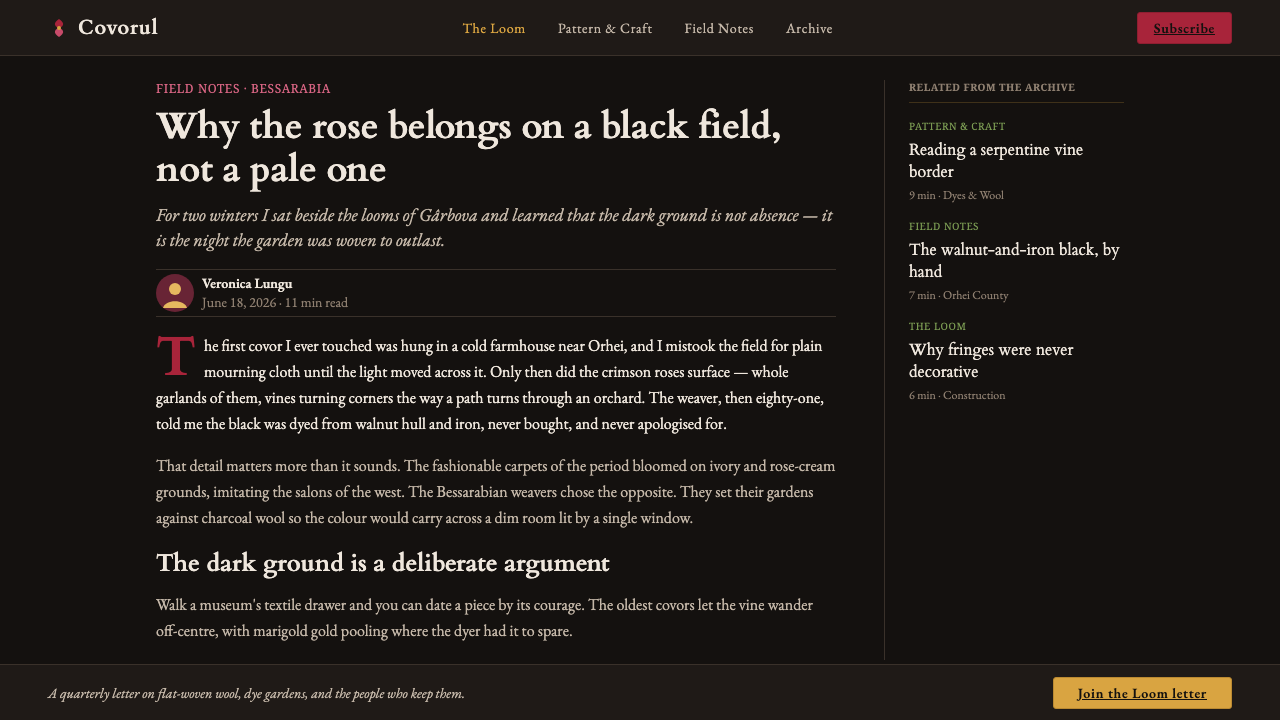
As a contemporary interface vocabulary, Moldovan covor kilim translates that handwoven warmth into an atmosphere of deep charcoal, jewel-saturated botanical accents, old-world serif typography, and ornamental framing. Content is treated as something held within a textile border rather than placed on an empty screen. The intended mood is quiet, sumptuous, and handmade, with no place for glossy surfaces or geometric abstraction.
Where does Moldovan Covor Kilim come from?
The covor belongs to a Bessarabian flat-weaving tradition documented through vintage examples from the twentieth century, while its visual language is associated with work made before 1900. Its regional identity is Eastern European rather than narrowly national: Moldova, historic Bessarabia, and Romania form the cultural setting named for the tradition. That geography matters because the style reads as a woven domestic object with local continuity, not as an isolated ornamental pattern.
Its makers are identified collectively rather than through celebrated individual authors. Bessarabian village women weavers carried the tradition through handwork, while Moldovan flat-weave guild artisans represent its craft discipline and shared technical knowledge. This anonymity is central to the covor’s character: the authority of the work comes from accumulated making practices, wool, pattern memory, and repeated skilled decisions rather than a single signature.
The floral kilim tradition supplies the central visual grammar. Roses, foliage, and curling vines are not incidental embellishments laid over an otherwise neutral composition; they are the composition. Their scale permits the textile to feel garden-like and immersive, while the serpentine lines keep the floral field in motion across the dark ground.
Aubusson floral carpet influence provides an important point of comparison. Pale-ground floral carpets establish one convention for luxurious botanical decoration, while the covor deliberately inverts it. By placing saturated flowers on charcoal-black wool, it creates a darker, more dramatic kind of illumination: blooms appear to glow matte rather than shine, and ornament becomes especially vivid because the field around it recedes.
What defines the Moldovan Covor Kilim look?
Dark Wool Field
A charcoal-black ground carries the entire system. It should feel matte, dense, and absorptive, like wool that holds light rather than reflecting it. The darkness is not an empty backdrop: it is the condition that allows roses, foliage, and fringed borders to gain presence. Keep broad areas calm so the botanical work can appear to emerge from within the field.
Botanical Garlands
Large naturalistic crimson roses are joined by serpentine vines and forest-green foliage. The motifs should feel gathered into garlands rather than dispersed as isolated icons. Curving stems create a patient visual route, while flowers provide moments of fullness and pause. Avoid reducing the plants to crisp symbols; their value lies in their organic, ornamental abundance.
Jewel-Saturated Bloom
Crimson, sky blue, marigold gold, and green act as concentrated botanical notes against charcoal. Their effect should be rich and matte, closer to dyed fiber than lacquer or light. Let rose tones lead emotionally, with blue and gold appearing as luminous companions. The palette is most convincing when each bloom seems embedded in the dark wool field.
Old-World Serif
Typography should carry the gravity and intimacy of an old-world serif. It belongs with the textile rather than hovering above it as a neutral digital layer. Titles can feel ceremonial and literary; supporting text should remain composed and readable. The serif voice connects the botanical richness to a sense of inherited craft without requiring additional decoration.
Fringed Frame
Ornamental borders frame content like the selvage and fringe of a woven rug. They should create enclosure, not a hard technical box. A border can mark a featured story, a panel, or an entire page as a textile object, with deliberate irregularity and warmth. Treat it as a finishing edge whose role is to hold the composition together.
Matte Handwoven Warmth
The style depends on tactile restraint. Surfaces should suggest wool, flat weave, and hand labor through quiet depth and visible compositional patience, not simulated gloss. The result is lavish in motif but subdued in finish. Any treatment that looks polished, slick, or mechanically abstract breaks the essential contrast between dark restraint and floral abundance.
Who shaped Moldovan Covor Kilim?
Bessarabian village women weavers are named as the collective custodians of the handwoven covor tradition. Their presence keeps the style grounded in domestic textile making rather than detached ornament. The large roses, winding vines, dark wool field, and fringed finish should therefore be understood as parts of a practiced woven language, shaped through community knowledge and handwork.
Moldovan flat-weave guild artisans represent the shared craft discipline behind the covor. Their importance lies in the flat-weave basis of the textile and in the controlled relationship between dark field, botanical motif, and decorative edge. In a modern adaptation, that discipline becomes compositional consistency: the interface should feel made, framed, and deliberately held together.
Aubusson floral carpet influence is not a maker but a crucial visual counterpart. It clarifies the covor’s distinctive decision to place floral abundance on a dark field rather than a pale one. This comparison explains why the palette feels so luminous without becoming glossy: the flowers gain intensity from contrast, while charcoal wool preserves a grounded, matte atmosphere.
How do you use Moldovan Covor Kilim today?
Moldovan covor kilim works best when a product needs richness, intimacy, and a visibly crafted point of view. Begin with a deep charcoal field and decide where botanical life is allowed to gather. Roses and vines should have room to travel, while content remains calm enough to be read. The strongest applications use the floral language as atmosphere and framing, not as a wallpaper placed behind every word.
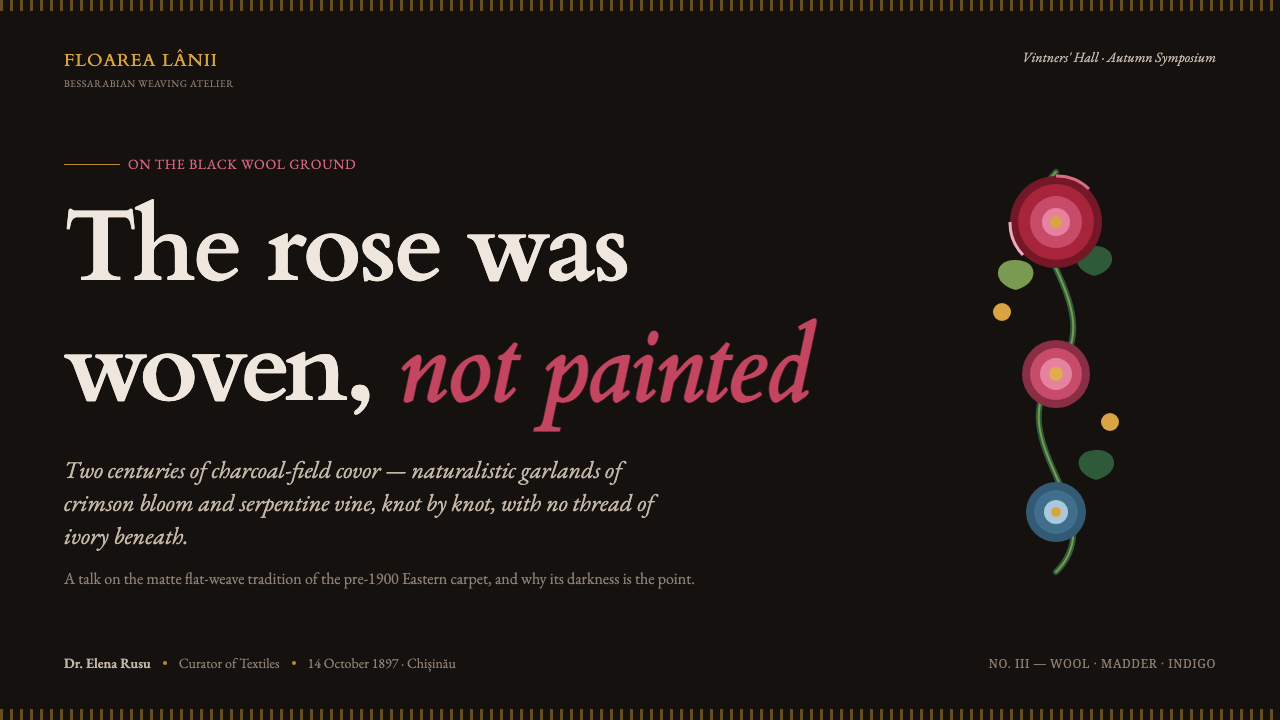
For presentation slides, make the cover feel like a single section of textile: a charcoal field, a gathered garland near an edge, an old-world serif title, and a restrained fringed finish. Content slides should give prose a quiet center while a vine or flower marks the margin. Data slides require special discipline: use botanical color as a meaningful emphasis, keep charts legible, and let the dark field provide contrast rather than turning each graphic into decoration.
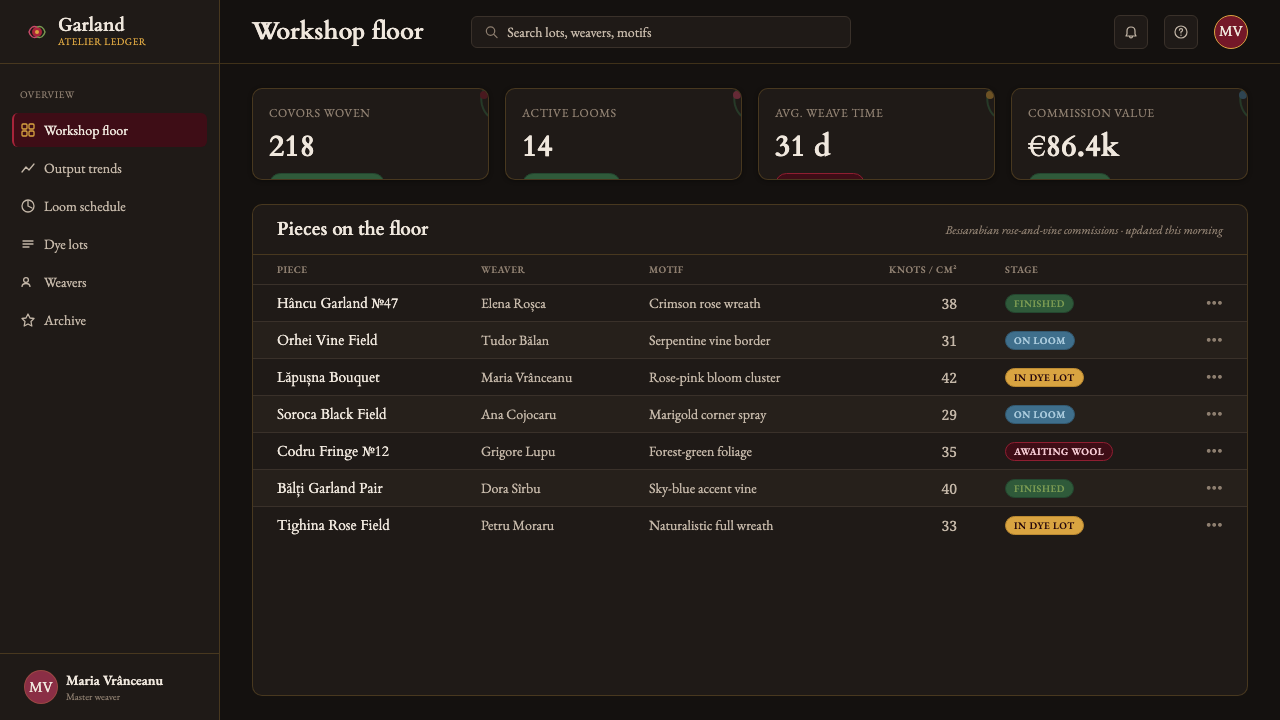
In web interfaces, the style suits editorial dashboards, collection pages, premium membership areas, and pricing experiences that benefit from a sense of ceremony. Dashboard panels can be framed like woven sections, with foliage reserved for identity moments and state changes rather than every control. Pricing can use a garland to distinguish a featured offer, while the typography and dark ground keep comparison information composed and readable.
For editorial and marketing work, let the textile metaphor organize the page. A feature article can open with a rose garland and settle into generous dark reading space; a campaign can use fringed borders to make a message feel like a keepsake. Alternate richly ornamented feature areas with quieter text-led areas, so floral abundance remains special and the reader is not asked to decode decoration continuously.
The common mistake is to mistake darkness and flowers for the whole style. A glossy black surface, sharp abstract motifs, generic floral stickers, or scattered jewel colors lose the covor’s woven restraint. Another mistake is making every panel equally ornate. Authentic adaptation depends on contrast between the charcoal field and concentrated botanical moments, and between old-world richness and disciplined readability.
Moldovan Covor Kilim — FAQ
Is Moldovan covor kilim simply a dark floral style?
No. The dark floral appearance is inseparable from the handwoven wool flat-weave premise. Its character comes from the relationship between a matte charcoal field, large naturalistic garlands, saturated blooms, serpentine vines, and a textile-like framed finish. Removing that sense of woven restraint leaves a generic dark botanical treatment.
Why is the charcoal ground so important?
The charcoal wool field inverts the pale-ground convention associated with Aubusson floral carpets. It allows crimson, sky-blue, marigold-gold, and green motifs to appear luminous while preserving a matte, grounded mood. A light ground changes the style’s central visual argument: flowers no longer emerge from darkness.
Can the style support dense information?
Yes, provided ornament is assigned a limited role. Use the dark field and serif typography to establish reading stability, then place garlands, vines, and fringed borders at meaningful transitions, features, or margins. Dense tables, charts, and controls should not all compete with botanical detail; clarity needs quiet territory.
Should imagery be geometric or glossy to modernize it?
Neither is appropriate to the stated design system. The covor vocabulary is botanical, matte, and handwoven: roses, foliage, vines, wool-dark depth, serif type, and fringed ornamental borders. Modern use comes from disciplined composition and useful digital hierarchy, not from replacing its organic textile logic with polished abstraction.
Where does Moldovan covor kilim work less well?
It is less suitable where an interface needs neutral efficiency, a bright and airy mood, or highly abstract visual signaling. The style asks for darkness, ornament, and a contemplative reading pace. If a product cannot give botanical framing and old-world serif type enough room to matter, a quieter visual system will be more coherent.
Related design styles
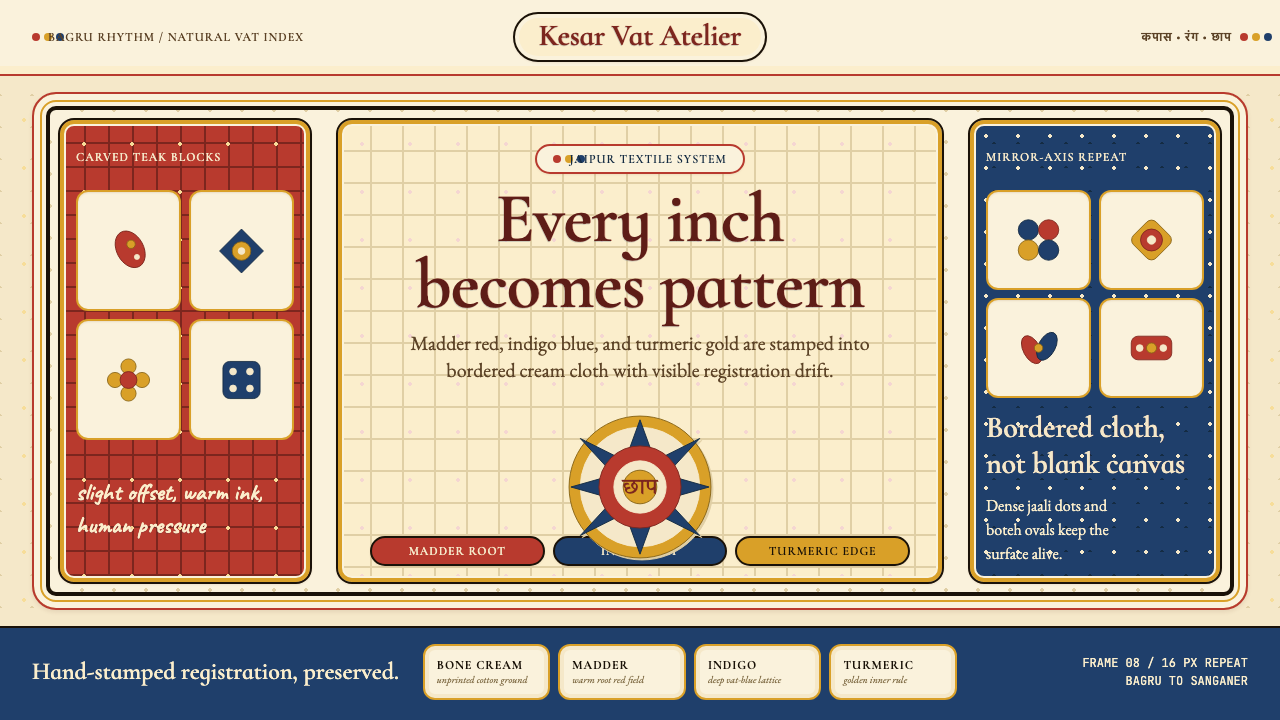 Indian Block PrintPattern claims every inch. Madder, indigo and turmeric stamp dense bordered c…
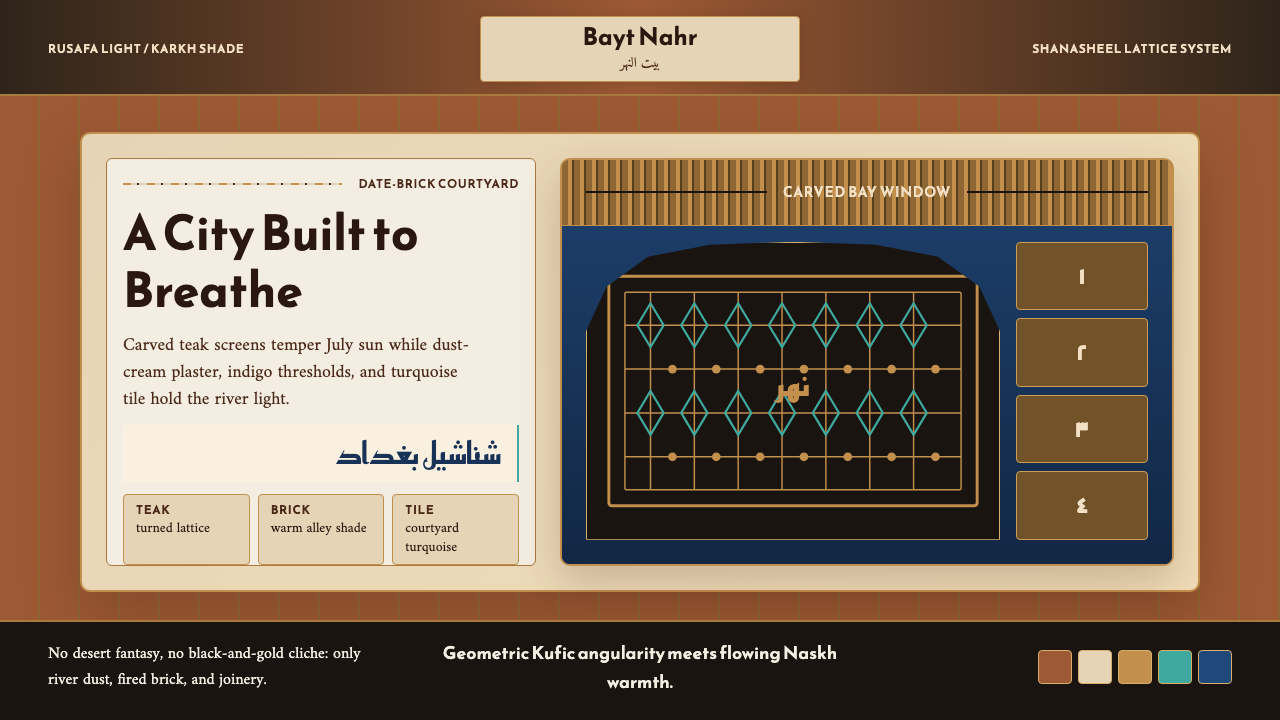 Iraqi Baghdad Shanasheel HouseBreathes through ornament. Date-brick ground, teak lattice, and turquoise til…
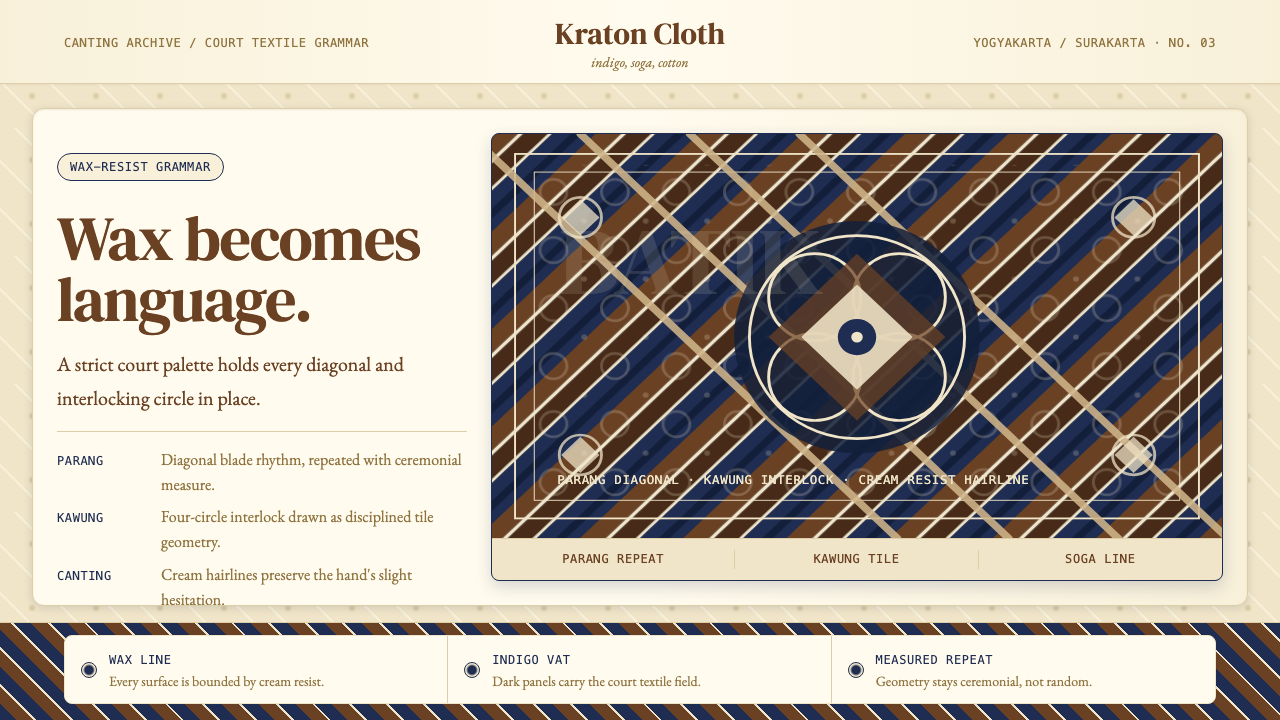 Javanese BatikCeremonial repetition. Indigo, soga, and cream frame a tiled canting motif.
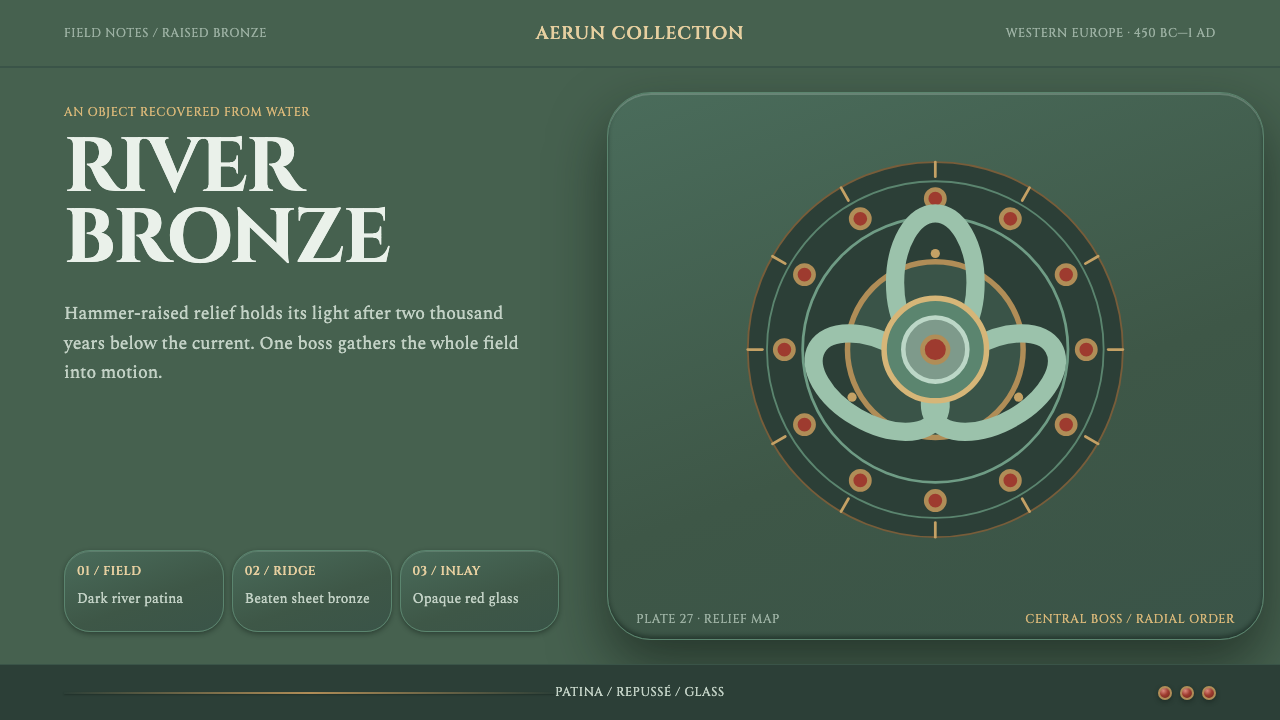 La Tène Celtic MetalworkMetalwork that still moves. Patina-green relief radiates from a bronze boss,…
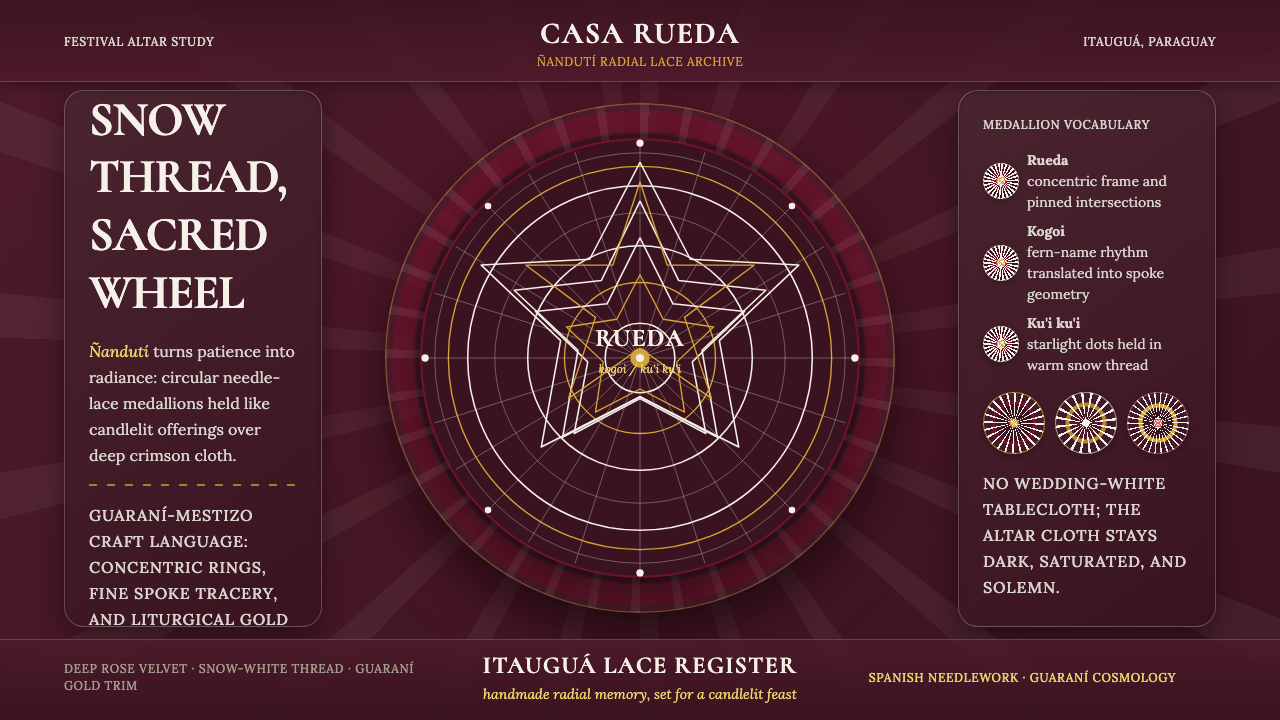 Paraguayan Itauguá Ñandutí Spider LaceReverent craft glows. Snow lace medallions radiate over rose velvet with Guar…
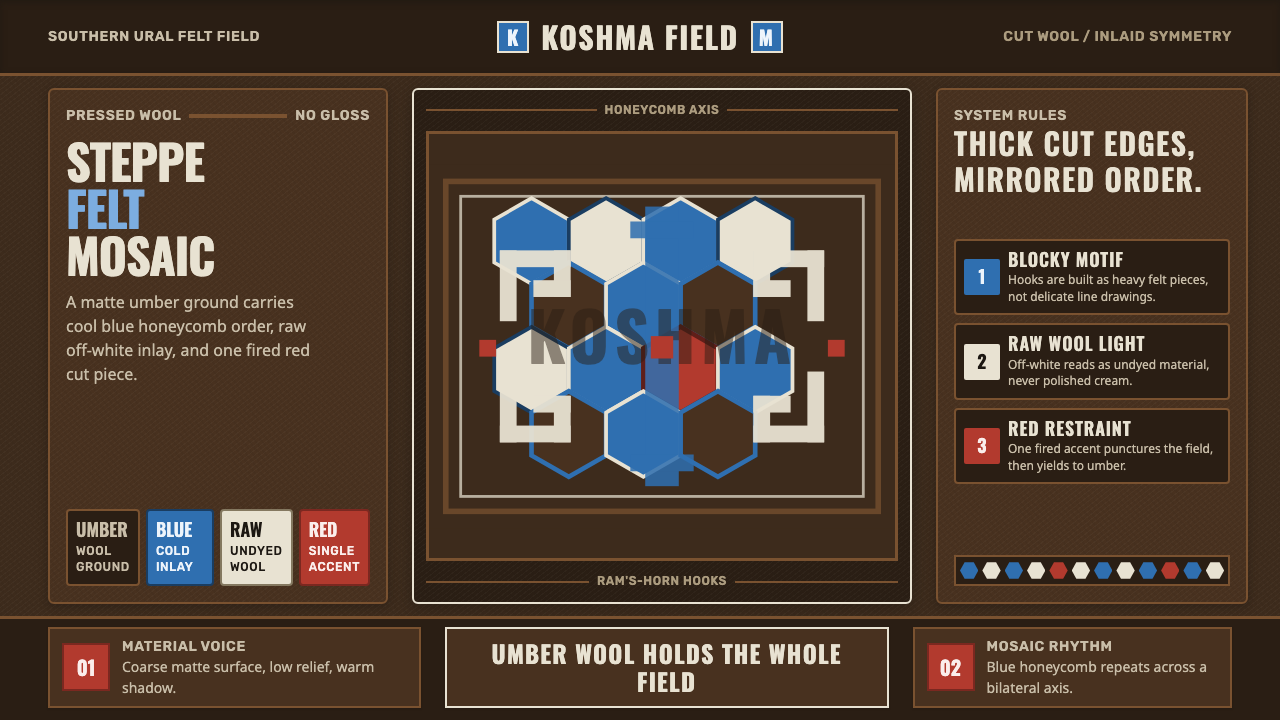 Bashkir Honeycomb Felt OrnamentSteppe craft feels weighty. Umber felt holds blue honeycomb and raw-wool hook…