What is Nivkh Bear Festival?
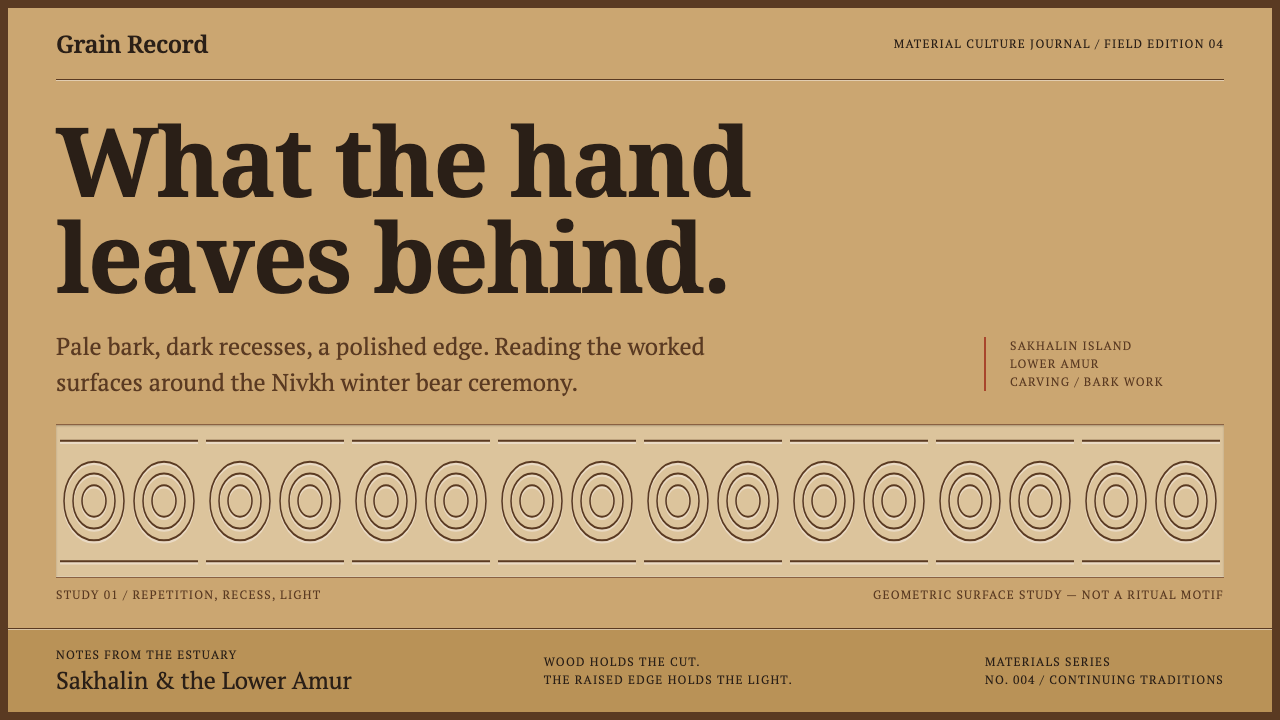
The Nivkh Bear Festival style is built from the surfaces around a ceremony — shaved wood and bark, V-groove lines with a lit bevel, and borders that scroll and return on themselves.
Nivkh Bear Festival in brief
Nivkh Bear Festival takes its look from the material culture of the Nivkh people of Sakhalin Island and the Amur estuary in the Russian Far East. The winter bear festival at its centre is not a performance. A bear is raised in a log cage, fed, teased, shot, dismembered and shared out, because the bear is the son of the master of the taiga and is going home. The ceremony itself leaves no images.
What survives is the material around it, and much of it sits in museum drawers: ritual spoons, troughs, cage posts, birch-bark tues, stencilled bedding, and robes with dyed borders. This design language is built from those surfaces rather than from the ritual: pale shaved wood and the inner face of bark as the ground, a carved line as the basic mark, and a border that scrolls and curls.
The result is a tactile, warm and quiet style. Every line is cut into the ground rather than drawn on it; every edge has a bevel that catches light on one side; smoke darkens the recesses and hands polish the places they grip. It gives serif type a carved setting, and it makes a screen feel like an object that has been handled for generations.

Where does Nivkh Bear Festival come from?
The Nivkh live on Sakhalin Island and around the mouth of the Amur River. The sources describe the tradition as pre-1900 and continuing, and date the surviving ethnographic collections largely to the nineteenth and early twentieth centuries. The objects in the museum drawers are therefore not relics of a vanished culture but the part of a living one that happened to be gathered and stored. Because the objects are carved, bent and stitched from wood and bark, their ornament always follows a curved or uneven form, and that is what the style tries to carry across: a surface with the irregularity of a hand built into it.
The ceremony's logic explains the objects. In the Nivkh winter bear festival, as the introduction describes it, the bear is raised, fed, teased, shot, dismembered and shared, because it is regarded as the son of the master of the taiga, going home. The festival is an exchange between people and the forest, and the implements of the feast are made and decorated with that in mind. The sources call the wider pattern the circumpolar bear ceremonial complex: Nivkh practice is one expression of a bear-centred ritual tradition found among peoples across the northern world.
The ornament belongs to older lineages. The sources name an Amur-basin ornamental tradition, the scrolling, spiral-based decoration of the region, and a Sikachi-Alyan petroglyph lineage, tracing a line from the rock carvings of Sikachi-Alyan on the Amur to the double spirals on later wood and bark. The point for a designer is continuity: a scroll that returns on itself and ends in a curl is not an invented flourish but a very old way of ornamenting a surface.
Three names stand at the edge of this material. Lev Shternberg and Bronisław Piłsudski were ethnographers who documented the peoples of this region in the period when most of the surviving collections were made, and their work is part of how the objects were recorded and kept. Vladimir Sangi is a Nivkh writer, and his place in the list is a reminder that these are not only museum drawers: they belong to a people and a culture that continue.
What defines the Nivkh Bear Festival look?
Bark and Wood Ground
The ground is the colour of shaved pale wood and the inner face of bark: a warm yellow-tan that is closer to honey than to paper. It is not white and not grey. It should feel like a surface that has been cut and scraped, with the tone shifting subtly rather than lying perfectly even.
V-Groove Lines
Every line is a V-shaped groove cut into the surface, not a stroke drawn on it. Lines are therefore dark brown inside, with a narrow lit edge along one side. They read as incision; they thicken and thin with the cut and never end in a mechanical cap. A line with no groove has no business here.
The Lit Bevel
Each groove has a bevel that catches the light on one flank, and the light comes from one consistent direction across the page. This is the style's only depth device: a pale edge beside a dark line. Gradients, glows and soft cast shadows are not used; the effect is carved, not lit from within.
Scrolling Borders
Borders scroll, and return on themselves, forming double spirals that end in a curl rather than a stop. A frame is a continuous, flowing band, not four separate edges, and corners turn instead of meeting at angles. Ornamental bands are used to enclose and to separate, and they carry the style's main rhythm.
Smoke and Hand Wear
Use leaves its traces in a predictable way. Smoke darkens the recesses, the hollows of the grooves and the corners of containers, while the hand polishes whatever it grips, so raised and handled areas are lighter and slightly glossy. The wear explains the tonal variation on the surface and is placed logically; it is never sprinkled at random.
Serif Type in a Carved Setting
Type is a quiet serif, set in deep brown and given room, as if lettering were cut into the same wood. The serif's small terminals echo the finishing of a carved stroke. Display type is restrained in size and weight; the ornament, not the headline, carries the character.
Hand-Laid Irregularity
Ornament is laid by hand along an uneven surface, so it is not perfectly even, and should not be. Spacing varies a little, curves differ slightly from one repeat to the next, and strict mirror symmetry is avoided. The variation is small and consistent, enough to read as made by a hand rather than output by a machine.

Who shaped Nivkh Bear Festival?
An ethnographer listed in the sources. His name stands for the early scholarly attention to Nivkh life and material culture; the ethnographic collections that supply the objects behind this style were made largely in the nineteenth and early twentieth centuries, the same broad period as his work.
A second early ethnographer named in the sources, who worked among the peoples of Sakhalin. Documentation of this kind is part of why spoons, troughs and bark vessels survive with their context, which is what makes it possible to build a design language from them.
A Nivkh writer. His inclusion keeps the style from becoming only an ethnographic one: the culture speaks for itself, and the bear festival is part of a living tradition. For designers using this style, he is a prompt to treat the source with respect and to credit it.
How do you use Nivkh Bear Festival today?
Nivkh Bear Festival suits work that wants warmth, craft and gravity without ornament for its own sake: cultural institutions, natural materials, slow and thoughtful brands. It is a style of surfaces, not of imagery.
For slides, a cover can be a warm bark-yellow field with a single scroll border enclosing the title in deep brown serif type; the border is the whole illustration. Content slides use a quiet carved-line divider and plenty of margin, with body type in brown and headings in the same serif, slightly larger. Data slides work with bars drawn as grooves, a dark line with a pale bevel, rather than filled blocks, in a restrained palette of browns.
On the web, build pages as a set of carved panels: a bark-toned ground, groove lines as dividers, scroll borders at section edges and around the hero, and serif headings. It suits museums, heritage and ethnographic archives, craft-centred organisations, outdoor and natural-materials brands, tea and food producers, and long-form storytelling sites. Buttons are bevelled rather than flat, with a pale edge on one side; inputs read as cut channels. Pricing tiers can be panels bordered by a scroll band, with the recommended tier's border more deeply cut. Motion should be minimal: surfaces do not glide or glow, and at most a border draws itself along its curl.
For editorial and marketing, it fits books on culture and nature, exhibition catalogues, packaging for natural goods, invitations and long essays. Pages work with wide margins, serif text and a single scroll band as the title ornament. Photography should be of materials and objects, such as wood, bark and handwork, rather than staged scenes. Print rewards the style: uncoated, warm stock and a single dark ink approximate a carved surface better than any digital effect.
The common mistakes are to depict the ceremony or the bear, to treat a living people's ritual as costume, or to use the style to decorate a product unrelated to it. Others are to repeat the border as wallpaper across the page; to make the grooves too clean and perfect, which turns carving into outline; to add glossy gradients that contradict the matte wood; and to set the type in a modern sans that loses the carved setting.

Nivkh Bear Festival — FAQ
What is the Nivkh bear festival?
It is a winter ceremony of the Nivkh people of Sakhalin Island and the Amur estuary. A bear is raised in a log cage, fed, teased, shot, dismembered and shared out, because the bear is the son of the master of the taiga and is going home. It is not a performance. This style does not reproduce the ceremony; it draws on the spoons, troughs, posts, bark vessels and bedding that surround it.
Is it appropriate to use this style?
Yes, with respect. The source is the ceremonial material culture of a living people, so keep to surfaces, lines and borders, avoid depicting the bear or the ritual, avoid jokes and mascots, and credit the Nivkh origin where the project allows. Work that is about craft, nature, heritage or storytelling sits more naturally in it than work with no connection to those things.
How do I make a flat screen look carved?
Draw each line as a groove: a dark brown line with a narrow pale edge along one side, with the light coming from the same direction everywhere. Keep the ground matte and warm, avoid gradients and glows, and let the darker tone gather in the recesses and corners. Consistency of the light direction is what sells the effect.
Can I use it with sans-serif type?
The style is set up for a quiet serif, whose small terminals echo carved strokes. A warm humanist sans can work for small interface labels, but geometric or technical sans faces tend to break the carved setting. If the headline is a sans, let the scroll borders and groove lines do the work of keeping the surface hand-cut.
Does it work in a dark theme?
It is a light-ground style by origin: pale wood and bark are the heart of the palette. A dark variant is possible as a smoked, deep brown ground, keeping the lit bevel on the same flank and ensuring strong contrast for text. It becomes a different mood, closer to a hearth than to a workshop, so use it deliberately.
Related design styles
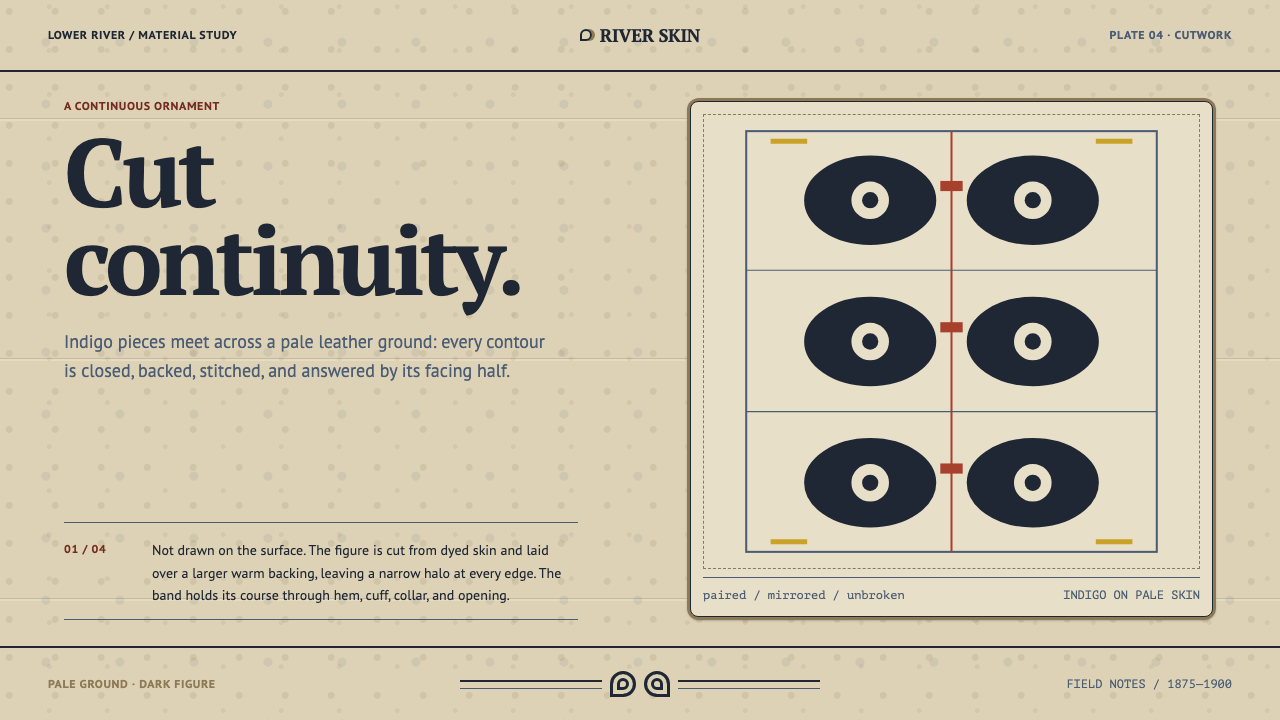 Nanai Amur SpiralCut continuity, never drawn. Dark indigo pairs run across mottled salmon-leat…
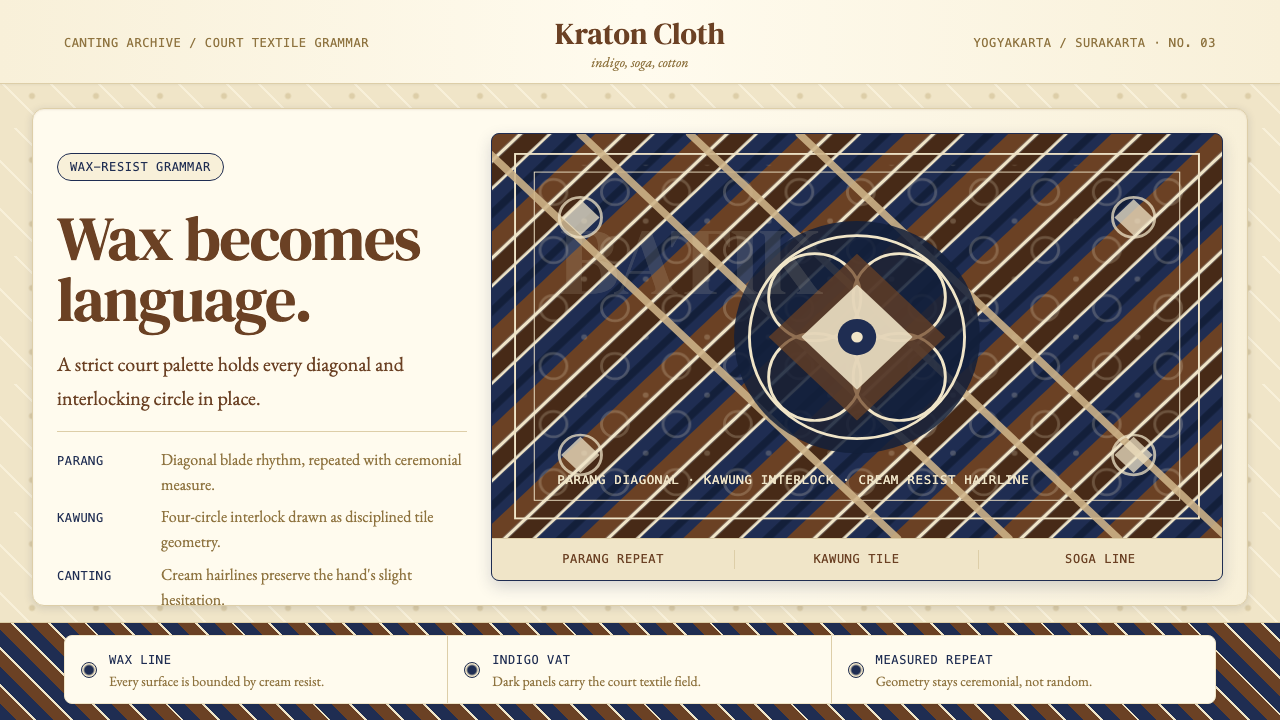 Javanese BatikCeremonial repetition. Indigo, soga, and cream frame a tiled canting motif.
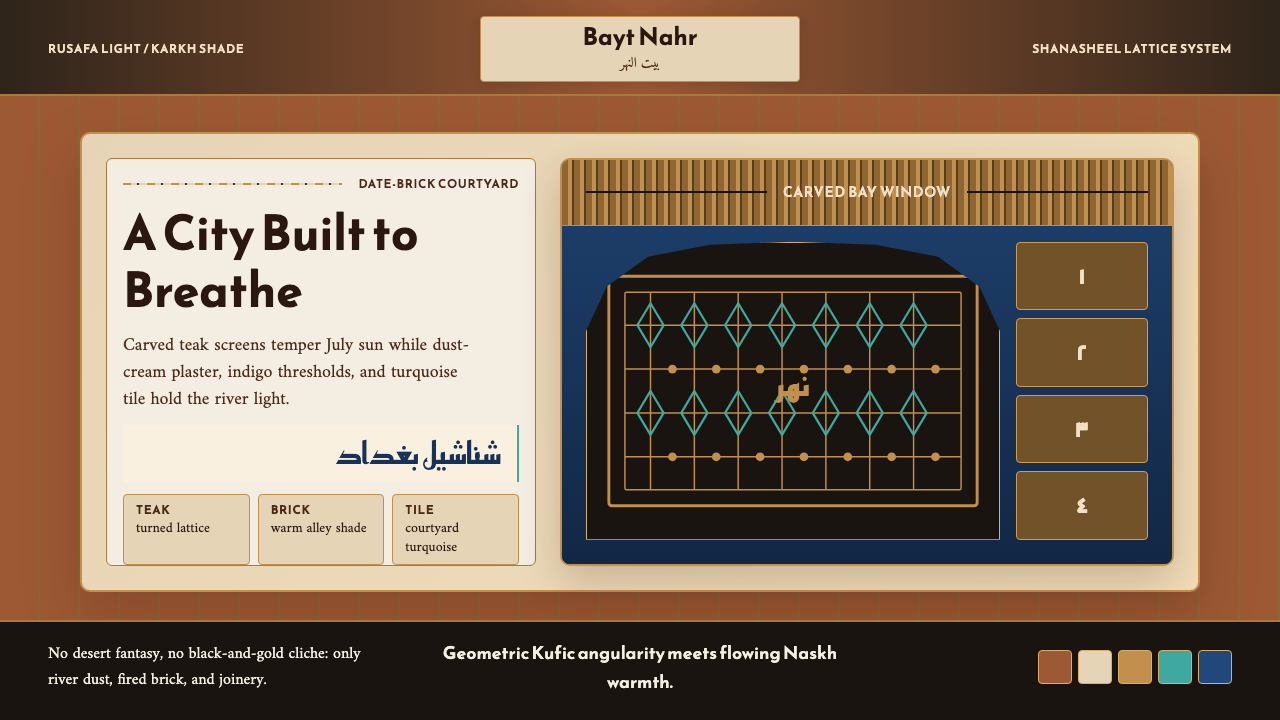 Iraqi Baghdad Shanasheel HouseBreathes through ornament. Date-brick ground, teak lattice, and turquoise til…
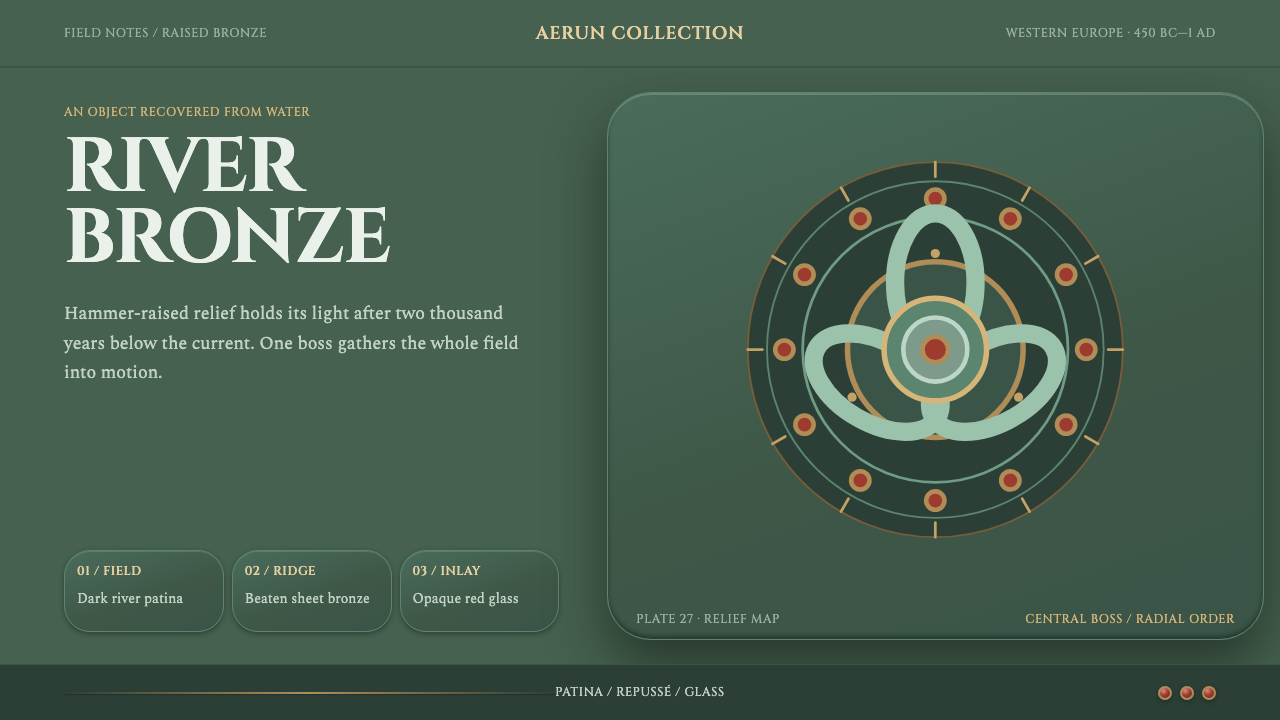 La Tène Celtic MetalworkMetalwork that still moves. Patina-green relief radiates from a bronze boss,…
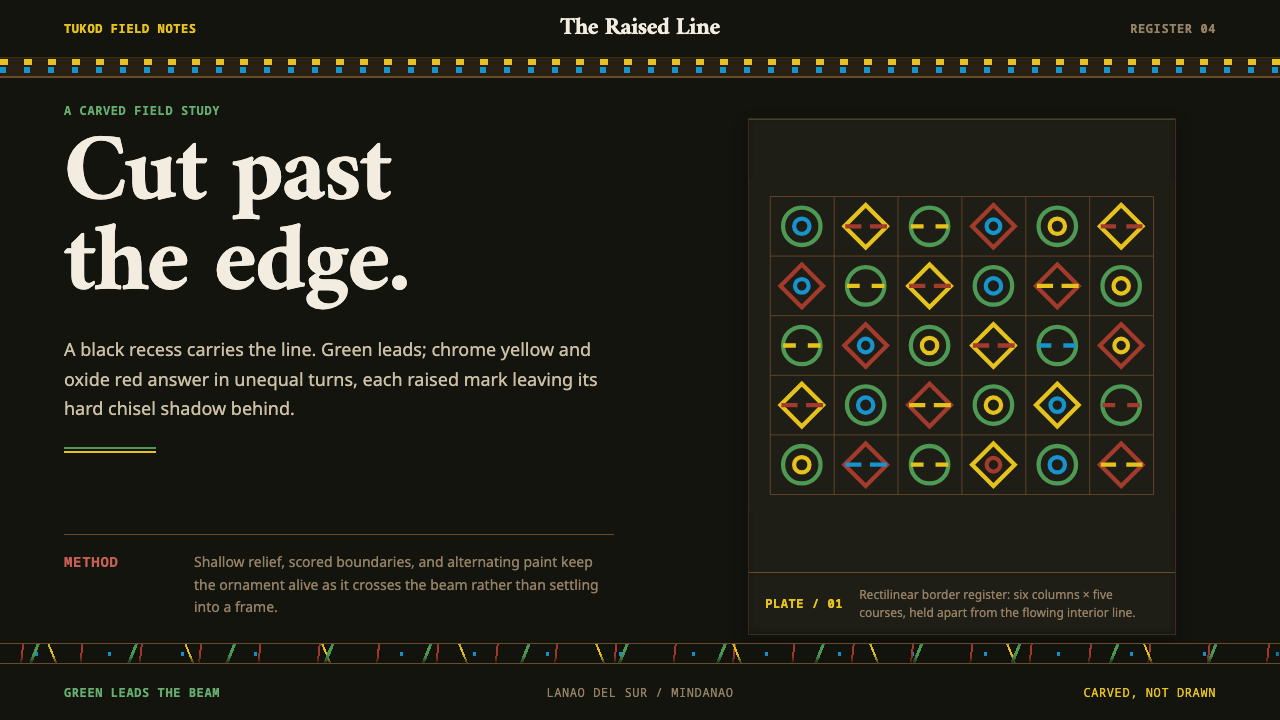 Maranao OkirCarving commands the field. Green, yellow and oxide-red lines rise from black…
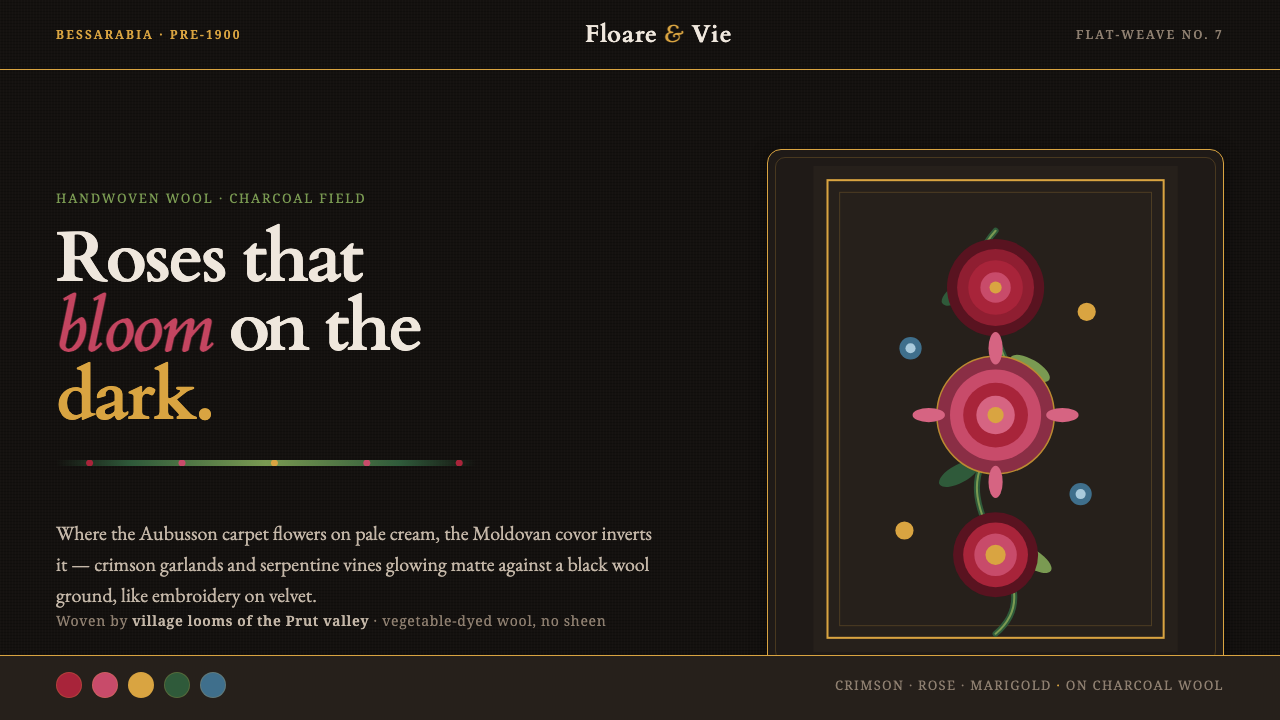 Moldovan Covor KilimRoses that bloom on the dark. Crimson garlands glow matte on a charcoal wool…