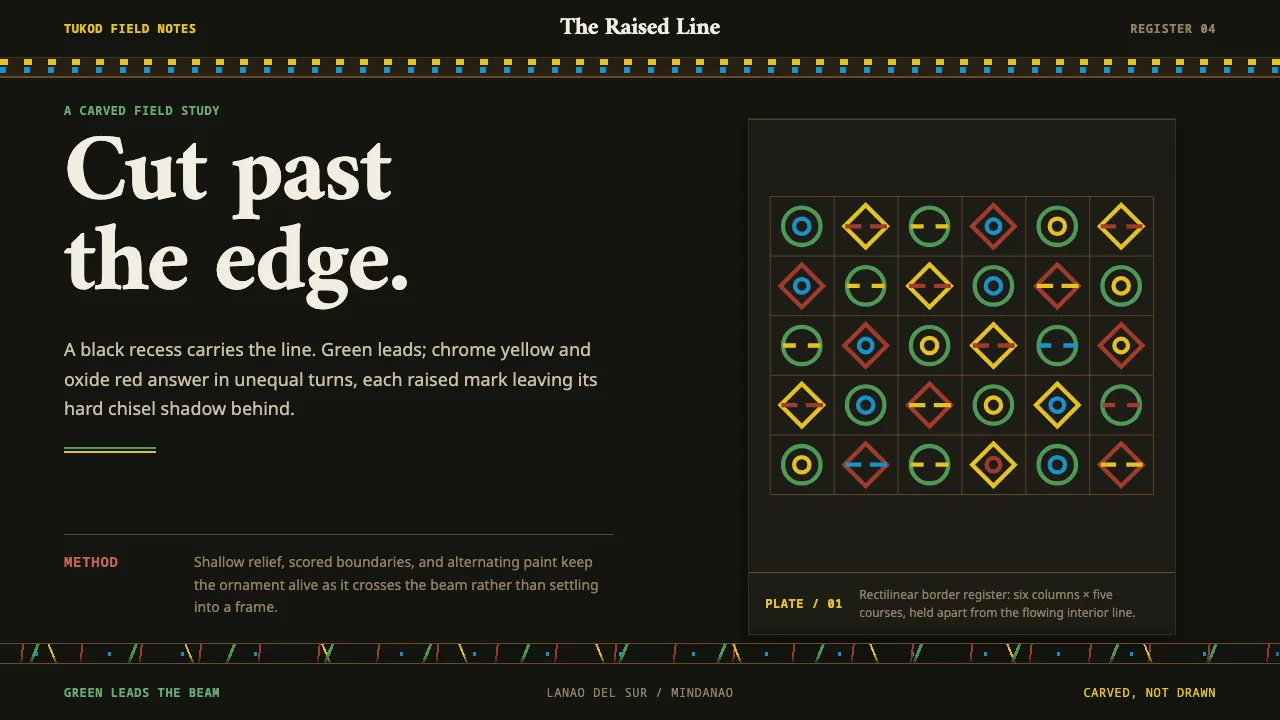
About Maranao Okir
Okir is carved ornament, not drawn ornament. Maranao panday cut it in shallow relief into the hardwood of the torogan — the datu's great house — then painted the field black and brought the raised scrollwork up in green, chrome yellow, oxide red and sky blue. The wing-shaped panolong beam is where it is loudest: a naga serpent's S-curve running the whole length of the beam, pako rabong fronds curling out of it, never mirrored.
This system takes the beam literally. The page is the black field. Everything that reads as content sits above it with a hard cut shadow, the way a chisel leaves an edge. Colour alternates along a line instead of filling a shape, borders are the rectilinear okir a bae register, and the ornament runs out to the edge rather than sitting inside a margin.
- Origin
- Lanao del Sur, Mindanao, Philippines
- Era
- pre-1900 onward; the great torogan of the 19th–20th centuries
- Key figures
- Maranao panday (hereditary carvers) · datu households of Lanao del Sur · National Museum of the Philippines · NCCA (National Commission for Culture and the Arts)
- Movements
- okir a dato (male register) · okir a bae (female register) · torogan architecture
Maranao Okir design spec
Colors
Typography
The other 11 sections — buttons, cards, spacing, motion, techniques and more — open once you unlock. Download the DESIGN.md or send it to your AI in one click. Unlock once, yours forever.
Sign up nowStyles similar to Maranao Okir
Also inspired by crafts & folk art, with a close feel.
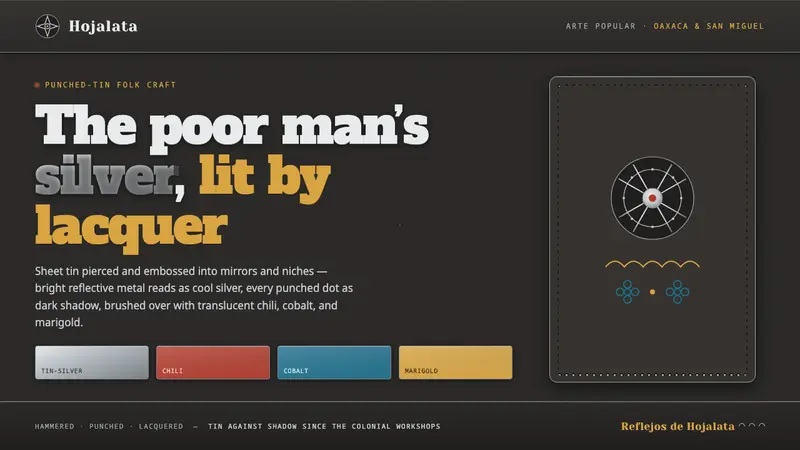 Punched Tin HojalataThe poor man's silver. Pierced tin on oxidized shadow, washed in chili, cobalt, marigold lacquer.
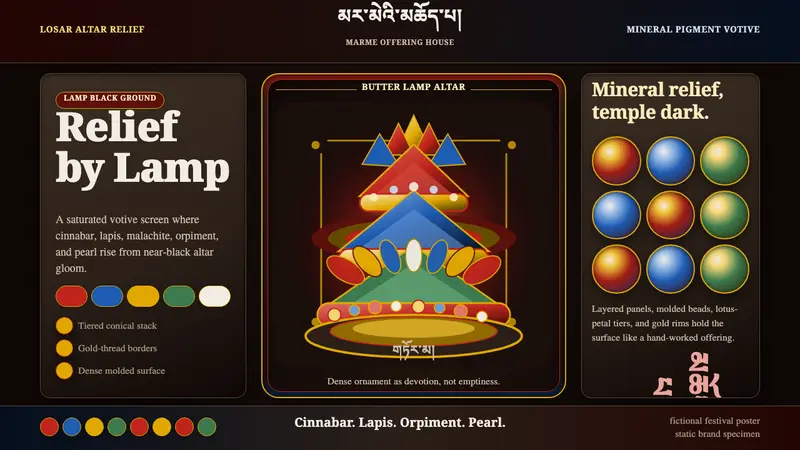 Tibetan Butter SculptureDevotion made dense. Cinnabar, lapis, and gold relief glow from altar black.
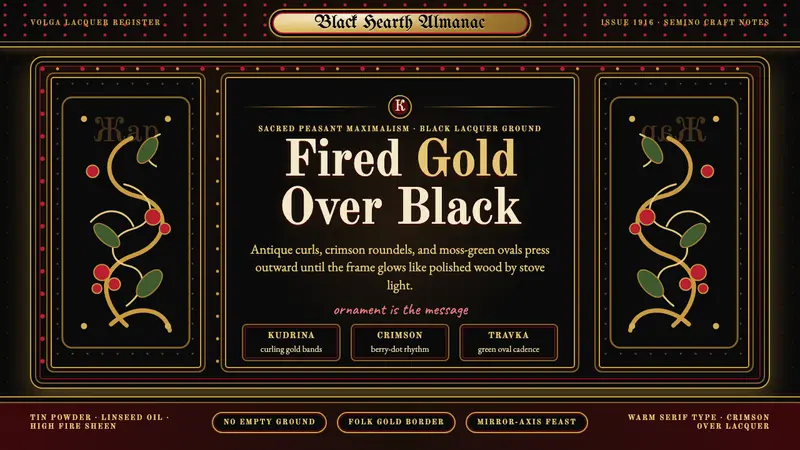 Russian KhokhlomaOrnament is the message. Antique gold curls and crimson dots crowd a black lacquer grid.
 Chinese New Year Spring FestivalThe new year arrives at full volume. Lantern red glows through lacquer night and gold sparks.