What is Bagan Yun Lacquerware?
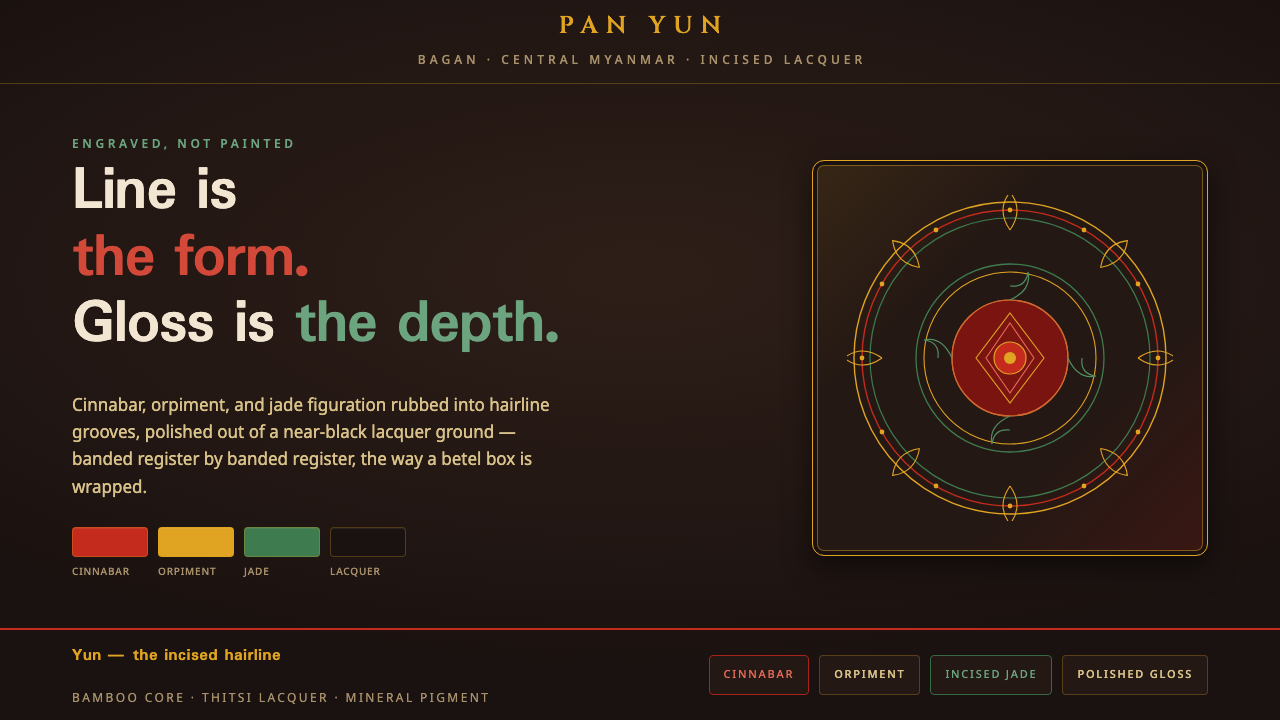
Bagan yun lacquerware lets color emerge as engraved light: cinnabar, orpiment, and green mineral pigment polished from a near-black field.
Bagan Yun Lacquerware in brief
Bagan yun lacquerware is a lacquer tradition of central Myanmar, associated with the Bagan and Myingyan region. Its making begins not with a painted panel or a solid carved block, but with a coiled bamboo core. Over that flexible structural body, artisans build layers of black-red lacquer until the object has the depth, darkness, and resilient surface required for engraving and polishing.
The defining operation is yun incising. Designs are cut into the lacquer as fine grooves, then those grooves are rubbed full of mineral pigment. Cinnabar produces red, orpiment produces yellow, and indigo combined with orpiment produces green. The colors do not sit broadly on the surface as painted fields. They occupy engraved channels, accumulating through repeated filling and finishing until line, color, and lacquer body become inseparable.
The finished effect is both dense and luminous. Figural imagery and scrolling ornament rise from a ground that reads almost black, while a glassy polish gathers light across the surface. The identity of the work lies in the hairline contour: forms are drawn, enclosed, repeated, and bordered through incision. Color intensifies the drawing, but the engraved line remains the structure that holds the image together.
Where does Bagan Yun Lacquerware come from?
Bagan yun lacquerware belongs to a living tradition that predates 1900 and continues the lacquer practices of colonial and pre-colonial central Burma. Its geographic center is the Bagan and Myingyan region of present-day central Myanmar. That regional identification matters because the style is not merely a palette or an ornamental motif; it is tied to a specific workshop knowledge of bamboo cores, layered lacquer, engraved channels, mineral pigments, and prolonged polishing.
The tradition is commonly described as Burmese yun incised lacquer. Its name directs attention to method rather than imagery: the decisive act is incision. A pattern is not simply applied over a dark ground; it is cut into the lacquer surface and then made visible by pigment lodged in each groove. This construction explains why the most intricate imagery still feels disciplined. The line is physically embedded in the object, and the color follows the line’s path instead of spreading independently across the field.
Within the broader context of Southeast Asian Buddhist decorative arts, yun lacquerware accommodates intricate figural and scrollwork imagery without abandoning the commanding presence of the lacquer ground. The near-black field is not empty background. It provides the depth against which every cinnabar, yellow, and green contour can appear to glow. Concentric borders further organize the imagery, turning the surface into a sequence of contained visual zones rather than an unbounded illustration.
The named makers in the source tradition are Bagan pan yun workshops and anonymous family lacquer artisans. Their anonymity is meaningful: this is described as a handcraft tradition transmitted through artisan families, not a style built around a single celebrated author. The value lies in sustained control—coiling the bamboo body, layering lacquer, engraving the design, packing pigment into minute channels, and polishing until the object carries both darkness and inner brilliance.
What defines the Bagan Yun Lacquerware look?
Near-Black Lacquer Ground
The dark lacquer ground is the visual condition from which the entire design emerges. It is not a neutral backdrop and should not be treated as blank black paint. Its depth comes from layered black-red lacquer and its sheen from polishing. Against it, bright mineral pigment reads as embedded illumination rather than surface decoration.
Engraved Contour
Fine incision is the structural language of yun work. Every figure, leaf, curl, and enclosure is first established as a cut line. The result depends on contour remaining legible at close range and coherent across the whole object. Broad areas of unstructured flat color would weaken the style because they displace the groove as the primary carrier of form.
Mineral Color in Channels
Cinnabar red, orpiment yellow, and indigo-and-orpiment green are meaningful because of where they reside: inside incised grooves. Their role is to clarify the engraved image and to create contrast with the lacquer field. Color should feel rubbed in, concentrated, and released by polish, never casually brushed across the surface.
Banded Borders
Concentric bands frame and pace the imagery. Rather than using a single isolated outline, the style often lets borders echo one another, creating a measured transition between central image, surrounding ornament, and outer edge. These bands make the surface feel composed as an object, not merely illustrated as a picture.
Figural and Scrollwork Density
The imagery is intricate, with figural elements and scrolling ornament sharing the same engraved discipline. Complexity is achieved by accumulation of small contours, enclosed bands, and repeated turns, not by atmospheric modeling or loose painterly gesture. The image should feel patiently built and continuously connected to the surface around it.
Glassy Polish
Polishing gives the lacquer its deep glassy sheen and changes how the engraved color is perceived. The surface catches light as one continuous skin while the pigments appear from within their channels. The desired depth is therefore not a simulated optical effect; it is the consequence of lacquer layers, incision, pigment filling, and a highly finished surface.
Who shaped Bagan Yun Lacquerware?
Bagan pan yun workshops are identified in the source material as key custodians of the tradition. They represent the workshop setting in which the technical sequence remains coherent: a coiled bamboo core receives layered black-red lacquer, the lacquer is incised, mineral pigment is worked into the cuts, and the surface is polished. Their significance is collective and process-based rather than attached to a single named designer.
Anonymous family lacquer artisans are the other key human presence named by the source. Their work is described as a quiet, concentrated craft passed through generations. This framing places authorship in accumulated skill: patience with repeated layers, precision in hairline incision, judgment in pigment filling, and restraint in polishing a surface whose darkness must remain as active as its color.
Burmese yun incised lacquer is the central named practice through which the visual language is made. As a figure in the history of the object, it stands for the technique that turns decoration into embedded drawing. Its importance is that it binds image and material together: the motif cannot be separated cleanly from the lacquer surface because it is physically cut into and filled within it.
How do you use Bagan Yun Lacquerware today?
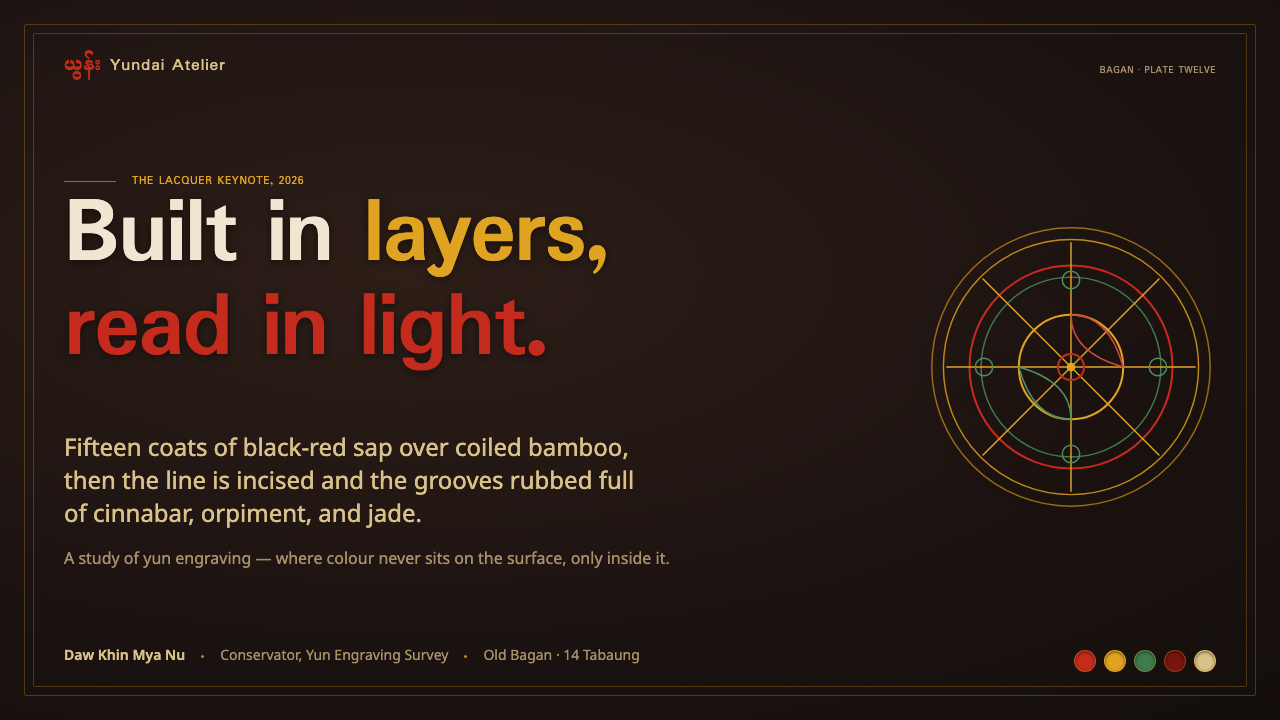
For presentation covers, use the contrast between a near-black lacquer field and a small number of engraved-looking colored contours as the organizing image. A title should remain calm and clearly separated from the ornament, allowing one banded border or a concentrated figural fragment to establish the atmosphere. The cover should suggest depth through polished darkness and embedded line, not through broad painted color or generic luxury effects.
Content slides benefit from a disciplined division between text and ornament. Keep explanatory copy on an uncluttered field, then use narrow yun-inspired borders, a restrained scroll segment, or a fine contour motif to mark sections. On data slides, the most convincing translation is diagrammatic: categories can be differentiated by red, yellow, and green linework against a dark ground, while the information itself remains easy to read. Do not force charts to imitate historical imagery; borrow the system of engraved hierarchy instead.
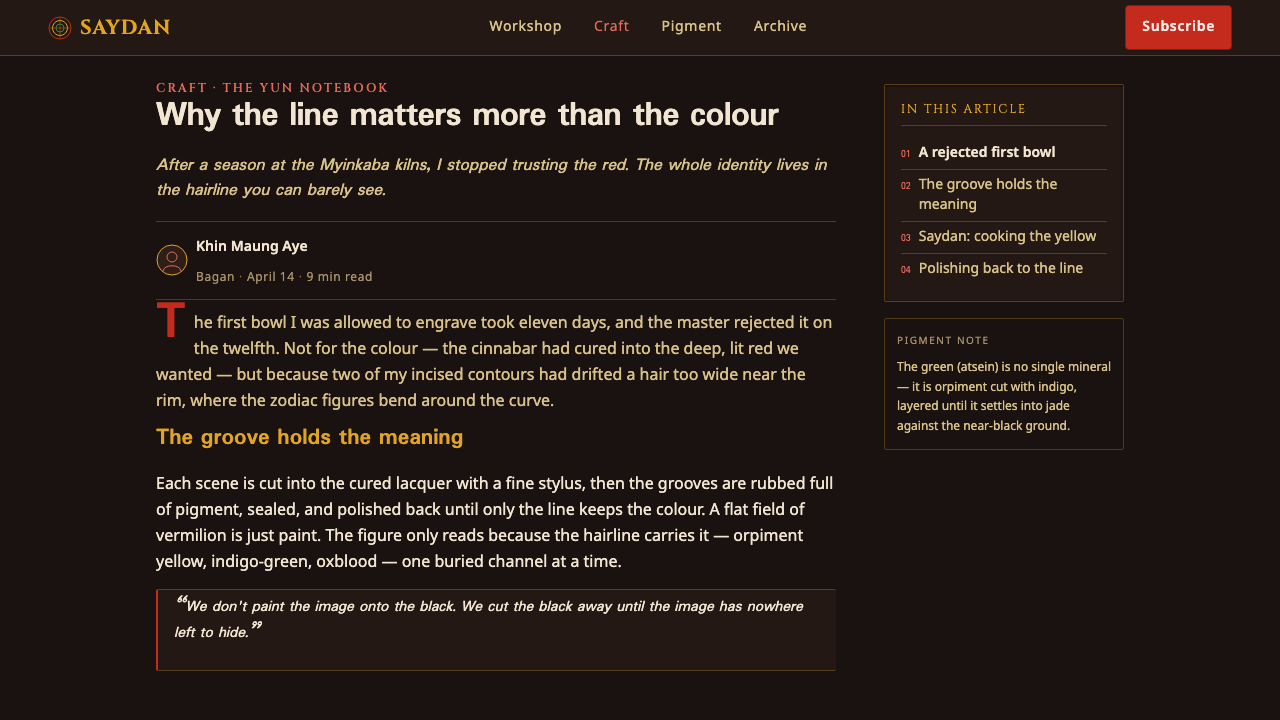
For web interfaces, the style suits cultural archives, collection pages, premium editorial dashboards, and pricing pages where dark focus and careful attention are appropriate. The interface can use a deep lacquer-like background, bright incised accents for active paths and boundaries, and polished visual surfaces that make content feel contained. Navigation and controls should remain direct. Yun references work best at edges, separators, focal frames, and selected states, leaving the functional center of the interface legible.
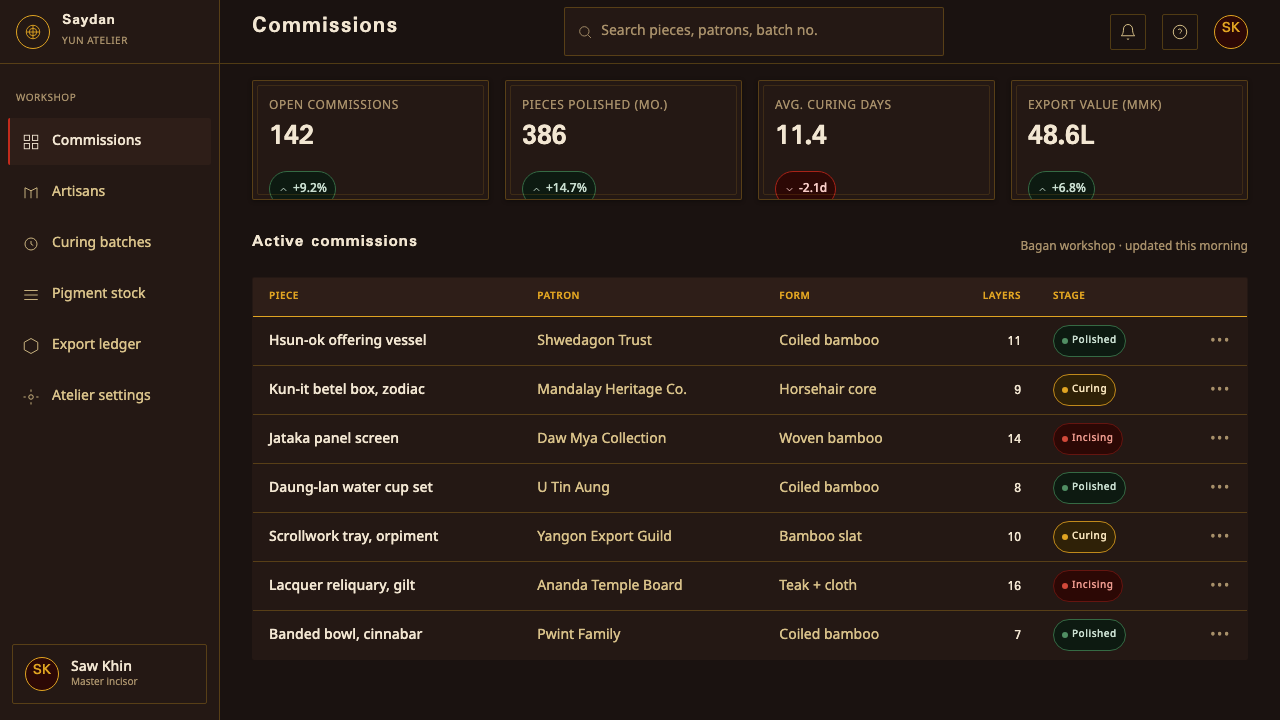
In editorial and marketing work, treat scrollwork and banding as a pacing device. A long-form article can open with a dense ornamental field, then move into quiet reading areas punctuated by engraved-rule section breaks. Product storytelling can use close details of contour, pigment, and gloss to explain making without reducing the tradition to an exotic pattern. The strongest layouts alternate concentration and rest: dense linework at moments of entry or emphasis, generous dark or quiet fields where information needs room.
The common mistake is to translate yun lacquerware into a dark background scattered with bright decorative lines. That reproduces neither the technique nor the visual logic. The essential relationship is engraved contour, pigment held inside the groove, concentric organization, and polish that unifies the surface. Avoid broad neon-like fills, arbitrary multicolor ornament, loose brushwork, and generic metallic shine. If the line does not feel structurally cut into a lacquer field, the result may be decorative, but it is not convincingly yun-derived.
Bagan Yun Lacquerware — FAQ
Is Bagan yun lacquerware painted decoration?
No. Its defining visual identity comes from yun incising. Designs are engraved into layered lacquer as grooves, and mineral pigments are rubbed into those grooves. This is why contour matters more than flat fill: the image is physically constructed inside the lacquer surface rather than laid broadly on top of it.
Why does the color appear to glow from the dark ground?
The effect comes from the combination of a near-black layered lacquer ground, bright pigments concentrated in incised channels, and a deep glassy polish. The dark field creates contrast, while the polish gathers light across the continuous surface. Because color is held within cut lines, it appears released from the object rather than simply placed upon it.
What motifs define the style most clearly?
The approved source describes intricate figural imagery and scrollwork, structured by hairline contour and concentric banded borders. The important feature is not a single iconographic subject but the way every motif is made: drawn through incision, enclosed by repeated borders, and sharpened with mineral color against the dark lacquer ground.
Can the style be adapted without copying a lacquer object literally?
Yes, if the adaptation preserves the underlying relationships rather than copying ornament indiscriminately. Use dark polished fields, fine embedded-looking contours, contained borders, and concentrated color accents. Keep functional text and information clear, and let ornament frame or direct attention rather than overwhelm the content. The translation should honor incision as a logic of structure.
What should designers avoid when referencing yun lacquerware?
Avoid treating it as a generic dark luxury style or as a collection of bright ornamental strokes. Broad flat color, loose painted gestures, arbitrary decorative density, and shine detached from material logic all miss the point. The tradition depends on a specific sequence: lacquer depth, engraved line, pigment in the groove, banded organization, and polish. Remove that sequence and the visual reference becomes superficial.
Related design styles
 Cambodian Pidan IkatSacred cloth glows. Ebony-indigo bands carry warm-brown ikat figures with fea…
 Indonesian Pencak SilatHeld in stillness, drawn in gold. Songket thread glows on black silat garb un…
 Alchi Monastery MuralDevotional depth. Lapis fields and coffered grids glow on terracotta plaster.
 Yolngu Morning Star PoleCeremony becomes surface. Gold rarrk hatchwork climbs deep ochre-brown bands.
 Afghan Baluchi Prayer RugDevotional darkness glows. Plum field, oxblood mihrab, and camel borders surf…
 Armenian Khachkar Cross-StoneStone becomes memory. Tuff grey, pomegranate red, and carved borders hold the…