What is Indonesian Pencak Silat?
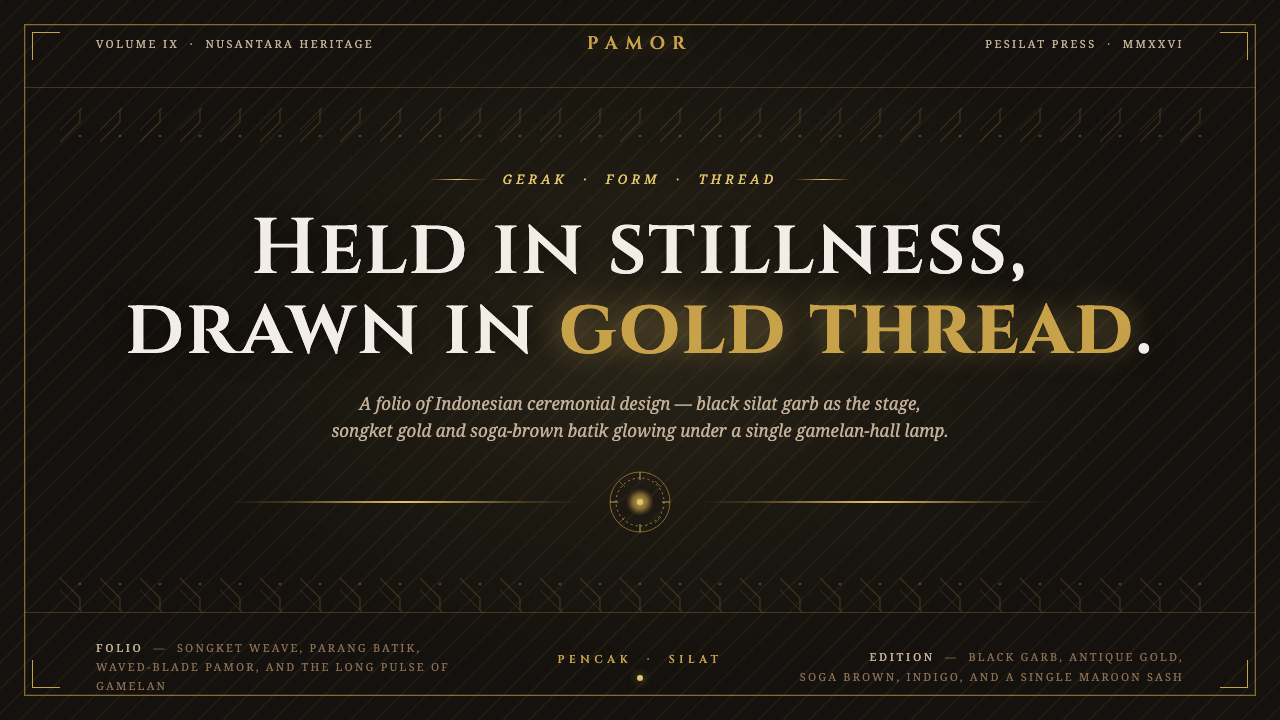
Indonesian Pencak Silat holds power in stillness — black ceremonial garb, glowing songket gold, and a kris drawn through the low pulse of gamelan.
Indonesian Pencak Silat in brief
Indonesian Pencak Silat is a Malay-Indonesian martial tradition whose visual language joins disciplined movement with ceremonial dress and material craft. The ground is a deep batik-indigo black, recalling the black garb worn by silat practitioners. Against it, parang-motif texture, soga-brown batik, antique gold, and maroon sash details appear as restrained signs of lineage, ritual, and controlled force.
Its defining contrast is not black and cream but black and songket gold. Gold thread should seem to catch a single concentrated light, as though the entire composition were being observed inside a gamelan hall under one lamp. The effect is intimate rather than theatrical: darkness establishes silence, while metallic warmth identifies the gesture, the sash, or the edge of the kris.
The aesthetic is ceremonial, tactile, and deliberate. It favors a near-black field over pale backgrounds, patterned surfaces over generic decoration, and a small number of meaningful materials over a crowded palette. Every visible element should feel handled, woven, carved, or worn into significance.
Where does Indonesian Pencak Silat come from?
Pencak silat belongs to a long-standing Nusantara martial heritage rooted in Indonesia and the wider Malay world. The tradition predates 1900 and survives as more than a fighting method: it is carried through the bodies of pesilat, the ceremonial black garment, the batik sash, and the controlled handling of the wavy kris dagger. Its visual identity is therefore inseparable from practice, dress, and ritual atmosphere.
The surrounding craft traditions give the martial form its material vocabulary. Batik contributes the deep indigo-black ground and the parang motif, whose repeated blade-like rhythm suggests direction and disciplined force. Songket weaving contributes the gold-thread sash, a surface whose value comes from labor, pattern, and the way metallic fibers catch light. Kris craft contributes the distinctive wavy blade and the presence of the empu, the specialist smith associated with its making.
The aesthetic world is also shaped by sound and space. The kris is drawn to the low pulse of gamelan, so movement is imagined as measured rather than hurried. A single gamelan-hall lamp becomes the ideal lighting metaphor: it leaves most of the field in darkness and gives selected surfaces a warm, concentrated glow. This creates a design language of reveal, restraint, and controlled attention.
The tradition is preserved through a network of practitioners and makers rather than a single authorial style. Pesilat carry the movement, batik artisans carry the patterned cloth, songket weavers carry the luminous textile, and kris smiths carry the blade craft. Together they form a visual system recognized as part of Indonesia’s intangible cultural heritage and the wider cultural world of Southeast Asia.
What defines the Indonesian Pencak Silat look?
Black Ceremonial Ground
The base is a genuinely dark batik-indigo black, never a softened charcoal and never a pale neutral masquerading as darkness. It should feel like cloth worn for practice and ceremony: dense, quiet, and capable of absorbing surrounding color. Pale empty space is not the default; the composition begins inside the garment.
Songket Gold
Gold is the signature accent and must behave like woven thread rather than flat yellow paint. Use it for the sash, a kris edge, a restrained rule, or a small emblem. Its authority comes from scarcity and light: gold should glow out of the black field, not flood it.
Batik Pattern
Parang-motif texture introduces movement without illustration. The pattern should remain integrated with the surface, more sensed than announced, so the black ground retains its composure. Soga-brown batik can warm the field at selected moments, but it should read as dyed cloth with history, not as a decorative print layered on top.
Measured Movement
Composition should imply a controlled martial sequence: a held pause, a directional sweep, then a precise release. Diagonals may echo the kris or the parang motif, while large quiet areas preserve the feeling of readiness. Motion is strongest when it emerges from stillness.
Single-Lamp Illumination
Lighting behaves as if it comes from one gamelan-hall lamp. Highlights gather on gold thread, folded cloth, and the kris, while adjacent surfaces fall quickly into shadow. Avoid broad ambient brightness; the design should feel discovered in darkness rather than evenly displayed.
Material Presence
Surfaces should suggest woven songket, wax-resist batik, worn black cloth, and forged metal through edge, pattern, and restrained texture. Material difference replaces decorative variety. A small number of honest surfaces will create more depth than a collection of unrelated effects.
Ritual Restraint
The system avoids exuberant ornament even when the materials are rich. Maroon sash color, antique gold, and batik brown should appear as deliberate signals, never as a full-spectrum palette. The emotional register is dignity, concentration, and inherited craft.
Who shaped Indonesian Pencak Silat?
Pesilat are the practitioners who carry Pencak Silat through disciplined movement, black ceremonial garb, and the ritual handling of the kris. In the design system, they represent the living body of the tradition: readiness held in stillness, direction expressed through posture, and power made visible through control.
The empu are the specialist smiths associated with kris craft. Their presence gives the wavy dagger a material and cultural gravity beyond weaponry. Visually, the kris should appear as a forged, deliberate object whose curved rhythm can organize composition without becoming an ornamental prop.
Batik artisans carry the patterned cloth tradition, including the parang motif and soga-brown surface vocabulary. Their work supplies the system with rhythm and tactile depth. Batik should function as a living field of marks, close enough to black to preserve restraint and distinct enough to reward attention.
Songket weavers create the gold-thread textile that gives this visual world its signature glow. Their craft is represented not by generic metallic shine but by the suggestion of woven labor, repeated pattern, and concentrated reflection. Songket gold is the point where darkness becomes luminous.
How do you use Indonesian Pencak Silat today?
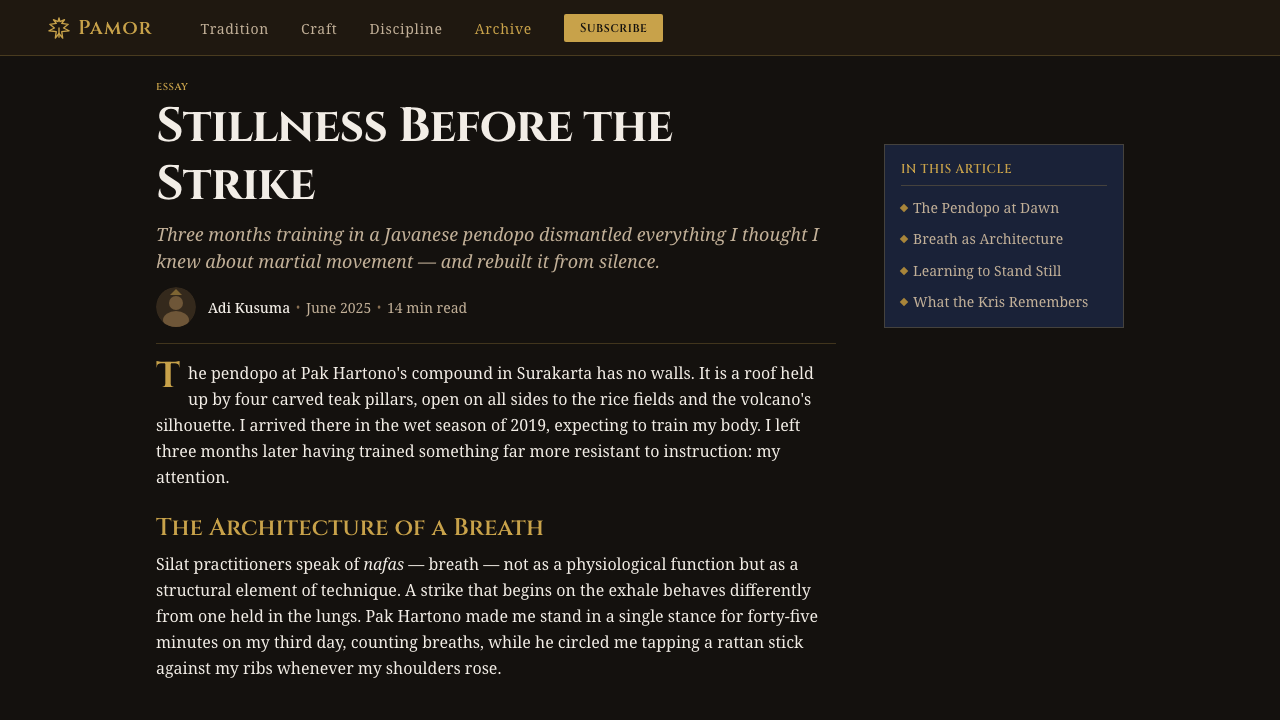
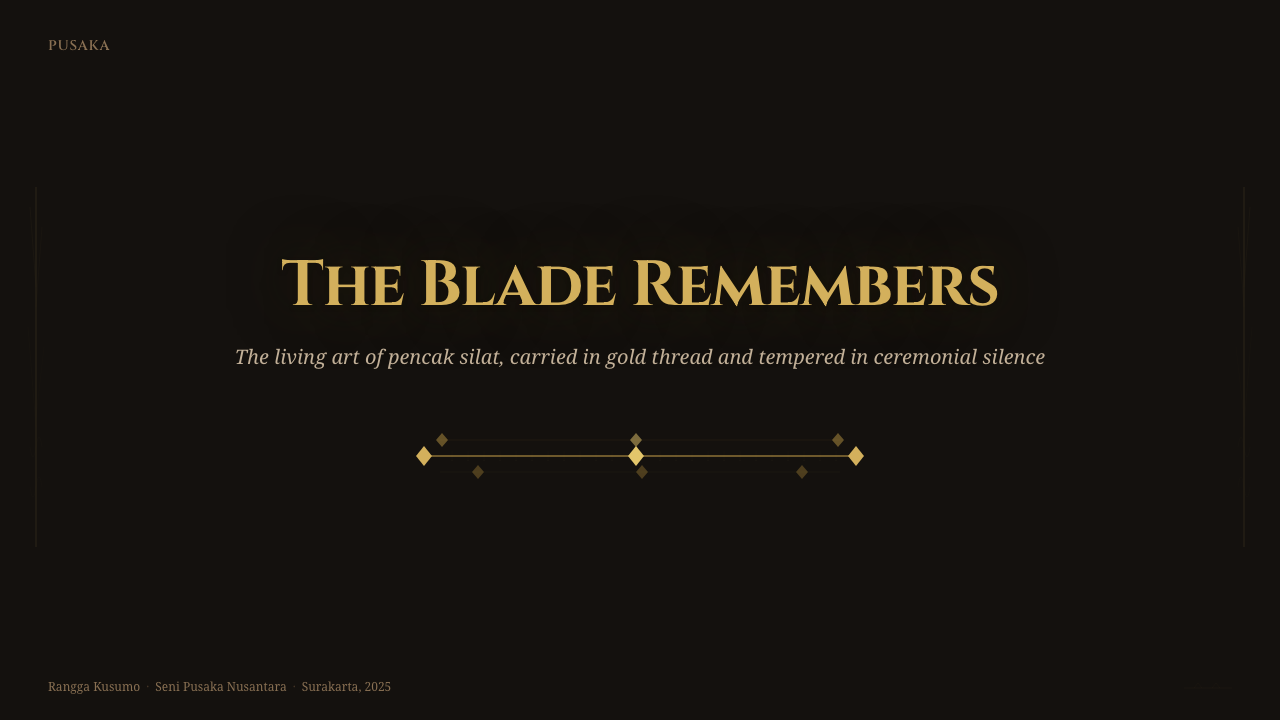
For presentation slides, let the cover establish the ritual atmosphere: a deep black field, a restrained gold-thread gesture, and a title that appears with the authority of an inscription. Content slides should keep the darkness intact and use batik texture or a maroon sash band to distinguish sections. Data slides work best as ceremonial diagrams, with gold carrying the primary signal and soga-brown or maroon separating secondary categories.
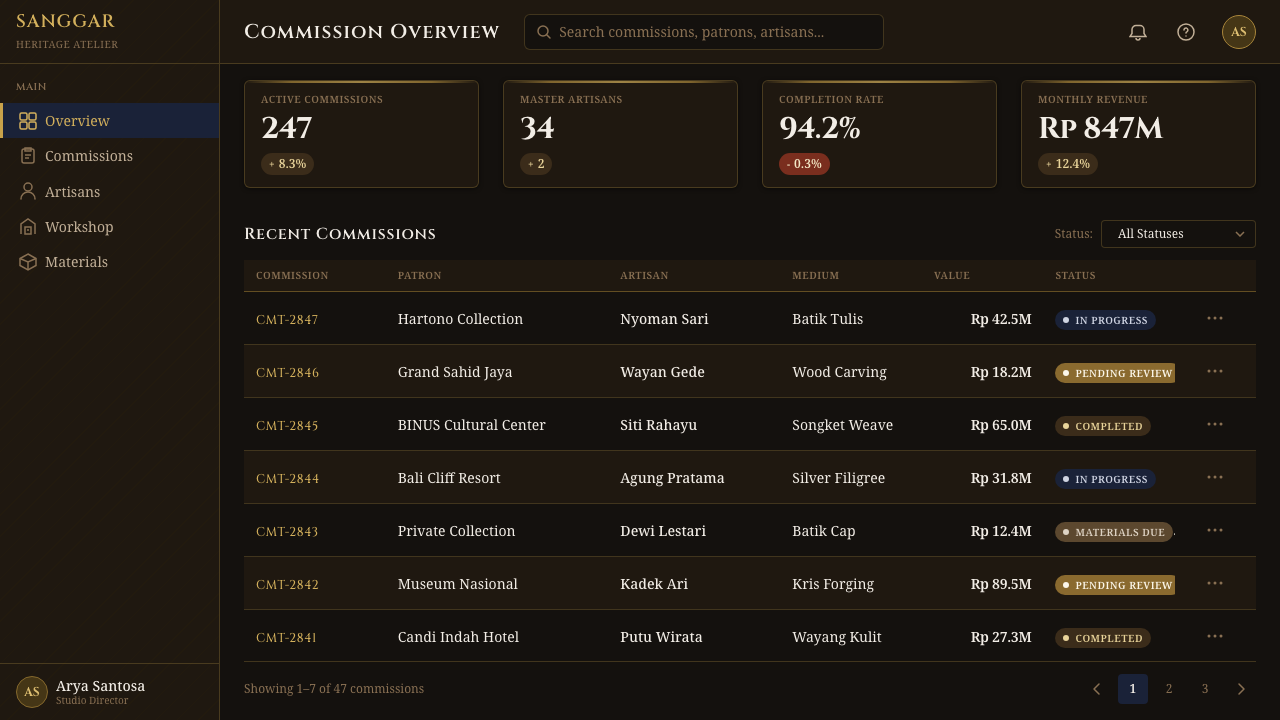
For web interfaces, this style suits dashboards, analytical tools, and pricing pages that want to feel focused, premium, and culturally grounded. Use the near-black field for the main environment, antique gold for active states and key actions, and batik-inspired pattern only in controlled surfaces such as headers, navigation bands, or selected cards. Panels should feel like layered cloth or carved material, with edges and highlights doing more work than bright fills.
For editorial and marketing work, build a strong contrast between long quiet passages and moments of luminous detail. A feature article can place a narrow column of text beside a large dark image or patterned field, using a gold rule or maroon sash tone to mark transitions. Marketing pages can treat the kris as a directional motif, moving diagonally through the composition while the copy remains calm, direct, and ceremonially spaced.
For identity systems, reserve the richest treatment for moments that deserve attention: a title lockup, a product tier, a call to action, or a featured quotation. Supporting elements should remain nearly black, brown, or muted maroon so the gold retains its authority. The style is especially effective when the interface feels like entering a room prepared for practice or ceremony rather than opening a brightly lit commercial surface.
The common mistake is to turn Indonesian Pencak Silat into generic luxury styling: black backgrounds, excessive gold, glossy gradients, and decorative pseudo-ethnic motifs. That approach loses the discipline of the source. Keep the black ground substantial, let gold appear sparingly, make the batik pattern tactile rather than loud, and ensure every diagonal, sash, and highlight suggests movement, craft, or ritual purpose.
Indonesian Pencak Silat — FAQ
Is this simply a black-and-gold luxury style?
No. Black and gold are the visible contrast, but the system is grounded in Pencak Silat practice, ceremonial garb, batik, songket, kris craft, and gamelan atmosphere. Luxury styling usually seeks abundance and polish; this system seeks concentration, material honesty, and ritual restraint. If the references to woven thread, dyed cloth, forged metal, and controlled movement disappear, the result is no longer faithful to the source.
Why should the ground be near-black rather than cream or white?
The black ground is tied directly to the ceremonial garb of silat practitioners and to the deep batik-indigo world described by the source. It establishes the atmosphere before any accent appears, allowing songket gold, antique gold, soga-brown batik, and maroon sash color to emerge as concentrated signals. A pale ground can be used only if the project has a compelling reason to depart from the system’s central material metaphor.
How should batik and songket appear in a digital interface?
Batik should appear as an integrated, low-contrast field whose parang rhythm is discovered gradually. Songket should appear as a restrained highlight that suggests woven gold thread, not as a continuous metallic coating. Both materials need room around them. If every panel carries visible pattern and every action is gold, the interface loses hierarchy and the craft becomes visual noise.
Can the style use bright colors beyond gold and maroon?
It can, but brightness should remain subordinate to the dark ground and the source materials. The approved visual vocabulary centers on batik-indigo black, songket gold, soga-brown batik, antique gold, and maroon sash color. Introducing unrelated bright colors weakens the connection to the garment, textile, and lamp-lit atmosphere. When an additional signal is necessary, it should be quiet enough to preserve the system’s nocturnal dignity.
What makes the kris motif useful beyond decoration?
The kris supplies a directional and rhythmic form. Its wave can guide the eye through a page, separate a title from supporting information, or suggest a transition from stillness into action. Used well, it becomes an organizing gesture grounded in the tradition. Used repeatedly without purpose, it becomes a prop. The motif should always clarify movement, hierarchy, or ritual focus.
Related design styles
 Bagan Yun LacquerwareEngraved, not painted. Cinnabar, orpiment and jade hairlines polished from ne…
 Cambodian Pidan IkatSacred cloth glows. Ebony-indigo bands carry warm-brown ikat figures with fea…
 Alchi Monastery MuralDevotional depth. Lapis fields and coffered grids glow on terracotta plaster.
 Yolngu Morning Star PoleCeremony becomes surface. Gold rarrk hatchwork climbs deep ochre-brown bands.
 Afghan Baluchi Prayer RugDevotional darkness glows. Plum field, oxblood mihrab, and camel borders surf…
 Armenian Khachkar Cross-StoneStone becomes memory. Tuff grey, pomegranate red, and carved borders hold the…