What is Micronesian Etak Star Compass?
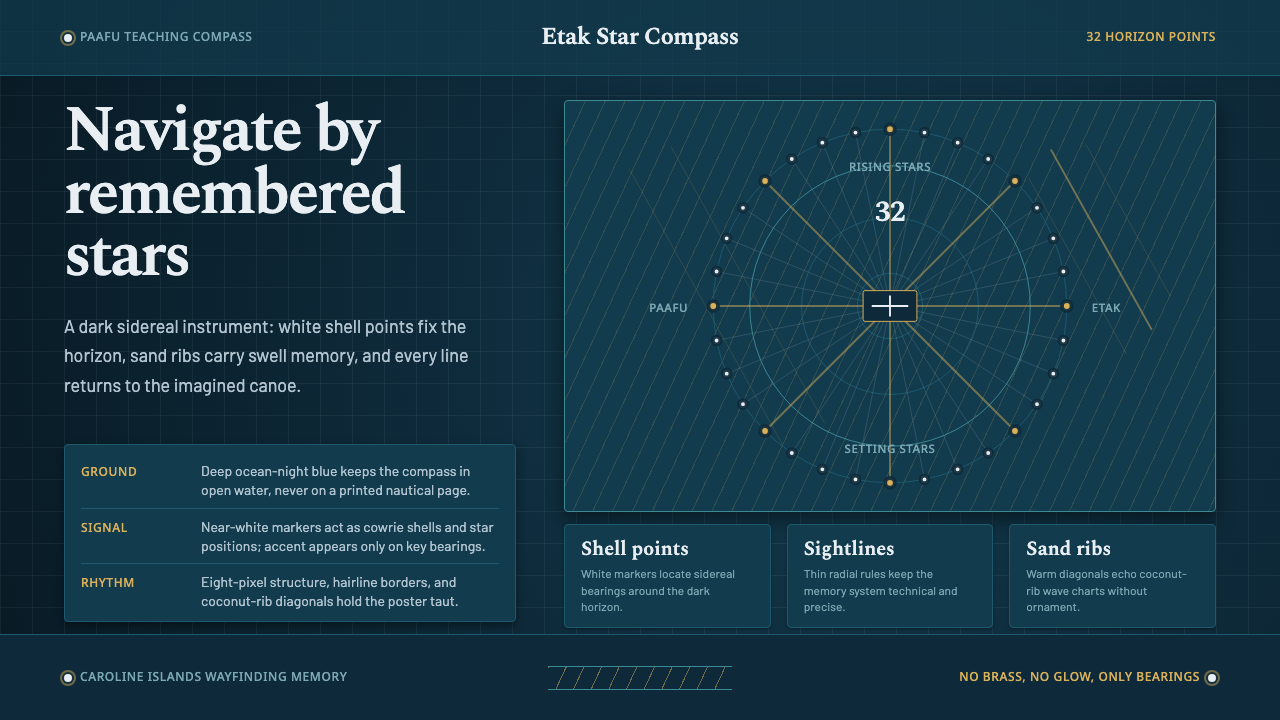
The etak compass turns navigation into memory — a dark ocean of space where white stars, fine sightlines, and warm sand ribs hold an entire voyage in the mind.
Micronesian Etak Star Compass in brief
The Micronesian etak star compass, also called paafu, is a navigational memory system from the Caroline Islands in the central Pacific. It divides the horizon into thirty-two points, each associated with the rising or setting position of a key star. Carolinian palu, or master navigators, held the system mentally rather than consulting instruments or charts. They steered through a combined reading of starlines, ocean swells, and the imagined movement of a reference island passing relative to the canoe.
This design language translates that mental instrument into a visual system. Its foundation is a deep ocean-and-night ground: nearly black, spacious, and quiet enough for small marks to carry authority. Against it sit precise white star points and thin lines of sight. Warm sand-colored ribs introduce a second register, recalling the coconut-rib lattices and shell-marked wave charts used to model the sea. The result is neither nautical decoration nor generic celestial imagery. It is a map of remembered relationships.
The style feels exact without becoming mechanical. White points establish orientation, radial lines suggest bearings, and curved or ribbed structures imply the movement of swells. Composition should feel organized around a center yet remain open to the surrounding darkness. Every mark has a navigational role: a point identifies, a line aligns, a rib records motion, and empty space preserves the scale of the ocean.

Where does Micronesian Etak Star Compass come from?
The etak tradition belongs to a pre-1900 sidereal wayfinding practice from the Caroline Islands of Micronesia. Its essential instrument was not a manufactured object but a learned spatial model. The horizon was understood through recurring star positions, while the sea supplied a second layer of information through swell patterns. Navigation therefore joined sky, water, memory, and motion into one continuous act of interpretation.
The system's defining idea is the reference island. A palu could imagine an island sliding past the canoe as the vessel moved, using that imagined movement to organize changing bearings. The compass was consequently not a static diagram alone. It was a mental sequence, a way of keeping orientation while the navigator, canoe, stars, and sea were all in motion.
In the mid-twentieth century, Mau Piailug made this knowledge teachable by giving it a physical form. He laid white cowrie shells in a ring on sand to create a paafu teaching compass. Alongside it, coconut-rib lattices marked with shells modeled the patterns of ocean swells and the positions of islands. These objects did not replace memory; they made an invisible structure visible enough to be learned and shared.
The tradition remains associated with Carolinian palu, with Mau Piailug as its major modern teacher, and with pwo initiates who continue its line of transmission. Its visual legacy is therefore not an archaeological reconstruction but a living practice made legible through material signs: white shells, sand, coconut ribs, star positions, and the imagined passage of land across the sea.
What defines the Micronesian Etak Star Compass look?
Ocean-Night Ground
The background should feel like open water after nightfall: deep, nearly black, and expansive rather than flatly decorative. Darkness is not merely a contrast device; it represents the unmeasured space in which orientation becomes meaningful. Keep the ground quiet so that small white marks can function as bearings instead of glitter.
White Star Points
White points carry the highest visual authority. They should be crisp, sparse, and deliberately placed, with variation coming from position and grouping rather than ornamental treatment. A point is a sign of orientation: it may anchor a title, mark a destination, or punctuate a radial field, but it should never become a random starry texture.
Sightlines
Fine white sightlines connect points into relationships. They suggest bearings, alignment, and the act of looking across distance. Lines should remain thinner and quieter than the points they organize. Their purpose is to reveal a route through space, not to form a dense technical diagram.
Warm Sand Ribs
Warm sand tones provide the system's material memory. They recall sand, coconut ribs, and the woven wave charts used in teaching. Use them as curved ribs, braided structures, or directional bands that introduce tactile warmth without pretending to reproduce a literal craft object. Their role is to model motion and rhythm against the stillness of the star field.
Radial Memory
The composition is often organized from a central point or implied center, echoing a ring of shells and a horizon divided into bearings. Radial structure should feel navigational rather than ornamental. Let directions open outward, with enough asymmetry and interruption to suggest a living passage rather than a perfectly mechanical wheel.
Measured Restraint
The style depends on the tension between exact marks and vast emptiness. Do not fill every dark area with stars, lines, or wave motifs. Repetition should feel memorized and purposeful. The strongest compositions allow silence around the navigational signs, making each point, line, and rib appear necessary.

Who shaped Micronesian Etak Star Compass?
Mau Piailug was the navigator who made the etak system teachable through physical demonstration. By arranging white cowrie shells in a ring on sand and pairing the paafu with coconut-rib wave charts, he gave learners a visible model for a knowledge system otherwise held in memory. In this design language, he represents the bridge between lived navigation and shared instruction.
The Carolinian palu are the master navigators who carry the system as a mental instrument. Their practice joins star positions, swell patterns, and the imagined motion of a reference island. They are not represented by portraits or emblems in this style; their presence is expressed through disciplined orientation, restrained marks, and the confidence of a line that knows where it is going.
Pwo initiates represent the continuation of navigational knowledge through learning and transmission. Their place in the system is reflected in the teaching compass itself: knowledge is made visible, rehearsed through relationships, and carried forward through memory. A design inspired by etak should therefore feel instructional as well as atmospheric, inviting the viewer to understand a structure rather than merely admire a mood.
How do you use Micronesian Etak Star Compass today?
For presentation slides, use the style as a sequence of bearings. A cover can place a restrained field of white points against the deep ground, with one warm sand rib or curved band establishing the direction of the composition. Content slides should preserve a clear route through information: one dominant sightline, a small number of star-like markers, and generous darkness around the text. Data slides can treat charts as navigational diagrams, using white for the principal reading and warm sand for secondary movement or comparison. The slide should feel like a remembered route becoming visible.
For web interfaces, the compass language suits dashboards, pricing pages, and tools concerned with orientation, progress, or connected systems. Keep the dark ground continuous across the interface, use white for primary labels and active bearings, and reserve warm sand for secondary states, grouping, or movement. Radial structures can organize overview screens, while ribbed bands can indicate flow between sections. Avoid making every control luminous; the system is clearer when only the current route and its essential markers receive emphasis.
For editorial and marketing work, the style supports stories about navigation, learning, memory, place, and long-distance connection. An article can begin with a quiet star field, then introduce sand-colored ribs as section markers or marginal guides. Marketing pages benefit from the contrast between a vast dark field and a few exact signs: a destination, a route, a teaching object, or a line of movement. The visual language is especially effective when copy explains relationships rather than simply announcing features.
The common mistake is to treat the theme as a collection of nautical symbols: anchors, ropes, waves, constellations, and decorative shells. That approach loses the central idea. Etak is not about adding ocean imagery to a surface; it is about representing navigation as stored knowledge. Avoid crowded star fields, arbitrary radial lines, glossy effects, and repeated shell motifs without purpose. Every visible element should clarify orientation, memory, material teaching, or movement through space.

Micronesian Etak Star Compass — FAQ
Is the etak star compass simply a nautical or celestial theme?
No. Nautical and celestial imagery are only the visible vocabulary. The deeper subject is navigation as memory: a system in which star positions, swell patterns, and the imagined movement of a reference island remain connected in the navigator's mind. A faithful application should therefore show relationships and orientation, not merely add shells, waves, or stars as decoration.
What is the relationship between etak and paafu?
The etak star compass is also called paafu. In the teaching practice associated with Mau Piailug, paafu can also refer to the physical compass made by arranging white cowrie shells in a ring on sand. The terms therefore connect the navigational system with the material demonstration that made its structure easier to teach and remember.
Can this style work without showing literal stars?
Yes, provided the design preserves the logic of orientation. White points can become markers, nodes, or destinations; fine lines can become routes; sand-colored ribs can become bands of movement or memory. What matters is the relationship between signs and space. Literal stars are useful, but the system is stronger when its navigational structure survives even after the imagery is reduced.
Why should the background remain so dark and spacious?
The dark ground represents the ocean-and-night environment in which orientation takes place. It also gives the white points the quiet contrast they need to act as bearings. If the background becomes busy or brightly varied, the composition begins to behave like decoration rather than a navigational memory system. Darkness is part of the meaning, not merely a visual backdrop.
Related design styles
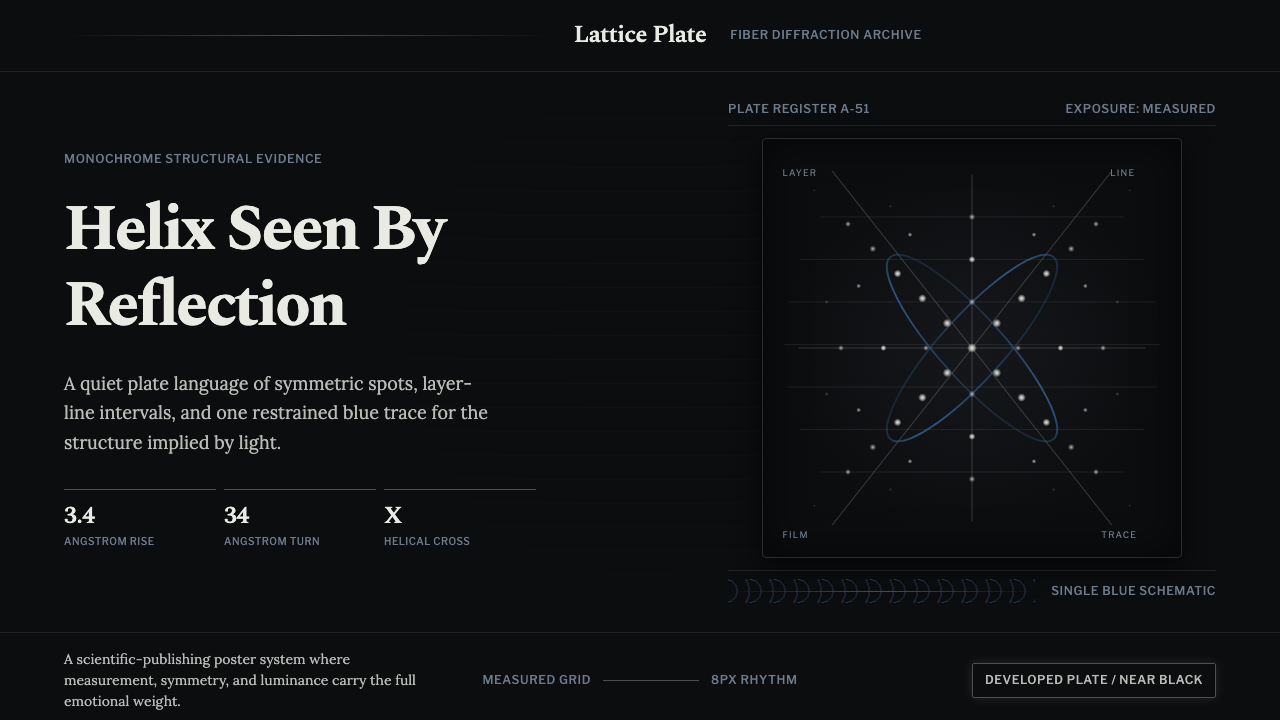 X-Ray CrystallographyQuiet evidence glows. Near-black film, Spectral serifs, and an X-cross spot l…
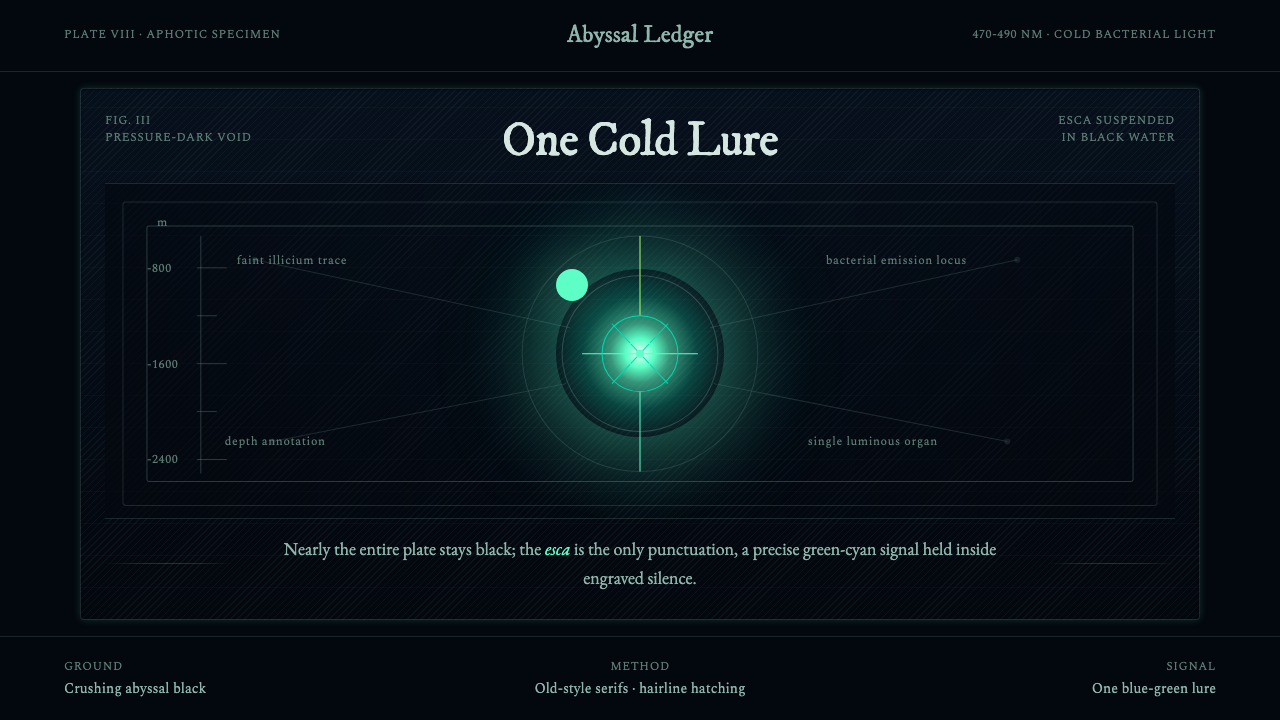 Anglerfish Lure BioluminescenceLight is scarce. Old serifs and hairline rules frame one cold green-cyan lure.
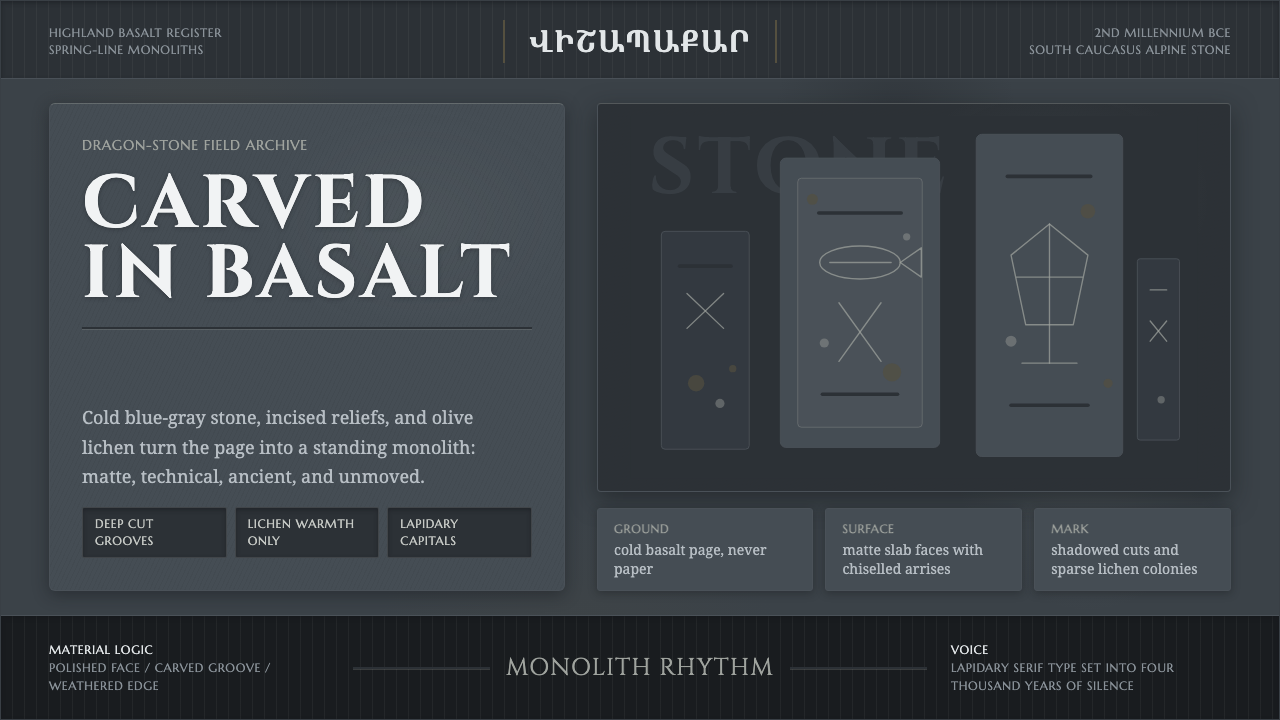 Armenian Vishapakar Dragon StoneAncient, cold, unmoved. Basalt gray slabs, incised grooves, sparse olive lich…
 Everest Expedition (1953)Quiet heroism, precisely measured. Ice-blue contours and mono data cross a sn…
 Hauran Basalt StoneMonolith refuses shine. Charcoal Cinzel capitals lock into dry-laid basalt gr…
 Inca Ashlar StoneworkStone becomes the page. Granite-gray planes lock into hairline ashlar seams.