What is Hauran Basalt Stone?
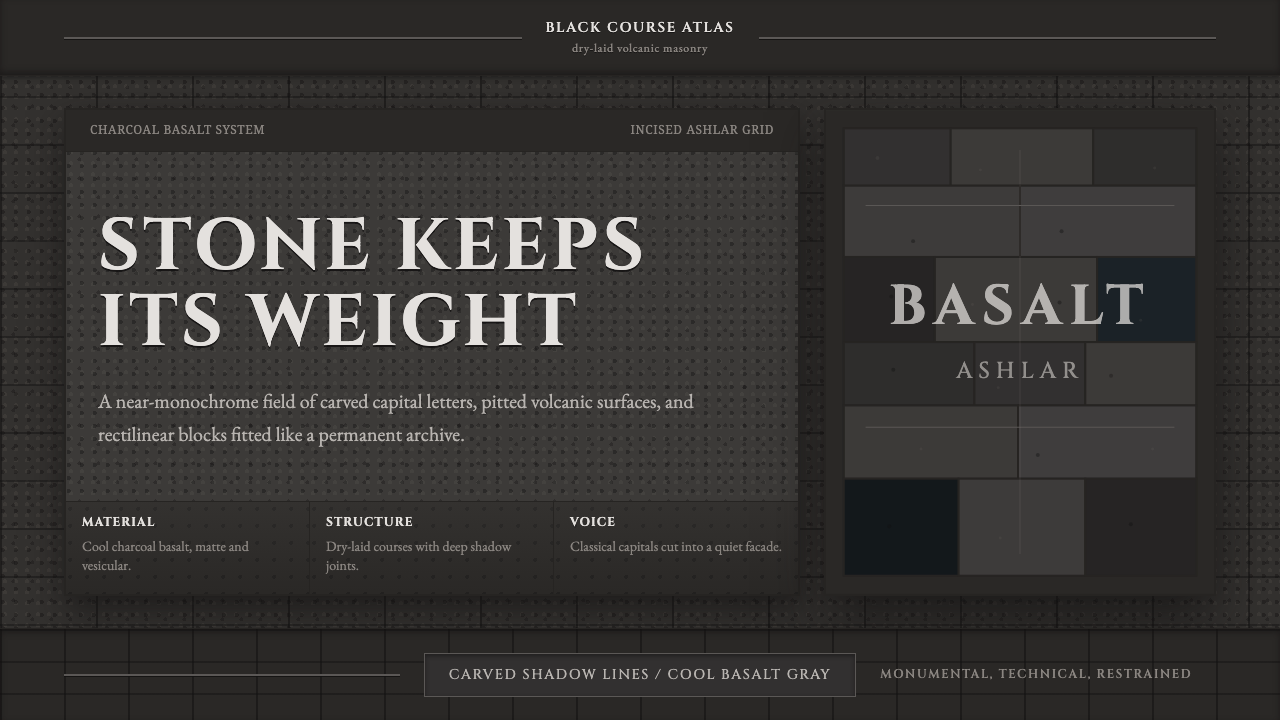
In the volcanic Hauran, an entire architectural tradition was carved from a single black stone — and refused, on principle, to shine.
Hauran Basalt Stone in brief
This system takes its material and mood from the Hauran, a volcanic plateau straddling what is today southern Syria and northern Jordan, where nearly every building for two thousand years has been constructed from the same stone: basalt, a dense, dark, gas-pocked rock formed by cooling lava. Unlike the pale limestone and sandstone that dominate most of the ancient Levant, basalt gave Hauran architecture a uniformly dark, almost monolithic character — walls, doors, columns, and roof slabs all cut from a single somber material.
The result, both historically and in this digital rendering, is architecture that refuses shine. Basalt has a naturally matte, slightly rough surface studded with tiny volcanic vesicles, and it holds heat and shadow rather than reflecting light. Where marble courts attention and limestone glows warm in low sun, basalt absorbs — buildings in the Hauran read as deep charcoal masses against a bright sky rather than luminous forms competing with it.
This system distills that masonry tradition into an interface language built almost entirely from tonal contrast: cool charcoal grounds, deeply carved shadow lines standing in for the incised joints between dry-laid stone blocks, and monumental capital letterforms recalling the inscriptions Roman builders once carved directly into basalt lintels. Nothing here is polished. The severity is the point.
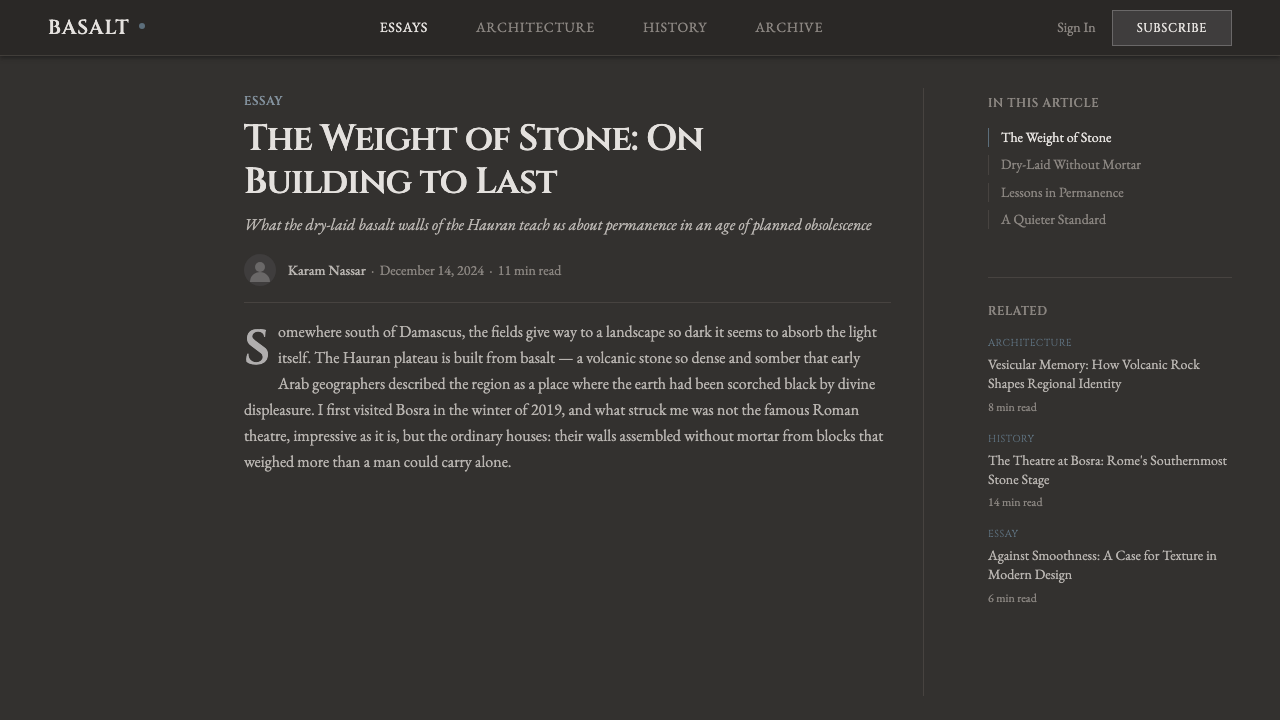
Where does Hauran Basalt Stone come from?
The Hauran — also known by its Arabic name Jabal al-Druze, or Druze Mountain — is a broad volcanic plateau formed by repeated lava flows over millions of years, leaving the entire region blanketed in basalt boulders and bedrock with essentially no other building stone available locally. For the communities who settled here across antiquity, this was not an aesthetic choice but a practical necessity: builders used what the ground gave them, and the ground gave them almost nothing but black volcanic rock.
That constraint produced genuine engineering innovation. Basalt is far too hard to carve into long, thin structural beams the way softer limestone can be shaped, so Hauran builders developed a distinctive corbelled construction technique — laying successive stone courses that step inward until a roof opening can be closed with a single capping slab, all without using timber, which was scarce on the treeless plateau. The same hardness produced the region's famous monolithic stone doors: entire doors, door frames, and even hinge pivots carved from single slabs of basalt, some of which have swung on their stone pivots for well over a thousand years.
The Hauran's most celebrated single structure is the Roman Theatre at Bosra, built in the second century CE after Rome annexed the Nabataean Kingdom in 106 CE and made Bosra the capital of the new province of Arabia. Carved almost entirely from local basalt and originally seating an estimated fifteen thousand spectators, the theatre is one of the best-preserved Roman theatres anywhere in the world — a survival owed directly to the exceptional hardness and earthquake-resistance of the stone it was built from, which withstood centuries of seismic activity that destroyed comparable limestone structures elsewhere in the region.
The theatre's preservation was reinforced, almost accidentally, by later history. In the twelfth and thirteenth centuries, Ayyubid rulers — the dynasty founded by Saladin — recognized the basalt structure's defensive potential and fortified it into a citadel, walling in the Roman seating bowl with additional basalt towers and ramparts. What began as an entertainment venue spent centuries functioning as a fortress, protected by the same dark stone that had made it monumental in the first place, before archaeologists began uncovering the Roman theatre within the citadel walls in the twentieth century. UNESCO inscribed the old city of Bosra as a World Heritage Site in 1980.
What defines the Hauran Basalt Stone look?
Monolithic Basalt Mass
Every surface reads as solid volcanic stone rather than a thin applied finish. Because basalt is dense and dark all the way through — not a light material with a dark coating — the system avoids any effect that suggests a colored layer sitting on top of a lighter base. Planes are treated as if carved from a single block, with depth communicated through the angle and depth of shadow rather than through gradient or highlight.
Carved Joint Lines
Dry-laid ashlar construction — stone fitted without mortar — leaves visible seams between blocks, and this system treats those seams as a structural grid rather than decoration. Fine, precise lines divide surfaces the way mortarless joints divide a Hauran wall, giving even flat digital panels the sense of being assembled from discrete stone units rather than poured as a single continuous sheet.
Vesicular Texture
Basalt's defining physical trait — the tiny gas bubbles trapped in the rock as it cooled — gives its surface a fine, consistent roughness rather than the smooth grain of limestone or the veining of marble. Rendered digitally, this translates to a restrained, almost noise-like surface texture rather than any glossy or polished finish, reinforcing the material's refusal to shine that gives the whole system its character.
Monumental Inscribed Capitals
Lettering draws on the tradition of Roman lapidary inscription — capital letters carved directly into stone lintels and civic monuments, close in spirit to classical revival letterforms such as Cinzel. Letters are wide, upright, and evenly weighted, designed to be legible when incised rather than printed, and are used sparingly, reserved for headlines and labels rather than dense body copy.
Corbelled Rhythm
The stepped, inward-leaning logic of corbelled stone roofing — courses of basalt advancing slightly with each layer until they meet — inspires a repeating rhythm of slightly offset rectangular blocks rather than a perfectly uniform grid. This gives compositions a quiet sense of accumulation, as though each element were laid down in sequence rather than placed all at once.
Windowless Severity
Traditional Hauran buildings kept openings small and deliberate, a response to a harsh climate and the sheer difficulty of cutting large openings into basalt. The system carries that discipline forward as a preference for large unbroken dark planes punctuated by very few, very deliberate points of light or contrast — restraint used to heighten the impact of every element that is allowed through.

Who shaped Hauran Basalt Stone?
Working after Rome annexed the Nabataean Kingdom in 106 CE and established the province of Arabia with Bosra as its capital, Roman military engineers and local basalt masons together raised a theatre for an estimated fifteen thousand spectators entirely from the volcanic stone at hand. Their choice of material — dictated by geology rather than preference — produced one of the best-preserved Roman theatres in the world, since basalt's hardness resisted the seismic activity that destroyed many comparably grand limestone theatres elsewhere in the empire.
Across roughly two thousand years, an unbroken vernacular tradition of local stonemasons developed and refined the region's distinctive basalt building techniques: corbelled roofing that required no timber, dry-laid ashlar walls fitted without mortar, and the celebrated single-slab basalt doors whose stone pivots have functioned for centuries. This anonymous, generational craft tradition — not any single named architect — is responsible for most of the Hauran's built environment.
Before Rome arrived, Bosra was already a major city of the Nabataean Kingdom, the same trading civilization better known for carving Petra's rose-colored sandstone facades farther south. In the Hauran, the Nabataeans worked in the local basalt instead, and their urban foundations at Bosra — streets, water systems, and civic structures — underlie much of what Roman and later builders expanded upon.
In the twelfth and thirteenth centuries, engineers working under the Ayyubid dynasty founded by Saladin recognized the defensive value of the Roman theatre's thick basalt walls and enclosed the entire structure within a fortified citadel, adding towers and ramparts of the same dark stone. Their fortification inadvertently protected the Roman theatre inside for centuries, preserving it until archaeologists uncovered it within the citadel walls in the twentieth century.
How do you use Hauran Basalt Stone today?
This basalt system suits any product that wants to project permanence, seriousness, and weight rather than lightness or approachability — financial platforms, security and infrastructure tools, archives, or brands built around durability and craft rather than novelty. Because the palette lives almost entirely in dark tones, it also serves any product that defaults to a dark interface as a primary mode rather than an optional theme.
For slides, a cover works well as a single deep charcoal plane with the title set in wide, evenly weighted capitals near the base of the frame — echoing an inscription carved into a lintel rather than type floating in space. Content slides should favor a small number of large, deliberate blocks of information rather than dense bullet lists, each block separated by a carved-looking rule instead of a soft divider. Data visualizations read well as blocky, unbeveled shapes in tonal grays, avoiding any gradient fill that would suggest a glossy or reflective surface at odds with the material's matte character.
In web interfaces, the system suits dashboards that want to feel authoritative and unshakeable — dark charcoal backgrounds, sharply defined card edges, and generous unbroken space between major sections, echoing the small, deliberate openings of traditional Hauran walls. Pricing pages benefit from treating each tier as a distinct carved block rather than a soft card, with clear incised-looking dividers between tiers rather than drop shadows, reinforcing the sense of something built to last rather than assembled quickly.
For editorial and marketing contexts, the style supports long-form content that wants to feel weighty and considered — think investigative journalism, heritage brands, or premium hardware marketing. Headlines set in wide monumental capitals against deep charcoal grounds work well as section openers, while body copy should stay restrained and unornamented, letting the occasional carved-looking rule do the work that colored accents or icons would do in a lighter system.
The most common mistake is lightening the palette until it reads as generic dark mode rather than basalt specifically — losing the fine vesicular surface texture, the carved joint lines, and the monumental capital lettering collapses the system into an indistinct dark theme. A second common mistake is adding gloss or reflective highlights for visual interest; basalt's entire identity rests on refusing shine, and any glossy treatment undermines the material logic the whole system is built on.
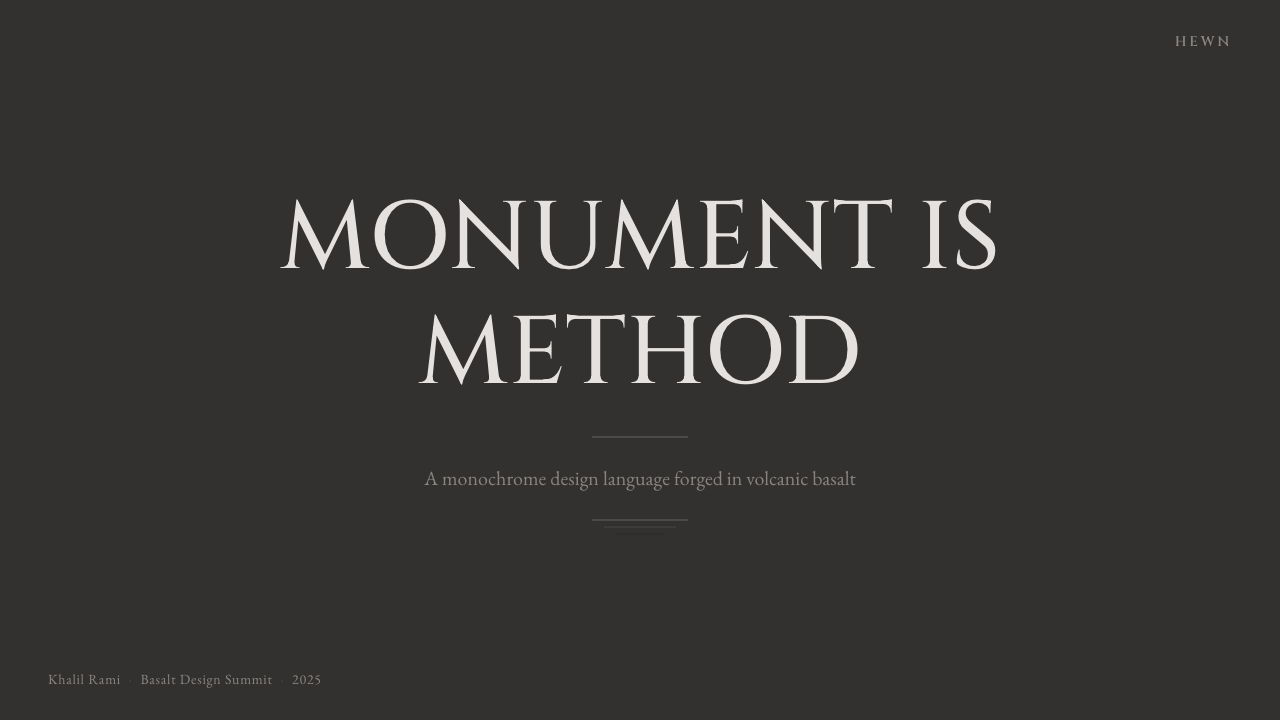
Hauran Basalt Stone — FAQ
Why does this system stay dark and matte instead of using any lighter accent tones?
Because basalt itself is dark all the way through, not a light stone with a dark surface treatment. Historic Hauran buildings had almost no light-colored material available locally to contrast against — no white limestone trim, no pale plaster. Introducing a light accent color would misrepresent the actual material condition the system is drawn from. Where the historic buildings do introduce contrast, it comes from tonal variation within the basalt itself and from the sharp geometry of shadow, not from a second, lighter material — and that is the same logic this system follows.
Is this style specific to Syria and Jordan, or does it represent a broader region?
The specific tradition this system draws from — Hauran basalt vernacular architecture and the Roman-era theatre at Bosra — is geographically precise, tied to a volcanic plateau that straddles the modern Syria–Jordan border. Basalt architecture exists elsewhere in the world wherever volcanic geology provides the local stone, but the particular combination this system captures — corbelled basalt roofing, dry-laid ashlar walls, monolithic stone doors, and Roman civic monuments carved from the same material — is distinctive to the Hauran and does not generalize to volcanic building traditions elsewhere without losing its specific character.
How does this differ from a generic industrial or 'dark stone' aesthetic?
Generic dark-stone or industrial aesthetics tend to borrow color and roughness without the underlying logic that produced them. This system is built specifically around basalt's physical properties — its vesicular texture, its refusal to reflect light, its extreme hardness that made corbelled construction and monolithic doors possible — and around a specific historical outcome, the Roman theatre at Bosra surviving centuries of earthquakes because of the very stone this system is modeled on. A generic dark theme is a mood; this system is a material logic with a documented architectural history behind it.
What role does the Roman theatre specifically play, versus the vernacular houses?
The vernacular Hauran house contributes the system's domestic-scale devices — small deliberate openings, corbelled roofing rhythm, dry-laid joint lines — while the Roman theatre at Bosra contributes its most monumental register: the wide, evenly weighted inscribed capitals and the sense of civic-scale permanence. Together they give the system two registers to draw on, a quieter one for dense interface work and a more monumental one for headlines, hero sections, and moments meant to communicate authority.
Related design styles
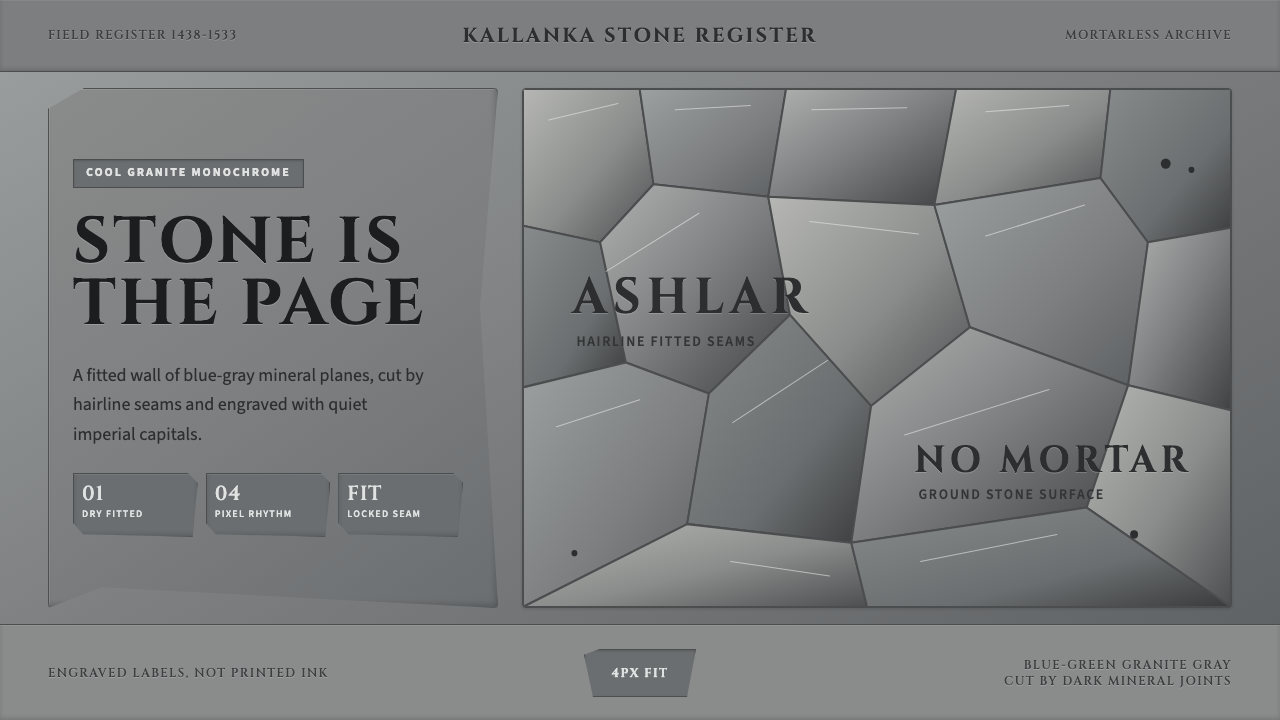 Inca Ashlar StoneworkStone becomes the page. Granite-gray planes lock into hairline ashlar seams.
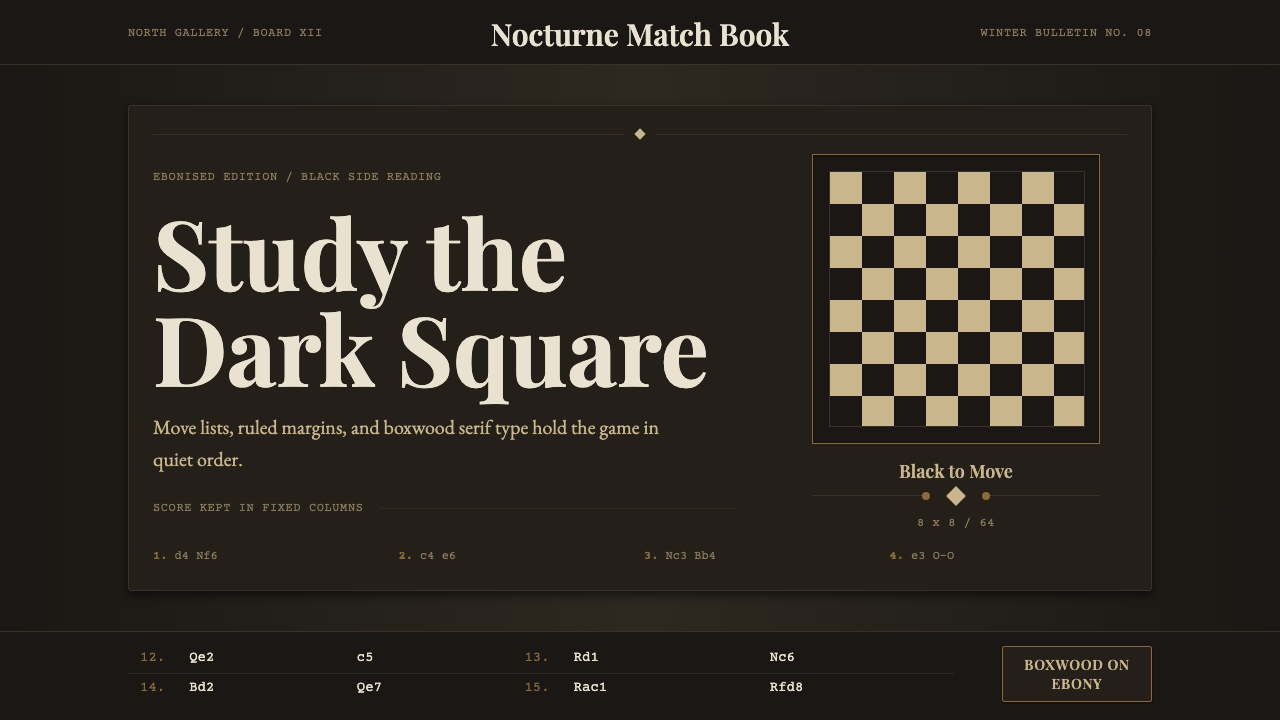 Chess TournamentQuiet intellect. Cream Playfair type, walnut rules, and notation glow on ebon…
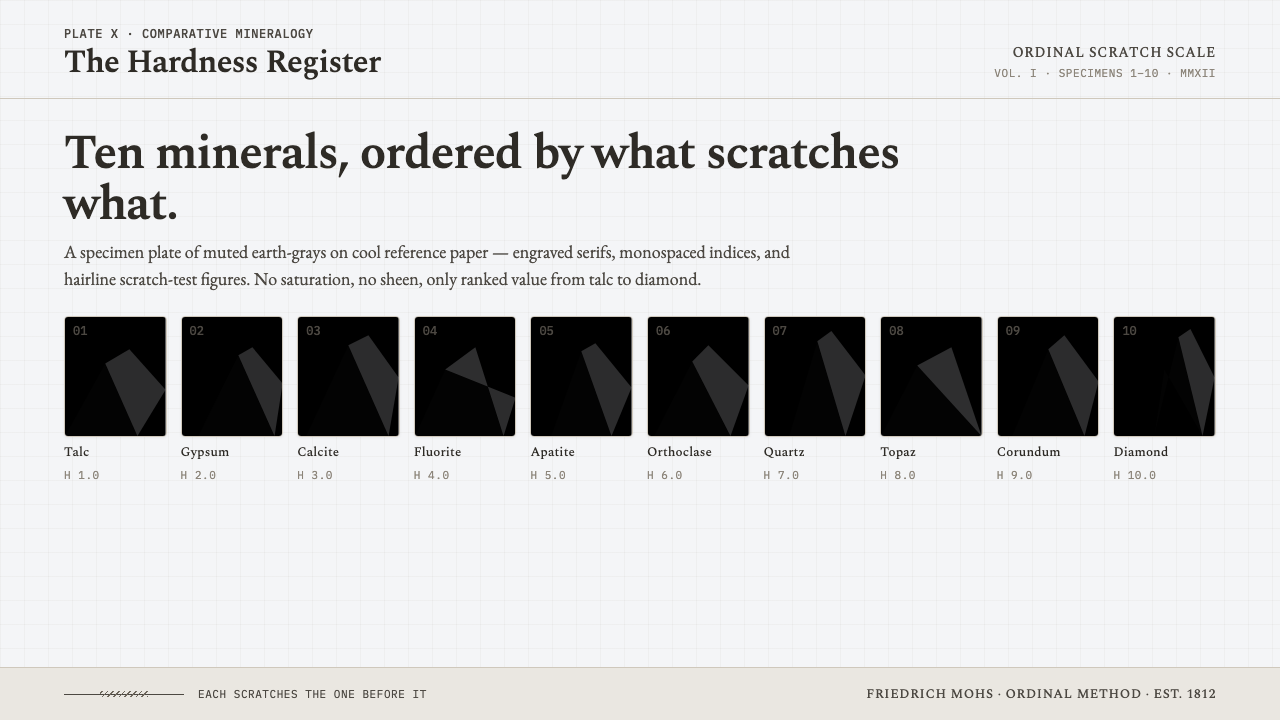 Mohs Hardness ScaleRanked by what scratches what. Ten mineral-gray chips on cool chart-white, en…
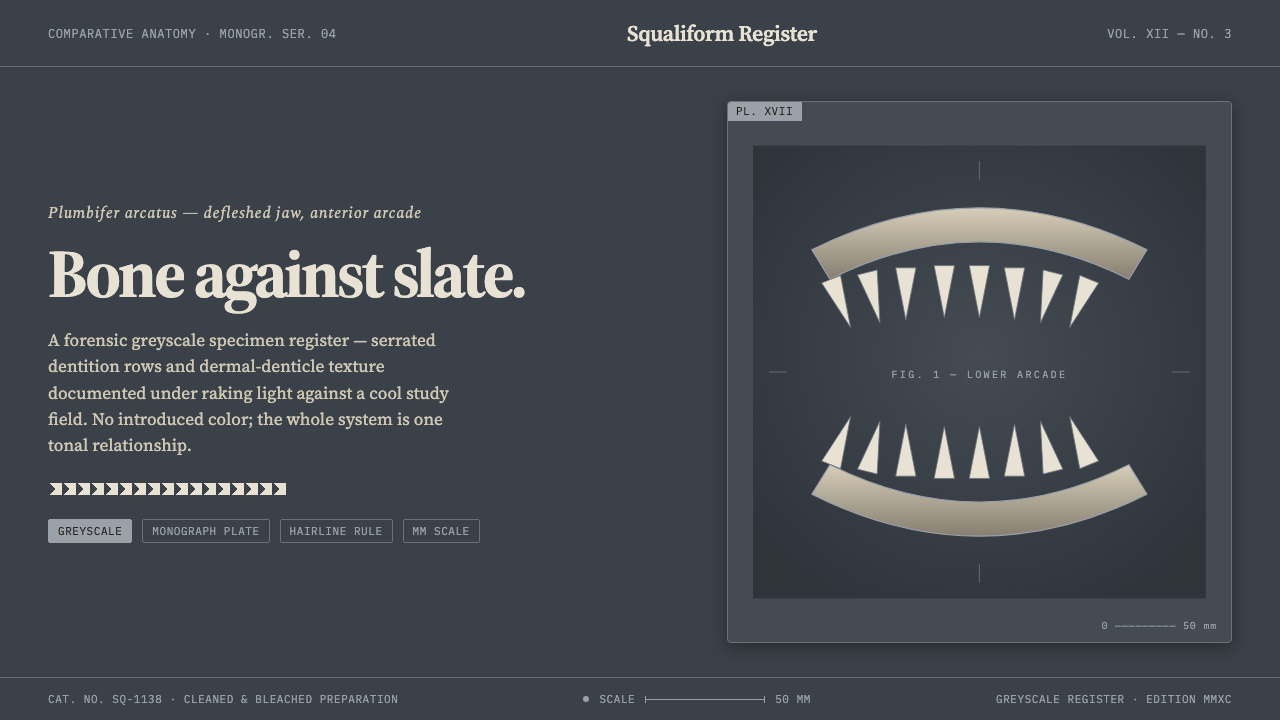 Shark Jaw & DentitionForensic and strictly greyscale. Bone-white serrated dentition floats on a co…
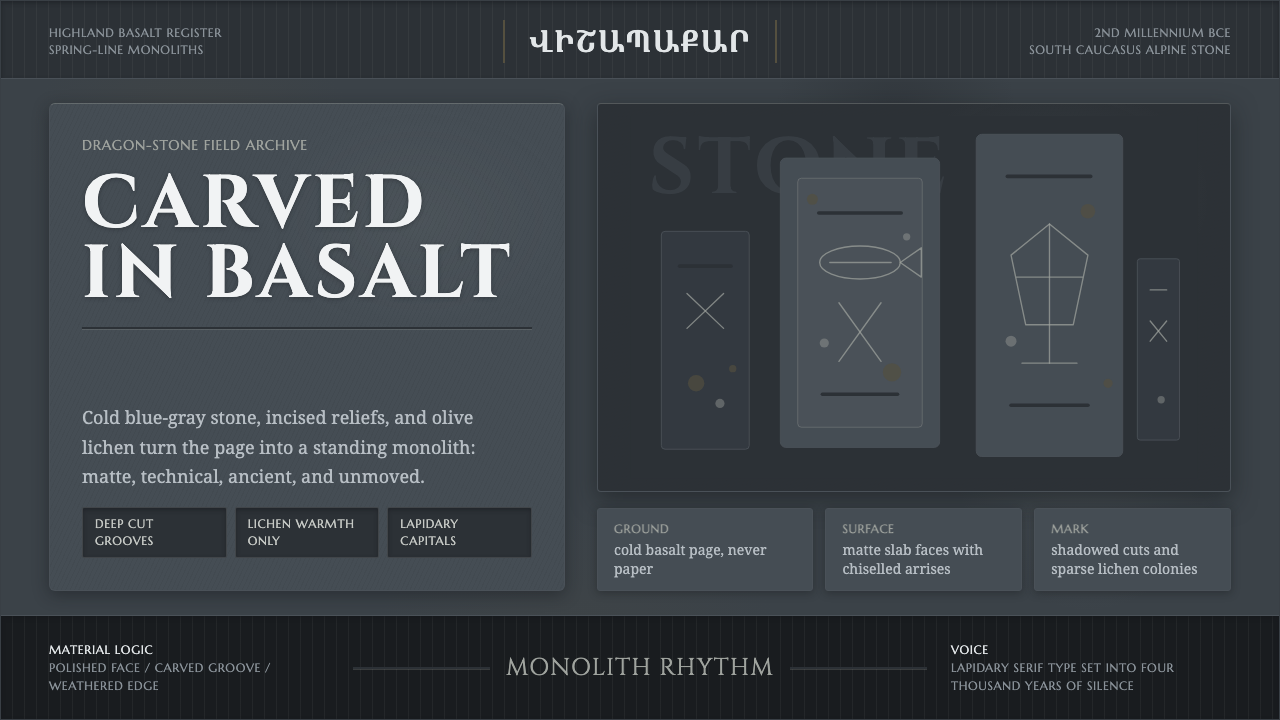 Armenian Vishapakar Dragon StoneAncient, cold, unmoved. Basalt gray slabs, incised grooves, sparse olive lich…
 Grisaille PaintingStone without color. Payne-gray relief, Cinzel capitals, and recessed panels…