What is Shark Jaw & Dentition?
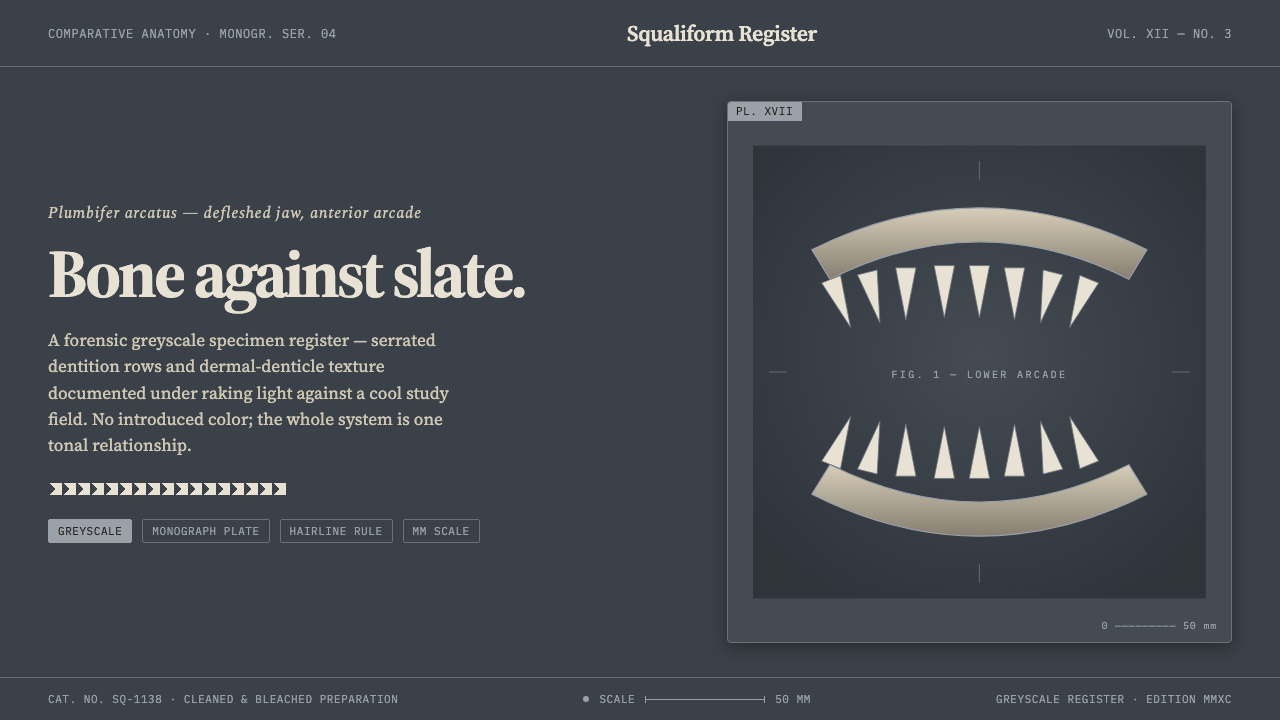
Shark Jaw & Dentition turns a design into a forensic specimen plate: bone-white serrated teeth suspended in cold slate, framed by hairline rules and measured with clinical restraint.
Shark Jaw & Dentition in brief
Shark Jaw & Dentition is a strictly greyscale visual language derived from mid-century North American elasmobranch monographs. Its central image is the cleaned and whitened shark jaw: a serrated, bone-white sequence of teeth presented against a dark slate study field. The subject is not treated as an illustration of an animal in motion, but as a specimen made available for inspection.
The system depends on a narrow material vocabulary. Cold slate establishes the ground, ivory and bone-white tones define dentition, and near-black values support text, rules, and framing devices. Hairline borders, plate numbers, and millimeter scale bars give the composition the character of a museum record. There is no decorative hue competing with the evidence.
Its atmosphere is forensic rather than dramatic. The jaw may feel imposing because of its anatomy, but the design does not rely on theatrical shadows, saturated color, or cinematic movement. Fine dermal-denticle texture, serrated edges, and measured spacing carry the visual interest. Every element appears to belong to a study plate whose purpose is to identify, compare, and preserve.
Where does Shark Jaw & Dentition come from?
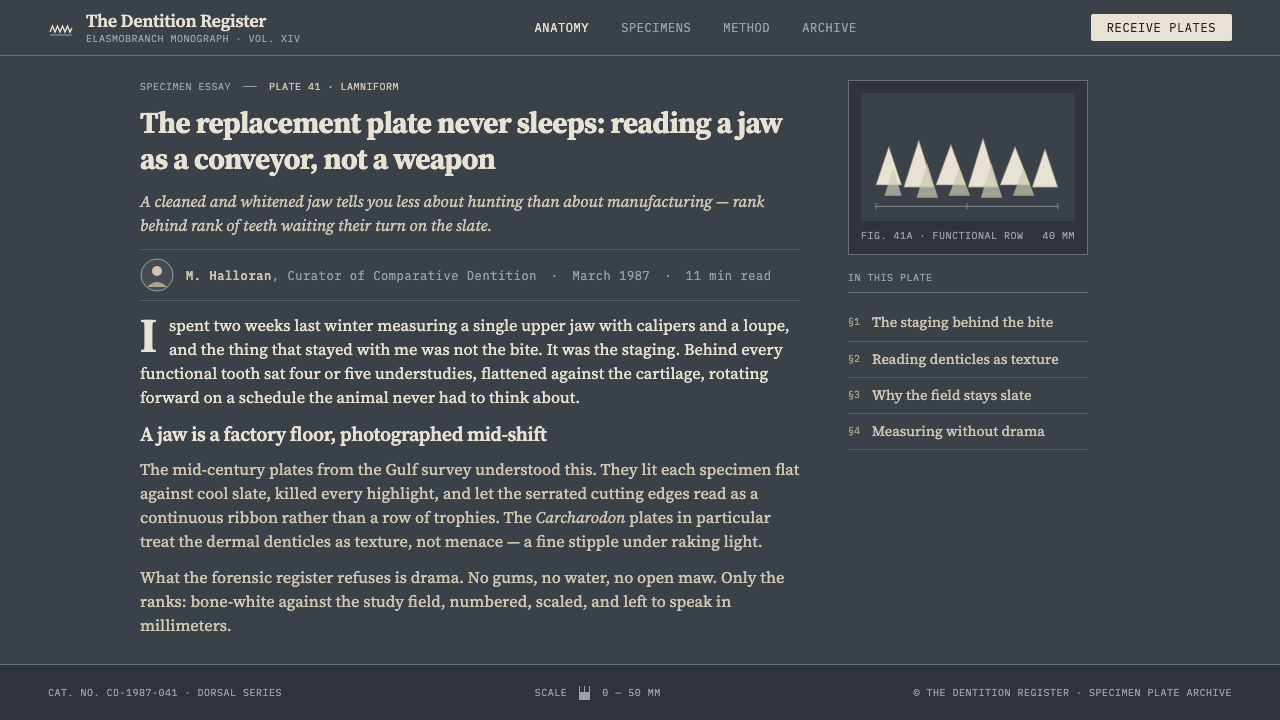
The source material belongs to the tradition of mid-century North American elasmobranch monographs, specialized publications concerned with sharks and their anatomical evidence. These works documented jaws and tooth-replacement plates as prepared specimens rather than as picturesque natural-history scenes. The resulting visual register was controlled, observational, and designed to make physical structure legible.
Preparation is central to the style. Shark jaws were cleaned and whitened so that the dentition could be read as a coherent anatomical sequence. Serrated teeth became the dominant visual rhythm, while fine dermal-denticle texture supplied a quieter field of evidence. The specimen was not beautified by adding atmosphere; it was clarified by removing distractions.
The study field reinforces that discipline. A dark slate ground separates the pale jaw from its surroundings without introducing a new chromatic story. Against it, the teeth read as ivory or bone-white, while the surrounding information can retreat into charcoal and near-black. Contrast performs the work that color would perform in another system.
The wider practice combined scientific specimen photography with natural-history monograph illustration. Its key contributors were comparative-anatomy researchers, elasmobranch monograph illustrators, museum jaw-preparation specialists, and bone-cleaning technicians. This design style preserves their division of labor: the specimen is the authority, the image is an instrument of observation, and the surrounding graphics exist to identify and measure what has been shown.
What defines the Shark Jaw & Dentition look?
Cold Slate Ground
The background is a dark, cool slate field rather than a neutral black void. It gives the specimen a study surface and creates enough tonal distance for bone-white teeth to remain legible. The ground should feel stable, matte, and archival, with no atmospheric texture competing with the jaw.
Bone-White Dentition
Teeth are the brightest and most tactile elements in the system. Their ivory range should feel mineral, cleaned, and slightly warm against the cold slate, while retaining a restrained greyscale character. Serration is a structural rhythm: repeated edges create evidence of anatomy without requiring ornament.
Hairline Framing
Rules and frames are delicate, precise, and subordinate to the specimen. They organize the plate like a catalogued record, enclosing information without becoming a heavy graphic container. Their thinness suggests measurement and conservation rather than decoration or emphasis.
Measured Annotation
Plate numbers and millimeter scale bars function as evidence markers. They give the composition an institutional voice and prevent the jaw from becoming a merely dramatic silhouette. Annotation should remain orderly and quiet, allowing the specimen to dominate while making its documentation unmistakable.
Dermal-Denticle Texture
Fine dermal-denticle texture supplies close-range complexity. It should be revealed selectively, as a quiet surface detail that rewards inspection rather than a pattern spread across the whole layout. Texture belongs to the specimen and should never read as a decorative background treatment.
Forensic Greyscale
The palette is defined by tonal contrast, not by hue. Slate, charcoal, ivory, bone-white, and near-black values establish hierarchy while preserving a single material world. The absence of introduced color is an active decision: it makes every change in lightness, edge, and texture carry documentary weight.

Who shaped Shark Jaw & Dentition?
These researchers supplied the analytical purpose behind the monograph plates. Their concern was to make anatomical structure comparable and legible, which explains the restrained framing, prepared specimens, and measured annotation that define the style.
Elasmobranch monograph illustrators translated specialist observation into clear visual plates. Their work balanced the recognizable silhouette of the jaw with the fine evidence of serration and denticle texture, keeping depiction subordinate to study.
Museum jaw-preparation specialists made the specimen readable through cleaning and whitening. Their contribution is reflected in the system’s preference for exposed structure, bone-like pale tones, and surfaces that feel preserved rather than theatrically rendered.
Bone-cleaning technicians represent the careful material labor behind the image. Their role supports the visual language of clarity: distracting residue is removed, the dentition is separated from visual noise, and the prepared jaw becomes the authoritative center of the plate.
How do you use Shark Jaw & Dentition today?
For presentation slides, use the style most directly on the cover: a dark slate field, a large isolated jaw or tooth plate, and a quiet frame that makes the image feel catalogued. Keep the title pale and spare, with plate information placed as a secondary layer. Content slides should behave like continuation sheets, using hairline rules, restrained annotation, and a clear specimen-to-text relationship. Data slides can treat measurements, comparisons, and sequences as evidence panels, with bone-white marks against the study field and no decorative color.
For web interfaces, the system suits dashboards that present monitoring, cataloguing, research, or evidence. A slate interface can give the main specimen or primary data view the strongest contrast, while ivory text and fine rules establish hierarchy without visual noise. Pricing pages can use the monograph logic to make tiers feel like classified plates: each plan receives a disciplined information block, a clear identifier, and one pale emphasis state. Buttons and active states should remain quiet and functional, never becoming bright promotional signals.
For editorial and marketing work, Shark Jaw & Dentition is strongest when the page feels like a published study rather than a lifestyle campaign. Use a prepared image or tightly cropped anatomical detail as the anchor, then surround it with short captions, plate references, and measured notes. Marketing copy should be direct and evidentiary. The style supports institutions, research tools, archives, museums, and products that want to communicate precision, seriousness, and controlled access to knowledge.
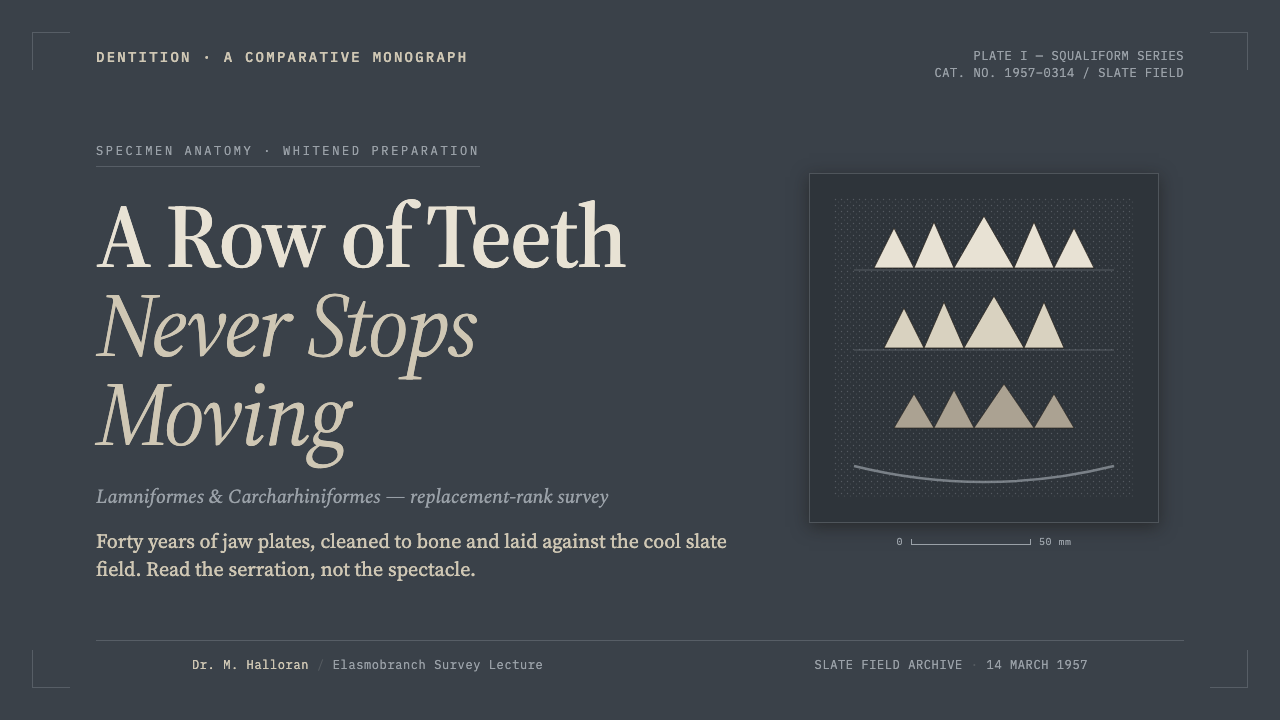
The style also works for covers, catalog pages, and campaign sequences built around progressive inspection. A first panel may show the complete jaw, a later panel may isolate serration, and another may reveal dermal-denticle texture. The visual grammar remains stable when every crop is treated as evidence from the same specimen. Repeated frames, consistent slate grounds, and pale anatomical forms create continuity without requiring a broad image library.
The common mistake is turning forensic restraint into horror theatrics. Excessive blood references, aggressive red accents, cinematic smoke, glossy highlights, or oversized distressed type shift the work from specimen documentation toward entertainment. Another mistake is flattening everything into pure black and white so that the slate, ivory, and bone-white distinctions disappear. The system depends on subtle tonal separation: the image should feel cold, preserved, and exact, not merely dark.
Shark Jaw & Dentition — FAQ
Is Shark Jaw & Dentition a horror style?
Not by default. Its source is scientific specimen photography and natural-history monograph illustration, so the governing mood is forensic observation rather than horror. The teeth may appear severe because they are serrated and presented at high contrast, but the design remains controlled through slate grounds, prepared pale material, hairline rules, and measured annotation. Horror cues such as blood, theatrical red, smoke, or distressed effects move the style away from its source.
Why must the palette remain strictly greyscale?
Because the style treats contrast as evidence. The prepared jaw is separated from the cold study slate through changes in lightness, material impression, and edge clarity rather than through competing hues. Introducing a vivid color would create a new expressive subject and weaken the sense that the plate is documenting one coherent specimen. Ivory, bone-white, charcoal, and near-black are enough to establish hierarchy.
Can the system use photography as well as illustration?
Yes. Both are present in the source tradition. Photography should preserve the sense of a cleaned and whitened specimen on a dark study field, while illustration should clarify the jaw, tooth replacement, serration, or denticle texture without adding decorative scenery. In either medium, the image should behave as a plate for inspection. Cropping, framing, and annotation must support identification rather than turn the anatomy into spectacle.
What kinds of products suit this style?
It suits products and institutions associated with research, archives, museums, comparative analysis, specimen cataloguing, and disciplined data presentation. It can also support a brand that wants to communicate seriousness and material precision. It is less suitable when the experience depends on warmth, playful color, softness, or an inviting lifestyle mood. The style works when the product’s values align with inspection, preservation, and evidence.
Related design styles
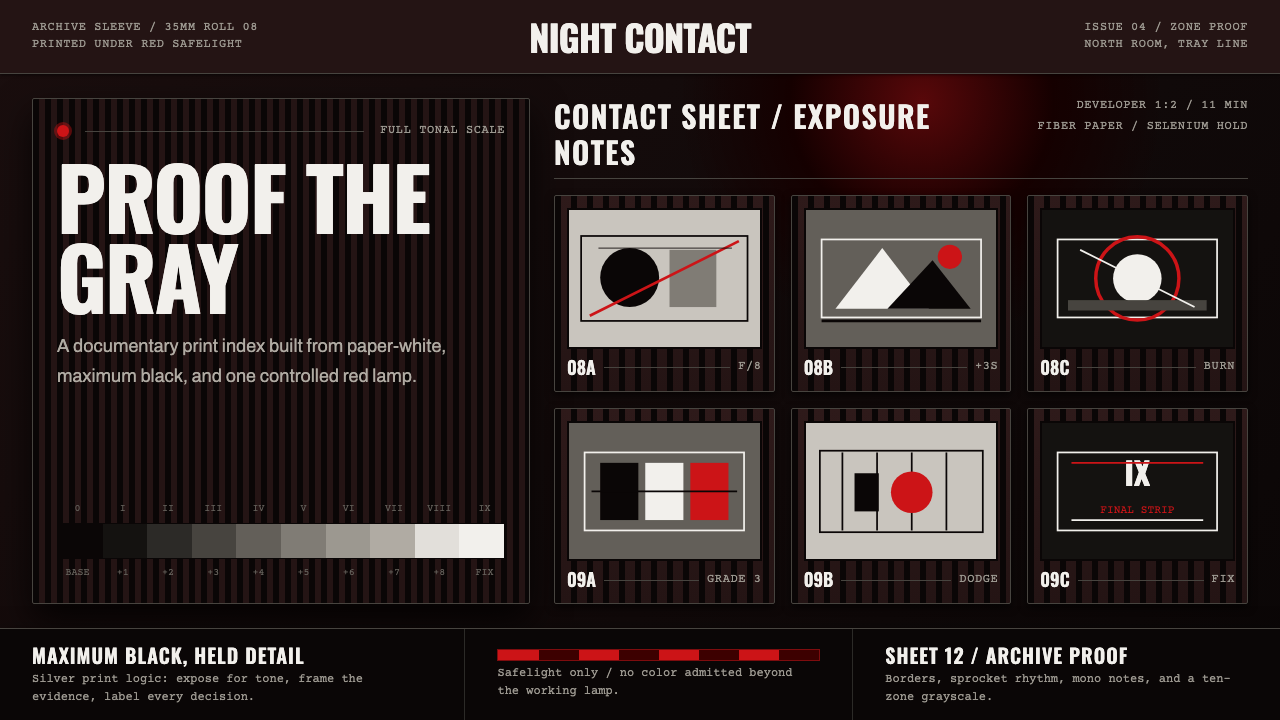 Silver Gelatin DarkroomTonality is the craft. Safelight red, contact grids, and ten-zone grays hold…
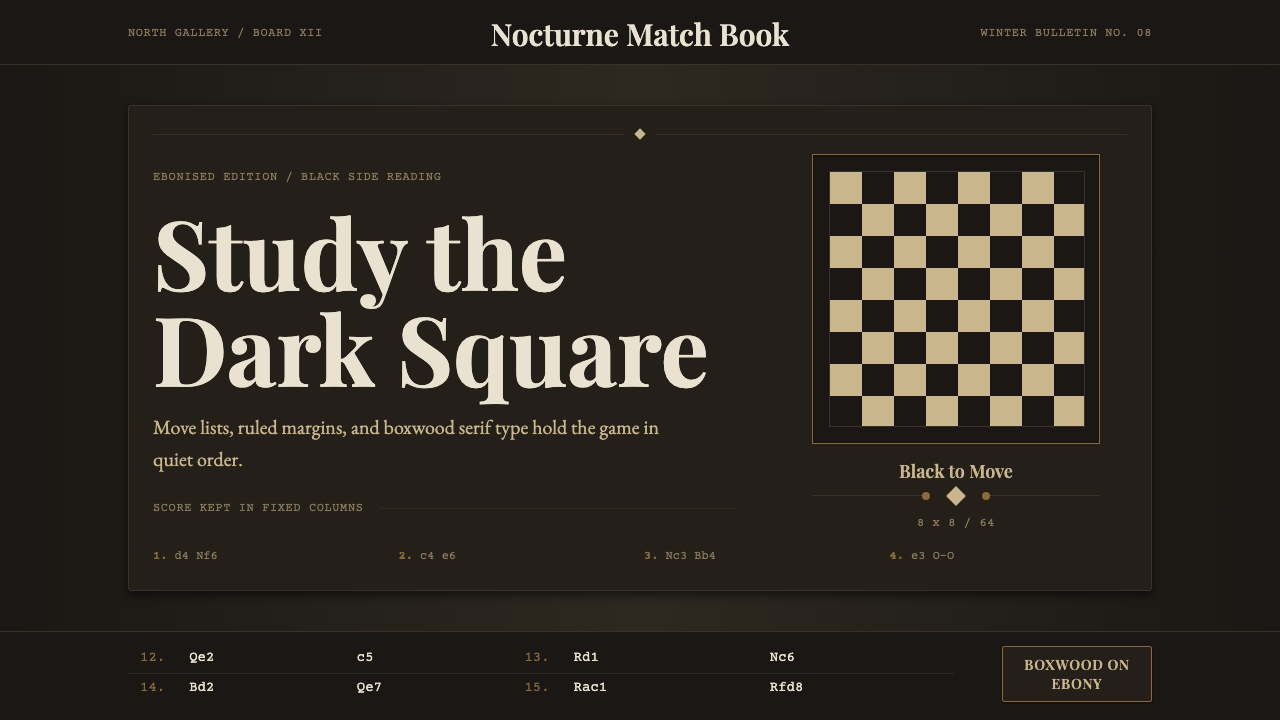 Chess TournamentQuiet intellect. Cream Playfair type, walnut rules, and notation glow on ebon…
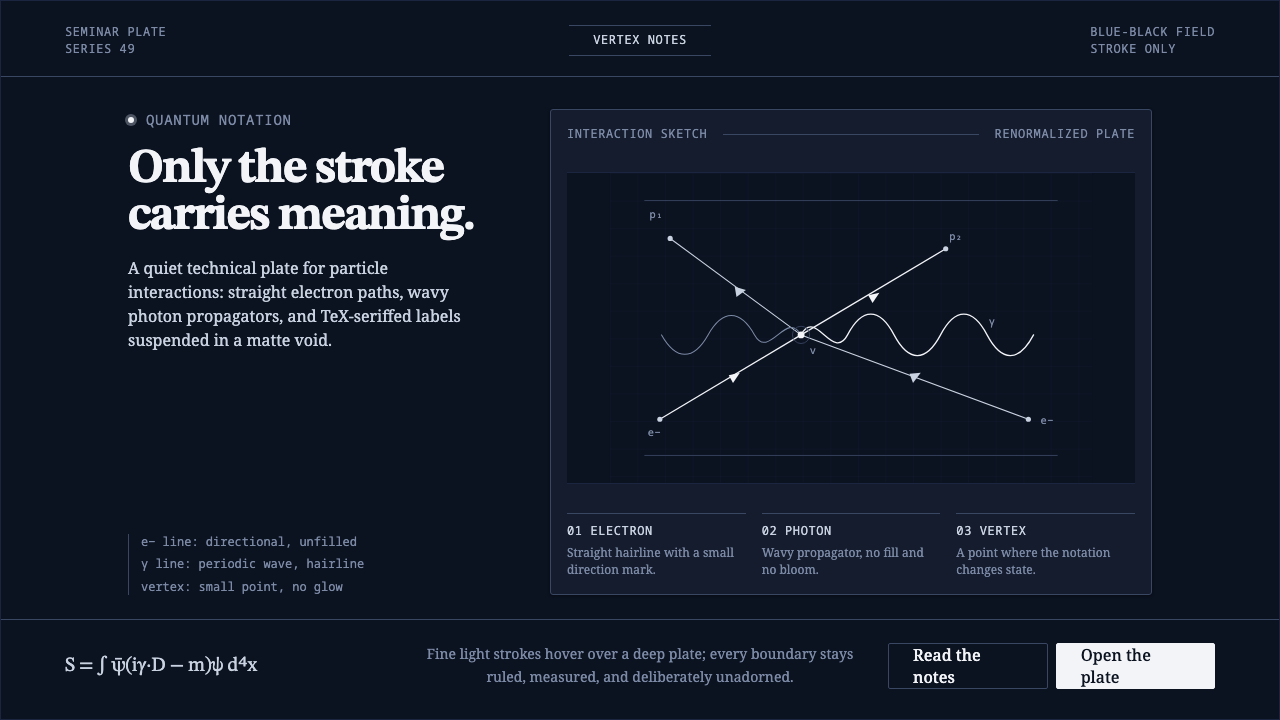 Feynman Diagram QEDMeaning reduced to strokes. Pale QED lines and TeX serif type float on blue-b…
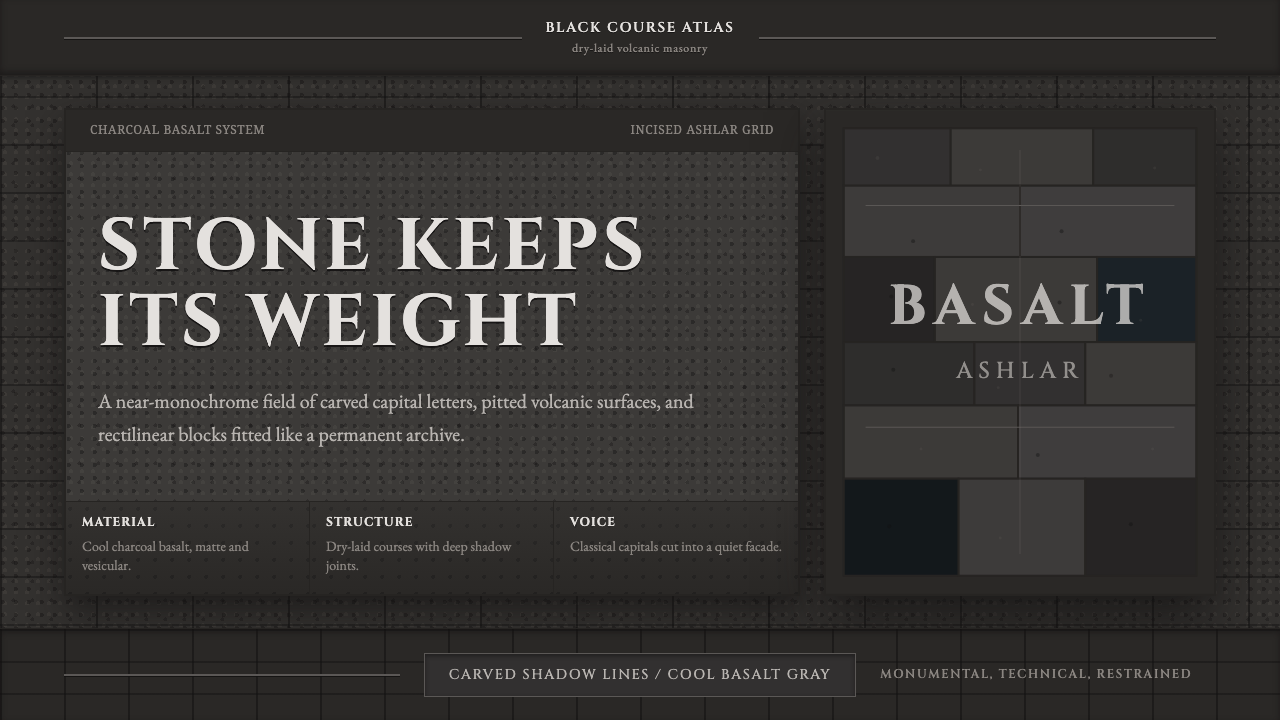 Hauran Basalt StoneMonolith refuses shine. Charcoal Cinzel capitals lock into dry-laid basalt gr…
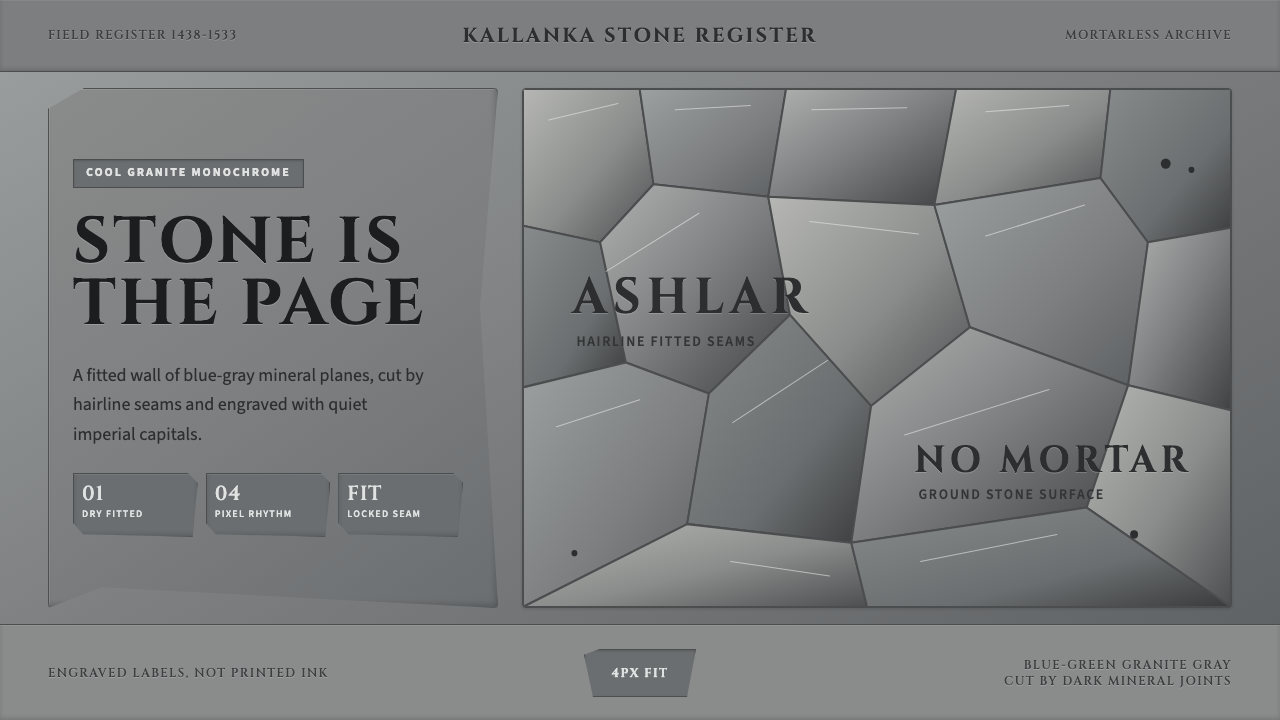 Inca Ashlar StoneworkStone becomes the page. Granite-gray planes lock into hairline ashlar seams.
 Soviet Classified MapAustere field intelligence. Khaki grid, forest green fills, brown contours, r…