What is Armenian Vishapakar Dragon Stone?
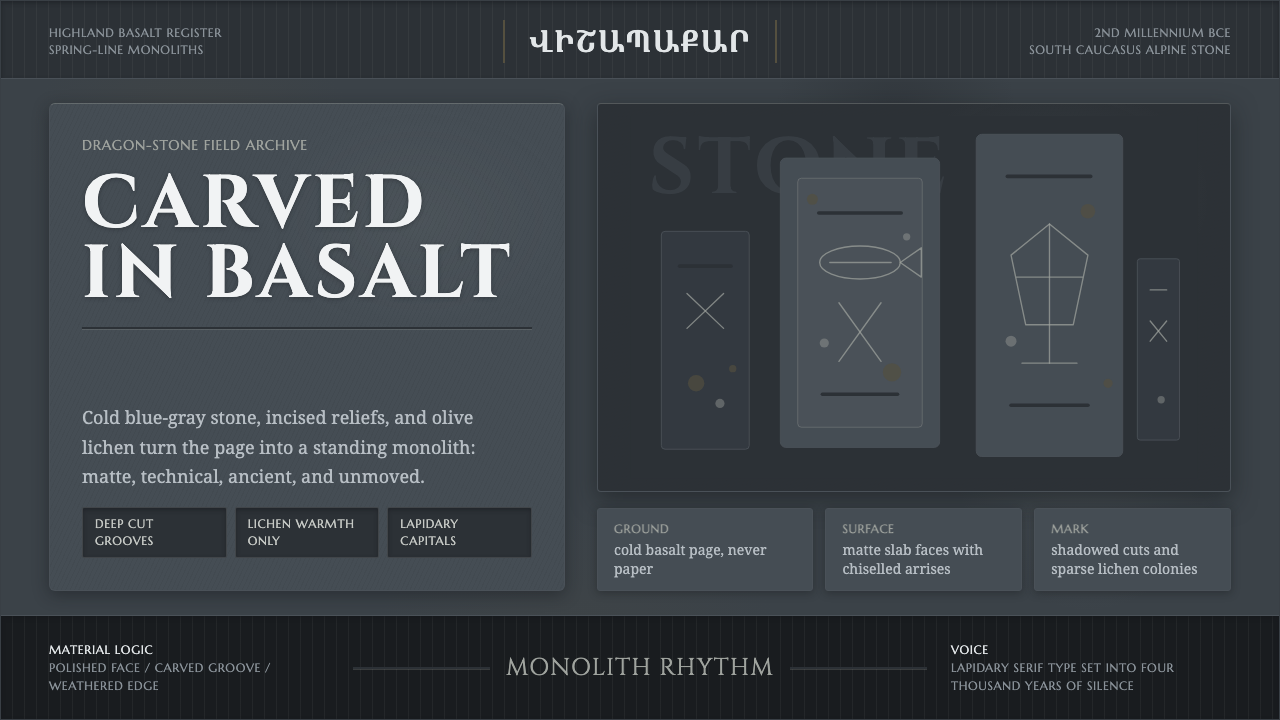
Armenian Vishapakar Dragon Stone turns the highland monolith into an interface language of basalt, incision, silence, and the rare warmth of lichen.
Armenian Vishapakar Dragon Stone in brief
Vishapakar, commonly rendered as dragon stones, are Bronze-Age megaliths from the Armenian Highland. Made from basalt and andesite, they stand in high alpine pastures and bear forms cut directly into volcanic stone: incised fish and elongated bull-hide motifs. Their visual force does not depend on abundance or ornament. It comes from mass, weathering, and the conviction that a mark made in stone should remain legible against wind, cold, and time.
As a design system, Armenian Vishapakar Dragon Stone translates that condition into a dark, mineral interface. The ground feels like cold blue-gray basalt rather than a neutral digital backdrop. Surfaces are matte, dense, and chiselled; lines behave like grooves cut into a slab, catching darkness instead of floating above it. The result is not theatrical antiquity. It is a deliberately restrained visual language built around permanence, material weight, and the authority of inscription.
The style’s warmth is intentionally scarce. Olive and tan lichen interrupt the stone field in small, irregular traces, making the surrounding gray feel more alive without becoming decorative. Lapidary serif typography carries the same role as a carved inscription on a polished face: it should appear placed, cut, and durable. Vishapakar-inspired work is strongest when every visible element feels necessary enough to survive being carved into rock.
Where does Armenian Vishapakar Dragon Stone come from?
The source tradition belongs to the Bronze Age megalithic culture of the Armenian Highland, in the South Caucasus. Vishapakar stones were carved during the second millennium BCE by prehistoric stone-workers and placed in high alpine pasture landscapes. Their setting matters as much as their imagery: these are not small portable objects but upright volcanic forms encountered against open land, weather, and distance.
Basalt and andesite give the tradition its material premise. Both are volcanic stones, and the supplied description emphasizes their cold, dark character. The visual system therefore begins with a surface that feels geological rather than manufactured. It does not imitate polished luxury stone or domestic masonry; it draws on slabs whose texture has been chiselled, exposed, and altered by the highland climate.
The known carved vocabulary is spare but distinct: fish forms and stretched bull-hide motifs. The material does not assign them a fixed symbolic interpretation, and a faithful contemporary treatment should not invent one. Instead, their value for design lies in their method: recognizable figures reduced to deliberate incisions, organized across a monumental field, with empty stone remaining an active part of the composition.
Four thousand years of highland wind and lichen are part of the stones’ present identity. That long weathering process gives Vishapakar-derived design a useful discipline. Interfaces need not simulate damage or fabricate archaeological patina; they can instead use restrained tonal variation, occasional organic interruption, and deeply recessed-looking marks to suggest duration. The reference is a surviving monolith, not a themed surface.
What defines the Armenian Vishapakar Dragon Stone look?
Basalt Ground
The dominant field is cold, dark, and blue-gray, with the density of volcanic rock. It should feel broad and still rather than glossy or atmospheric. Small shifts in mineral tone can keep the surface from becoming empty, but the ground remains a single continuous slab, not a collection of decorative panels.
Carved Groove
Rules, dividers, and graphic marks read as incisions rather than drawn strokes. Their depth is conveyed through darkness, sharp edges, and local shadow, as if material has been removed from the surface. A groove should organize information with the same seriousness as a cut in stone.
Matte Chiselled Surface
Surfaces are tactile but restrained: matte, cut, and slightly irregular in character. The aim is not photorealistic stone texture. Instead, the interface should imply a worked mineral face through quiet tonal compression and a refusal of slick reflective finish.
Lichen Accent
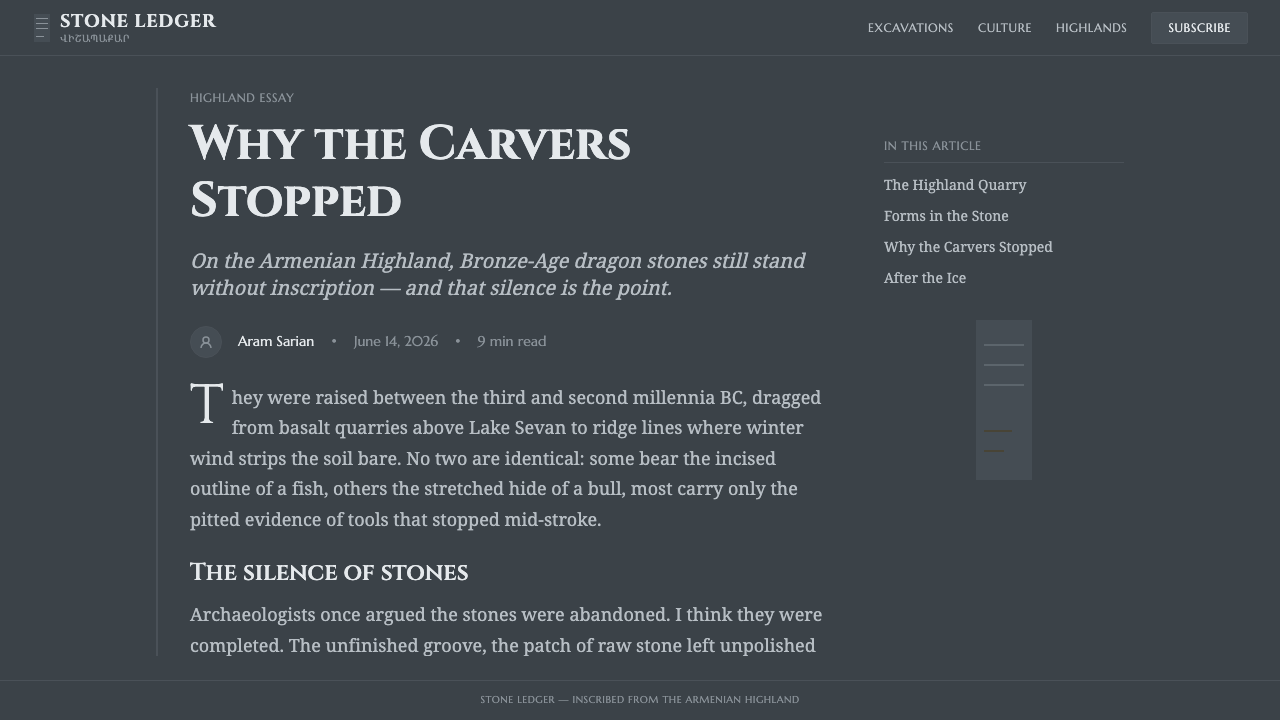
Olive-tan lichen is the system’s only real warmth. It appears sparingly, like growth on exposed stone, to identify a selected state, a useful annotation, or a moment of human attention. It must remain irregular and secondary; too much turns the style from weathered monument into camouflage.
Lapidary Typography
Serif typography is treated as inscription. Headlines need a formal, measured presence, while supporting text remains calm and highly readable against the dark ground. Spacing should create the impression that words were deliberately set onto a stone face, not rapidly assembled in a temporary interface.
Monolithic Composition
Composition favors large uninterrupted fields, few decisive anchors, and generous silence around information. Fish-like or hide-like motifs can appear as carved evidence rather than illustration. The layout should feel encountered as a whole before it is read in detail, much like an upright stone seen across open pasture.

Who shaped Armenian Vishapakar Dragon Stone?
The only named makers in the supplied record are the prehistoric stone-carvers of the Armenian Highland vishap tradition. Their work establishes the style’s central lesson: form is achieved by cutting directly into resistant material, leaving a permanent relationship between figure, groove, and untouched stone.
The vishapakar stelae are the visual protagonists of the system. Their upright, megalithic presence supplies the sense of scale, stillness, and endurance. In contemporary design, they are best understood as a compositional model rather than an icon to be copied literally.
The documented fish forms and stretched bull-hide motifs provide the tradition’s carved vocabulary. Their importance lies in their economy: they make the stone recognizable without covering it. They should remain sparse, incised, and materially integrated whenever they inform a contemporary visual application.
How do you use Armenian Vishapakar Dragon Stone today?
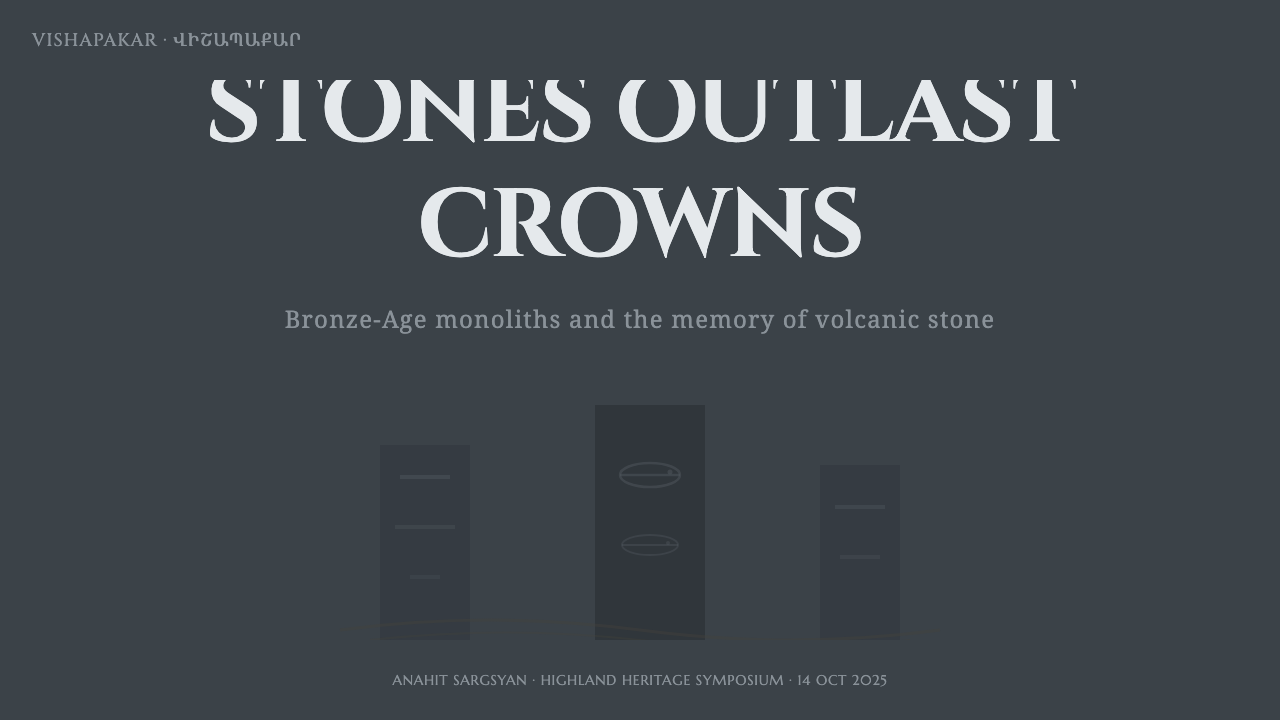
For presentation covers, use the monolith as the organizing idea. Let a dark basalt-like field occupy the page, give the title a measured lapidary presence, and introduce one deeply incised line or fragmentary motif as the point of orientation. The cover should feel like a face of stone encountered before its inscription is deciphered, not like a history slide decorated with archaeological imagery.
Content slides benefit from the style’s discipline of carved hierarchy. Treat headings as inscriptions, body copy as carefully placed supporting evidence, and dividers as recessed channels. Data slides can use the same language: bars, paths, and markers should appear embedded into the dark field, while the lichen accent identifies the most consequential value or current selection without turning every datum into a signal.
For web interfaces, Vishapakar works especially well in analytical dashboards, archives, research tools, and products that need to communicate permanence and concentration. Keep navigation quiet and typographic, group related material within broad mineral surfaces, and use groove-like boundaries to separate states. Interactive feedback should remain precise and local, preserving the sense that the interface is one coherent slab.
In editorial and marketing work, the style favors long-form essays, cultural programs, architectural stories, and high-consideration product narratives. Give quotations, captions, and metadata room to sit beside the main text rather than competing for attention. A motif can introduce a section or mark a transition, but it should behave as a trace in stone, not as a repeating ornamental pattern.
The common mistake is mistaking darkness for Vishapakar. A black background, generic cracks, aggressive texture, and fantasy-dragon imagery do not recreate the tradition. The style depends on volcanic restraint, legible incision, sparse warmth, and respect for unmarked surface. If every region is distressed, glowing, or symbolically overloaded, the monolithic calm disappears.
Armenian Vishapakar Dragon Stone — FAQ
Is Vishapakar Dragon Stone a fantasy or medieval style?
No. Its source is a Bronze-Age megalithic tradition of the Armenian Highland, centered on basalt and andesite stones carved during the second millennium BCE. The word dragon stone can invite fantasy associations, but the supplied visual evidence is more austere: upright volcanic slabs, incised fish forms, stretched bull-hide motifs, wind, and lichen. Contemporary work should preserve that archaeological restraint rather than add invented creatures, heraldry, or medieval ornament.
How should the fish and bull-hide motifs be used?
Use them as sparse carved evidence, not as a decorative library. The approved material identifies these forms but does not assign a fixed meaning to either, so they should not be presented as coded labels or invented symbols. A fragment at a section edge, a recessed mark near a title, or a quiet motif within a broad field is more faithful than repeated patterning across every surface.
Can the lichen accent become a main brand color?
Usually it should not. The olive-tan lichen is effective because it is the rare warmth against a cold basalt environment. When it becomes dominant, the material contrast that gives the system its atmosphere is lost. Reserve it for selection, emphasis, annotation, or a small living interruption in the mineral field, and let the stone remain visually primary.
What separates an authentic application from a generic dark stone interface?
Authenticity comes from relationships, not surface effects. The basalt ground must feel monolithic; marks must behave like purposeful incisions; typography must carry inscriptional composure; and the lichen accent must remain scarce. A generic dark stone interface often adds cracks, shine, heavy texture, or dramatic visual effects. Vishapakar-derived work does the opposite: it uses empty stone, durable hierarchy, and a few irreversible-looking decisions.
Related design styles
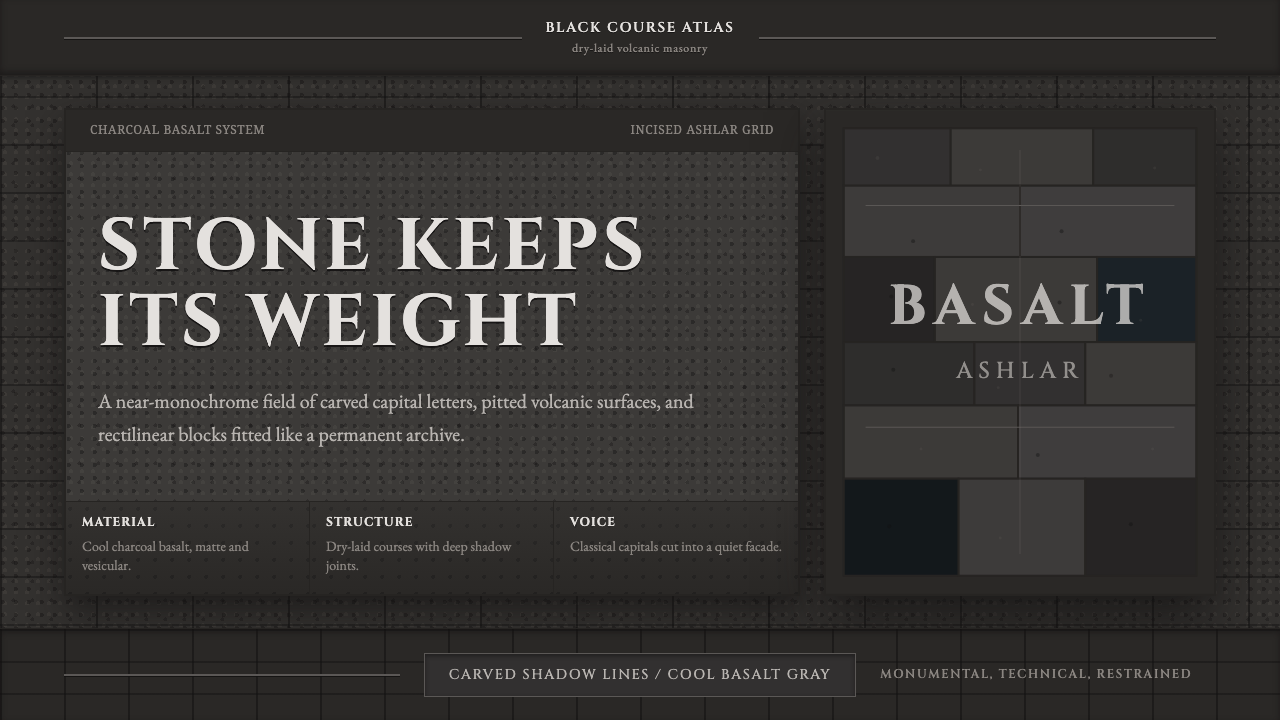 Hauran Basalt StoneMonolith refuses shine. Charcoal Cinzel capitals lock into dry-laid basalt gr…
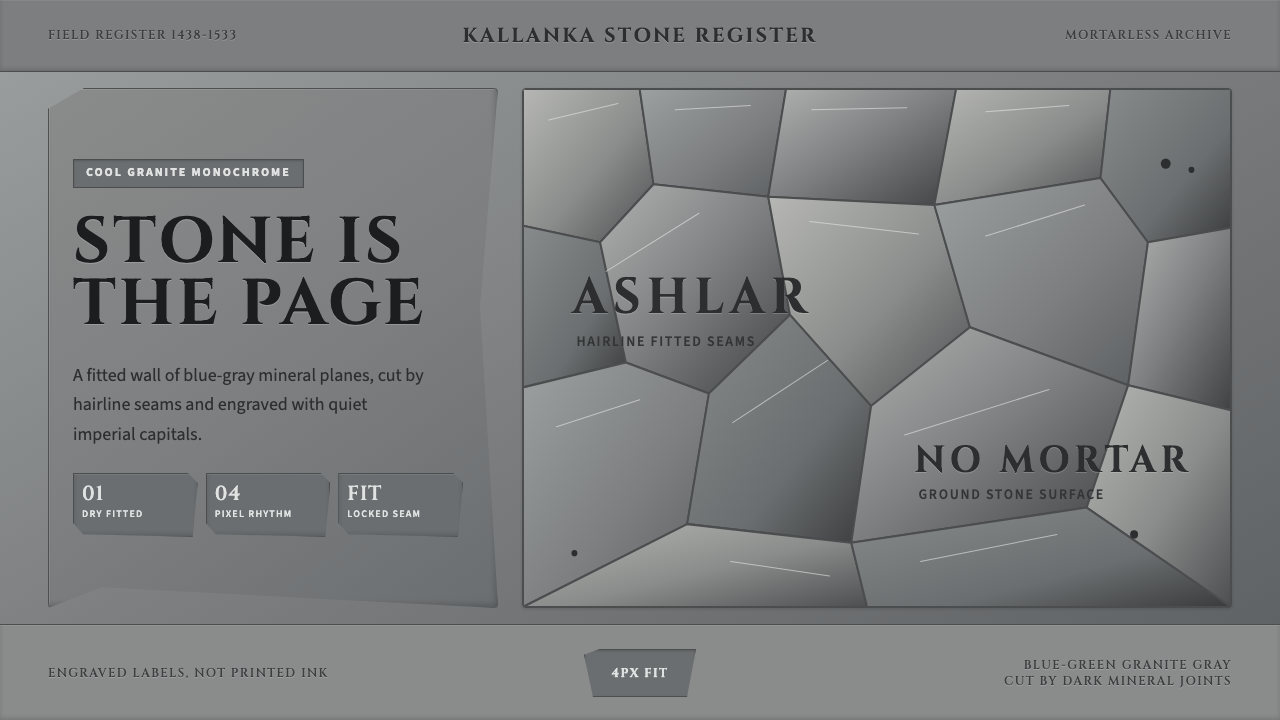 Inca Ashlar StoneworkStone becomes the page. Granite-gray planes lock into hairline ashlar seams.
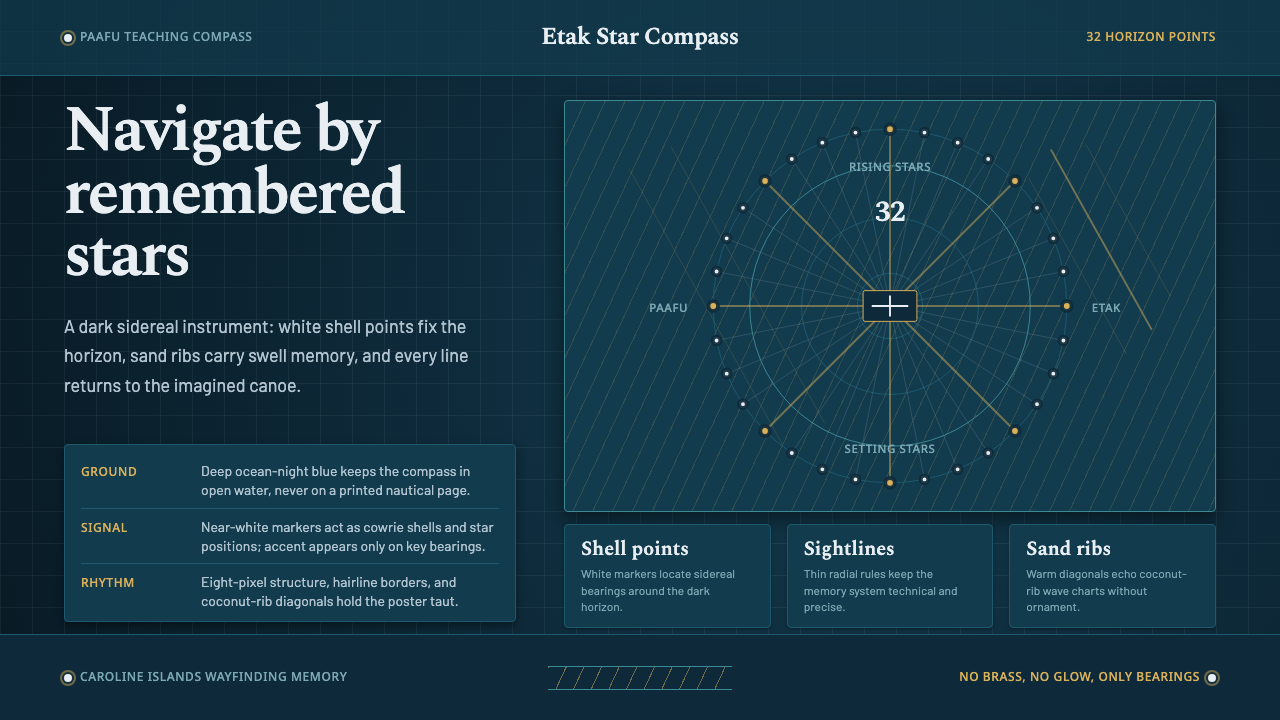 Micronesian Etak Star CompassNavigation as memory. White star points and sand ribs map a 32-point ocean-ni…
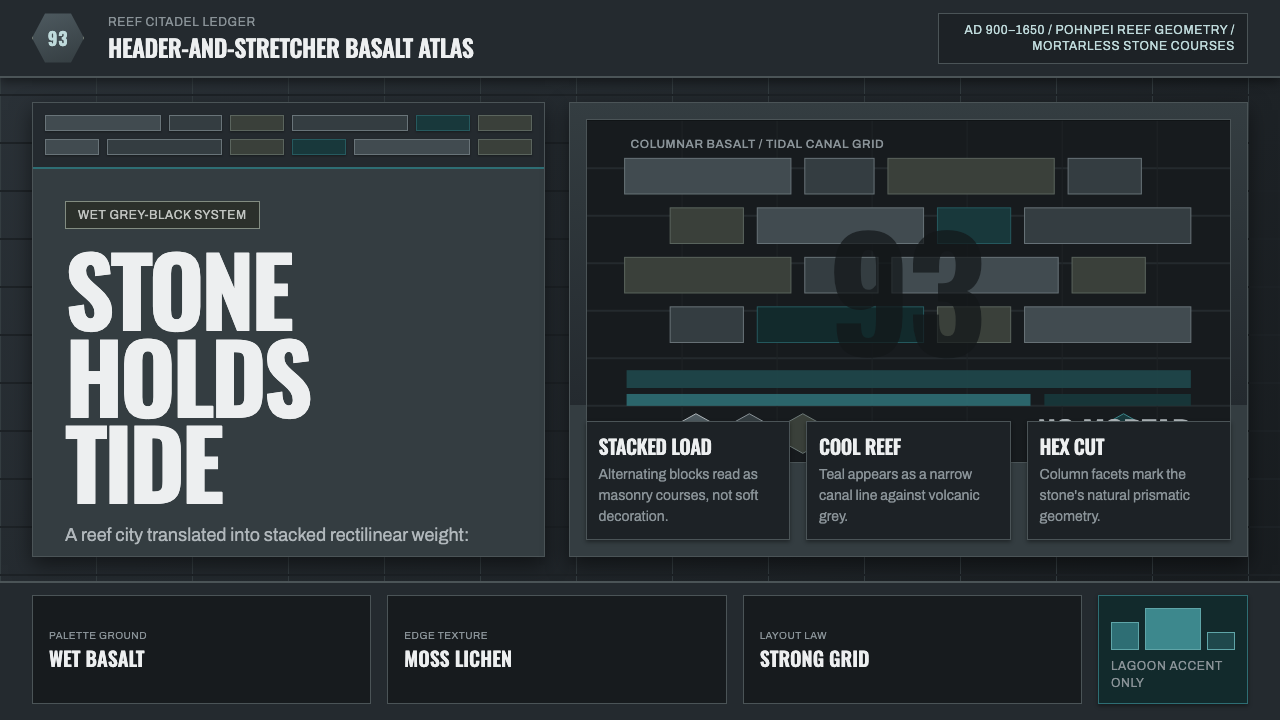 Nan Madol Basalt MegalithStone holds tide. Grey-black basalt grids cut by a narrow lagoon-teal vein.
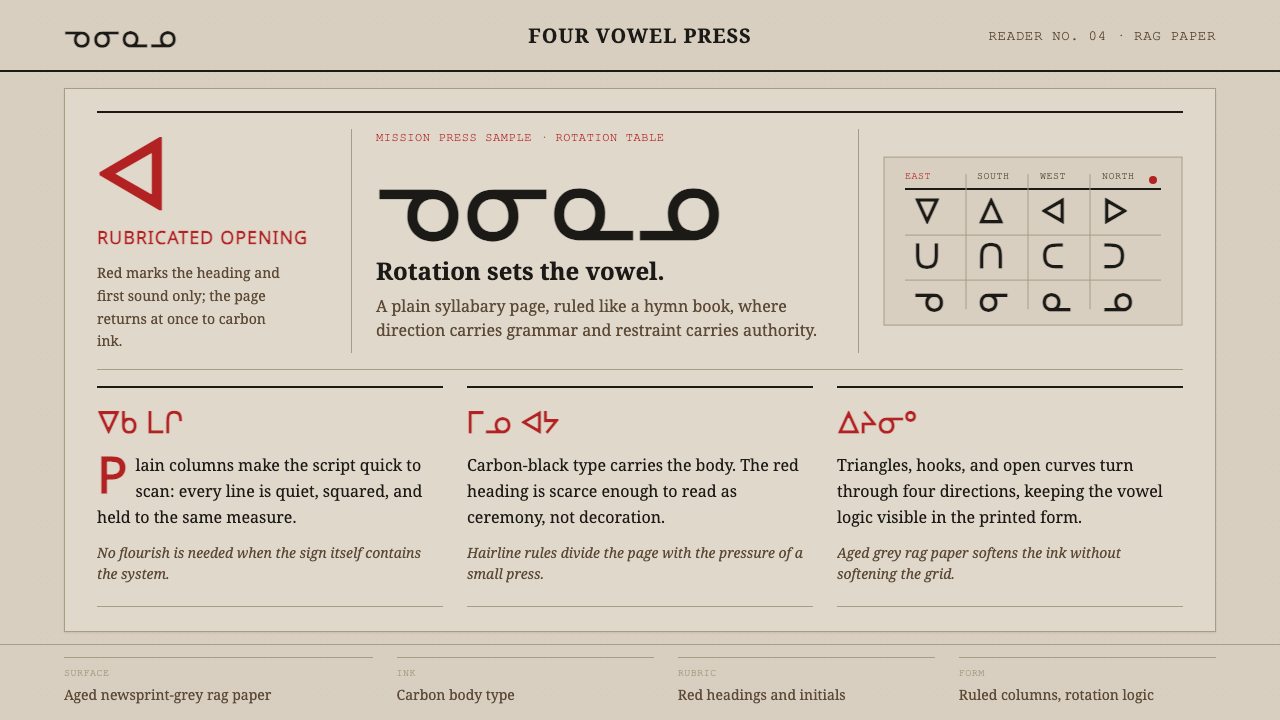 Cree SyllabicsPlain ink has authority. Carbon columns and red rubrication sit on rag-grey p…
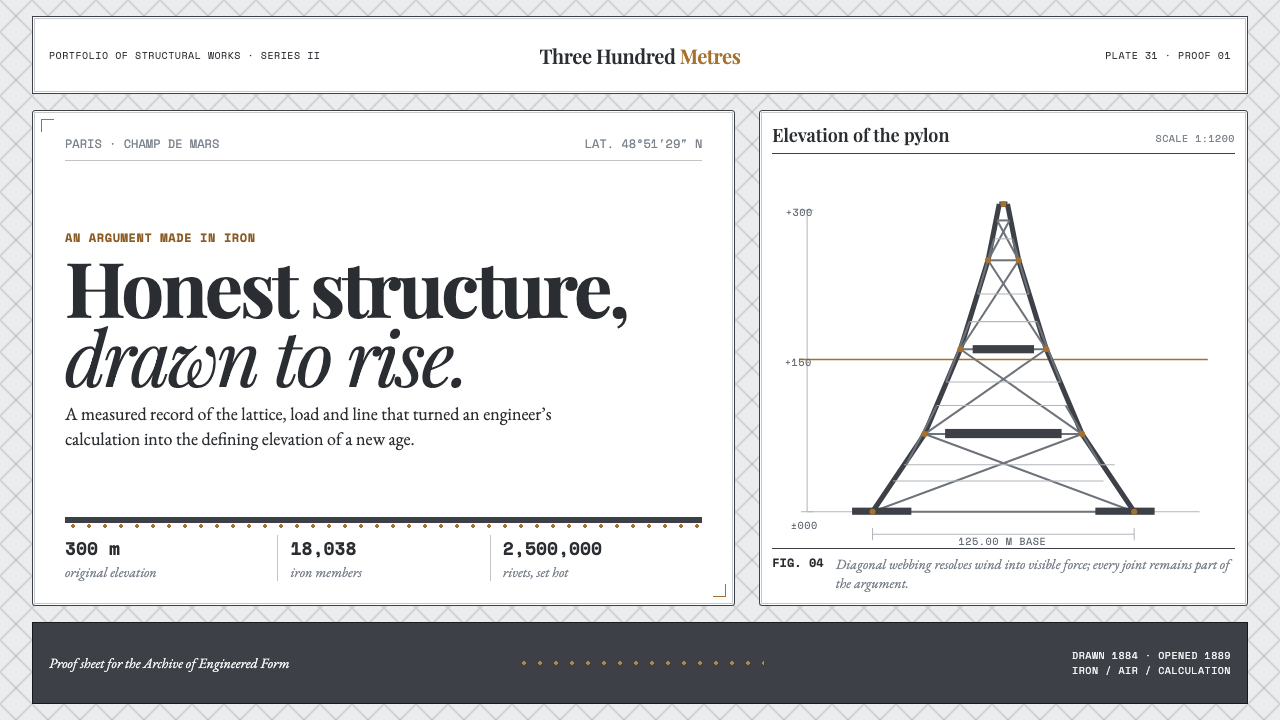 Eiffel Tower (1889)Structure speaks plainly. Graphite lattice, bronze rivets and measured type m…