What is Nan Madol Basalt Megalith?
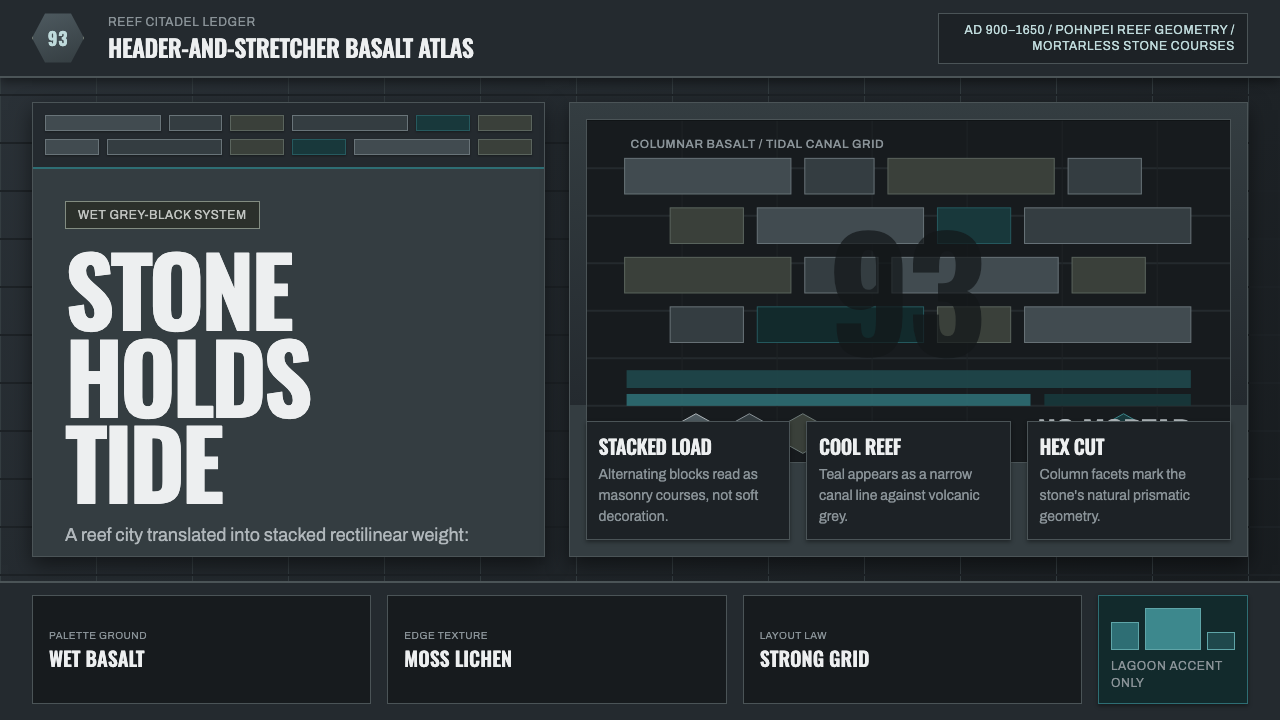
Nan Madol Basalt Megalith turns a tidal city of grey-black volcanic columns into a design language of weight, repetition, and a single cool line of lagoon water.
Nan Madol Basalt Megalith in brief
Nan Madol is a ceremonial and mortuary capital built on a fringing reef off the southeast shore of Pohnpei in the Federated States of Micronesia. Its ninety-three artificial islets are defined by walls of naturally hexagonal columnar basalt, arranged in interlocking stacked courses. The result is neither a conventional city nor an isolated monument: water separates the built masses, while stone establishes their boundaries, routes, and gravity.
As a visual system, Nan Madol Basalt Megalith takes its cue from that construction. It is dark, cool, matte, and structural. Grey-black fields dominate; lagoon teal appears as a narrow interruption rather than an all-over atmosphere. Rectilinear walls create the main rhythm, while the faceted ends of basalt columns introduce hexagonal detail. The style should feel assembled from heavy units that resist weather, not drawn as a light decorative pattern.
The essential contrast is between mass and tide. Stone appears load-bearing, layered, and imperfectly regular, with moss and lichen softening only selected surfaces. Water remains shallow, clear, and cool in character. There is no warm desert nostalgia, polished luxury, or romantic ruin effect. The visual impression is volcanic material set on coral reef: durable, damp, monumental, and continuously exposed to the sea.

Where does Nan Madol Basalt Megalith come from?
Nan Madol developed on the reef off Pohnpei between roughly AD 900 and 1650, during the Saudeleur and Nahnmwarki dynasties. The supplied historical frame identifies the Saudeleur rulers with its establishment as a ceremonial and mortuary capital. Its setting is fundamental to its identity: architecture was made not beside water, but within a reef landscape where channels and islets were part of the built order.
Its monumental construction depended on naturally hexagonal columnar basalt. Prismatic stone columns were quarried from volcanic rock beds, carried across open water by raft, and laid in header-and-stretcher courses to form walls. No mortar binds the system. Instead, the visual and structural logic comes from accumulated mass, interlocking placement, and the persistent horizontal rhythm of stacked stone.
The physical environment gave this architecture its distinctive palette and surface character. Wet basalt reads as cool grey-black rather than dry charcoal; moss and lichen add irregular muted variation; the surrounding lagoon supplies a shallow turquoise-teal counterpoint. This is why a Nan Madol-derived composition should preserve the tension between dark material density and clear water, rather than treating stone as a generic rustic texture.
The source material places Nan Madol within Micronesian megalithic architecture and columnar-basalt monumental construction, and names the UNESCO World Heritage Committee among its key institutional figures. For design use, that context matters because the style is rooted in a specific place, material, and construction tradition. It should be approached as an interpretation of documented architectural conditions, not as a loose tropical-fantasy motif.
What defines the Nan Madol Basalt Megalith look?
Basalt Palette
Grey-black is the governing field, with cool charcoal variation suggesting wet volcanic stone. Lagoon teal is used sparingly as a channel, edge, or focal seam. Warm earth colors, sun-baked beige, and bright tropical mixtures break the material logic. The palette should feel damp, mineral, and restrained rather than dramatic for its own sake.
Stacked Structure
Layouts should be built from visible courses, long horizontal bars, and offset rectangular masses. Repetition must imply construction rather than ornament: each layer appears to carry the next. Slight irregularity is useful when it suggests hand-placed stone, but the overall composition remains deliberate, stable, and compressed.
Columnar Facets
Hexagonal and prismatic details derive from columnar basalt rather than from a generic geometric trend. Use faceted ends, clipped corners, and clustered stone modules as secondary structure. These forms work best when embedded in a larger wall-like system; isolated hexagons can quickly lose the connection to material and place.
Water Channels
Teal water is not a background wash. It functions as separation, route, and relief between dark masses, echoing the channels between artificial islets. A narrow cool opening can make a dense composition feel navigable. Broad watery gradients or decorative waves weaken the style's architectural discipline.
Matte Weathering
Surfaces should read as cool, matte, and weather-exposed. Moss and lichen may appear as subdued irregular deposits, never as lush botanical decoration. Texture belongs chiefly to stone joints, damp mottling, and erosion-like variation. Gloss, polished marble effects, and metallic sheen contradict the reef-bound basalt character.
Monumental Restraint
The style gains authority through density, scale contrast, and repetition, not through spectacle. Typography and imagery should leave room for the stone system to dominate. Decorative symbols, excessive ruin imagery, and theatrical distress make the result feel fictional. The strongest work is quiet enough to let mass, water, and weather carry the meaning.

Who shaped Nan Madol Basalt Megalith?
The Saudeleur rulers are identified in the source material as the dynasty associated with Nan Madol's construction as a ceremonial and mortuary capital between roughly AD 900 and 1650. In a design narrative, their significance is the project’s civic and ritual scale: the architecture was organized as a capital across artificial islets, not as a decorative stone enclosure.
The historical era supplied for Nan Madol includes the Nahnmwarki dynasties alongside the Saudeleur period. The approved material does not expand on individual rulers or events, so the relevant lesson is one of continuity: the site’s visual language belongs to a long-lived cultural landscape rather than to a single isolated construction moment.
The UNESCO World Heritage Committee is named in the source material as a key institutional figure connected to Nan Madol. Its inclusion reinforces that the site should be treated with specificity and respect. Contemporary design references should foreground the documented basalt construction, reef setting, and cultural context rather than reducing the place to an anonymous dark-stone aesthetic.
How do you use Nan Madol Basalt Megalith today?
For presentation covers, use a dense dark field built from stacked basalt-like bars, interrupted by a single narrow teal channel. Let the title sit as though it has been cut into or placed against the wall rather than floating above it. Content slides should establish a calmer structural rhythm: sections become courses of stone, supporting notes occupy recessed areas, and generous dark negative space prevents the composition from becoming visually heavy.
Data slides can borrow the logic of artificial islets and water channels. Treat each data group as a compact stone mass, then use cool teal separation to clarify relationships or movement. Avoid playful charts, candy-colored series, and glossy diagram effects. The most convincing result feels like a map of linked structures, where hierarchy comes from accumulated mass and deliberate gaps.
For web interfaces, the style fits dashboards, archives, research tools, and pricing pages that benefit from a serious, material sense of order. Use dark panels as contiguous walls rather than floating glass surfaces. Teal should identify routes, selected states, or meaningful transitions. Cards need firm edges and strong grouping, while navigation should resemble a sequence of carved labels or connected channels.
Editorial and marketing work can use the style to give long-form stories, institutional pages, or product launches a measured monumental tone. Pair wide dark image fields with narrow passages of text, allowing captions and metadata to act like smaller stones fitted into a larger wall. Marketing language should remain precise; the visual system becomes less credible when paired with exaggerated claims or lush tropical imagery.
The common mistake is to treat Nan Madol as a generic fantasy ruin or a loose dark-mode theme. Copying stone texture without the water-to-mass relationship produces scenery rather than structure. Likewise, making teal too abundant turns the lagoon accent into decoration. Start with stacked load-bearing order, preserve the cool material palette, and use water as a controlled interruption.

Nan Madol Basalt Megalith — FAQ
Is this style simply a dark stone aesthetic?
No. Dark basalt is essential, but it is only one part of the system. Nan Madol-derived work depends on the relation between stacked columnar stone, artificial-islet geometry, narrow water channels, and a reef setting. A dark surface with random rock texture misses the architectural logic. The composition must feel assembled from repeated weight-bearing units and opened by cool water.
How should teal be used without overwhelming the basalt?
Use it as water behaves at Nan Madol: as a boundary, a channel, or a clear interval between masses. It works best in narrow, intentional passages that reveal structure. When teal becomes the dominant background or appears in many unrelated accents, it stops reading as lagoon water and becomes an ordinary decorative color. Stone should remain the visual ground.
Can the style use photographs or illustrations?
Yes, provided imagery supports material and site rather than replacing them. Photographs can emphasize wet basalt, stacked courses, mossy surfaces, shallow lagoon water, or the boundary between stone and reef. Illustrations should be diagrammatic and structural, using blocks, channels, and faceted forms. Avoid romanticized jungle ruins, generic island imagery, or fantasy architecture not grounded in the supplied context.
Where does Nan Madol Basalt Megalith work best?
It is strongest where durability, record-keeping, cultural context, or spatial systems need to be felt: archives, research platforms, maps, institutional storytelling, environmental dashboards, and analytical product pages. It is less suitable for work requiring soft intimacy, playful abundance, or bright commercial energy. The style communicates endurance and containment, so the product message should be able to carry those values.
Related design styles
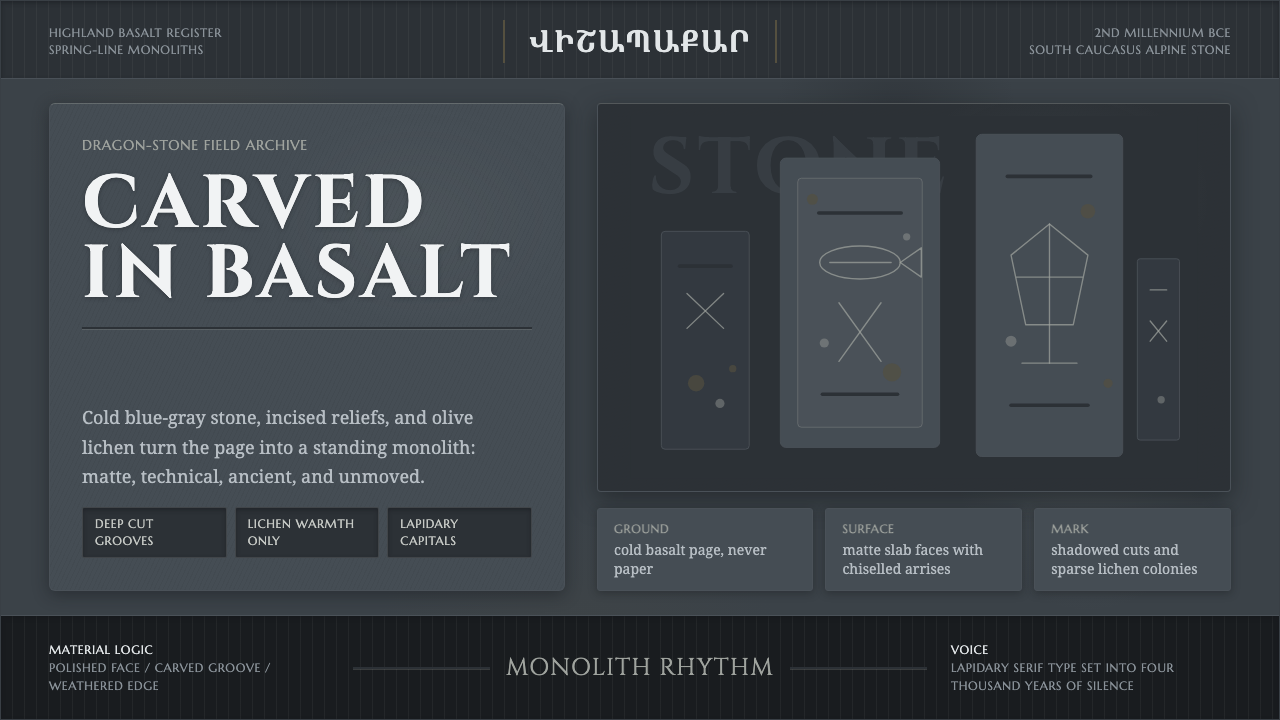 Armenian Vishapakar Dragon StoneAncient, cold, unmoved. Basalt gray slabs, incised grooves, sparse olive lich…
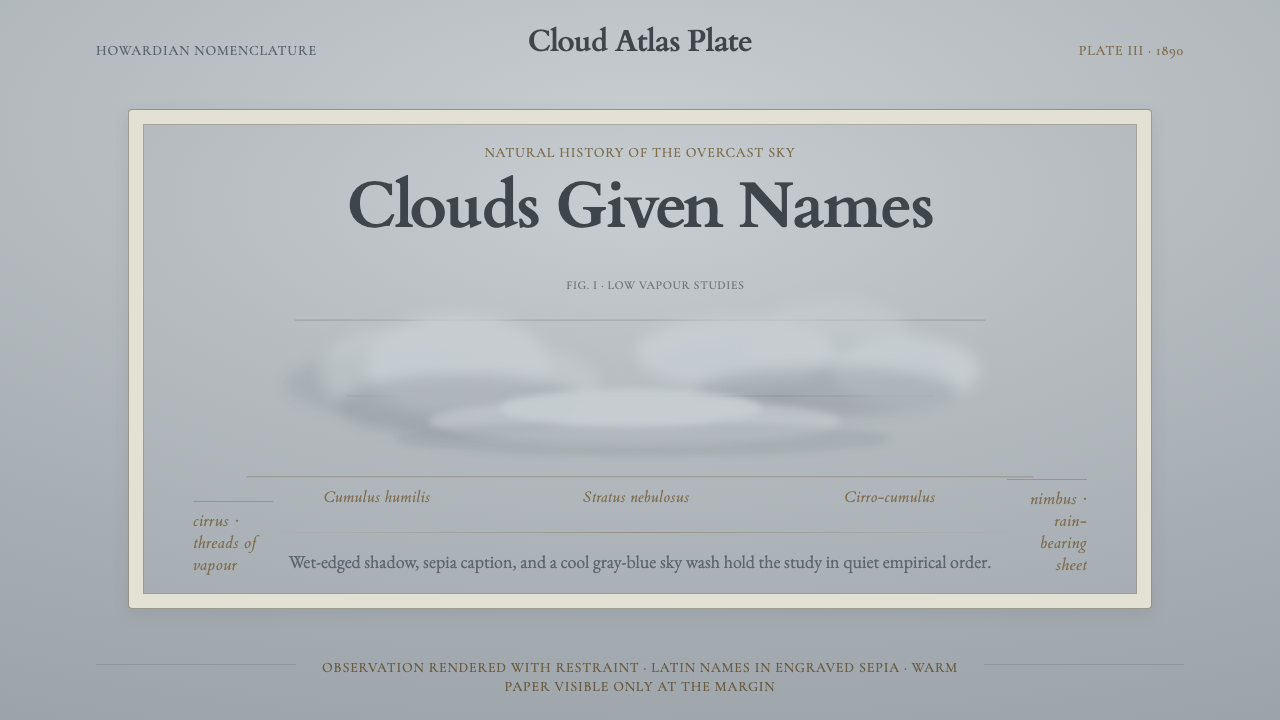 Cloud Atlas PlateObservation becomes atmosphere. Gray-blue wash, soft clouds, and sepia Latin…
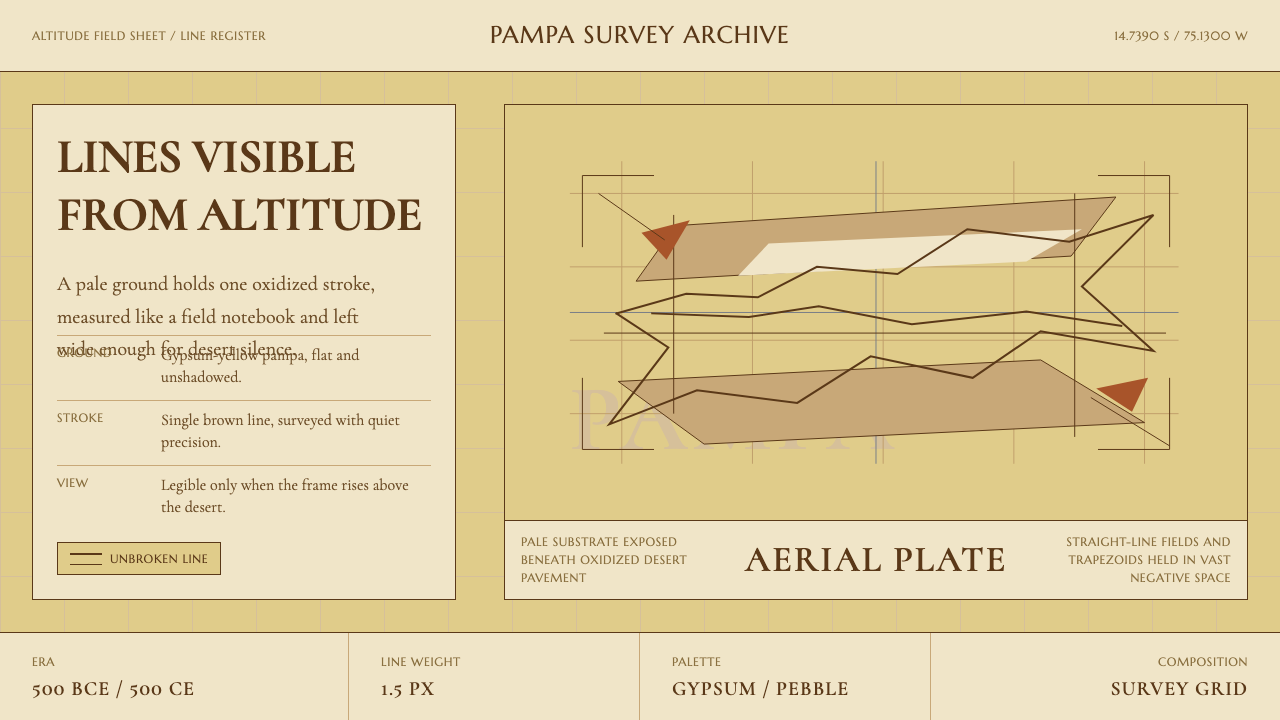 Peruvian Nazca Lines (Geoglyph)Vastness holds the line. Gypsum ground, pebble-brown strokes, and survey-grid…
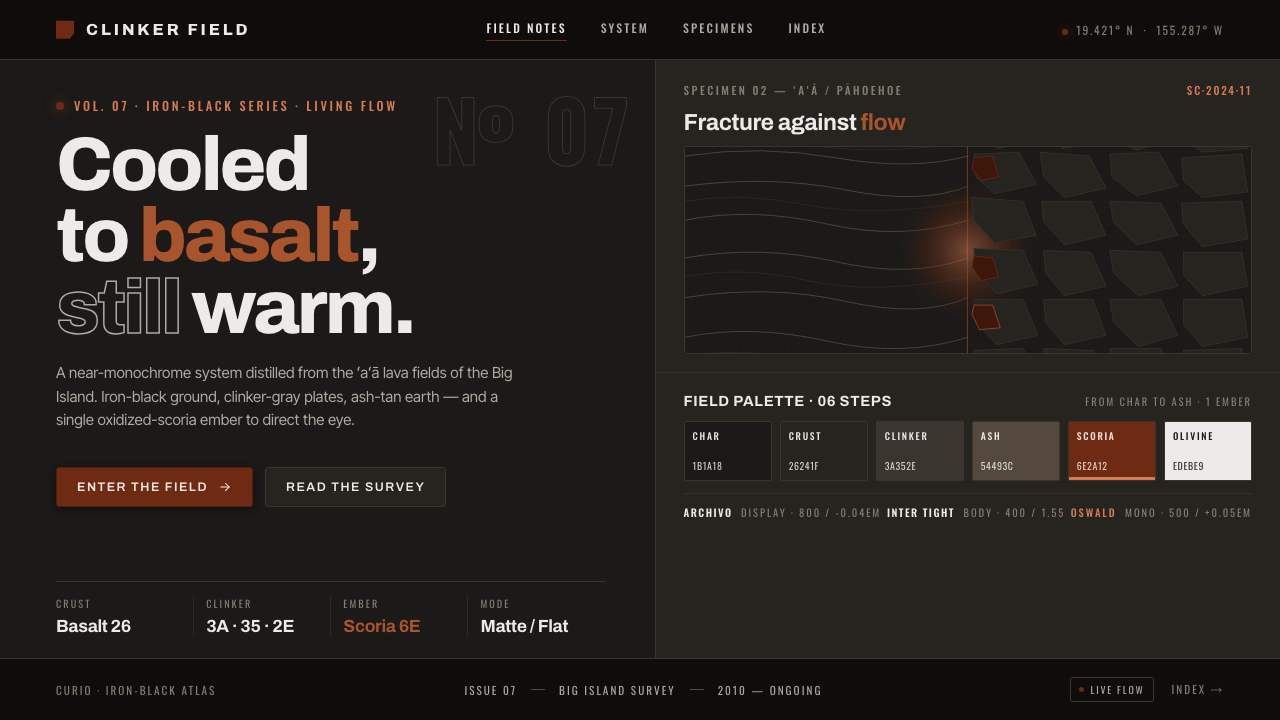 Hawaiian ʻAʻā Lava FieldIron-black, with one warm ember. Matte basalt char, clinker-gray plates, scor…
 Inuit IglooCold craft, clear light. Glacial cyan and Jura type trace a spiral-block dome…
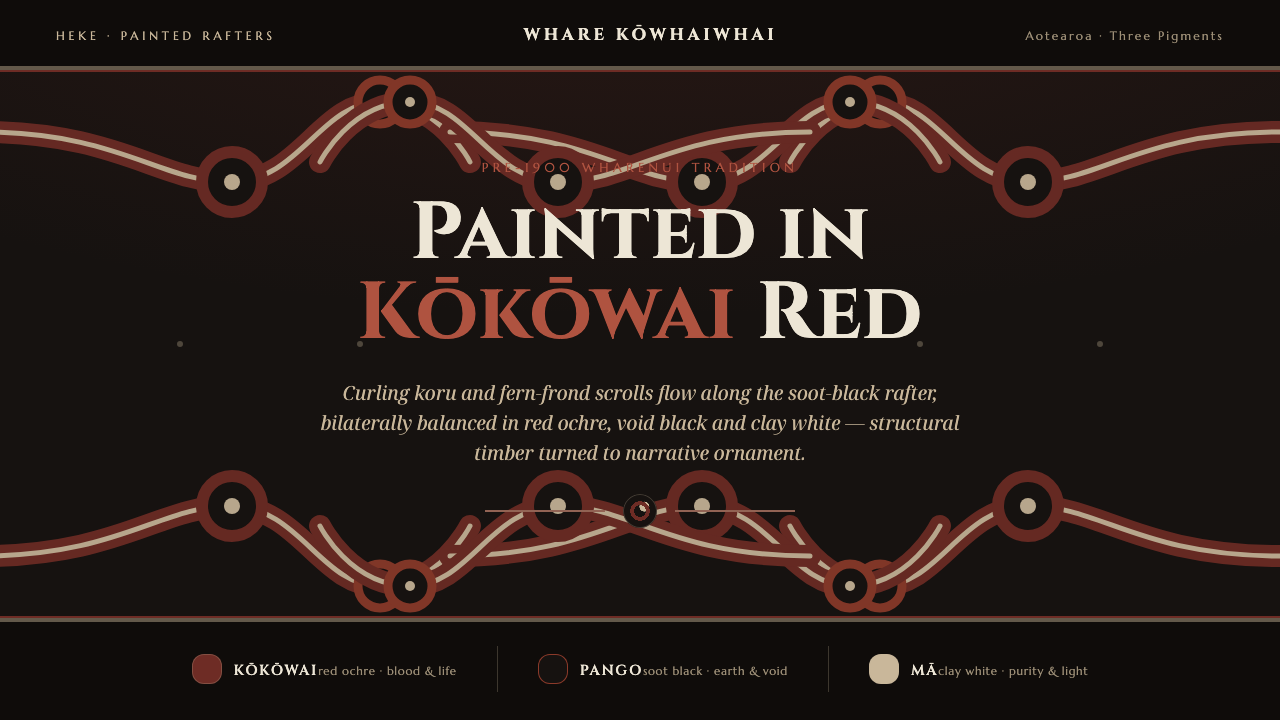 Māori Kōwhaiwhai RafterPainted timber, not pixels. Kōkōwai-red koru scrolls in mirrored balance on b…