What is Georgian Chokha?
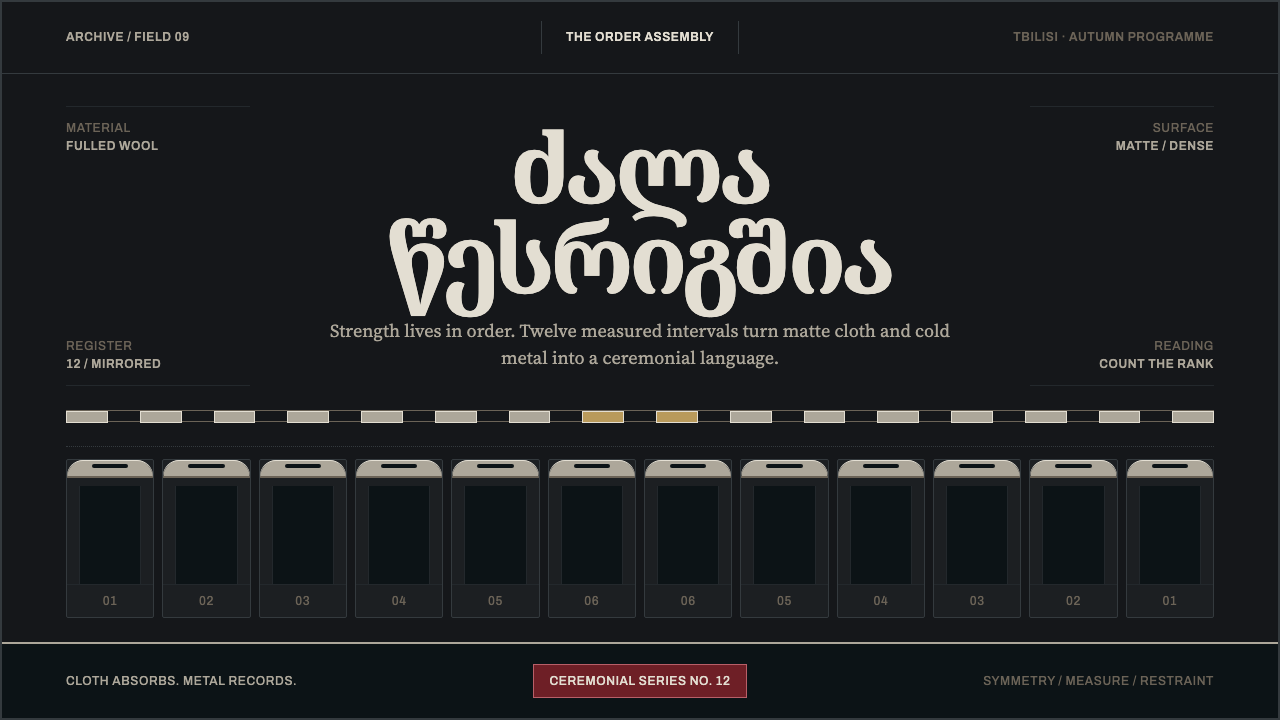
The Georgian chokha makes gravity countable: two mirrored ranks of silver-capped tubes on matte black wool, and nothing else bright anywhere on the garment.
Georgian Chokha in brief
The chokha is a fulled wool coat that has been worn across Georgia and the wider Caucasus for at least a thousand years, and it is still seen at weddings, on folk stages and at military ceremonies. Its whole design argument sits on the chest. Two mirrored rows of masri, hollow tubes that once held pre-measured powder charges for muzzle-loading guns, are stitched flat to the front of the coat and capped in silver, niello or gilt. Each row has a number of tubes that can be counted at a glance.
Everything else on the garment is deliberately plain. The cloth is dense matte broadcloth in black, wine or dark blue. A black leather belt studded with silver plaques sits at the waist, and a khinjal dagger hangs at the hip. There is no embroidery, no floral ornament, no gloss and no bevel. The wool absorbs light completely, and the only brightness in the whole outfit is metal, arranged in a repeating rank that the eye can tally.
Brought to a screen, the style becomes very dark broadcloth pages, a horizontal band of repeated silver marks, strict left-and-right symmetry, and a waist line that cuts the layout at roughly two thirds of its height. It is a system of gravity rather than of decoration: it earns seriousness through order, repetition and restraint, and it treats the metal accent as the single permitted form of light.

Where does Georgian Chokha come from?
The chokha is documented from the 9th century, and the reference material for this style gives its canonical form as the 18th to the early 20th century. It belongs to Georgia, with the regions of Kartli, Kakheti, Khevsureti and Adjara named as part of its home, and to the wider North Caucasus. The coat is not a single costume but a family of related garments, and the version that has shaped this style is the dense, dark, long-skirted coat associated with the eastern Georgian tradition of Kartli and Kakheti.
Its most distinctive feature has a practical origin. The masri on the chest were pockets for powder: hollow, open-ended tubes holding a pre-measured charge, so that a rider or soldier could reload without fumbling. Over time they became a form of display. The tubes were capped in silver, in niello, which is silver darkened with an inlaid black alloy, or in gilt, and arranged in symmetrical ranks. A functional ammunition store turned into an ornamental ranking, which is a pattern that design history knows well: the useful object that becomes a sign, with its function now unneeded and its form carefully preserved.
Colour has social meaning in the tradition. The reference material notes the Circassian practice of coding rank through the colour of the chokha, and the black, wine and dark blue cloth of the Georgian version belong to the same culture of readable dress. This matters for design: in the chokha, the palette is not an expression of taste but a sign of standing. A limited set of dark tones is therefore part of the logic, and the system gains its authority from the way a restricted vocabulary can be read as a code.
In the 20th century, the chokha was revived as ceremonial and stage costume. The reference material dates this revival from 1945 and ties it to the Soviet-era stage-costume movement, in which folk dance companies and theatres presented the coat as a national emblem. Names attached to the style include Joseph de Baye, the Machavariani family, Iliko Sukhishvili and Nino Ramishvili, which together span documentation, craft and performance. Today the chokha survives in three roles: a wedding garment, a stage garment and a ceremonial uniform, and in each of them the same chest, the same belt and the same dark cloth are recognisable.
What defines the Georgian Chokha look?
Matte Broadcloth Ground
The ground is a dense, dark, light-absorbing surface that reads as fulled wool: black, wine or deep blue, never glossy. It has weight but no sheen, and it shows no highlights, no gradient and no bevelled edge. Because the ground absorbs light so completely, whatever does catch it is seen at once. In a layout, this means pages that are very dark but not harsh, with a soft, even tone and a feeling of thickness rather than of glass.
Mirrored Ranks of Masri
The defining motif is two rows of identical tubes, mirrored on either side of a central axis and aligned in a repeating rank. The tubes are regular, closely spaced and flat against the cloth. In the system, this becomes a horizontal band of repeated silver marks, like the divisions on a ruler. The repetition is the point: the eye counts, and counting produces a feeling of order and discipline that no single large ornament could achieve.
Metal as the Only Light
Silver, niello and gilt supply every bright point on the garment. They are small, repeated and never used as large fills. Silver is the principal tone, niello adds a darker, patterned variant, and gilt appears as a warmer accent. The effect is of a dark field with a limited number of cold or warm glints. A system that follows this rule keeps its brightest values for a short list of marks and refuses to use them anywhere else.
Strict Symmetry
The chokha is built on a vertical centre line, and the left and right halves mirror each other exactly. The symmetry is not softened by asymmetric touches. It conveys formality and gravity, and it makes the garment easy to read at a distance: the viewer immediately knows where the centre is. In layout terms, this suggests a central axis, balanced margins and paired elements, which is the opposite of the dynamic asymmetry favoured by many modern styles.
The Waist Line
A black belt of silver plaques runs across the body at the waist and divides the garment into two zones: the chest, with its ranks of tubes, and the skirt, which is plain. Translated into a page, the belt becomes a single strong horizontal line that cuts the composition at about two thirds of its height. Above it sits the decorated zone; below it, a large calm area of dark cloth. This proportion gives the layout a settled, grounded feeling.
No Embroidery, No Gloss, No Bevel
The chokha refuses the usual vocabulary of richness. It has no floral embroidery, no shiny fabric and no bevelled or embossed detail. The dignity of the garment comes from what is left out. A design that follows it should do without drop shadows, gradients, glossy highlights, metallic textures and decorative borders, and rely on flat colour, a few precise marks and generous plain space. What remains must be exact, because there is nothing to hide errors.

Who shaped Georgian Chokha?
Joseph de Baye is the first of the names the reference material associates with the style, and he represents the outside observer, a figure through whom the Caucasian costume tradition was documented and described for a wider audience. Records by observers of this kind are part of why a garment's details, such as the arrangement of the chest ranks and the layout of the belt, are known with any precision. For a designer, his name is a reminder that a visual system has often been preserved by those who recorded it.
The Machavariani family appears in the reference material as a family name rather than an individual, which points to craft knowledge transmitted within households. The chokha is a tailored garment with exacting construction, and its tradition of making rests on the kind of inherited skill that a family name implies. In design terms, the entry stands for the principle that consistent quality over generations comes from repeated practice of a small set of precise rules.
Iliko Sukhishvili is associated in the reference material with the Soviet-era stage-costume revival, the movement that carried the chokha from everyday and ceremonial wear into theatre and folk-dance performance. Stage use sharpened the garment's visual logic: on a platform, symmetrical ranks, dark ground and bright metal read clearly at a distance. That is the same clarity that makes the style work on a screen, where a viewer needs to understand structure at a glance.
Nino Ramishvili is listed alongside Iliko Sukhishvili, and the pairing points to the performance side of the chokha's modern life. The reference material dates the ceremonial revival from 1945 to the present, and the stage is one of the main places where the garment continues to be seen. For anyone applying the style, the pairing is a reminder that the system was shaped for presentation: for being looked at, from across a room, by an audience.
How do you use Georgian Chokha today?
The chokha style works best for material that needs gravity, formality and a sense of craft without ornament. Its discipline is plain to state: a very dark matte ground, one band of repeated silver marks, strict symmetry, a waist line at about two thirds, and nothing shiny. The success of the style depends on counting, so the marks must be regular and exact.
On presentation slides, a cover can place the title on the lower, calm area of a dark ground with a horizontal band of silver tick marks running across the upper third, and a belt line dividing the two zones. Content slides should keep the same structure, using the band as a header and the lower zone for text. Data slides suit tally-like presentation: rows of identical marks that can be counted, ranked columns and symmetric comparison layouts with two sides mirrored on a central axis.
For web interfaces, the style fits premium and ceremonial products: dark-mode dashboards where a limited number of metrics are shown as countable marks, membership and certificate pages, investment, legal and heritage products, and booking or event sites for weddings and formal occasions. Navigation is centred and quiet; cards sit in symmetrical pairs; a pricing page can set tiers as mirrored panels with a metal-toned rule for the recommended one. Buttons are flat and boxed, with silver as the accent for the primary action only.
In editorial and marketing work, the style gives formal publications, craft-brand pages, jewellery, tailoring, spirits, cultural institutions and ceremony-related content a serious voice. Articles can use a centred column with a thin silver band between sections, and a belt-like rule to mark a break in the story. Product pages for handmade or metal goods benefit from the single, clear accent, because it makes the metal the only thing that shines.
The most common mistake is to read the metal as licence for chrome effects: bevelled silver, shiny gradients, gold foil textures or glowing edges. The garment has none of these, and adding them destroys the matte logic. A second mistake is to use silver too widely, as a background colour, a large heading colour or a general text colour, which removes its scarcity. A third is to break the symmetry or add decorative embroidery-like patterns. Strictness is the point: the rank only impresses if it is exact.

Georgian Chokha — FAQ
What are masri, and why do they matter for design?
Masri are the hollow tubes stitched in two rows on the chest of the chokha, originally holding pre-measured powder charges for muzzle-loading guns. For design, they matter because they turn a practical object into a rhythm: identical, evenly spaced, capped in metal and countable. The idea they offer is that a small repeated unit, applied with exactness, can carry more authority than a large decorative element.
Why does the style avoid gloss and gradients?
Because the garment is made of matte wool, and the metal gets its power from being the only thing that shines. If the ground has highlights or gradients, it competes with the metal, and the single bright accent loses its meaning. Matte surfaces also read as dense and serious, which is the intended character. A flat ground with precise, small, bright marks is both more faithful to the source and more legible on a screen.
Is it a military style?
Not in the sense of camouflage or tactical design. The chokha does appear at military ceremonies, and its tubes began as ammunition holders, but its modern life is largely ceremonial: weddings, folk stages and formal occasions. The visual character is closer to formal dress than to utility wear. In design, it is better described as ceremonial and disciplined than as martial.
Which colours can the broadcloth be?
The reference material names black, wine and dark blue for the cloth, and it notes that colour carried rank in the related Circassian tradition. In a design system, that suggests choosing one deep tone per project and applying it consistently, instead of mixing several. Black is the most austere, wine is warmer and dark blue is cooler, but in all three the ground stays matte and the silver stays the only bright element.
Can the style work on a light background?
It is built on darkness. The matte black, wine or deep blue ground is the whole premise, and the metal reads as bright only because everything around it is dark. A light version would remove the contrast that produces the gravity, and the silver would turn into grey marks on white. If a light page is unavoidable, it is better to keep dark panels within it, using the chokha's band and belt lines on a dark surface, rather than to invert the style.
Related design styles
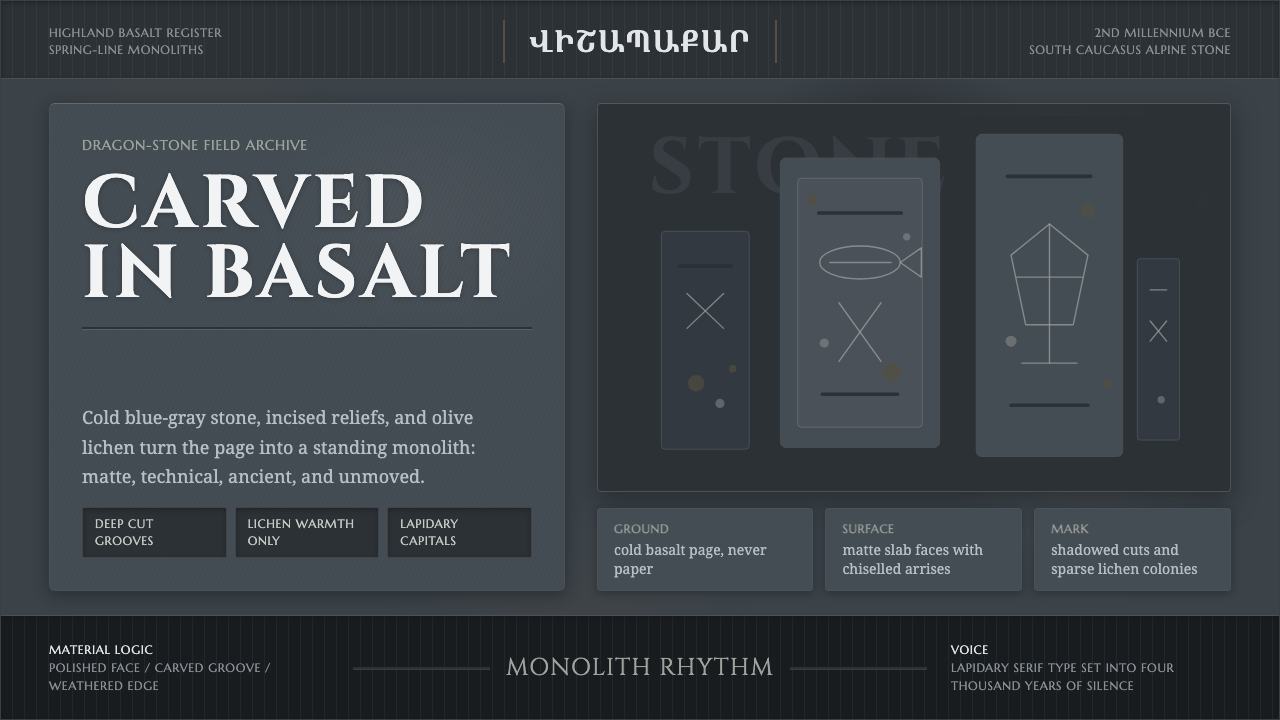 Armenian Vishapakar Dragon StoneAncient, cold, unmoved. Basalt gray slabs, incised grooves, sparse olive lich…
 Nan Madol Basalt MegalithStone holds tide. Grey-black basalt grids cut by a narrow lagoon-teal vein.
 Abbasid Blue QuranLuxury by restraint. Flat gold Kufic bands cross an indigo parchment field.
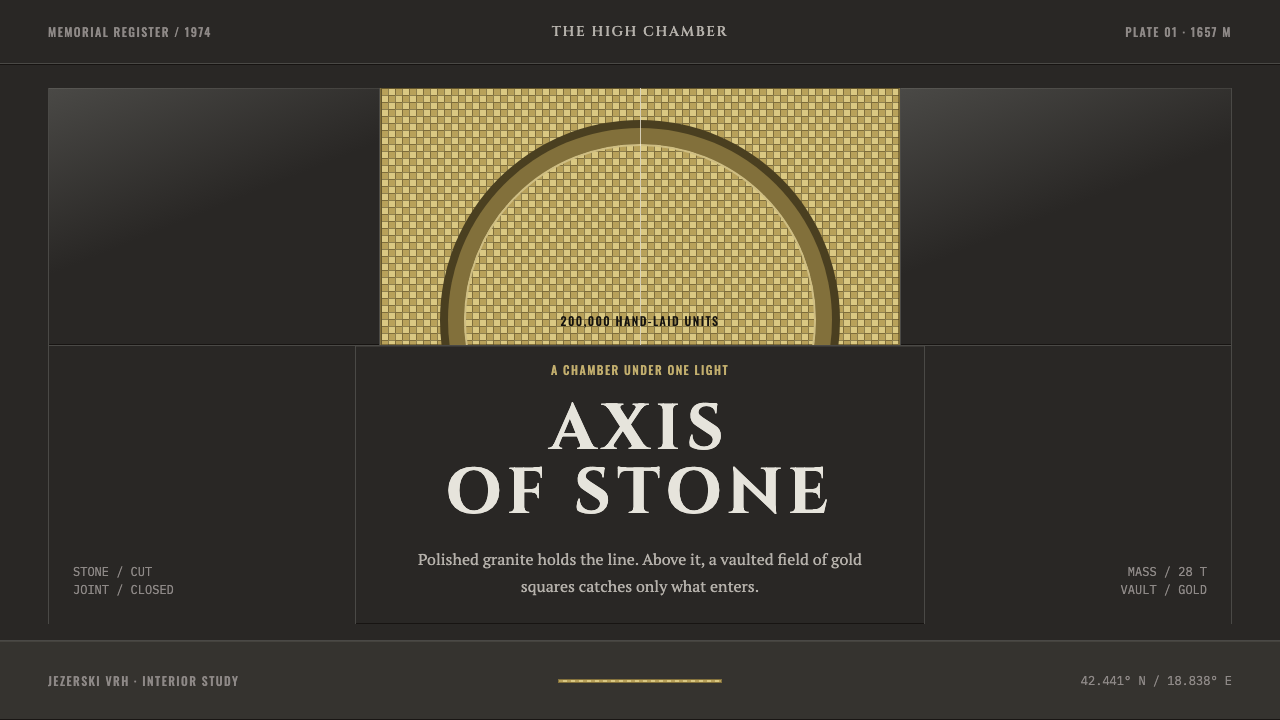 Njegoš MausoleumGravity is the ornament. Dark granite meets a strict axis and a vault of disc…
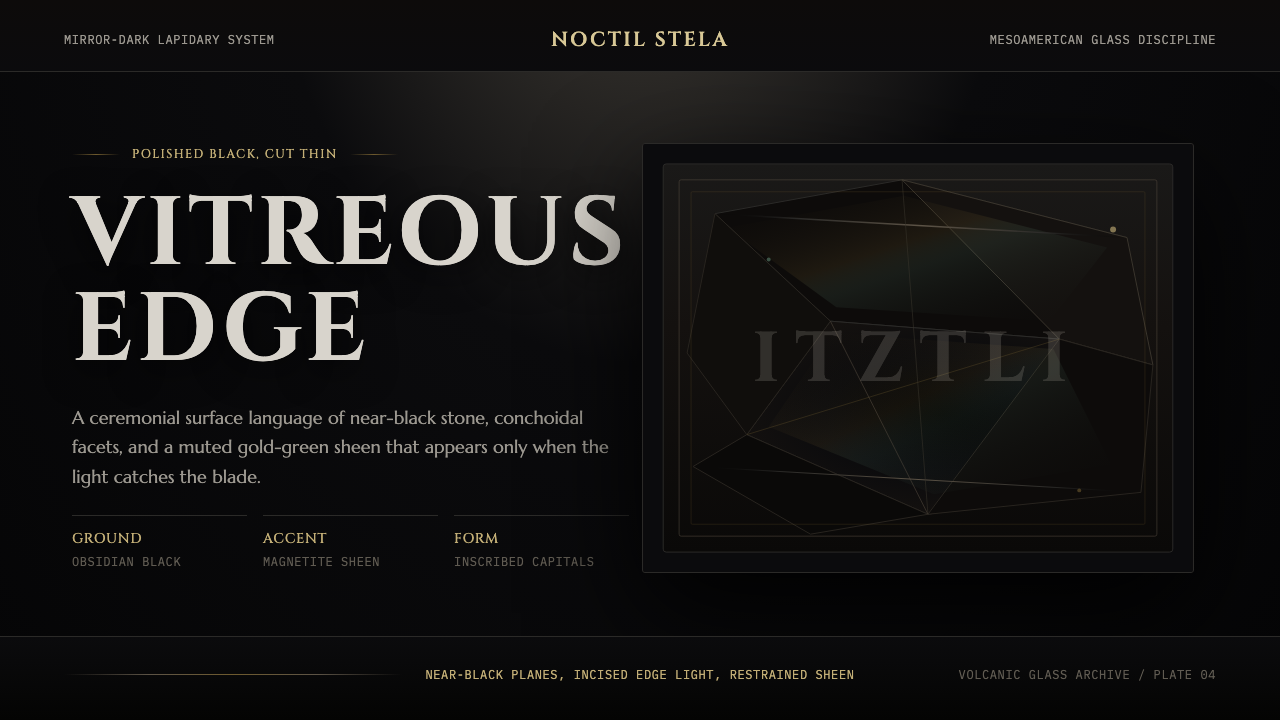 Obsidian Volcanic GlassMirror-dark gravitas. Cinzel capitals, obsidian facets, and muted gold-green…
 Pyrite Crystal HabitFool's gold under the loupe. Striated brass pyritohedra on slate, serif names…