What is Pyrite Crystal Habit?
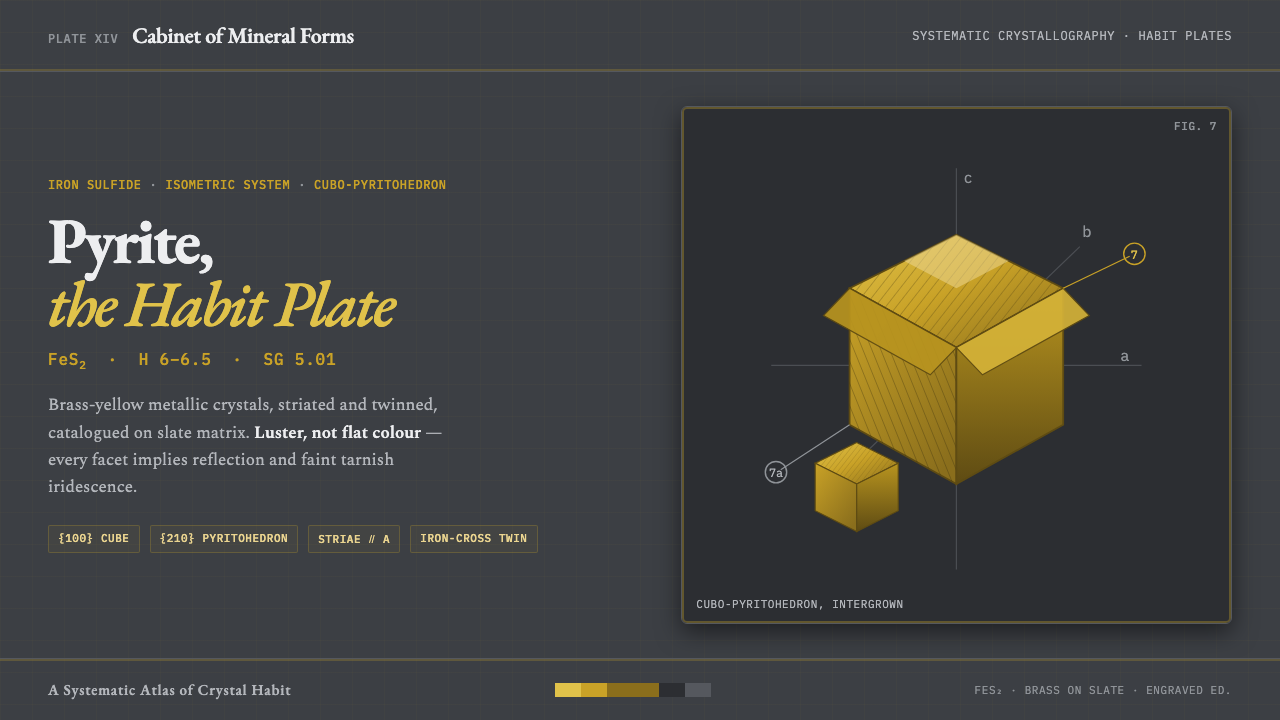
Pyrite Crystal Habit brings the authority of a nineteenth-century mineral plate to the screen: brass-lit crystal forms, slate shadow, engraved names, and the quiet rigor of classification.
Pyrite Crystal Habit in brief
Pyrite Crystal Habit is a dark editorial design language derived from pre-1900 Western European crystallographic habit plates. Those engraved illustrations catalogued the changing external forms of iron sulfide, FeS2, with special attention to cubo-pyritohedron formations: hard, faceted bodies that appear both mathematical and mineral-grown. The style takes their visual discipline rather than treating pyrite merely as a gold-colored decorative motif.
Its central image is the pyrite specimen under close observation. Pale brass-yellow crystal faces emerge from a slate-grey rock matrix, carrying fine striations, metallic luster, faint tarnish, and occasional signs of intergrowth or twinning. The composition should feel studied rather than staged, as though each object has been extracted from a cabinet, given a formal name, and placed under an engraver’s attention.
In digital use, the old mineralogical plate becomes a system of hierarchy. A deep mineral-grey ground allows brassy gold forms to command attention; engraved serif names establish scholarly authority; monospaced labels suggest axes, specimen records, and crystallographic indices. The result is not luxury branding in a generic sense. It is an atmosphere of material evidence, observation, and ordered knowledge.
Where does Pyrite Crystal Habit come from?
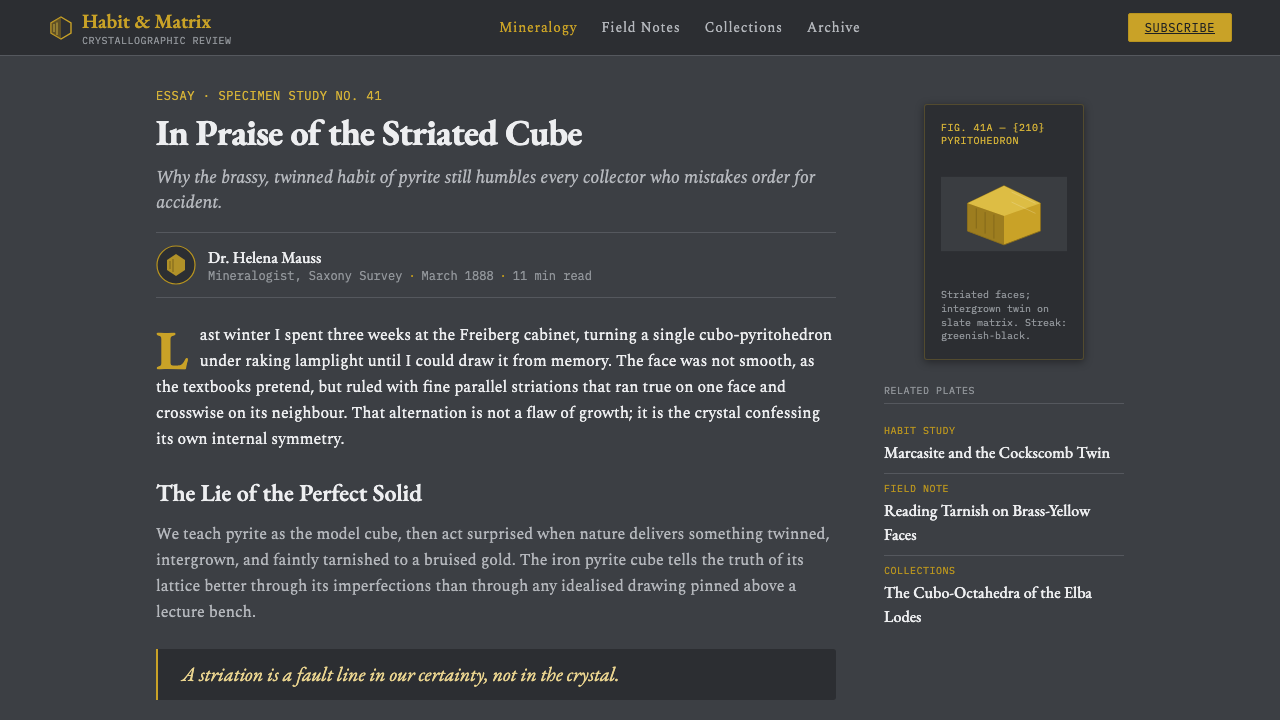
The style originates in the pre-1900 Western European practice of crystallographic habit plates. In the nineteenth century, systematic crystallography and mineralogy depended on images that could compare specimens precisely. A plate did not simply portray a stone for admiration; it recorded recurring crystal habits, visible faces, relationships between forms, and the features by which one mineral occurrence could be distinguished from another.
Pyrite was especially suited to this mode of study because its crystal habit is conspicuously geometric. The cubo-pyritohedron form offered mineralogists a specimen whose faces could be observed, named, and compared while still retaining the irregularity of natural growth. Striations, metallic reflection, intergrown crystals, and twins made the illustration more than a diagram. They showed where an idealized form met a particular physical specimen.
The visual authority of these plates came from their union of system and craft. Crystallographers, systematic mineralogists, and crystal-habit codifiers required legible notation, while engravers supplied tonal precision and surface detail. Serif titles, measured labels, dark grounds, and carefully isolated specimens all served a shared purpose: turning the mineral into a durable unit of knowledge. Pyrite Crystal Habit carries this method forward as an interface language without pretending to be a literal historical reproduction.
What defines the Pyrite Crystal Habit look?
Mineral Ground
The background is deep, cool, and stone-like rather than theatrical black. It should suggest slate, shadowed rock, or the recess of a specimen drawer. This ground suppresses visual noise and gives the brassy crystal a concentrated, almost illuminated presence.
Brass Crystal Luster
Pyrite appears as pale brass-yellow metal, never as smooth commercial gold. Its faces carry directional striations, sharp planar changes, subtle dulling, and restrained tarnish iridescence. The luster should describe a faceted mineral body, not a polished ornament or liquid metallic effect.
Faceted Habit
Cubo-pyritohedron geometry provides the main silhouette language. Forms should feel cut by planes and governed by growth, with crisp edges and readable changes of face. Intergrown specimens and twins add credibility when they clarify the mineral’s structure rather than merely making the scene busier.
Engraved Serif Authority
Specimen names use a serif voice with the gravity of an engraved caption. The typography should feel archival, precise, and mildly formal, carrying the authority of a plate title without becoming ornate. It names what is seen and gives the composition a scholarly center.
Monospaced Indices
Monospaced text is reserved for axes, indices, specimen markers, and technical fragments. Its regular rhythm contrasts with the engraved serif name and signals classification rather than narrative. Labels should read as evidence attached to the object, not as decorative pseudo-science.
Plate Discipline
Space is deliberate and observational. A specimen, its title, and its notation require room to be examined separately before being understood as a set. Decorative clutter, unrelated gilding, and casual atmospheric effects weaken the central promise: every visible detail should help the viewer inspect the crystal.

Who shaped Pyrite Crystal Habit?
Nineteenth-century crystallographers supplied the analytical framework behind habit plates. Their concern was not simply whether a mineral looked beautiful, but how its visible faces and recurring forms could be observed, compared, and made legible as part of a systematic record.
Systematic mineralogists treated specimens as evidence within a larger classification project. Their methods gave importance to matrix, surface condition, and relationships between crystals, encouraging illustrations that preserved material specificity instead of reducing every specimen to an abstract symbol.
Crystal-habit codifiers transformed recurring external forms into a shared descriptive vocabulary. Their work made the plate a communication tool: a labeled image could carry structure, comparison, and identification at once. The contemporary style inherits that compactness of visual explanation.
How do you use Pyrite Crystal Habit today?
For presentation covers, use one dominant pyrite form against a mineral-grey field, supported by an engraved serif title and a compact monospaced index. Let the specimen establish the composition before any supporting text arrives. Content slides should become orderly plate fields: titles identify the subject, labels distinguish evidence, and generous dark space prevents technical information from feeling crowded.
Data slides work best when information is treated as a collection of specimens rather than as generic business decoration. Charts, comparisons, and status groups can be framed as discrete observed forms, with brassy emphasis reserved for the finding that matters most. Keep labels exact and calm. The style is strongest when it makes evidence feel examined, not when it makes every metric appear precious.
For web interfaces, Pyrite Crystal Habit suits research dashboards, archives, analytical products, and premium catalog experiences. A dark mineral ground can hold a clear hierarchy of specimen-like cards, metadata panels, filters, and indices. On pricing pages, use the same language to distinguish plans through material presence and archival order, while keeping plan names and decisions immediately legible.
Editorial and marketing pages benefit from the style’s ability to make a subject feel collectible and credible. Use a named hero specimen, an introductory plate caption, then sections that alternate between close material detail and restrained technical notation. It is especially effective where a product has provenance, process, research, or a body of evidence worth foregrounding.
The common mistake is confusing mineralogical authority with generic black-and-gold luxury. Smooth gold gradients, ornamental flourishes, random numerical labels, and crowded metallic effects erase the plate’s observational character. Preserve the slate ground, faceted structure, striated material detail, serif naming, and purposeful monospaced notation; the atmosphere comes from disciplined evidence, not from expensive-looking decoration.
Pyrite Crystal Habit — FAQ
Is Pyrite Crystal Habit simply a black-and-gold luxury style?
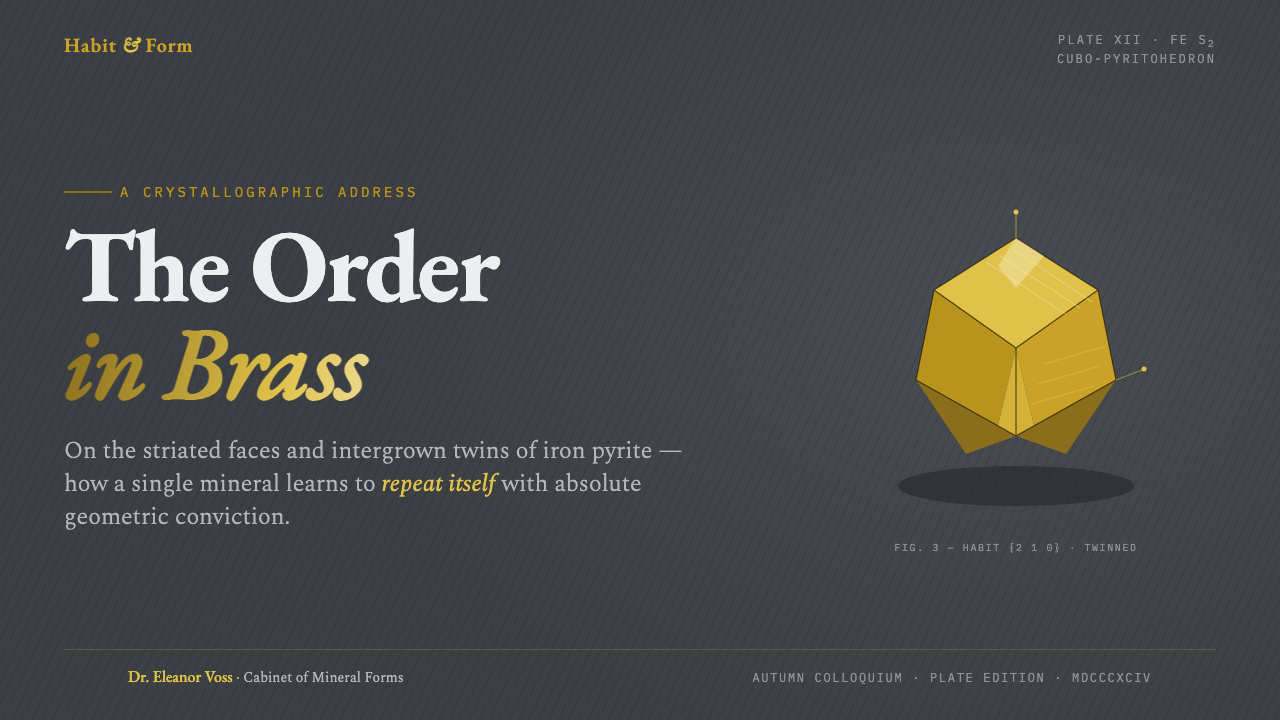
No. Brass-yellow and dark grey are present because they describe pyrite on a slate-like matrix, not because they signal luxury by themselves. The defining qualities are crystallographic observation, faceted habit, striated surfaces, named specimens, and disciplined notation. If the material evidence disappears, the style becomes generic luxury styling.
Why combine serif names with monospaced labels?
The pairing recreates two roles found in a mineralogical plate. The engraved serif name gives the specimen historical and editorial authority; monospaced notation carries indexing, axes, and technical reference. Their contrast separates identification from classification, helping a screen feel both learned and operational.
Can photography be used in this style?
Yes, when photography behaves like specimen observation. A close mineral view, a slate-like matrix, visible facets, or an image that reveals striations can support the system. Photography becomes less suitable when it introduces unrelated lifestyle atmosphere or replaces the crystal’s readable structure with glossy abstraction.
Which products benefit most from Pyrite Crystal Habit?
It is best for products that benefit from evidence, provenance, classification, or material seriousness: research tools, analytical dashboards, collections, archives, and catalog-led experiences. It is less natural for products whose primary promise is softness, spontaneity, or casual social warmth. The fit depends on whether the product wants users to inspect and trust, rather than merely browse and react.
Related design styles
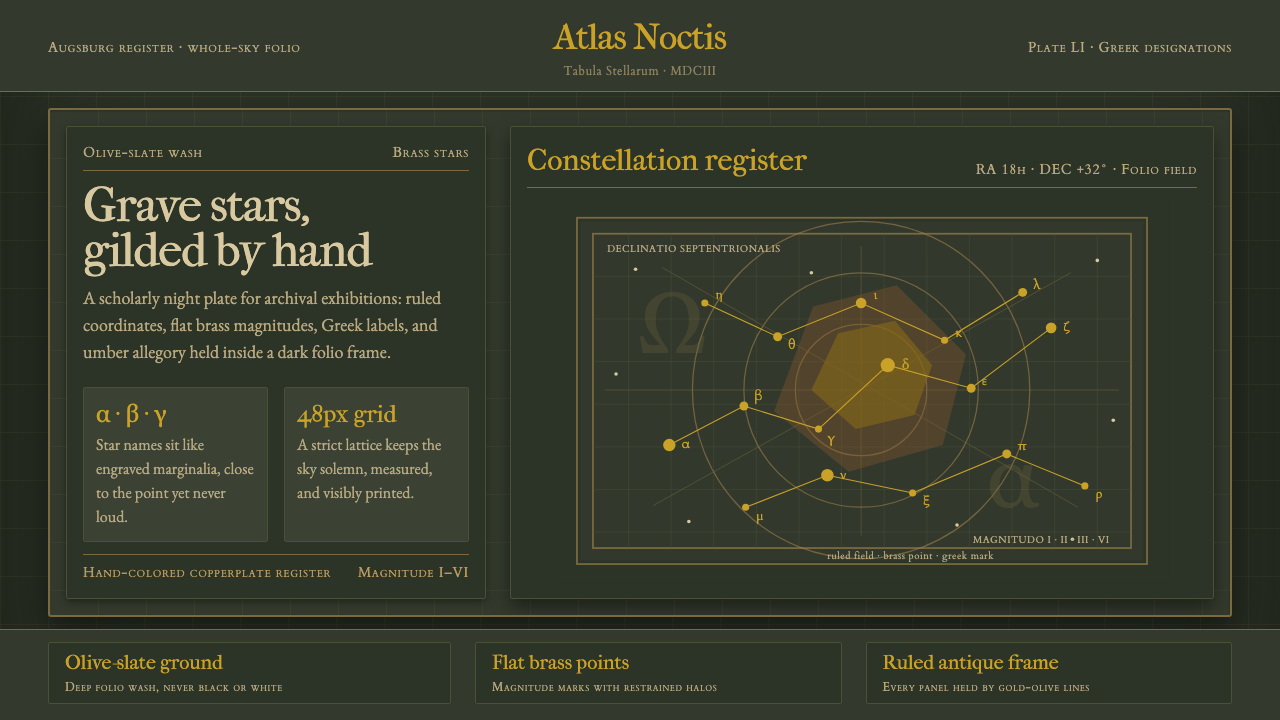 Bayer UranometriaGrave celestial folio. Olive-slate grid, brass stars, Greek labels, old-style…
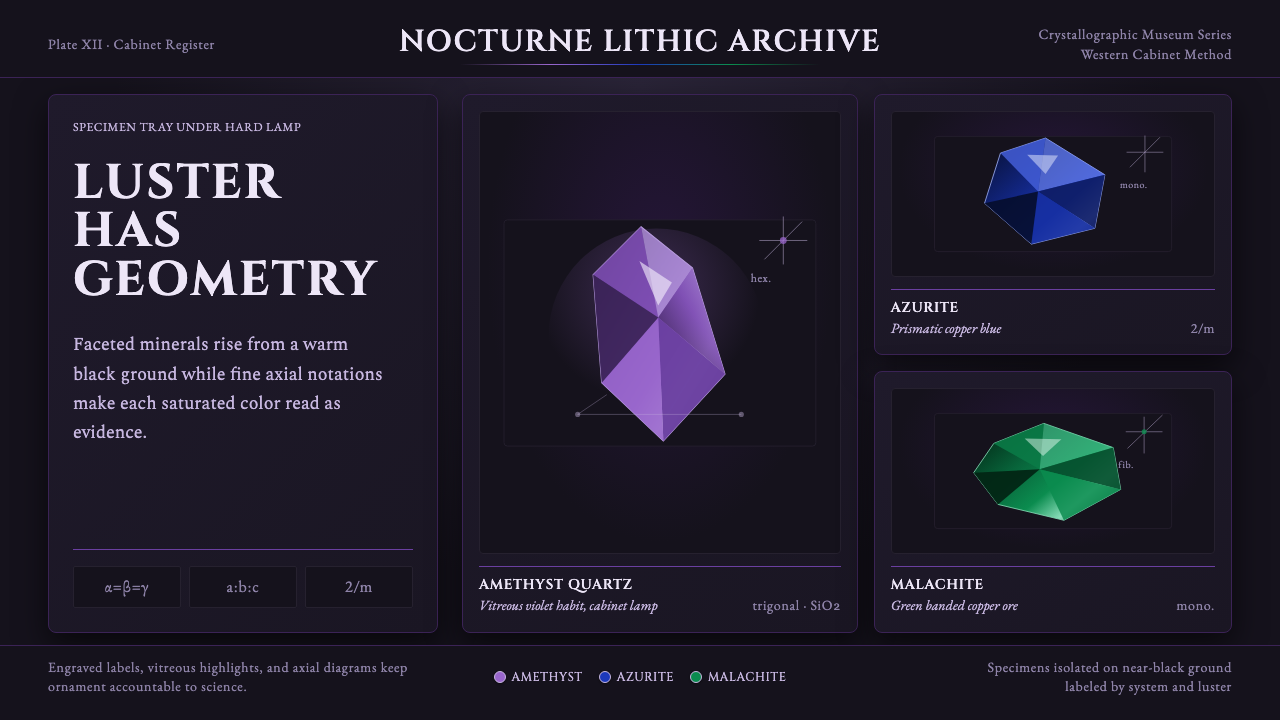 Mineral Specimen PlateScience becomes ornament. Amethyst, azurite, and malachite facets glow on bla…
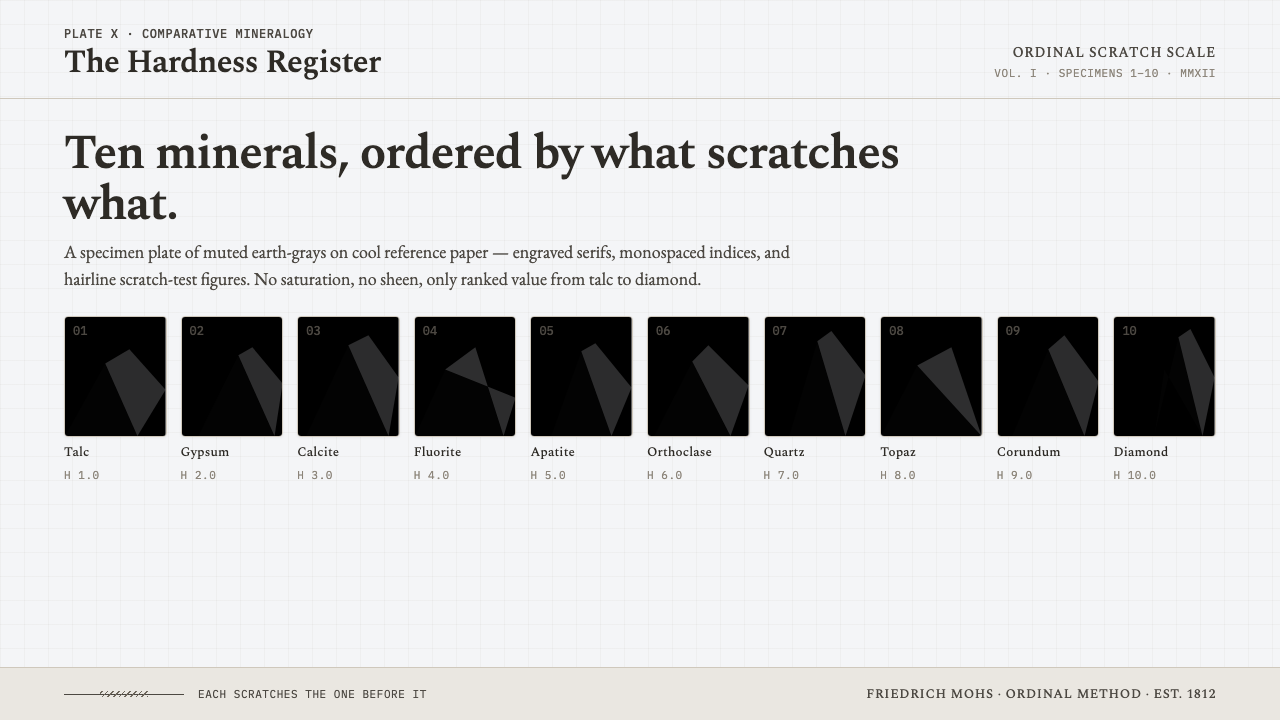 Mohs Hardness ScaleRanked by what scratches what. Ten mineral-gray chips on cool chart-white, en…
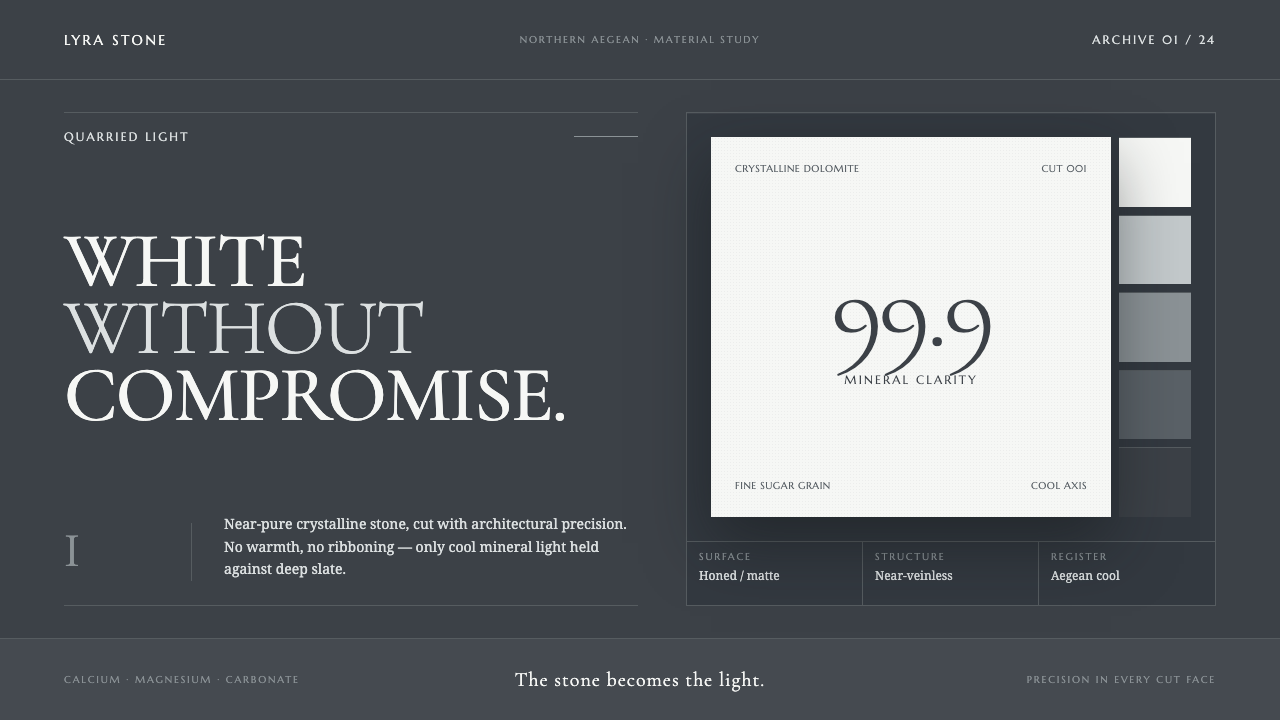 Thassos White MarbleWhite becomes material. Crystalline serif forms float on deep, cool Aegean sl…
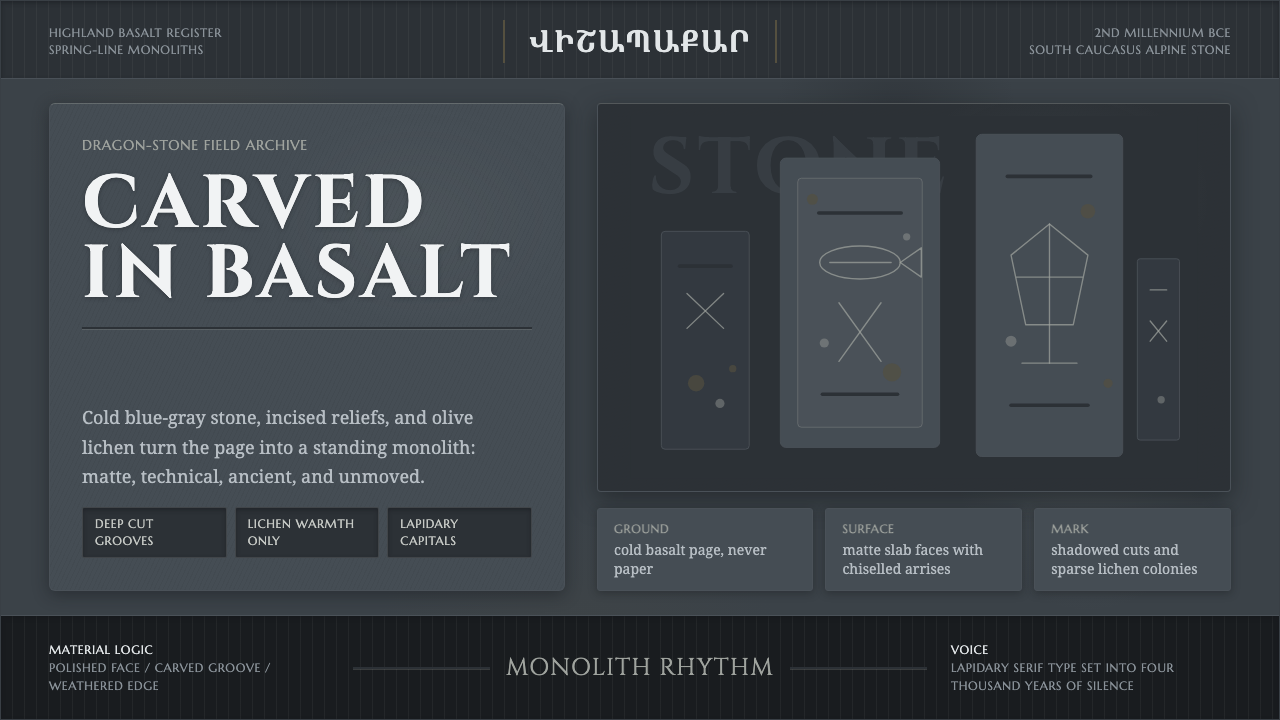 Armenian Vishapakar Dragon StoneAncient, cold, unmoved. Basalt gray slabs, incised grooves, sparse olive lich…
 Carrara MarbleLuxury in restraint. Cool stone-white fields, feathery gray veins, and Cinzel…