What is Sowei Helmet Mask?
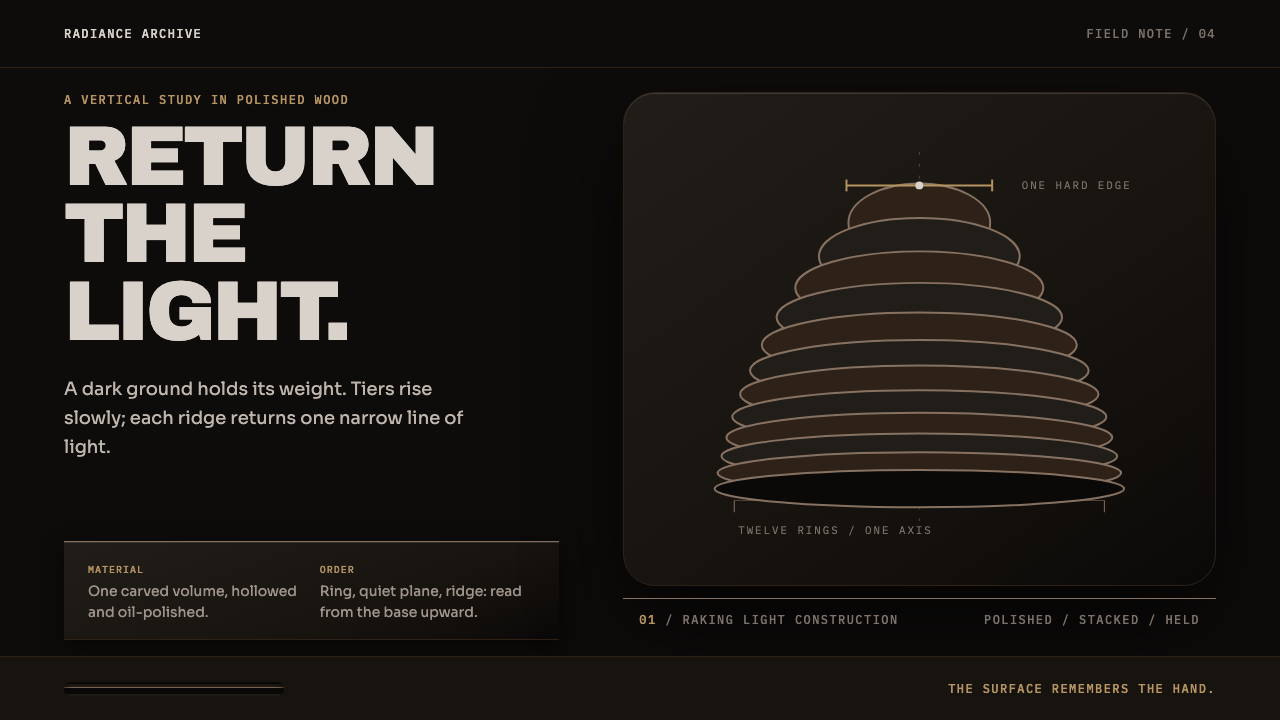
The sowei is a polished black helmet mask danced by Mende women, and its logic — stacked tiers, a low quiet face, light kept to a single hard edge — makes a dark design style in which brightness has to be earned.
Sowei Helmet Mask in brief
The Sowei Helmet Mask style takes its name and its logic from the sowei, the carved helmet mask of the Sande society among the Mende people of Sierra Leone. A sowei is cut from a single block of wood and hollowed out so that it can drop over the entire head of the wearer. It is dyed dark and then rubbed, traditionally with palm oil, over and over, until the surface returns only one narrow, hard line of highlight. As a visual system it is dark, polished, vertical and stacked, and it is organised around a rule that sounds simple and turns out to be demanding: light is earned, not spread.
What sets the sowei apart among African mask traditions is who stands on each side of it. It is commissioned for women and danced by women. The dancer is known as the ndoli jowei, and her whole body is wrapped in black raffia fibre, so the mask is not a face held up in front of a person but the crown of a complete costume. For design that is a useful image. The carved head is the one region where detail and highlight gather; everything beneath it is dark, continuous and calm.
Read as an interface, the mask divides into three tiers from bottom to top. At the base are rings that wrap the neck in concentric bands. Above them sits a low, quiet face with a broad forehead and lowered features. At the top rises an elaborately ridged coiffure. The system borrows that order directly: a dark polished ground, content arranged in stacked tiers, and brightness used as a thin edge that shows where a form turns, never as a wash that floods a surface. Where many dark interfaces reach for glow, gradient and bloom to lift content off black, the sowei does the opposite. It lets the surface stay deep so that a single ridge of light can mean something.
Where does Sowei Helmet Mask come from?
The sowei belongs to the Sande, the women's initiation societies of the Mende, whose country lies in Sierra Leone and reaches into neighbouring Liberia and Guinea. There is no single founding date to cite. The tradition's origins reach back before 1900; the classic corpus that museums and scholars handle, the objects most people picture when they hear the word sowei, was collected in the nineteenth and early twentieth centuries; and the society itself is still active. That last point shapes how a designer should approach the style. The sowei is not a closed historical period, like a movement that ended when a school was shut. It is the regalia of a living institution, and what this style borrows is an order of forms and a way of handling a surface, not a relic.
The object sits within the wider family of West African helmet-mask carving. A helmet mask differs from a face mask in the simplest physical way: it encloses the whole head rather than covering only the face, so it is built as a volume with a front, sides, crown and back. That is why a sowei is carved from one block and hollowed rather than assembled from parts. The craft is subtractive and then burnished. The carver removes wood until the form emerges, the surface is darkened, and the long labour of rubbing brings the finish up until the mask reflects light in one place. Its beauty is a product of repeated finishing, not of added ornament, and that is precisely the attitude the design system is built to reproduce.
The second distinguishing fact is the pairing of patrons and wearers. Among African mask traditions this is uncommon: the sowei is commissioned by women and worn by women. The dancer's role has its own name, the ndoli jowei, which the reference record for this style lists as a tradition in its own right, the 'dancing sowei'. Her body disappears beneath black raffia fibre, and the carved head becomes the point where all attention gathers. The costume's dark mass and the mask's polished crown together produce a composition that this system treats as its foundational image: a large, quiet, dark field with one precisely lit region.
Outside readers have approached the sowei largely through the work of scholars, and the reference record for this style names three: Sylvia Ardyn Boone, Ruth B. Phillips and William Siegmann. Their names are the reading list behind the system, a pointer for anyone who wants to understand the cultural meaning that a design reference can only gesture at. That distinction deserves to be kept in view. The visual system translates the sowei's structure, meaning its tiers, ridge, rings and polish, into screens and slides. It does not translate, and should not claim to translate, the meaning the mask carries inside Sande ritual.
What defines the Sowei Helmet Mask look?
Polished Blue-Black Ground
The base is not flat black but a deep, cool blue-black, the colour of wood that has been dyed and then rubbed for a very long time. It reads as a surface with depth rather than an absence of colour. Neighbouring tiers differ by small, deliberate steps of darkness, so structure comes from tone rather than from borders, and the whole page feels carved from one material.
Stacked Tiers
Content is organised in horizontal bands piled vertically, following the mask's order from neck rings to face to crown. Each tier has a distinct job: a base tier that anchors and repeats, a central tier that holds the calm main content, and a top tier that carries the most articulated shape. The eye climbs the stack the way it climbs the mask.
Light as an Edge
Highlights are hard, thin and rare. They sit along ridges — the top edge of a card, the rim of a selected item, the line between two tiers — and they show where a form turns. There are no soft glows, no bloom, no gradient washes. The surface stays dark so that one crisp line of light carries meaning.
Concentric Ring Rhythm
The rings at the neck give the system its way of repeating. Parallel bands, evenly spaced, serve as dividers, step indicators and the rhythm of list rows. The repetition is calm and nearly identical from band to band, with variation kept small, so the ring pattern reads as structure rather than as pattern for its own sake.
The Quiet Face
The central region of the mask is its stillest: lowered features and a wide, uncluttered forehead. Translated into layout, the main content area is restrained, with generous untouched space around a few elements. Importance is signalled by position and by the single lit edge rather than by size, saturation or decoration.
Ridged Crown
The top of the sowei is its most elaborate zone, a coiffure divided into parallel ridged lobes. The system lets the header or hero carry the most articulated geometry, segmented and parallel and ridged, while everything beneath it settles down. Complexity is permitted in one place and withheld everywhere else.
One Block, No Seams
Because the mask is carved from a single piece, nothing on it looks assembled. The equivalent on screen is material consistency: one family of surfaces, one handling of edges, one logic for how light falls. Mixed container styles, borrowed widget looks and decorative patches break the illusion of a single carved object.

Who shaped Sowei Helmet Mask?
The Sande are the women's initiation societies of the Mende, and the sowei is their mask. Everything in the style traces back to this institution: the object is commissioned for women, danced by women, and understood inside a society that remains active. A designer should treat the Sande as the owner of the form. The style borrows structure and finish and leaves the ritual meaning where it belongs.
The ndoli jowei is the dancer who wears the sowei, the 'dancing sowei' of the reference record. Wrapped completely in black raffia fibre, she turns the mask into the crown of a whole figure. Her presence explains why the style insists on a large dark field with one brilliant region, and why the mask never reads as a face floating on its own.
The carvers belong to the wider tradition of West African helmet-mask carving. Their method is the one the style imitates: take a single block, hollow it to fit over a head, darken it, and finish it by rubbing until it gives back one hard highlight. The craft is a lesson in subtraction. Form comes from what is removed, and shine comes from patience rather than from added effects.
The reference record for this style names these three as its key figures, and they are best understood as the scholarly route into the sowei. Anyone who wants more than the visual system, meaning the cultural weight of the mask and the society behind it, should start with their writing. Citing the style without acknowledging that reading list would turn a living tradition into a mood board.
How do you use Sowei Helmet Mask today?
The Sowei Helmet Mask style is best understood as an argument for restraint in dark design. It suits work that wants gravity, craftsmanship and a sense of hushed value, and it asks for discipline in return: dark surfaces have to carry depth through tone, and light has to be rationed. Treated that way it is one of the more distinctive dark systems a designer can reach for, because it replaces the usual vocabulary of glow and gradient with edges, tiers and polish.
For presentation slides, a cover works best when it echoes the mask's proportions: a deep blue-black field, the title set low and quiet in the central tier, and a single thin line of highlight along one edge or ridge. Content slides can be treated as stacked bands, with a narrow header tier, a calm main tier for the argument and a repeating footer tier of rings or rules. Data slides benefit from the same rationing of light. Let the one series that matters take the bright edge and give the others darker tonal steps, so the chart tells its story by where the light falls.
On the web, the style is well suited to dashboards, media and product pages that want depth without noise. Tonal layering separates panels instead of borders and shadows. The highlight edge belongs to the thing the user is acting on: the selected row, the focused field, the recommended plan on a pricing page. Navigation and step indicators can borrow the ring rhythm as evenly spaced bands. Keep status colours few and muted, so that the lit edge remains the strongest signal on any screen.
For editorial and marketing work the style fits subjects with material presence: craft, objects, audio, fragrance, archives and exhibitions, premium goods with a story behind them. A long-form article can run on a dark polished ground with a quiet measure of text, and a hero can take the ridged-crown idea as its single elaborate element. Photography should be low-key and side-lit, so that images share the page's logic of one hard highlight; flat, brightly lit stock photography fights the system.
The most common mistake is to read 'dark' as licence for glow. Neon halos, bloom and soft gradient lift spread the very light the style is supposed to ration, and the page ends up as an ordinary dark mode with a decorative texture on top. The second mistake is literal borrowing: pasting mask silhouettes or imitation patterns onto a layout turns a structural reference into costume and misrepresents a living tradition. Take the order of tiers, the ring rhythm and the handling of light, and leave the iconography alone. A third, quieter mistake is too many highlights. Once every card has a bright edge, none of them means anything.

Sowei Helmet Mask — FAQ
What is a sowei?
A sowei is a helmet mask of the Sande society among the Mende of Sierra Leone. It is carved from one block of wood, hollowed so that it drops over the whole head, dyed dark and rubbed until its surface returns a single narrow highlight. It is commissioned for women and danced by women, in the role called ndoli jowei.
How is this different from an ordinary dark mode?
An ordinary dark mode inverts a light interface and often adds glow to compensate. This style begins from a physical object. Depth comes from tonal tiers of blue-black, structure from stacked bands and ring rhythm, and brightness only from thin, hard edge highlights. The result is quieter and more tactile, and it is less forgiving: if light is used freely, the logic collapses.
Can it be used for a brand with no connection to West Africa?
Yes, with care. What transfers is the structural logic: tiers, ridges, rings and rationed light. What should not transfer is the iconography or the ritual meaning. Using the system for a craft studio, an audio brand or an archive is a design decision about gravity and finish. Dressing a product in mask imagery is a different act, and not one the style asks for.
Does the style have a light-background version?
Not in any faithful sense. The premise is that light is earned against a polished dark surface, and a light ground removes the very thing that makes a highlight meaningful. If a light companion is needed, the better course is to keep the tier order and ring rhythm and swap the dark field for a restrained neutral, accepting that the result is a derivative and not the style itself.
How many highlights is too many?
A useful test is whether a viewer can say where the light is. If one edge on the screen is clearly the brightest, the system is working. If several compete, the light has been spread. On dense screens, let each tier have at most one lit element and keep decorative lines tonal rather than bright.
Related design styles
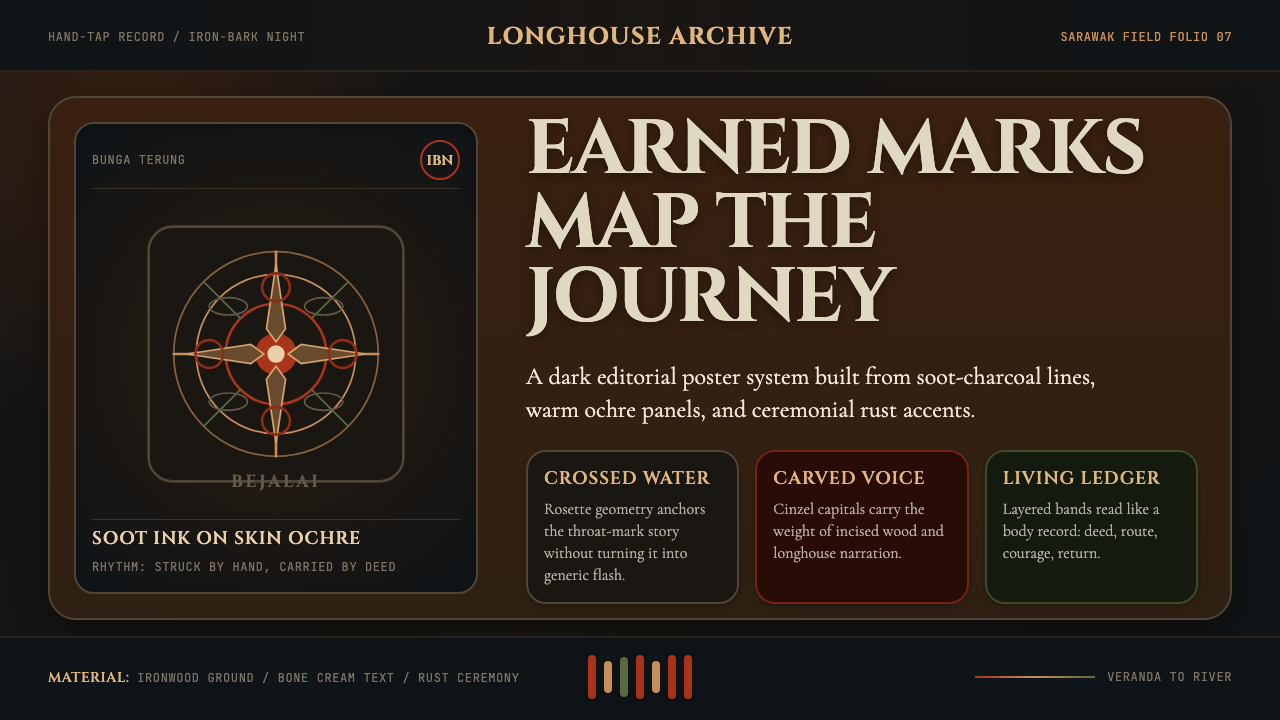 Dayak Borneo Tattoo (Iban)A living journey ledger. Soot lines, ochre panels, and rust rosettes feel han…
 Gabonese Fang Mask & ByeriStillness has weight. Mirror-black forms, brass hairlines, and museum shadow…
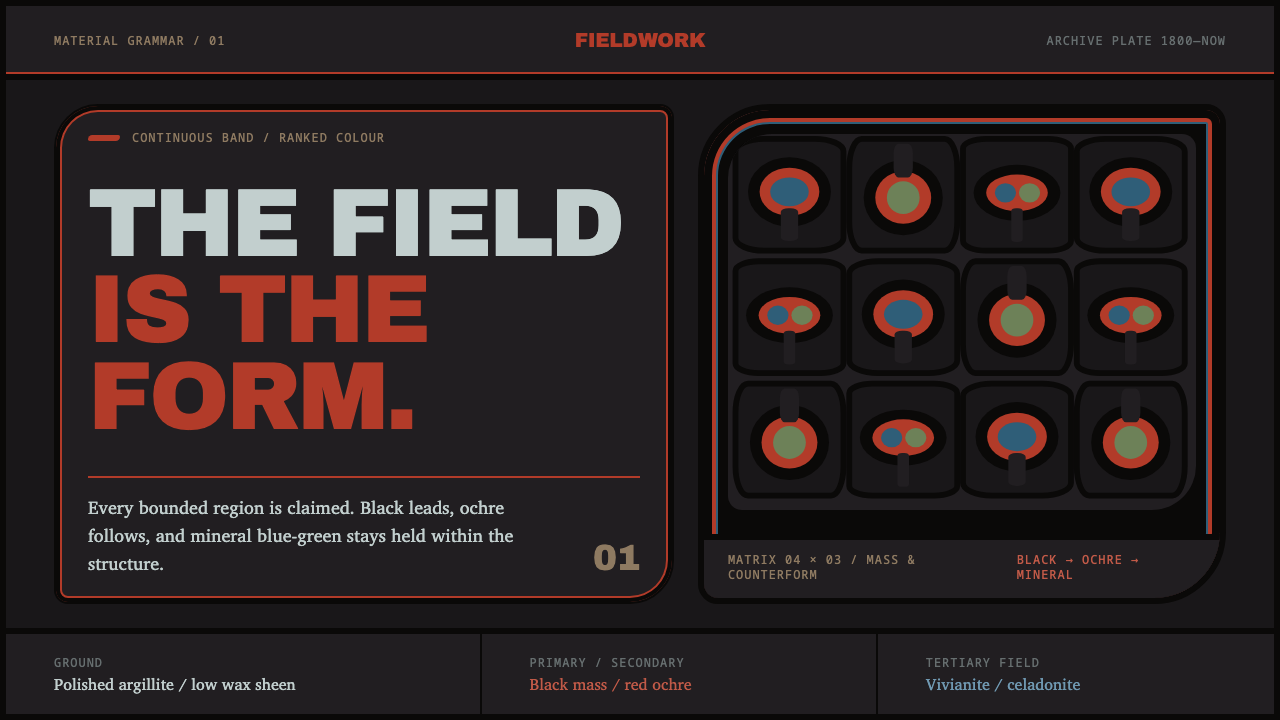 Haida FormlineEvery field is claimed. Black bands lead ochre and mineral blue-green through…
 Ifugao BululTouch reveals the archive. Narra red breaks through near-black patina in a qu…
 Jingdezhen BlancQuiet porcelain glows. Warm glaze-white on slate reveals hidden anhua incisio…
 Joseon Moon JarQuiet imperfection glows. Milk-white porcelain floats on charcoal with a visi…