What is Anglerfish Lure Bioluminescence?
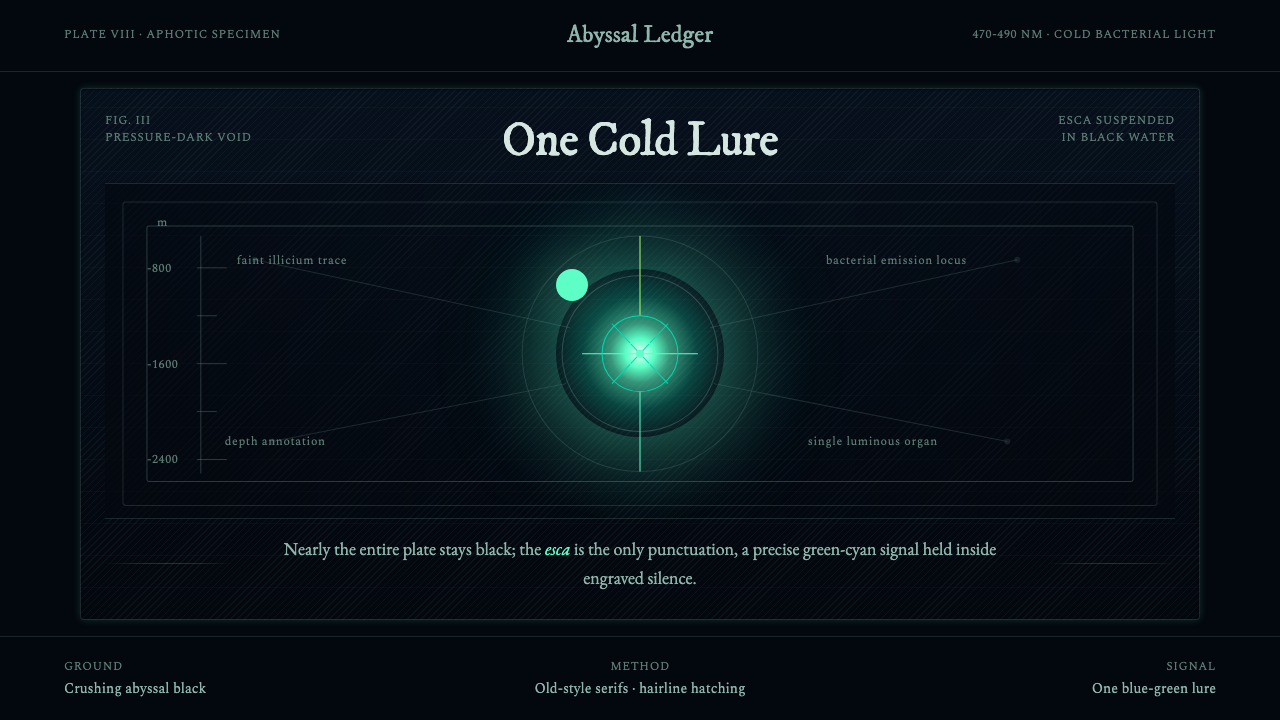
In the pressure-dark abyss, one bacterial green-cyan lure becomes the only punctuation: cold, exact, and surrounded by the visual memory of an engraved scientific monograph.
Anglerfish Lure Bioluminescence in brief
Anglerfish Lure Bioluminescence is a dark visual system built around the ceratioid anglerfish's esca, the luminous lure suspended before the animal in the aphotic deep ocean. Symbiotic bacteria produce its blue-green light at wavelengths around 470–490 nanometres. Rather than treating that glow as spectacle, the style makes it scarce: nearly everything remains black, allowing one cold point of light to define attention, distance, and life.
Its second source is the tradition of pre-1900 deep-sea monographs and nineteenth-century scientific engraving. Old-style Fell-like serifs, fine hairline rules, engraved hatching, specimen framing, and depth annotations give the composition the authority of an archival plate. Yet the ground is never allowed to resemble warm paper. The engraving language appears to have been lowered intact into the abyss, where pale lines hover over pressure-dark space.
The resulting aesthetic is neither ordinary natural history nor futuristic neon. It stages an encounter between historical observation and modern bioluminescence research: an antique system of classification confronting an organism whose light appears almost technological. The tension is essential. Typography and rules describe; darkness conceals; the esca alone performs.
Where does Anglerfish Lure Bioluminescence come from?
The style begins with the pre-1900 tradition of engraved scientific illustration. Before deep-ocean subjects could be presented through modern imaging, monograph plates organized unfamiliar life through disciplined line work, labels, sectional views, and measured-looking frames. Engravers translated specimens and observations into marks that could survive reproduction. Their visual grammar made the unknown legible without pretending to make it familiar.
Deep-sea monograph plates provide the more specific frame. The abyss is global, remote, and aphotic; it offers no ordinary landscape light by which a viewer can orient themselves. Within this system, the historical plate is stripped of its paper setting and rebuilt as a field of floating evidence. Hairline boundaries, hatching, and annotations remain, but darkness becomes the primary material rather than an empty margin around an illustration.
Modern bioluminescence science supplies the central event. Research associated with institutions such as the Woods Hole Oceanographic Institution, and with figures including Edith Widder, has made living light a subject of sustained scientific attention. Research from roughly the 2010s through the 2020s also provides the modern biological confirmation behind the bacterial blue-green lure. The style translates that evidence into hierarchy: one luminous organ receives the emphasis that an older plate might have given to an entire specimen.
Theodore Pietsch and the broader study of deep-sea anglerfishes connect the luminous phenomenon to the animal itself, while biofluorescence research forms a neighboring field of inquiry. The design does not collapse every kind of marine light into one effect. Its governing image remains specific: a symbiotic bacterial glow attached to an anglerfish lure, framed by an engraving tradition older than the research used to explain it.
What defines the Anglerfish Lure Bioluminescence look?
Abyssal Ground
Black is not merely a background color; it represents the aphotic ocean as a spatial condition. It should occupy almost the entire composition, swallowing ordinary cues of surface, horizon, and atmosphere. Empty areas feel pressurized rather than calm. The darkness must remain deep and uninterrupted enough that every pale mark appears provisional, as if observation itself could be extinguished.
The Singular Lure
The green-cyan esca is the dominant luminous event and should rarely compete with another saturated element. Its glow is compact, cold, and biologically specific. A restrained halo may suggest light dispersing through water, but the source remains clearly localized. The lure works as focus, orientation point, and narrative agent: the viewer looks because something in the darkness appears to be looking back.
Engraved Typography
Old-style serif typography evokes the authority and slight strangeness of an engraved monograph. Letterforms should feel cut, printed, and historically burdened rather than polished for a contemporary interface. Large titles remain measured instead of theatrical. Smaller annotations resemble specimen labels or marginal scholarship, creating a voice that is precise, patient, and older than the luminous subject it describes.
Hairline Structure
Rules, frames, and connectors are extremely fine and pale, recalling copperplate divisions and scientific callouts. They organize evidence without becoming architecture. Lines may bracket a title, trace a specimen boundary, or connect a note to the esca, but they should never brighten into a decorative cage. Their fragility heightens the contrast between human classification and the immense pressure-dark field.
Hatching and Evidence
Fine hatching supplies form where photography or continuous shading would feel too immediate. It can suggest an anglerfish silhouette, anatomical mass, or the recession of water while preserving the logic of an engraving. Marks should remain directional and economical. Dense passages emerge selectively from black, so the image reads as accumulated observation rather than a fully illuminated scene.
Depth Annotation
Depth labels, taxonomic-looking notes, and small reference marks establish a documentary rhythm. Their purpose is not to explain everything, but to imply that the specimen occupies a measurable world beyond ordinary human access. Annotation should remain secondary to the lure and should cluster with intention. Scattered pseudo-scientific decoration weakens the system; every note must appear attached to an act of observation.
Scarcity of Light
Illumination is treated as biological evidence, not atmosphere. There is no sunlight, warm paper glow, or broad cinematic wash. Pale type and engraving lines are visible only enough to be read, while the lure receives the sole sense of emitted light. This hierarchy prevents the design from becoming generic science fiction and preserves its defining proposition: in the abyss, light is an event.

Who shaped Anglerfish Lure Bioluminescence?
The often-anonymous engravers of deep-sea monographs supplied the style's historical syntax: fine hatching, disciplined outlines, labeled details, and framed plates capable of turning unfamiliar organisms into reproducible knowledge. Their contribution here is not a single signature image but a method of looking. The design borrows their patience and precision while replacing the pale printed sheet with an abyssal black field.
Bioluminescence researchers associated with the Woods Hole Oceanographic Institution represent the modern scientific context behind the luminous subject. Their presence shifts the visual idea away from maritime folklore and toward observed biology. In the design system, that research lineage appears through restrained annotation, specificity about bacterial light, and a refusal to treat every mysterious marine glow as the same phenomenon.
Edith Widder stands within the source material as a key figure in bioluminescence research. For this aesthetic, her relevance lies in the disciplined attention given to living light as evidence rather than visual fantasy. That distinction shapes the entire composition: the lure may appear uncanny, but its presentation remains observational, biologically grounded, and surrounded by the quiet apparatus of scientific description.
Theodore Pietsch represents the anglerfish-centered branch of the source material. His inclusion anchors the luminous esca to the morphology and study of the animal rather than allowing it to float free as an abstract neon symbol. Within the visual language, that anchoring encourages specimen logic, anatomical suggestion, and labels that keep the point of light connected to a particular deep-sea organism.
How do you use Anglerfish Lure Bioluminescence today?
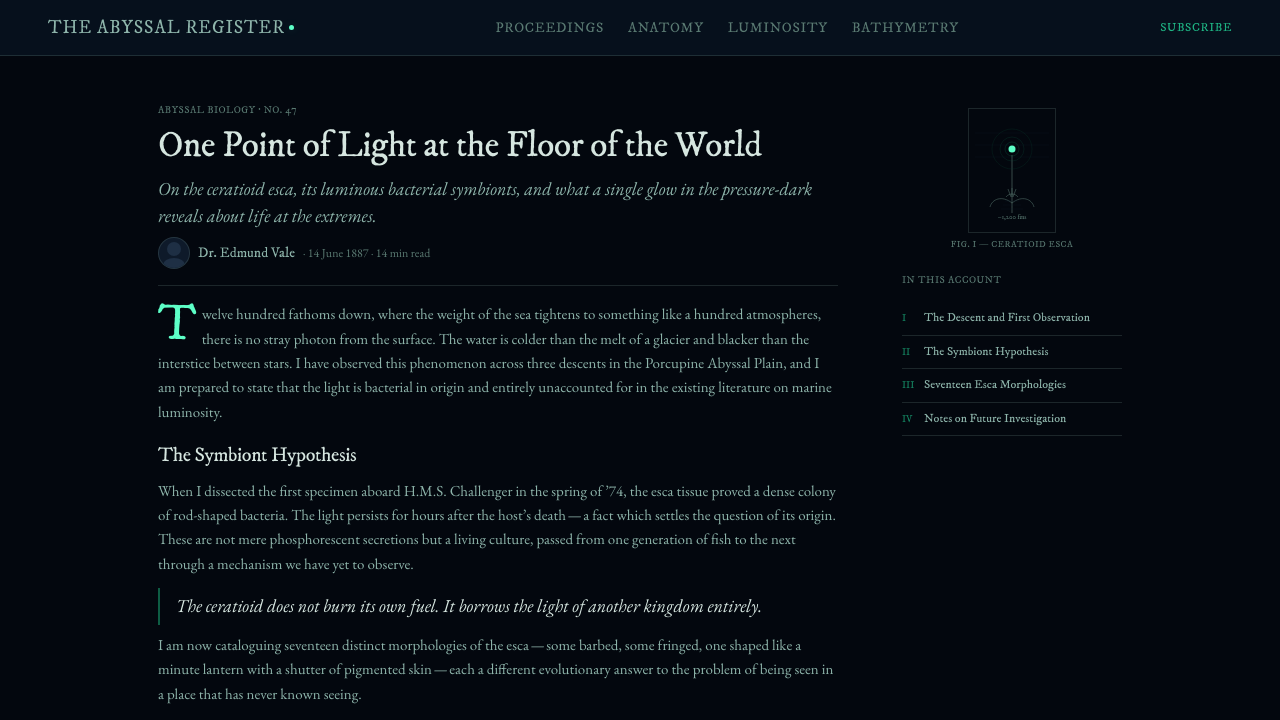
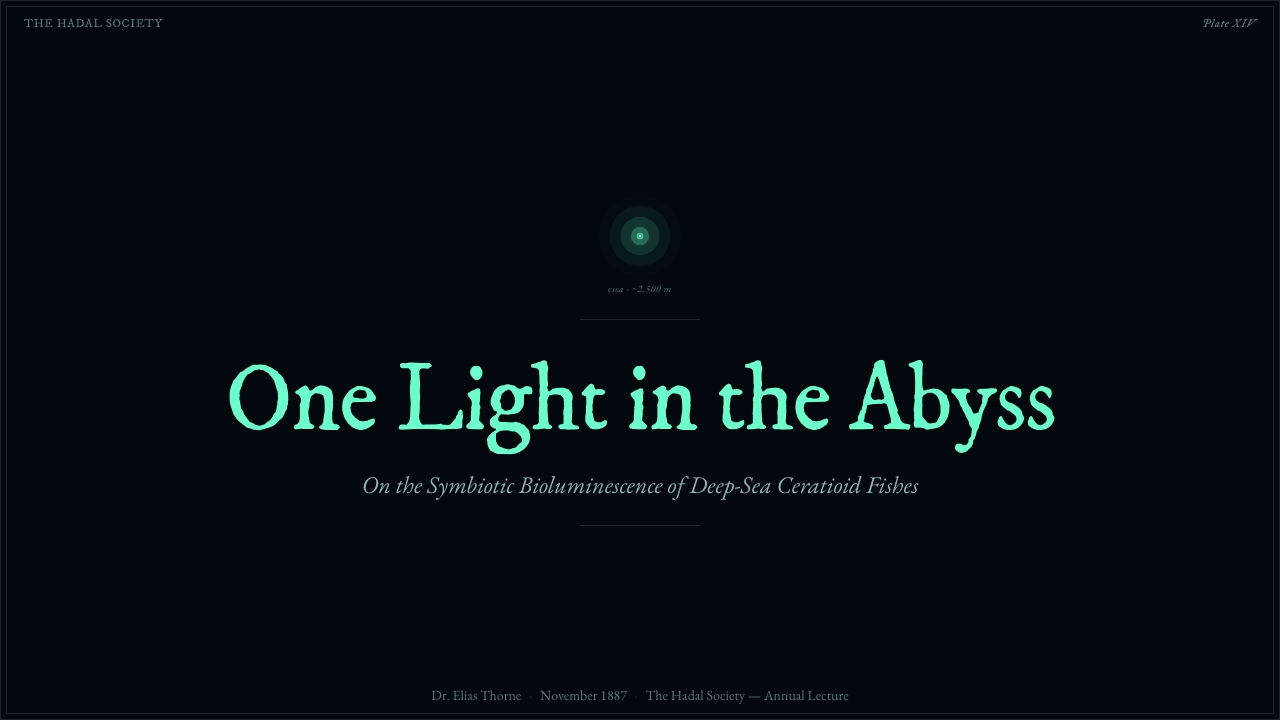
For presentation covers, the style is strongest when the title occupies a restrained engraved frame and a single green-cyan lure interrupts a large black field. The cover should feel discovered rather than announced. Content slides can use hairline rules to separate argument, evidence, and marginal annotation, with old-style serif headings establishing an archival voice. Keep most areas unlit so that hierarchy comes from rarity, not from filling every region.
Data slides should resemble annotated monograph plates rather than conventional corporate charts. A single luminous series can carry the primary finding, while secondary series recede into pale engraved lines. Labels may sit like depth notes beside a specimen, and small reference marks can connect observations without enclosing every value in a box. The chart remains readable, but its visual drama comes from one signal emerging from a much larger field of absence.
For web interfaces, Anglerfish Lure Bioluminescence suits research dashboards, exploratory archives, and pricing pages that benefit from mystery without sacrificing authority. Navigation and body copy should remain pale and quiet against black. Green-cyan light is best reserved for the active state, decisive metric, or recommended tier. Fine frames can define panels, but broad glowing borders and repeated illuminated cards would destroy the necessary scarcity.
Editorial and marketing layouts can treat each section as a descent into evidence. A long article might open with a nearly empty black spread, then introduce engraved silhouettes, marginal notes, and one luminous biological detail as the reader moves deeper. Marketing pages can use the lure as a metaphor for discovery, attraction, or a signal found within overwhelming complexity. The metaphor works only when the content genuinely supports those ideas; otherwise the abyss becomes empty theatrics.
The common mistake is to interpret the theme as generic underwater neon. Filling the interface with cyan glows, bright gradients, futuristic type, and decorative particles removes both halves of its identity: bacterial rarity and engraved scholarship. Another mistake is making every line equally visible. Authentic application requires ruthless hierarchy. Most marks should whisper, a few should describe, and only the esca should appear to generate light.
Anglerfish Lure Bioluminescence — FAQ
Is this style simply a dark version of a nineteenth-century scientific plate?
No. The engraved plate supplies typography, hatching, frames, and an observational attitude, but the abyss changes their meaning. On a traditional pale sheet, black marks define the specimen. Here, pale marks barely survive against black, and a bacterial lure becomes the only emitted light. The reversal is conceptual as well as tonal: classification no longer masters the unknown but appears fragile inside it.
Why must the green-cyan light remain so limited?
Because scarcity is the subject, not merely a styling preference. The esca matters because it exists within an aphotic environment where light is exceptional. Repeating the same glow across buttons, borders, icons, and illustrations turns biological evidence into decoration. A limited luminous accent preserves orientation and tension: the viewer always knows which element is alive, active, or carrying the central claim.
How is bioluminescence different from biofluorescence in this visual system?
The source material places both within the surrounding research context but makes bioluminescence the central mechanism. The anglerfish lure is presented as light produced through symbiotic luminous bacteria, not as a surface merely responding to external illumination. Visually, that means the esca appears to emit its own cold signal. Biofluorescence may inform neighboring scientific references, but it should not replace the defining bacterial event.
Can photography be used without breaking the engraved character?
It can, but photography should enter as evidence rather than as a cinematic scene. A tightly isolated biological detail, restrained monochrome study, or image translated into line-like texture can coexist with hatching and annotations. Broad underwater vistas, dramatic beams, and richly colored marine imagery shift attention toward atmosphere. The engraved character survives when the image feels examined, indexed, and partially withheld.
Where does this style work poorly?
It struggles when a product needs continuous warmth, cheerful abundance, or effortless casual familiarity. The black field, antique typography, and isolated lure create gravity and suspense; those qualities can burden playful consumer tools or content that depends on immediate friendliness. It also performs poorly when every component must demand equal attention. The system needs silence around a few important signals, so dense interfaces require careful reduction before adopting it.
Related design styles
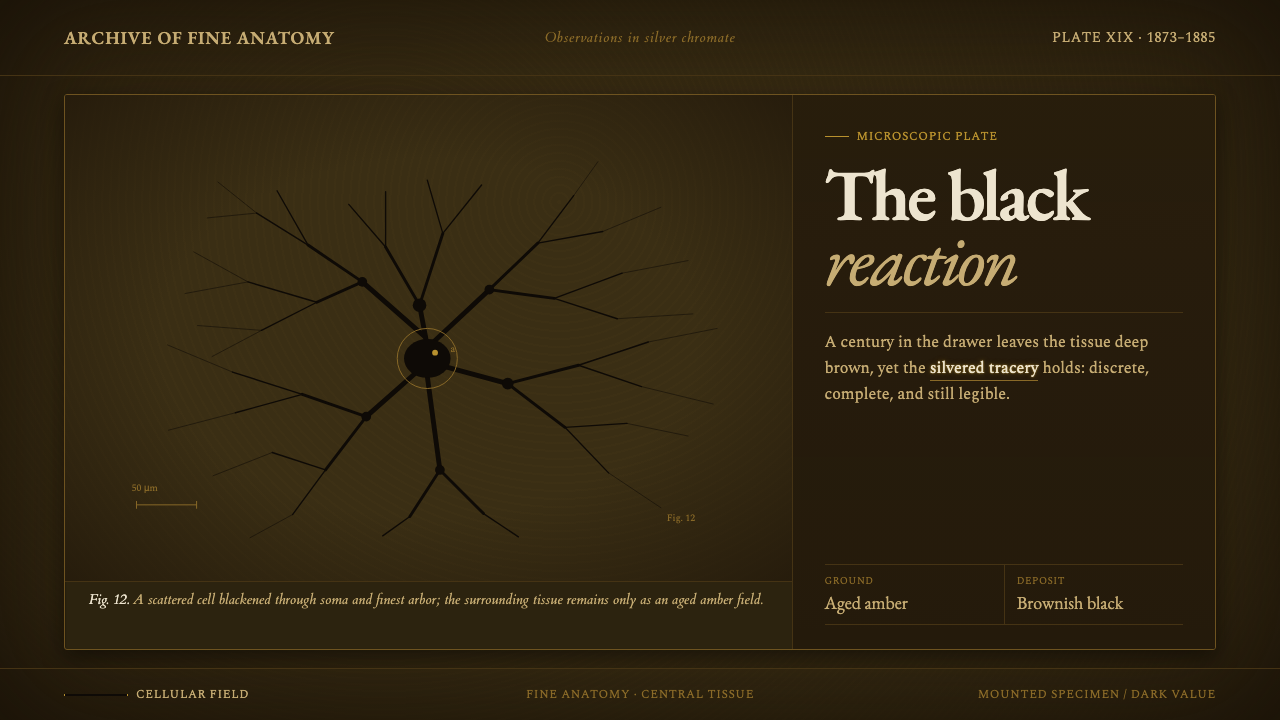 Golgi Neuron Silver StainA century-darkened specimen. Near-black dendrites branch across an aged amber…
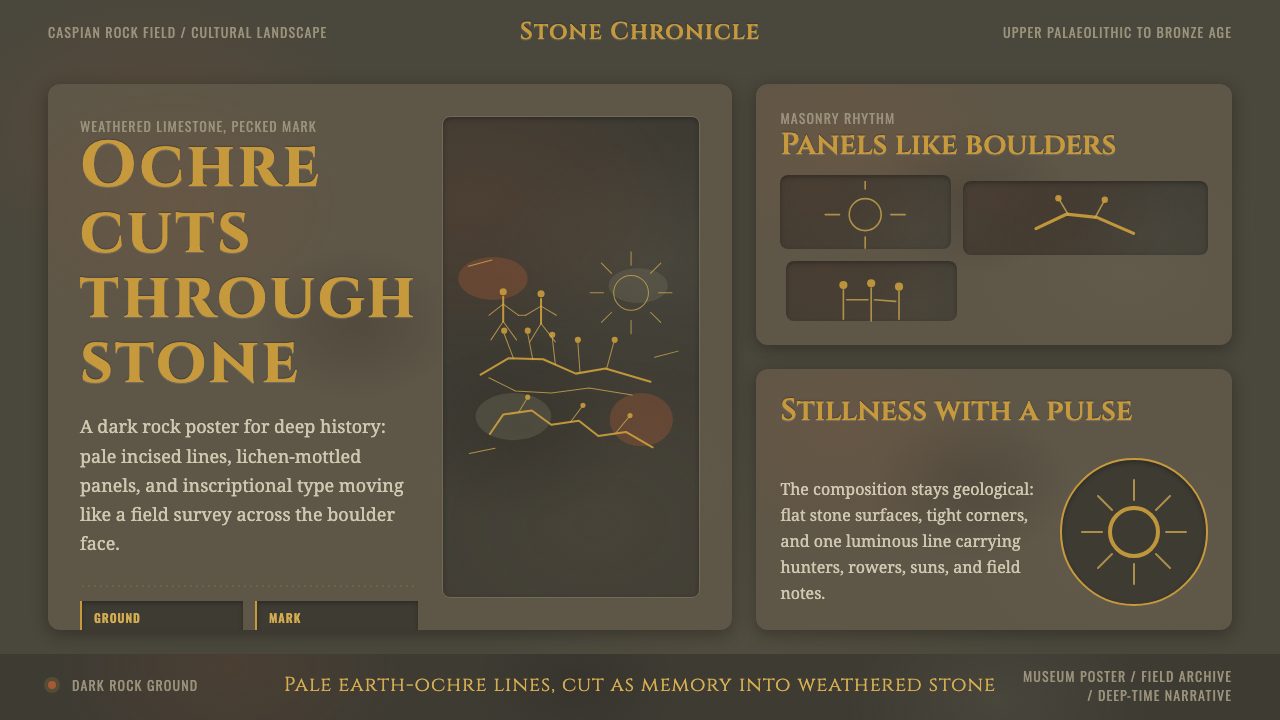 Azerbaijani Gobustan PetroglyphAncient rock speaks. Ochre incisions glow across dark lichen-mottled stone.
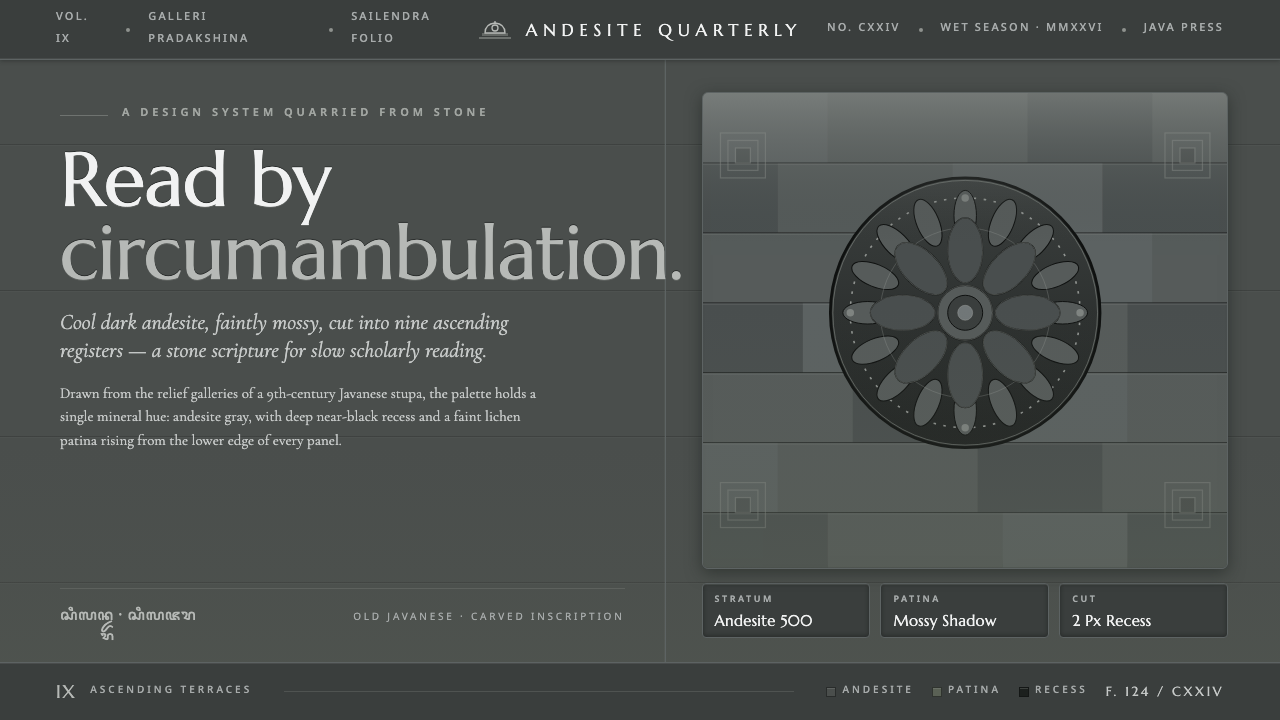 Borobudur Andesite GrayStone read like scripture. Cool andesite gray, near-black recess, mossy patin…
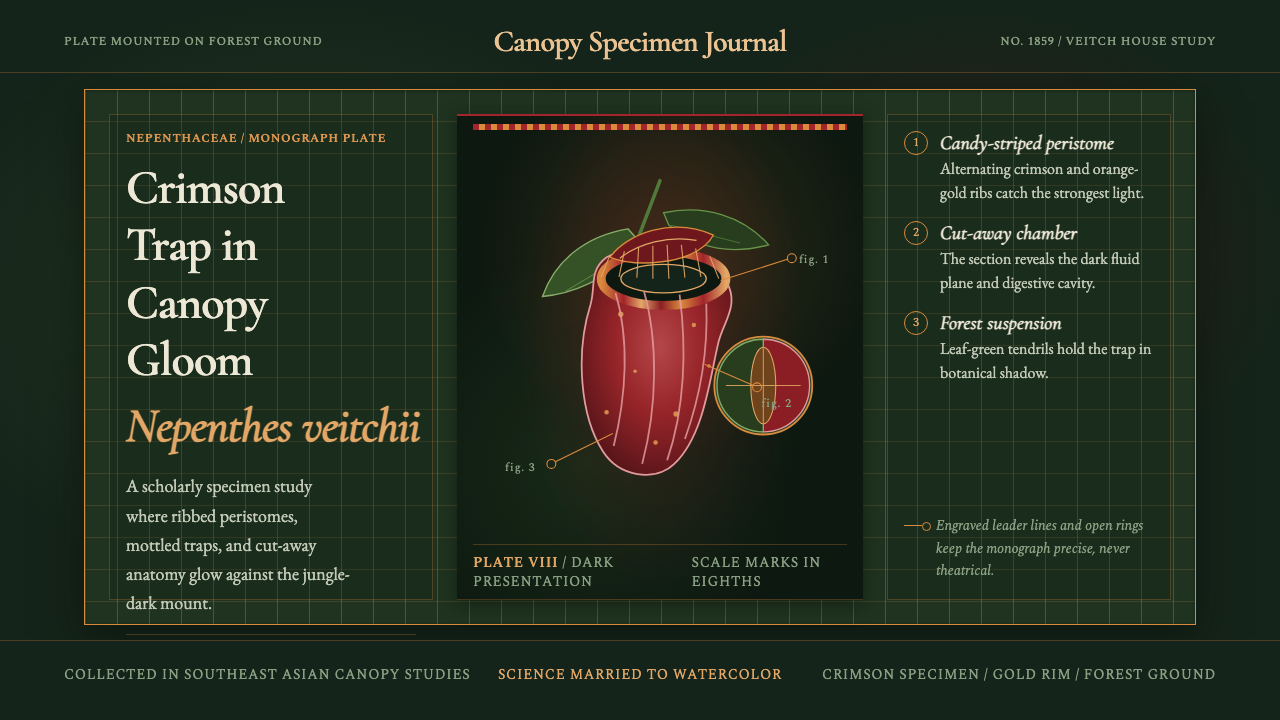 Carnivorous Pitcher PlantBotanical danger glows. Crimson traps and gold rims float on jungle-dark gree…
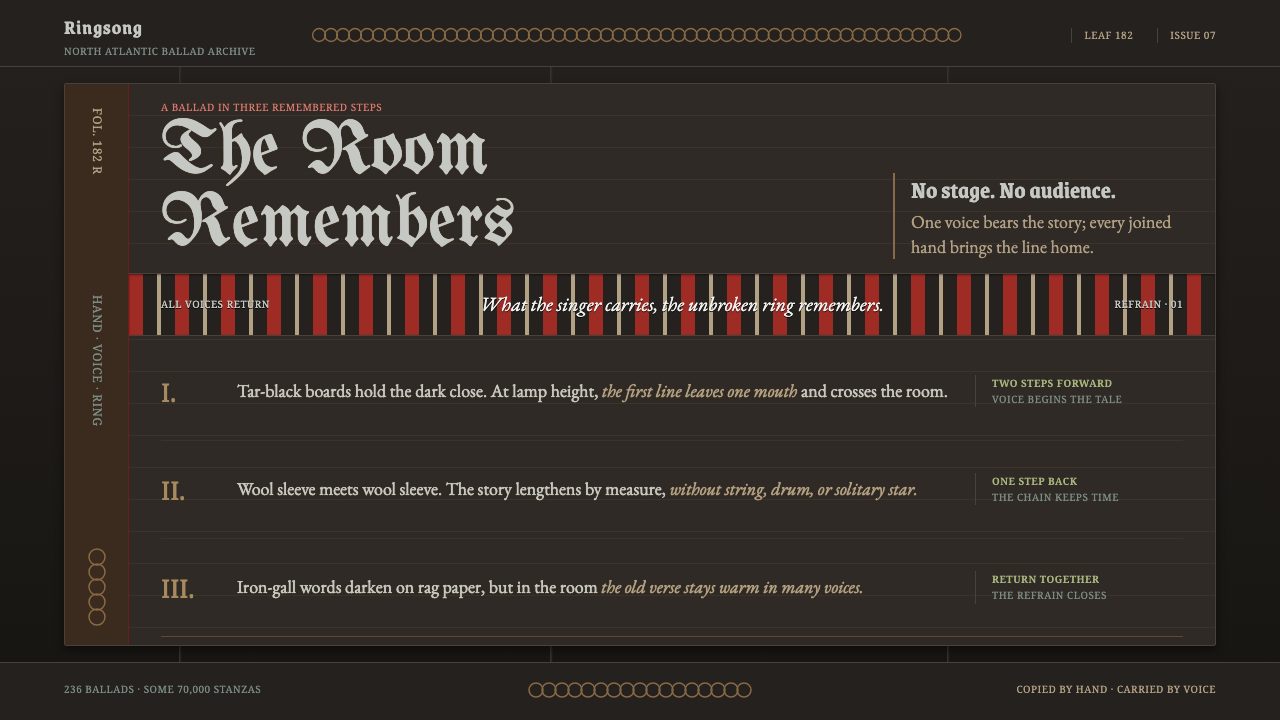 Faroese KvæðiThe room sings as one. Silver type and red refrain bands rule a tar-black man…
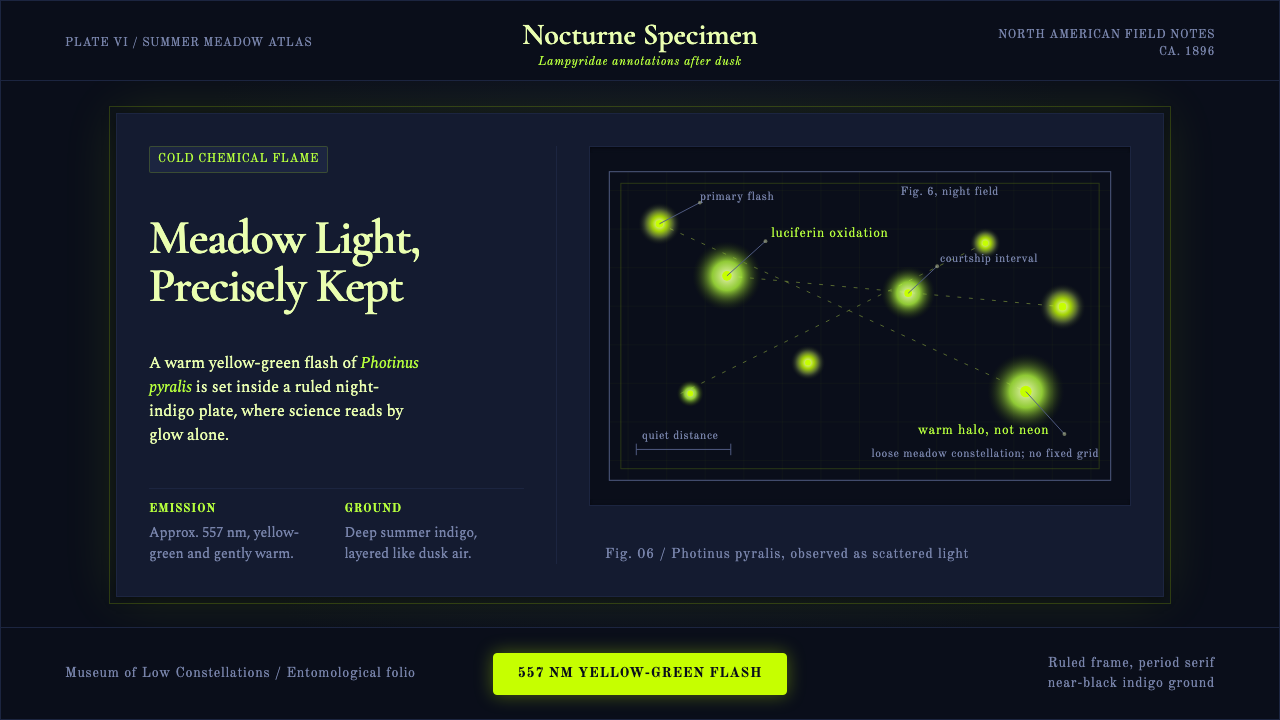 Firefly BioluminescenceQuietly luminous. Yellow-green 557 nm sparks drift through ruled indigo plate…