What is Faroese Kvæði?
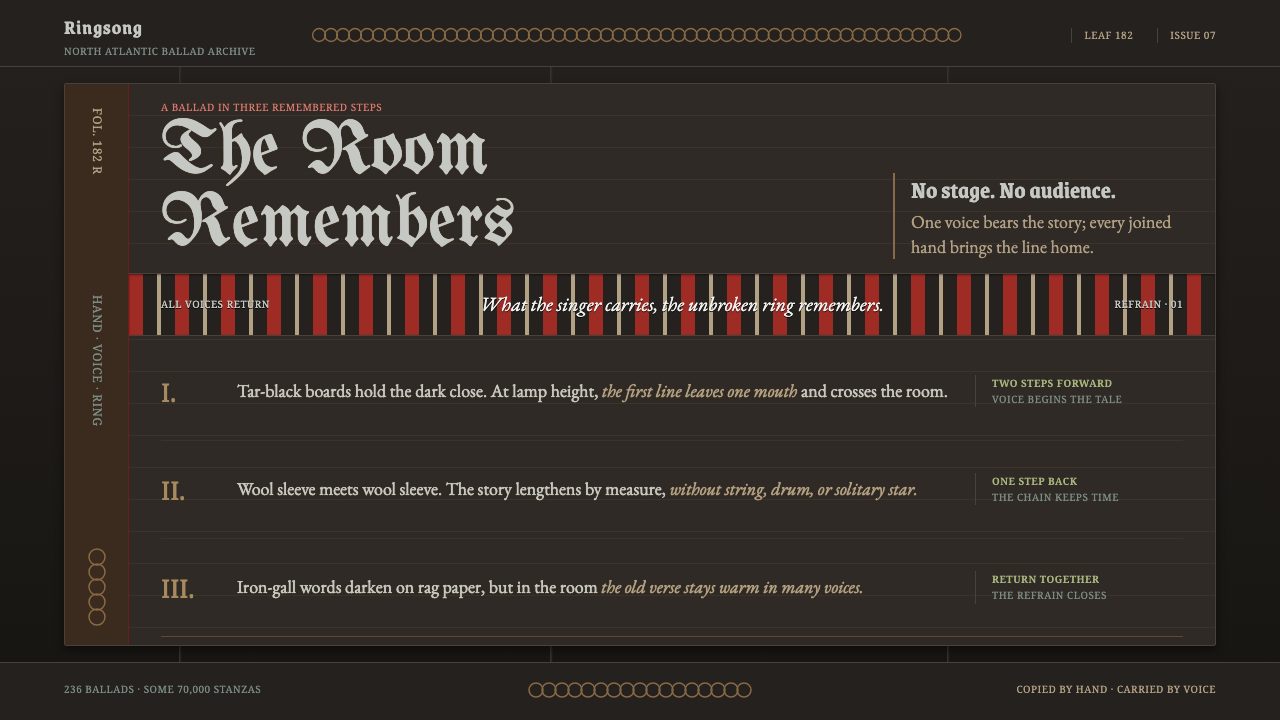
Kvæði turns a whole room into one instrument — an unbroken ring of dancers singing tens of thousands of stanzas from memory, now held on tar-black manuscript pages ruled in silver and red.
Faroese Kvæði in brief
Kvæði are the traditional ballads of the Faroe Islands: 236 texts have survived, running to roughly 70,000 stanzas in total. They are performed with no instrument whatsoever — the only sound is the human voice — while the room holds hands and moves together in an unbroken ring, a form known as the chain dance. A lead singer carries the narrative forward, stanza by stanza, and the rest of the room answers on a recurring refrain, so the performance is structured as call and response repeated for as long as the story requires.
The performance setting shaped the tradition as much as the words did. The dance took place in dance halls with walls of tarred black timber boarding under a turf roof, lit only at the level of a candle — a dark, close, warm interior rather than an open or brightly lit space. Sound, not sight, carried the event; the room's darkness put the weight entirely on voice and unison movement.
This design system does not try to reconstruct the dance hall itself. Instead it takes what the ballads look like on their second surface — the written page. Between 1821 and 1831, the ballads were copied by hand into a collected manuscript, stanza by stanza, on rag paper, in iron gall ink that browns slightly at the edge of every stroke. The system rules that manuscript logic across a dark timber ground: stanza blocks, a returning refrain band that interrupts the flow the same way the sung refrain interrupts the narrative, leaf numbers in the margin, and the red, black, and silver of Faroese national dress standing in for illustration.
Where does Faroese Kvæði come from?
The ballads themselves are presumed to date to the fourteenth century, though the evidence for that dating is the internal content and language of the texts rather than any surviving manuscript from that era — for centuries, kvæði existed purely as oral performance, carried forward only through the memory of singers and the repeated occasions of the chain dance.
Systematic written collection began much later. Jens Christian Svabo undertook some of the earliest transcription work in the late eighteenth century, part of a broader Nordic and European movement of the period to record oral folk material before it could be lost. His work opened the written record of a tradition that had, until then, existed only in performance.
The most significant single manuscript came between 1821 and 1831, when Jóannes í Króki copied hundreds of pages of kvæði stanza by stanza onto rag paper, using iron gall ink whose characteristic browning at the edge of each stroke is now part of the manuscript's visual identity. This collected manuscript, later known as Sandoyarbók, gave the oral tradition a fixed written form for the first time at this scale, and it is this specific physical object — rather than the ballads in the abstract — that this design system draws its surface from.
Later scholars extended the written record further: V. U. Hammershaimb and Svend Grundtvig both contributed to the broader nineteenth-century project of documenting and publishing Faroese and Nordic ballad material, situating the kvæði within the wider European movement of manuscript collecting that was recording oral traditions across the continent during the same decades. Even as scholarship fixed the ballads on paper, the chain dance itself never stopped being performed live, and it continues without interruption into the present.
What defines the Faroese Kvæði look?
Color
The ground is a tarred, near-black timber tone — the color of the dance hall's boarded walls — rather than any conventional paper white. Against it, the design draws only from the red, black, and silver of Faroese national dress: a deep wool red for emphasis, black for structure, and a cool silver for the buckles and clasps that catch what little candlelight there is. No Nordic pastel palette of white and pale blue belongs here; this is a North Atlantic system of wool and tar.
Manuscript Structure
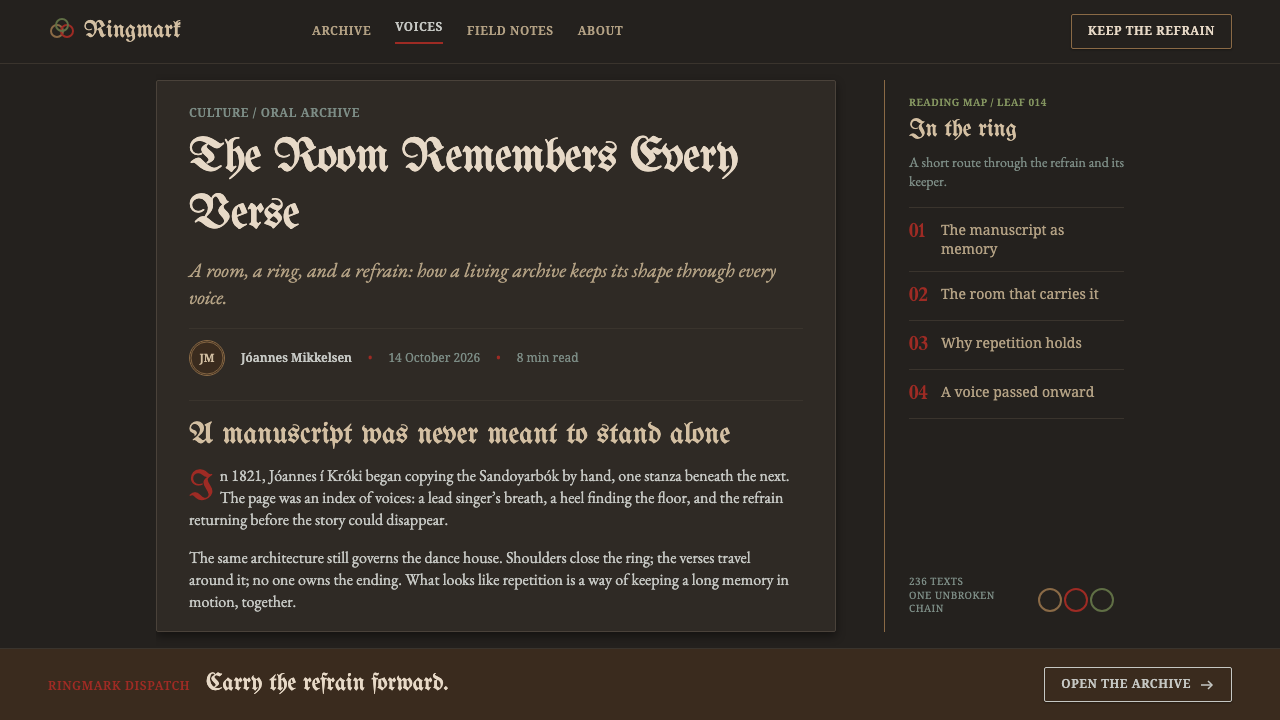
Content is organized the way Jóannes í Króki organized his copying: in discrete stanza blocks, ruled across the page like lines on a manuscript leaf. Each block reads as a self-contained unit, echoing the way a lead singer delivers one stanza at a time before the room answers, rather than flowing as a single continuous column of text.
The Refrain Band
A fixed band recurs at regular intervals, interrupting the stanza blocks exactly as the sung refrain interrupts the narrative in performance — the whole room answering the lead singer. In a layout, this becomes a repeating horizontal band, visually distinct from the stanza blocks, that punctuates the page at a steady rhythm rather than appearing only once as a header.
Ink and Edge Texture
The iron gall ink of the original manuscript browns slightly at the edge of every stroke, a physical trace of the ink's chemistry rather than a decorative effect. A faithful system preserves a hint of that edge softening on linework and lettering, distinguishing it from a flat, uniformly crisp digital line.
Marginalia and Leaf Numbers
Leaf numbers sit in the margin exactly as they do in the original manuscript, functioning as a quiet navigational device rather than a decorative flourish. This detail matters because it signals that the source is a working document meant to be read stanza by stanza in sequence, not a single decorative artifact.
Restraint and Darkness
The dance hall was lit at candle level, and the manuscript itself is dense, handwritten, and dark rather than bright or airy. A system drawn from this tradition should stay visually close, warm, and low-lit in feeling — generous white space and bright illumination work against the material's actual character, which is intimate and dim by design, not by accident.
Who shaped Faroese Kvæði?
Svabo carried out some of the earliest transcription of Faroese ballad material in the late eighteenth century, opening a written record for a tradition that had, until then, existed purely through oral performance and memory. His work belongs to the broader European effort of the period to capture oral folk culture in writing before it could be lost.
Between 1821 and 1831, Jóannes í Króki copied the collected kvæði stanza by stanza onto rag paper in iron gall ink, producing the manuscript now known as Sandoyarbók. This is the single object this design system draws its visual surface from — its stanza blocks, its browning ink edges, its leaf numbers in the margin — making í Króki's copying work the direct source of the system's texture, not merely a historical footnote.
Hammershaimb was part of the nineteenth-century scholarly effort that documented and published Faroese ballad and language material, contributing to the broader project of fixing an oral tradition in written form during the same period that produced the Sandoyarbók manuscript.
Grundtvig contributed to the wider nineteenth-century Nordic project of collecting and publishing ballad material, situating the Faroese kvæði within a regional pattern of manuscript collecting that was recording oral traditions across Scandinavia and the North Atlantic during the same decades.
How do you use Faroese Kvæði today?
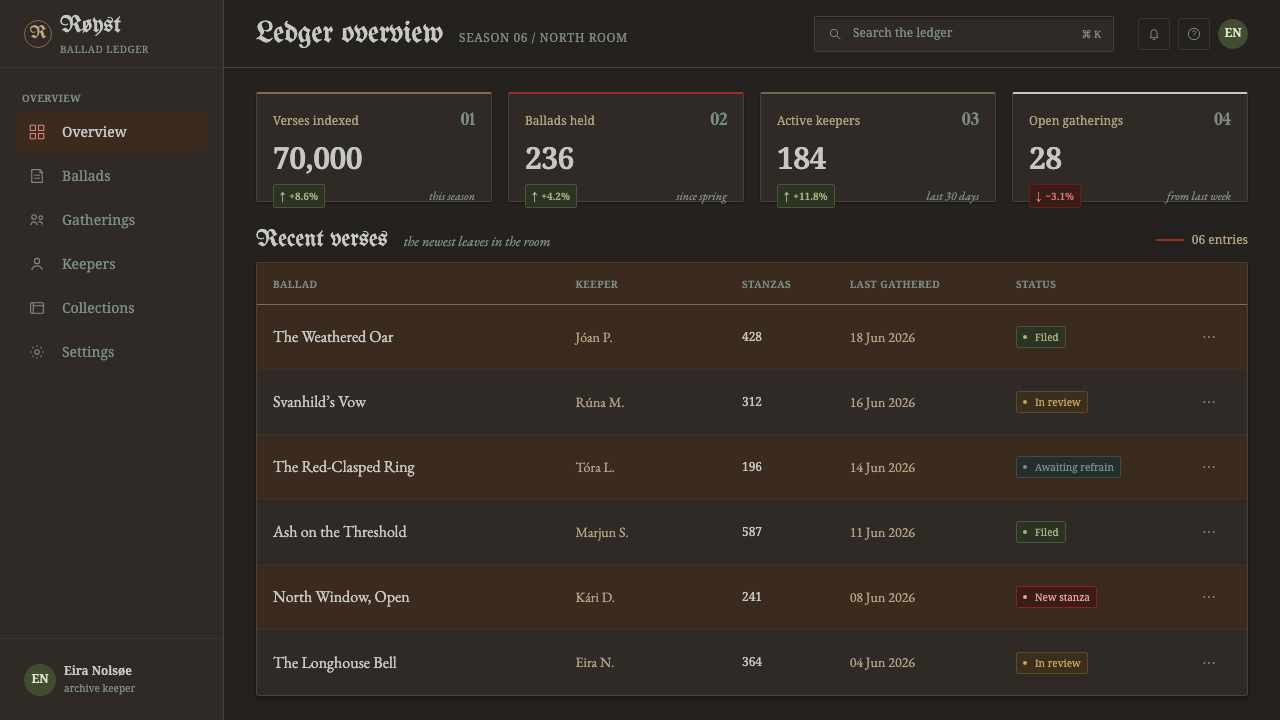
This system works best wherever a product wants to feel like an intimate, communal, oral tradition rendered on paper — cultural or heritage content, music and performance platforms, or any editorial product built around collected, archival material rather than glossy contemporary photography. Its core move is treating the page as a manuscript leaf rather than a printed sheet: dark ground, handwritten rhythm, a recurring structural band.
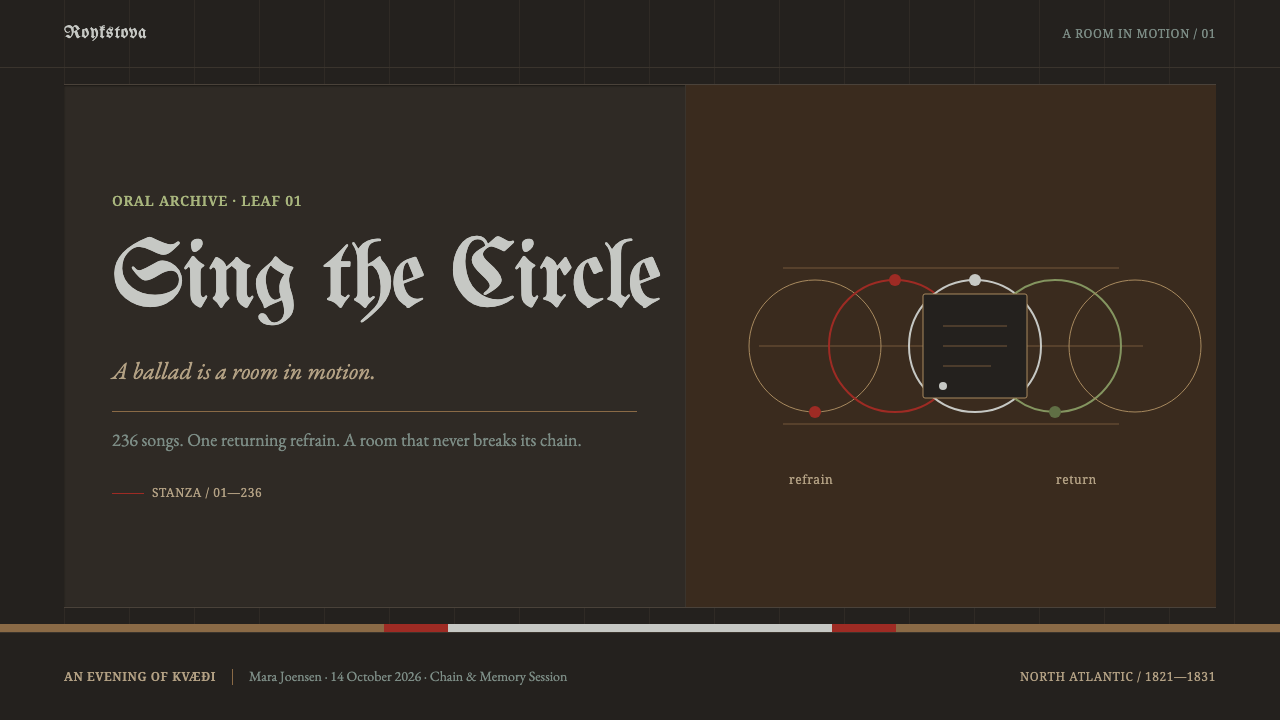
For presentation slides, a cover works well when it echoes a manuscript's title leaf — a dark timber-toned field, a leaf number in the corner, and a single line of title text set the way a stanza would be, rather than as a large graphic headline. Content slides should be built from stanza-like blocks of text with a recurring refrain-style divider band separating sections, reinforcing the call-and-response rhythm rather than a conventional bullet-point structure.
In web interfaces, the refrain band translates naturally into a recurring section header or a repeating status strip that appears at fixed intervals down a long page — something that punctuates content the way a sung refrain punctuates a ballad. Dark, warm timber-toned backgrounds suit long-form reading views better than a bright white canvas, and any accent elements should draw only from the red-black-silver set rather than a wider decorative palette.
For editorial and marketing work, the manuscript logic supports long-form storytelling particularly well: leaf-number-style pagination markers, stanza-block paragraph rhythm, and a recurring pull-quote band that functions like the refrain give a piece of writing the feel of something transcribed and preserved rather than freshly typeset. Marketing materials for cultural, folk, or heritage-adjacent products can lean on the dark ground and silver-accented linework to suggest permanence and craft rather than novelty.
A common mistake is defaulting to a bright, airy Scandinavian-minimalist palette of white and pale blue, which belongs to a different Nordic design lineage entirely and contradicts the actual material this style is drawn from — a dark, candle-lit dance hall and a browning, handwritten manuscript. Another mistake is treating the refrain band as a one-time decorative header rather than a genuinely recurring structural element that interrupts the content at intervals, the way the sung refrain interrupts the story.
Faroese Kvæði — FAQ
Why does the design use a dark, near-black background instead of a manuscript-style cream or white?
Because the source material is doubly dark: the chain dance was performed inside a hall with tarred black timber walls lit only at candle level, and this system draws its surface from that dark, close setting rather than from a generic bright manuscript aesthetic. A cream or white ground would misrepresent both the performance space and the tradition's tone.
What is the significance of the recurring refrain band in the layout?
It translates a performance structure directly into a visual one. In the chain dance, a lead singer carries each stanza and the whole room answers on a fixed refrain, over and over, for as long as the ballad runs. The recurring band in the layout is the visual equivalent of that refrain — a structural interruption that appears at intervals rather than once, keeping the call-and-response rhythm of the original performance legible on the page.
Where do the red, black, and silver colors come from?
They come from Faroese national dress, not from any illustration or decoration added to the manuscript. The system uses this specific, limited palette — a deep wool red, structural black, and cool silver for buckle-like accents — as its only source of color beyond the dark timber ground, keeping the palette tied to a real cultural object rather than an invented color scheme.
Is this style specific to the Faroese ballads, or could it apply to other oral traditions?
The underlying moves — a dark ground standing in for a dim performance space, stanza-like content blocks, a recurring band standing in for a refrain, and a restrained palette drawn from a real cultural object — could inform work about other unaccompanied, communal oral traditions. But the specific palette and manuscript details here are drawn directly from the kvæði and the Sandoyarbók manuscript, so applying it elsewhere means replacing those specifics with the equivalent details of the new tradition rather than reusing this exact palette.
Does the chain dance still take place today, or is this purely a historical reference?
The chain dance continues to be performed today without interruption, even though the manuscript this system references was made two centuries ago. The tradition sits at an unusual intersection: a living, ongoing communal performance practice on one side, and a specific, fixed nineteenth-century written artifact — the Sandoyarbók manuscript — on the other, and this design system deliberately draws from the latter rather than attempting to depict the living performance itself.
Related design styles
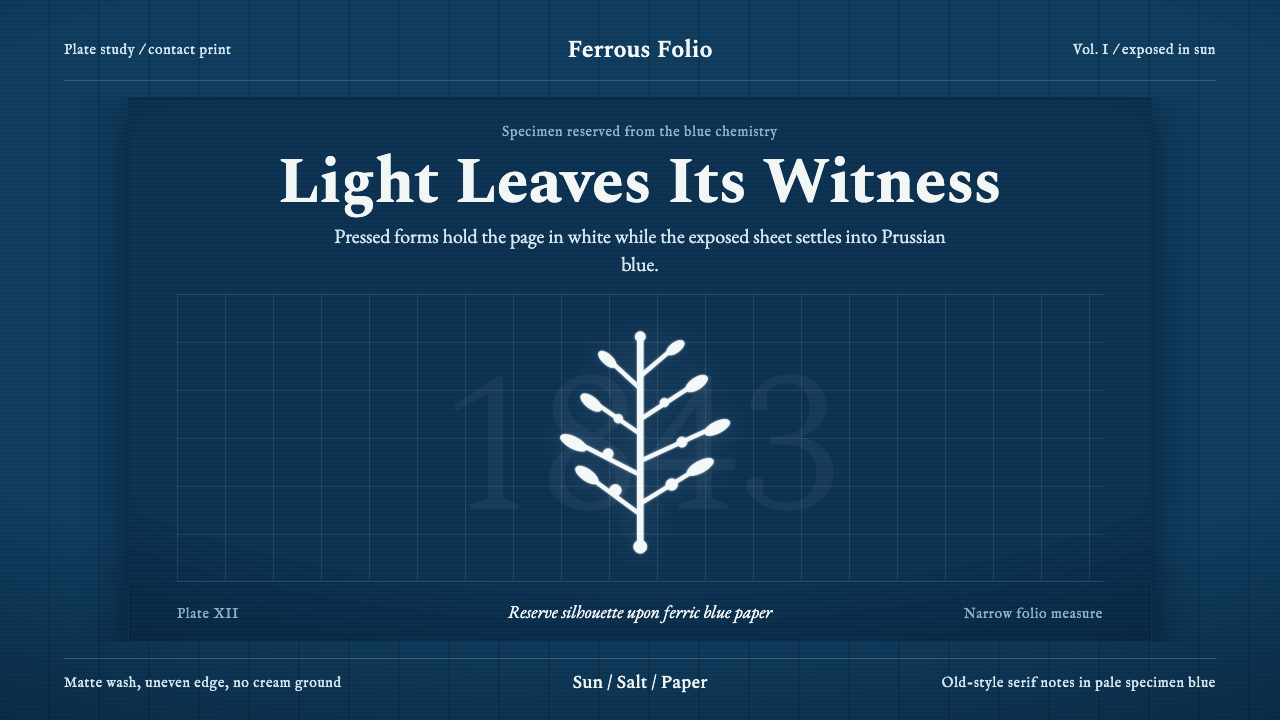 Anna Atkins CyanotypeScience turns spectral. Prussian blue ground, white reserves, Victorian serif…
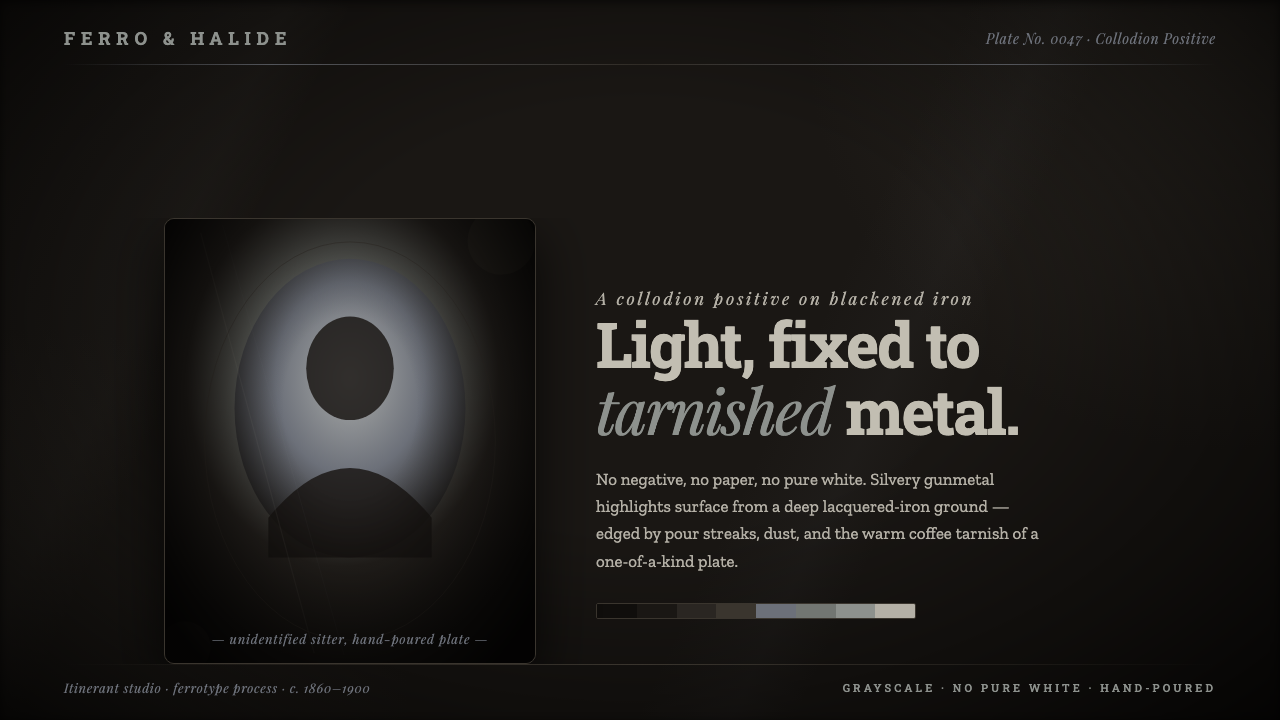 Tintype Wet PlateLight fixed to tarnished metal. Gunmetal grays rise from blackened iron, capp…
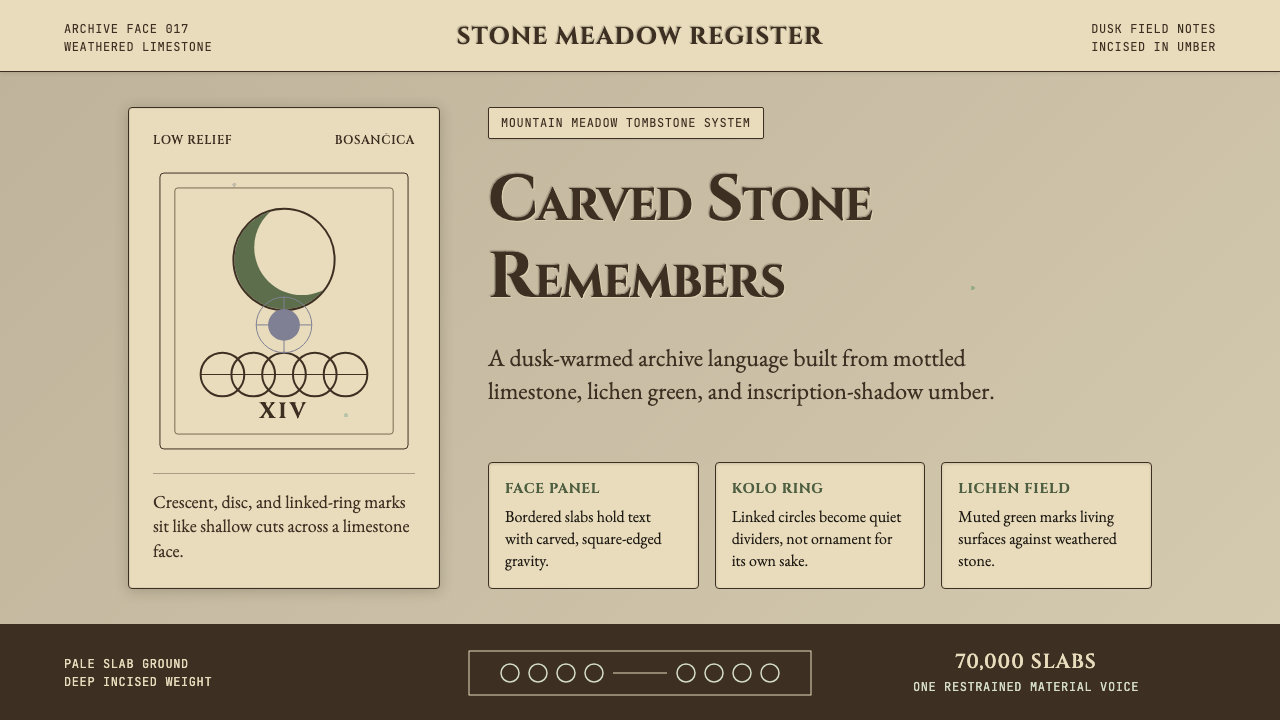 Bosnian Stećak Medieval TombstoneStone remembers quietly. Lichen green and Cinzel cuts sit on weathered limest…
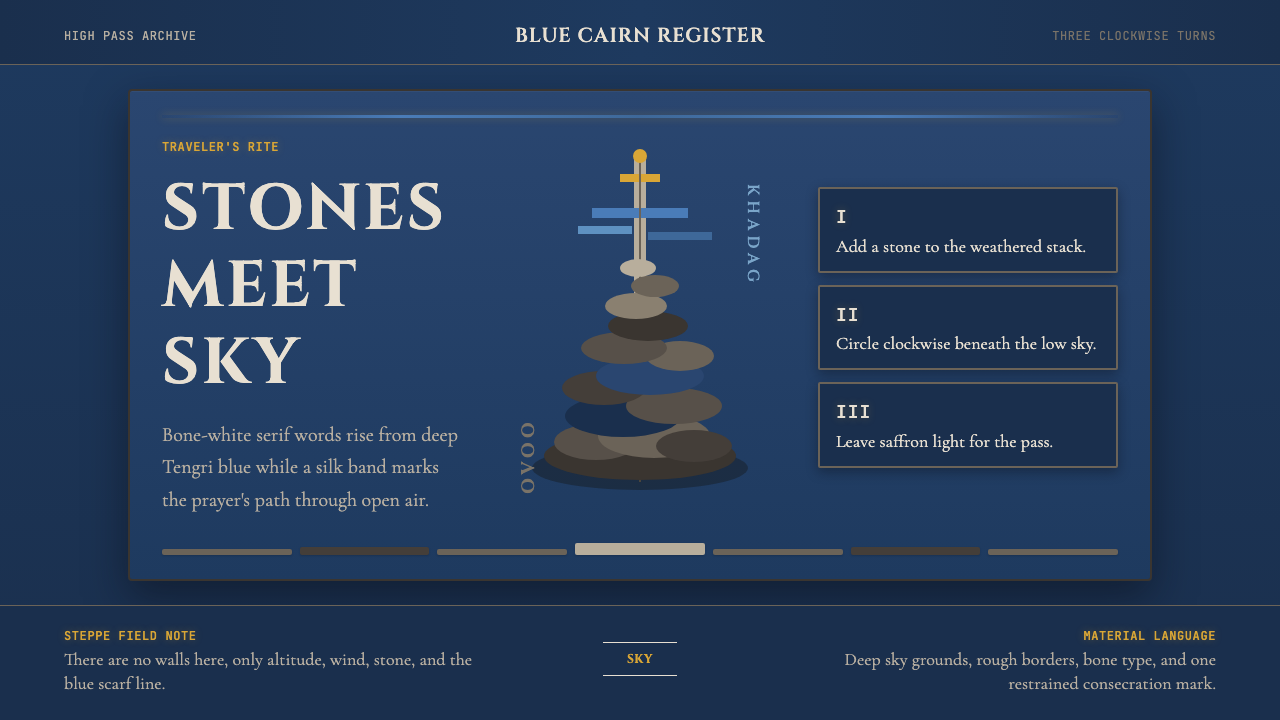 Mongolian Ovoo (Cairn Prayer Site)Sacred austerity. Steppe-blue ground, bone serif type, and one silk-blue pray…
 Seychellois Vanilla TakamakaBotanical apothecary in shadow. Deep green, brass hairlines, and copperplate…
 Carnivorous Pitcher PlantBotanical danger glows. Crimson traps and gold rims float on jungle-dark gree…