What is Mexican Papel Picado Tissue?
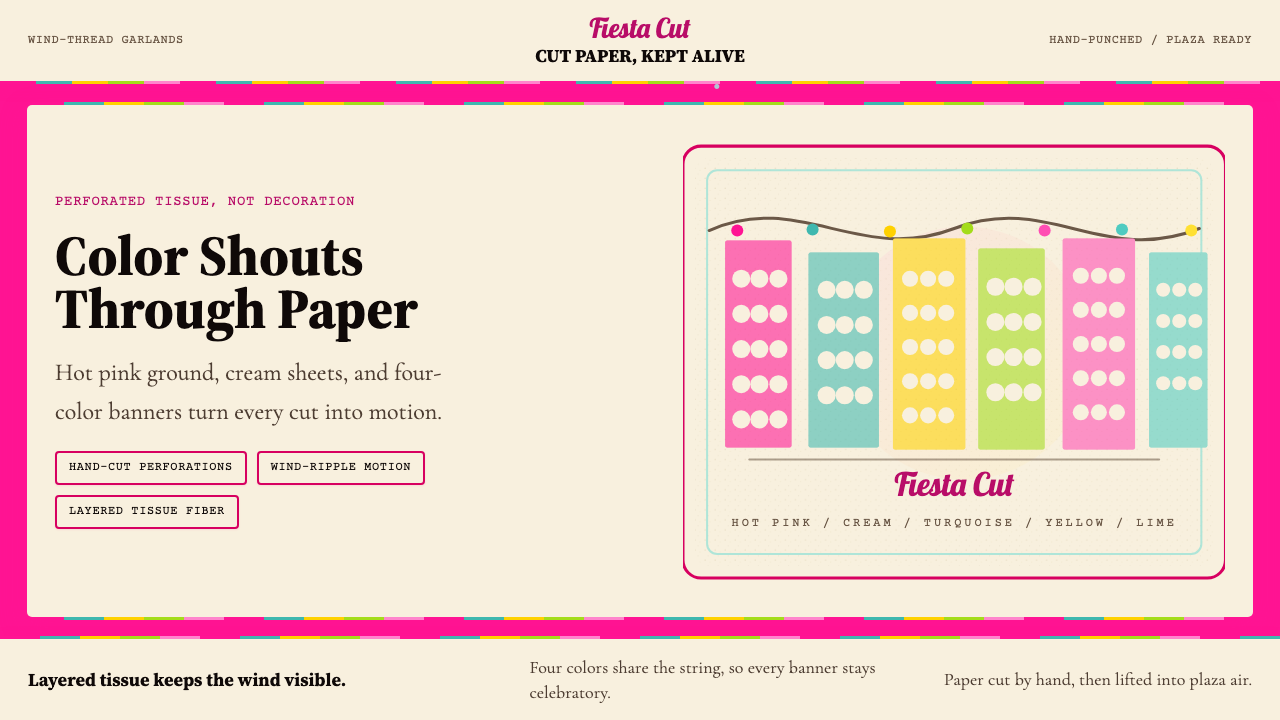
Papel picado transforms humble tissue into a riot of perforated color — hot pink, turquoise, magenta, and yellow banners strung across plazas and churches, making every Mexican fiesta feel alive with movement and light.
Mexican Papel Picado Tissue in brief
Papel picado — literally 'perforated paper' — is the Mexican folk tradition of cutting elaborate designs into stacked layers of brightly colored tissue paper using mallets, chisels, and specialized cutting tools. The finished banners are strung into garlands and draped across plazas, churches, market stalls, and home altars for festivals ranging from Día de Muertos to weddings, quinceañeras, and Christmas posadas. The visual effect is electric: dozens of translucent banners in four or more saturated colors overlap and shift in the breeze, filtering light and casting colored shadows across everything beneath them.
As a design system, papel picado captures that layered, celebratory visual energy — the saturated palette of tissue colors against sky and stone, the geometric rhythm of rectangular banner shapes, the intricate lace-like perforations that define motifs of skulls, flowers, animals, and geometric patterns. Unlike many folk-art traditions that exist primarily in museums, this one has been in continuous everyday practice for well over a century, still made by hand in the same Puebla village where it was codified.
What distinguishes papel picado from surface decoration is its structural character: the design is created by what is removed, not what is added. Negative space is the medium. Perforations that form a skull or a marigold are defined by absence, and the color of the tissue — the ground itself — becomes the image. This reversal of figure and ground gives the aesthetic its particular visual depth and its conceptual richness as a design language.

Where does Mexican Papel Picado Tissue come from?
The village of San Salvador Huixcolotla, in the state of Puebla, Mexico, is considered the world capital of papel picado. Though perforated and cut-paper traditions existed throughout Mesoamerica long before European contact — the Aztecs used bark paper amate in religious ceremony, and cut-paper offerings called papeles were central to pre-Hispanic ritual — the specific form of tissue-paper banner art as practiced today took its definitive shape in the late nineteenth and early twentieth centuries, as commercially produced tissue paper from Europe and later Mexico replaced handmade amate.
The Vivanco family of San Salvador Huixcolotla stands at the center of this tradition's modern history. Margarito Vivanco is widely credited with systematizing and expanding the craft in the early twentieth century, developing both the vocabulary of motifs — skulls, flowers, birds, geometric borders — and the production techniques that allowed many banners to be cut simultaneously from stacked sheets. The family's workshop became the model for the village's broader artisan economy, and the Vivanco name remains synonymous with master-level papel picado internationally. Maria Vivanco and subsequent generations carried the tradition forward, maintaining the hand-chisel technique even as demand grew for machine-cut versions.
The post-revolutionary Mexican period of the 1920s and 1930s saw papel picado elevated from a local craft to a symbol of national identity. The muralist movement and the broader cultural project of post-revolutionary Mexico, which sought to valorize indigenous and mestizo folk traditions against the Eurocentric aesthetics of the Porfirian era, brought papel picado into the same cultural conversation as Diego Rivera's murals and Frida Kahlo's embroidered tehuana dress. The craft became a visual shorthand for Mexicanidad — Mexican-ness — and its imagery, particularly the calavera skull motif associated with Día de Muertos, entered the global visual vocabulary of Mexican culture.
In 1998, UNESCO recognized Día de Muertos — and by extension the visual culture surrounding it, including papel picado — as part of the Intangible Cultural Heritage of Humanity. This recognition amplified international interest in the tradition while also raising ongoing questions about authenticity and mass reproduction: commercially printed plastic 'papel picado' has proliferated globally, and distinguishing genuine hand-cut tissue work from its industrial simulacra has become a point of advocacy for Huixcolotla artisans. Through 2024, the village's master craftspeople continue to produce both traditional ceremonial banners and commissioned decorative work for international clients, sustaining a living tradition now well into its second century.
What defines the Mexican Papel Picado Tissue look?
Color Palette
The palette is built from the full spectrum of saturated tissue-paper colors — hot pink, turquoise, magenta, acid yellow, vivid orange, lime green, cobalt, and deep violet — used simultaneously and without hierarchy. Unlike restrained design systems that limit color to two or three hues, papel picado embraces four, six, or eight colors in a single composition, relying on the translucency of tissue and the visual rhythm of repetition to prevent chaos. The resulting effect is not polychromatic excess but jubilant abundance: every color at full intensity, every color present at once.
Negative Space and Perforation
The defining visual characteristic of papel picado is its relationship to negative space. Motifs are not drawn or painted onto a surface — they are cut away from it. The perforations create lace-like patterns of extreme intricacy: a single banner might contain dozens of individual cuts forming skulls, marigolds, birds in flight, or interlocking geometric borders. This structural inversion — where the image lives in what is removed — gives every composition an airy, layered quality that no painted surface can replicate. Light passes through the perforations, and as banners overlap, colors mix and shift.
Banner Geometry
Individual papel picado banners are rectangular, with a simple scalloped or notched lower edge that softens the formal boundary. This rectangular module — repeated dozens of times in alternating colors along a string — creates a strict geometric rhythm: a horizontal grid of color blocks interrupted by perforated decoration. The regularity of the format is essential; it is what allows the wild variation of colors and motifs to cohere as a unified visual system. The banner shape functions like a typographic measure: a containing form that gives the interior detail its legibility.
Tissue Texture and Translucency
The material — thin, almost weightless tissue paper — is not incidental to the aesthetic; it is constitutive of it. Tissue transmits rather than reflects light, so colors appear luminous rather than opaque. When multiple layers overlap — as they always do in a garland — the overlapping regions produce new mixed colors and tonal gradations that were never explicitly designed. The surface also carries the faint fiber texture of the paper itself, visible on close inspection, which grounds the digital abstraction of the style in something handmade and tactile. Applying this aesthetic means embracing a similar quality of translucency and layering rather than solid, opaque fills.
Celebratory Motif Vocabulary
Papel picado has a defined iconographic vocabulary drawn from Mexican folk and ritual tradition. Calaveras (decorated skulls) are the most internationally recognized motif, closely associated with Día de Muertos. Alongside them appear marigold flowers (cempasúchil), birds, butterflies, deer, maguey plants, and geometric border patterns derived from pre-Hispanic textile traditions. Religious imagery — crosses, doves, sacred hearts — appears in pieces made for baptisms, weddings, and feast days. The motifs are never photorealistic; they are always stylized, simplified, and compressed into the constraints of the cutting tool, producing forms that are simultaneously bold in silhouette and intricate in detail.
Movement and Wind
Papel picado is not a static art form. The banners are designed to move — to sway and flutter in the breeze, catching and releasing light, overlapping and separating. This kinetic quality is inseparable from its visual identity. The tissue is light enough that even indoor air currents cause visible motion. Translating this into digital and print design means building in a sense of layering, rhythm, and visual flux — compositions that feel active rather than settled, where overlapping elements create depth and where no single focal point holds the eye too long. The aesthetic resists the fixed and the permanent.
Imperfection as Authenticity
Hand-cut papel picado carries the marks of its making: slight irregularities in cut edges, minor variations in the spacing of identical motifs across stacked sheets, the particular compression of a chisel that gives each cut a slightly different character. These imperfections are not flaws to be corrected — they are the aesthetic's proof of life. A design system that draws from this tradition should deliberately incorporate similar qualities: slightly uneven treatments, textured grounds, elements that echo handcraft rather than mechanical perfection. The worst misapplication of the style is a version so precisely rendered that it loses the warmth and vitality that are its entire point.

Who shaped Mexican Papel Picado Tissue?
Margarito Vivanco of San Salvador Huixcolotla is the figure most responsible for transforming papel picado from a local seasonal practice into a systematized, exportable craft tradition in the early twentieth century. He developed and codified the primary motif vocabulary — particularly the calavera skull, floral, and geometric border designs — and refined the stacking-and-cutting technique that allows a single artisan to produce dozens of identical banners in a session. His workshop became the seed of Huixcolotla's identity as the global center of the craft, and his name is invoked by contemporary artisans as the standard of master-level work.
Maria Vivanco carried the family tradition forward across the middle decades of the twentieth century, maintaining the hand-chisel technique during a period when commercially cut and printed alternatives were becoming available. Her role was as much curatorial as creative: sustaining the integrity of the hand-cut method, training apprentices within the family and village system, and resisting the dilution of the craft into purely decorative souvenir production. She represents the continuity function that keeps living craft traditions alive between their moments of wider recognition.
Spanning multiple generations from the 1920s through the present, the Vivanco family workshop functions less as a single biography and more as an institution — the primary site where the aesthetics, techniques, and iconographic vocabulary of master-level papel picado were developed, tested, and transmitted. The workshop's continued operation into the 2020s means that the tradition it represents is not a historical artifact but a living practice, with artisans who learned directly from those who codified the form. International collectors, festivals, and design clients continue to commission work from the workshop, sustaining both its economic viability and its cultural authority.
While not an individual artisan, UNESCO's 1998 recognition of Día de Muertos — and by extension the visual culture surrounding it — as Intangible Cultural Heritage of Humanity had a defining effect on how papel picado is understood and valued internationally. The recognition elevated the craft from folk decoration to world heritage, brought it into serious design and cultural conversation, and also created new tensions: the UNESCO designation increased demand for papel picado-adjacent aesthetics globally, accelerating the proliferation of machine-cut plastic imitations that Huixcolotla artisans have had to actively distinguish their work from. The designation thus both honored and complicated the tradition.
How do you use Mexican Papel Picado Tissue today?
Applying papel picado as a design system requires understanding what makes it work at the source: it is not merely a bright color palette but a system of layered translucency, geometric rhythm, and celebratory excess operating within a strict modular container. The rectangular banner format is the key structural constraint — it is what prevents the abundant color and intricate detail from becoming visual noise. Any application of this style that loses the containing geometry loses the tradition's organizational logic along with it.
For presentation slides, papel picado works powerfully on cover pages and section dividers. A cover using this system builds the background from layered, slightly translucent color fields in three or four tissue-paper hues — hot pink, turquoise, yellow, magenta — overlapping at their edges to create mixed-color regions, with title type reversed in cream or white against the richest color zone. Section dividers can employ a horizontal band of banner-like rectangles in alternating colors, each containing a simplified perforation-style motif. Content slides should pull back: a cream or white ground with one tissue color used as accent for pull quotes, section labels, and data callouts. Data visualizations benefit from the full palette — bar charts and categorical legends in the saturated tissue colors, clearly differentiated and jubilantly distinct.
For web interfaces, papel picado is well-suited to event pages, festival marketing sites, cultural institution portals, and any context where celebration, cultural richness, and visual energy are desired brand values. The approach: use a near-white or warm cream ground for readability, deploy the saturated palette in banner-like horizontal strips, header regions, and interactive states. Navigation and card components can incorporate subtle perforation-style border patterns. Avoid using all saturated colors at full intensity in body content areas — reserve the maximum saturation for hero sections, calls to action, and festive highlights. Pricing and dashboard pages using this style should use one or two tissue colors to differentiate tiers, with the remaining palette appearing in illustration or decorative elements only.
For editorial and marketing work, the style excels in contexts that want to signal warmth, festivity, and cultural connection — food brands, hospitality, cultural events, community organizations. A papel picado-inspired editorial layout uses wide, layered color bands across the top of the page to echo the garland format, body text on a cream ground, and chapter or section markers that echo the banner's rectangular module. Marketing materials — posters, social cards, event invitations — can embrace the full palette at high saturation, layering color fields with open perforation-style motifs in white or cream to create the characteristic visual depth. The style is especially strong for Día de Muertos-adjacent and Latino cultural marketing, where it carries genuine resonance rather than decorative borrowing.
A common mistake when applying this style is mistaking its abundance for permission to use all colors simultaneously at equal intensity across all elements. Authentic papel picado has hierarchy within its richness: the banner format contains the color, the perforations create breathing room within each banner, and the sky or wall behind provides the neutral foil that makes the saturation legible. In digital application, this translates to maintaining neutral zones — white, cream, or off-white backgrounds — where the eye can rest between encounters with the saturated palette. A composition where everything is simultaneously at maximum saturation reads as overwhelming rather than celebratory. The goal is abundance with rhythm, not chaos.

Mexican Papel Picado Tissue — FAQ
Is papel picado only appropriate for Mexican or Day of the Dead themed projects?
The cultural specificity of papel picado is real and should be taken seriously — this is not a style to apply carelessly to unrelated contexts. That said, its core visual logic — layered translucent color, geometric banner rhythm, perforated negative space, celebratory saturation — is transferable to any project where festivity, warmth, and visual richness are appropriate values. Wedding and event design, food and hospitality brands, community and cultural institutions, and festival marketing across many cultures can all draw from this system authentically. The test is not whether the project is explicitly Mexican but whether the values of celebration, craft, and joyful abundance are genuine to the product's purpose. Superficial application that treats the style as exotic decoration without engaging its structural logic is both aesthetically weak and culturally disrespectful.
How do you handle the translucency effect in digital design where elements are opaque by default?
The translucency of tissue paper is one of papel picado's defining qualities, but it can be approximated in digital work through several approaches that do not require literal transparency. Layering slightly lighter or more muted versions of adjacent colors in overlap zones — so that where a pink banner and a yellow banner cross, the overlapping region reads as a warm peach — simulates the optical mixing of light through tissue. Another approach is to use genuinely semi-transparent color fills in overlap regions, which works well in both screen and print contexts. The key is that the overlap must be visible and intentional, not hidden or smoothed away. In contexts where transparency is not practical, a graphic pattern of the same hue family used in the overlap zone achieves a similar reading.
What is the difference between authentic papel picado and the machine-cut plastic versions?
The distinction is both material and aesthetic. Authentic hand-cut papel picado is made from tissue paper — thin, translucent, biodegradable — using mallets and chisels operated by trained artisans who can cut dozens of layers simultaneously. Machine-cut plastic versions replicate the silhouette of the motifs but lose the tissue's translucency, the slight irregularities of hand work, the way the paper catches and diffuses light, and the material softness that makes hand-cut banners flutter rather than flap. From a design standpoint, the plastic version is a logo compared to a painting — technically derived from the same source but missing the qualities that made the source meaningful. For design applications drawing from this tradition, the hand-cut tissue qualities — translucency, slight imperfection, luminous color — are the ones worth emulating, not the harder, more mechanical character of the plastic imitations.
Can this style work in a restrained or minimal context, or does it require full festive intensity?
Papel picado can absolutely be applied at reduced intensity without losing its identity, but the reduction must be systematic rather than arbitrary. The most successful restrained applications retain the structural elements — the rectangular banner module, the perforation-style patterning, the layered-color logic — while pulling back the number of simultaneous hues to two or three and increasing the proportion of neutral ground. A cream background with one vivid tissue-pink accent and a single perforation-pattern detail border reads as papel picado-derived without overwhelming. What cannot be reduced is the quality of the color itself: a muted, desaturated version of the palette produces something that reads as vaguely ethnic and decorative rather than specifically grounded in this tradition. The saturation is not optional — it is the tradition's visual voice. Reduce the quantity of color, but never its quality.
How does papel picado relate to other perforated or cut-paper traditions around the world?
Cut-paper and perforated-paper traditions appear across many cultures — Chinese jiǎnzhǐ, Polish wycinanki, German Scherenschnitte, Japanese kirigami, Indian rangoli border patterns translated into paper, and the amate bark-paper offerings of pre-Hispanic Mesoamerica that are among papel picado's own ancestors. What distinguishes the Mexican tissue-banner tradition is its specific combination of features: the sequential banner format designed for garland stringing, the tissue-paper material with its particular translucency and luminosity, the saturated multi-color palette that uses four or more hues simultaneously, and the specific iconographic vocabulary of Día de Muertos and Catholic folk-festival imagery. Other cut-paper traditions tend toward single-color or two-color work, or toward framed individual compositions rather than repeating garland modules. The combination of all these features together — material, format, palette, iconography, and ritual context — is what makes papel picado visually and culturally distinct.
Related design styles
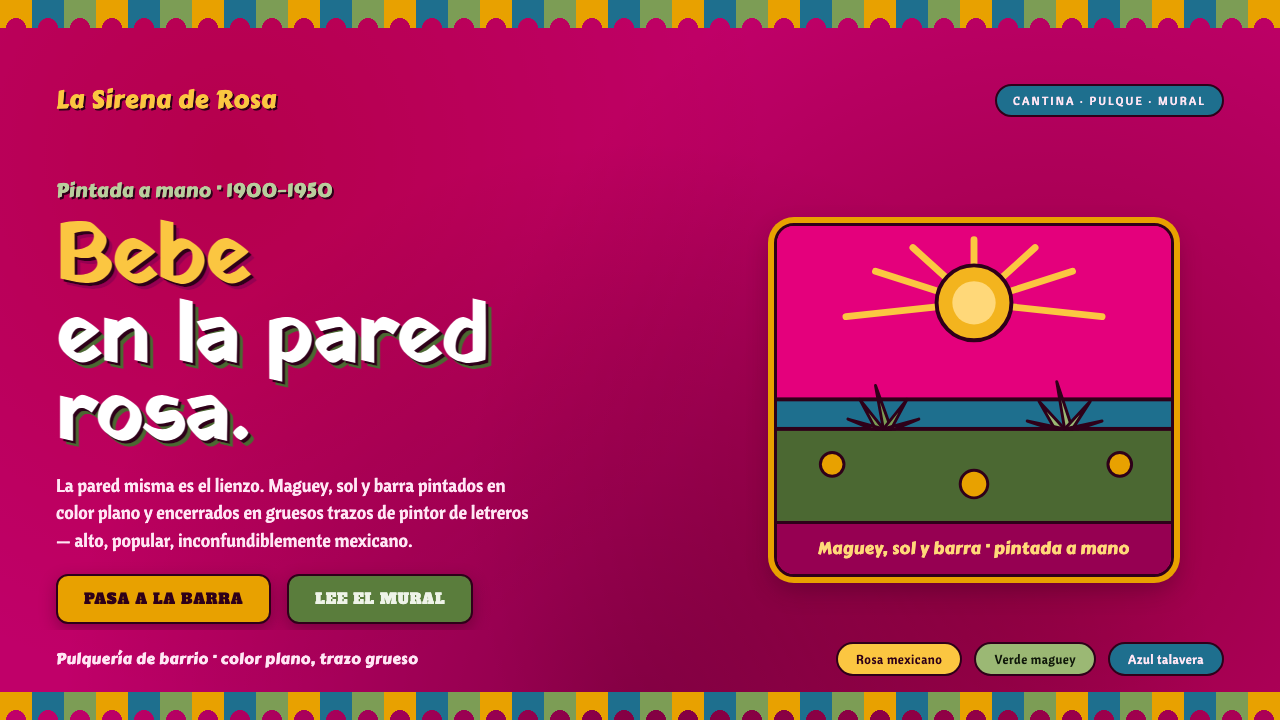 Mexican Pulqueria MuralThe wall is the canvas. Hot rosa-mexicano plaster, maguey green and marigold…
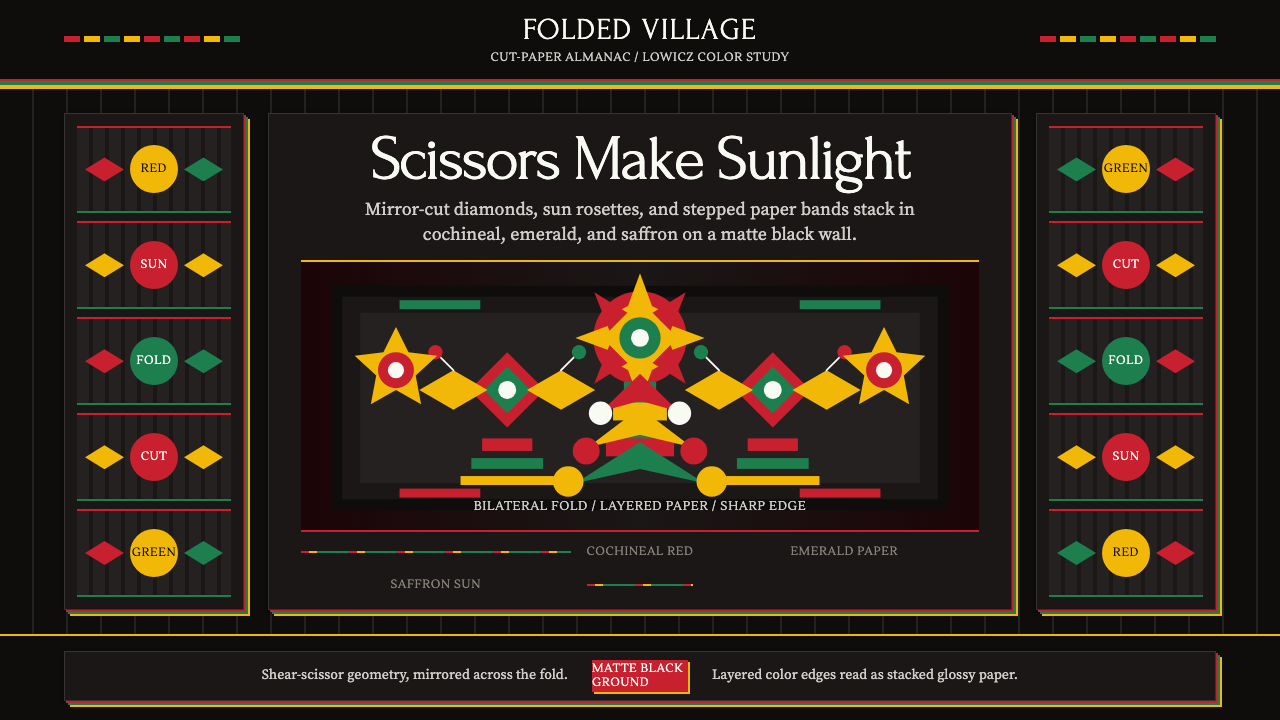 Polish Wycinanki (paper-cut folk art)Cuts sing in symmetry. Cochineal, emerald, and saffron layers blaze on black.
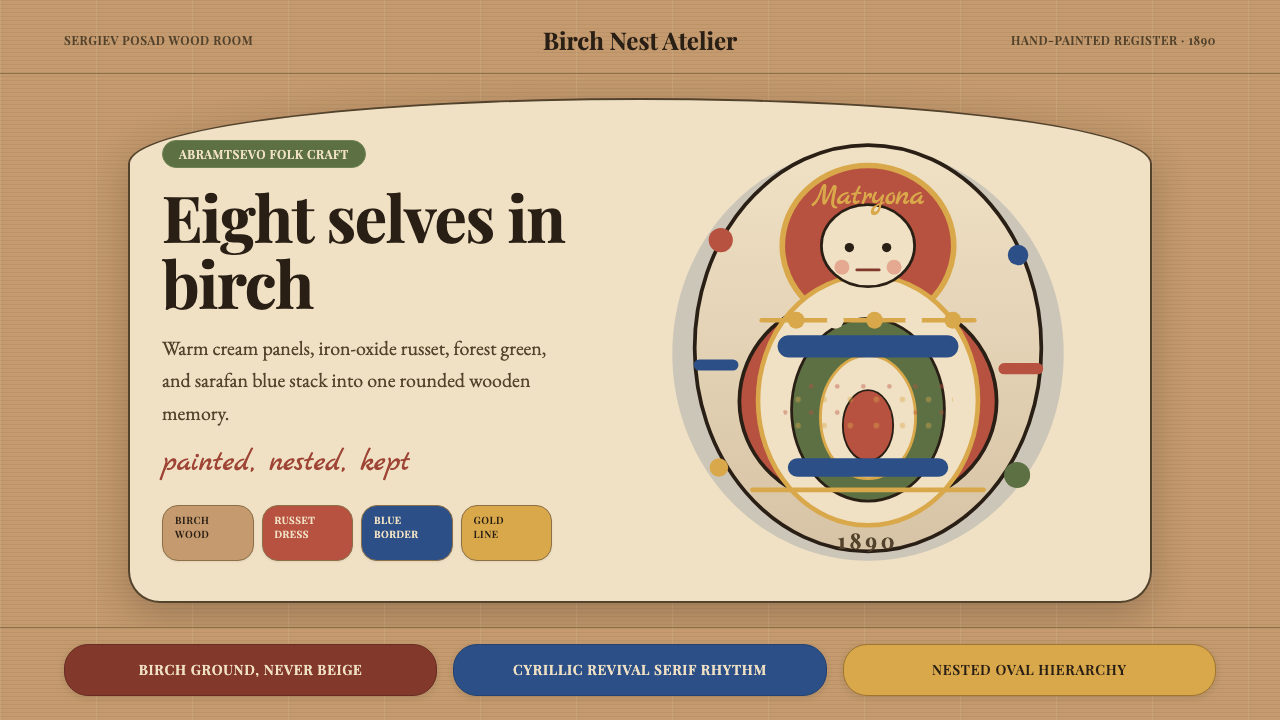 Russian Matryoshka 1890Warmth nests inward. Birch, cream, russet, and egg-oval type stage handmade d…
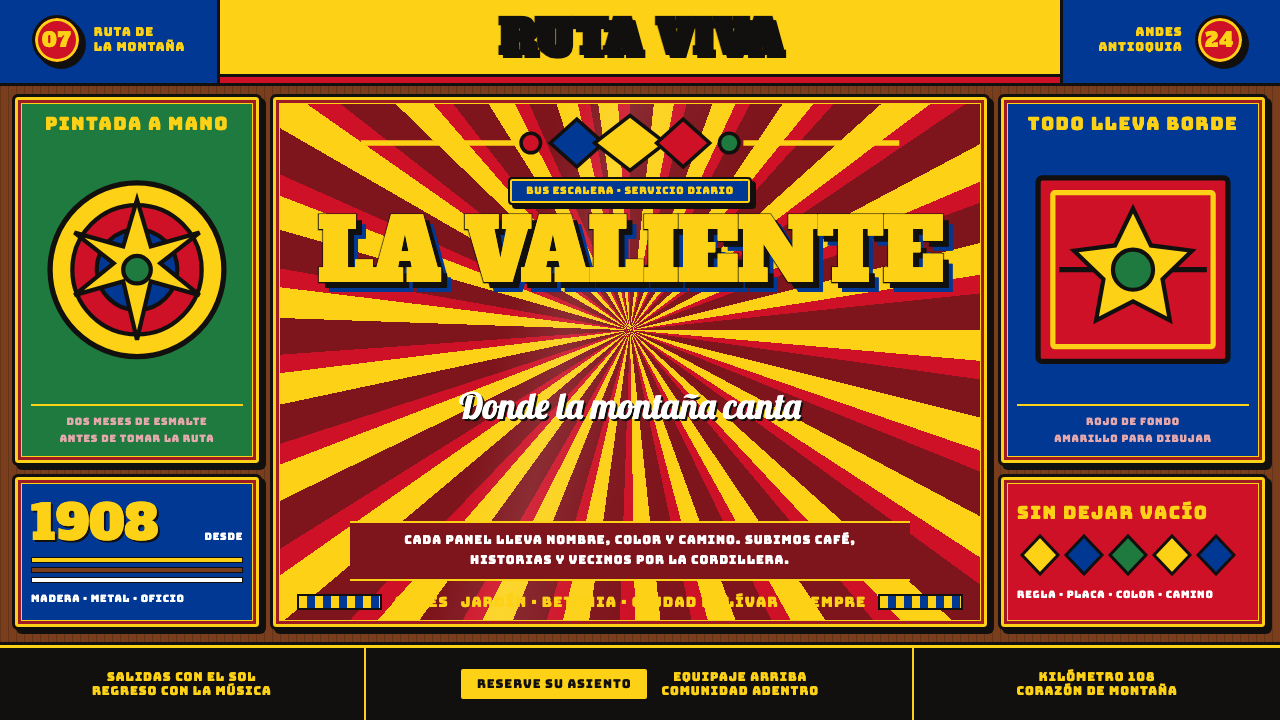 Colombian Chiva BusNothing is left unpainted. Flag-yellow rules, slab lettering and black keylin…
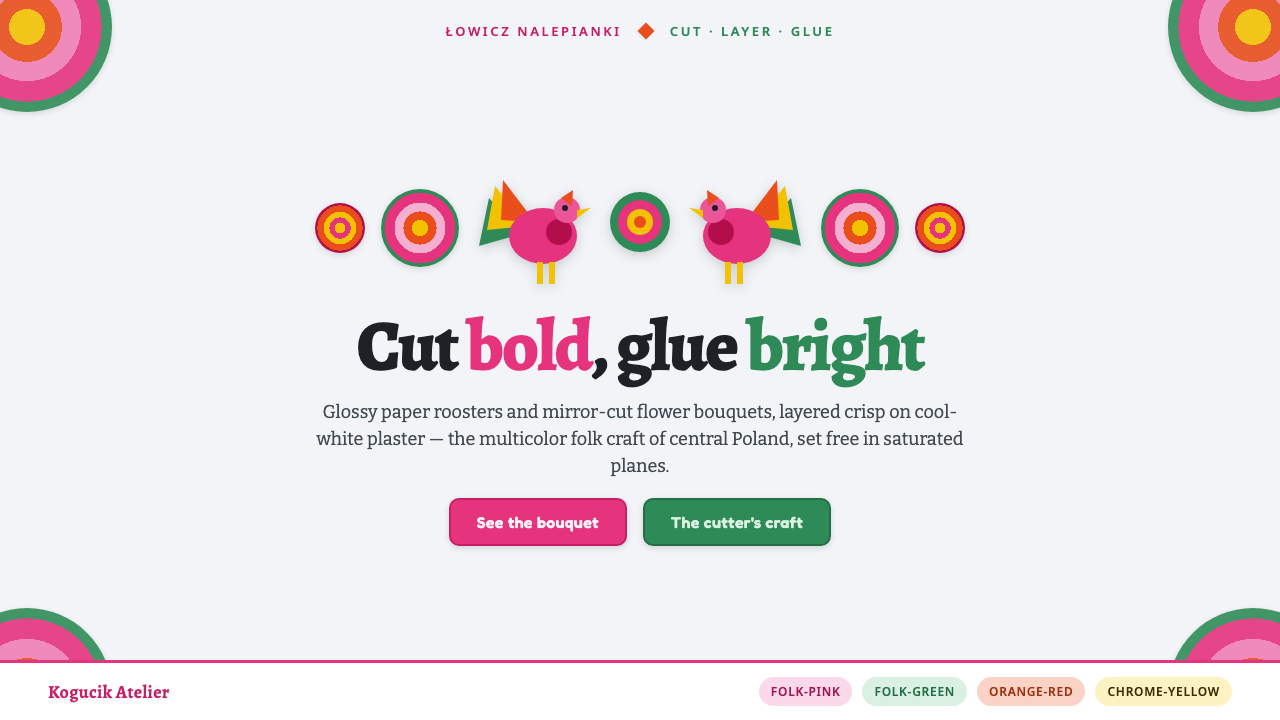 Polish Wycinanki PinkFolk papercut maximalism. Hot-pink roosters and mirror-cut bouquets layered o…
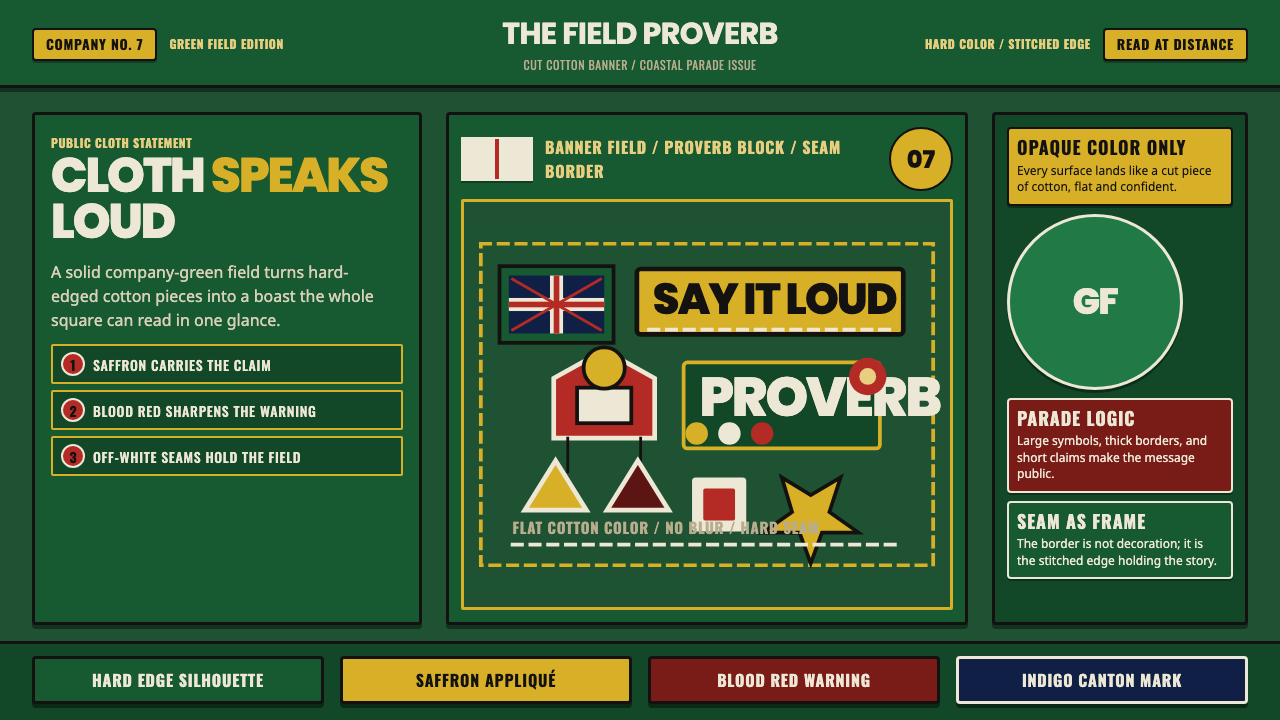 Asafo Fante Flag AppliquCloth speaks loud. Deep green field, saffron appliqué, hard seams, bold prove…