What is Polish Wycinanki (paper-cut folk art)?
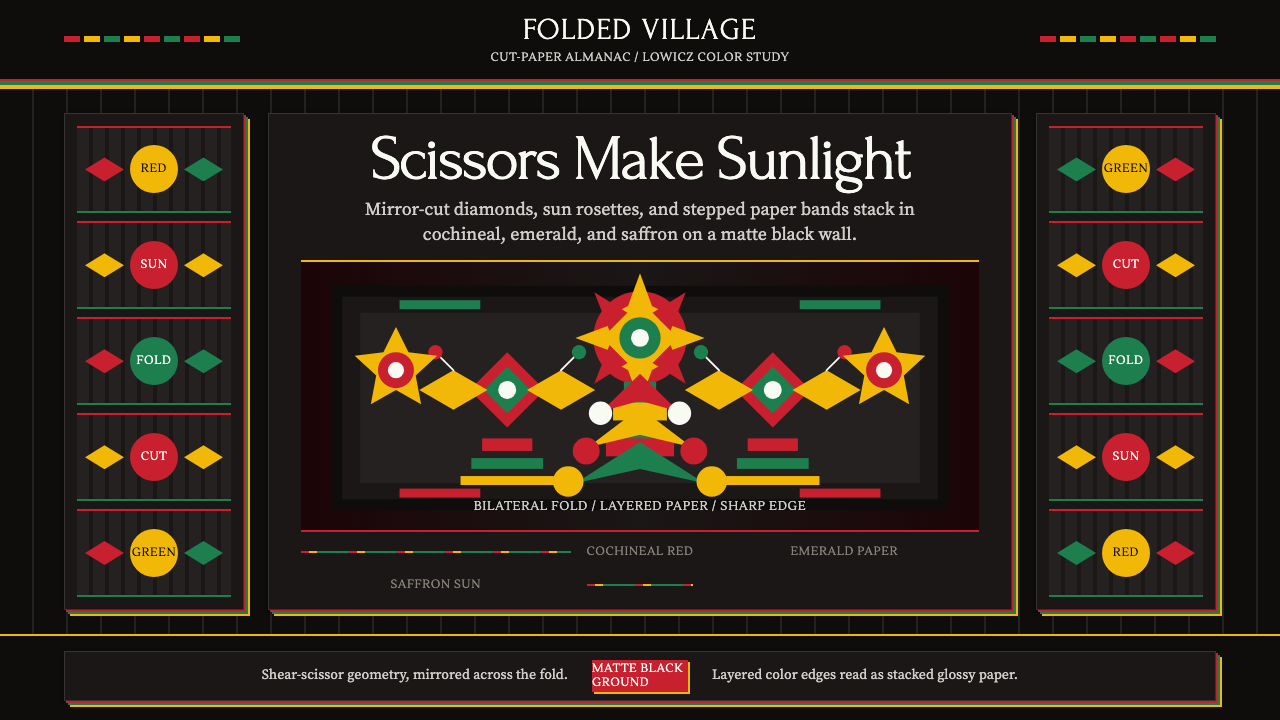
Polish Wycinanki turns the humble act of cutting paper into a blazing ritual of symmetry, roosters, and layered color that transforms any surface it touches.
Polish Wycinanki (paper-cut folk art) in brief
Wycinanki (pronounced roughly vee-chee-NAHN-kee) is the Polish folk art of cutting colored paper into elaborate symmetrical compositions. Peasant women in the Łowicz and Kurpie regions of central Poland developed this tradition using nothing more than sheep-shearing scissors — the same heavy, curved blades used to clip wool — and sheets of brightly dyed paper. The results were intricate layered compositions of roosters, flowers, sun rosettes, trees of life, and abstract geometric medallions, displayed on the freshly whitewashed walls of rural cottages.
What distinguishes Wycinanki from other paper-cutting traditions worldwide is its specific combination of bilateral mirror symmetry, saturated color layering, and a dark display ground. The artist works by folding paper and cutting through multiple layers at once, so that a single snip creates matching forms on both sides of the fold. Multiple cuts of differently colored paper are then layered atop one another, building up compositions in which cochineal reds, emerald greens, saffron yellows, and ultramarine blues compete and harmonize against a matte black backing.
Visually, Wycinanki is immediately recognizable — and almost paradoxically bold for an art made with scissors and paper. The black ground throws every color forward, creating an effect closer to stained glass or illuminated manuscript than to anything we ordinarily associate with rural handicraft. Every edge is crisp and absolute; there is no blending, no shading, no gradation. Pure saturated hues sit side by side in hard-edged silhouette, producing a visual energy that is festive, forceful, and deeply geometric.
Where does Polish Wycinanki (paper-cut folk art) come from?
The precise origins of Wycinanki are difficult to pin down, because paper-cutting as a domestic practice almost certainly predates the first documentary records of it. Ethnographers began seriously cataloguing the tradition in the 1880s, when Maria Znamierowska-Prüfferowa and other Polish folklorists visited villages in the Mazowsze and Łowicz regions and found the practice already well established. By then, the tradition likely stretched back several generations — to roughly the 1820s or 1830s — when imported colored paper became affordable enough for village households to use decoratively.
Two regional styles emerged as the most distinctive. The Łowicz style (from the plains south-west of Warsaw) is characterized by multi-layered, multi-colored compositions of extreme chromatic richness. A single Łowicz piece might layer six or seven differently colored sheets, one atop another, with each layer contributing a different element — a red rooster, a green leafy branch, a yellow floral wreath — to the final composite image. The Kurpie style (from the forested region north-east of Warsaw) tends toward single-color or two-color silhouettes — typically black on white or white on color — favoring spindly tree-of-life compositions with branching forms of great linear delicacy. Both traditions rely on bilateral symmetry as an organizing principle, but Łowicz pushes toward chromatic maximalism while Kurpie leans toward graphic economy.
The social function of Wycinanki was intimately tied to seasonal renewal and domestic ritual. Cottage walls were re-whitewashed before Easter each year, and the fresh paper-cuts were applied to the new white surface as part of the preparation for the holiday. Wycinanki also appeared at weddings and other festive occasions. The motifs were not arbitrary: roosters symbolized fertility and protection from evil; the sun rosette marked the transition of seasons; the tree of life connected the household to ancestral continuity. The art was transmitted from mother to daughter, with individual families developing recognizable personal styles within the shared regional vocabulary.
The twentieth century brought both threat and revival. The disruptions of two world wars and the mass migration of rural populations to industrial cities put the tradition at risk of extinction. The Cepelia folk cooperative, established in Poland after World War II, played a decisive role in preserving and commercializing Wycinanki alongside other Polish folk crafts. Artists such as Apolonia Nowak and Jadwiga Wojtczak became celebrated practitioners whose work was collected by museums and exhibited internationally, transforming what had been a domestic wall decoration into a recognized fine-art medium. Today, Wycinanki is taught in regional cultural centers, featured in Polish design exports, and recognized by UNESCO as a form of intangible cultural heritage.
What defines the Polish Wycinanki (paper-cut folk art) look?
Bilateral Mirror Symmetry
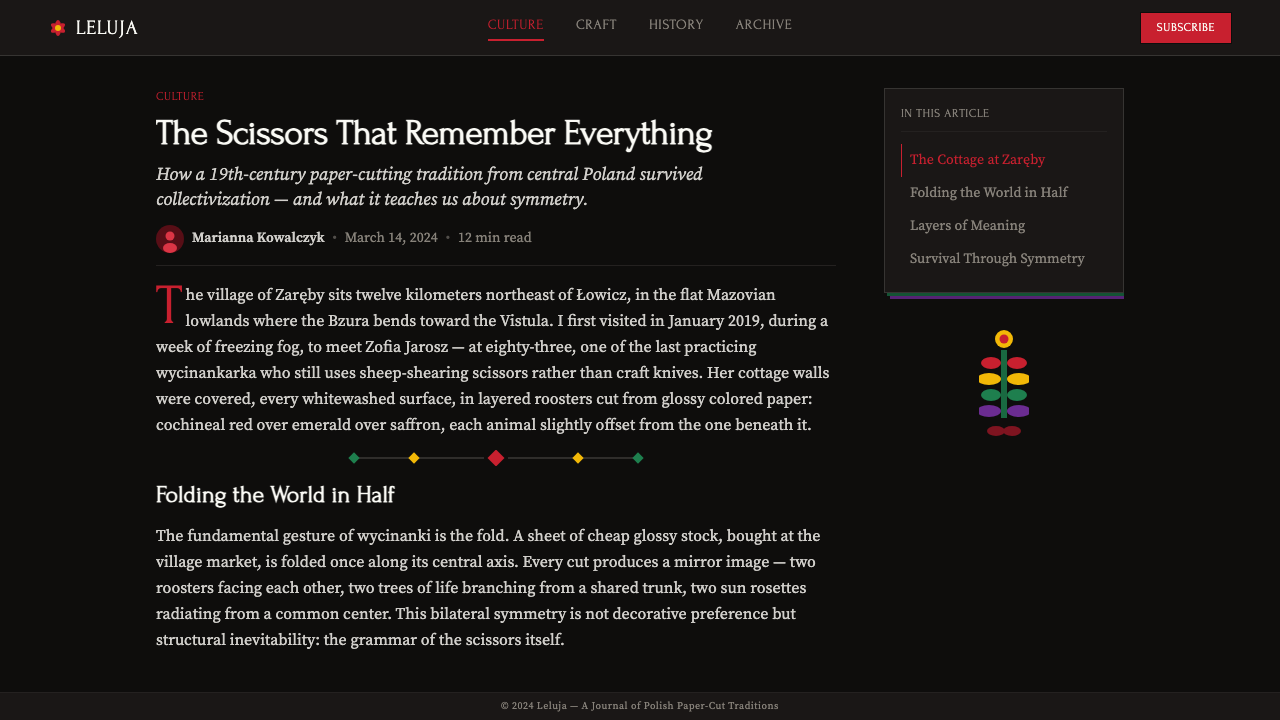
Every Wycinanki composition is organized around an axis of bilateral symmetry — what appears on the left is exactly mirrored on the right, and often what appears on the top is mirrored on the bottom as well. This symmetry is not an aesthetic choice imposed from outside; it is a mechanical consequence of the folding-and-cutting technique. The fold creates the mirror line, and the scissors cut through both halves at once, guaranteeing absolute precision. The result is a visual rhythm of paired forms — two roosters, two blossoms, four identical petals radiating from a center — that feels simultaneously archaic and almost hypnotic.
Saturated Chromatic Layering
The signature color logic of Łowicz Wycinanki is additive layering: individual sheets of deeply saturated color are stacked one atop another, each contributing a distinct hue to the composition. The palette typically draws from a set of intensely saturated warm and cool tones — deep reds and pinks, vivid greens, bright yellows, and strong blues or purples — used at full chromatic intensity with no softening or mixing. Unlike painting, where colors can be blended or muted, each paper layer retains its pure hue. The complexity of the composition emerges not from blending but from the contrast and juxtaposition of pure color zones.
Matte Black Ground
The display convention for Łowicz Wycinanki sets the multi-colored paper-cut against a matte black backing, and this choice is fundamental to how the colors behave. On a white ground, saturated colors would compete with the brightness of the background; on black, every hue is thrown forward with maximum vividness, and the contrast between the dark ground and the brilliantly colored forms becomes the primary visual event. The black ground also serves a compositional function: the uncut black areas become part of the design, creating shadow-like negative space that gives the overall composition depth and structure.
Archetypal Folk Motifs
Wycinanki's vocabulary is not open-ended: it draws from a finite set of archetypal motifs that recur across generations and regions. The dominant figures are the rooster (a symbol of protection, vitality, and the warding off of evil), the peacock (associated with pride and beauty), the tree of life (connecting earthly and spiritual realms), the sun rosette (marking cyclical time and harvest), and the stylized floral bouquet. These motifs are not depicted realistically — the rooster is not a naturalistic bird but a highly geometrized form built from layered semicircles, pointed tail feathers, and bold comb shapes. All representation is absorbed into geometric rhythm.
Hard-Edge Precision
Because the medium is cut paper rather than painted or drawn line, every edge in Wycinanki is absolutely clean. There is no equivalent of a brushstroke wobble, no pencil smear, no gradual transition between figure and ground. The edge of a cut paper form is as precise as the blade that made it — sharp, decisive, and unambiguous. This hard-edge quality means that Wycinanki forms translate with unusual fidelity to digital contexts: they can be reproduced at any scale without loss, and vector interpretations preserve the original quality of the cuts in a way that is impossible with softer, more textured folk art forms.
Festive Density and Abundance
Unlike modernist traditions that prize negative space and compositional restraint, Wycinanki deliberately fills its frame. A finished piece is dense with form — leaves, petals, birds, and geometric borders accumulate until the composition reaches a state of controlled abundance that reads as celebratory excess. The compositional logic is centrifugal: motifs radiate outward from a central axis or medallion, branching and proliferating as they move toward the edges. White space is not a virtue here; fullness is. This density is central to the aesthetic's festive charge and is what makes it immediately recognizable as folk art rather than fine-art minimalism.
Regional Dialect Variations
Although all Wycinanki shares the core technique of folded-and-cut paper, distinct regional styles constitute genuine visual dialects. Łowicz Wycinanki is the most internationally recognized variant, defined by its multi-color layering and the matte black ground. Kurpie Wycinanki tends to work in a single strong color against white, favoring spindly tree-of-life forms and a more linear, graphic quality. Lublin-region Wycinanki may incorporate additional narrative elements and a broader range of figurative subjects. These are not superficial variations — the regional styles encode different aesthetic priorities, different symbolic vocabularies, and different relationships between the figure and its ground.
Who shaped Polish Wycinanki (paper-cut folk art)?
Among the most celebrated Łowicz Wycinanki artists of the twentieth century, Nowak's work exemplifies the tradition at its most chromatic and compositionally complex. Her multi-layered roosters and floral medallions were collected by Polish state institutions and exhibited abroad, helping elevate the tradition from anonymous domestic craft to individually attributed folk art. Her career, spanning most of the latter half of the twentieth century, represents the period when Cepelia's institutional support gave professional legitimacy to master practitioners.
Wojtczak is another major figure in the Łowicz tradition whose work demonstrates the extraordinary range of compositional invention possible within the tradition's fixed motif vocabulary. Working with rooster, peacock, and tree-of-life forms that any Łowicz practitioner would recognize, she developed arrangements of such visual density and color orchestration that her pieces approach the formal complexity of tapestry. Her work was central to international museum presentations of Polish folk art and has become a reference point for contemporary designers drawing on the Wycinanki aesthetic.
An ethnographer and museum curator rather than a practitioner, Znamierowska-Prüfferowa was nevertheless one of the most important figures in the history of Wycinanki as a recognized cultural form. Her systematic fieldwork in the 1880s and beyond, documenting the distribution of regional paper-cutting styles across Poland, established the scholarly foundation on which all subsequent preservation and promotion efforts rested. The Łowicz Museum collections that preserve historical examples of the tradition owe their scope largely to her early collecting and cataloguing work.
A major nineteenth-century Polish Realist painter, Chełmoński is not a Wycinanki practitioner but his paintings of rural Polish life — cottage interiors, peasant figures, village celebrations — provide the most vivid visual documentation of the social context in which Wycinanki was created and displayed. His depictions of cottage walls decorated with paper-cuts, done at a time when the tradition was at its peak of domestic vitality, constitute an invaluable historical record. For designers approaching Wycinanki, Chełmoński's paintings offer a sense of how the art functioned in its original environment: not as isolated artifact but as one element of a richly decorated domestic world.
How do you use Polish Wycinanki (paper-cut folk art) today?
Wycinanki is one of the most visually distinctive folk-art systems available to contemporary designers, and its core properties — bilateral symmetry, hard-edged form, saturated color on dark ground — translate with unusual clarity into digital work. Unlike many historical styles that require either literal reproduction or extensive abstraction before they become usable, Wycinanki's inherent geometry and vector-compatible edge quality make it naturally at home in screens, slides, and print without mediation.
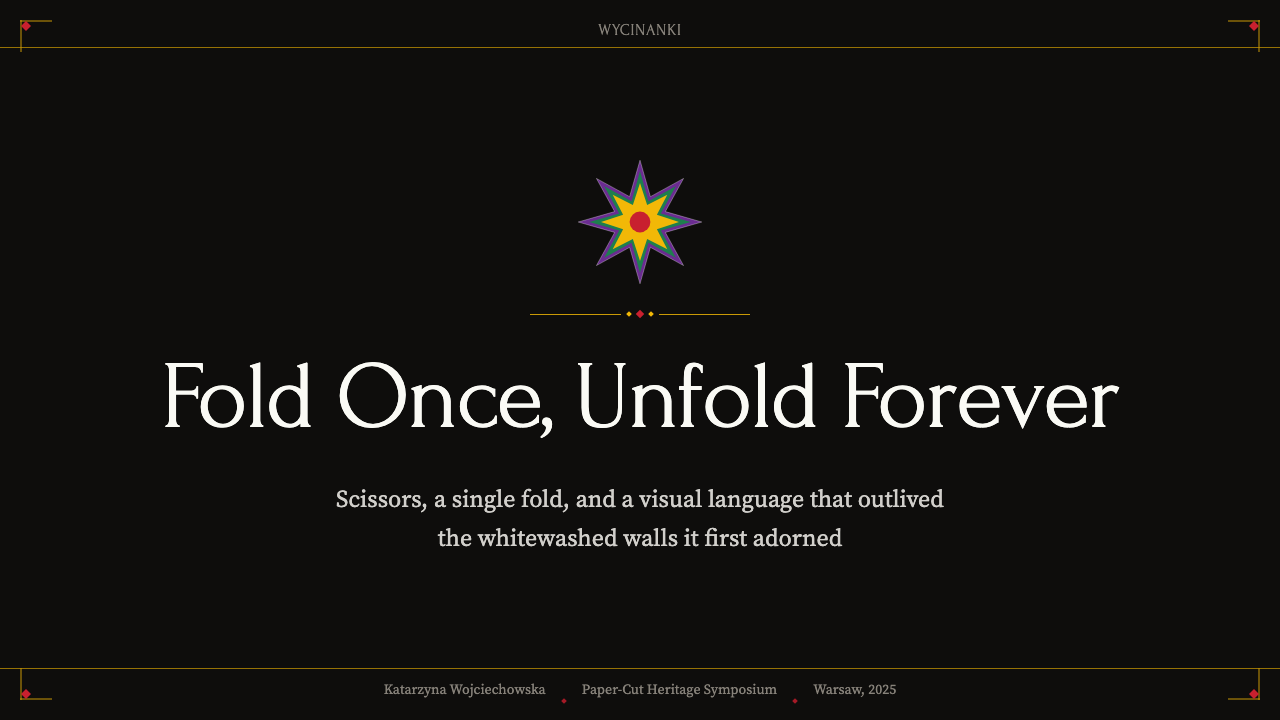
For presentation slides, Wycinanki offers an immediately striking visual language for cover pages and section dividers. A cover slide in this mode works best with a near-black or deep charcoal background field, a large central motif in the tradition's characteristic rooster or radial floral form rendered as a vector silhouette, and the title set in a clean, generous typeface that lets the folk imagery carry the decorative weight. Avoid competing visual elements — the motif should be allowed to read as a complete statement. For content slides, restraint is essential: a single Wycinanki-derived border or medallion accent in the corner or header zone can anchor a slide in the aesthetic without overwhelming information.
For web interfaces, Wycinanki works best as a bold accentual layer rather than an all-over system. A dark-ground hero section with a large bilateral symmetry motif as a background element can establish the visual tone of a brand or campaign page immediately. In UI contexts — product cards, navigation elements, pricing tiers — translating the saturated palette into a careful set of accent colors used against near-black surfaces creates richness without visual chaos. The folk-art associations make this system particularly apt for products in cultural, artisanal, festive, or heritage-adjacent categories. It reads less well in purely technical or enterprise contexts where the ornamental density may conflict with clarity.
For editorial and marketing work, Wycinanki's festive density is one of its greatest assets. A full-bleed feature image built from a large symmetrical paper-cut composition against black makes a vivid editorial opening; smaller medallion motifs work as ornamental chapter or section markers in long-form content. In event marketing — concert posters, festival branding, seasonal campaigns — the style's connection to celebration and ritual gives it immediate emotional resonance. The palette's intensity also photographs well and maintains impact in both digital and physical print contexts.
A common mistake when applying Wycinanki is reducing the tradition to its color palette alone — using saturated red, green, and yellow on dark backgrounds without the structural symmetry that gives those colors their coherence. The palette without the symmetry reads as generic folk decoration. Equally problematic is attempting to use Wycinanki as an all-over texture in complex information-dense layouts: the tradition's characteristic density, which is an asset in decorative or hero contexts, becomes a liability when it competes with body text, data tables, or interactive UI elements. Use the aesthetic to frame and establish tone; clear functional zones should remain visually quiet.
Polish Wycinanki (paper-cut folk art) — FAQ
How does Wycinanki differ from other paper-cutting traditions like Chinese jiǎnzhǐ or Japanese kirigami?
All three traditions share the basic technique of cutting paper to create decorative forms, but the visual outcomes are quite different. Chinese jiǎnzhǐ typically works in a single color — most iconically red — and prioritizes intricate figurative cutting within a unified field. Japanese kirigami tends toward geometric abstraction and three-dimensional folded forms. Wycinanki's distinguishing feature is its multi-color layering system: rather than creating complexity through the intricacy of a single cut, it builds up chromatic richness by stacking multiple sheets of differently colored paper, with each layer adding a new hue and a new element to the composition. The matte black display ground is also a specifically Polish convention not found in the same form in other traditions.
Is Wycinanki strictly symmetrical, or is there room for asymmetric compositions?
The traditional Wycinanki produced by the folding technique is structurally symmetric because the fold itself enforces mirror duplication. However, asymmetric compositions do exist within the tradition — some pieces involve carefully placed single figures or narrative arrangements that do not depend on folding — and contemporary designers working in a Wycinanki-inspired mode have explored asymmetric applications of the palette and motifs. The key distinction is that symmetry in traditional Wycinanki is not just an aesthetic preference but a consequence of the process itself. When designers depart from bilateral symmetry, they move away from the tradition's deepest formal logic, even if they retain its color and motif vocabulary.
How do you use Wycinanki's saturated palette without making a design feel garish?
The key is the dark ground. In traditional Wycinanki, the saturated colors are not experienced in isolation — they are always read against matte black, which absorbs competing ambient energy and allows the colors to assert themselves without visual collision. On a white or light background, the same hues would likely feel overwhelming or discordant. When adapting the palette for design work, maintaining a strong dark anchor — whether as a background field, a framing element, or a dominant structural block — allows the bright accents to read as bold and festive rather than chaotic. A second discipline is restraint in the number of colors used simultaneously in any given zone: the traditional pieces can carry many colors because each one is contained in a distinct form. In UI or layout contexts, letting each color occupy its own territory is what keeps the composition legible.
Can Wycinanki work for digital brands that are not traditionally folk-oriented?
Yes, but the translation requires intention. Wycinanki's formal properties — radial symmetry, high-contrast saturated color, hard-edged geometric silhouette — are strong enough to function as a visual system independently of their folkloric associations, in the same way that Bauhaus geometry can be used without invoking the specific political history of 1920s Germany. A brand seeking boldness, festivity, and strong visual identity can draw on Wycinanki's structural vocabulary without presenting itself as a Polish folk arts brand. The risk to manage is inadvertent kitsch: if the folkloric associations are half-evoked and half-abandoned, the result can feel theme-park rather than principled. Commitment to the formal system — the symmetry, the dark ground, the pure-color zones — while leaving the specific iconographic motifs behind produces more successful adaptations.
What is the difference between Łowicz and Kurpie Wycinanki, and which is more commonly referenced in design work?
Łowicz Wycinanki is the style most commonly associated with the name internationally and most frequently referenced in design work. It is defined by its multi-layered, multi-colored compositions displayed against black, featuring roosters, peacocks, and floral medallions built up from stacked sheets of different saturated hues. Kurpie Wycinanki, by contrast, typically works in a single color against white or a light ground, favoring tall, branching tree-of-life compositions with a spindly, linear graphic quality. Łowicz's chromatic maximalism photographs more dramatically and translates more immediately into bold brand or campaign imagery, which is why it dominates the international design reference. Kurpie's single-color silhouette style, however, may be more useful in design contexts where clarity and graphic economy are paramount — it functions almost like an elaborate illustrative icon system.
Related design styles
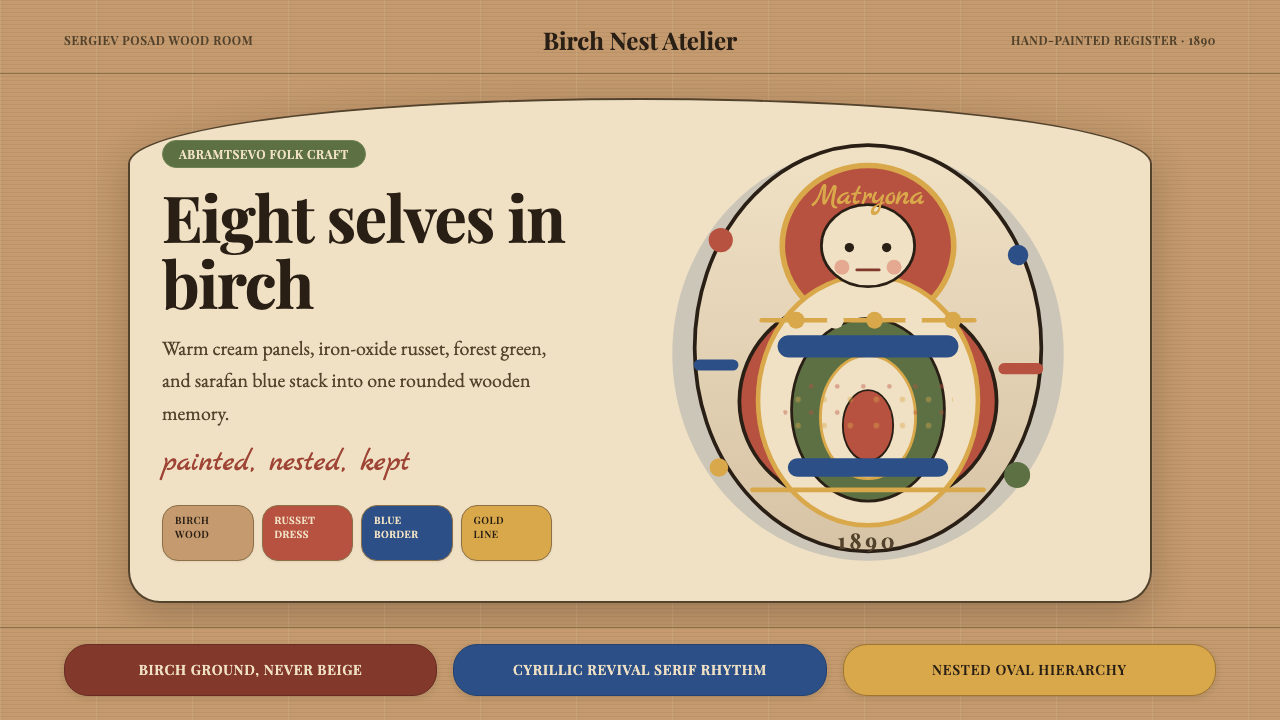 Russian Matryoshka 1890Warmth nests inward. Birch, cream, russet, and egg-oval type stage handmade d…
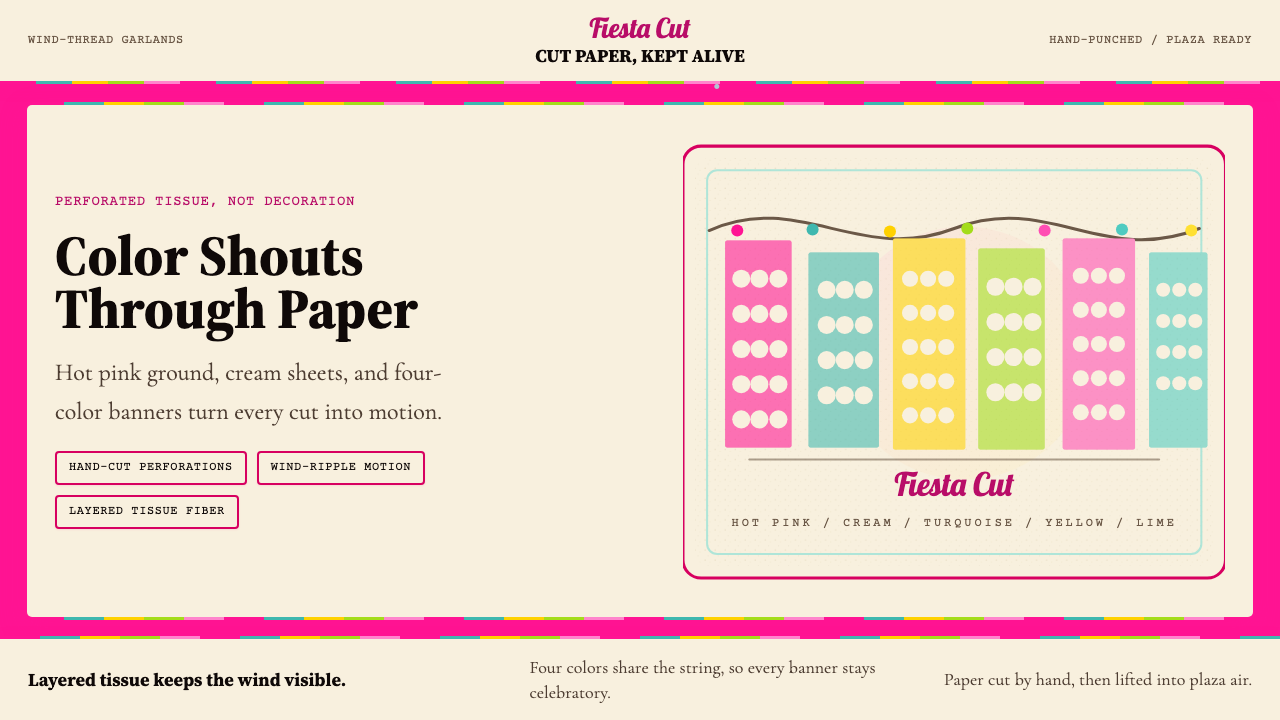 Mexican Papel Picado TissueFiesta cut paper. Hot pink, turquoise, yellow banners and hand-cut perforatio…
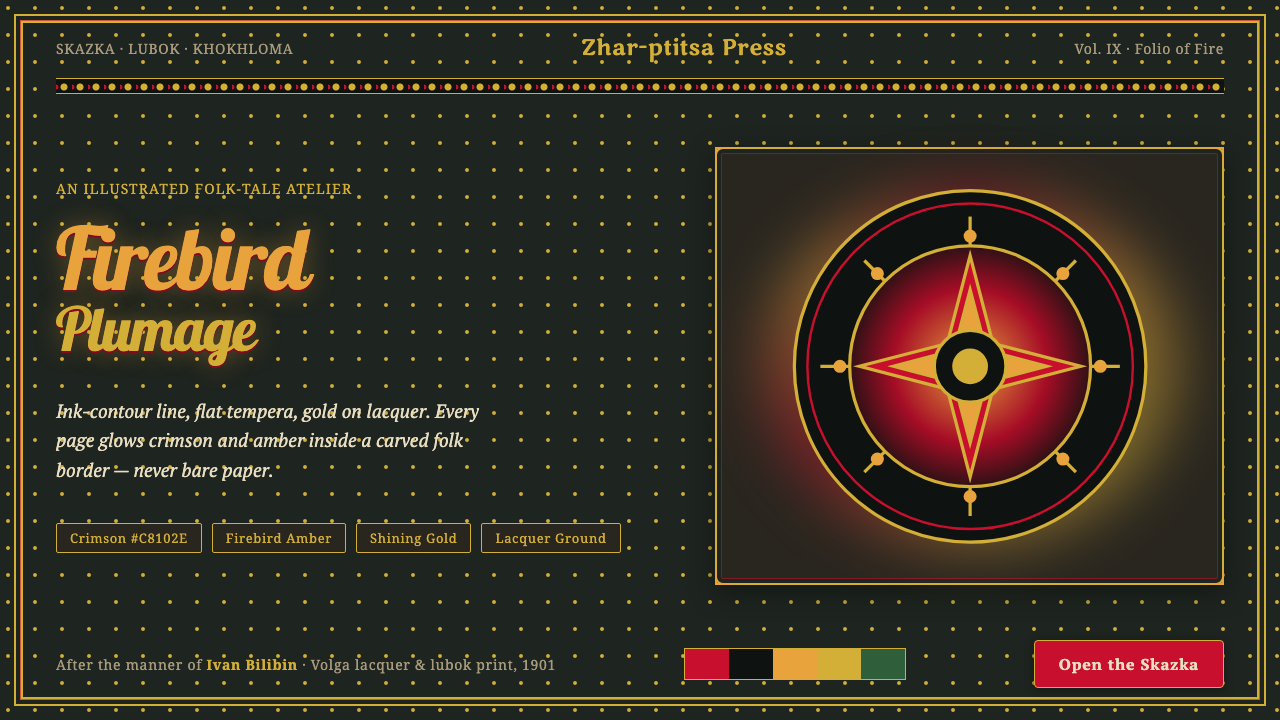 Slavic Firebird FolkloreNever bare paper. Crimson-gold firebird plumage glows in gilt folk borders on…
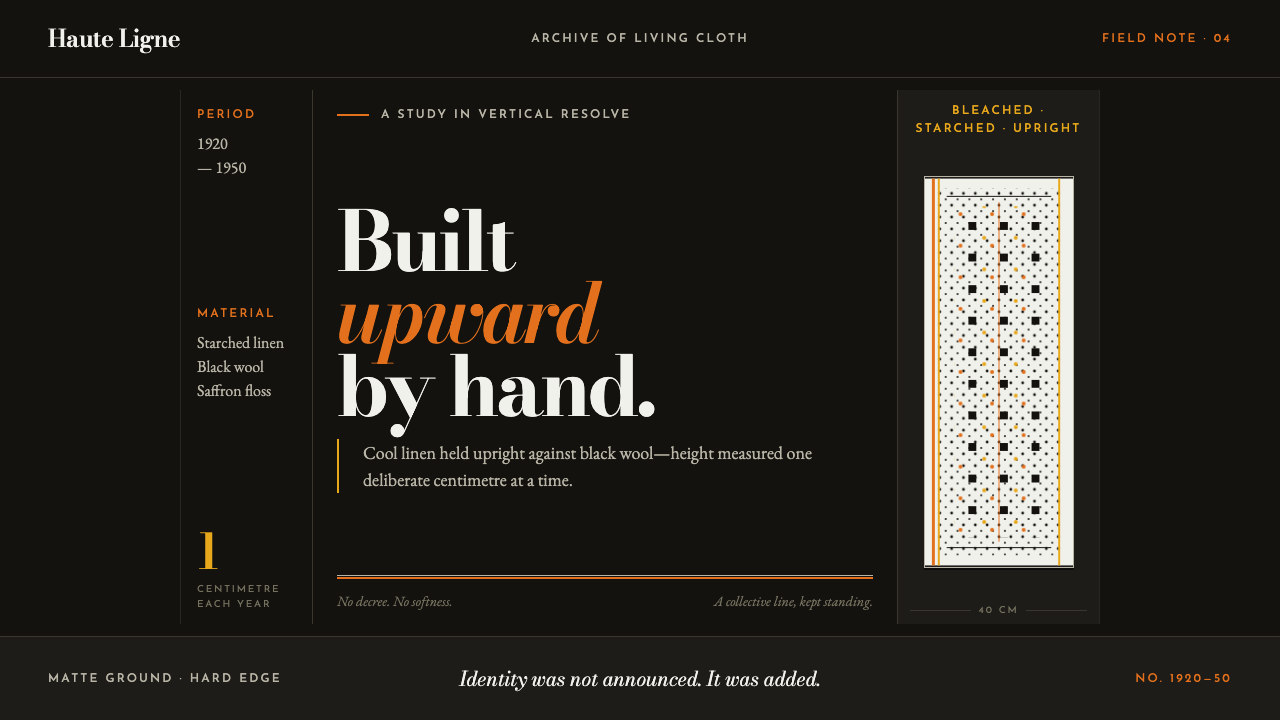 Bigouden CoiffeIdentity stands tall. Starched linen rises over matte black, edged in saffron…
 Greenlandic KalaallisuutColour, kept by rule. Hard-edged bead bands blaze symmetrically across a seal…
 Palauan Bai StoryboardNarrative hits like carved wood. Bai red, ochre bands, kaolin panels, black o…