About Polish Wycinanki (paper-cut folk art)
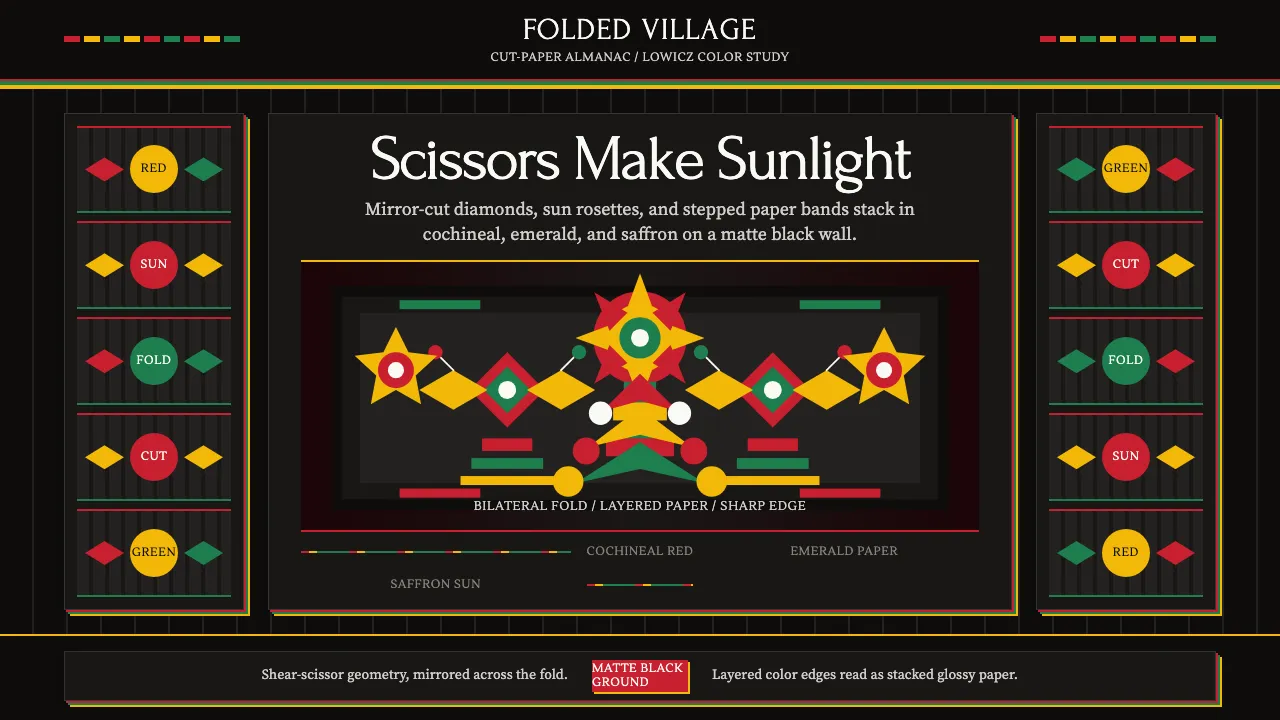
Wycinanki is the Polish peasant tradition of cutting layered colored paper with sheep-shearing scissors, producing symmetric roosters, sun rosettes, and tree-of-life motifs. Originating in the 1830s Łowicz and Kurpie villages, these chromatic paper-cuts adorned whitewashed cottage walls with cochineal reds, emerald greens, and saffron yellows.
This design system captures the sharp scissor-edge geometry, bilateral mirror symmetry, and saturated layered color of Łowicz multi-color paper-cuts displayed against a matte black museum ground.
Learn more about the Polish Wycinanki (paper-cut folk art) style
- Origin
- Poland — Łowicz, Kurpie, Mazowsze, Lublin region
- Era
- 1820s–1830s onward; peak village production 1880–1939; contemporary revival
- Key figures
- Apolonia Nowak · Jadwiga Wojtczak · Maria Znamierowska-Prüfferowa · Józef Chełmoński
- Movements
- Polish vernacular folk art · Cepelia folk cooperative · Łowicz Folklore Museum preservation
Polish Wycinanki (paper-cut folk art) design spec
Colors
Typography
The other 11 sections — buttons, cards, spacing, motion, techniques and more — open once you unlock. Download the DESIGN.md or send it to your AI in one click. Unlock once, yours forever.
Sign up nowStyles similar to Polish Wycinanki (paper-cut folk art)
Also inspired by crafts & folk art, with a close feel.
 Chinese New Year Spring FestivalThe new year arrives at full volume. Lantern red glows through lacquer night and gold sparks.
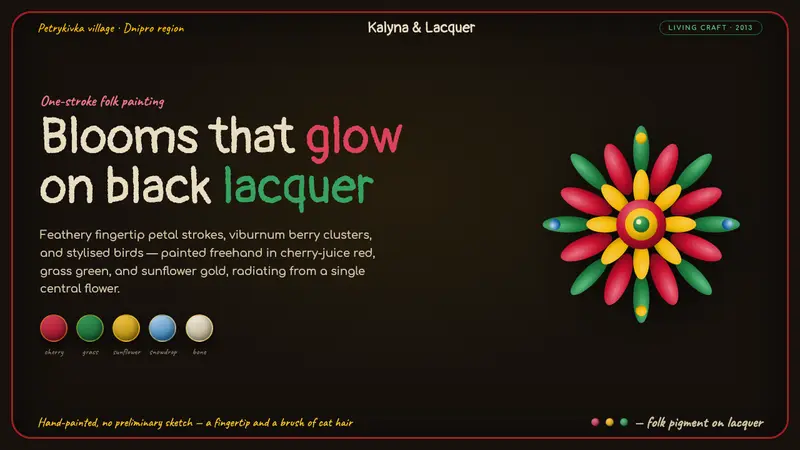 Petrykivka Folk PaintingFolk maximalism that glows. One-stroke red-green-gold blooms radiate from a center on black lacquer.
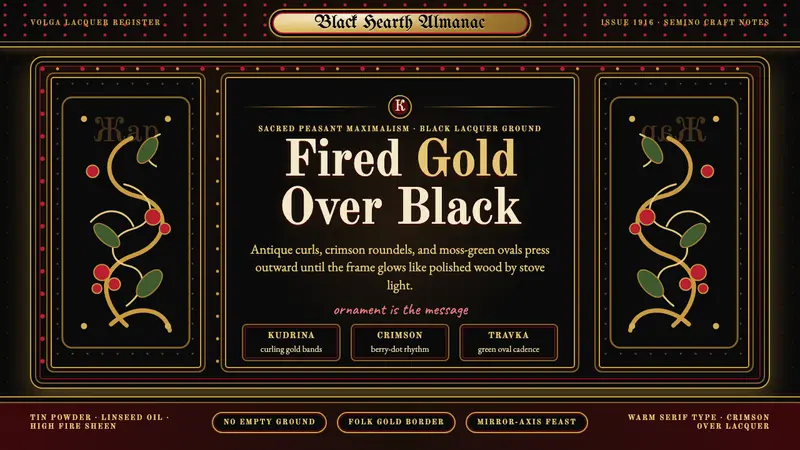 Russian KhokhlomaOrnament is the message. Antique gold curls and crimson dots crowd a black lacquer grid.
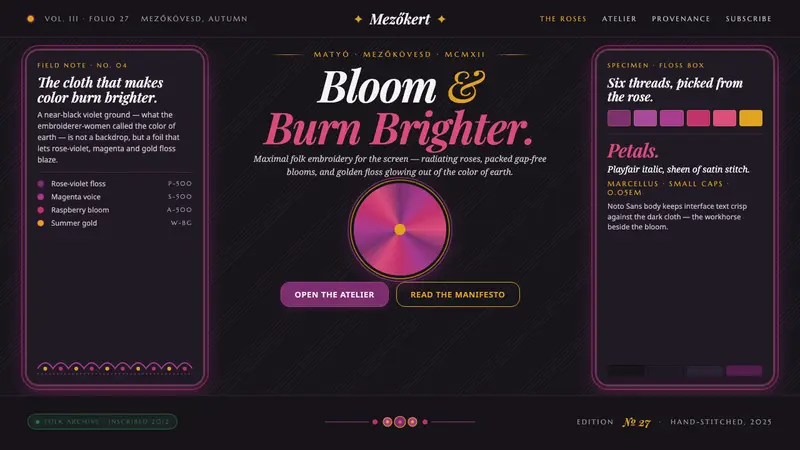 Hungarian Matyó VioletFolk embroidery, maximal. Rose-violet and gold blooms blaze gap-free on near-black violet cloth.