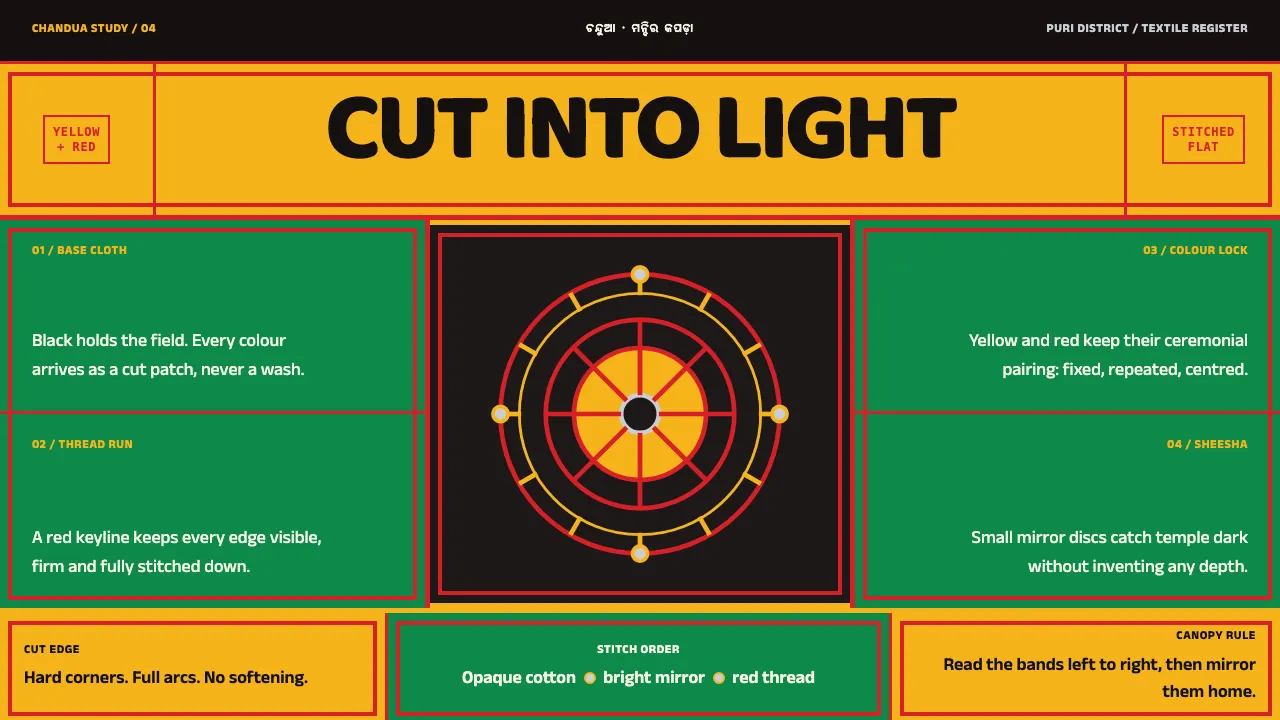
About Pipli Appliqué
Pipli is one road in Puri district where tailor families have cut and stitched chandua appliqué for the Jagannath temple longer than anyone kept records. Canopies, banners, ceremonial umbrellas and the covers that dress the Rath Yatra chariots all come off the same low workbenches — shapes scissored from dyed cotton, laid on an opaque base cloth, held with buttonhole and satin stitch, and ringed with small mirrors that catch light in the dark of the temple.
The system takes the cloth literally. The page is the black base; everything else is a patch sitting on it. Four canonical shades carry the whole thing, colours are locked by deity rather than chosen per screen, and depth is refused outright — a shape is separated from its ground by a stitch line and a colour change, never by a shadow.
- Origin
- Pipli village, Puri district, Odisha, eastern India
- Era
- pre-1900 to present; temple-service craft on the Rath Yatra calendar
- Key figures
- the hereditary Darji tailor families of Pipli · the Shree Jagannath Temple Administration, Puri
- Movements
- Odishan temple craft · chandua appliqué (GI-registered) · Rath Yatra chariot decoration
Pipli Appliqué design spec
Colors
Typography
The other 11 sections — buttons, cards, spacing, motion, techniques and more — open once you unlock. Download the DESIGN.md or send it to your AI in one click. Unlock once, yours forever.
Sign up nowStyles similar to Pipli Appliqué
Also inspired by crafts & folk art, with a close feel.
 Chinese New Year Spring FestivalThe new year arrives at full volume. Lantern red glows through lacquer night and gold sparks.
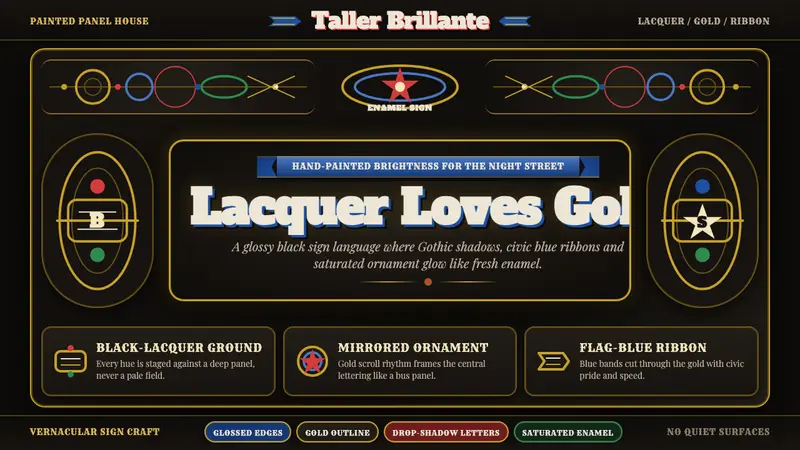 Fileteado Porteño Sign ArtBlack lacquer turns maximal. Gold scrolls, blue ribbons and Gothic shadows glow like enamel.
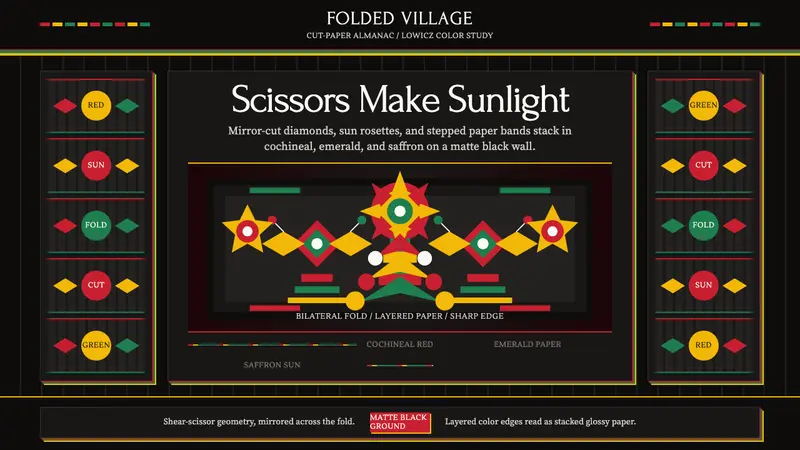 Polish Wycinanki (paper-cut folk art)Cuts sing in symmetry. Cochineal, emerald, and saffron layers blaze on black.
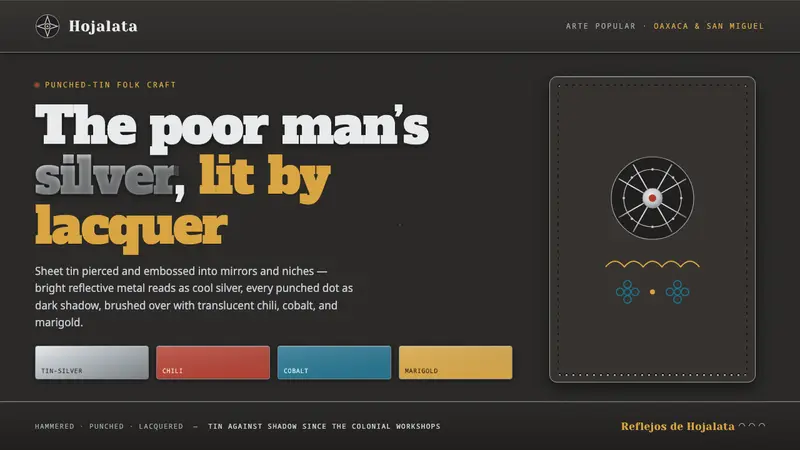 Punched Tin HojalataThe poor man's silver. Pierced tin on oxidized shadow, washed in chili, cobalt, marigold lacquer.