What is Tajik Pamir Needlework (Chid Roof)?
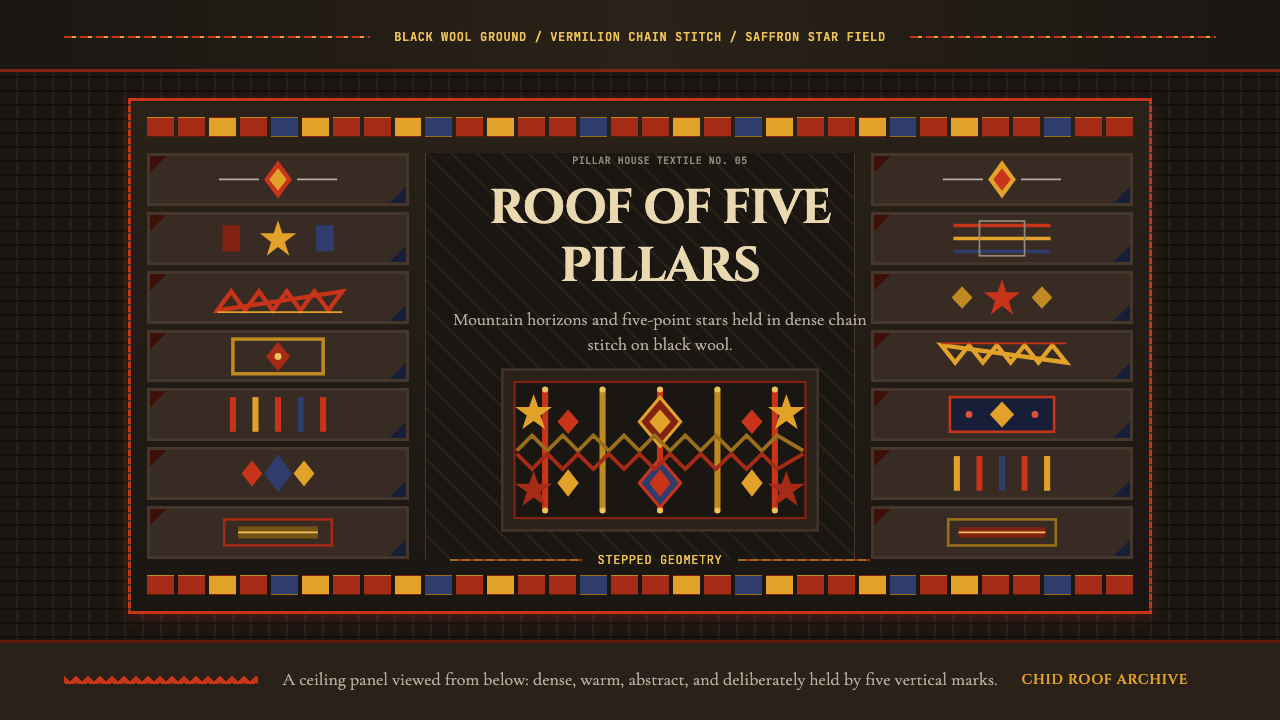
In the high valleys of the Pamir, five sacred pillars hold up a cosmos stitched in vermilion and saffron against black wool — and that ceiling has become a design system.
Tajik Pamir Needlework (Chid Roof) in brief
Tajik Pamir Needlework (Chid Roof) is a visual system derived from the ceremonial embroidered ceiling panels of the Pamiri chid — the five-pillared central room that serves as both domestic hearth and cosmological diagram in the high-altitude homesteads of Gorno-Badakhshan. Women of the Shughnan, Wakhan, and Bartang valleys stitched dense chain-stitch panels in deep red, saffron yellow, and accents of ivory against a ground of black undyed wool, producing geometric fields of stepped diamonds, eight-pointed stars, and interlocking zigzags that map mountain horizons and celestial alignments onto textile.
The design system translates this material tradition into interface: a dark wool ground stands in for a very deep background, the chain-stitch geometry becomes the structural ornament of composition, and the warm spectrum of vermilion-to-saffron defines a color arc that is simultaneously festive and authoritative. Nothing is smooth; every curve is resolved into a staircase of right angles. Typography, when evoked in this system, carries the weight and deliberateness of carved wooden beam inscriptions rather than the fluency of printed type.
The resulting aesthetic is dense, warm, and structurally legible. It reads as textile even when rendered digitally — the eye perceives a woven surface rather than a lit screen. This quality makes it unusual among dark-mode design systems, most of which lean toward the cold end of the spectrum. Pamir Needlework is warm dark: richly chromatic, spatially flat, and geometrically exact.
Where does Tajik Pamir Needlework (Chid Roof) come from?
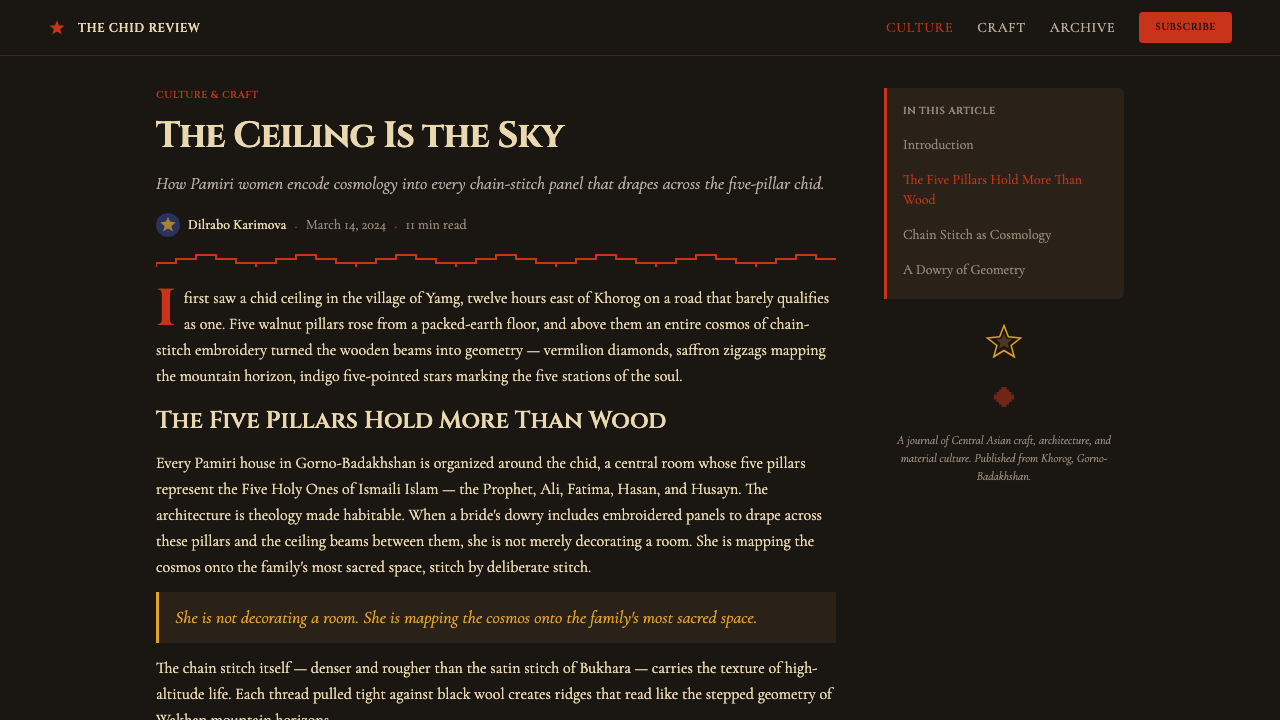
The chid room — its name derived from the Shughni word for the central pillar — is the architectural and spiritual core of the traditional Pamiri house. The five pillars that define the room's grid correspond in Ismaili cosmology to the Five Holy Ones of the faith: the Prophet, Ali, Fatima, Hasan, and Husayn. The ceiling above them, divided into a geometric lattice by the timber framing, was the surface that women of the household transformed over generations through embroidery into a textile cosmogram — a star-map and prayer surface simultaneously. The embroidered panels, called chid namad or chid gilam, were suspended above the central hearth, where smoke and firelight animated the stitched geometry.
The needlework tradition that decorated these panels belongs to a broader Central Asian suzani textile culture but developed a distinctly Pamiri character shaped by material constraints and geographic isolation. Above three thousand meters, dye plants are scarce; the dominant palette emerged from what was reliably available — madder root for the deep reds, saffron-adjacent mountain plants for the yellows, and the natural black-brown of the Pamir sheep's wool for the ground. The chain stitch, executed with a hooked needle called a tambour hook, allowed rapid coverage of large surfaces with a continuous thread, producing the dense interlocked geometry that characterizes Pamir work at its finest.
Mikhail Andreev, the Russian ethnographer who documented Pamiri material culture in the early twentieth century, recorded the structural symbolism of the chid ceiling in detail, noting that individual panels often depicted specific mountain passes or celestial bodies recognizable to local communities. Hermann Kreutzmann's later fieldwork in the Wakhan corridor and Shughnan documented the regional variation in pattern vocabulary — Wakhi work tends toward more open, airy diamond grids, while Shughni embroidery is denser and more saturated in its reds. Sayfullo Abdulloev, a Tajik ethnomusicologist and cultural historian, has connected the geometric cosmograms of the needlework to the structural symbolism of Pamiri oral poetry, arguing that both traditions encode the same cosmological map in different media.
The collectivization campaigns of the Soviet period (roughly 1930 through the 1950s) disrupted the transmission of the practice sharply. Communal living arrangements dissolved the household workshop structure within which embroidery skills passed from mother to daughter; synthetic dyes replaced the mountain plant palette; and mass-produced textiles undercut the functional necessity of hand-stitched panels. The peak era of the tradition — dense, cosmologically sophisticated, naturalistically dyed — is generally dated to the period between the 1880s and the 1960s. Post-independence revival efforts in Tajikistan have focused on Khorog, the regional capital of Gorno-Badakhshan, where craft cooperatives and museum collections preserve and teach the pattern vocabulary.
What defines the Tajik Pamir Needlework (Chid Roof) look?
Ground Color
The foundation of the system is a very deep, near-black ground evoking undyed Pamir wool — not the cold blue-black of most dark interfaces, but a brown-tinged black that reads as organic and warm. This ground absorbs light rather than emitting it, producing a sense of depth and material weight that differs fundamentally from the sharp contrast of pure digital black.
Warm Chromatic Arc
The primary color range moves from deep vermilion at one end to warm saffron-gold at the other, with the full spectrum between — brick red, terracotta, burnt orange, deep amber — all usable within the system. Ivory and aged white appear as accent and highlight tones. Cool colors are absent or deeply suppressed; blues and greens, if they appear at all, are warm-shifted toward teal and olive. The palette is explicitly festive and cosmological, not corporate.
Stepped Geometry
Every diagonal line is rendered as a staircase of horizontal and vertical segments — the direct consequence of chain-stitch embroidery on a woven grid, where true diagonals are impossible. This stepped vocabulary applies universally: borders zigzag, diamonds step outward at their points, stars resolve into octagonal forms built from right-angle increments. The visual effect is simultaneously regular and handmade, mechanical and warm.
Cosmological Density
Pamir embroidery does not leave ground visible between motifs — the surface is covered fully, corner to corner, in interlocking geometric units. Applied to interface design, this principle manifests as a preference for filled compositions over airy ones: tight grid arrangements, pattern backgrounds rather than empty fields, textural framing around content areas. Negative space is not used in the contemporary minimalist sense; instead, hierarchy is established through scale and chromatic intensity.
Chain-Stitch Texture
The chain stitch produces a distinctive raised, looping line that reads as texture even at a distance — each stitched form has a slight three-dimensionality from the thread's physical presence. In digital translation, this quality can be approximated through subtle repeating micro-patterns along lines and borders, and through a warm, slightly uneven quality in solid color fields that distinguishes them from the flat fills of other dark design systems.
Five-Pillar Grid Structure
The chid room's five pillars divide the ceiling into five zones, and this structural logic persists in the design system as a preference for odd-numbered column arrangements — five or three columns rather than four or two — and for layouts that have a single strong central axis surrounded by symmetrical flanking zones. Content is organized as if viewed from below, looking up at a structured ceiling rather than reading across a flat page.
Carved Beam Typography
Type in this system should carry visual weight consistent with carved rather than printed letterforms — broad strokes, deliberate spacing, and a sense that each character occupies its own measured territory on the dark ground. Decorative calligraphy is not the reference; the Pamiri carved wooden beams are — utilitarian, durable, and spatially decisive. Very light weights disappear against the dense ground and should be avoided.
Who shaped Tajik Pamir Needlework (Chid Roof)?
The Russian ethnographer Mikhail Andreev conducted extensive fieldwork in the Pamir valleys in the early twentieth century, producing detailed documentation of Pamiri domestic architecture, material culture, and decorative arts. His recordings of the chid room's symbolic program — including the cosmological significance of each pillar and the pattern vocabulary of individual embroidered ceiling panels — remain foundational references for scholars of Pamiri visual culture. Andreev's work was produced in a period when the tradition was still intact as a living practice, making his documentation uniquely valuable.
Sayfullo Abdulloev, a Tajik ethnomusicologist and cultural historian based in Dushanbe, has produced scholarship connecting the geometric cosmograms of Pamiri textile art to the structural symbolism of regional oral poetry and music. His argument — that the chid ceiling panel and the oral epic encode the same cosmological map through different sensory channels — situates Pamiri needlework within a broader tradition of material cosmology and has influenced how contemporary designers engage with the pattern vocabulary as philosophically coherent rather than merely decorative.
Hermann Kreutzmann, a German geographer specializing in high-altitude Central Asia, conducted sustained fieldwork in the Wakhan corridor, Shughnan, and adjacent Pamir valleys, documenting regional variation in the needlework tradition alongside broader ethnographic surveys of mountain communities. His comparative documentation revealed that the Wakhi and Shughni embroidery schools differ significantly in density, color saturation, and pattern vocabulary — findings that have allowed designers and curators to distinguish between regional sub-traditions within the broader Pamiri needlework category.
The makers of the canonical Pamir chid ceiling panels — the women of Shughnan, Wakhan, and Bartang who stitched the cosmological maps that now define the tradition — are almost entirely unnamed in the historical record. Their work was household labor and devotional practice simultaneously, passed through apprenticeship within families rather than through formal institutions. The period from the 1880s through the 1940s is considered the apex of technical and cosmological sophistication in the embroidery, and the panels surviving from this era in museum collections in Dushanbe, Khorog, and Saint Petersburg represent the tradition at its most resolved.
Following Tajikistan's independence in 1991 and the end of the Tajik Civil War in 1997, cultural revival organizations in Khorog — the capital of Gorno-Badakhshan — began documenting surviving embroiderers, collecting pattern templates, and organizing cooperatives to teach and practice the craft. These cooperatives have been instrumental in preserving the pattern vocabulary as a teachable system rather than allowing it to persist only in institutional collections. Their work has also connected Pamir needlework to the international craft market, bringing contemporary awareness to a tradition that had been largely invisible outside the region.
How do you use Tajik Pamir Needlework (Chid Roof) today?
Pamir Needlework is an unusual dark-mode system in that its warmth and density make it unsuitable for contexts where clinical clarity is expected, but extraordinarily powerful for contexts where richness, authority, and cultural depth are valued. Applying it well requires committing to its core logic — warm darkness, stepped geometry, and cosmological density — rather than selectively borrowing its surface palette.
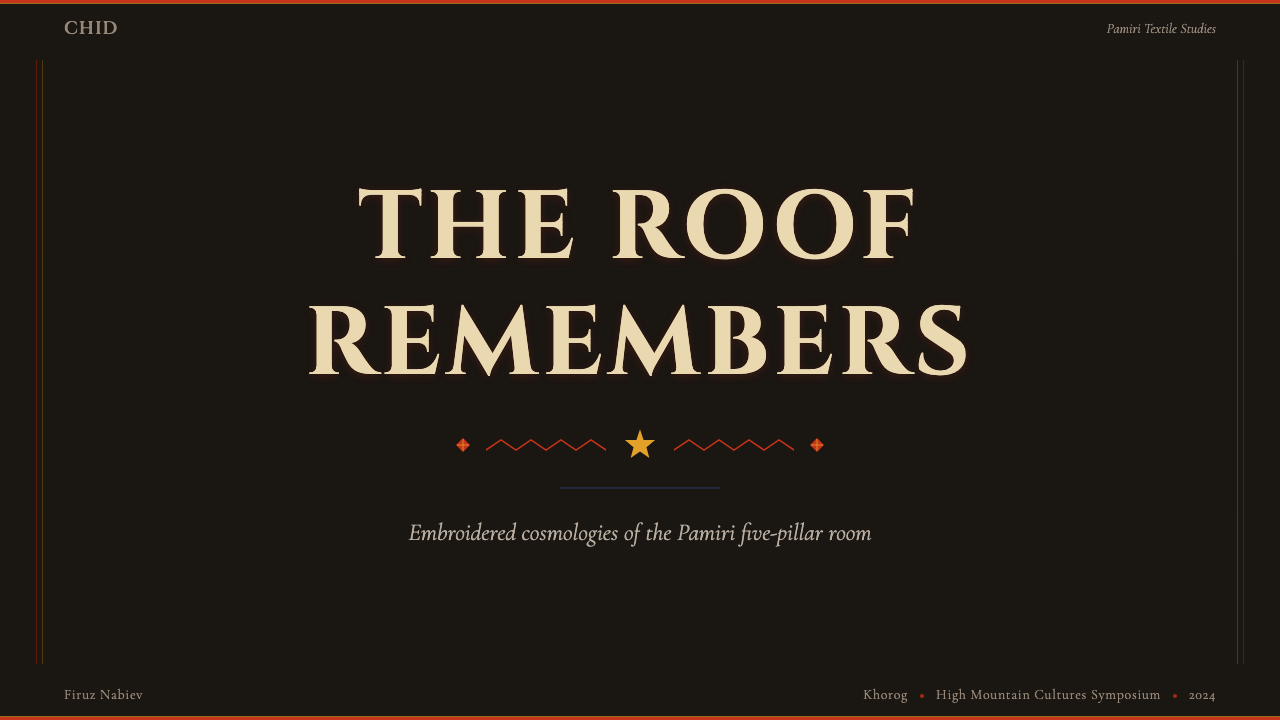
For presentation slides, the system works most naturally on full-bleed dark covers where a single large embroidery-derived geometric motif anchors the composition, with a title set in a heavy, broadly-spaced typeface in saffron or ivory against the deep ground. Content slides should maintain the density principle: borders frame each slide section, and data or text is organized within defined cells rather than floating freely. Data visualization translates well into the geometric vocabulary — stepped bar charts, diamond-shaped scatter plot markers, and area charts with stepped rather than smooth edges all read as native to the system. Avoid white or very light backgrounds on content slides; even a slightly warmed deep tone maintains system coherence.
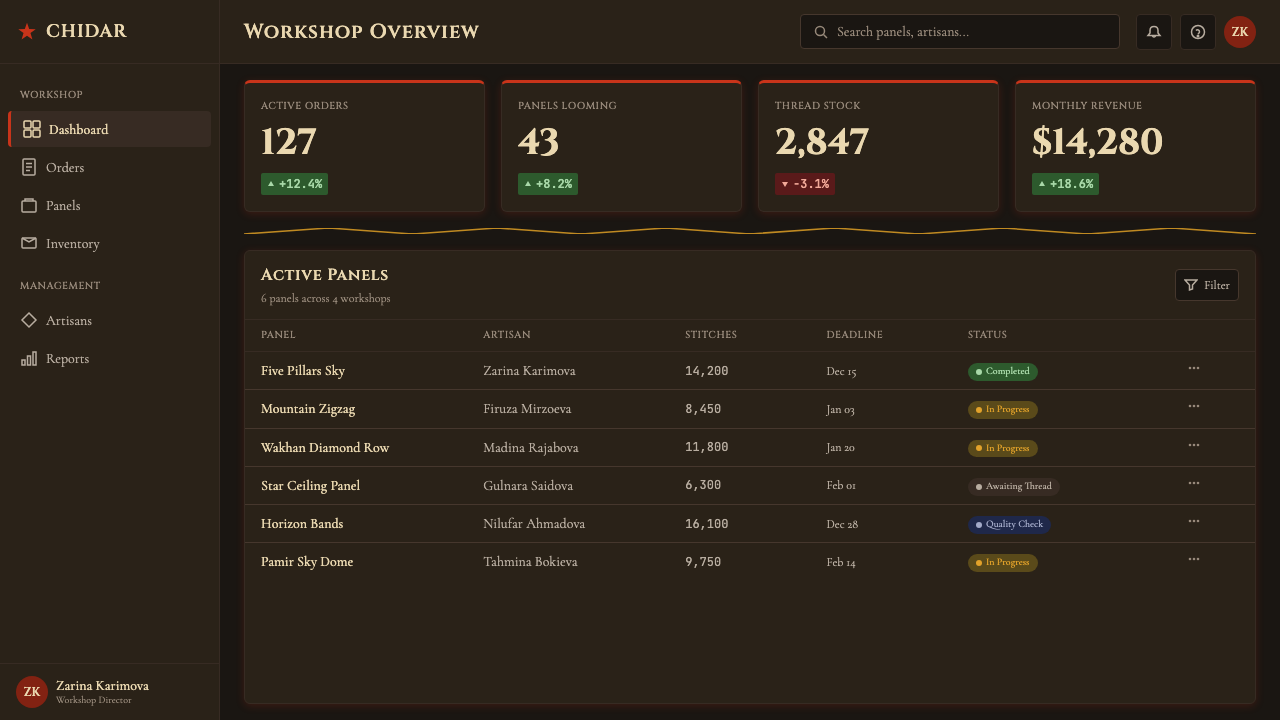
For web interfaces, this system is best suited to contexts that carry cultural weight or require a strong sense of occasion — a premium cultural institution, a heritage brand, a festival platform, or a product positioned around craft and specificity. Dashboard and data interfaces work when the chart forms adopt the geometric vocabulary; pricing pages work when tiers are differentiated through chromatic intensity within the warm arc rather than through generic blues or greens. Navigation should be substantial in visual weight, using full-width bars and heavy type rather than ghost menus and light hairlines. Interactive states are best communicated through saffron or bright vermilion, which advance naturally against the dark ground.
For editorial and marketing work, the system supports strong feature-length visual treatments where an article or campaign is given an immersive, textile-like environment. A Pamir-inflected editorial layout sets body text in warm ivory against a deep ground, uses stepped geometric ornaments as section dividers, and allows pull-quotes or key data to appear in the warm chromatic arc at larger scale. Marketing applications benefit from the poster-like quality: full-screen covers alternating between deep-ground-on-pattern and pattern-on-deep-ground, with single vermilion or saffron calls to action that carry the eye without competing with the overall field.
The most common mistake when applying this system is stripping the density — using the warm palette against a white or near-white background as if it were a folk-inspired accent system. The system only coheres against the deep ground; transplanted onto white, the stepped geometry and warm chromatics become decorative rather than structural. A secondary error is over-relying on red at the expense of the full warm arc: the system's richness comes from the interplay between vermilion, the mid-range brick and terracotta tones, and the saffron-gold, not from saturated red alone.
Tajik Pamir Needlework (Chid Roof) — FAQ
Is this system only suitable for Central Asian or heritage-themed products?
No — the system's visual logic is structural rather than illustrative. It does not require Central Asian content to function; what it requires is a context where warmth, density, and ceremonial weight are appropriate values. A premium whisky brand, an astronomy application, a festival branding system, or a platform for craft and maker culture can all adopt the system without referencing its geographical origin at all. The risk of cultural misappropriation is lower here than with icon-heavy folk systems, because the source vocabulary is abstract geometry rather than representational symbols with specific ritual significance.
How does the stepped geometry affect responsive design at small screen sizes?
Stepped geometry scales downward with some difficulty: at very small sizes, the staircase detail that gives the motifs their handmade quality becomes either illegible or visually noisy. The practical resolution is to define two registers of the geometry — a detailed version for large viewports where the stepping is visible and meaningful, and a simplified version for mobile where diagonal lines are approximated with fewer steps or replaced with the underlying geometric form (diamond, star, zigzag) without the staircase detail. This is consistent with how the tradition itself handles scale variation in embroidery: finer work for ceremonial panels, bolder simplified forms for everyday textiles.
Can the system work effectively in a lighter or mixed-key version?
A fully light-key inversion of the system tends to fail because the warm palette reads as dusty and low-contrast against cream or white grounds — unlike, say, a Bauhaus inversion where the primaries retain their punch on any neutral ground. A mixed-key approach works better: a deep-ground hero section transitioning to a warm cream main body, with the geometric ornament appearing as a textural border or divider rather than as a full background field. The key is to keep at least one major surface in the deep register; eliminating the dark ground entirely loses the defining quality of the system.
How should imagery and photography be treated within this system?
Photography is a difficult fit for a system whose reference is textile rather than lens-based imagery. When photography is necessary, the most coherent approach is to treat images as inlaid panels within the geometric field — cropped to geometric shapes (hexagons, stepped rectangles, diamond grids), given a warm duotone treatment in the system's chromatic arc, and bordered by a geometric frame consistent with the pattern vocabulary. Full-bleed naturalistic photography breaks the textile illusion that gives the system its identity. Illustration that adopts the stepped geometric vocabulary — flat, warm-palette, staircase-diagonal — integrates far more naturally than photography.
What distinguishes Pamir Needlework from other Central Asian textile design systems like Uzbek suzani?
Uzbek suzani typically works on a light or cream ground, uses a more varied botanical vocabulary including stylized pomegranates, floral medallions, and vine tendrils alongside geometric forms, and tends toward more saturated polychromy — many colors at high intensity simultaneously. Pamir Needlework is darker, more restricted in palette, more strictly geometric (the mountain geography and high-altitude material constraints produced a more abstract vocabulary), and organized by a cosmological structural logic rather than by aesthetic abundance. Suzani reads as celebratory abundance; Pamir work reads as structured cosmology. The difference matters for application: suzani-derived systems feel festive and warm; Pamir-derived systems feel authoritative and deep.
Related design styles
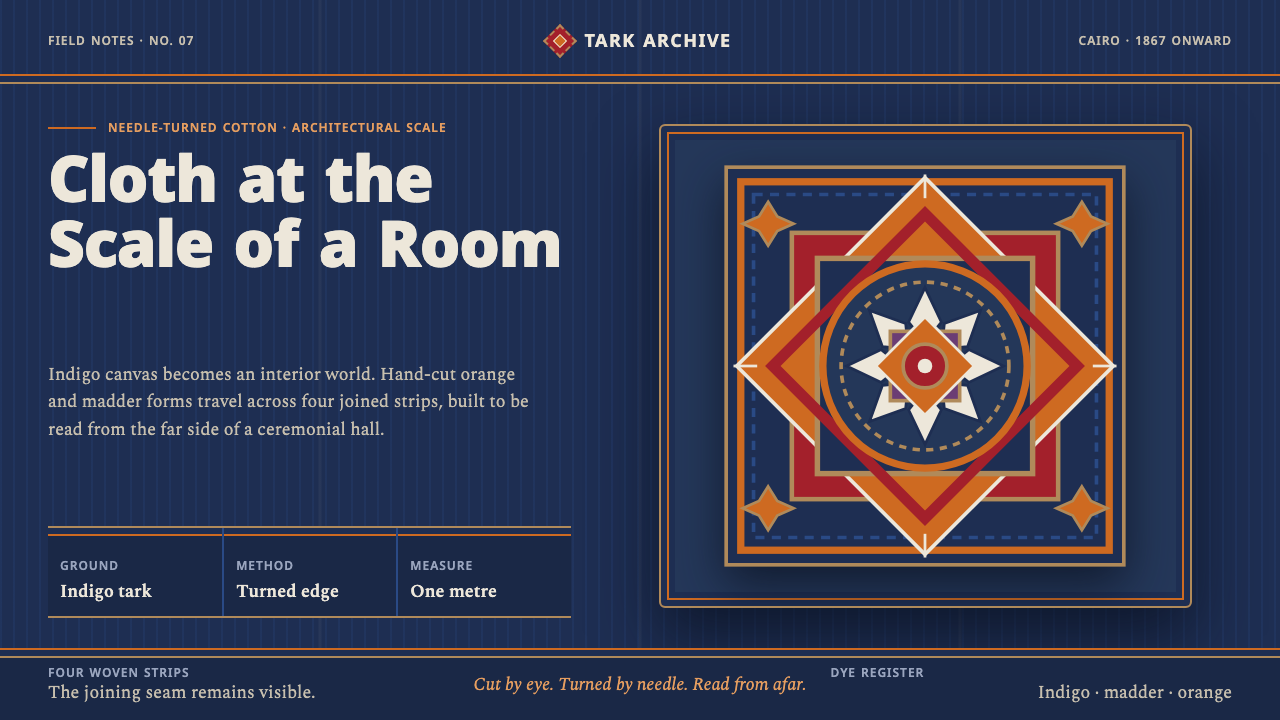 Khayamiya Tentmaker AppliquéCloth becomes architecture. Indigo canvas holds monumental orange and madder…
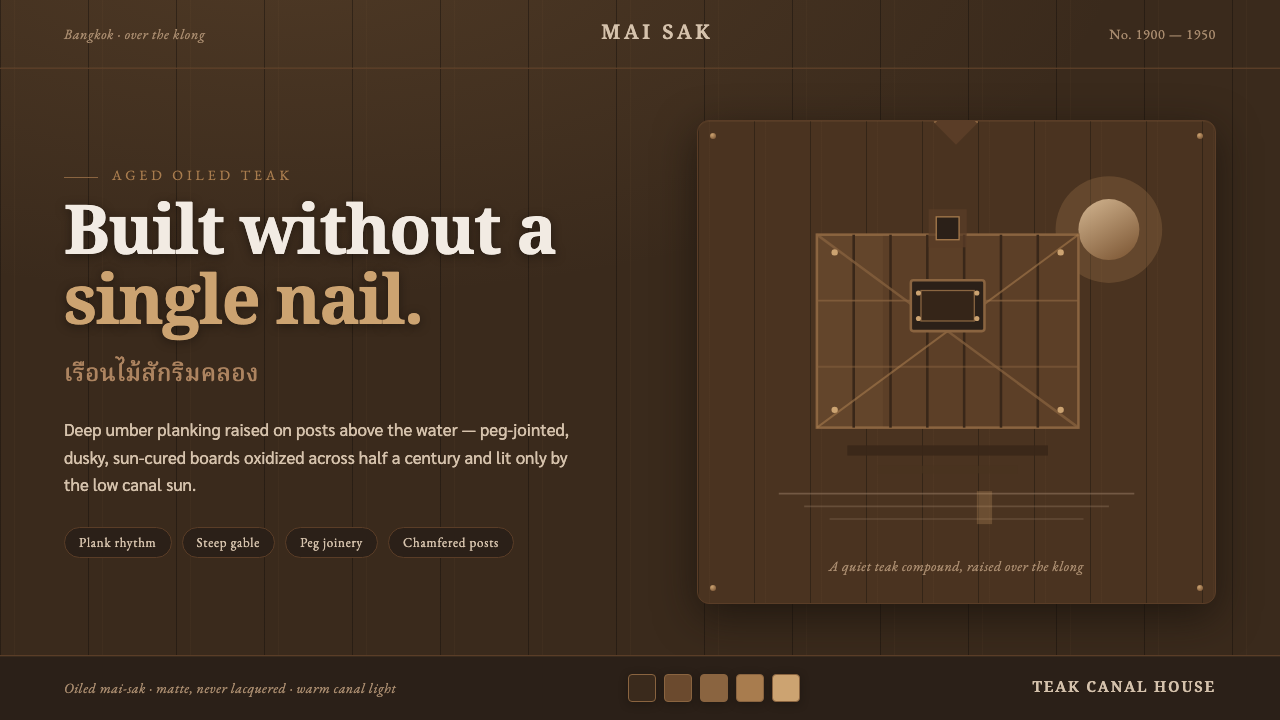 Thai Teak Canal HouseAged oiled teak, never fresh-sawn. Deep umber planks raised over the klong, l…
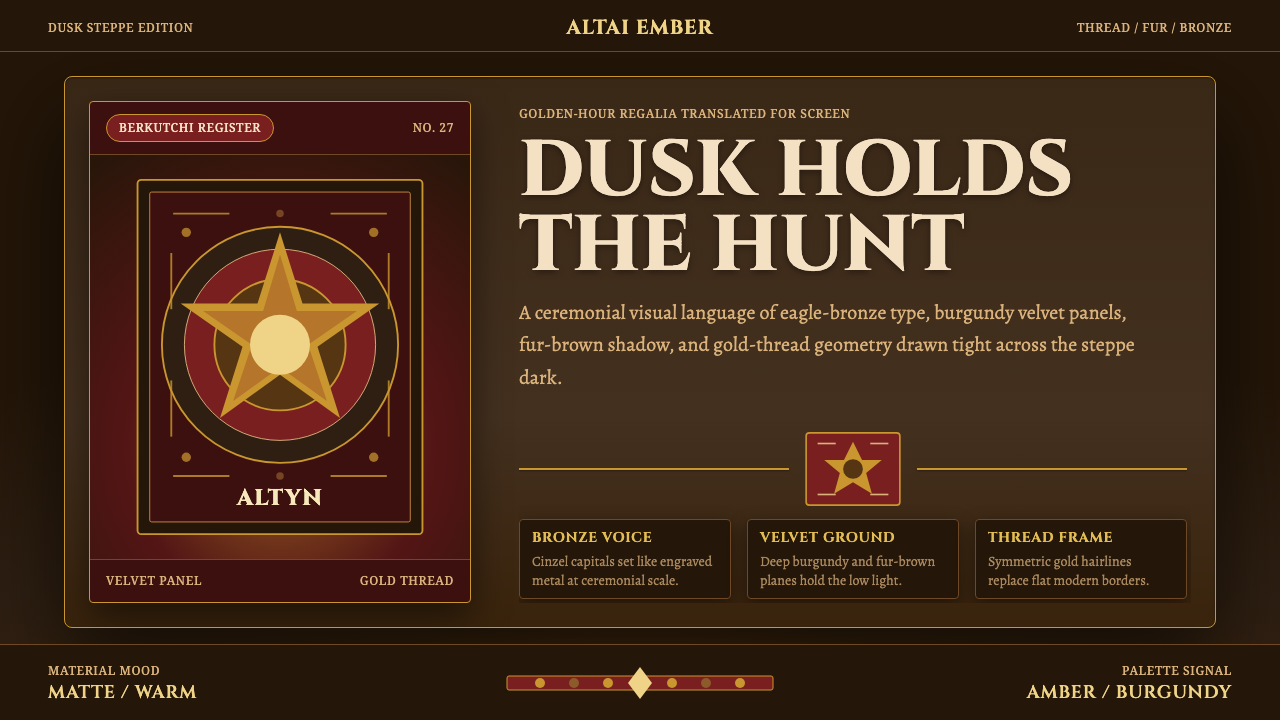 Kazakh Eagle HunterGolden hour feels handmade. Burgundy velvet, bronze type, and gold-thread bor…
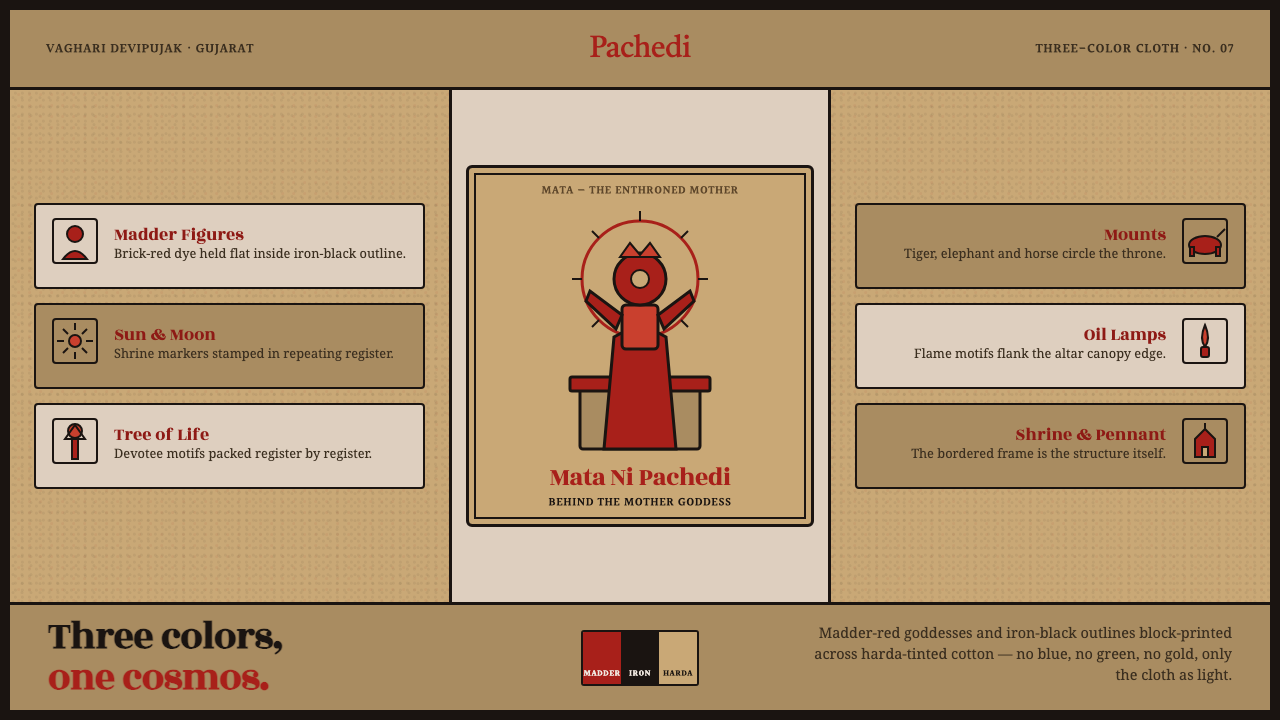 Mata Ni Pachedi Temple ClothThree colors, one cosmos. Madder-red goddesses, iron-black outlines, harda-ti…
 Spice Souk Market PyramidsColour glows out of shadow. Saffron-paprika-sumac heaps on dim earthen brown,…
 Čičmany Painted House OrnamentWhite is the ornament, not the page. Lime-white folk geometry on dark weather…