What is Palauan Bai Storyboard?
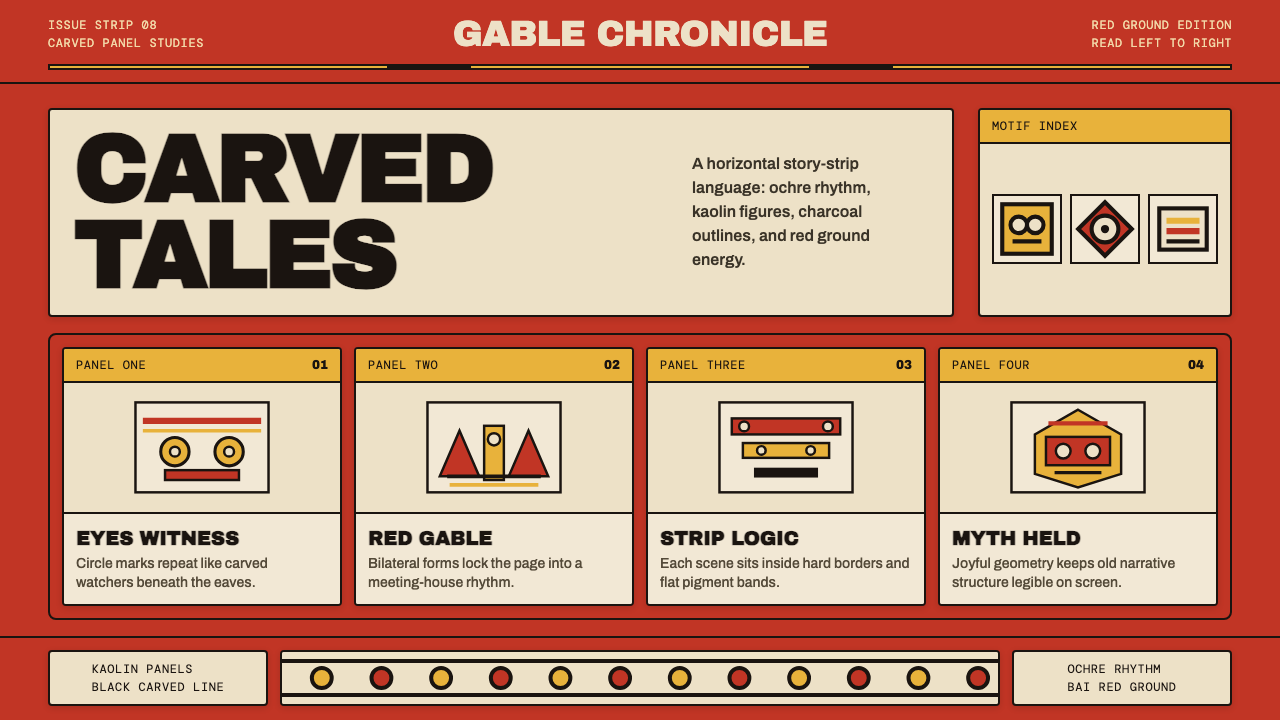
Palauan bai storyboards turn architecture into sequential myth — carved friezes beneath men's meeting-house eaves that read like comic strips rendered in wood, ochre, and kaolin white.
Palauan Bai Storyboard in brief
Palauan Bai Storyboard is a design language drawn from the carved and painted narrative friezes of the bai — the men's meeting houses that served as the political and ceremonial heart of Palauan village life. These friezes ran beneath the eaves in repeating panel sequences, each panel depicting a scene from clan mythology, a fishing episode, a moral fable, or a record of tribute and warfare. The palette was severe and intentional: a deep bai red ground, bands of warm ochre yellow, passages of kaolin white, and hard black outlines that separated every figure and form.
What makes the tradition visually distinctive is the combination of bilateral symmetry and sequential rhythm. Each panel is internally balanced — figures mirrored across a central axis — yet the frieze as a whole reads left to right like a story unfolding in time. The human figures within these panels are rendered in a stylized shorthand: round circle eyes, simplified limbs, and flattened bodies that prioritize graphic legibility over anatomical accuracy. The result is a system that is simultaneously monumental and immediate, the way a good diagram is both explanatory and striking.
As a contemporary design system, Palauan Bai Storyboard channels this graphic energy into digital and print contexts. Its defining qualities are the warm bai red ground, the repeating panel structure, the hard outline aesthetic, and a restrained four-color palette that feels archaic and commanding at once. Used well, it communicates narrative weight and cultural rootedness without requiring any literal reference to Pacific imagery.
Where does Palauan Bai Storyboard come from?
The bai as an architectural form is ancient in Palau, with oral traditions placing the earliest men's meeting houses on Babeldaob island many centuries before European contact. These structures were distinguished by elaborately carved gable boards and, later, by painted horizontal friezes along their exterior beam faces. The iconographic program of a bai was not decorative in the Western sense — each scene was a record, a statement of clan identity, and a mnemonic device for stories that might otherwise require hours of oral transmission to convey.
The tradition entered the historical record through the observations of German ethnographer Augustin Krämer, whose late-nineteenth and early-twentieth century fieldwork documented bai structures across Koror and the neighboring islands of the Palauan archipelago. Krämer recorded the layout, symbolism, and narrative content of the friezes in systematic detail, establishing the scholarly foundation for understanding them as a coherent visual language rather than naive decoration. His documentation proved invaluable after the Second World War, when many original bai structures were damaged or destroyed.
The post-war period, when Palau came under United States trusteeship beginning in 1945, produced an unexpected flowering of the storyboard form. Palauan carvers — working in wood and adapting the traditional frieze into portable, saleable objects — began producing storyboard panels for the military and civilian audiences now present on the islands. This was not mere tourist craft: carvers like Charlie Gibbons became recognized as serious practitioners who maintained the iconographic canon while adapting the format. Sue Rosoff and Robert Owen documented and supported this revival through institutional channels, helping to preserve the tradition's integrity as it navigated the pressures of a commercial market.
The storyboard panels that emerged from this period established what is now recognized as the canonical form: a rectangular wooden board, landscape-oriented, divided into three to six horizontal registers, each register containing a narrative scene bounded above and below by painted bands. The palette remained anchored to the original bai colors — the red, ochre, white, and black that had defined the architectural friezes for generations. This fidelity to the source palette was not conservatism for its own sake; it was the continuation of a system in which color itself carried meaning, marking the sacred and the secular, the living and the ancestral.
What defines the Palauan Bai Storyboard look?
Color Palette
The palette is anchored to four colors derived directly from the bai architectural tradition: a deep, warm red that saturates the ground plane; a band of ochre yellow used for framing strips and secondary fills; kaolin white reserved for highlighted figure areas and graphic accents; and a matte black that outlines every form with decisive clarity. No gradients soften these boundaries. The four colors work through contrast and adjacency, not blending — each hue holds its own territory, making even complex narrative scenes immediately readable from a distance.
Panel Rhythm
The most architecturally distinctive feature of the system is its register structure: content is organized into horizontal bands stacked vertically, each band a self-contained scene that nevertheless participates in a larger sequential reading. This rhythm is not merely decorative — it encodes the logic of narrative time. A layout that adopts this panel rhythm immediately acquires a sense of deliberate pacing, as if each section were a frame in a story that the viewer moves through rather than a field of information that competes for attention simultaneously.
Bilateral Symmetry
Individual panels within the frieze tradition are composed around a vertical central axis, with figures and objects mirrored or balanced across it. This is not the rigid mathematical symmetry of neoclassical architecture — it allows for variation in figure pose, scale, and placement — but it consistently produces a sense of ceremonial composure. In digital application, this compositional logic translates to centered page structures, mirrored icon systems, and layout grids where content elements are weighted equally on either side of a strong central spine.
Stylized Figure Language
The human figures in bai friezes are not portraits — they are glyphs. Large circle eyes dominate simplified heads; limbs are elongated or abbreviated to clarify action rather than render anatomy; bodies are flattened to present the most legible profile view. This is a system optimized for communication at a distance, in variable light, by an observer who may be walking past. The design principle it encodes — maximum legibility through maximum simplification — is equally applicable to icon design, pictogram systems, and any interface element that must be read quickly and reliably.
Hard Outline Construction
Every figure, band, and shape in the bai frieze is bounded by a black outline of consistent weight. This outline is not a shadow or a glow — it is a structural separator, the visual equivalent of the carved groove that defined each form in the original woodwork. In design application, this translates to components with strong, defined edges: bordered containers, outlined icons, and typographic treatments that favor stroke over fill. The outline logic also enforces a kind of visual democracy — all elements are equally present, separated from their neighbors by the same firm boundary.
Warm Ground Dominance
The bai red that saturates the ground of the traditional frieze is the system's most recognizable signature. It is not a neutral surface — it is an active chromatic field that pushes every figure placed on it forward and charges the entire composition with a sense of heat and ceremony. Contemporary applications that commit to this warm red ground find that it unifies disparate content elements, creates an unmistakable visual signature, and communicates cultural weight without historical overstatement.
Sequential Narrative Logic
The frieze format imposes a discipline of sequencing that is unusual in static visual media: information must be organized not just spatially but temporally, with a beginning, middle, and directed conclusion. This narrative constraint is a feature, not a limitation. Applied to contemporary content, it encourages designers to think about the order in which information is encountered and to give each section a distinct role in a larger argument — rather than presenting all information as equally weighted and simultaneously available.
Who shaped Palauan Bai Storyboard?
Gibbons was one of the most accomplished Palauan storyboard carvers of the post-war revival period, whose work helped establish the canonical form of the portable storyboard panel as a serious artistic medium rather than a tourist souvenir. His compositions maintained the iconographic discipline of the traditional bai frieze — the circle-eye figures, the register structure, the red-ochre-white-black palette — while adapting the scale and format to objects that could travel, be collected, and be studied outside of their original architectural context.
The German ethnographer whose late-nineteenth and early-twentieth century fieldwork produced the most systematic early documentation of Palauan bai architecture and iconography. Krämer's detailed recordings of frieze layouts, narrative content, and color usage established the scholarly record from which later researchers, carvers, and cultural preservation efforts would draw. His work sits at the junction of colonial-era ethnography and genuine curatorial care — imperfect in its framing, invaluable in its detail.
Rosoff worked to document and support the storyboard carving tradition during the American trusteeship era, contributing to the institutional recognition of the form as an art practice with a continuous tradition rather than a recent commercial invention. Her work helped contextualize the post-war storyboard revival within the longer history of bai iconography, countering the tendency to treat the tourist-market panels as a degraded or inauthentic version of the original tradition.
Owen engaged with the storyboard tradition in the context of Pacific arts advocacy and documentation, contributing to the broader scholarly and institutional framework that helped protect the tradition's cultural standing during a period when it was at risk of being reduced to commercial novelty. His work exemplifies the role that outside scholars and advocates have played in maintaining the integrity of indigenous visual traditions as they navigate contact with global markets.
How do you use Palauan Bai Storyboard today?
Palauan Bai Storyboard is a high-signal style — its palette and panel structure are visually distinctive enough that even a partial application reads clearly. This creates both an opportunity and a responsibility: used with fidelity to its organizing principles, it communicates narrative authority and cultural depth; used superficially, it risks looking like a costume rather than a language. The key is to adopt the structural logic — the panel rhythm, the bilateral balance, the hard outline, the warm ground — rather than simply borrowing the color palette.
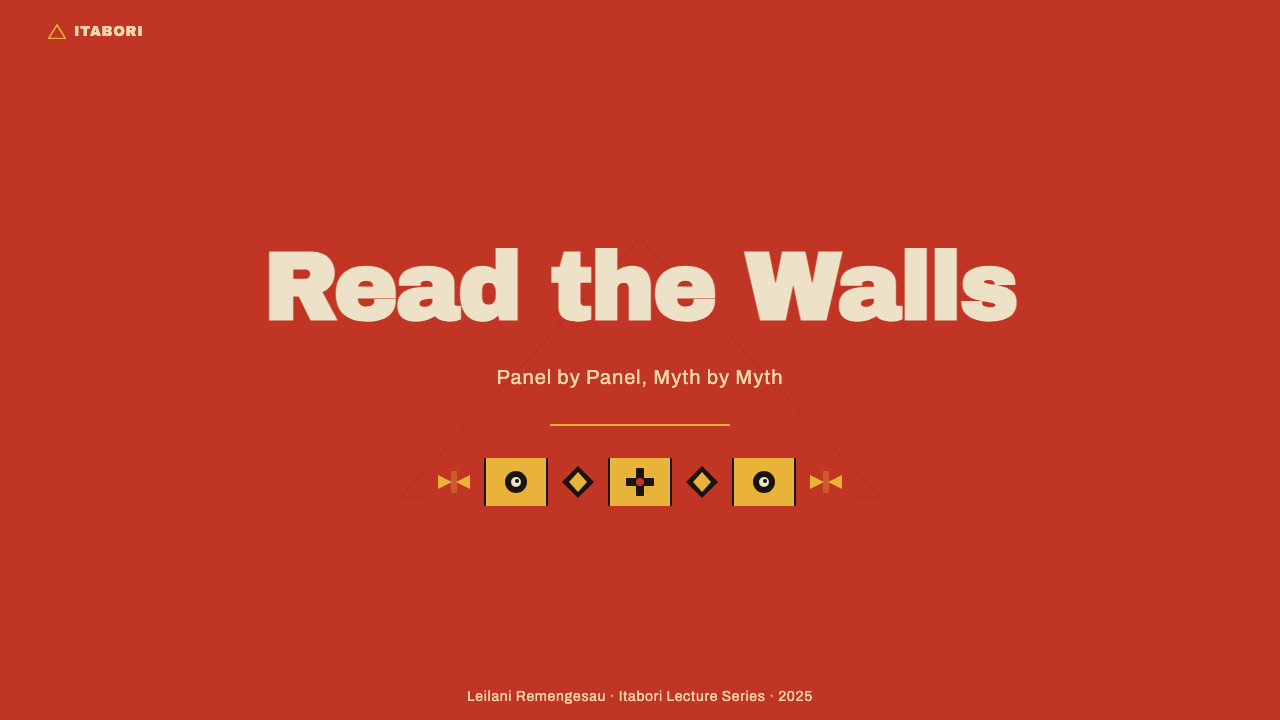
For presentation slides, the style is particularly effective on cover pages and section dividers where strong visual identity is required. A cover framed by a deep warm-red ground, a centered title in high-contrast type, and horizontal banding at the top and bottom edges immediately establishes the register-panel logic without requiring any figurative imagery. Content slides work well when organized as distinct horizontal zones — a title band, a content register, a caption band — each separated by the characteristic black outline strip rather than whitespace alone. Data visualizations take on an iconic quality when charts and graphs are rendered in the four-color palette with hard outlines replacing soft-shadow conventions.
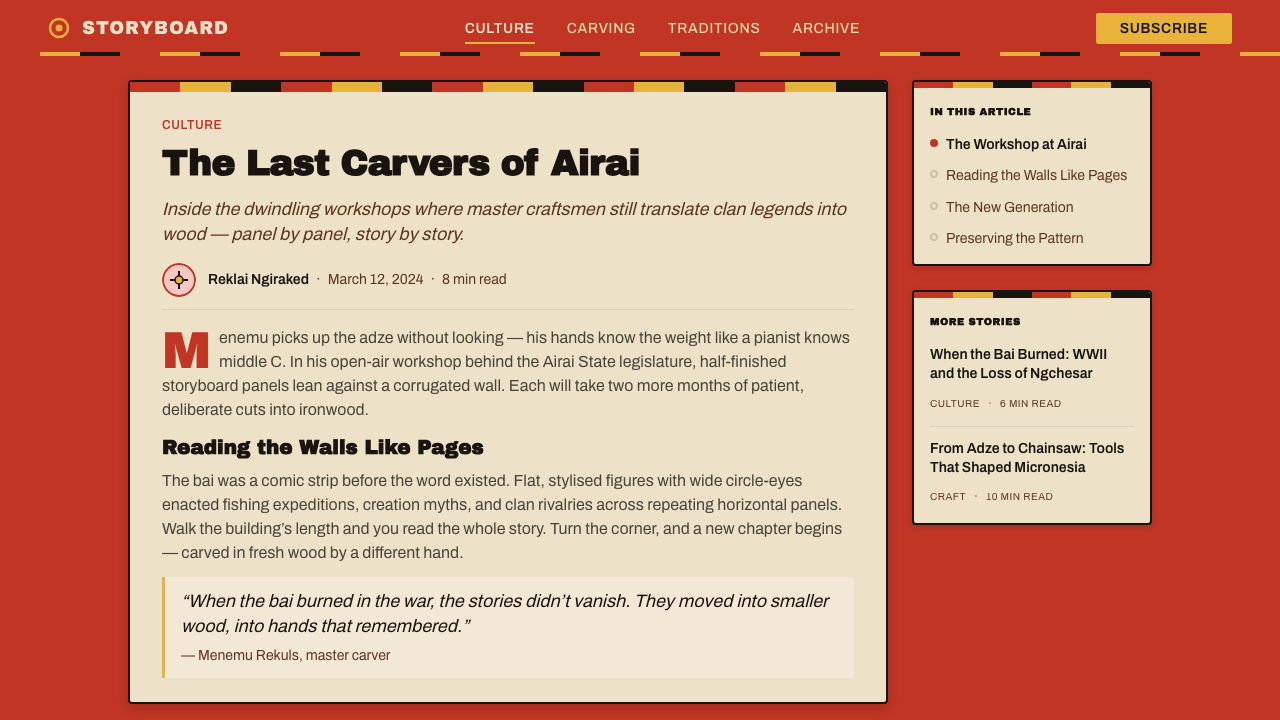
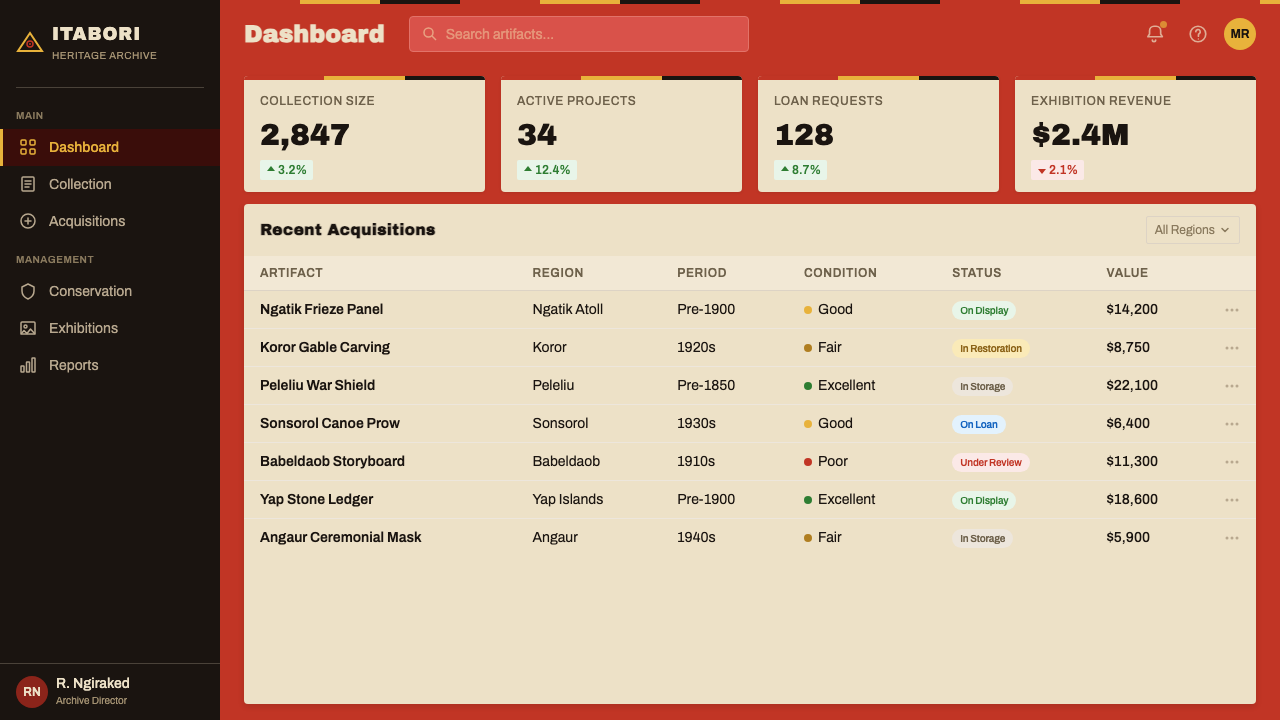
For web and dashboard interfaces, the system suits contexts where strong wayfinding and clear hierarchy are priorities. A dark warm-red header band, a near-white content field, and ochre-highlighted interactive elements create a navigation system with unmistakable visual hierarchy. Pricing pages benefit from the panel-rhythm logic: tier columns read as distinct registers, each self-contained yet part of a horizontal sequence. The hard-outline card treatment — a defining edge rather than a soft shadow — works especially well at this scale, giving each content block a presence appropriate to the style's monumental origins.
For editorial and marketing contexts, the style's boldness makes it well-suited to feature moments: section breaks, pull quotes, and campaign headers where visual impact must compete with surrounding content. A full-width bai-red band with reversed white type creates an interruption as commanding as a carved gable board. Marketing pages organized in stacked horizontal registers — alternating red, ochre, and near-white fields — naturally inherit the frieze's sequential narrative logic, guiding a reader through a story rather than presenting undifferentiated information.
A common mistake is applying the palette without the structural commitment. Bai red used as an accent color in an otherwise neutral layout loses its semantic charge — it looks borrowed rather than systemic. The palette only achieves its full effect when the warm red functions as the dominant ground against which other elements are placed, not as a highlight applied selectively. Similarly, soft shadows and gradient fills directly contradict the hard-outline logic that gives the style its carved-object clarity; a layout that mixes these conventions will look unresolved rather than layered.
Palauan Bai Storyboard — FAQ
Is this style culturally appropriate to use outside of Pacific contexts?
The question deserves a considered answer rather than a reflexive yes or no. The Palauan bai storyboard tradition is a living practice with specific cultural meanings attached to its iconography, its color symbolism, and its narrative content. Using the abstract design language — the panel structure, the palette, the hard-outline construction — as a formal system is different from reproducing the specific figures, myths, or ceremonial symbols of the tradition. The former borrows a visual grammar; the latter risks appropriating sacred content. When applying this style, the responsible approach is to adopt the structural and chromatic logic while avoiding direct reproduction of traditional figures or scenes, and to be transparent about the style's origins when context requires it.
How does this style differ from other Pacific or Oceanic design traditions?
Oceanic design traditions are extraordinarily diverse — the bark cloth patterns of Tonga, the spiral tattoo systems of the Maori, the geometric weaving of Samoa, and the bai friezes of Palau share a Pacific geography but draw on entirely different visual grammars. The Palauan tradition is distinguished by its sequential narrative logic (the panel-frieze structure that encodes stories in time), its specific four-color palette derived from architectural pigments, and its bilateral symmetry within each register. These qualities make it quite distinct from, say, Polynesian traditions where radial symmetry and interlocking geometric motifs dominate, or Melanesian traditions where figural carving takes on very different formal qualities.
Can the style work effectively in a light or white-ground application?
The traditional form is explicitly a warm-ground system — the red field is the foundation, not a choice among equals. A white-ground inversion is possible but requires significant recalibration. On a light ground, the bai red and ochre yellow must shift from background to foreground roles, functioning as bold fills within contained shapes rather than as ambient fields. The hard-outline logic becomes even more important in this inversion, because it is the outline, not the ground color, that will carry the system's graphic clarity. Light-ground applications also tend to read as more contemporary and less ceremonial — which may be desirable depending on the context, but represents a genuine departure from the tradition's original register.
How should typography be handled within this style?
The bai tradition itself has no typographic component — the communication system is entirely visual and pictographic. Contemporary application therefore requires a typographic approach that complements rather than competes with the frieze's visual logic. Typefaces with strong geometric character — without excessive calligraphic variation in stroke weight — read most compatibly within the panel structure. Type should be set in high contrast against its ground: white on red, black on ochre, or red on near-white. Scale contrast is more effective than weight variation alone as a hierarchy signal. One crucial consideration: avoid typefaces with delicate serifs or fine-stroke details, as these will be visually overwhelmed by the bold palette and outline-heavy composition that surrounds them.
Does the sequential panel logic only work for narrative content, or can it be applied to non-narrative layouts?
The panel-register structure works for non-narrative content equally well — it is, at its core, a system for organizing information into discrete, hierarchically equivalent zones. A pricing comparison table, a features list, a timeline, a portfolio grid: all of these can be organized using register logic without implying a narrative sequence. What the structure provides in non-narrative contexts is not story but clarity of segmentation — each band declares its content category as clearly as a chapter heading, and the consistent visual treatment across bands communicates that the information within each is of comparable importance. The key is to maintain the visual discipline of the panel boundary: if the bands blur into one another through soft transitions or overlapping elements, the organizational logic collapses.
Related design styles
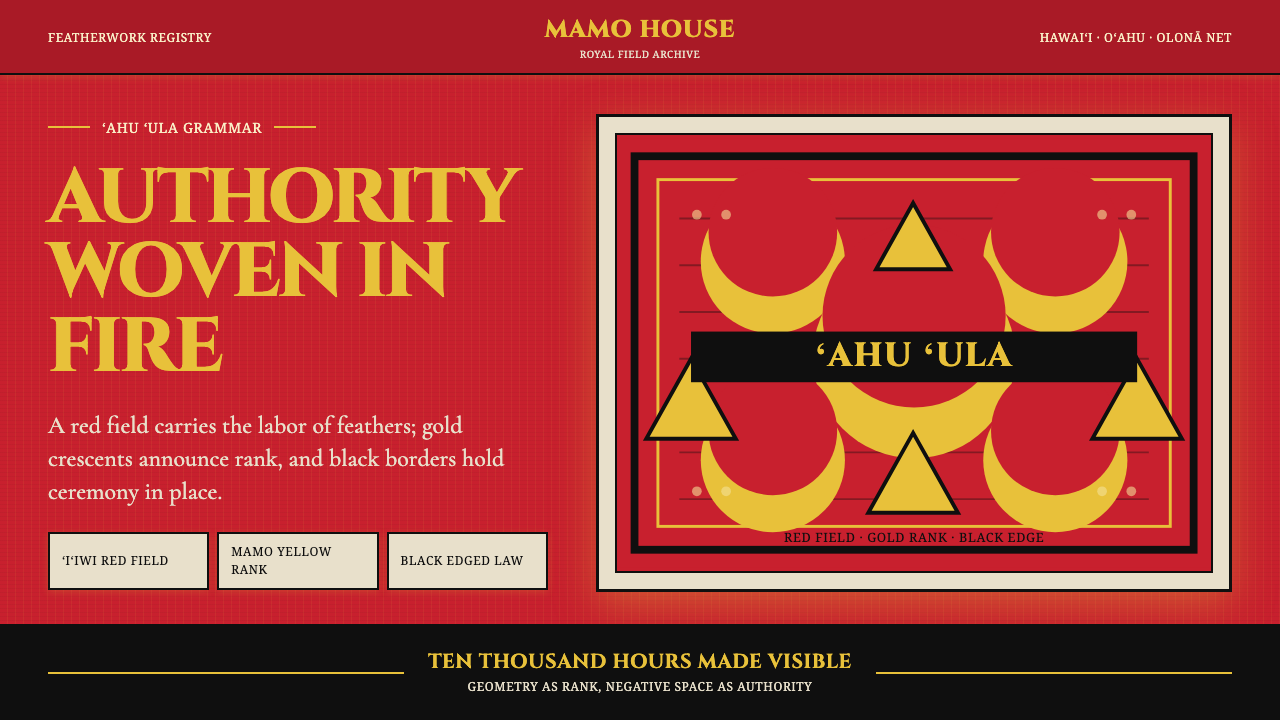 Hawaiian Feather Cape (ʻAhu ʻUla)Ceremony has weight. Red feather fields, mamo yellow crescents, black borders.
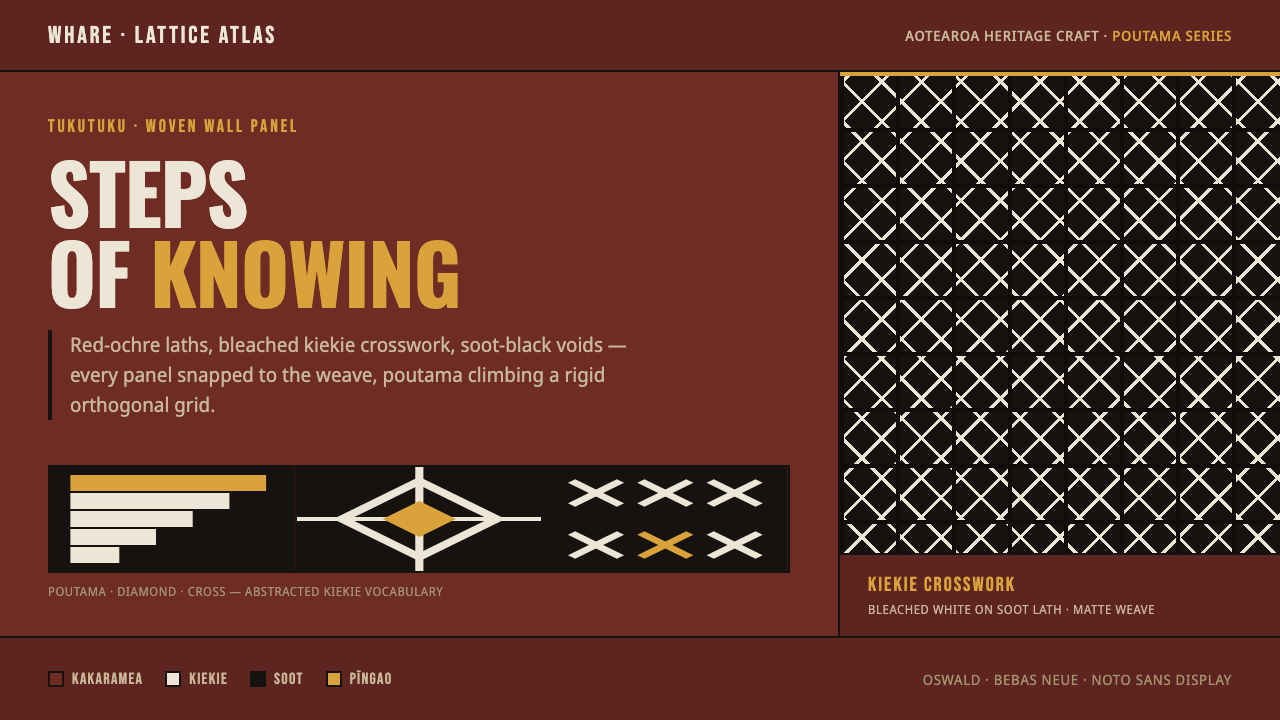 Māori Tukutuku PanelTukutuku weave, rendered strict. Bleached kiekie crosswork laces poutama step…
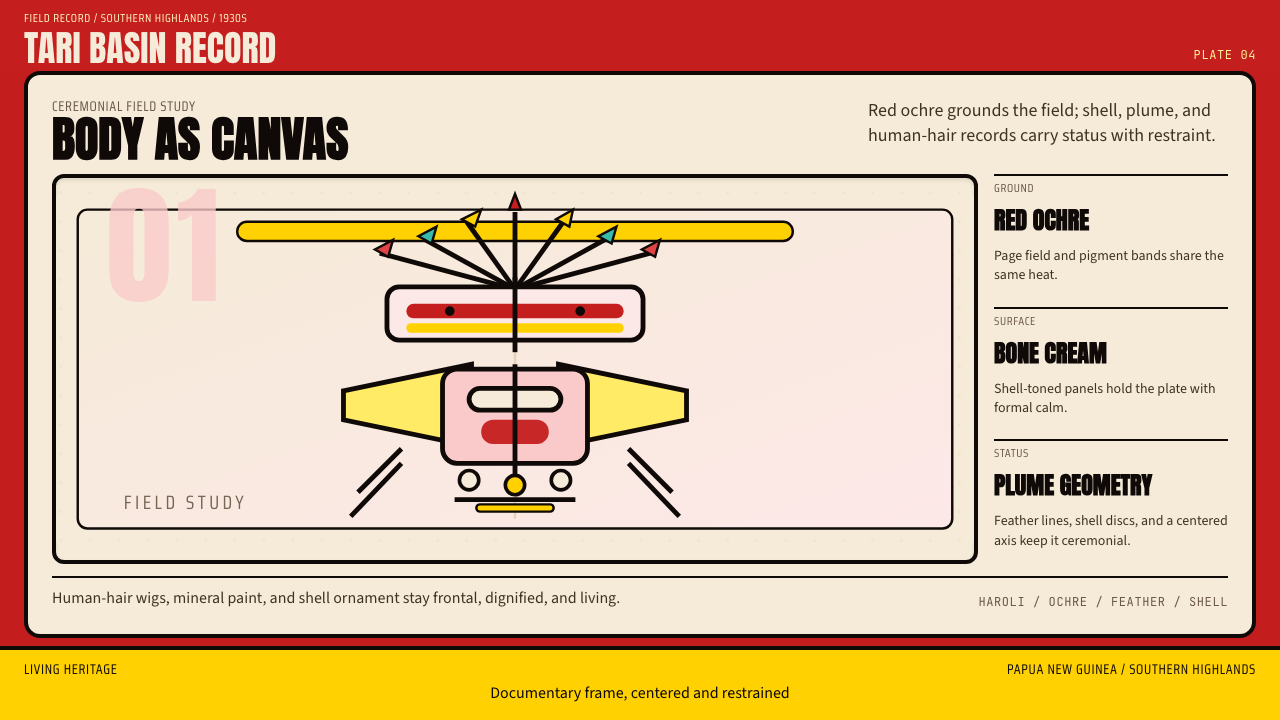 PNG Huli WigmanBody as ceremony. Red ochre, cream bone, and feathered geometry hold a fronta…
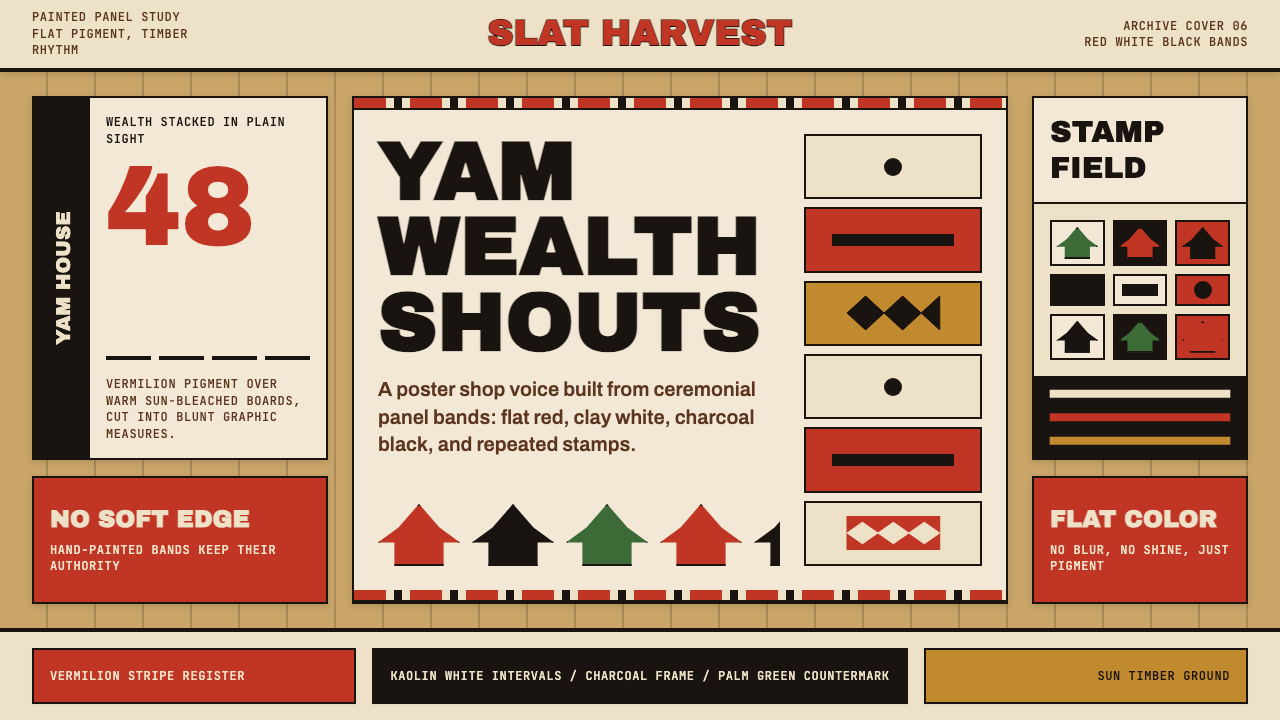 Trobriand Yam House PaintPainted wealth speaks loud. Vermilion bands and black stamp silhouettes hit t…
 Akan Adinkra (Ghana)Proverbs become cloth. Russet grids, lampblack serif marks, and gold-edge ban…
 Akan Carved StoolMatte wood carries memory. Honey amber, Marcellus type, and crescent-column r…