What is Russian Matryoshka 1890?
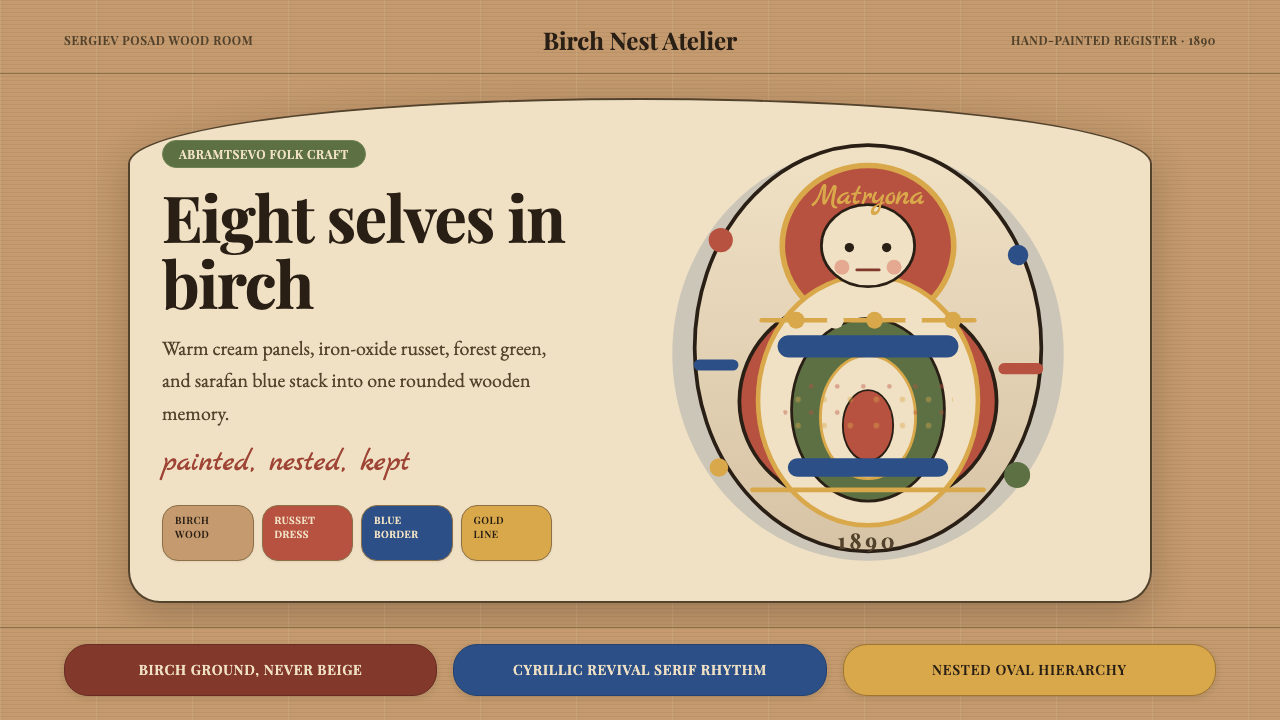
Warm birchwood, hand-painted russet and cream, and an egg-oval silhouette that nests seven smaller selves inside one — the Russian matryoshka is folk craft distilled into a visual system.
Russian Matryoshka 1890 in brief
Russian Matryoshka 1890 is a design aesthetic rooted in the material and pictorial world of Russian folk craft at the turn of the twentieth century. Its defining qualities are warmth without sentimentality, handmade depth without roughness, and a sense of generous ornament that remains legible at any scale. The palette draws on the physical substance of the original dolls — the natural honey tone of birch, the deep russet of iron-oxide pigment, the cream of unpainted wood, the forest green of the peasant apron — with touches of cobalt and ivory used sparingly for highlight and contrast.
The aesthetic is organized around the oval and the nested figure. Where Bauhaus reaches for the circle and the square, matryoshka design reaches for the egg-oval — a form that suggests both biological origin and protected interiority. Decorative surface work is floral and figurative rather than geometric, recalling the embroidered patterns on Russian peasant dress. Lettering, where it appears, draws from Cyrillic types in use during the Russian Revival printing movement of the late nineteenth century: weighty, upright, with bracketed serifs that evoke the warmth of hand-setting.
Unlike design systems rooted in abstraction, the matryoshka aesthetic is unapologetically representational. It celebrates the crafted object, the painted face, the turned wood grain. Applied to contemporary design work, it offers a counterweight to minimalism: a rich, layered visual field that communicates care, cultural rootedness, and the irreplaceable value of the hand-made.
Where does Russian Matryoshka 1890 come from?
The first matryoshka was created in 1890 at the Abramtsevo estate outside Moscow, the cultural colony funded by industrialist and arts patron Savva Mamontov. Abramtsevo had become the gathering point of the Russian Revival movement — an intellectual and artistic project that sought to recover pre-Petrine folk traditions in the face of rapid industrialization and Western cultural influence. Artists, architects, and craftspeople came to Abramtsevo to study traditional embroidery, ceramic tile work, woodcarving, and peasant dress, attempting to distill them into a consciously Russian visual identity.
Painter Sergei Malyutin designed the form and the painted surface decoration of the first set; wood-turner Vasily Zvyozdochkin carved it on a lathe from blocks of linden and birch. The subject was a peasant girl named Matryona — a diminutive of Matrona, derived from the Latin for mother — holding a black rooster, with seven successively smaller figures nested inside, the innermost a swaddled infant. The choice of subject was deliberate: the nesting structure embodied the peasant matriarch, fertility, and the continuation of generations. There is also evidence that Malyutin and Mamontov were inspired by a Japanese kokeshi doll brought back from Japan, though the specific origin of this influence remains contested among scholars.
The set was exhibited at the Sergiev Posad toy workshops and entered commercial production almost immediately at the craft workshops of that town, which had been a center of wooden toy manufacture for centuries. When the first matryoshka won a bronze medal at the Paris Universal Exposition of 1900, international demand transformed a workshop craft into an industry. Production spread from Sergiev Posad to other towns — Semyonov in the Nizhny Novgorod region became a second major center, developing its own regional style characterized by bolder floral bouquets on the apron and a simpler face treatment.
The matryoshka's ascent coincided with and was partly driven by the Russian Revival movement's broader agenda of Narodnost — a cultural nationalism that valorized peasant tradition as the authentic soul of Russia in contrast to cosmopolitan, Westernized urban culture. Elizaveta Mamontova, Savva's wife, ran the Abramtsevo workshop that produced the first dolls and oversaw the documentation of folk patterns that influenced their decoration. By the time of the 1917 Revolution, the matryoshka had already become the most internationally recognizable symbol of Russian visual culture — a position it has never relinquished.
What defines the Russian Matryoshka 1890 look?
Color Palette
The palette is warm and earthen: natural birchwood honey as the dominant ground, deep russet and burnt sienna for primary pictorial elements, forest green and leaf green for foliage and apron accents, and cream or ivory for unpainted wood and highlight areas. Cobalt and prussian blue appear as secondary accents. Black is used sparingly, mainly for facial features and outline reinforcement. The overall temperature is warm amber — there are no cool grays, no pure whites, no desaturated neutrals.
Form and Silhouette
The egg-oval is the governing form — rounded at the shoulders, widest at the hips, tapering gently toward a flat base and a rounded head. This silhouette reads as stable, grounded, and protective. In design applications, this preference for rounded, organic contours extends to layout containers, decorative borders, and pictorial frames. Hard corners and sharp angles are foreign to the system; even rectangular elements tend to carry generous border-radius equivalents.
Decorative Surface and Ornament
Surface decoration is rich and figurative: roses, rosebuds, leaves, and berries painted in a stylized folk manner rather than botanical realism. The painting style is confident and gestural — visible brushwork, slight irregularity of line — which communicates handmade authenticity rather than mechanical perfection. Decorative borders use repeating floral or geometric folk motifs drawn from traditional embroidery patterns. Nothing is left plain that could carry ornament without disrupting legibility.
Typography and Lettering
Type in this system references the Cyrillic letterforms produced by Russian Revival printing in the late nineteenth century: upright serifs with bracketed terminals, moderate stroke contrast, and a weight that reads as solid without feeling heavy. Lettering is treated as a craft object in its own right — sometimes hand-rendered, sometimes set in Revival-era type — and tends to sit within decorative cartouches or bordered panels rather than floating freely on a white field. Latin equivalents would be humanist serifs with warm ink-trap details rather than cold geometric or transitional types.
Layering and Depth
Depth is achieved through layering rather than shadow. Foreground elements — the central figure, the primary decorative motif — sit visibly above middle-ground decorative bands, which in turn sit above the warm ground color. This spatial logic mirrors the nesting structure of the dolls themselves: each layer is self-contained and legible on its own, yet participates in a larger whole. Drop shadows, where used at all, are warm-toned and soft-edged rather than cool and hard — consistent with the effect of candlelight or diffuse interior light rather than outdoor sun.
Pattern Density
The system operates at a higher pattern density than most contemporary design languages. Surfaces are expected to carry decoration; empty areas are used sparingly and intentionally, typically as breathing room between major pictorial elements rather than as a default state. This density is never chaotic because the decorative vocabulary is limited and internally consistent — the same rose forms, the same leaf profiles, the same border geometry repeat throughout, creating visual coherence within richness.
Material Warmth
The entire visual system reads warm — a quality produced not by any single color choice but by the cumulative effect of honey-toned grounds, earthen pigments, and the visual implication of hand-applied surface. Even in digital contexts, matryoshka-derived design should feel as though it originated in physical material — painted, turned, or woven — rather than generated on a screen. Textures, where used, reference natural materials: wood grain, woven linen, hand-laid paper.

Who shaped Russian Matryoshka 1890?
A painter associated with the Abramtsevo circle and a key figure in the Russian Revival movement, Malyutin designed both the form and the painted decoration of the original matryoshka set in 1890. His background was in easel painting and graphic illustration — evident in the confident figurative drawing of the first doll's face and costume — but his involvement with Abramtsevo had deepened his engagement with folk motifs and traditional craft objects. The first set he designed depicted eight figures, with the outermost a peasant girl holding a black rooster, and the innermost a swaddled infant. Malyutin later became known for his work on architectural ornament and book illustration in the Russian Revival style.
The craftsman who physically carved the first matryoshka set, Zvyozdochkin was a skilled wood-turner based in the Sergiev Posad region, the historic center of Russian wooden toy manufacture. The technical challenge he solved was not trivial: carving a set of nested hollow figures from birch or linden wood requires precise calibration of wall thickness and interior diameter at each size so that each doll fits snugly inside the next without binding. Zvyozdochkin's solution established the technical template that craftspeople across Sergiev Posad and Semyonov would follow for decades. His contribution is often underrepresented in histories of the matryoshka that emphasize the painted surface over the carved form.
The industrial magnate and arts patron who funded the Abramtsevo estate and made it a laboratory for Russian Revival art and craft, Mamontov was the enabling condition for the matryoshka's creation. He invited artists, architects, and craftspeople to Abramtsevo, funded their research into peasant traditions, and organized the workshops that produced the first doll set. His belief that Russian art needed to look inward — to its own folk traditions rather than outward to French and German academic painting — shaped the intellectual environment in which the matryoshka became possible. Mamontov was later convicted of financial crimes and lost his fortune, but the cultural institutions he built outlasted his personal ruin.
Savva's wife and a significant figure in her own right, Elizaveta Mamontova managed the Abramtsevo craft workshop that produced the first matryoshka sets and oversaw the systematic documentation of folk embroidery patterns, wood-carving traditions, and peasant costume that fed into the workshop's decorative vocabulary. Where Savva was the patron and visionary, Elizaveta was the organizer and archivist — ensuring that the research into traditional craft was methodical and that its findings were applied consistently in the workshop's output. Her role in the matryoshka's origin is often credited only in passing.
One of the early master craftsmen at the Sergiev Posad workshops who helped establish the commercial matryoshka tradition in the years immediately following the Paris Exposition of 1900. Leonov's workshop refined the painting conventions that would define the Sergiev Posad regional style: a detailed, realistic face with fine brushwork, elaborate floral costume decoration, and careful attention to color layering. The Sergiev Posad style he helped codify — more pictorial and detailed than the later Semyonov style — became the benchmark against which other regional variants were measured and is the form most closely associated with the original Abramtsevo aesthetic.
How do you use Russian Matryoshka 1890 today?
The matryoshka aesthetic is one of the warmest and most distinctive folk-derived design systems available for contemporary work, but it requires commitment to apply well. It is not a palette swap or a single texture applied to an otherwise neutral layout. The system works when all of its elements — color, form, ornament, lettering — operate together as a consistent cultural register. Applied selectively, it tends to look like decoration; applied comprehensively, it becomes a complete point of view.
For presentation slides, the matryoshka style produces memorable cover pages and strong editorial layouts for storytelling decks. A cover slide benefits from a large egg-oval motif as the central anchor, surrounded by floral decorative borders, with the presentation title set in a weighty serif that references Revival-era letterforms. Section divider slides can use the nesting logic explicitly — a sequence of three or four oval frames of diminishing size, each containing a section title, visualizing the concept of layers within layers. Content slides should use the warm honey ground color, reserve decorative borders for headers only, and let body content sit on clean cream-white panels inset within the decorated field rather than trying to decorate every content zone.
For web interfaces, the matryoshka style is best suited to cultural institutions, craft e-commerce, food and hospitality brands, storytelling platforms, and any product where warmth, handmade quality, and cultural specificity are core values. Dashboard applications and data-heavy interfaces are poor matches — the visual richness competes with the need for scannability in information-dense contexts. In web UI, the practical approach is to concentrate the full decorative treatment on hero sections, navigation frames, and marketing components, while using a simplified warm palette with restrained ornament for interactive content zones, form fields, and data display areas.
For editorial and marketing work, the style excels in contexts that call for visual storytelling with cultural depth. Book covers, magazine spreads, campaign posters, and seasonal greeting materials all benefit from the rich surface and the nesting compositional logic. Marketing layouts work best when they adopt the system's principle of layered frames: an outer decorative border, an inner content panel, and a central featured element — each readable as its own zone while together forming a unified whole. Print and physical media are natural homes for this aesthetic; digital applications should prioritize texture and warmth over the crisp pixel-perfection that looks out of place in this visual language.
The most common mistake when applying the matryoshka aesthetic is treating the ornament as optional decoration rather than as structural communication. Stripping the floral borders from an otherwise matryoshka-styled layout does not produce a cleaner, more modern version of the style — it produces a layout that has lost its organizing logic and visual warmth without gaining the clarity that a genuinely minimal system provides. A second common error is importing the palette without the warmth: cool-toned photography, cool-gray UI surfaces, or desaturated stock images will immediately undercut the system's essential character. Every element in the visual field should read as warm, handmade, and considered.
Russian Matryoshka 1890 — FAQ
Is the matryoshka aesthetic too kitsch for serious design work?
The accusation of kitsch is worth taking seriously, because there is a version of matryoshka-influenced design that has become genuinely kitsch — the mass-produced tourist souvenir, the airport gift-shop aesthetic. But the original matryoshka was not kitsch: it was a serious product of a rigorous cultural project, created by trained artists who were studying and systematizing authentic folk traditions. The distinction in application is between using the aesthetic as cultural costume — borrowing visual markers of Russianness without understanding what they mean — and using it as a genuine design system, where the warmth, the nesting logic, and the craft values are structurally integrated. The former is kitsch; the latter is a legitimate historical style with as much intellectual grounding as Art Nouveau or the Arts and Crafts movement.
How does the matryoshka aesthetic differ from other Russian folk art styles like Khokhloma or Palekh?
All three draw from the same broad tradition of Russian decorative folk art, but they differ significantly in palette, surface treatment, and pictorial approach. Khokhloma is characterized by its gold, black, and red palette on wooden objects — a lacquered, highly reflective surface treatment that gives it a richer, more opulent quality than the matte handpainted surface of the matryoshka. Palekh is a miniature painting tradition on lacquered papier-mache, with extremely fine brushwork, jewel-like colors, and a strong narrative figure tradition derived from medieval icon painting. The matryoshka style is warmer and more accessible than either: less opulent than Khokhloma, less technically demanding in its figuration than Palekh, and more broadly associated with peasant life and everyday warmth rather than courtly luxury or religious narrative.
Can the matryoshka aesthetic work in dark-mode interfaces?
With care, yes — but a dark-mode matryoshka requires rethinking the palette rather than simply inverting it. The natural analog is candlelit interior space rather than outdoor daylight: a very deep warm brown or mahogany as the ground rather than pure black, with the honey and russet tones lightened slightly to maintain their warmth against the dark field. The cream becomes a warm off-white; the forest green remains usable. The decorative ornament reads well against a dark warm ground because its primary function is contour and pattern rather than color contrast. Cold charcoal or blue-black grounds are not compatible with the system — they immediately extinguish the warmth that the aesthetic depends on.
The matryoshka originated in the Russian Revival movement, which had nationalist underpinnings. Is using this style politically charged?
The nationalist context of Narodnost is part of the historical record and worth understanding, but it does not make the aesthetic itself politically contentious in the way that, say, certain symbols from the twentieth century are. The matryoshka's visual language — warmth, craft, nesting, folk decoration — has been internationally adopted, reinterpreted, and culturally diffused over more than a century. It is used across cultures as a symbol of layered identity, hidden depth, and handmade value rather than as a specifically Russian nationalist statement. Design practitioners should understand the origin context, as with any historical style, but the aesthetic is not inherently freighted with political meaning in contemporary application.
What makes the Sergiev Posad and Semyonov regional styles different, and does it matter for design application?
The Sergiev Posad style — associated with the original Abramtsevo aesthetic and the first commercial workshops — tends toward detailed, realistic facial rendering, elaborate and varied costume decoration, and a higher degree of pictorial complexity overall. The Semyonov style, which developed after 1900 in the Nizhny Novgorod region, simplified the facial treatment and concentrated decoration on a bold, centralized floral bouquet on the apron, with the upper body and head left relatively plain. For design application, Sergiev Posad offers a richer, more pictorially complex reference point suited to editorial and cultural contexts; Semyonov is more graphically bold and pattern-driven, better suited to packaging, print, and contexts where a strong repeating motif is the goal. Both are legitimate references within the matryoshka aesthetic; choosing between them is partly a question of visual complexity appropriate to the project.
Related design styles
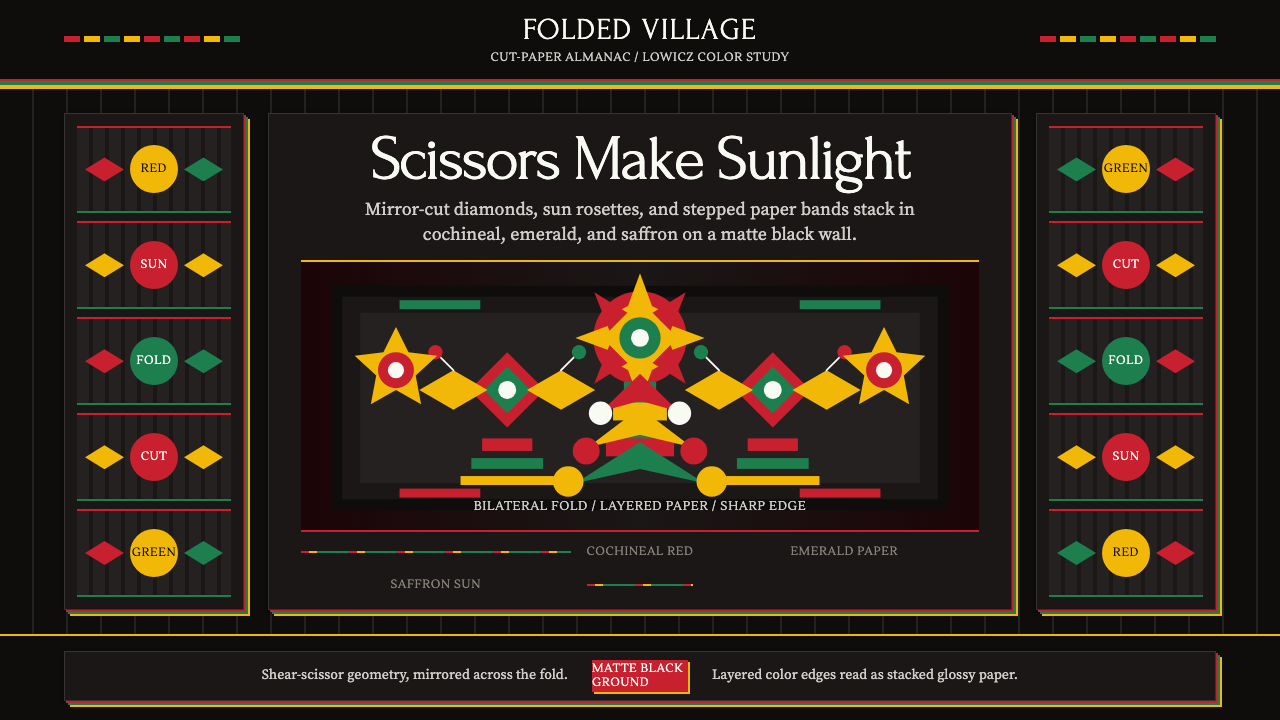 Polish Wycinanki (paper-cut folk art)Cuts sing in symmetry. Cochineal, emerald, and saffron layers blaze on black.
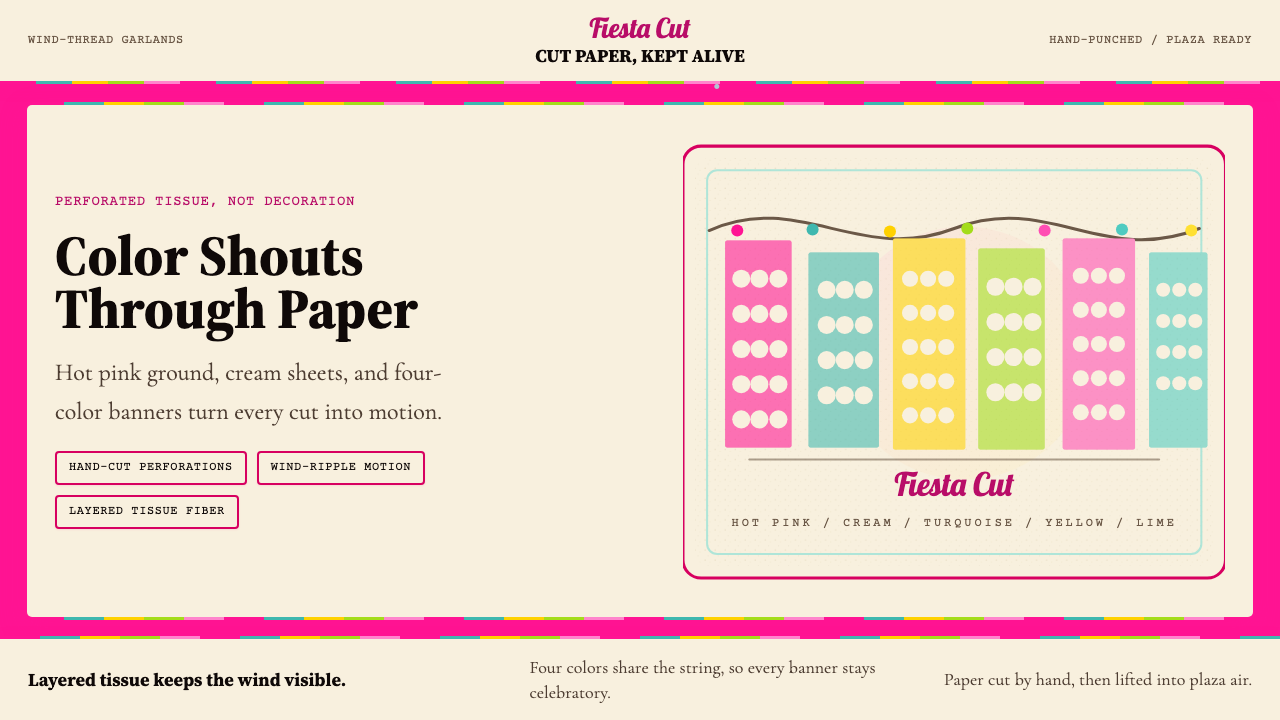 Mexican Papel Picado TissueFiesta cut paper. Hot pink, turquoise, yellow banners and hand-cut perforatio…
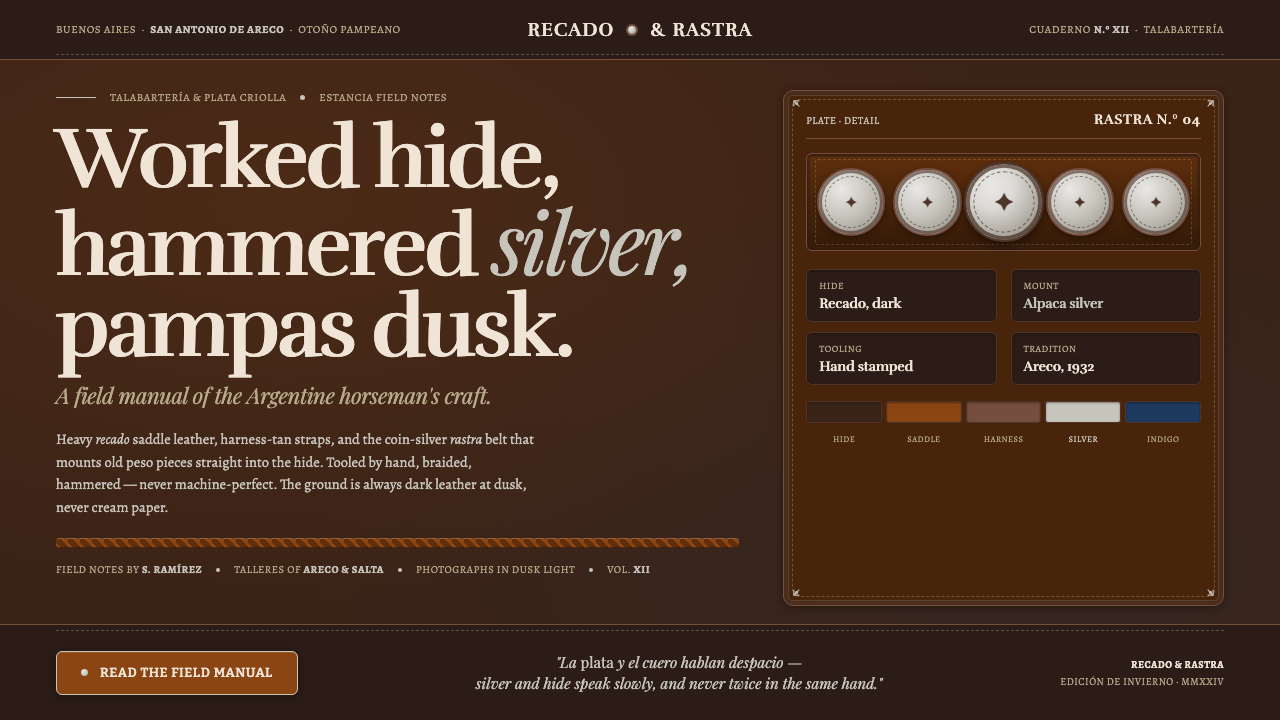 Gaucho LeatherHand-worked horseman craft. Dark recado leather, harness tan, coin-silver ras…
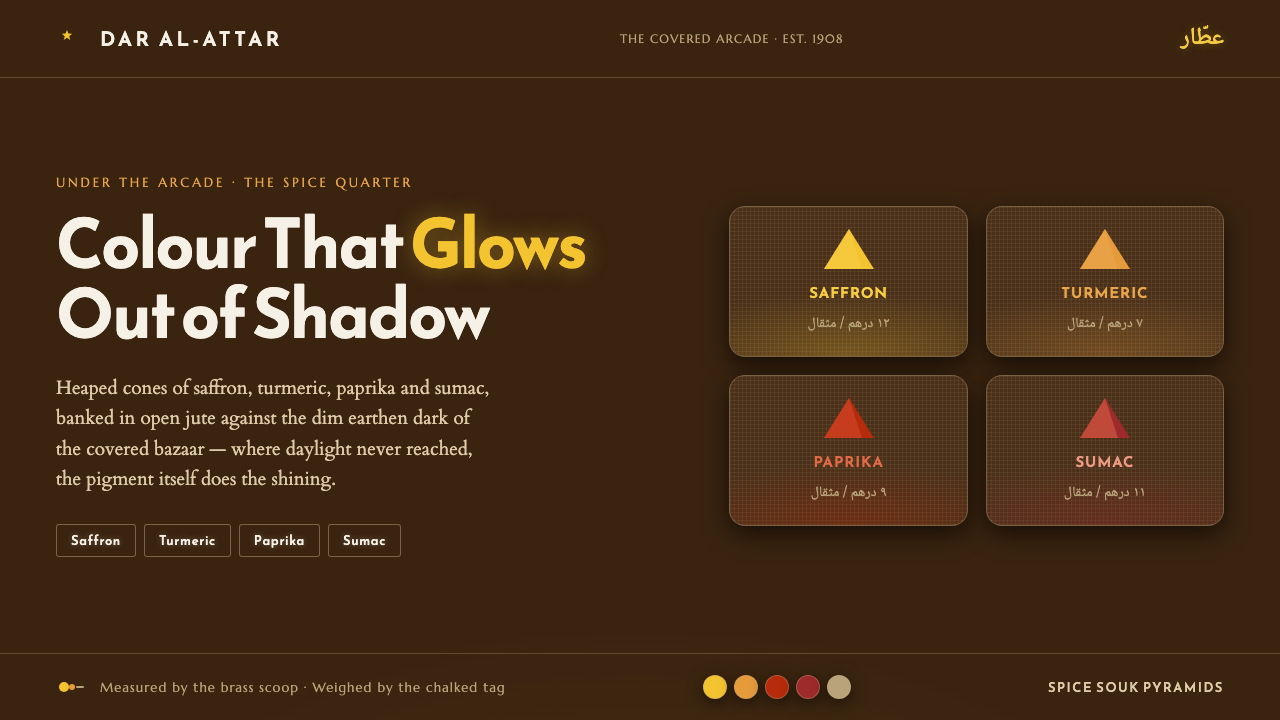 Spice Souk Market PyramidsColour glows out of shadow. Saffron-paprika-sumac heaps on dim earthen brown,…
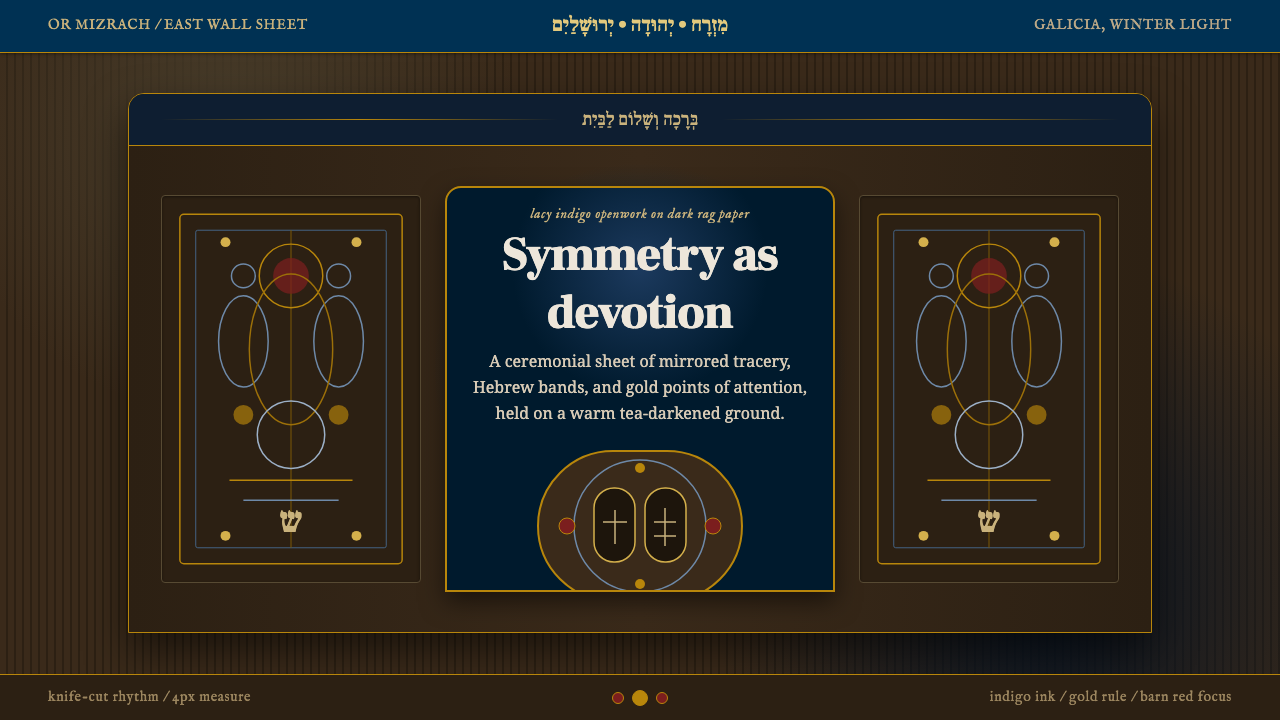 Jewish Papercut MizrahDevotion as openwork. Indigo filigree and Hebrew bands glow on dark rag paper.
 Kazakh Eagle HunterGolden hour feels handmade. Burgundy velvet, bronze type, and gold-thread bor…