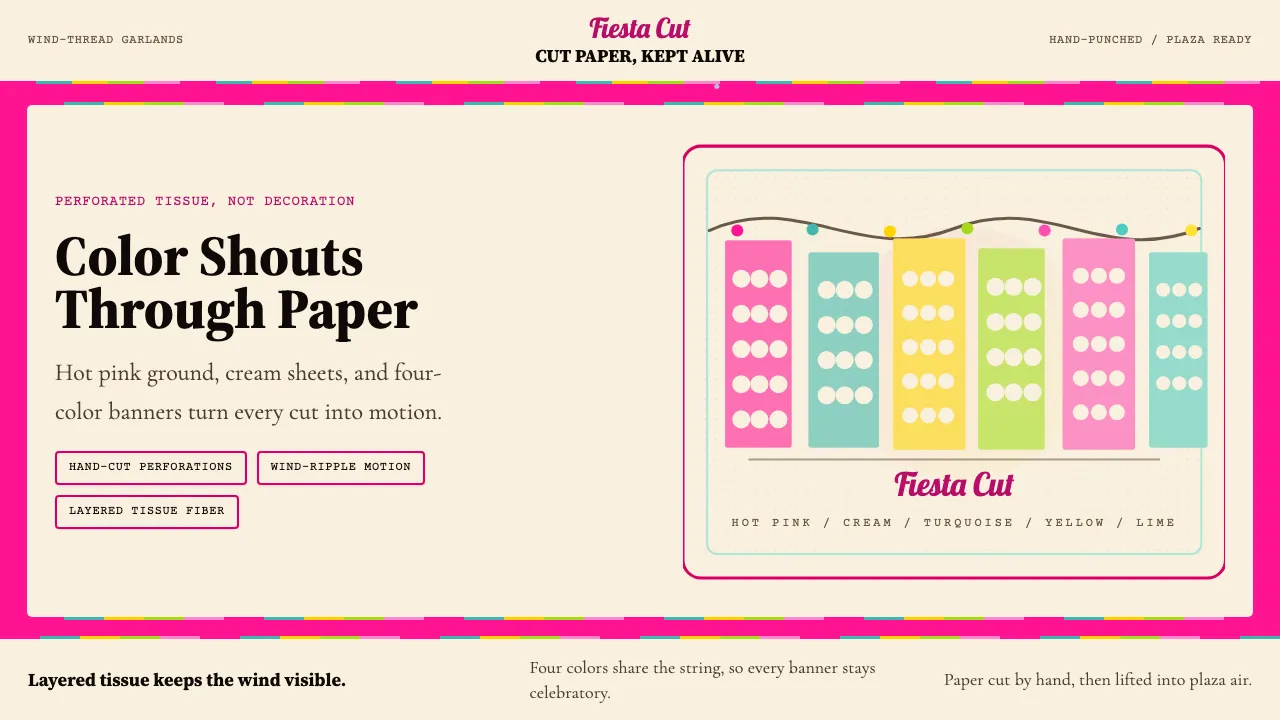
About Mexican Papel Picado Tissue
Papel picado — perforated paper — is the Mexican folk tradition where artisans punch elaborate designs into stacks of brightly-colored tissue using mallets and chisels, then string the banners into garlands across plazas and churches. This system captures that riot of hot pink, turquoise, magenta, and yellow tissue against cream paper and blue sky, with the hand-cut imperfection and wind-rippled movement that makes every fiesta feel alive.
The design language draws from San Salvador Huixcolotla, Puebla — the village considered the papel picado capital — where the Vivanco family has practiced since the 1920s. Every surface carries the texture of tissue fiber, the geometry of rectangular banners, and the celebratory saturation of four or more colors used simultaneously.
- Origin
- San Salvador Huixcolotla, Puebla, Mexico
- Era
- Late 19th c. tradition; codified early 20th c. by Huixcolotla masters; UNESCO 1998; continuous through 2024
- Key figures
- Vivanco family · Margarito Vivanco · Maria Vivanco
- Movements
- Mexican folk-paper-craft tradition · Día de Muertos ceremonial heritage · Post-revolutionary Mexican folk-art-as-national-identity
Mexican Papel Picado Tissue design spec
Colors
Typography
The other 11 sections — buttons, cards, spacing, motion, techniques and more — open once you unlock. Download the DESIGN.md or send it to your AI in one click. Unlock once, yours forever.
Sign up nowStyles similar to Mexican Papel Picado Tissue
Also inspired by crafts & folk art, with a close feel.
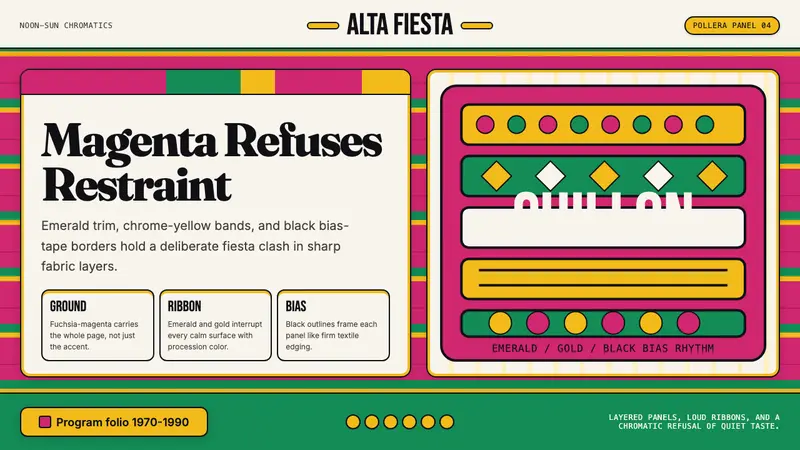 Bolivian Pollera Fiesta MagentaChromatic defiance. Magenta ground, emerald bands and black outlines clash like fiesta trim.
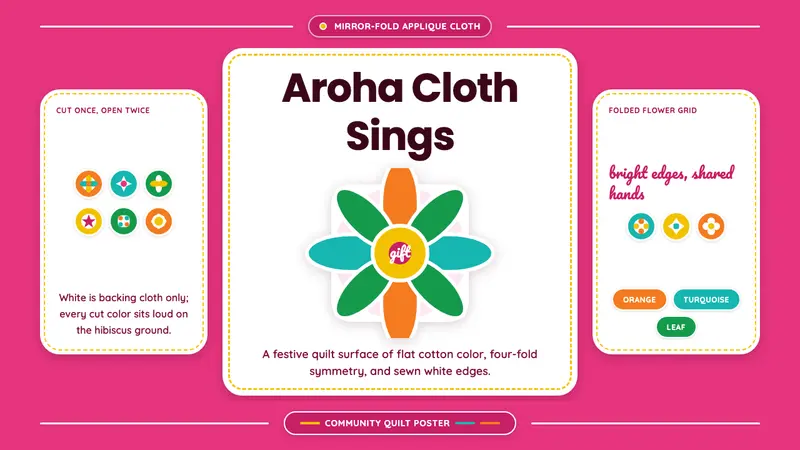 Cook Islands TivaevaeSaturated craft sings. Hibiscus pink carries mirror-fold florals in flat applique color.
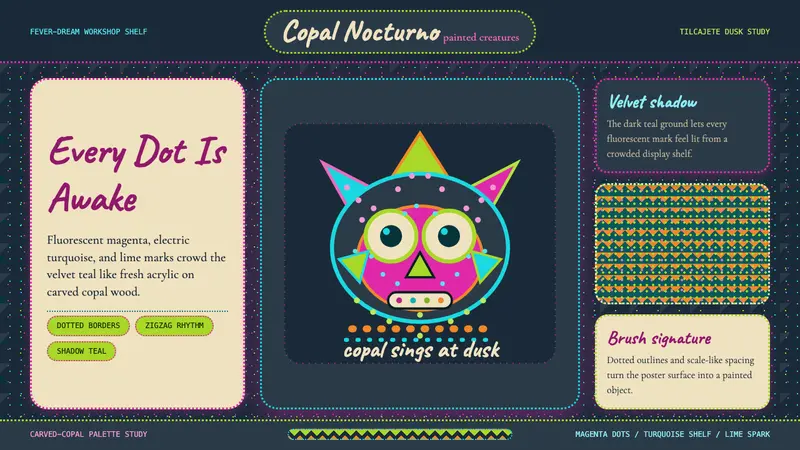 Mexican Alebrije Oaxaca (Linares 1936)Fever craft glows. Velvet teal carries magenta dots, turquoise zigzags, and Caveat script.
 Gujarati Bandhani Tie-DyeFestival precision. Fuchsia cloth, turmeric dot constellations, Caveat lettering.