What is Merina Lambamena?
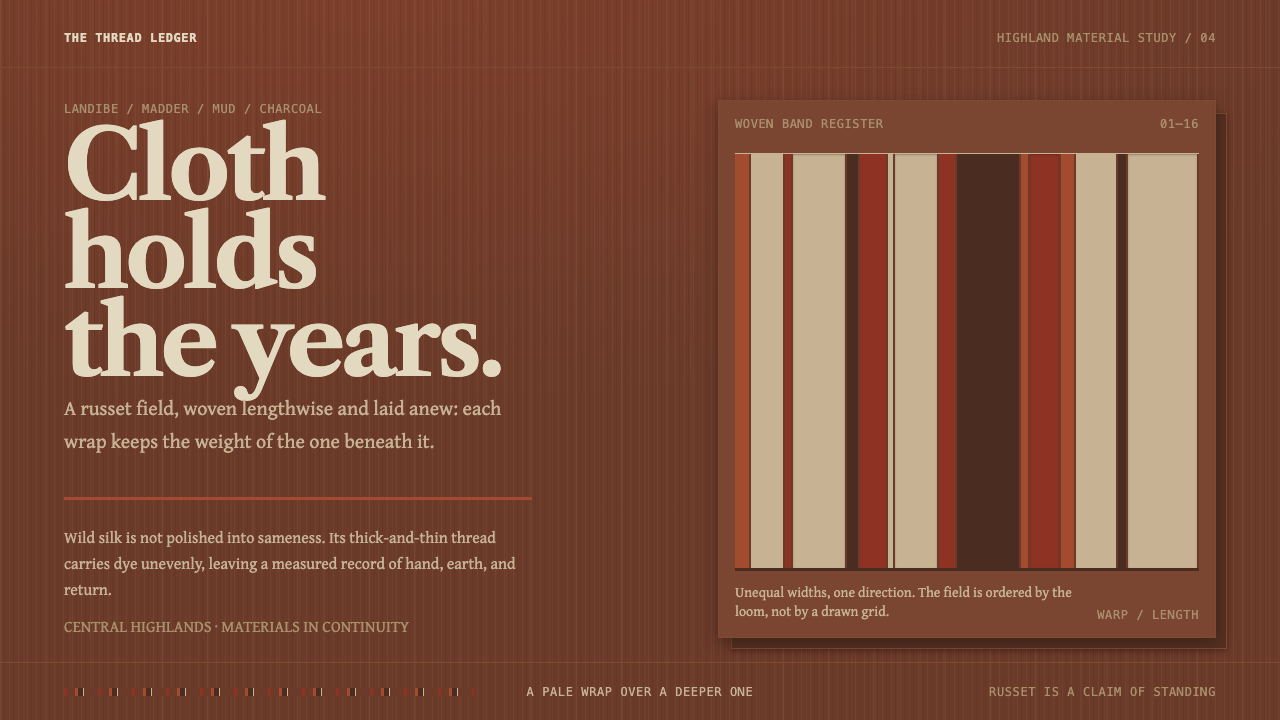
The lambamena is the burial cloth of Madagascar's highlands — russet wild silk woven in lengthwise bands and laid in layers that keep what came before.
Merina Lambamena in brief
Merina Lambamena is a design style taken from the burial cloth of the Merina highlands of Madagascar. The lambamena is woven from landibe wild silk, hand-loomed and dyed with madder, mud and charcoal, and its name reads as 'red lamba', a name that speaks of prestige rather than of any literal scarlet. What the loom actually yields is a russet field banded lengthwise, thick and thin in the same thread.
As a design system it takes the cloth at its word. Everything runs as a stripe along one axis, with widths that vary and a direction that never does. Panels stack with a slight offset, the way each famadihana lays a paler wrap over the one already there, and edges end in selvedge and fringe rather than in a clean cut. The ground is dark, russet and matte, and the type is set in a quiet old-style book serif.
The style's central idea is accumulation. Most digital interfaces treat the past as something to be replaced; the lambamena treats it as something to be covered and kept. Depth, in this style, is not elevation above a surface but layers on top of earlier layers, each a little paler, each leaving the one beneath partly visible. That makes it unusually well suited to subjects built on memory, lineage and record-keeping.
Where does Merina Lambamena come from?
The lambamena belongs to Imerina, the central highlands of Madagascar, with Antananarivo and Ambalavao named in the source as centres of the tradition. The source dates it to the Merina kingdom before 1900 and notes that both the famadihana rite and landibe weaving continue today. It sits within what the source calls the Austronesian textile tradition in Madagascar, and within a specific highland practice of wild-silk weaving.
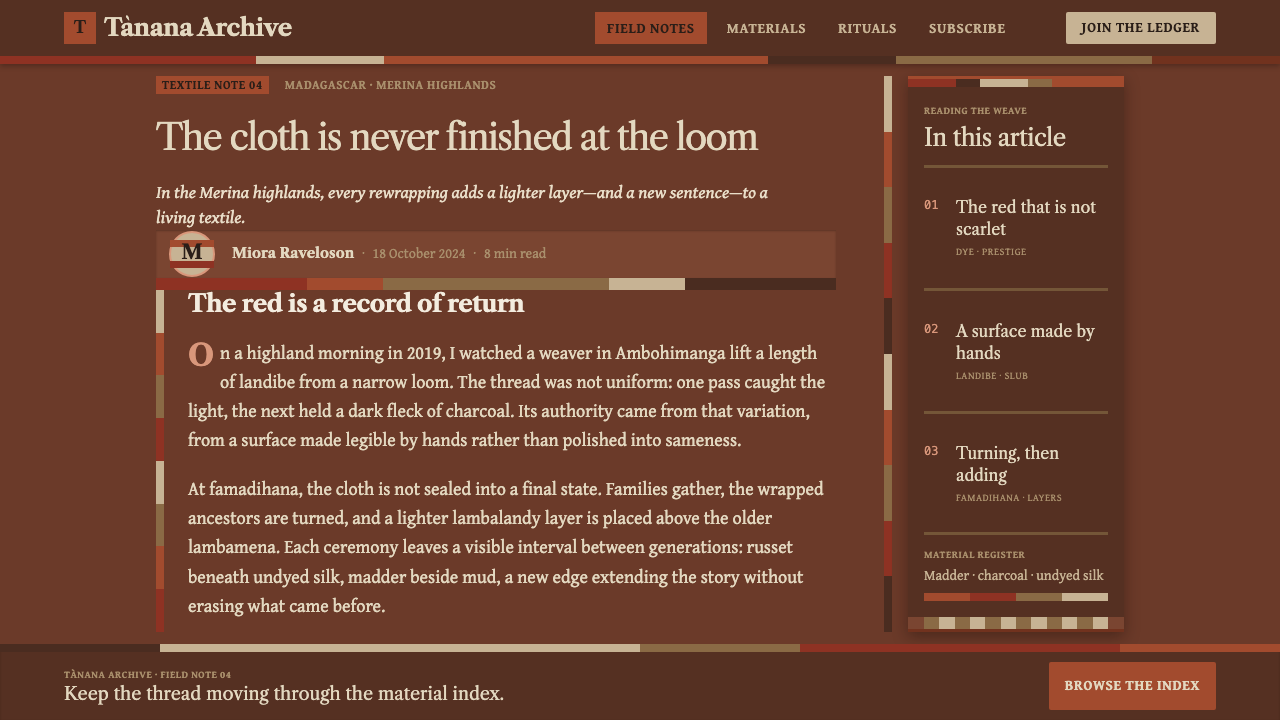
The cloth is made from landibe, the wild silk of the highlands, and it is made by women. Highland women weave it by hand on a loom and dye it with madder, mud and charcoal: madder is the red element, mud and charcoal the dark ones, and together they produce a deep russet rather than a bright red. The name 'red lamba' is about weight, not hue. The red speaks of the standing of the royal house and of the ancestors, which is why it is given to a cloth that looks brown.
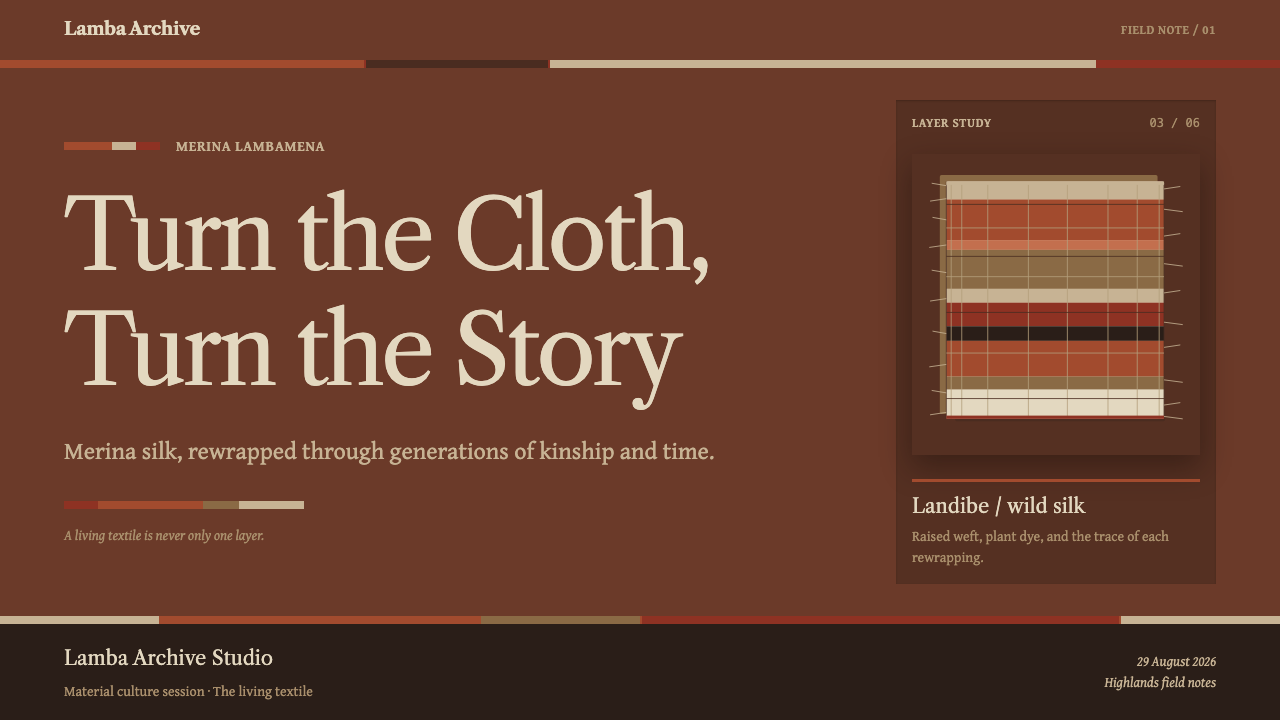
The famadihana is the rite that gives the cloth its meaning. Every five to ten years, families bring their ancestors out and rewrap them in a new, paler silk, so the burial cloth is built up in layers over time rather than made once. That layering is the style's most important formal inheritance. It is why the system stacks panels with a slight offset, why paler layers sit over darker ones, and why an old cloth is not discarded but kept beneath the new.
The source lists three groups of key figures: the Merina highland women who weave and dye landibe silk, the Merina sovereigns, and the London Missionary Society press at Antananarivo. The first two are the makers of the cloth and the standing its name evokes. The third points to the highland capital's other medium of record, printed text, and it is the natural reference for the calm book serif the system pairs with the woven bands. Cloth and print, one handmade and one set in type, are the two ways the highlands kept what came before.
What defines the Merina Lambamena look?
Russet Field
The ground is russet, a brown with red in it, produced by dyeing with madder, mud and charcoal. In the dark theme it becomes a deep, matte red-brown field against which pale text and paler panels read clearly. The red is a depth, not a brightness. Scarlet would betray the idea: the lambamena is called red for what it means, and its colour is earth.
Bands on One Axis
Every division in the layout is a woven band, not a hairline. Bands run along one axis only; their widths vary but their direction never does. Thick bands and thin bands alternate, and the result is a rhythm of stripe rather than a grid of boxes. Elements are organised along the band, not enclosed by a box.
Stacked Wraps
Panels stack with a slight offset, the way each famadihana lays a paler wrap over the one beneath. Hierarchy is expressed by layering and by lightening, not by elevation. A newer layer is a little paler and sits slightly off the edge of the one below, so that the older layers remain partly visible. History is read in the stack.
Selvedge and Fringe
Edges are where a cloth shows how it was made. Panels end in selvedge, the finished side edge of woven cloth, or in fringe, the loose ends of the warp, instead of in a clean cut. Cards carry a fold-crease shadow, shallow and tied to the fold rather than to a floating light, and a frayed termination. Nothing looks cut out of a sheet; everything looks woven to its length.
Uneven Thread
Wild silk spun by hand varies in thickness: thick and thin in the same thread. The style keeps that irregularity as texture rather than smoothing it into a machine-reeled sheen. Surfaces are matte and slubby, not glossy; the finish should look spun and woven, with slight variation along each band, not extruded and polished.
Quiet Field and Wide Margins
The cloth has a width, and the layout keeps it. Margins are wide, like the unused breadth of a cloth, and the text sits in a calm old-style serif that stays out of the way. Quietness is the point: the page is a field in which bands do the structural work and type does the reading, and neither competes for attention.
Who shaped Merina Lambamena?
The makers of the lambamena. They weave landibe wild silk by hand on the loom and dye it with madder, mud and charcoal. Every property the style asks for — the banded field, the uneven thread, the russet colour — is the direct product of their materials and methods, which is why the system treats those properties as fixed rather than as styling choices.
Named in the source as part of the tradition's setting. The 'red' of the cloth's name is, in the source's account, a statement about royal and ancestral weight rather than about pigment, and the sovereigns of the Merina kingdom stand behind that weight. For designers, the lesson is that the colour carries status and memory and should be treated with some gravity.
A press at the highland capital, named in the source's references. It is the printed-word counterpart to the woven cloth, and the natural reference point for the way this system pairs woven bands with a calm, book-like serif: the two media of record in Antananarivo sitting together on the same page.
How do you use Merina Lambamena today?
Merina Lambamena is a style for subjects built on memory, lineage and layered time. It fits genealogy and family-history products, archives and historical timelines, memorial and tribute pages, museum and heritage storytelling, and any interface where the user is accumulating a record rather than racing through a task. It is solemn by temperament, so it is less suited to playful, promotional or highly interactive products.
For slides, the cover is a russet field divided into broad horizontal bands, with the title set in pale serif type on one band and a thinner band below carrying a date or subtitle. Content slides stack bands the way the wraps stack, with a little offset from one to the next, and keep generous side margins. Data slides are among the style's best uses: horizontal bar charts are literally warp bands, with bar thickness varying to show magnitude, and stacked bars can be read as successive wraps, each a little paler than the last.
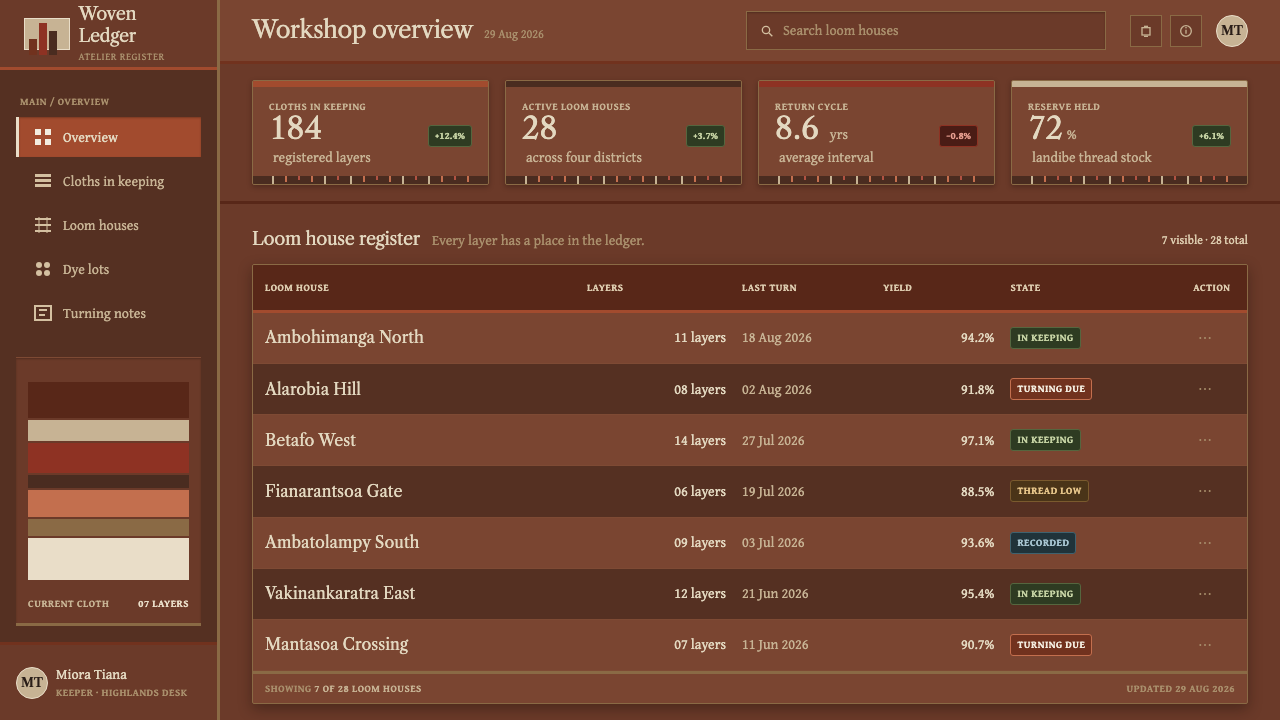
For web interfaces, the style suits timelines, record views, family trees, version histories and activity logs, where layering over time is the content. Cards are stacked panels with a fold-crease shadow and a frayed or fringed lower edge, never floating glass. Dividers are bands in a slightly lighter or darker tone, not hairlines. A pricing page can arrange plans as stacked bands of different thickness, and a dashboard works best when metrics are bars and bands rather than rings and gauges. Keep body text pale on the dark field, with enough size and weight for comfortable reading.
In editorial and marketing work, the style gives long-form stories about family, memory, heritage and craft a calm, dignified frame. Chapters can be marked by a change of band instead of a heading flourish, pull quotes can sit on a paler wrap laid over the main field, and images can be framed by fringe-like edges. Photography of textiles, hands and domestic objects fits easily, and a restrained grade toward warm brown keeps it within the palette.
The most common mistake is to pull the colour toward bright red because of the name. The lambamena is russet, and a scarlet version loses its earth and its solemnity. A second mistake is to break the single axis with diagonals, curves or rotated elements, which removes the logic of the stripe. A third is to use thin hairline dividers where a band belongs, or to add glossy gradients where the surface should be matte and uneven. Finally, take care with context: the cloth is a funerary object, and the style should not be used in ways that treat the dead or the rite as decoration.
Merina Lambamena — FAQ
What is a lambamena?
The lambamena is the burial cloth of the Merina highlands of Madagascar. It is woven by hand from landibe wild silk and dyed with madder, mud and charcoal, producing a russet field banded lengthwise with thick and thin in the same thread. It is used in the famadihana rite, in which ancestors are rewrapped in a fresh, paler cloth. As a design style it turns those facts into a dark russet ground, single-axis bands, stacked panels and fringed edges.
Why is it called a 'red lamba' if the colour is russet?
Because the name describes standing, not hue. According to the source, the red speaks of the weight of the royal house and of the ancestors, while what the loom actually produces is a russet field. For designers, that means the right colour is a deep, earthy red-brown. A bright, saturated red would match the word but not the cloth, and it would lose the gravity the name is meant to carry.
What is the famadihana, and why does the style stack panels?
The famadihana is the rite in which families bring their ancestors out every five to ten years and rewrap them in a paler cloth, so the burial wrapping is built up in layers over time. The style turns that into its depth model: panels stack with a slight offset, newer layers are a little paler, and older layers stay partly visible beneath. Depth means accumulation rather than elevation, and no layer is discarded.
Why does everything run in one direction?
Because the cloth is woven in warp bands, and the bands run in one direction only. On the loom the width of a band can change from thick to thin, but its direction cannot. The system keeps that discipline: dividers, charts and layout blocks are all stripes along a single axis, which gives the page an unmistakable rhythm and keeps decoration subordinate to structure.
Can the style be used for products that are not about death or ancestry?
Yes, as long as the subject can carry its weight. The structural ideas of banded layouts, layered panels, fringed edges and uneven matte texture suit anything that accumulates over time: records, timelines, histories and archives. What to avoid is using the style playfully or as costume, and anything that treats the burial rite itself as decoration. Name the tradition as the source whenever it is used.
Related design styles
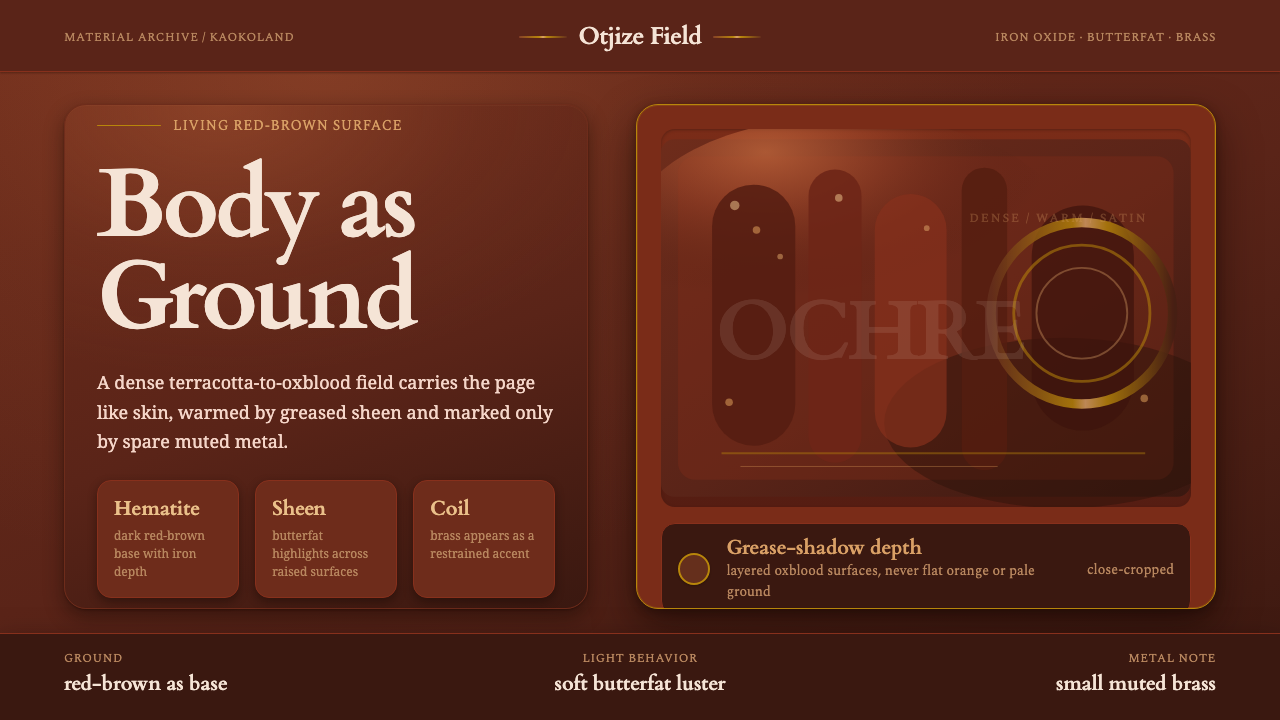 Himba Otjize Ochre NamibiaDense and ritual-warm. Oxblood ground, butterfat sheen, and sparse brass coil…
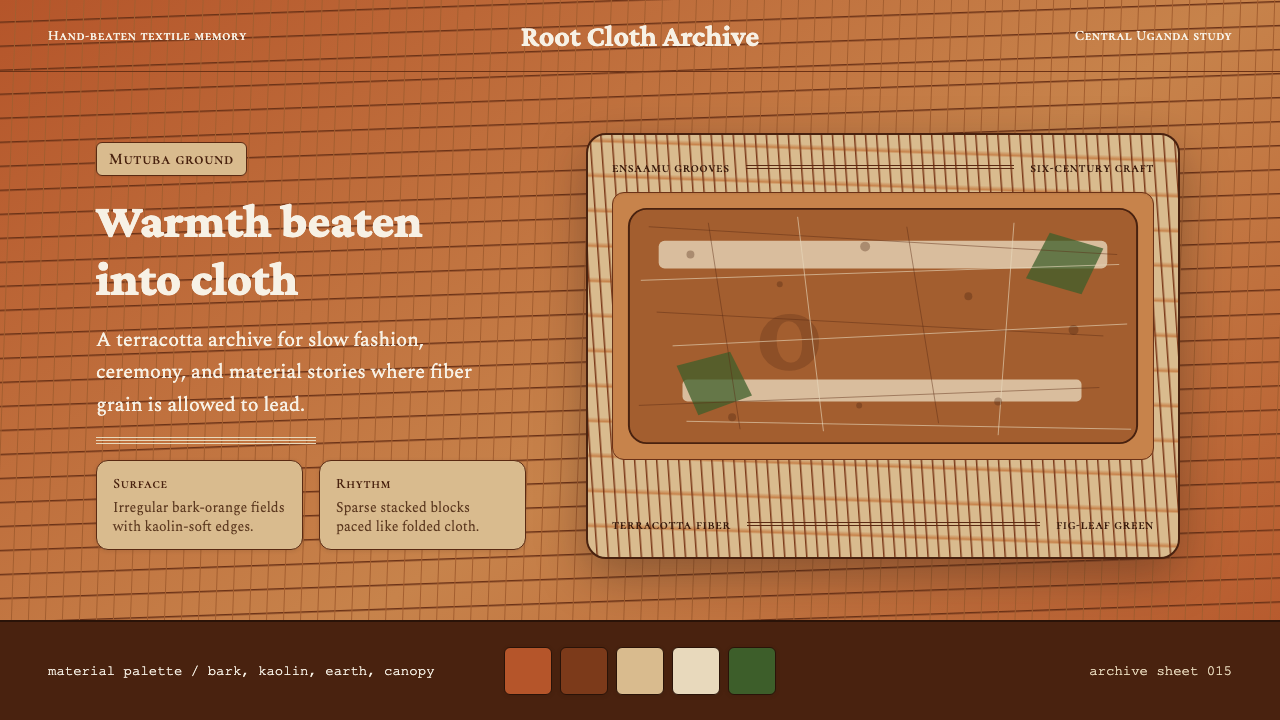 Ugandan Mutuba BarkclothHandmade warmth holds. Terracotta grain, Crimson Pro, and sparse stacked clot…
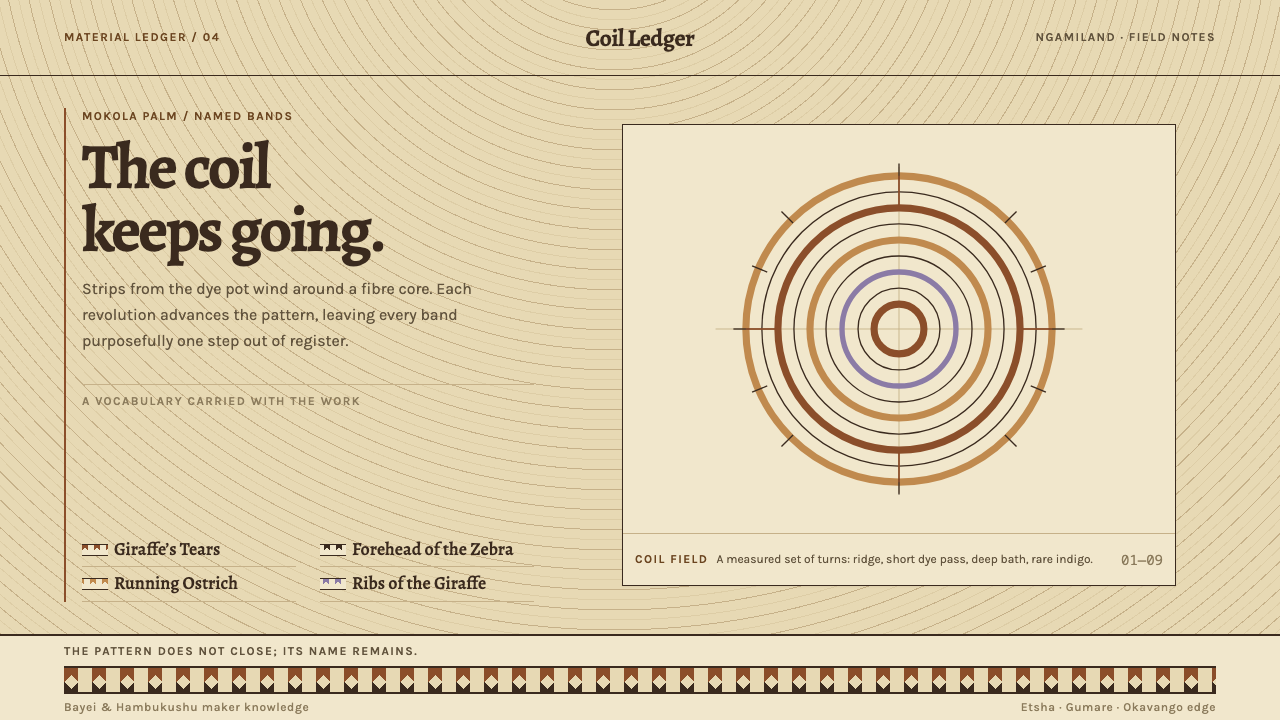 Botswana Coiled BasketThe pattern keeps travelling. Bark-brown stepped bands wind across a straw co…
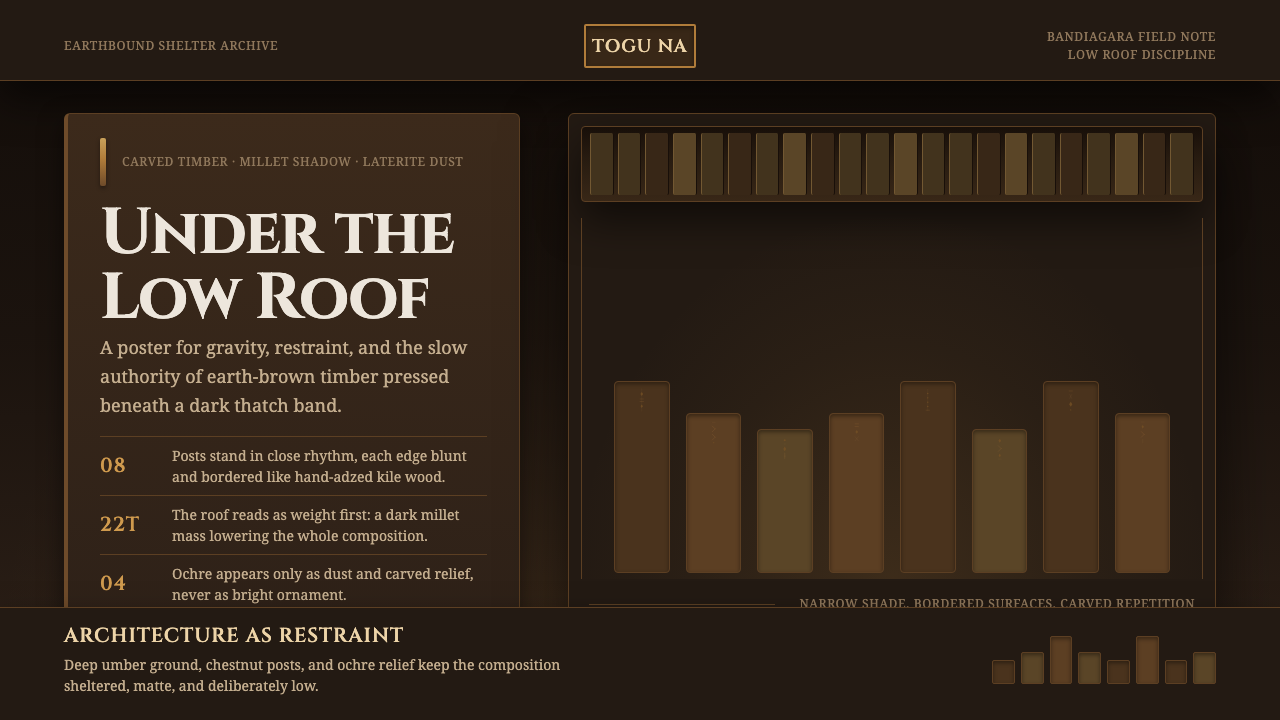 Dogon Toguna Shelter MaliGravity made visible. Deep umber ground, low roof band, chestnut posts in sha…
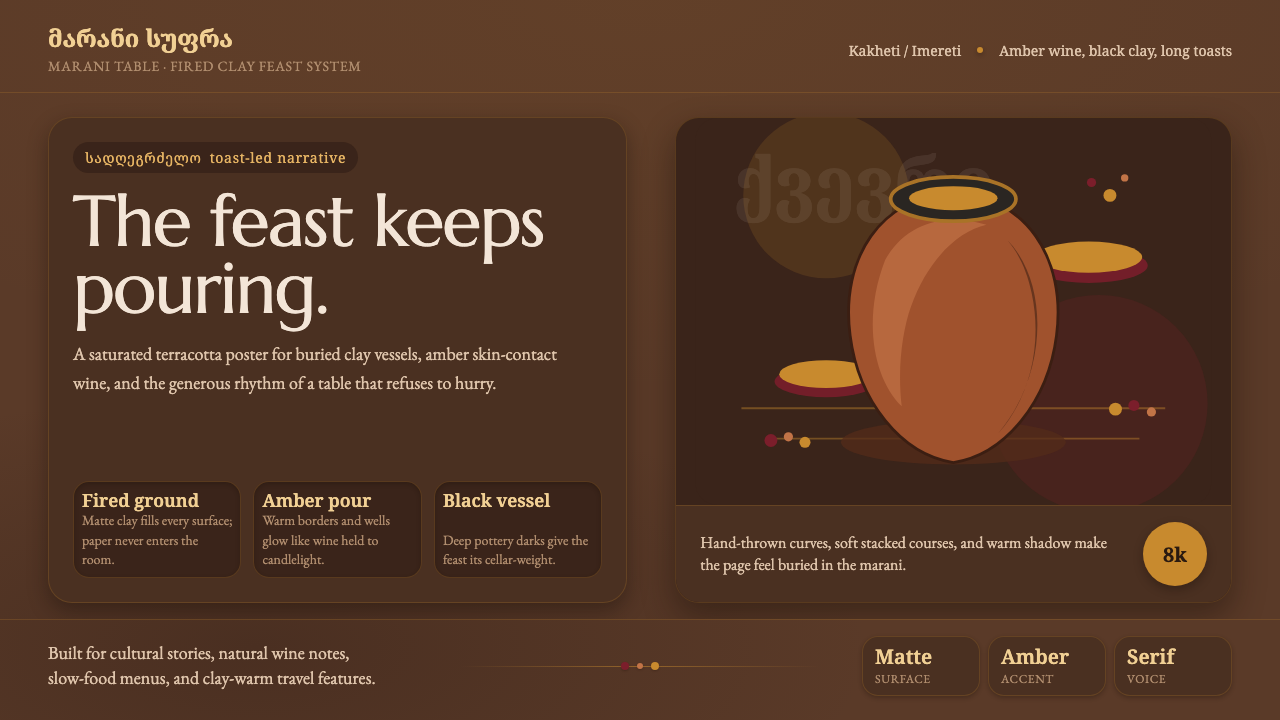 Georgian Qvevri Supra FeastHospitality made earthen. Terracotta ground, amber wine, Georgian serif curve…
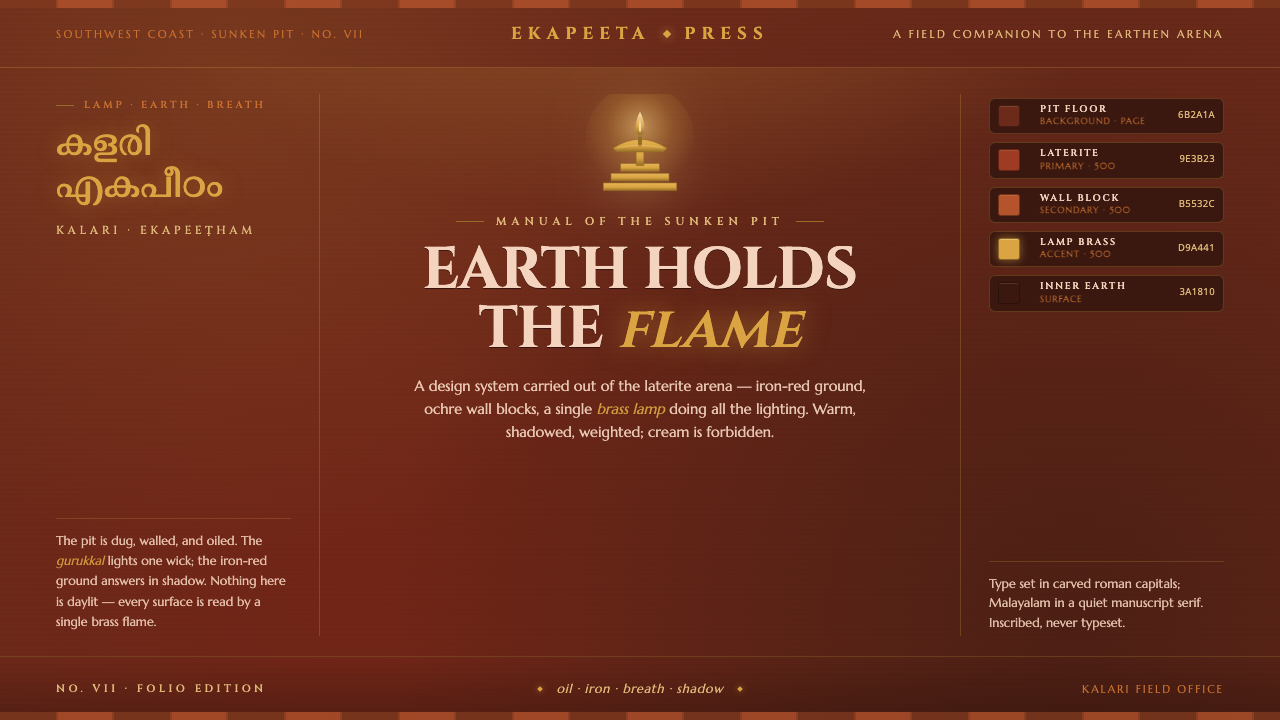 Kalaripayattu Kalari ArenaEarth holds the flame. Iron-red laterite, ochre wall blocks, a single brass l…