What is Dogon Toguna Shelter?
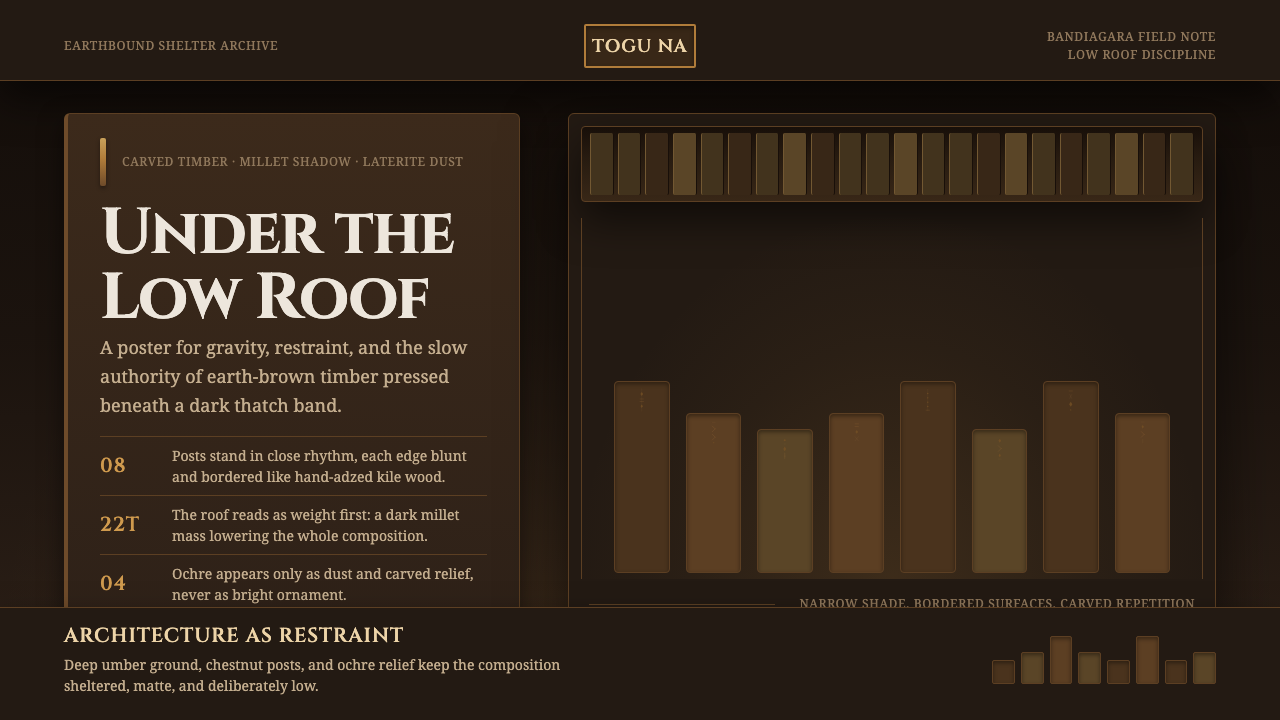
Dogon Toguna Shelter turns gravity into a visual language — deep umber shadow, weathered chestnut timber, a low roof band, and carved posts that make restraint feel protective.
Dogon Toguna Shelter in brief
The toguna, meaning great shelter, is the men's council house of the Dogon, rooted in the Bandiagara escarpment of Mali. Its design identity begins with weight: a packed millet-stalk roof carried by carved kile-wood posts, a ceiling held deliberately just above head height, and a deep shadow that makes the entire structure feel earthbound rather than elevated.
As a visual style, Dogon Toguna Shelter is dark, tactile, and unhurried. Deep umber ground is interrupted by chestnut timber, silvery weathering, laterite dust, shallow ancestor figures, and zigzag relief. Nothing appears polished for its own sake. Surfaces feel handled by sun, wind, earth, and time.
The essential mood is protective restraint. The low roof does not create spectacle; it creates shelter and regulates posture. The carved posts do not behave like decoration added afterward; they carry structure while holding memory in their surfaces. The result is architecture as gravity: grounded, shaded, materially honest, and quietly ceremonial.

Where does Dogon Toguna Shelter come from?
The toguna is described as a great shelter and serves as the men's council house within Dogon village life. Its tradition is ancient in its roots and living in its practice, belonging to Dogon vernacular architecture rather than to a named modern movement. The structure is therefore understood through use as much as through appearance: it is a place where elders gather, sit, and deliberate beneath a deliberately constraining roof.
Its construction concentrates meaning into a few forceful elements. A roof of packed millet stalks weighs 22 tons and rests on eight carved posts of kile wood arranged in three rows. The ceiling sits just above head height, requiring those inside to remain seated or bent beneath it. The architectural gesture is practical and symbolic at once: physical restraint becomes a condition for keeping disputes from becoming blows.
The Bandiagara escarpment and the Dogon country of Mali give the shelter its visual setting. Chestnut timber is bleached by sun into silvery brown, while laterite dust settles across the surface in ochre traces. Shallow ancestor figures and zigzag relief are carved into the posts, binding the material presence of the shelter to the memory carried by the village and its woodcarvers.
For design interpretation, the tradition should be approached as a complete spatial ethic rather than as a collection of motifs. The low roof, deep shadow, carved supports, and weathered surfaces all express the same idea: authority is grounded, shelter is shared, and visual richness comes from accumulated material presence rather than surface abundance.
What defines the Dogon Toguna Shelter look?
Ground and Color
The visual field begins in deep umber, almost like packed earth held in shade. Chestnut brown and silvery weathered brown provide the principal variation, while laterite ochre appears as a dusty trace rather than a bright accent. The palette should feel mineral, sun-worn, and compressed, with darkness carrying as much identity as color.
Low Roofline
The defining proportion is low and heavy. Horizontal bands should feel close to the head, creating a sheltered field rather than an open vista. A composition that rises too high, leaves excessive air above the subject, or aims for weightless elegance loses the toguna character. Restraint must be felt physically.
Weathered Timber
Wood is not presented as a pristine luxury surface. It is chestnut, sun-bleached, silvery, dusty, and marked by time. Texture should remain quiet and broad, suggesting grain and abrasion without becoming decorative noise. Material variation is allowed to accumulate slowly, like a surface exposed to weather rather than manufactured for effect.
Carved Relief
Ancestor figures and zigzag relief appear as shallow marks embedded in the supports. The treatment is incised and structural, never glossy or theatrical. Relief should be discovered at close range, with shadow doing part of the drawing. Pattern is therefore memory held in material, not a repeating surface graphic.
Shadow and Depth
Shadow is the primary spatial instrument. Forms should emerge from darkness with broad, quiet transitions rather than sparkle or visual effects. The shelter is not modeled as a brightly lit object; it is understood through what remains visible beneath cover. Depth comes from concealment, overlap, and the pressure of the roof.
Composed Restraint
Composition should feel arranged by supports, roof bands, and intervals of shadow. Typography and imagery belong inside that structural order, not above it. A small number of strong forms, held in tension, is more faithful than a crowded field of ethnographic symbols. The style asks for patience before emphasis.

Who shaped Dogon Toguna Shelter?
The elders are the human presence around which the toguna is organized. They gather beneath its low roof to deliberate, and the architecture gives their discussion a physical setting of patience, posture, and restraint. In a design interpretation, they represent grounded authority rather than individual celebrity.
The men's council is not a decorative reference but the shelter's social purpose. Its presence explains why the roof is low, why the space is shaded, and why the structure feels deliberately unhurried. The council gives the style its ethical center: design should support conduct, not merely create atmosphere.
The village woodcarvers give the shelter its visible memory. Their carved posts carry ancestor figures and zigzag relief while continuing to serve as structural supports. They embody the union of use and meaning that defines the toguna: a surface can remember without becoming ornamental excess.
How do you use Dogon Toguna Shelter today?
Dogon Toguna Shelter works best when its principles are transferred together: weight, shadow, low proportion, weathered material, and restrained relief. Borrowing only the dark palette produces a generic rustic mood. The style becomes legible when every choice suggests shelter, grounded authority, and the slow accumulation of time.
For presentation slides, the cover should feel like an entrance beneath a low roof: a dark ground, a restrained title, and one strong horizontal or vertical structural element. Content slides should keep text within a clear field of shadow, with headings treated as carved markers rather than loud signals. Data slides can use posts, roof bands, and layered blocks as organizing metaphors; the information should remain legible without losing the sense of weight.
For web interfaces, the style suits dashboards, pricing pages, and tools that need to feel dependable rather than energetic. Use deep backgrounds, quiet card boundaries, muted timber-like surfaces, and restrained highlights for active states. Panels should feel sheltered and nested. A pricing page can express hierarchy through density, material contrast, and the pressure of horizontal bands instead of bright badges or decorative gradients.
For editorial and marketing work, build a narrow, shaded reading environment with broad margins and deliberate pauses between sections. A large opening image can suggest the roof and posts without reproducing them literally. Campaign language should emphasize endurance, protection, memory, and material honesty. Calls to action are strongest when they appear as clear interruptions in the dark field, not as competing ornaments.
The common mistake is treating the style as an excuse for dark brown decoration or indiscriminate ethnic pattern. Avoid covering every surface with zigzags, adding polished wood effects, or making the composition theatrically exotic. The defining quality is restraint: one low roof gesture, a few carved traces, deep shadow, and enough silence for the material to carry meaning.

Dogon Toguna Shelter — FAQ
Is Dogon Toguna Shelter simply a dark rustic style?
No. Darkness is only one part of the system. Its identity comes from the relationship between low proportion, structural posts, sheltering shadow, weathered timber, and carved memory. A generic rustic treatment may imitate rough material, but it usually lacks the toguna's sense that architecture regulates posture and conduct.
Why is the low roof so important?
The roof is both physical shelter and social restraint. The ceiling sits just above head height, so people beneath it remain seated or bent rather than standing freely. That condition helps keep council disputes from becoming blows. In visual work, the low roof should therefore create pressure, intimacy, and composure rather than merely act as a decorative horizontal line.
Can the style work on a lighter background?
It can, but the result must preserve the logic of shelter and shadow. A lighter field may be used as exposed ground or weathered material, while the main composition still needs a strong dark enclosure or band. If the entire design becomes bright, airy, and weightless, it no longer communicates the visual character of the toguna.
How should the ancestor figures and zigzag relief be used?
Use them as embedded traces rather than surface wallpaper. The relief should appear on supports, edges, or selected structural fields, with enough shadow for it to emerge gradually. Repeating the pattern everywhere weakens its meaning. The strongest interpretation lets the carving feel discovered, carried by material, and connected to the shelter's structural order.
What distinguishes the style from minimalism?
Minimalism often removes detail to achieve visual reduction. Dogon Toguna Shelter uses restraint for a different reason: to make weight, shelter, material, and conduct perceptible. Its surface is not empty; it is quiet, weathered, and selectively marked by ancestor figures and zigzag relief. The goal is not purity through absence but clarity through grounded presence.
Related design styles
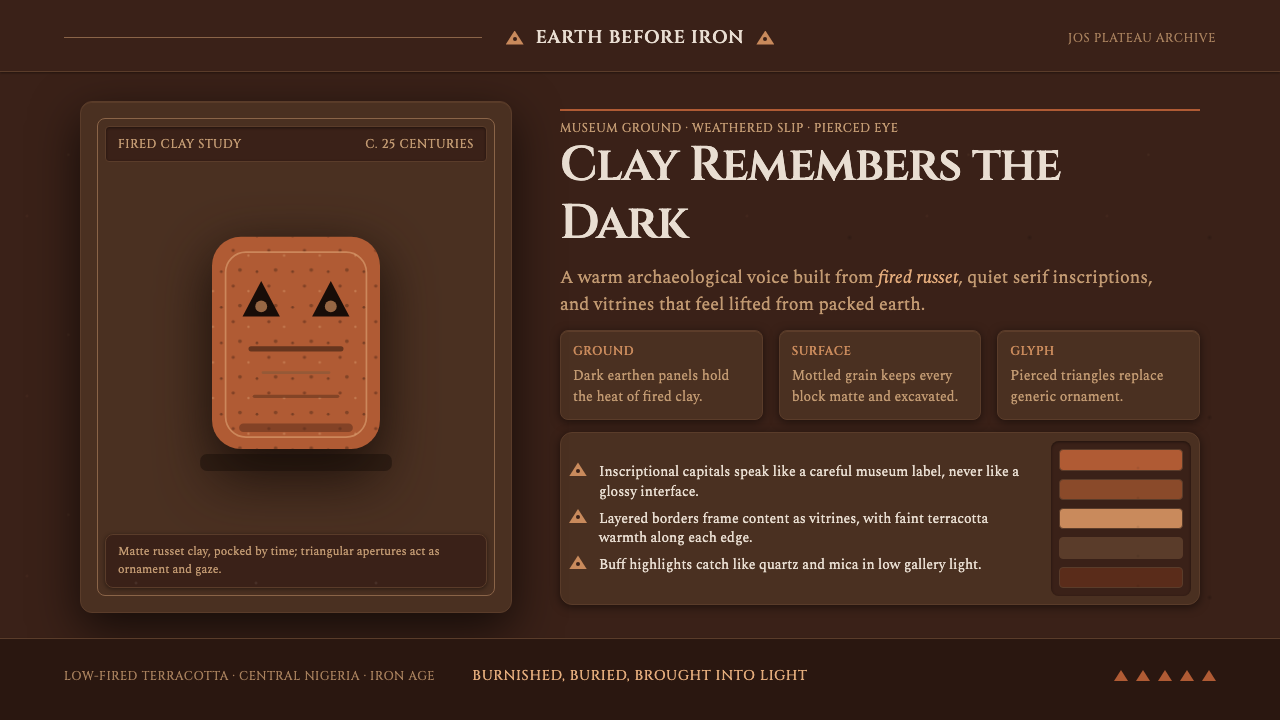 Nok Terracotta NigeriaAncient clay holds the dark. Russet grain, Cinzel labels, and pierced triangl…
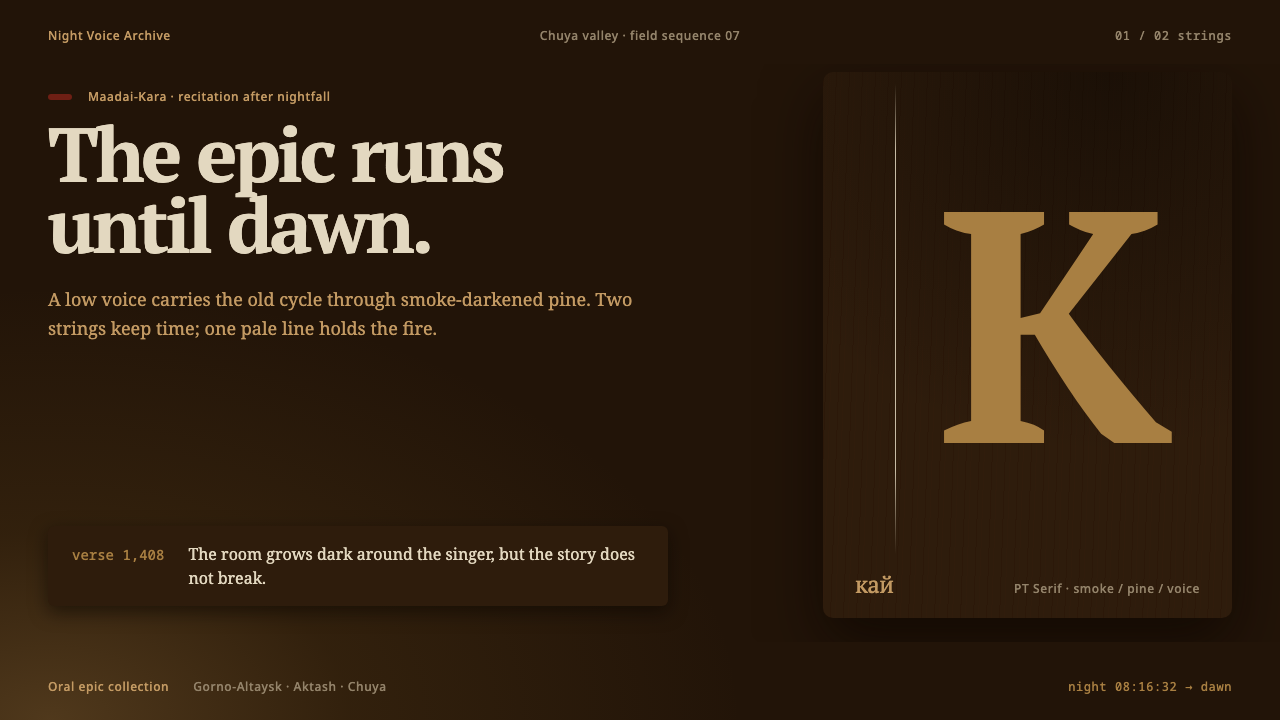 Altai Kai EpicEpic voice burns until dawn. Smoke-brown layers meet one pale string and a si…
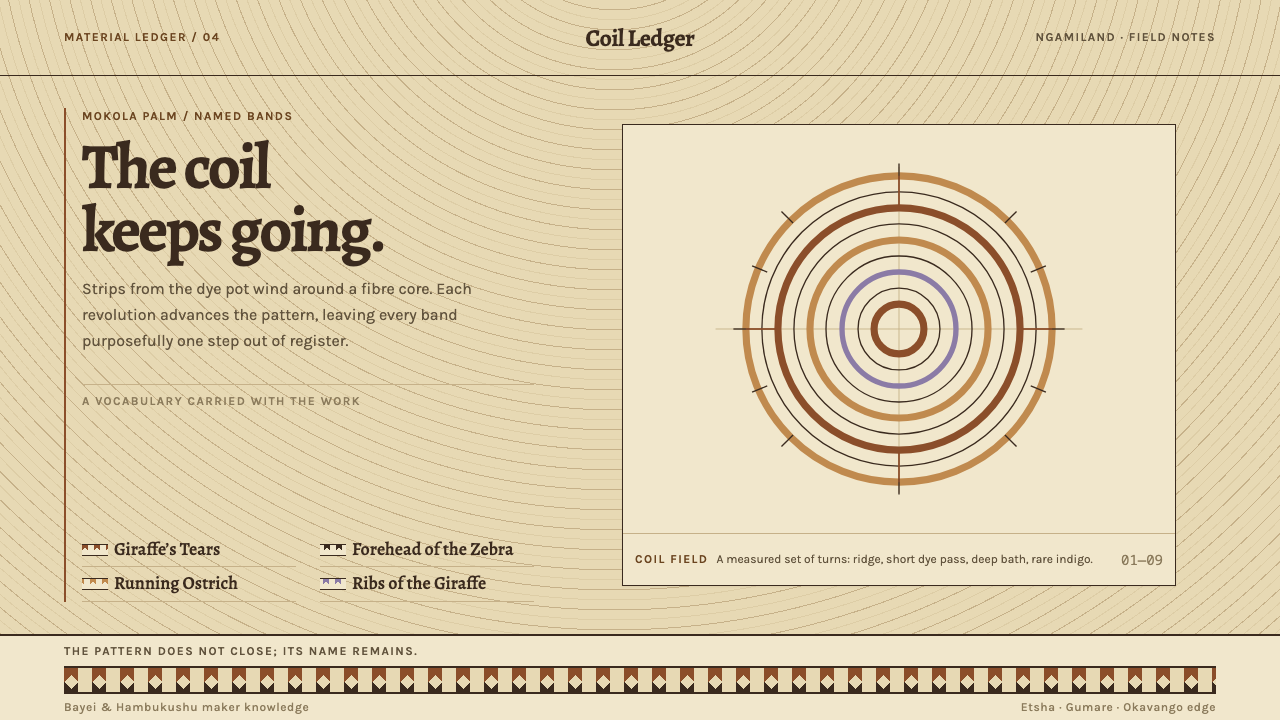 Botswana Coiled BasketThe pattern keeps travelling. Bark-brown stepped bands wind across a straw co…
 Cheese Affinage CavePatience reads as stone. Rind brown, mold green, and oak shelf grids glow in…
 Desert VarnishStone remembers. Sandstone glyphs cut through near-black varnish in stacked f…
 Hawaiian Hula Pahu DrumSacred weight, hand-marked. ʻAlaea red, kapa texture, and stacked carved regi…