What is Nok Terracotta Nigeria?
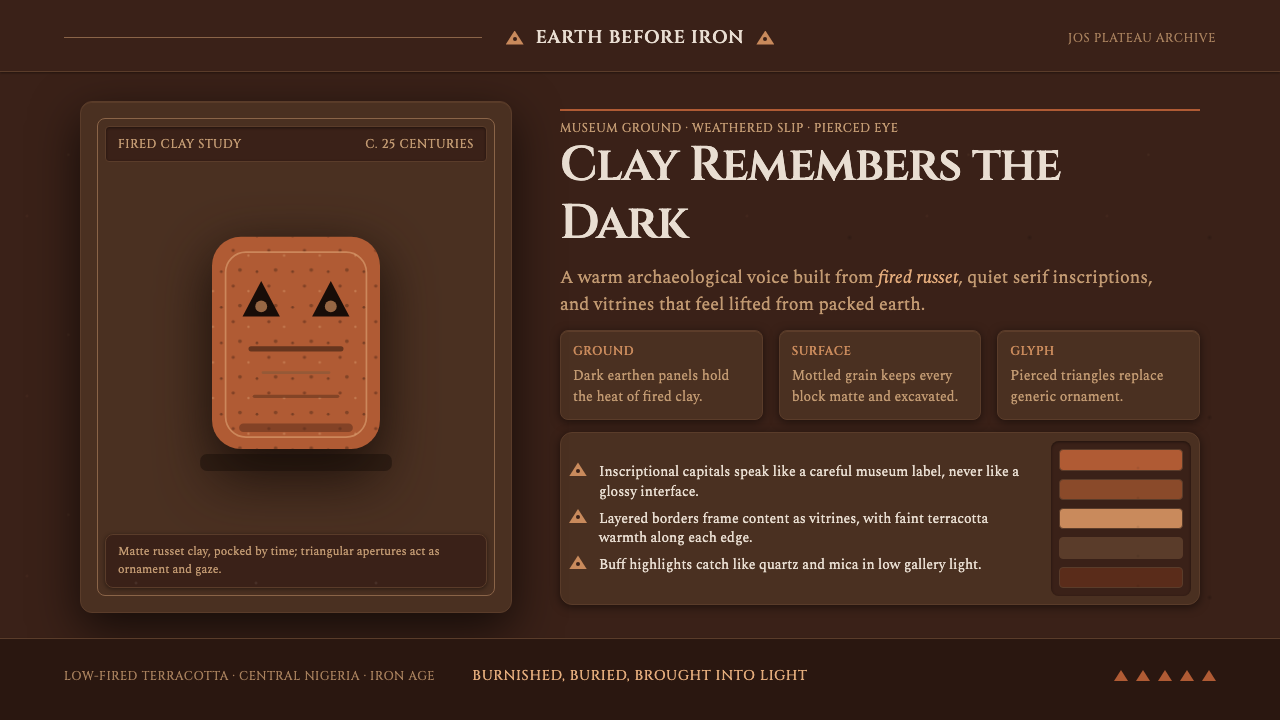
Nok Terracotta Nigeria turns the darkness of excavation into a visual language: weathered clay, watchful pierced eyes, and the quiet radiance of material drawn from the earth.
Nok Terracotta Nigeria in brief
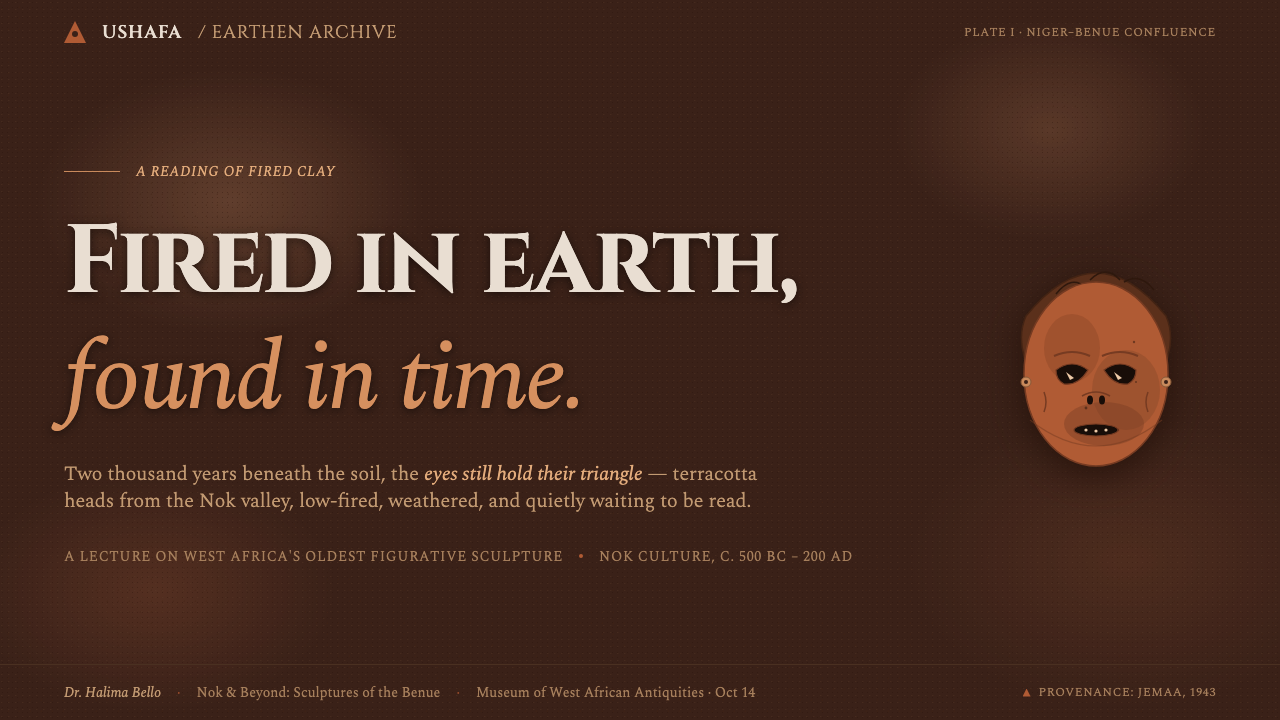
Nok Terracotta Nigeria draws from the Nok culture of central Nigeria, whose hollow terracotta heads and figures are the oldest known figurative sculptures in West Africa. Produced from low-fired clay and buried for more than two millennia, these works carry an unusually direct physical presence: russet-orange fired earth softened into mottled brown, pitted surfaces, mineral grains, and openings that make the face feel both constructed and mysteriously alive.
The system does not imitate an archaeological object as a museum replica. Instead, it takes the conditions surrounding Nok terracotta seriously: darkness as a setting for clay, irregular grain as evidence of material, and triangular or D-shaped pierced eyes as a formal language. The result should feel excavated rather than manufactured, as though each interface surface has been burnished by use and then altered by long burial.
Its mood is restrained, ceremonial, and tactile. A dark earthen field allows warm terracotta forms to emerge without becoming decorative spectacle. Fine quartz-like and mica-like flecks suggest the mineral life of clay under dim light, while carved apertures create visual tension between solid mass and empty space. The style replaces polished digital smoothness with the dignity of fired, weathered matter.
Where does Nok Terracotta Nigeria come from?
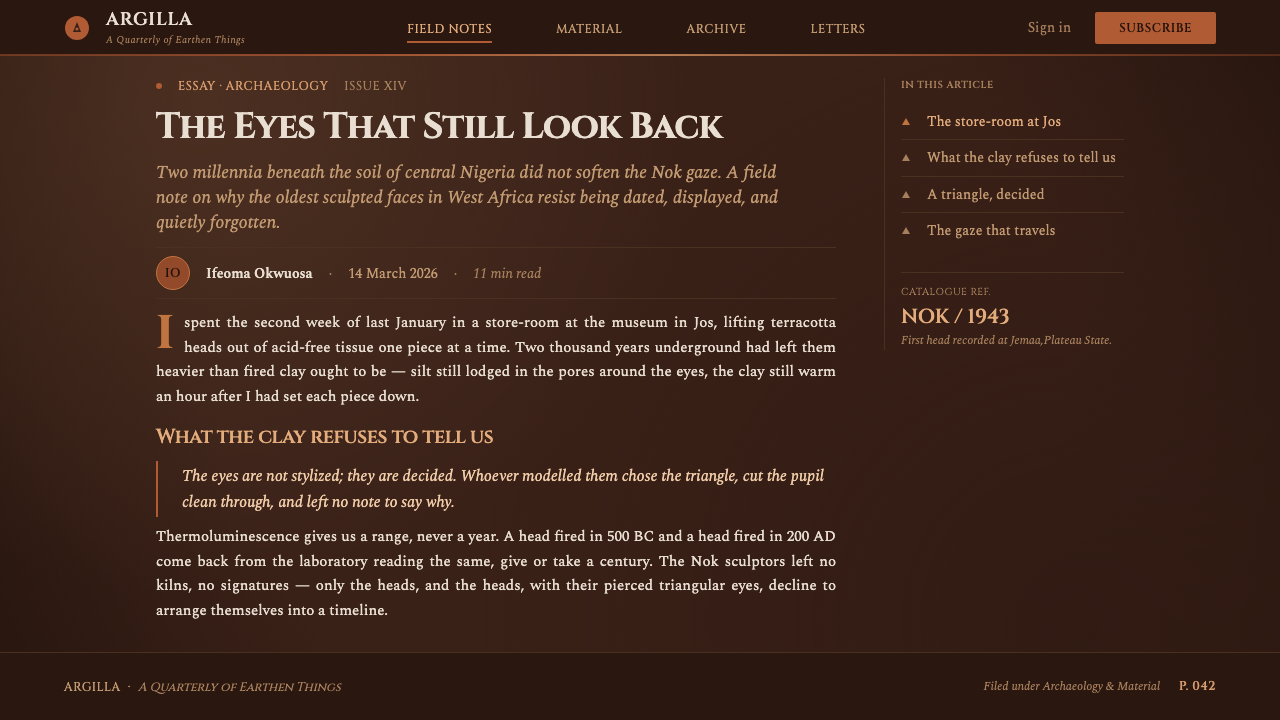
The Nok culture flourished in the Nok and Jos Plateau region of central Nigeria, in West Africa, from about 500 BC to 200 AD. Its terracotta tradition belongs to Iron Age West Africa and is recognized in the supplied material as the earliest known sub-Saharan figurative sculpture. That position matters for the style: the visual reference is not a later decorative revival, but an ancient sculptural language shaped through clay, fire, hollow volume, and the long afterlife of burial.
The works came to wider attention through twentieth-century tin-mining excavations on the Jos Plateau. Their rediscovery was accidental, a fact that gives the visual system one of its central ideas: revelation through disturbance. The material is not presented as pristine craft arriving directly from a workshop. It appears as something recovered from earth, marked by the conditions that concealed it and made it visible again.
Nok heads and figures are defined by hollow construction and low-fired terracotta. Their surfaces are not uniform; time in the ground leaves mottling, pocks, and granular variation. Quartz and mica are described as catching dim light, which suggests a visual approach built around sparse glints rather than broad shine. The material should appear warm but not glossy, aged but not lifeless, tactile without becoming theatrical.
The pierced triangular and D-shaped eyes are the tradition’s most immediately transferable motif. They are not simply facial details. In a contemporary system, they can become apertures, directional marks, cutout ornaments, or framing devices, always retaining the tension between a dense clay body and a void passing through it. Bernard Fagg appears in the supplied origin material alongside Nok culture artisans, connecting the tradition’s makers with its later archaeological recognition.
What defines the Nok Terracotta Nigeria look?
Earthen Darkness
The ground is dark, matte, and earthen rather than theatrical black. It functions like a museum plinth or excavation shadow, allowing clay-colored forms and mineral flecks to emerge gradually. Darkness should hold the composition together, not swallow its information.
Terracotta Patina
Surfaces resemble fired clay that has been burnished, buried, and weathered. Russet warmth gives way to mottled brown variation, shallow pocks, and uneven grain. The finish should feel accumulated over time, never lacquered or digitally pristine.
Pierced Eyes
Triangular and D-shaped openings are the primary ornament. Their force comes from subtraction: a void cut through a solid form. Used in frames, markers, masks, or icons, they should read as carved apertures rather than generic geometric decoration.
Mineral Grain
Fine grain gives the style its excavated realism. Sparse quartz-like and mica-like particles catch restrained light across otherwise matte surfaces. The effect is particulate and local, never a uniform sparkle layer spread over the entire composition.
Inscribed Typography
Cinzel labels provide a carved, ceremonial voice. Type should feel measured and inscribed, with generous breathing room around short labels and titles. It is most effective when treated as an artifact marking or museum designation, not as ornamental display lettering.
Solid and Void
The system balances heavy clay masses against cut-through openings. Large areas should feel weighty, almost sculptural, while apertures introduce sightlines and movement. This contrast gives the style its watchful quality: the surface appears still, but the void seems to look back.
Who shaped Nok Terracotta Nigeria?
The Nok culture artisans are the essential authors of this visual source. Their hollow, low-fired terracotta heads and figures established a sculptural vocabulary of clay mass, facial openings, granular surfaces, and figurative presence. Because individual makers are not named in the supplied material, the system should acknowledge the tradition collectively rather than inventing a singular artistic author.
Bernard Fagg is named in the supplied origin material as a key figure associated with Nok. Within this article’s scope, his importance lies in the later recognition of a tradition rediscovered through twentieth-century tin-mining excavations. He represents the archaeological bridge between objects long buried in the Jos Plateau region and their public cultural visibility.
The Nok terracotta tradition functions here as a figure in its own right: a continuous visual inheritance rather than an individual biography. Its oldest-known sub-Saharan figurative status gives contemporary use a responsibility to preserve the language of hollow clay, weathering, and pierced form instead of reducing it to an exotic pattern library.
How do you use Nok Terracotta Nigeria today?
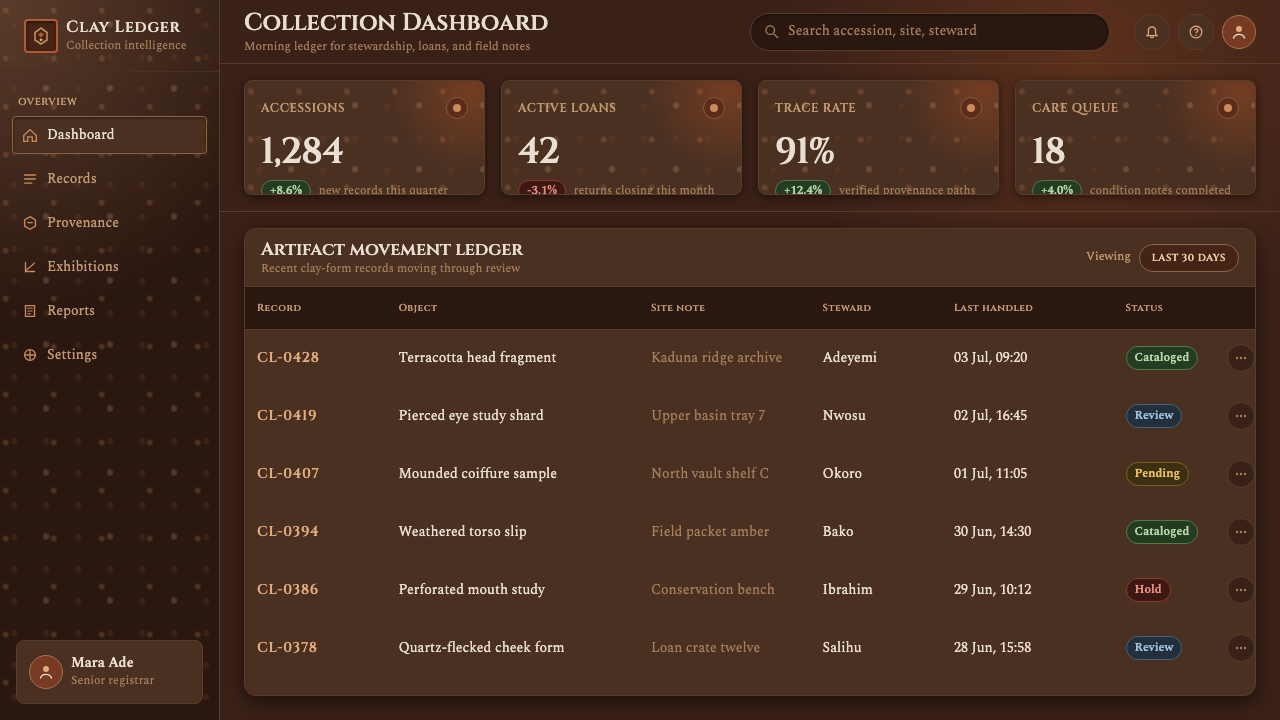
For presentation covers, use darkness as a field of emergence. A single terracotta-like mass, a pierced triangular opening, and a short inscribed title can establish the subject before any supporting detail appears. Content slides should become quiet display cases: a dark ground, disciplined text blocks, and one weathered clay marker for each section. Data slides benefit from the contrast between dense forms and empty apertures; charts should feel carved and assembled, not glossy or overly animated.
For web interfaces, the style is strongest in cultural archives, collection browsers, exhibitions, research tools, and editorial dashboards. Use the dark earthen background to establish continuity, then let warm clay accents identify active states, selected objects, or key metrics. Cards should feel like labeled artifacts on a display surface, while pierced-triangle marks can guide navigation or indicate expandable information. Keep interaction cues legible enough that atmosphere never obstructs use.
For pricing pages and product comparisons, the system can create a sense of permanence without making the page feel antique. Treat plans as distinct clay forms set against the same excavated ground; use typography and spacing to establish hierarchy, and reserve brighter terracotta emphasis for the primary decision. The strongest approach is quiet and material: comparison information remains easy to scan, while texture appears in controlled edges, markers, and feature fields rather than behind every line of text.
For editorial and marketing work, let images or illustrations behave as excavated fragments rather than full-bleed lifestyle scenes. A close crop of granular clay, a facial aperture, or an isolated sculptural silhouette can punctuate a long article. Marketing sections can alternate between shadowed information fields and warm terracotta statements, using mineral grain to soften transitions. The voice should remain respectful and descriptive, foregrounding material history rather than treating the culture as a source of generic visual drama.
The common mistake is to turn Nok references into a costume: adding random tribal-looking motifs, excessive cracks, or bright orange everywhere. This weakens the actual logic of the source material. The system depends on restraint—darkness that reveals rather than decorates, grain that suggests weathering rather than damage, and pierced forms that preserve the specific structural tension of Nok terracotta. Use fewer motifs, give them more space, and let the clay carry the meaning.
Nok Terracotta Nigeria — FAQ
Is this style only appropriate for museums or archaeology projects?
No, but its values should fit the subject. It works well wherever material history, cultural stewardship, research, provenance, or quiet authority matter. A product can use the visual language without pretending to be ancient, provided the terracotta references remain structural and respectful rather than decorative shorthand.
Why are the pierced triangular and D-shaped eyes so important?
They are a defining feature of the supplied Nok reference material. More importantly, they express the style’s central formal idea: a face or clay mass becomes powerful because emptiness has been deliberately cut through it. Repeating that relationship is more faithful than copying surface color alone.
Can the system use bright highlights?
Yes, but highlights should behave like mineral catches in dim light, not polished reflections. Small quartz-like or mica-like glints can make a dark composition feel alive. Broad glossy shine weakens the weathered, low-fired character and makes the material read as synthetic.
How can designers avoid reducing Nok culture to an aesthetic trend?
Begin with the specific facts carried by the material: central Nigeria, the Nok and Jos Plateau region, ancient hollow terracotta sculpture, accidental rediscovery through tin mining, and weathered fired clay. Avoid invented symbols or generalized African visual clichés. Let the design explain its source, preserve the distinction between archaeological tradition and contemporary adaptation, and use the motifs with restraint.
Related design styles
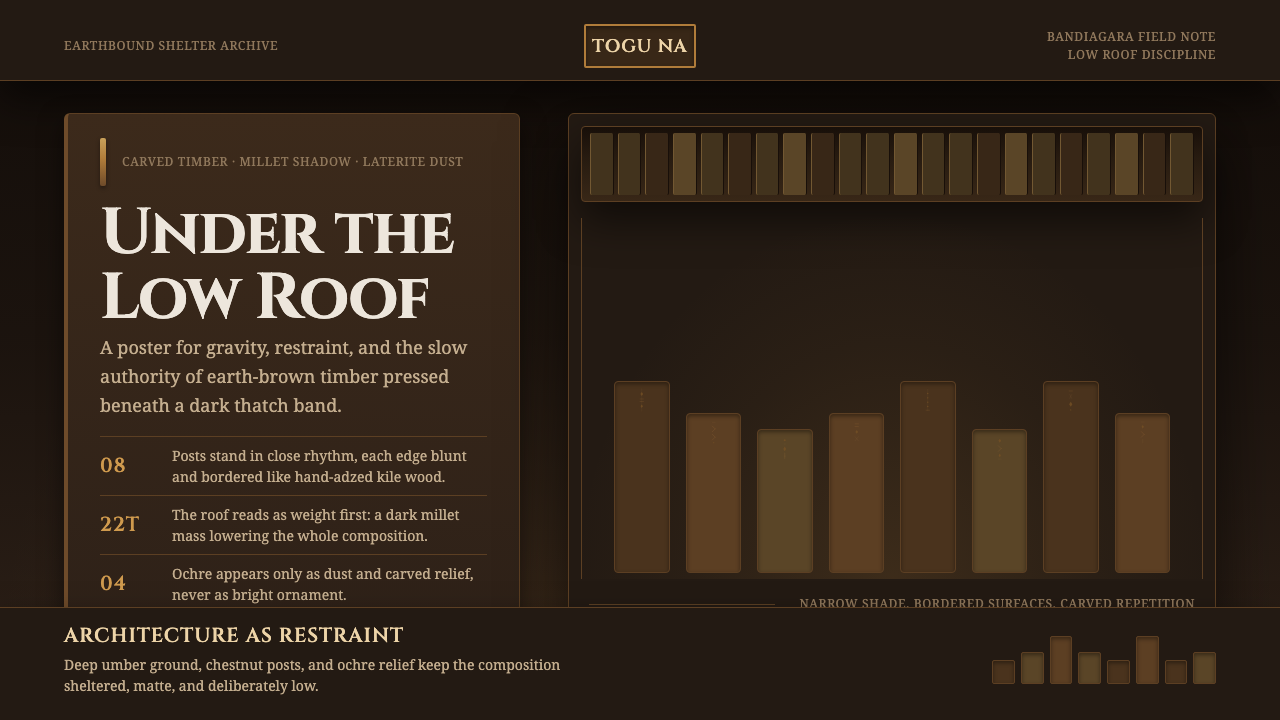 Dogon Toguna Shelter MaliGravity made visible. Deep umber ground, low roof band, chestnut posts in sha…
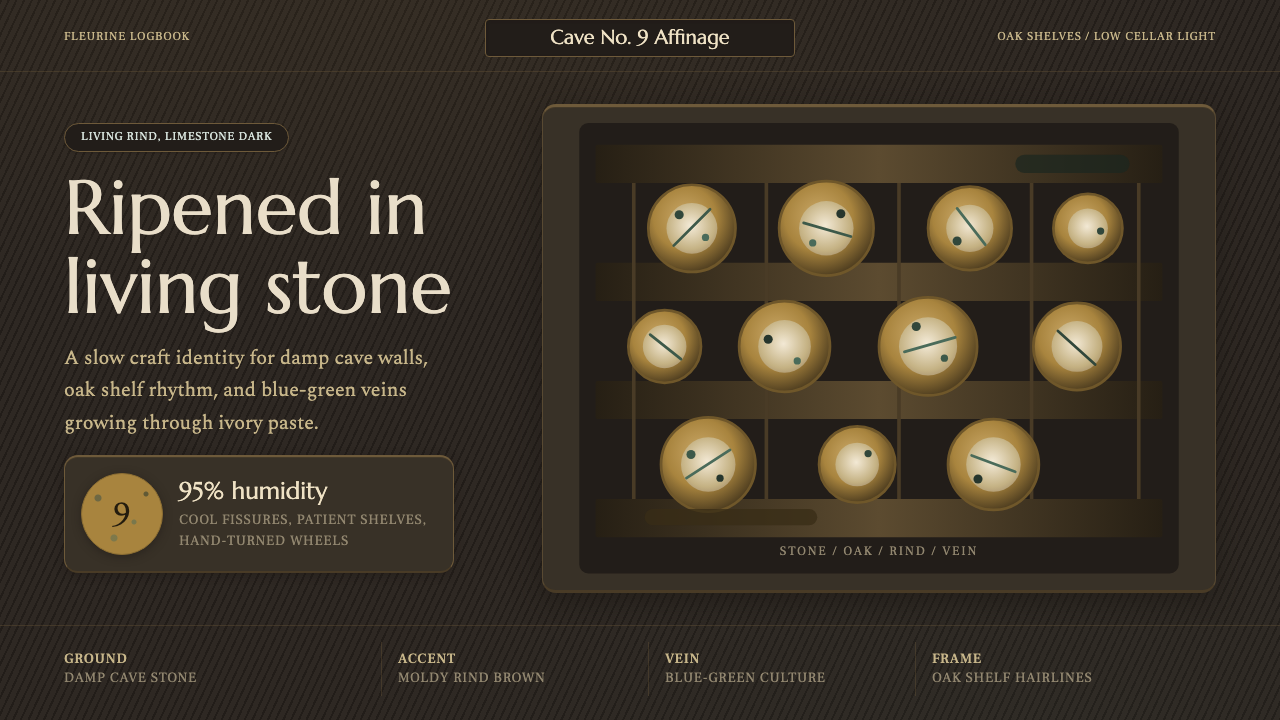 Cheese Affinage CavePatience reads as stone. Rind brown, mold green, and oak shelf grids glow in…
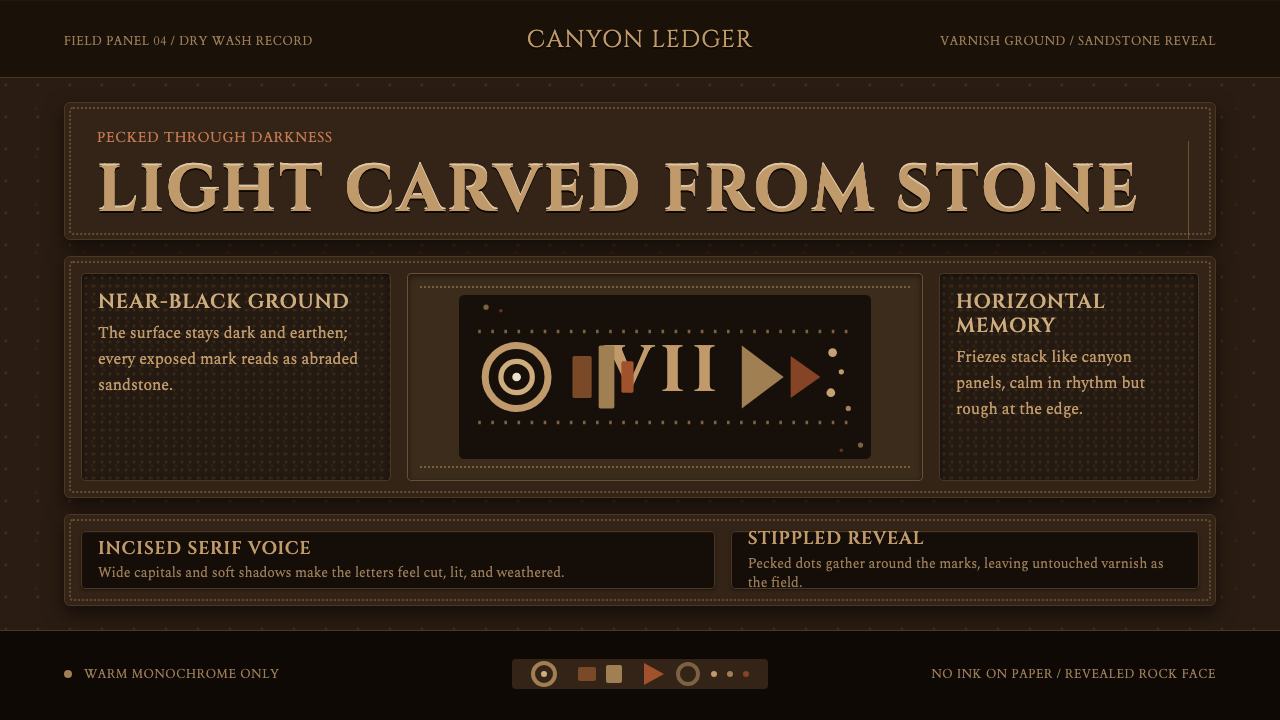 Desert VarnishStone remembers. Sandstone glyphs cut through near-black varnish in stacked f…
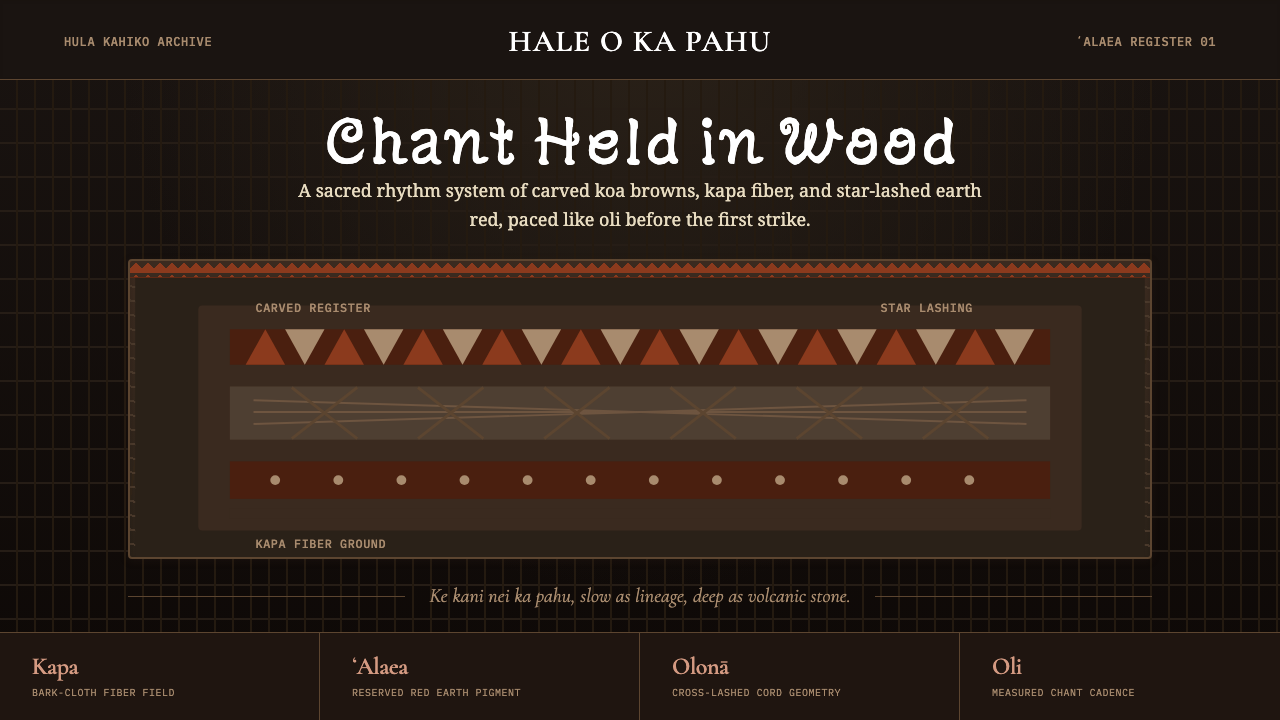 Hawaiian Hula Pahu DrumSacred weight, hand-marked. ʻAlaea red, kapa texture, and stacked carved regi…
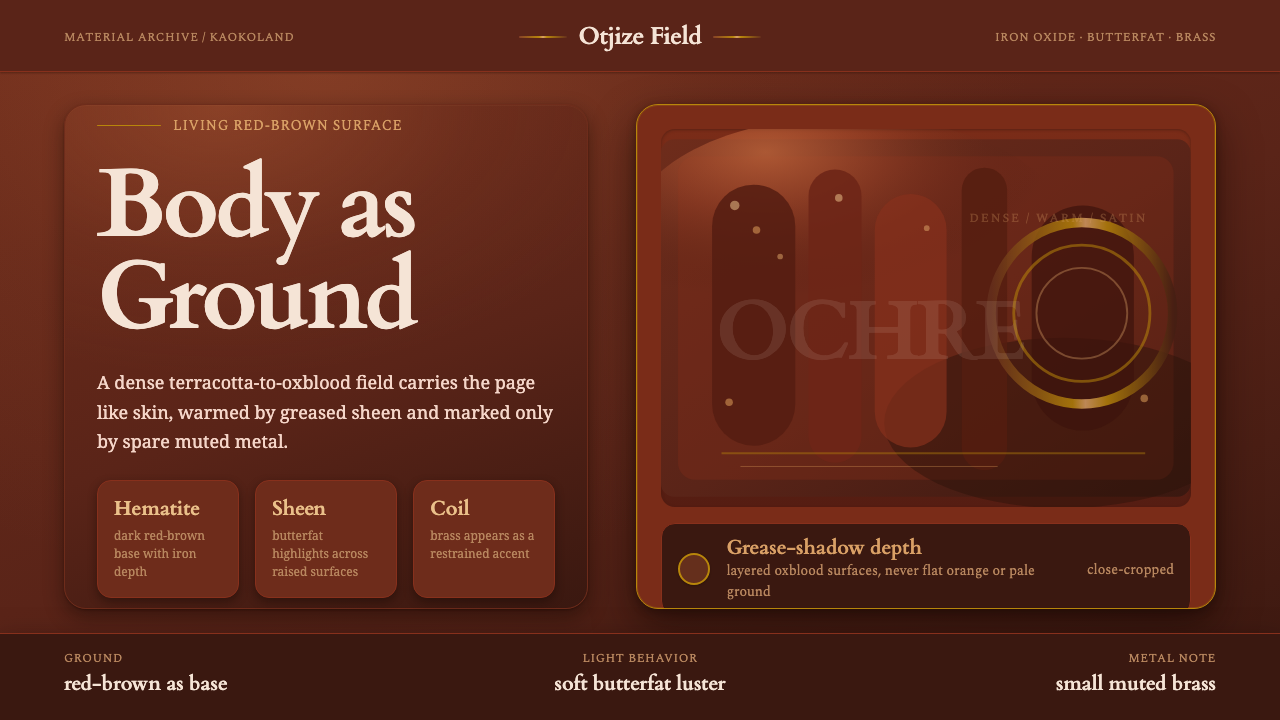 Himba Otjize Ochre NamibiaDense and ritual-warm. Oxblood ground, butterfat sheen, and sparse brass coil…
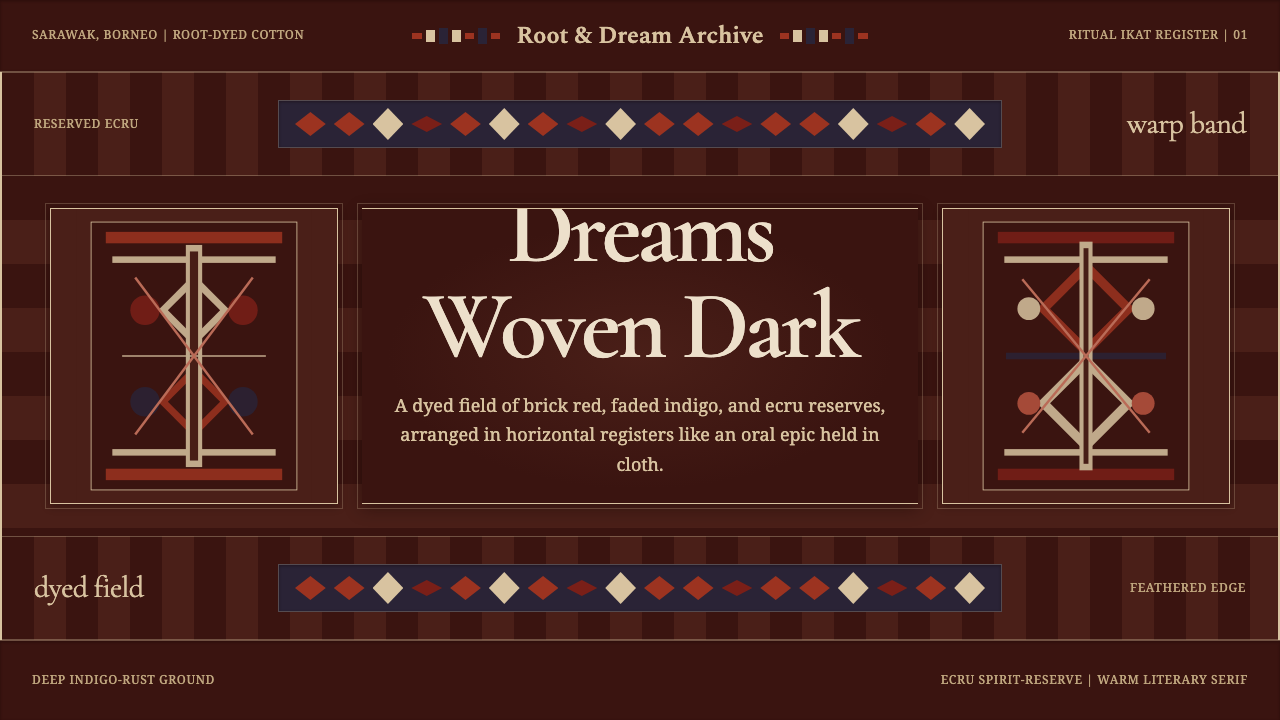 Iban Pua KumbuSacred cloth logic. Indigo-rust bands, ecru reserves, and blurred ikat edges…