What is Mendeleev Periodic Table?
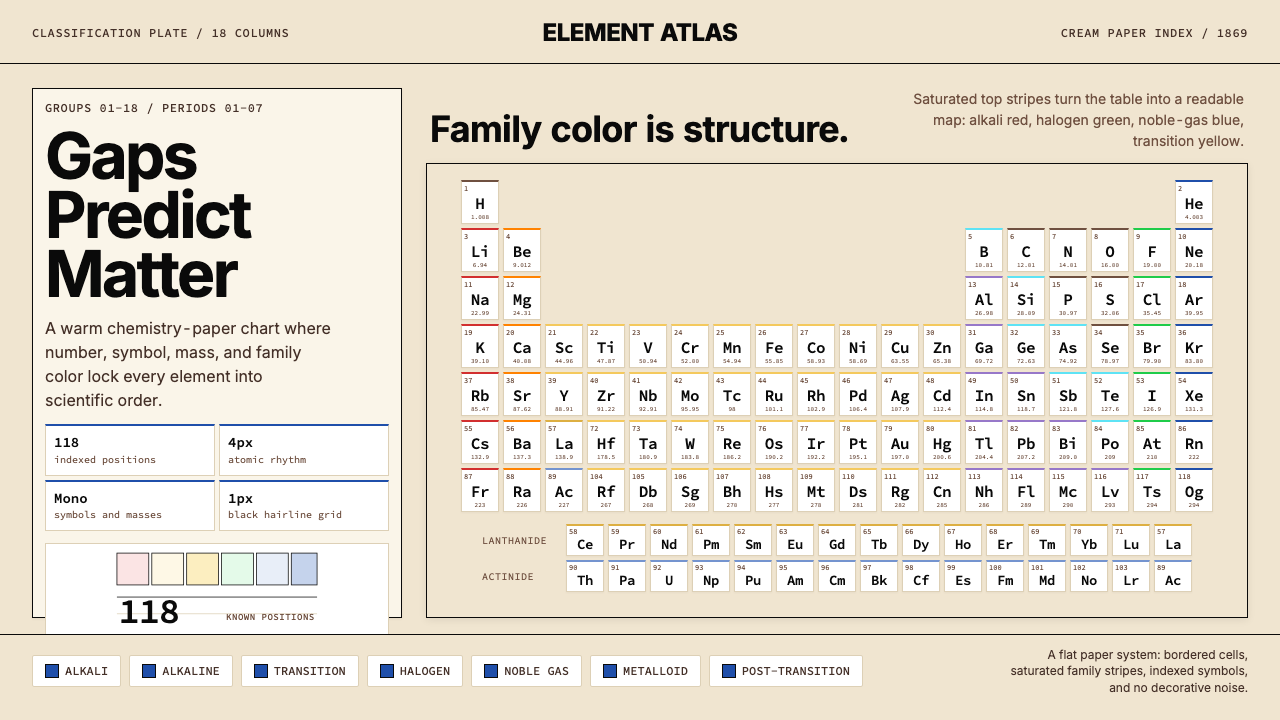
Mendeleev's 1869 periodic table turned the invisible logic of matter into a color-coded grid so precise it predicted elements the world had not yet found.
Mendeleev Periodic Table in brief
The Mendeleev Periodic Table aesthetic is a design system born not in a studio but in a St. Petersburg lecture hall, where Dmitri Ivanovich Mendeleev arranged 63 known elements into an ordered grid and discovered that periodicity — the recurrence of chemical properties at regular intervals — was a law of nature. The resulting visual artifact is one of the most recognized information designs in history: an 18-column tabular structure where each cell is a small data module containing an atomic symbol, an atomic number, and an atomic mass, organized horizontally by period and vertically by chemical family.
The aesthetic character of the periodic table is defined by structured density and chromatic classification. The warm cream or off-white ground — evoking chemistry paper, lab notebooks, and scientific print — carries deep-black ink in tight, monospaced letterforms. Chemical family groups are distinguished by saturated color bands: alkali metals in bold red, alkaline earths in warm orange, halogens in assertive green, noble gases in deep blue, and transition metals in controlled amber-yellow. The color is not decorative; it is classificatory. Every hue is a category, and every category has meaning.
What makes this system visually distinctive is the coexistence of rigorous grid discipline with warm, analogue materiality. The table does not feel cold or digital — it feels like a scholarly artifact, a wall chart in a Victorian laboratory or a university chemistry department. The grid is mathematical in its precision, yet the palette carries warmth and humanity. This tension between scientific exactness and physical warmth gives the Mendeleev aesthetic its unique character: encyclopedic, authoritative, and surprisingly approachable.

Where does Mendeleev Periodic Table come from?
In February 1869, Mendeleev was preparing a chemistry textbook — The Principles of Chemistry — and found himself unsatisfied with any existing framework for organizing the elements. Working in St. Petersburg, he spent a single intensive day arranging and rearranging element cards, ordering them first by atomic mass, then cross-checking against valence and chemical behavior. By the end of that day he had a working draft. The paper was read to the Russian Chemical Society on March 6, 1869, by a colleague while Mendeleev was away inspecting cheese cooperatives in the countryside. He had predicted that several gaps in his table corresponded to undiscovered elements, describing their expected properties in detail. When gallium (1875), scandium (1879), and germanium (1886) were subsequently identified and found to match his predictions almost exactly, the scientific world accepted the periodic law as established fact.
The visual form of the table evolved over the next several decades. Mendeleev's original 1869 arrangement was a horizontal list that read left to right; by 1871 he had reorganized it into the vertical-group format closer to what we recognize today, placing elements with similar chemical properties in the same column. The modern 18-column standard form — often called the long form — was developed through the early twentieth century as more elements were discovered and as Henry Moseley's 1913 work established that atomic number, not atomic mass, is the true ordering principle. Moseley's insight reorganized several anomalous pairs (argon before potassium, cobalt before nickel) and gave the table its definitive logical foundation.
The color-coding system that defines the table's contemporary aesthetic developed separately from Mendeleev's original work. Early printed periodic tables were purely typographic, relying on spatial arrangement and notation rather than color to convey classification. As chemistry education expanded through the late nineteenth and early twentieth centuries, wall charts and classroom posters began introducing color to distinguish element families — first in broad, impressionistic bands, later in the precisely defined category colors recognizable on modern tables. The saturated, family-coded palette now considered canonical emerged primarily through mid-twentieth-century chemistry publishing and educational materials.
The table's cultural reach expanded dramatically after World War II, when it became a fixture of secondary school science education worldwide. Printed on enormous wall charts, reproduced in textbooks across dozens of languages, and affixed to laboratory walls from São Paulo to Seoul, the periodic table achieved something rare for a scientific diagram: genuine iconic status. By the time Glenn T. Seaborg's actinide series work in the 1940s and 1950s reshaped the table's lower section — adding the lanthanides and actinides as the two floating rows below the main body — the table's visual grammar was so deeply embedded in global scientific culture that even these additions were assimilated without disrupting the overall aesthetic. The 118th element, oganesson, was confirmed in 2016, completing the seventh period and closing the table's current canonical form.
What defines the Mendeleev Periodic Table look?
Grid Structure
The defining formal element is an 18-column, 7-row grid where every cell is the same size and carries the same information architecture: element symbol at large scale at center, atomic number at the upper corner, atomic mass at the lower edge. This rigid uniformity of cell design creates a visual rhythm that is immediately legible at any scale, from a postage-stamp reproduction to a wall-spanning laboratory chart. The grid is not a decorative choice — it is an argument that all elements are equivalent units in a single classificatory system, regardless of their individual properties.
Saturated Family Color Bands
Each chemical family is assigned a distinct, fully saturated color that fills the cell background. Alkali metals read in assertive red, alkaline earth metals in warm amber or orange, halogens in bold green, noble gases in clear blue, and transition metals in controlled yellow or gold. These are not pastel suggestions — they are declarative hues that make classification visible from across a room. The saturated palette is functional: it allows a student or researcher to identify an element's chemical family instantly, without reading text.
Monospaced Element Symbols
Chemical symbols — H, He, Li, Au, Pb — are set in monospaced or near-monospaced letterforms that give every symbol an equal visual footprint within its cell. This typographic choice reflects the scientific convention of fixed-width notation: one or two letters, uppercase first, presented with no stylistic variation between elements. The effect is uniform, systematic, and legible. The symbol is the dominant typographic object in each cell; all other information — atomic number, mass — appears at smaller scale in the corners, maintaining clear visual hierarchy.
Warm Ground and Dark Ink
The background of the table — the space between cells and the outer margin — is traditionally a warm cream or off-white, evoking the paper stock of scientific publications, laboratory notebooks, and university wall charts. Against this warm ground, black ink is used for all text and structural grid lines. The contrast is high but not harsh: cream-and-black reads as scholarly and precise rather than stark and clinical. This combination connects the table visually to its origins as a printed scientific artifact rather than a digital display.
Floating Rows for Lanthanides and Actinides
A distinctive structural peculiarity of the modern periodic table is the two detached rows at the bottom — the lanthanide and actinide series — which are extracted from their logical position in periods 6 and 7 to keep the main table from becoming unwieldy wide. These floating rows are connected to the main body by implicit position only, typically with a thin line or bracket indicating where they slot in. This compositional decision — sacrificing strict logical continuity for a manageable rectangular format — is one of the most recognized visual conventions in all of scientific visualization.
Dense Information at Small Scale
Each cell in the periodic table is a compressed information module: typically three or four data points (symbol, atomic number, atomic mass, sometimes oxidation state or electron configuration) packed into a small rectangle. The typographic hierarchy within each cell is precise — large symbol, small superscript number above, small subscript mass below — and is maintained consistently across all 118 cells. This discipline of small-scale information density, where hierarchy is communicated by size and position rather than color or decoration, is one of the most transferable design principles the table offers.
Scientific Authority Through Systemization
The periodic table's visual authority derives not from aesthetics alone but from the demonstrated accuracy of its organizational logic. The table predicted the existence and properties of undiscovered elements; when those elements were found, they fit precisely into the predicted cells. This history of verified prediction is embedded in the visual artifact itself: every gap in early tables was an epistemic claim, and every filled cell a confirmed fact. Designs that draw on this aesthetic inherit — or should acknowledge — this quality of systematic, evidence-based authority, distinct from purely formal confidence.

Who shaped Mendeleev Periodic Table?
Mendeleev (1834–1907) was a Russian chemist who in 1869 published the first version of the periodic table, arranging the 63 then-known elements by atomic mass and demonstrating that their properties recurred at regular intervals. His most consequential act was not merely organizing known elements but leaving deliberate gaps for elements not yet discovered, and specifying their expected atomic masses and chemical behaviors with enough precision that when gallium, scandium, and germanium were subsequently discovered they matched his descriptions almost exactly. This predictive boldness transformed chemistry from an empirical catalog into a science with genuine predictive power.
Moseley (1887–1915) was a British physicist whose 1913 experiments measuring the X-ray spectra of elements demonstrated that atomic number — the number of protons in the nucleus — rather than atomic mass is the true organizing principle of the periodic table. This resolved several anomalous placements in Mendeleev's original arrangement (where argon appeared before potassium, despite being heavier) and provided the definitive physical explanation for why periodicity exists. Moseley was killed at Gallipoli in 1915 at age twenty-seven; the loss of his potential future contributions is frequently cited by historians of science as among the most consequential casualties of the First World War.
Seaborg (1912–1999) was an American nuclear chemist who co-discovered ten transuranium elements, including plutonium, and proposed the actinide concept — the idea that elements heavier than actinium form a series analogous to the lanthanides, and that this series should be extracted from the main body of the table and placed below it as a separate row. This reorganization of the table's lower section in the 1940s resolved a longstanding structural anomaly and produced the modern two-row-at-bottom format now universally recognized. Seaborg is the only person to have had an element named after them during their lifetime: seaborgium, element 106.
Meyer (1830–1895) was a German chemist who independently developed a periodic arrangement of the elements at roughly the same time as Mendeleev. His 1870 publication of a more detailed atomic volume curve demonstrating the periodicity of physical properties arrived slightly after Mendeleev's 1869 paper, and he is generally regarded as co-discoverer of the periodic law. Meyer's approach was more focused on physical properties, while Mendeleev emphasized chemical behavior and was more willing to make bold predictive claims about missing elements. The difference in approach — empirical-physical versus predictive-chemical — explains why Mendeleev's name became synonymous with the table.
Bohr (1885–1962) was a Danish physicist whose 1922 atomic model explained, for the first time, why the periodic table has the structure it does. His model of electron shells — with electrons occupying discrete energy levels around the nucleus — provided the quantum mechanical explanation for chemical periodicity: elements in the same column share the same outer-shell electron configuration and therefore exhibit similar chemical behavior. Bohr's work transformed the periodic table from an empirical regularity (these elements behave similarly, arranged thus) into a structural necessity (these elements must be arranged thus, because of how electrons fill orbitals). He was awarded the Nobel Prize in Physics in 1922.
How do you use Mendeleev Periodic Table today?
The Mendeleev Periodic Table aesthetic is among the most directly transferable scientific visual systems to contemporary design, precisely because its underlying logic is about information architecture rather than decoration. The table solves a genuine design problem — how to organize 118 unique entities so that structural relationships, family membership, and individual data are all simultaneously visible — and it solves it with a discipline that translates readily to other dense information contexts. Applying the aesthetic well means understanding what the table is actually doing: using saturated color to encode category, using grid uniformity to signal system, and using typographic hierarchy within each cell to rank information by importance.
For presentation slides, the periodic table aesthetic works exceptionally well as a structural motif on both cover and content pages. A cover slide can use the grid logic directly: arrange four to nine content blocks in a periodic-table-style layout, each with a bold symbol-style label, a category color, and two lines of descriptive text — creating immediate visual authority and a sense of systematic completeness. Content slides should adopt the cell-level information discipline: one dominant label, one or two supporting data points, and a category color as background. Data slides become genuinely powerful in this system — when each metric or KPI is represented as a periodic-table cell with a color-coded category, a bold symbol, and a numeric value, the comparison between cells is instant and the visual grammar communicates that each data point is part of a larger ordered system.
For web interfaces and dashboards, the aesthetic is particularly well-suited to any context requiring dense, comparative, categorized data display. Pricing pages with multiple tiers translate naturally: each tier becomes a cell with a bold identifier, a tier-color background, and feature attributes listed below. Feature comparison tables borrow the grid uniformity and color-coding directly. Dashboard metric cards can use the cell-module format: a short bold identifier at top center, the primary value at large scale below, and a category-color border or header band indicating which system or team the metric belongs to. Navigation should be typographic and direct — no icon-heavy decoration — with category colors used to orient the user within the broader system.
For editorial and marketing applications, the table's visual language supports both scientific authority and structural clarity. An article layout inspired by the periodic table uses a strict column grid, reserves color for category markers in the margin rather than for decoration, and uses monospaced or near-monospaced type for data labels and codes while keeping body text in a clean, readable face. Marketing pages can use the bold saturated color band as a section identifier — each section or product category introduced with a full-width color header echoing the table's family-color logic. The warm cream ground works well as the default page background, reserving white for content areas that require maximum contrast.
A common mistake when applying this aesthetic is treating the saturated family colors as a general accent palette and using them freely across unrelated elements. In the periodic table, every color means exactly one thing: membership in a specific chemical family. Designs that use the saturated reds, greens, and blues decoratively — without consistent categorical meaning — lose the system's core visual logic and produce work that looks merely colorful rather than systematically organized. A second common error is over-applying the grid uniformity at the expense of content hierarchy: not all information is equivalent, and the table's cell-uniformity works because every cell contains the same data types. When the underlying data is heterogeneous, the grid should be relaxed rather than forced.

Mendeleev Periodic Table — FAQ
Is the Mendeleev Periodic Table aesthetic the same as general scientific or data-visualization design?
No — the periodic table has a much more specific visual grammar than general data visualization. Most data visualization prioritizes continuous quantitative relationships: charts, graphs, and maps use position, length, or area to encode magnitude. The periodic table's grammar is categorical and tabular: it encodes group membership through color, uses uniform cell size regardless of any quantitative difference between elements, and organizes by discrete classification rather than by magnitude on a continuous axis. Designs that draw on this aesthetic are making a specific claim about their information: that it is systematically classifiable into a fixed set of families, not just measurable along one or two dimensions.
Can the aesthetic work in dark-mode or dark-background designs?
A dark-mode version of the periodic table aesthetic is possible but requires careful adjustment. The historic canonical form uses a warm cream or light ground; dark-mode inversions replace this with a deep neutral or near-black background, which changes the reading of the saturated family colors substantially. On a dark ground, fully saturated cell colors can feel aggressive or distracting rather than classificatory — the visual hierarchy shifts unpredictably. The most effective dark-mode adaptation uses slightly desaturated or muted versions of the family colors as cell fills, with the bold symbol remaining in a near-white or light cream, and reserves the fully saturated color for borders or accent bars only.
How does this aesthetic handle content that does not fit neatly into categories?
The periodic table aesthetic assumes that the content it presents is genuinely classifiable into a consistent set of families. When the underlying content is genuinely heterogeneous — a mix of data types, categories that do not have clear membership boundaries, or items that span multiple families — the aesthetic creates visual confusion rather than clarity. In such cases, forcing the grid and color-coding produces work that looks like it is making systematic claims it cannot actually support. The honest approach is to use the grid and cell format for the genuinely classifiable content, and to mark boundary cases explicitly — either with a neutral color, a mixed-category indicator, or by placing them in a distinct section of the layout.
Is the warm cream ground essential, or can the base be pure white?
Pure white is a valid alternative and is used in many modern digital implementations of the periodic table aesthetic. The difference is one of tone and reference: warm cream visually anchors the aesthetic in its origins as a printed scientific artifact — chemistry paper, wall charts, reference books — and creates a slightly softer, more scholarly feeling. Pure white pushes the design toward contemporary digital precision and higher contrast. Neither is categorically wrong, but the choice should be consistent with the rest of the design system. Mixing warm cream and pure white within the same layout — using one for the background and the other for card surfaces, for example — can make the design feel unresolved unless the contrast is deliberate and sufficient.
Does this aesthetic suit consumer-facing products, or is it better suited to professional and scientific contexts?
The periodic table aesthetic carries strong connotations of scientific authority, systematic organization, and encyclopedic completeness — qualities that resonate strongly in professional, educational, and analytical contexts. It works well for SaaS tools, developer platforms, analytics dashboards, educational applications, reference products, and any brand that wants to signal precision and systematic thinking. In consumer-facing products that depend on warmth, spontaneity, or sensory pleasure — food, lifestyle, fashion, entertainment — the table's grid discipline and classificatory logic tend to feel clinical or overly regimented. The aesthetic is not impossible in consumer contexts, but it requires softening the grid rigidity and using the color-coding more sparingly, so that the system quality reads as reassuring organization rather than institutional severity.
Related design styles
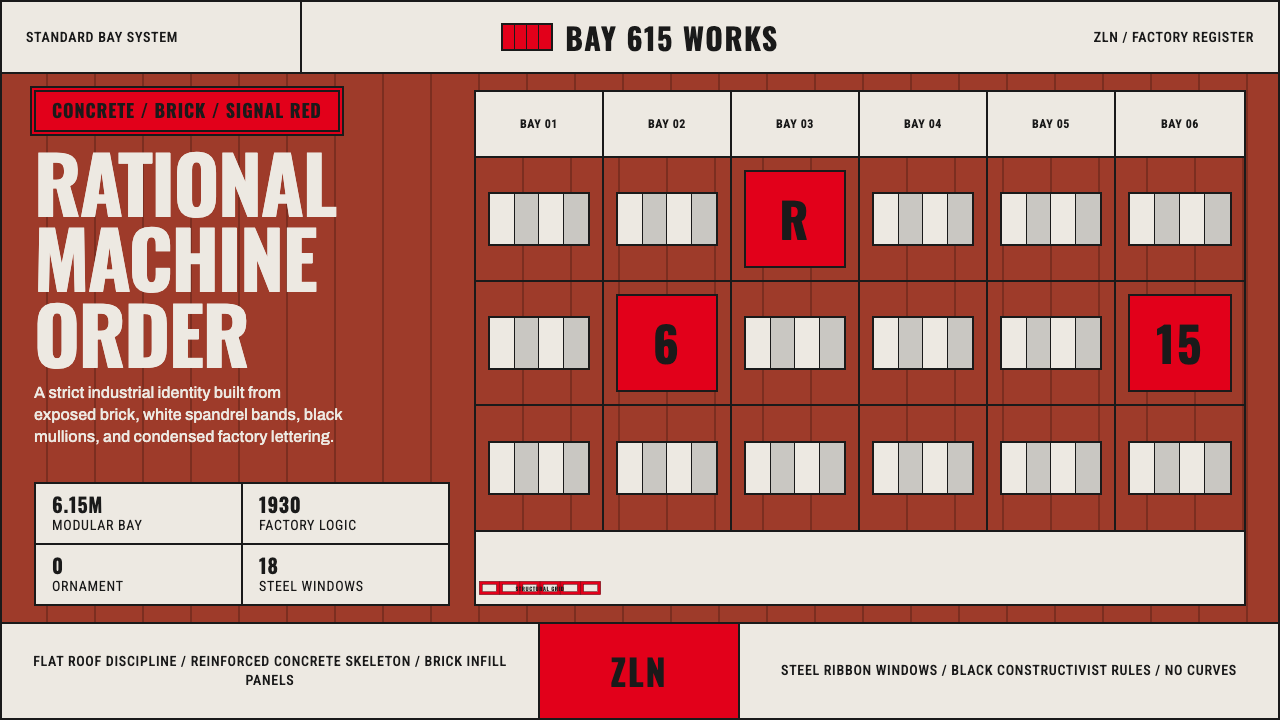 Baťa Zlín Functionalist BrandMachine-age precision. Brick red, concrete bands, and Oswald type lock into a…
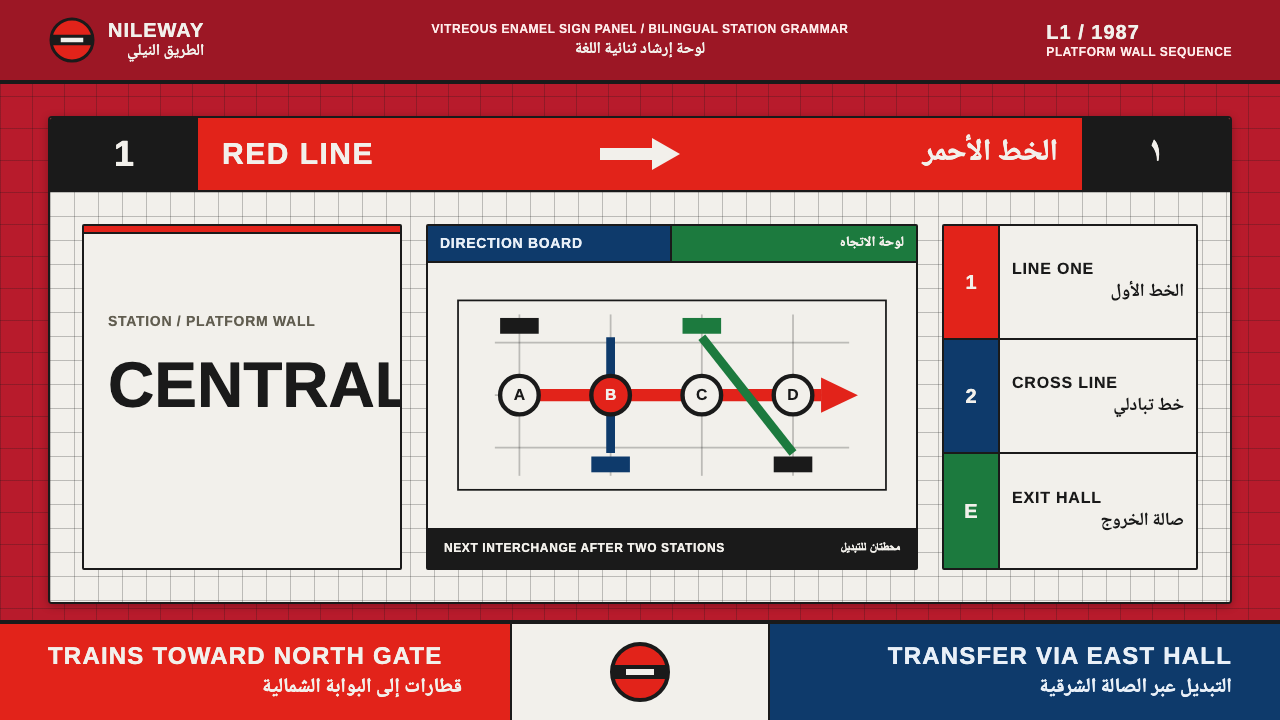 Cairo Metro WayfindingAuthority at speed. Enamel red, Arimo grids, and co-equal Arabic signage.
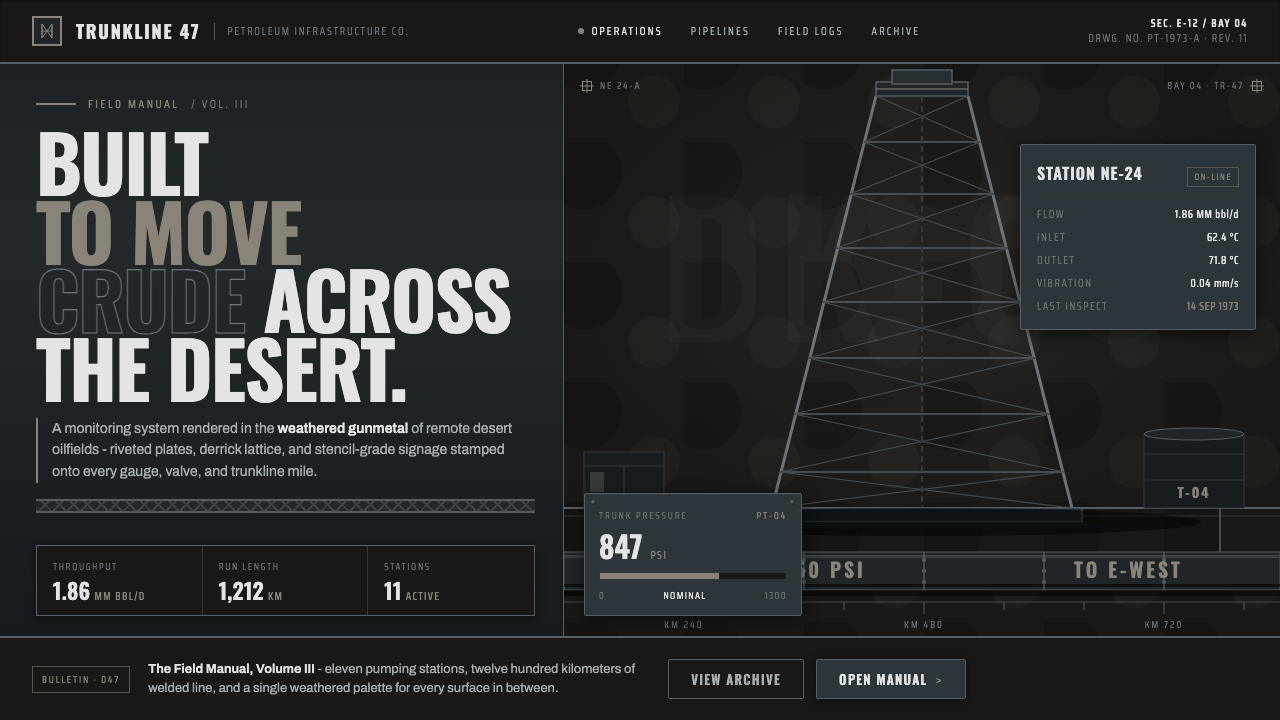 Gulf Oil Derrick IndustrialEngineered, not decorative. Soot-darkened gunmetal, derrick lattice, condense…
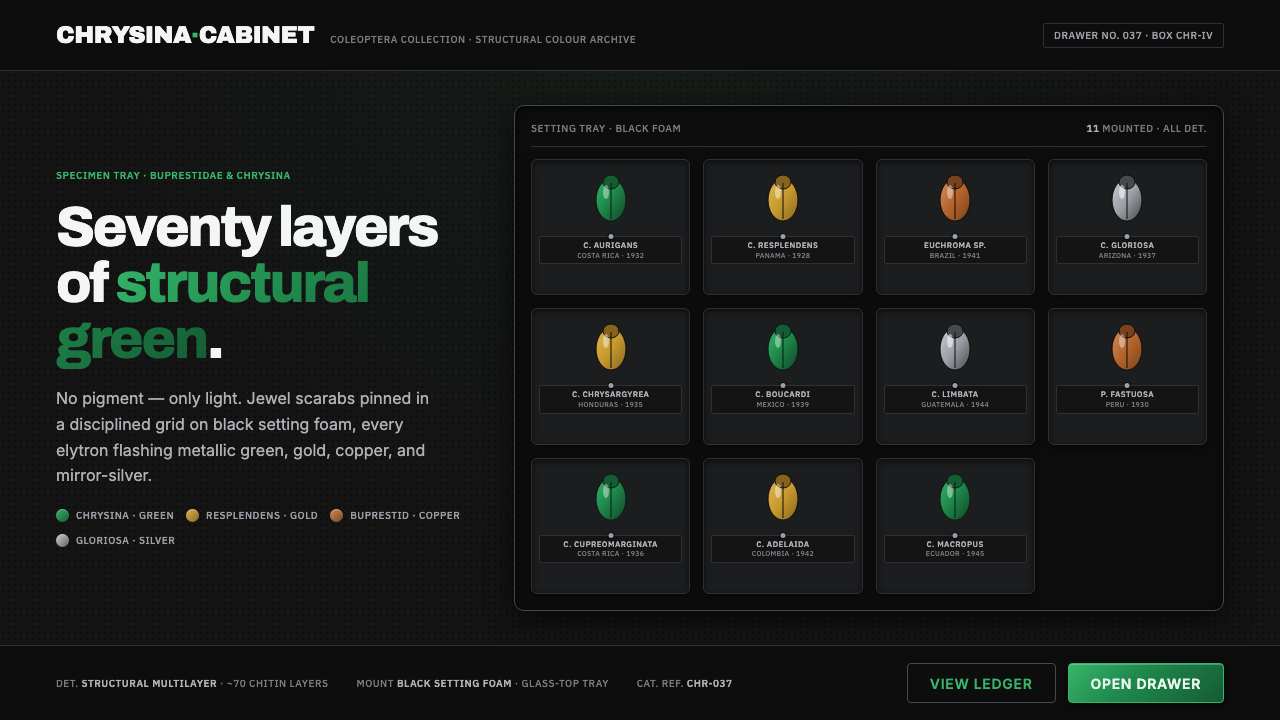 Iridescent Scarab DrawerOrder makes the shimmer read. Jewel scarabs pinned in a grid on black foam, m…
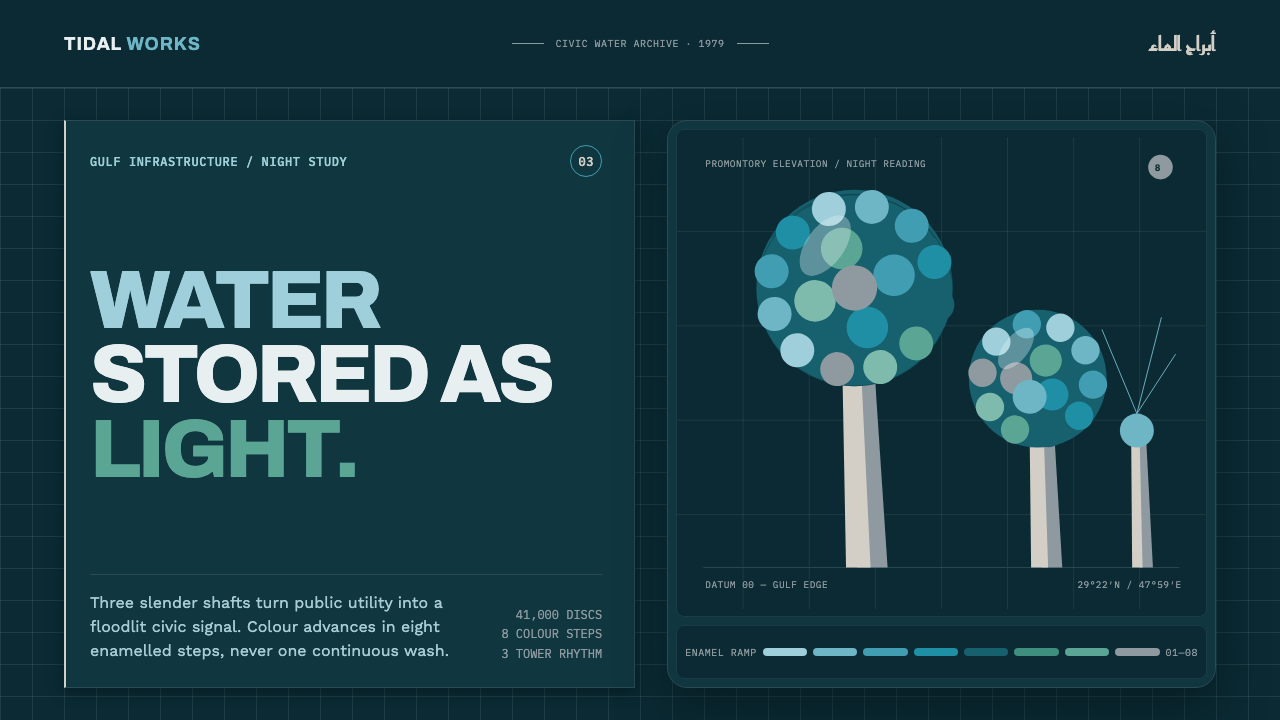 Kuwait Water TowersInfrastructure becomes a night monument. Eight enamel steps spiral across a d…
 Lunar RoverBuilt for the vacuum. Kapton-gold foil and stencil part-numbers against void-…