What is Mariana Trench?
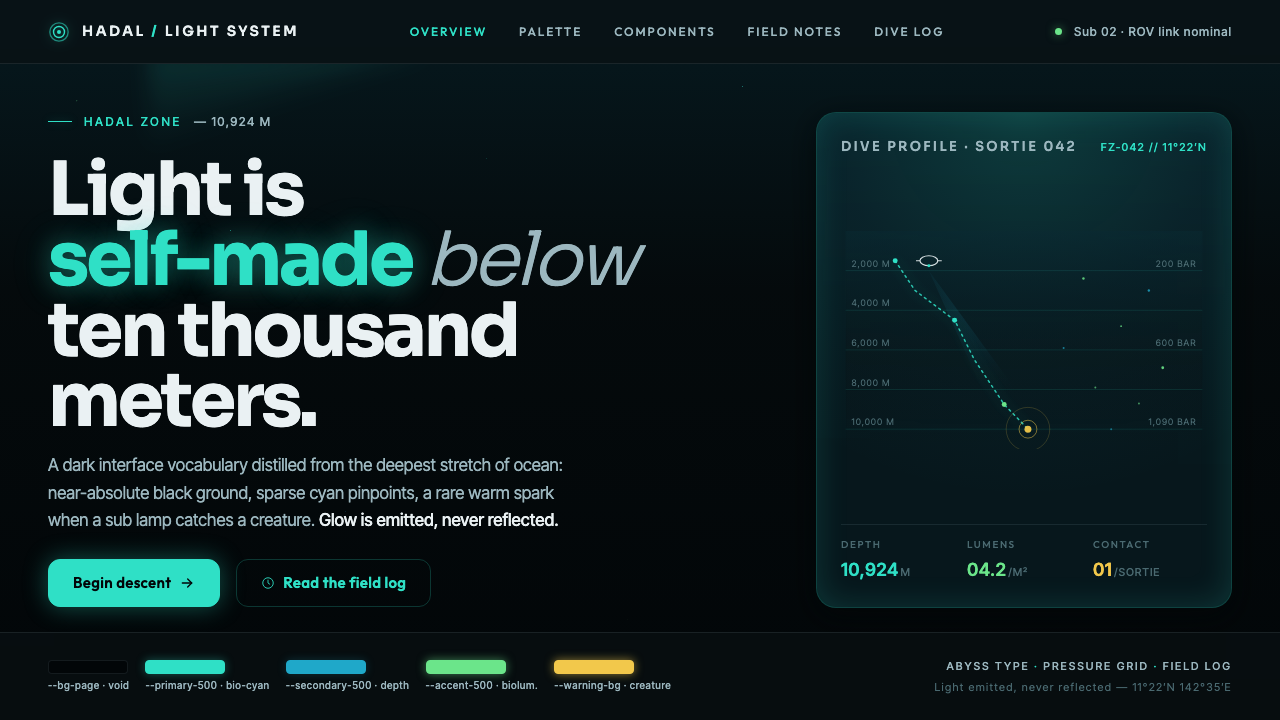
Mariana Trench turns darkness into an active material — a hadal-black field where cyan-green signals emerge, and warmth appears only when something living enters the beam.
Mariana Trench in brief
Mariana Trench is a dark design system drawn from the hadal zone below ten thousand meters in the western Pacific. There, water is absolute black under crushing pressure. No ambient daylight distributes attention; illumination comes only from a submersible lamp or the cold glow of bioluminescent life. Because short blue-green wavelengths travel farthest through seawater, cyan-green becomes the system’s natural signal color. The result is not an ocean illustration but an interface vocabulary built from absence, emergence, and controlled visibility.
Its central rule is that light must be made, never reflected. The ground is near-absolute black, not a decorative dark background, but the environment from which every visible element must declare itself. Cyan-green appears as sparse pinpoints, concentrated indicators, or restrained glows. Warm color is exceptional: it belongs to the rare creature caught in a submersible’s lamp, so it should feel like an event rather than a routine accent.
Mariana Trench organizes hierarchy through the behavior of light. Primary information emerges clearly from darkness, supporting information recedes into the field, and empty space carries the weight of depth. The style is quiet but not passive: every signal seems discovered, transmitted, or alive. Its strongest expression combines scientific restraint with the sensation of encountering a small luminous fact in water that otherwise gives nothing back.
Where does Mariana Trench come from?
The style belongs to the modern era of crewed and remotely operated hadal exploration, from 2010 to the present. Its geographic anchor is the Mariana Trench in the western Pacific, while its cultural field is global and internet-native. It grows from the problem of communicating an environment ordinary vision cannot enter: black water, crushing pressure, and illumination supplied by instruments or organisms. Its subject is therefore not the ocean surface, but the act of seeing at extreme depth.
Deep-sea exploration imaging provides the system’s physical grammar. The named references Fendouzhe and Limiting Factor stand for the equipment that carries vision into the hadal zone. Their importance here is not branding but condition: a vessel enters darkness, directs a beam, and reveals only what falls within that beam. The resulting image is selective rather than panoramic. It gives the interface a disciplined relationship between obscurity and evidence.
A second source is bioluminescence science visualization, represented in the source material by Monterey Bay Aquarium bioluminescence research. Within this logic, a blue-green point is not decoration; it is evidence that a living or instrumented source has produced light. The warm spark has a different status. It appears when a creature is caught in a submersible lamp, creating a brief contact between artificial illumination and living form. The palette therefore carries a narrative of discovery.
On the global internet, these two movements become a reusable visual system. Deep-sea exploration imaging supplies the black field and directed beam; bioluminescence visualization supplies the sparse, self-emitted signals. Together they produce a style that is modern because it treats darkness as a medium, not an absence to be filled. The interface becomes a controlled expedition: information is not placed everywhere, but found where the light reaches.
What defines the Mariana Trench look?
Hadal Color
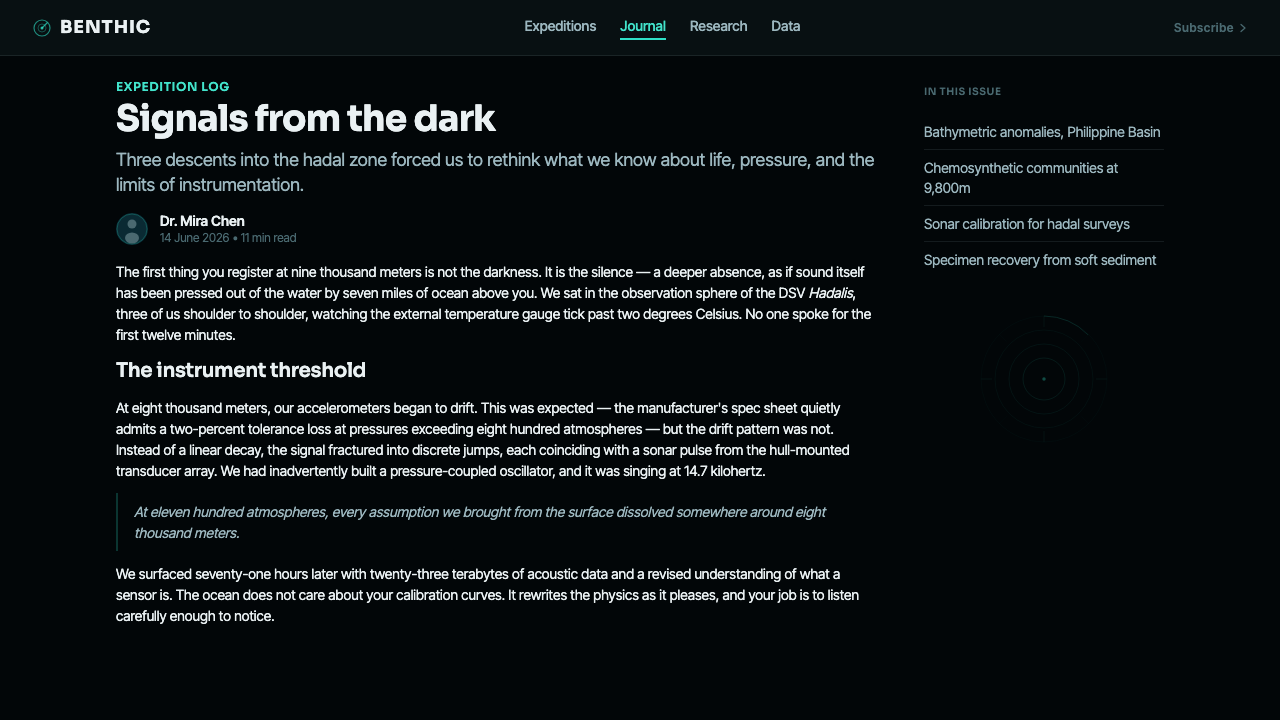
The palette begins with near-absolute black and allows cyan-green to carry most visible energy. The cool accent reflects the blue-green wavelengths that travel farthest through seawater, giving it both environmental credibility and functional clarity. Warm color is held back for rare moments of life under a submersible lamp. Color is therefore not a surface coating applied for variety; it is evidence of a light source and a way to distinguish ordinary signal from exceptional discovery.
Emitted Light
Every luminous element should appear to produce its own light. Pinpoints, indicators, and small glows feel like instruments or organisms emitting a signal into black water. Surfaces should not suggest reflected sunlight, polished material, or a hidden ambient source. This makes the system fundamentally different from a conventional dark interface: darkness is not simply the background, and brightness is not evenly available. Visibility is earned by emission.
Abyssal Ground
The ground is almost black and visually stable, creating the sensation of pressure and depth without illustrating either directly. Large areas of darkness are structural, not empty. They separate signals, slow the eye, and make each luminous mark feel located in space. The field should remain calm enough for small points of information to carry weight. If the ground becomes busy, the system loses the silence that gives its light meaning.
Sparse Signals
Cyan-green accents work best when they are scarce and concentrated. A small number of signals can establish hierarchy more effectively than a continuous luminous wash, because each point suggests a source, a reading, or a discovery. Repetition should feel intentional, like a field of distant beacons rather than a decorative pattern. The system gains intensity through restraint: the less light is available, the more consequential every light becomes.
Warm Spark
Warm color represents the rare creature revealed inside a submersible’s beam. It should remain noticeably different from the cool signal field and appear only when the composition needs a moment of contact, life, or surprise. Warmth is not a second general-purpose accent. When distributed everywhere, it loses its narrative role and turns the abyss into an ordinary multicolor interface. Its power comes from rarity and proximity.
Exploration Imagery
Imagery should draw from deep-sea exploration imaging and bioluminescence science visualization. Favor scenes where most of the frame remains dark and a lamp, organism, or luminous point establishes the subject. The image should communicate the condition of discovery rather than provide a generic underwater view. A successful composition makes the viewer feel that something has just entered visibility, preserving uncertainty around what the beam does not reveal.
Who shaped Mariana Trench?
Fendouzhe, the hadal submersible named in the source material, is a central reference for the system’s instrument-led vision. It represents the act of carrying a controlled light source into extreme darkness and making only a small portion of the environment visible. In design terms, its presence supports focused interfaces, isolated indicators, and imagery that feels observed through a vehicle rather than illuminated by a general atmosphere.
Limiting Factor is another named reference from modern hadal exploration. Within the Mariana Trench language, it stands for directed observation under conditions where visibility is limited by the darkness itself. Its conceptual value lies in the relationship between instrument, beam, and revealed subject. This relationship can guide layouts that keep the main message sharply visible while allowing surrounding space to remain unresolved and deep.
The bioluminescence research associated with Monterey Bay Aquarium anchors the system’s living-light dimension. It gives the cyan-green point a meaning beyond decoration: the point may suggest an organism producing its own cold glow. This reference also clarifies why the palette needs restraint. A luminous life signal should feel rare enough to command attention, preserving the sense that the viewer has encountered something alive within otherwise lightless water.
How do you use Mariana Trench today?
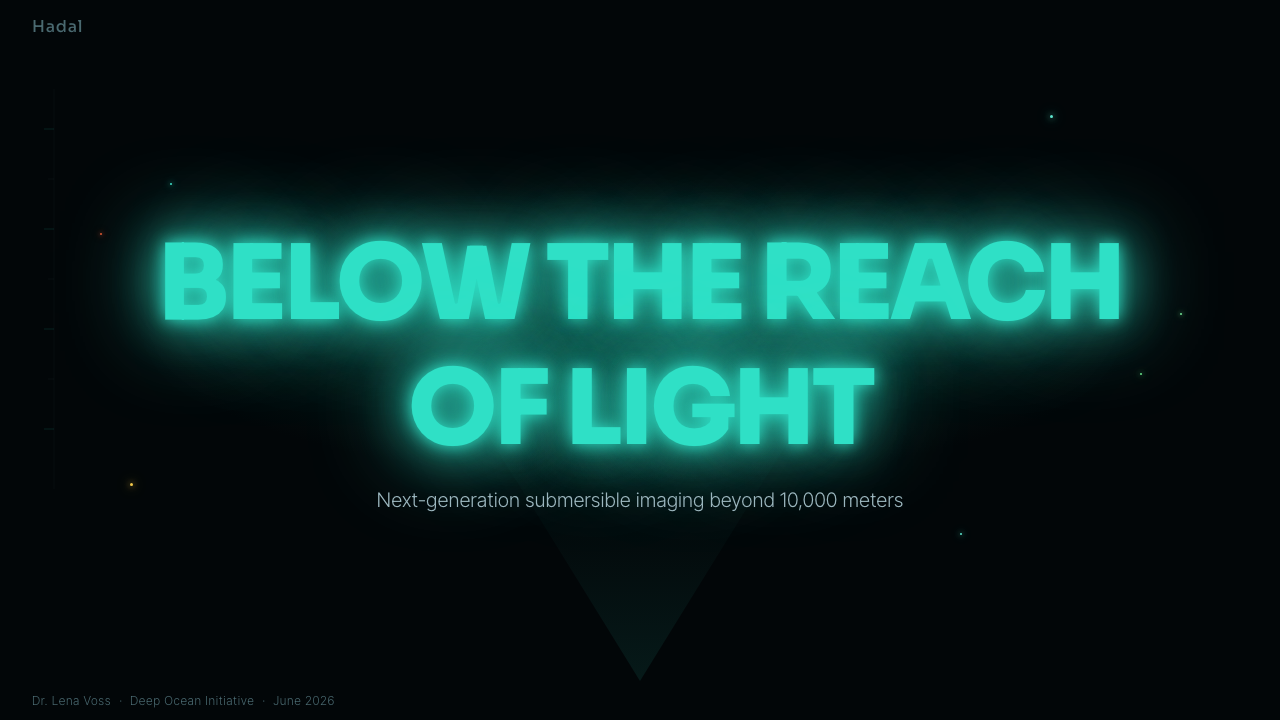
For presentation slides, use Mariana Trench as a controlled reveal. A cover can begin with a near-black field, a single cyan-green point, and a title that appears to have been found rather than placed. Content slides should preserve large areas of darkness and let each section emerge through a clear signal. Keep cool light as the organizing language, while reserving a warm spark for a rare human, biological, or discovery-oriented emphasis.
Data slides benefit from the system’s scientific visualization roots. Treat charts, diagrams, and key figures as emitted signals rather than illuminated surfaces. The main finding can carry the strongest cyan-green presence; supporting information should remain quieter and less luminous. A warm accent may identify an exceptional observation or an unexpected result, but it should not be distributed across every category. The viewer should feel that the data has been revealed by an instrument.
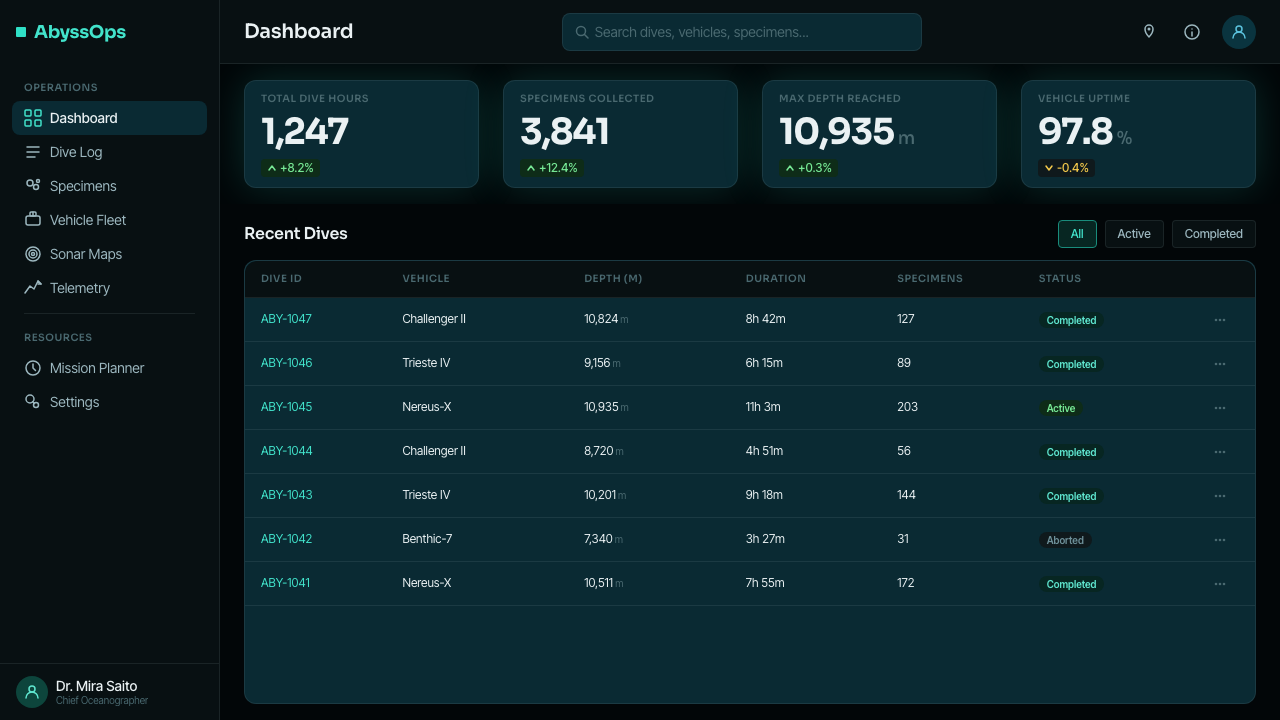
For web interfaces, the style suits dashboards and pricing pages that want to feel focused, technical, and exploratory. The near-black ground provides a stable field for concentrated status signals, while cyan-green can distinguish active readings, selected states, or primary actions. Pricing tiers should remain structurally clear without turning every option into a glowing beacon. Warm color is best reserved for a meaningful distinction, such as a rare feature or a moment requiring immediate attention.
In editorial and marketing work, Mariana Trench supports a strong rhythm of concealment and discovery. Deep-sea exploration imagery can introduce a story through a small illuminated subject surrounded by black water; bioluminescence references can give a campaign an organic point of surprise. Headlines should feel like signals in the field, while body content remains calm and legible. The style is especially effective when the subject involves research, exploration, instruments, hidden systems, or encounters with unfamiliar life.
The common mistake is turning the theme into generic neon futurism. Flooding the page with cyan-green, adding many competing glows, or using warm accents as ordinary decoration destroys the sense of scarcity. A busy background also weakens the hadal condition. The system works when darkness remains active, light appears to have a source, and every luminous element earns its visibility through hierarchy or discovery.
Mariana Trench — FAQ
Is Mariana Trench simply a dark-mode style?
No. A conventional dark mode usually changes the background while preserving ordinary assumptions about reflected surfaces and evenly available illumination. Mariana Trench treats darkness as the environment itself. Light must appear self-emitted, cyan-green signals remain sparse, and warm color carries the exceptional status of life caught in a submersible beam. The difference is behavioral, not merely tonal.
Why does cyan-green dominate the palette?
Short blue-green wavelengths travel farthest through seawater, so cyan-green is both an environmental reference and a useful signal color. It reads as cold, distant, and instrument-like against the near-black ground. The palette should not be expanded casually, because its power depends on the impression that these points are the available light in an otherwise black environment.
What does the warm spark represent?
It represents a rare creature caught in the light of a submersible. That makes it a moment of contact between artificial illumination and living form. In an interface, warm color should therefore mark an exceptional discovery, biological presence, or meaningful interruption. If it becomes a routine accent, it loses the narrative force that distinguishes it from the cool field.
Can Mariana Trench support information-heavy interfaces?
Yes, provided information is organized as a hierarchy of signals rather than a continuous luminous surface. Dashboards, pricing pages, and scientific visualizations can use the black field to separate levels of importance. The primary reading should emerge first, secondary readings should remain quieter, and exceptional states can receive the warm spark. Density must be managed through visibility, not filled with more light.
What kind of imagery belongs in the system?
Use imagery connected to deep-sea exploration imaging or bioluminescence science visualization. The strongest images leave most of the frame in darkness and let a lamp, organism, or luminous point establish the subject. Avoid generic underwater scenery that supplies its own broad atmosphere. The image should preserve the feeling that something has just entered visibility while the surrounding water remains unknown.
Related design styles
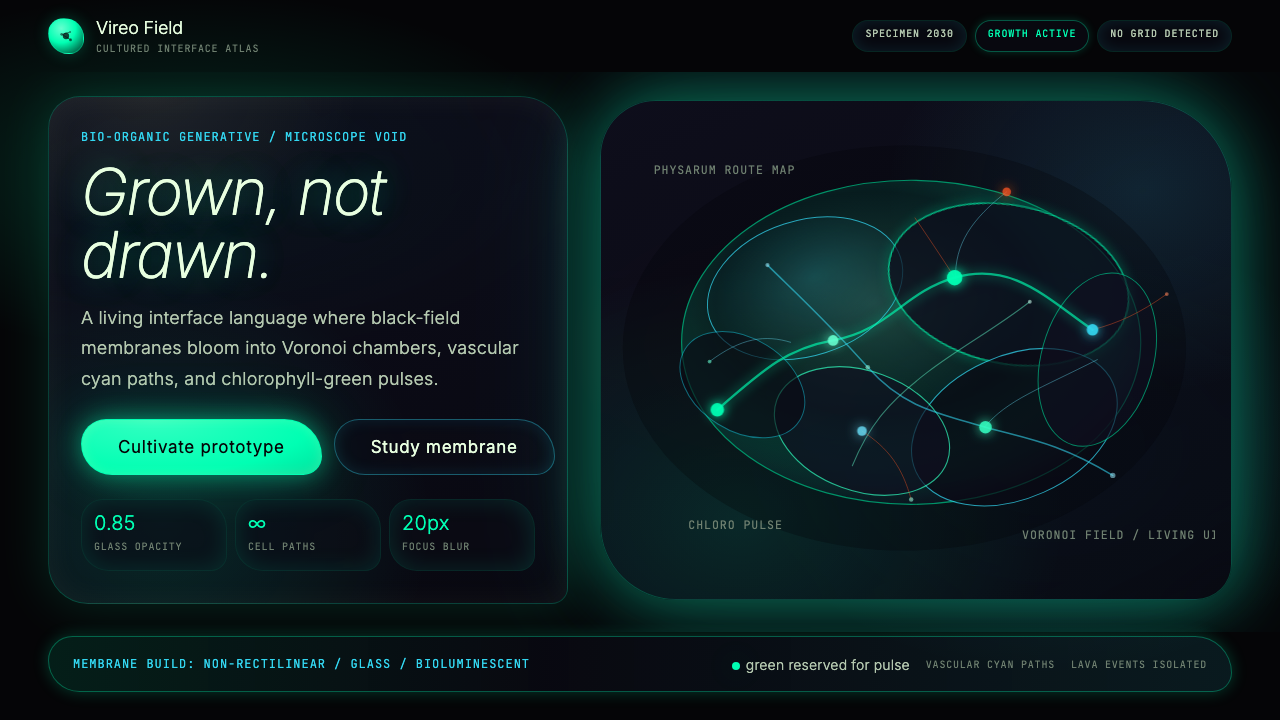 Bio-Organic GenerativeInterfaces feel cultured. Void black, Voronoi membranes, and neon chlorophyll…
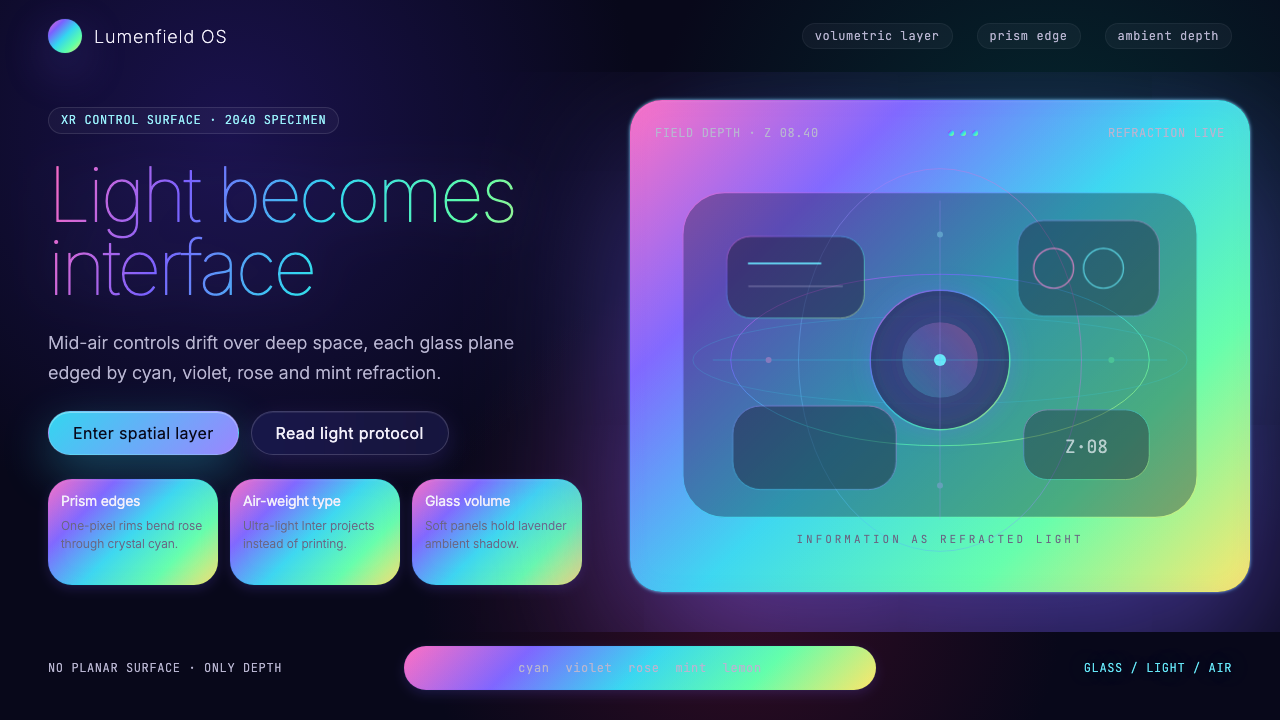 Holographic UI 2040Information made of light. Deep-space black, ultra-light Inter and prismatic…
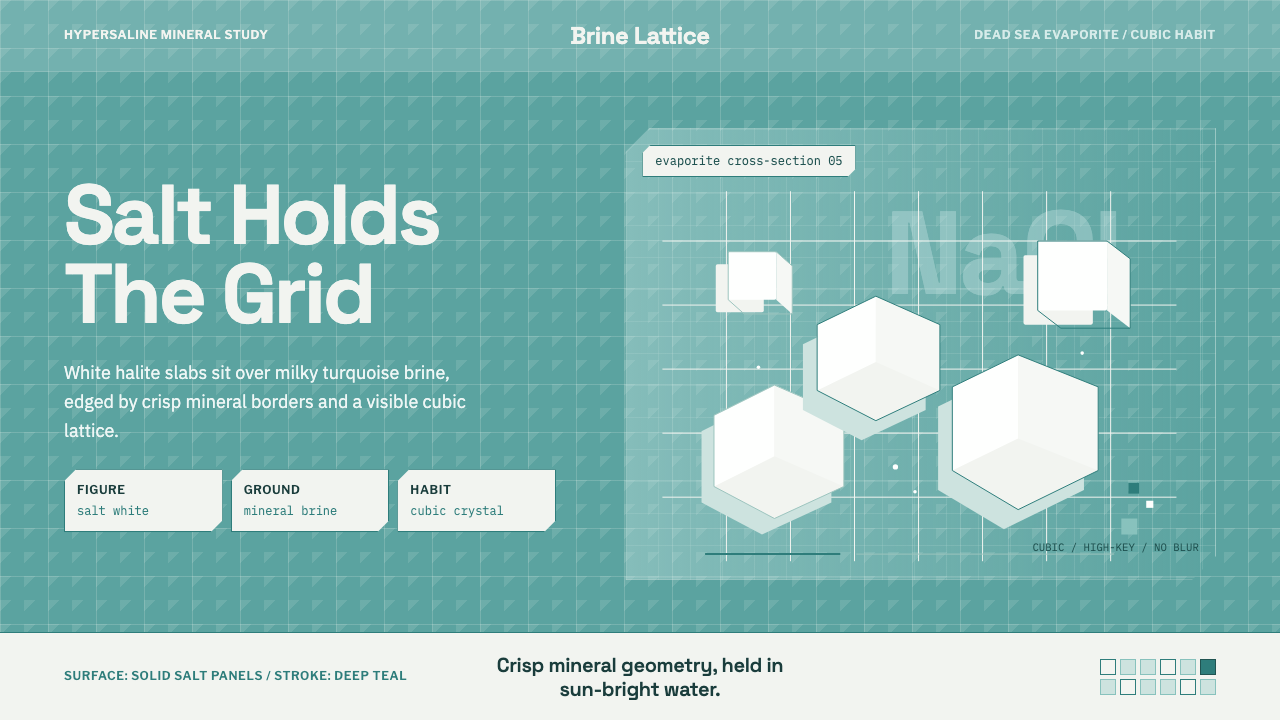 Salt Crystal EvaporiteCrystalline and cold. Salt-white cubes float over turquoise brine in a hard l…
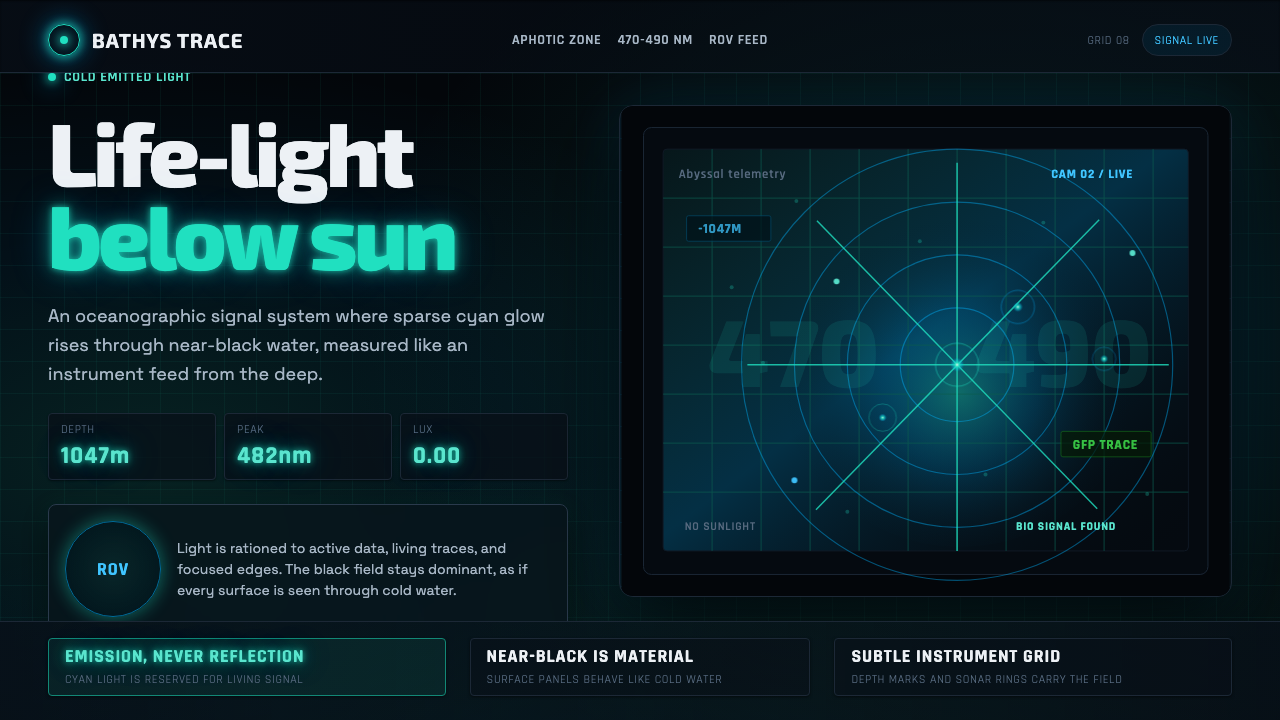 Abyssal BioluminescenceDark carries the signal. Electric cyan pins and Exo 2 readouts surface from a…
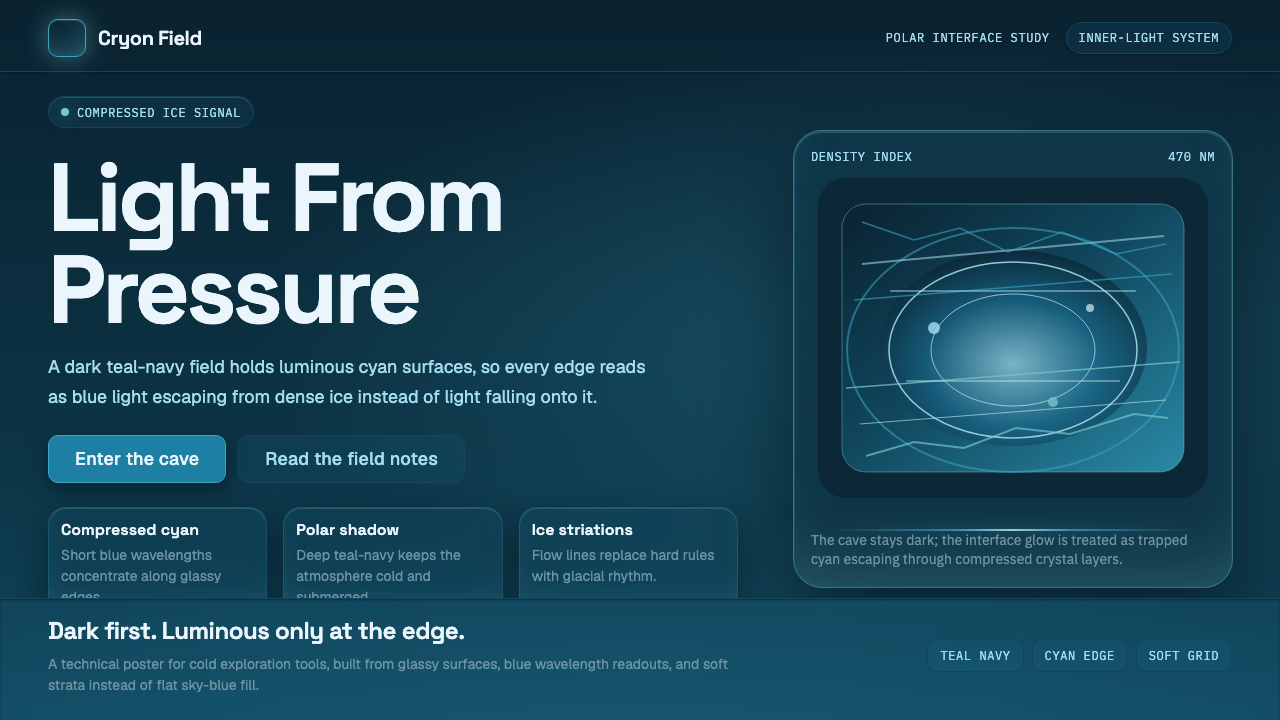 Glacier Ice CaveBlue emits from darkness. Teal-navy ground, Space Grotesk type, cyan striatio…
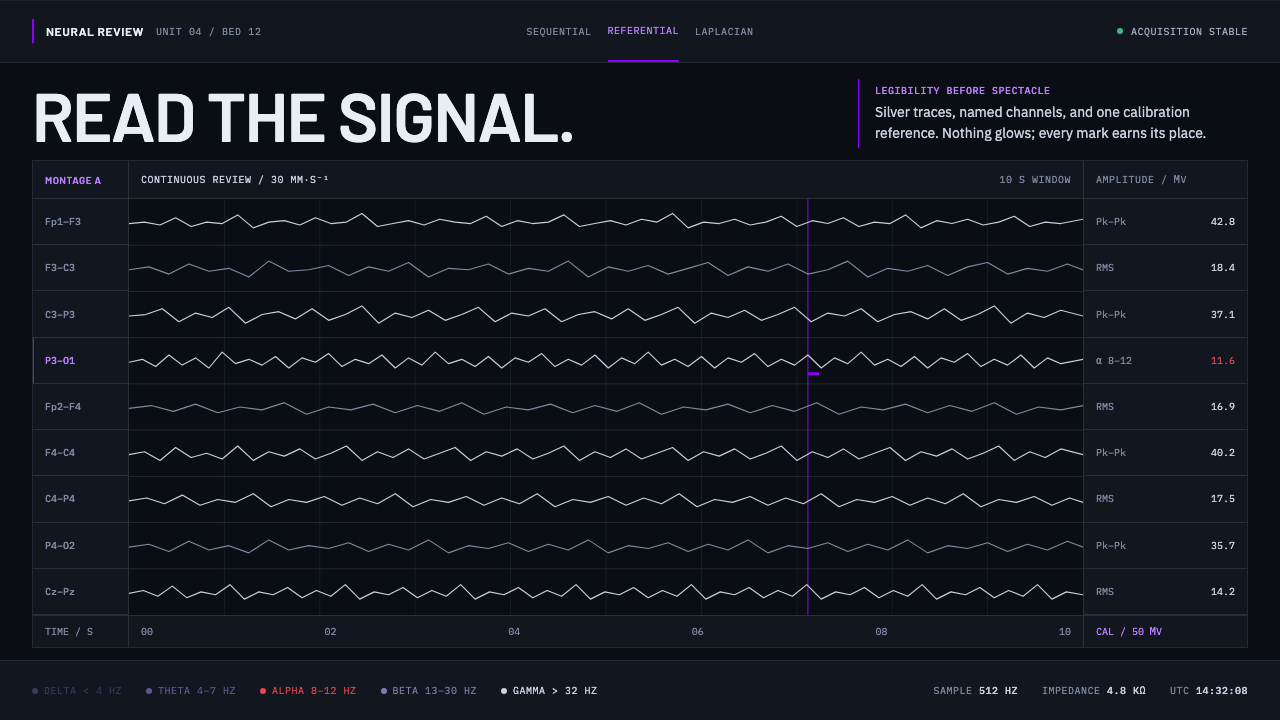 Neural Interface ClinicalClinical restraint makes signals legible. Silver traces cross near-black; vio…