What is Mallsoft Plaza Muzak?
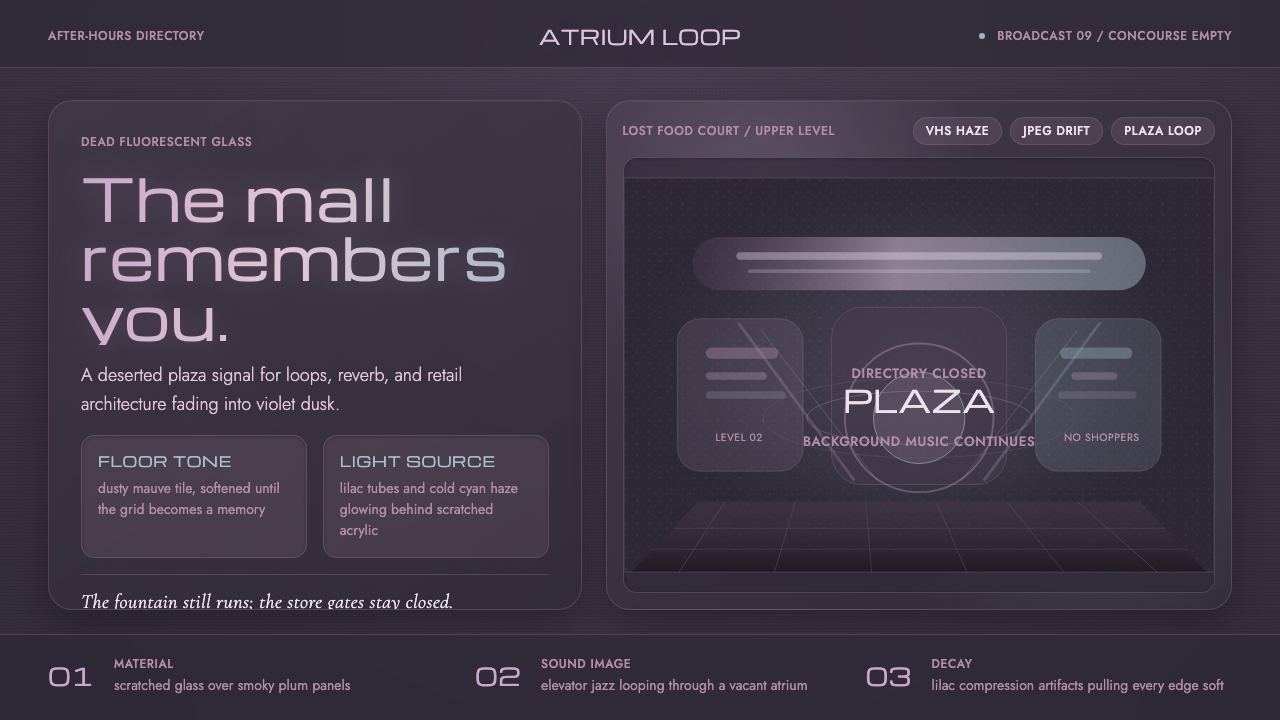
Mallsoft makes the abandoned shopping mall beautiful: dusty lilac glass, soft grids, looping muzak, and JPEG haze turning consumer space into a dream of permanent dusk.
Mallsoft Plaza Muzak in brief
Mallsoft is the sound and image of a mall that never closes but never opens either. It imagines an atrium without visitors, escalators without destinations, fountains without crowds, and food-court skylights illuminating nothing in particular. The style is less interested in the mall as a functioning commercial site than in the emotional residue left after commerce has gone quiet.
Born inside the early-2010s vaporwave scene, Mallsoft draws on the visual memory of 1980s–90s American consumer architecture: polished tile, interior plazas, fluorescent illumination, decorative glass, escalators, fountains, and spacious food courts. These elements are not presented with documentary clarity. They are submerged in reverb, video grain, JPEG compression, and a hazy atmosphere that makes the original image feel distant from its own reality.
Its central emotion is nostalgia without a stable object. Mallsoft may recall a real shopping center, but it can also evoke a place remembered from a photograph, a music track, or an imagined childhood. The style is beautiful because it is fading. Every softened edge, washed color, and degraded surface suggests time passing through a space designed to feel permanent.

Where does Mallsoft Plaza Muzak come from?
Mallsoft emerged in the early 2010s within the broader vaporwave scene, a global online culture of music, image-making, and net art. Its subject was not simply retro design. It was the emotional afterimage of consumer architecture: the mall as an enclosed world of circulation, artificial light, background music, and endless visual reassurance. Mallsoft isolated that world and slowed its emotional clock until the building seemed suspended between operation and abandonment.
The style developed through the meeting of several related movements and sensibilities: vaporwave, mallsoft or mallwave, dead-mall nostalgia, and low-fi net aesthetics. Vaporwave supplied the interest in commercial memory, synthetic atmosphere, and degraded media. Dead-mall nostalgia supplied the image of the empty or declining shopping center. Low-fi internet aesthetics supplied the compression artifacts, grain, blurred edges, and sense that the image had traveled through too many copies before reaching the viewer.
Its visual language is closely tied to the architecture of 1980s–90s American consumer space. The relevant details are ordinary but highly coded: an escalator rising into a blank upper level, a fountain placed beneath an atrium, pale tile catching weak interior light, glass tinted toward mauve or lilac, and a food-court skylight that makes artificial space feel faintly celestial. Mallsoft turns these familiar details into evidence of a vanished future.
The language continued through global online music and net-art communities from roughly 2012 to the present. Its key figures include System Corp., 猫 Neko Ninomiya, 浅水魚, and 2814. The source material identifies these names within the style's lineage rather than assigning a single institutional center or geographical origin. That distributed origin matters: Mallsoft feels less like a formal school than a shared atmosphere assembled across albums, images, uploads, and recurring visual memories.
What defines the Mallsoft Plaza Muzak look?
Dusty Lilac Palette
Mallsoft color is subdued, atmospheric, and pulled toward dusk. Lilac, mauve-grey, faded pink, and tired fluorescent white create the dominant field, while darker tones gather in tile seams, empty corridors, and distant architectural recesses. Saturation is softened rather than eliminated. The palette should feel as though light has passed through dust, old glass, and repeated compression before reaching the image.
Commercial Architecture
The mall is the primary subject, not a decorative backdrop. Escalators, fountains, atriums, skylights, food courts, tiled floors, and glass surfaces carry the style's meaning. These structures are presented as repeated systems designed for circulation and consumption, but their emptiness turns that efficiency into melancholy. Architecture remains recognizable while losing its practical urgency.
JPEG Haze
Degradation is not an afterthought applied to a finished image; it is part of the image's emotional content. JPEG haze, softened detail, blocky compression, and video-grain noise make the source feel recovered rather than newly produced. The image seems to have survived through old uploads and private recollection. Clarity is reduced just enough for memory to become more active than observation.
Soft Grids
Mallsoft uses grids, but they should feel embedded in architecture rather than imposed as a hard editorial system. Tile joints, ceiling panels, window frames, escalator rails, and repeated storefront divisions can create quiet horizontal and vertical rhythms. The grid organizes the scene while haze, blur, and weak contrast keep it from becoming clinical. Order remains visible, but its edges are dissolving.
Artificial Dusk
Light in Mallsoft is neither bright daylight nor convincing darkness. It is an interior twilight produced by washed fluorescent flicker, tinted glass, distant skylights, and a general pull toward grey. The atmosphere suggests a building whose lighting system continues after its social purpose has disappeared. Illumination becomes evidence of persistence rather than comfort.
Reverb as Space
The style's sound and image are inseparable. Piped muzak, looping melodies, and reverb imply a large interior even when the image is tightly cropped. Audio seems to bounce across tile, glass, and empty atrium space. In visual work, this principle can be translated through repetition, distant focal points, softened boundaries, and compositions that leave room for imagined sound to circulate.

Who shaped Mallsoft Plaza Muzak?
System Corp. is identified in the source material as one of Mallsoft's key figures. Within the style's distributed online lineage, the name belongs to the strand of practice that connects vaporwave's interest in commercial memory with the image of the empty mall: polished surfaces, artificial atmosphere, looping sound, and the melancholy of a consumer environment continuing after its audience has vanished.
猫 Neko Ninomiya appears in the approved material as a key figure in the Mallsoft and mallwave field. The name is part of a broader online culture that treats shopping architecture as an emotional archive. Its relevance here is not a single biographical detail, but its place within a shared vocabulary of faded commercial light, low-fi media, spacious interiors, and nostalgia for an uncertain past.
浅水魚 is listed among the style's key figures, linking the name to the global online communities where Mallsoft developed. The approved material places that lineage alongside vaporwave, dead-mall nostalgia, and low-fi net aesthetics. In that context, the figure represents the collective rather than institutional character of the genre: a mood circulated through sound, images, compression, and remembered architecture.
2814 is identified as another key figure in the source material. The name belongs to Mallsoft's wider networked lineage, where the mall becomes a vessel for atmosphere rather than a literal retail setting. Its significance can therefore be read through the genre's defining concerns: empty circulation, artificial light, degraded media, and the beauty produced when familiar commercial space begins to feel unreachable.
How do you use Mallsoft Plaza Muzak today?
For presentation covers, Mallsoft works best when the title feels like an announcement left behind in a deserted atrium. Use a wide architectural image with a distant escalator, fountain, skylight, or tiled floor, then let the title sit inside the haze rather than cutting sharply across it. A restrained lilac-grey field, weak fluorescent glow, and a single high-contrast text area can establish the mood immediately. The cover should feel spacious, quiet, and slightly unreachable.
For content and data slides, treat the presentation as a sequence of rooms rather than a stack of isolated cards. Preserve generous empty areas, use soft divisions inspired by tile joints or window frames, and let charts appear as faint architectural diagrams. Labels should remain clear enough to read, but the surrounding image can carry the atmosphere through grain, compression, and muted light. Data should feel like information still functioning inside a space whose social energy has faded.
For web dashboards and pricing pages, Mallsoft can support products concerned with archives, media, ambient systems, marketplaces, or cultural memory. Use dark surfaces with dusty lilac or washed pink illumination, subtle grid rhythms, and panels that feel like windows into a larger interior. Pricing tiers can read as different zones of the same mall rather than brightly separated promotional boxes. Keep interaction states legible and calm; the atmosphere should deepen hierarchy, not hide it.
For editorial and marketing work, the style is especially effective when the subject involves nostalgia, architecture, music, abandoned infrastructure, or the afterlife of consumer culture. Pair long-form text with spacious imagery, faded storefront perspectives, and captions that feel like museum labels recovered from an old directory. Marketing language should avoid sounding overly enthusiastic. Mallsoft gains power from understatement: the invitation is quiet, the promise is distant, and the image carries the emotional weight.
The common mistake is confusing Mallsoft with simply adding purple, blur, and noise to a modern layout. The style depends on a specific relationship between commercial architecture, artificial light, empty circulation, degraded media, and looping sound. If every element is equally hazy, the work loses structure; if every surface is aggressively distorted, the viewer loses the architectural memory that makes the atmosphere meaningful. Keep the mall recognizable before allowing it to dissolve.

Mallsoft Plaza Muzak — FAQ
Is Mallsoft simply a visual style, or does sound matter?
Sound matters because Mallsoft began as part of an online music and net-art culture, and its defining image is inseparable from piped muzak, looping melodies, and reverb. The sound implies an atrium larger than the frame, with music traveling across tile and glass after the crowd has disappeared. A visual work can evoke the style without audio, but it becomes more faithful when composition, repetition, and spatial emptiness suggest that sound is still circulating.
Why are shopping malls so central to the style?
The mall combines several conditions that Mallsoft needs: artificial light, controlled circulation, decorative architecture, background music, and a promise of endless consumer activity. When the space is shown empty or degraded, those same conditions become uncanny. The escalator still points somewhere, the fountain still occupies the atrium, and the skylight still imitates openness, but the social purpose has weakened. The mall becomes a perfect image of permanence turning into absence.
Does Mallsoft require visibly degraded images?
Degradation is central, but it should serve memory rather than function as random decoration. JPEG haze, grain, softened edges, and washed light make the image feel distant, copied, or half-recalled. If the source architecture disappears completely, the work loses the contrast between recognizable commercial space and emotional abandonment. The strongest treatment preserves enough structure for the viewer to identify the mall while allowing its surfaces and atmosphere to drift away.
Can Mallsoft be used on a light background?
It can, although the approved style is fundamentally dark and dusk-oriented. A light-ground version should not become clean, cheerful, or brightly commercial. It needs the same washed lilac atmosphere, weak contrast, softened architectural edges, and sense of artificial illumination. The question is not whether the background is literally dark, but whether the image feels enclosed, faded, and suspended after ordinary activity has stopped.
How is Mallsoft different from generic vaporwave?
Mallsoft belongs to vaporwave but narrows its attention toward the mall as a specific architectural and emotional setting. Generic vaporwave may draw on many forms of commercial memory, synthetic imagery, and degraded media. Mallsoft repeatedly returns to atriums, escalators, fountains, food courts, skylights, tile, glass, and muzak. Its emotional center is the deserted consumer interior: a place designed for circulation and desire that has become quiet enough to hear its own echo.
Related design styles
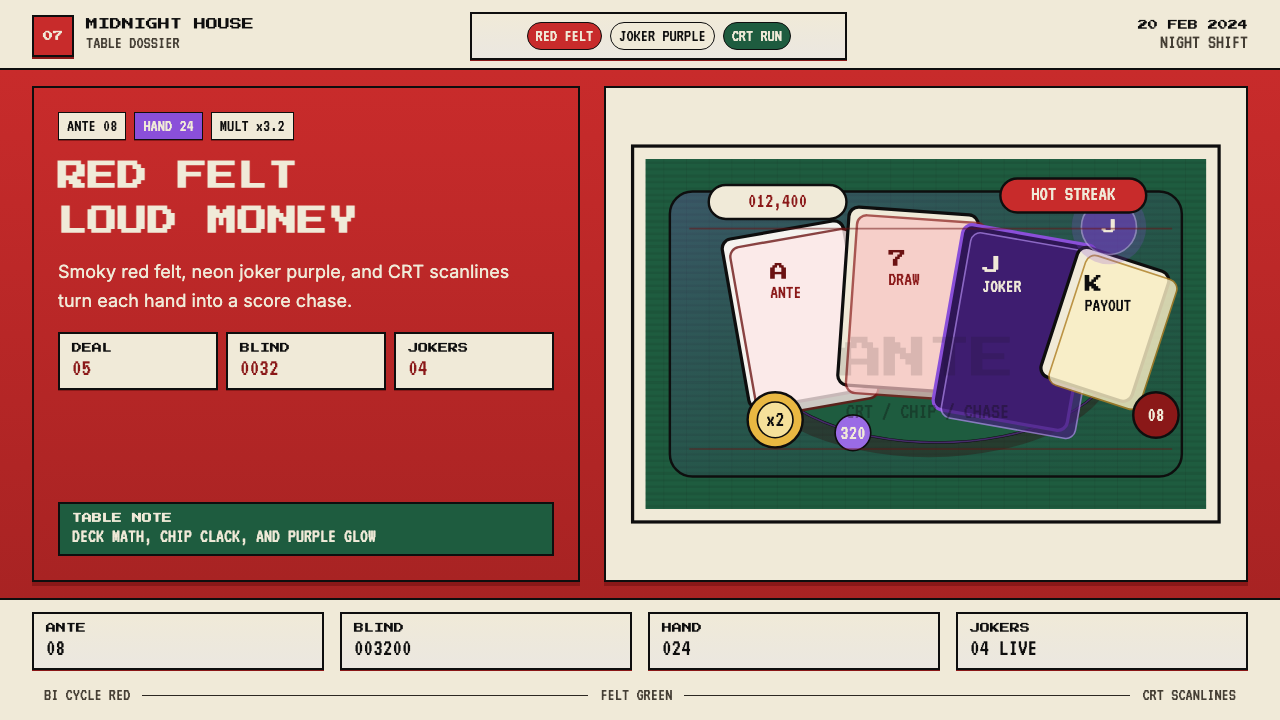 Balatro Poker RoguelikeLate-night poker math with a grin. Bicycle red, felt green, and CRT scanlines.
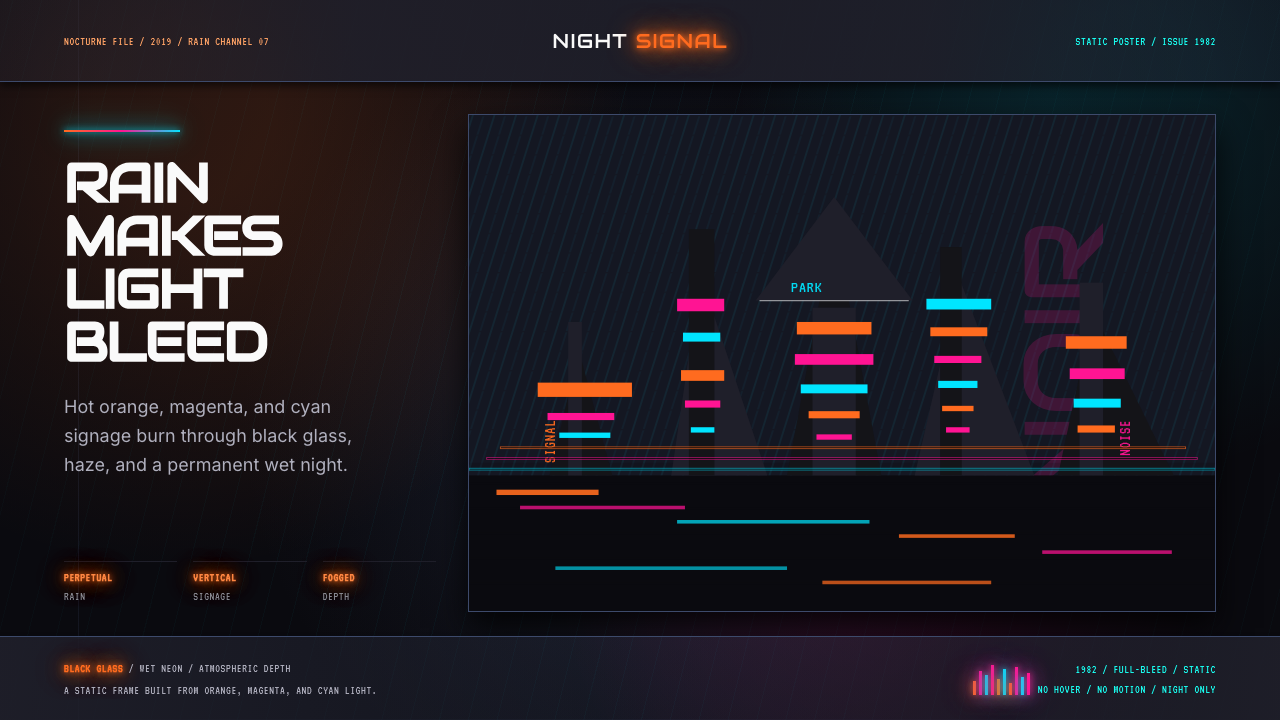 Blade Runner 1982 Neon NoirRain-soaked noir. Orange, magenta, and cyan neon cut black glass.
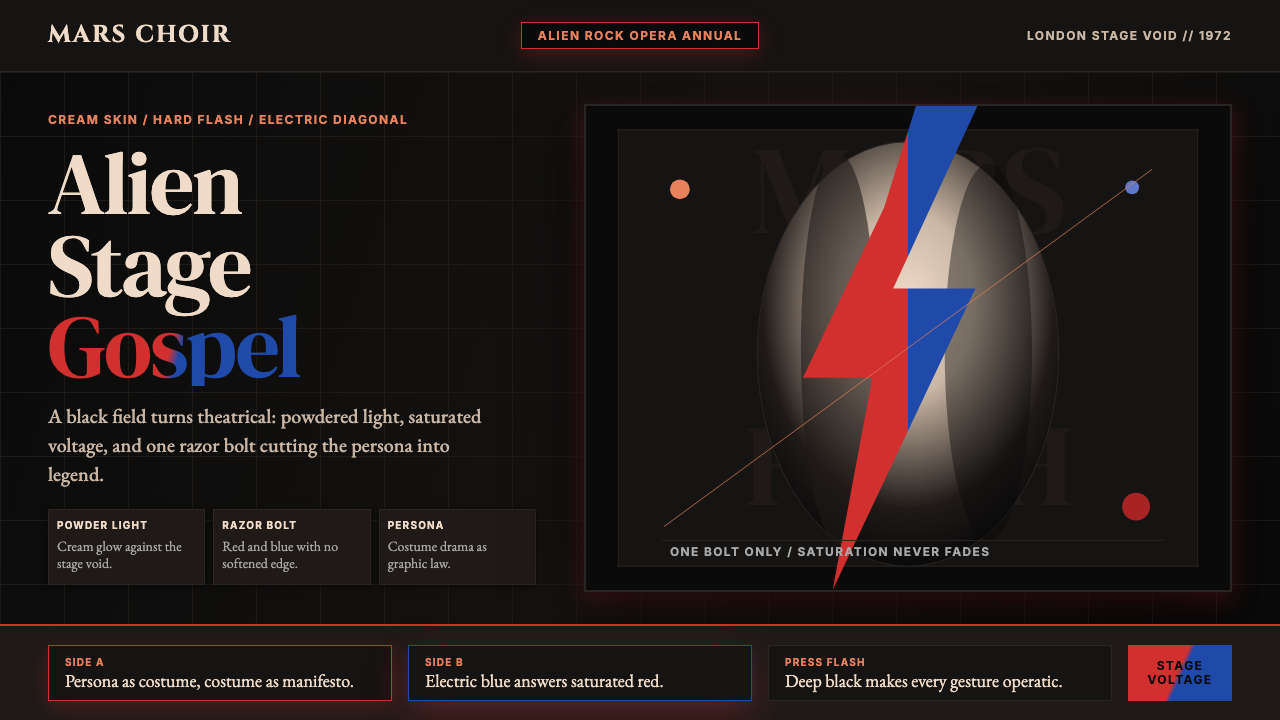 Bowie — Ziggy StardustTheater at full voltage. Cream-on-black portrait cut by one red and electric-…
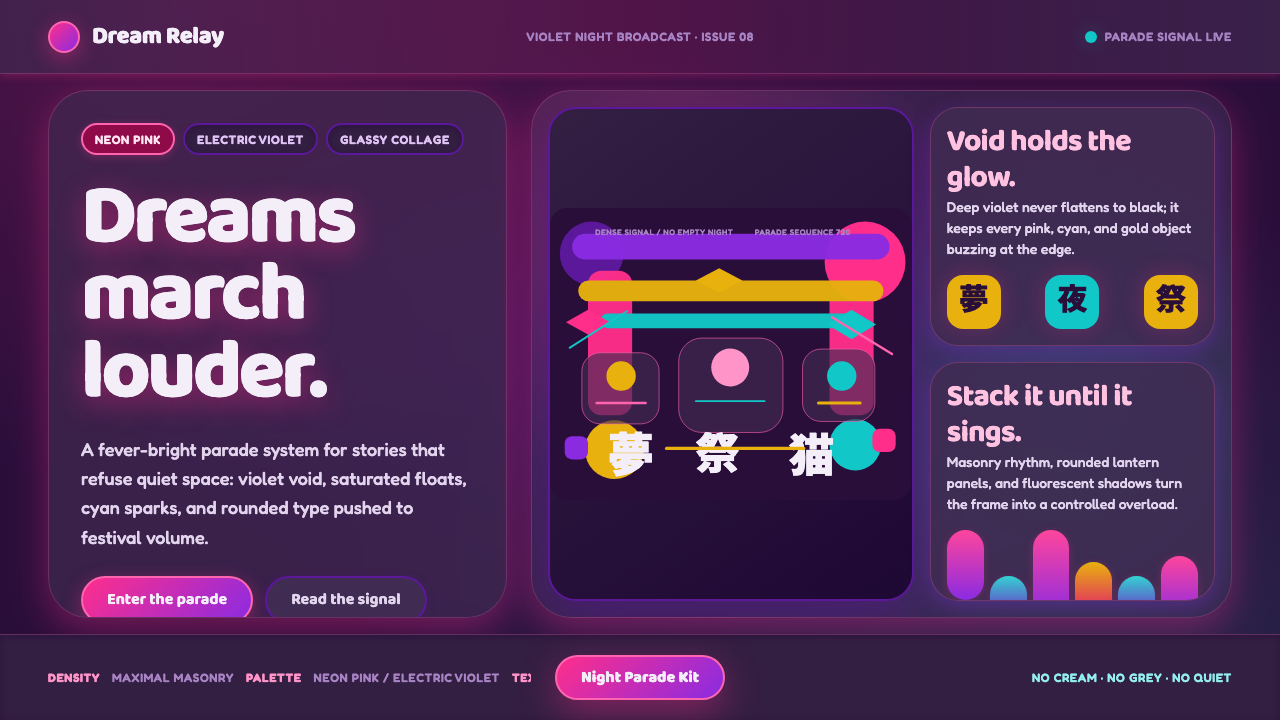 Paprika Dream ParadeDreams detonate in color. Neon pink and electric violet stack into a glassy p…
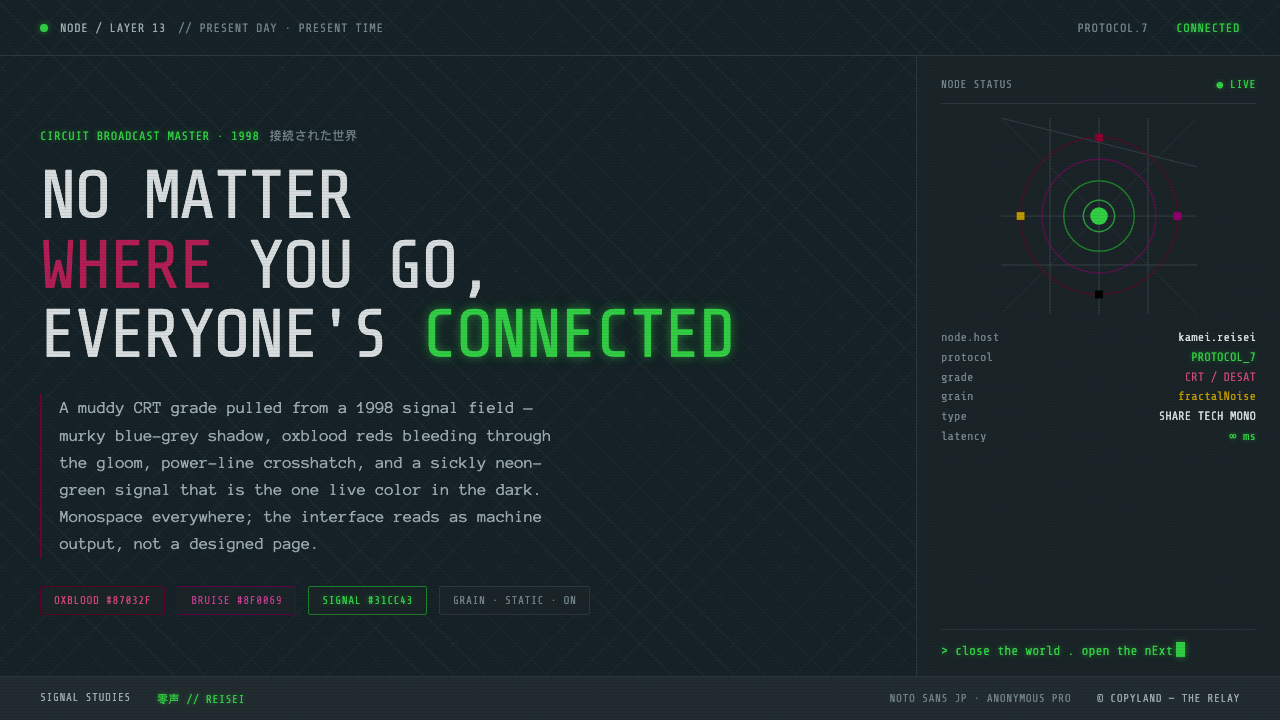 Serial Experiments LainMuddy CRT dread from the 1998 Wired. Blue-grey murk, oxblood reds, one sickly…
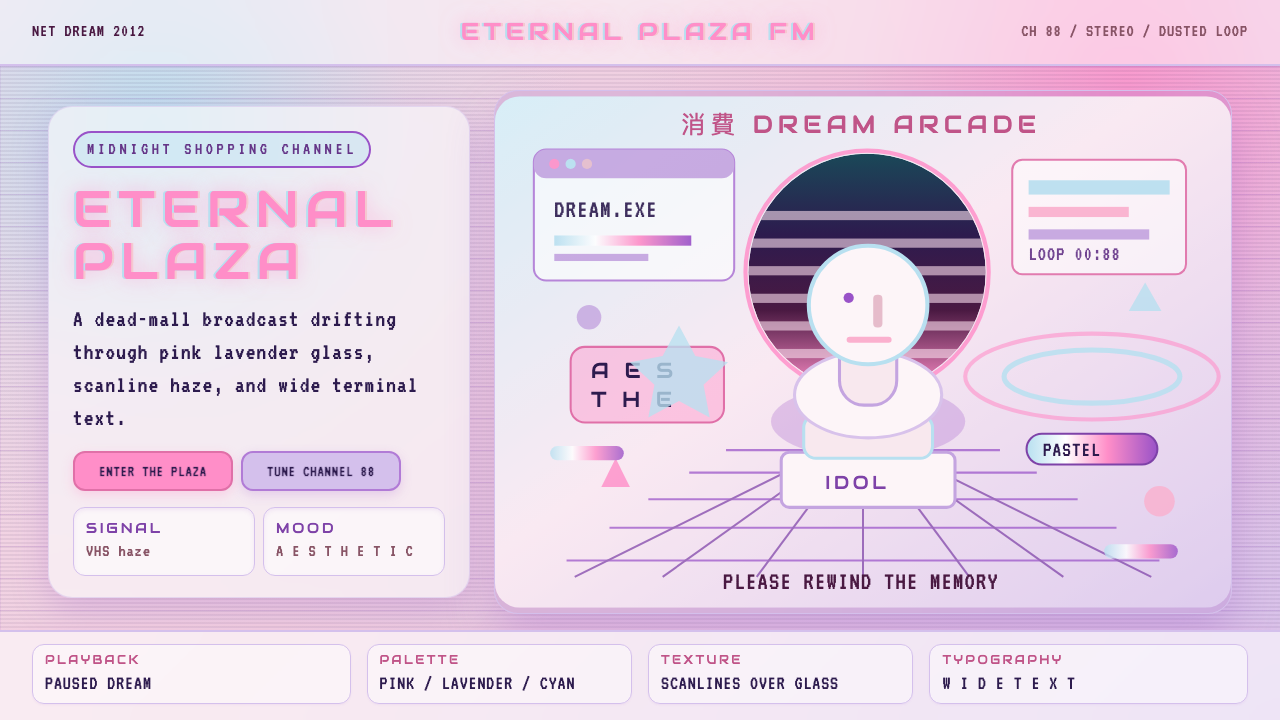 Vaporwave (Tumblr 2012)Dead-mall nostalgia glows. Pink-lavender glass, VHS scanlines, and wide retro…