What is Khanty Fish-Skin Coat?
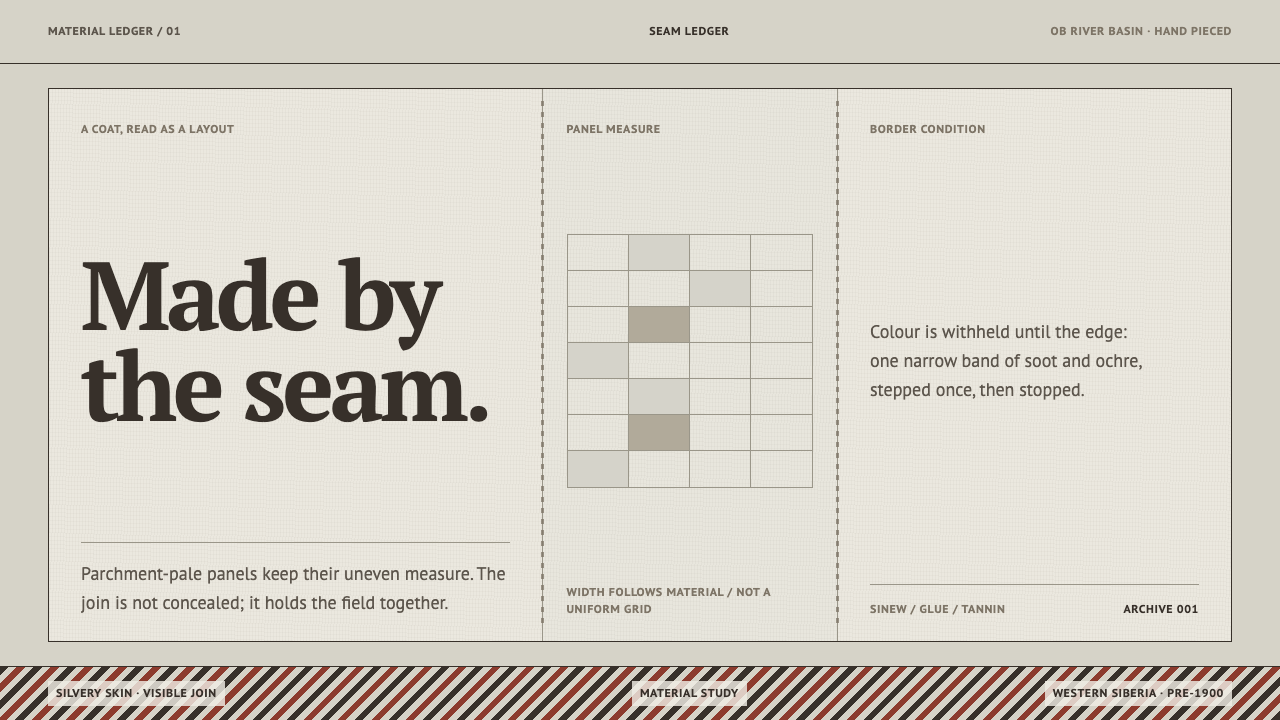
The Khanty fish-skin coat turns a river's catch into cloth: pale translucent panels, seams that do the drawing, and a single narrow border where all the colour is finally spent.
Khanty Fish-Skin Coat in brief
Khanty Fish-Skin Coat is a design style drawn from a garment made along the Ob river in Western Siberia, where Khanty women tanned the skins of sturgeon, sterlet and burbot into a soft, translucent leather and pieced them together into coats. Its visual language is a parchment-pale field built from panels of unequal width, seams left in plain sight, almost no colour in the interior, and one narrow stepped border in soot black and ochre that closes the composition and then stops.
The governing idea is that construction is decoration. A fish decides how wide a panel can be, and a join made with fish-glue and sinew thread decides where one panel ends and the next begins. A designer working in this style therefore does not add lines to a surface; the lines are already there, as seams, and the layout is simply the honest record of how the object was put together. Colour is treated as something withheld. The skin keeps its own silvery, pale-tan tone, lit through rather than opaque, and whatever else it carries comes from smoke, oil and alder tannin, never from applied pigment.
The overall impression is light, quiet and faintly irregular, almost the opposite of a template snapped to equal columns. The style belongs to a broader circumpolar fish-leather tradition, but inside a design library it reads as a rare kind of light-ground system: warm, thin-lined and restrained everywhere except for one disciplined band at the edge, where the whole garment's visual argument is made in a single gesture.
Where does Khanty Fish-Skin Coat come from?
The coat comes from the Ob river basin of Western Siberia, the homeland of the Khanty, an Ob-Ugric people. The practice described here predates 1900 and continued to be documented well into the twentieth century, which is why it can be studied today not only as an inherited method but as a body of recorded objects. Fish-skin sewing is counted among the Ob-Ugric crafts, and it sits inside a wider circumpolar fish-leather tradition, a name for the habit, found around the northern rim of the world, of turning fish skin into wearable leather.
The makers were women. Khanty women were the tanners and the sewers, and the whole chain of work passed through their hands: taking the skins of sturgeon, sterlet and burbot, working them into a soft, translucent leather, and joining the pieces into a coat with fish-glue seams and sinew thread. Nothing in that chain calls for a dye shop. The skin keeps its own colour, silvery and pale tan, lit through rather than opaque, and the warmer, darker tones that appear on it come from smoke, oil and alder tannin. Colour, in other words, is a by-product of treatment and handling, which is exactly why it feels earned rather than applied.
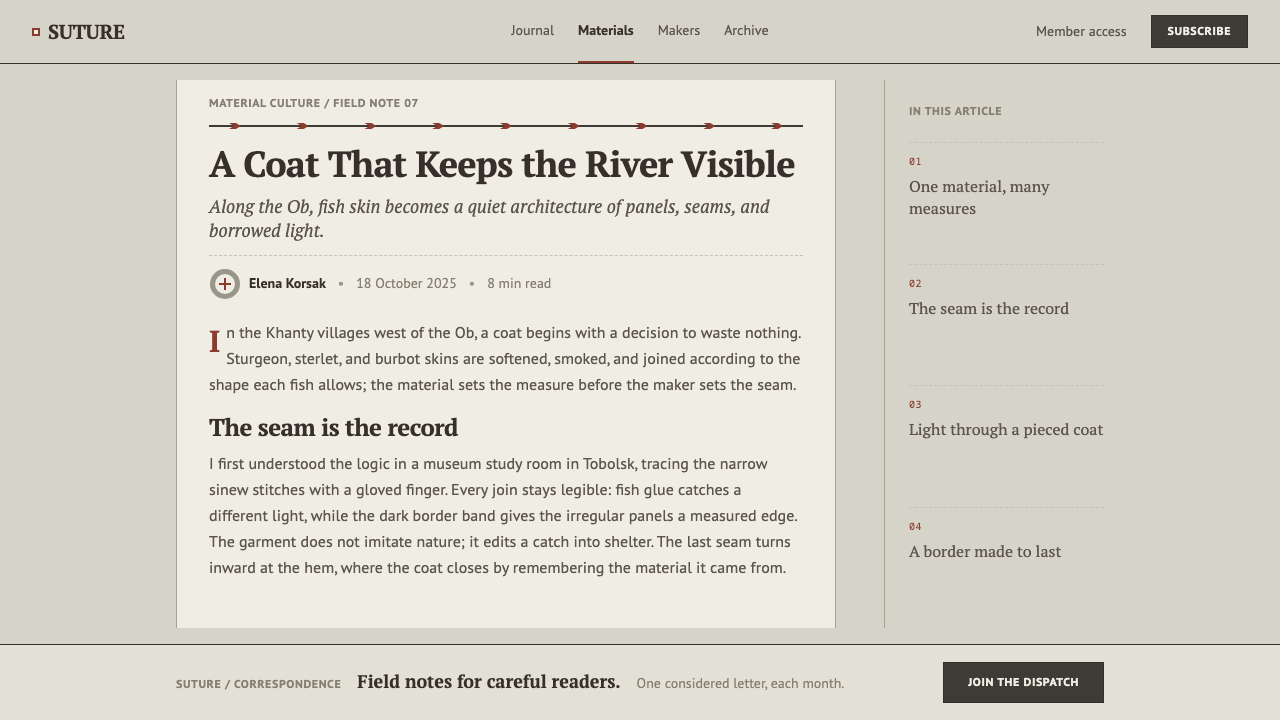
Because each skin is only as large as the fish it came from, a coat cannot be cut from one broad sheet. It has to be assembled from panels whose width is dictated by the animal, and the seams between them are structural, not stylistic. This is the fact the design system is built on. A pattern-cut garment starts from a drawing and trims the material to fit; here the material arrives with its own dimensions and the pattern is whatever those dimensions allow. The visible irregularity of a fish-skin coat is not a flaw to be corrected in the next version. It is the garment's signature, and the reason a modern reader can recognise it at a glance.
Our knowledge of these coats runs largely through museum collections. The Museum of Ethnography in Budapest, the Milwaukee Public Museum and the Victoria and Albert Museum are the institutions named in this style's source record, and they stand for the way the tradition reaches a design audience today: as finished objects, seen at garment scale, with panels, seams and borders intact. The design system takes that evidence literally. Panels stay uneven, seams stay visible, and colour is held back until the border, where one narrow stepped band of soot black and ochre closes the field and goes no further inward.
What defines the Khanty Fish-Skin Coat look?
Parchment Ground
The field is a pale, warm parchment tone that suggests leather held up to the light. It is not a flat white and not a cream tint: the intended effect is silvery and pale tan at once, with a sense that light passes into the material instead of bouncing off it. Large areas stay in this register, which gives the style its calm. Any darker value belongs to the border or to type; the interior is never filled with competing colour.
Smoke, Oil, Tannin
Every tone beyond the base skin has a physical origin: smoke, oil and alder tannin. That gives the palette a clear rule. Colours should look like deposits or stains, slowly acquired, not like inks chosen from a swatch. In practice the palette is narrow and earthy, and the border's soot black and ochre are the only assertive notes. Bright synthetic hues would contradict the logic of the object, because nothing on a fish-skin coat is pigment.
Irregular Panels
Panels differ in width because a fish decides how wide a piece of skin can be. In layout terms this means a composition built from unequal blocks set side by side rather than from identical columns. The unevenness has to be disciplined, since panels still align along shared edges and the overall silhouette stays coherent, but the rhythm comes from variation, the way a hand-assembled garment reads, instead of from repetition.
Seams as Drawing
Seams are never hidden, because the seam is the structure. Joined with fish-glue and sinew thread, they form the visible skeleton of the coat, and the style lets those lines do the work that borders, rules and ornaments do in other systems. Lines are thin, continuous and purposeful; each marks a real join between two pieces. A decorative divider that corresponds to no join at all is out of character.
One Stepped Border
The border is a narrow band of geometric applied pattern in soot black and ochre, stepped rather than curved. It is the only place where colour is fully spent, and it is spent exactly once: the band closes the composition and then stops. It does not echo through the interior as repeated accents or spill into headings. Its job is to frame, to conclude, and to make the quiet field read as deliberate rather than empty.
Withheld Colour, Quiet Depth
Because colour is withheld until the edge, the interior has to carry hierarchy by other means: placement, the scale of panels, the weight of seam lines and the spacing between them. Depth is expressed as translucency, layers that seem lit from behind, and not as heavy cast shadow, which would make the skin look opaque. The overall mood is of something handled and worn in: soft, slightly uneven, and entirely without gloss.
Who shaped Khanty Fish-Skin Coat?
The anonymous makers at the centre of the tradition. They tanned sturgeon, sterlet and burbot skins into soft translucent leather, joined the pieces with fish-glue and sinew thread, and gave the coat its logic: panels sized by the fish, seams left open to view, and colour limited to what smoke, oil and alder tannin leave behind, with one narrow border as the only deliberate flourish. Every rule of the design system is a restatement of choices these women made at the work table.
Named in the source record among the institutions associated with the documentation of Ob-Ugric fish-skin garments. As an ethnographic museum, it represents the European collecting tradition through which Siberian clothing reached scholars and, eventually, designers. A collection of this kind shows the coat as a whole object, so the proportion of panels to border can be read directly.
Another institution named in the source record. A public museum in the United States, it shows how far the coats travelled from the Ob basin and how widely the tradition is now held for study. Its value to designers is comparative: with more than one preserved garment, the constant features, such as irregular panels, open seams and an edge band, become clear.
The third museum named in the source record, and the one best known for design and the decorative arts rather than for ethnography. Its presence marks the point where a Siberian working garment is looked at as designed form: pale panels, exposed joins and a bordered edge. This style adopts that reading, treating the coat as a lesson in structure and restraint.
How do you use Khanty Fish-Skin Coat today?
Khanty Fish-Skin Coat is a quiet style, and it rewards quiet projects. It transfers well wherever hierarchy can come from structure, spacing and the weight of a line rather than from colour, because colour is the one thing the style refuses to hand out freely. Applying it correctly means understanding what the coat is doing: letting the seams draw, letting content decide widths, and saving the only strong colour for a single closing band.
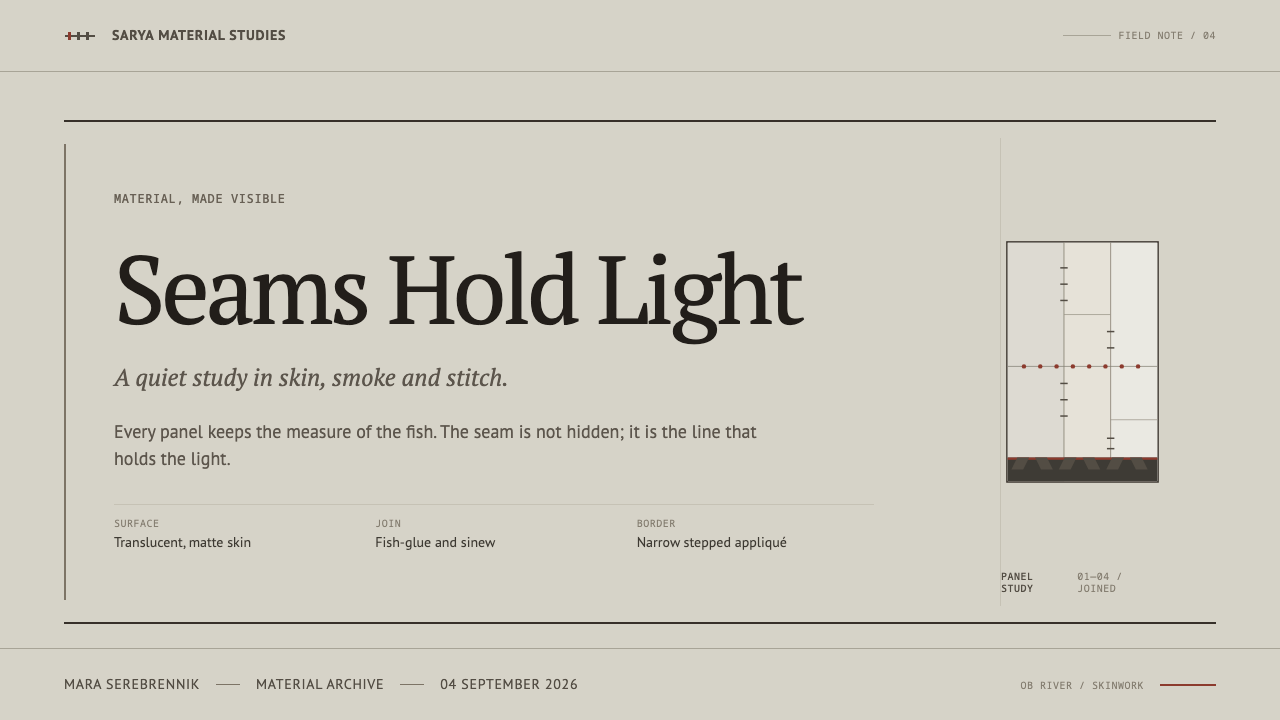
For presentation slides, a cover works best as a wide parchment field with the title set plainly and a stepped border in soot black and ochre closing one edge, so the border plays the role of the coat's hem. Content slides should be treated as assembled panels: two or three blocks of unequal width side by side, divided by thin seam lines that mark real boundaries between ideas. Data slides suit the same logic. Charts sit inside panels, axes and gridlines are drawn as seams, and a single dark or ochre mark is allowed to carry the one point the audience must remember.
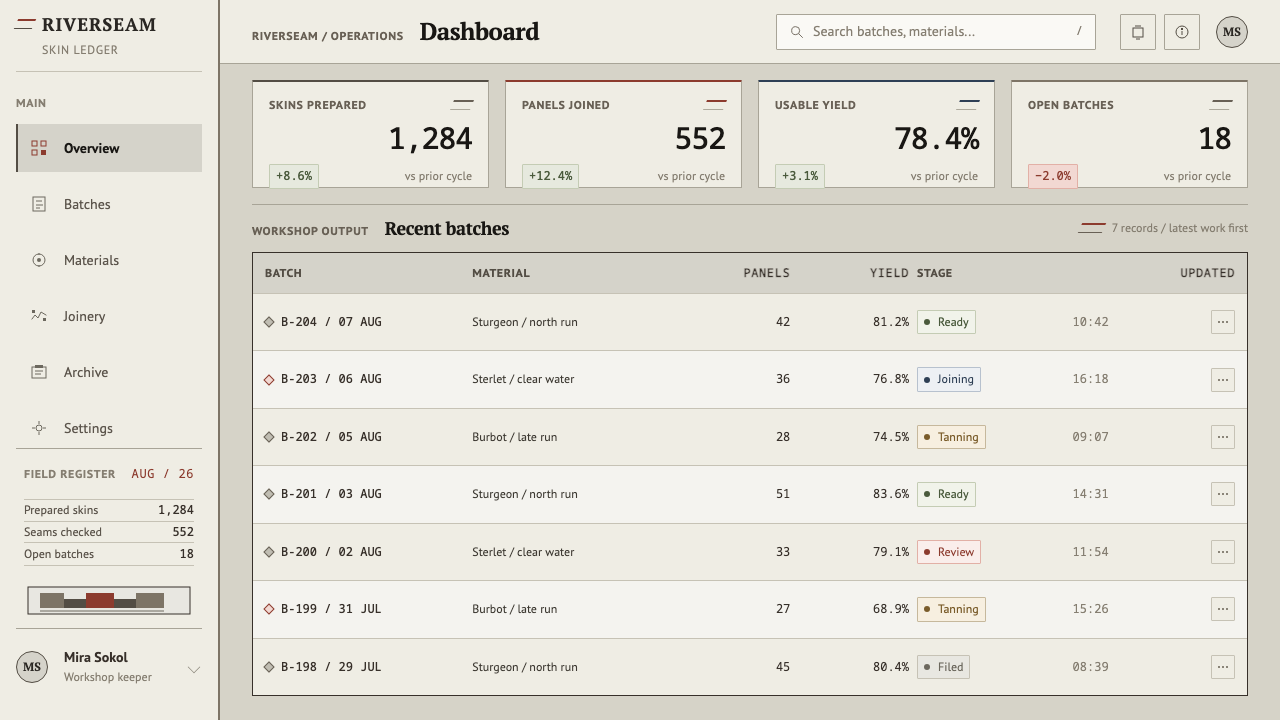
For web interfaces, the style fits calm, reading-led surfaces: documentation, knowledge bases, journals, portfolios and analytical tools where users scan rather than react. A dashboard can be organised as panels of different widths separated by fine lines, with the border treatment reserved for the outer frame or a single status band. On a pricing page, the recommended plan can be marked by the stepped band alone, while the other plans stay in the quiet parchment register. Navigation should be plain and typographic, with no icon decoration beyond simple geometric marks.
For editorial and marketing work, the style supports long-form storytelling about craft, heritage, outdoor goods or slow-made products. An article layout can alternate wide and narrow panels, use seam lines in place of ornamental dividers, and close each major section with a short echo of the stepped border. Photography should stay in natural, muted tones so it sits inside the parchment world instead of fighting it. Calls to action are best expressed through weight, placement and the border palette, not through a bright accent borrowed from elsewhere.
The most common mistake is spreading the border colours through the interior until the page becomes a two-colour theme. The coat works because colour appears once, at the edge, and then stops; repeated accents turn that discipline into ordinary decoration. A second error is to simulate leather grain, scales or stitching as texture, which adds surface effect with no structural job. A third is to equalise the panels for tidiness. The irregular widths are the point, and a grid of identical columns erases the one thing that makes the style recognisable.
Khanty Fish-Skin Coat — FAQ
What is the Khanty Fish-Skin Coat design style?
It is a design system modelled on coats that Khanty women made along the Ob river in Western Siberia from tanned sturgeon, sterlet and burbot skin. Translated to screen and page, it means a pale parchment field, panels of unequal width, visible seams that act as the drawing, and one narrow stepped border in soot black and ochre. Colour is held back until that border closes the composition.
Which fish were used, and how was a coat put together?
The source record names sturgeon, sterlet and burbot. Their skins were tanned into a soft, translucent leather, then joined with fish-glue and sinew thread. Because the width of each panel is set by the fish, the finished coat is made of unequal pieces whose seams stay visible. Any tone beyond the skin's own silvery, pale-tan colour comes from smoke, oil and alder tannin, not from pigment.
Does the style imitate the texture of fish leather?
No. The system takes the coat literally in structure: panel widths, exposed seams and a bordered edge. It does not take it literally in surface texture. Simulated scales or leather grain would be surface effect with no structural job, which runs against the principle that the seam is the structure. The sense of material comes from translucency, restrained warm tones and honest joins rather than from a photographic skin overlay.
Can this style work on a dark background?
It is designed as a light-ground style. The skin is described as lit through rather than opaque, and that quality depends on a pale, luminous field. On a dark ground the translucency idea is lost and the soot-black border has nothing to contrast against. If a dark variant is needed, treat it as a different style rather than an inversion, because the parchment field and the single dark border belong together.
Where does the style fit, and where does it struggle?
It suits quiet, reading-led work: documentation, long-form editorial, heritage and craft brands, portfolios, and calm analytical tools where hierarchy comes from spacing rather than colour. It struggles where a product needs loud calls to action, dense colour-coded data or high-energy motion, because the style deliberately withholds colour and avoids ornament. Use it where restraint is itself the message.
Related design styles
 Basque LauburuMemory cut into stone. Warm grey planes and four measured turns build depth f…
 Beni Ourain Berber CarpetRestraint feels tactile. Greige wool field, Oswald type, and a loose charcoal…
 Bonsai CultivationQuiet asymmetry. Pine green rests on dark tray earth, sealed by one vermilion…
 Chancay Gauze TextileQuiet woven dignity. Tan silhouettes float through a dark open cotton mesh.
 Hindu Widow White SariRestraint carries the weight. Ash-toned khadi, quiet serif type, and vertical…
 Japanese Tea CeremonyStillness has weight. Tatami straw, matcha green, and Mincho type leave room…