What is Kenyan Kiondo?
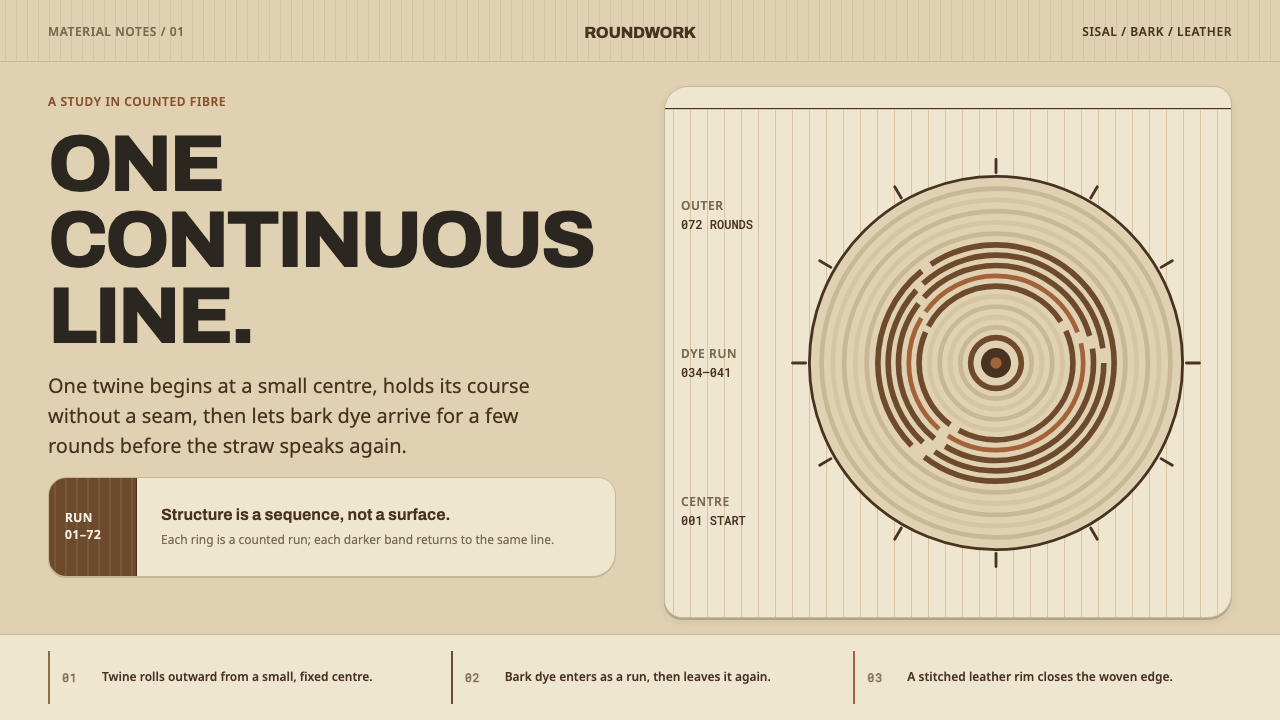
A kiondo is a bag made of one unbroken line, and its design system treats every band, rule and ring as something the weave count produced.
Kenyan Kiondo in brief
A kiondo, called chondo in Swahili, is a handwoven bag from Kenya. The weaver rolls sisal fibre into twine against her thigh, then coils it outward from a small centre, so that the whole wall of the bag is a single unbroken spiral. There is never a seam and never a panel. Leather finishes the object: a rim strip, base panels, handles, and saddle stitching that can be counted stitch by stitch.
Colour enters as bands. Twine steeped in dye made from bark, root, charcoal or soil joins the run, and leaves again a few rounds later. Because natural dye is uneven, the tone of a band drifts, one stretch deeper and another lighter, and that drift is exactly how it should look. Pattern in a kiondo is not applied after the fact; it is whatever the sequence of twine happened to produce.
The design system takes that logic literally. Undyed straw is the page. Dyed brown is the structure. Every band, rule and ring is something the weave count produced rather than something drawn on top of it. Corners are generously rounded, edges allow a little irregularity, and the whole surface reads as made by hand rather than measured by a ruler. Craft is structural here, never applied.

Where does Kenyan Kiondo come from?
The origins of the kiondo lie before 1900, among the Taita, Kikuyu (Agikuyu) and Kamba communities of Kenya's central highlands and southeast. The bag belongs to a wider East African fibre craft in which women are the weavers and the knowledge passes from hand to hand. The sisal that now defines the object is a later arrival: it reached East Africa in 1893, and weavers adopted it into practices that were already established.
From the early 1930s weaving for the market began in Makueni, where Kamba women weavers turned a household craft into something sold. That date matters for design. It marks the moment when the kiondo moved from being a made object in a domestic economy to being a recognisable product, and the visual system carries both sides of that history: the intimate logic of one weaver and one line, and the clean legibility of something meant to be seen and bought.
Two other traditions run through the reference notes. Natural bark and root dyeing supplies the brown bands whose tone drifts from round to round, and Agikuyu spiral symbolism recognises the spiral as more than a technique. The library records the spiral as meaningful in Agikuyu culture without prescribing one reading, which is the right instinct for a designer: respect the form, and avoid inventing a meaning for it.
The three groups named in the library as key figures are all collective: Taita women weavers, Kikuyu women weavers, and Kamba women weavers of Makueni. No single name stands in for the craft, and that fits the object. A kiondo is made by an anonymous hand following a shared method, and the design system inherits this anonymity as a kind of modesty. Structure, not signature, is what carries the work.
What defines the Kenyan Kiondo look?
Straw ground
The page is undyed sisal straw: a pale, warm, slightly yellow neutral with a dry, natural feel. It is light without being white, and it never reads as clinical. The ground lets the dyed structure stand out, but it also carries a quiet fibre quality, as if the page itself were woven.
Dyed brown structure
The deeper brown is the colour of twine steeped in bark, root, charcoal or soil. It carries headings, bands, rules and primary actions, and it is always structural rather than decorative. Because natural dye is uneven, the brown is allowed to vary slightly from place to place instead of staying a perfectly flat fill.
Counted rings and bands
Bands and rings are produced by the weave count. Their widths are whole multiples of a basic course, they repeat at regular intervals, and a viewer can count them. Nothing is painted on at an arbitrary size. If a band exists, it is because a certain number of rounds of dyed twine joined the run and left again.
One unbroken line
A kiondo has no seam and no panel, and the layout follows suit. Sections flow into one another along continuous rules and spirals rather than being cut into separate boxes. Where a break is needed, it is a change of band, not a hard cut. Pages should feel like one continuous course of work.
Drifting tone
Dye is uneven, and the system says so. A band may be denser at one end and lighter at the other, and neighbouring bands are never perfect copies. This drift is a feature: it signals that a hand and natural materials were involved. Overly uniform colour fills would read as a false, machine finish.
Generous curves, soft irregularity
Corners are rounded generously, the way a coiled wall curves into its base, and edges allow a little irregularity. Nothing is razor-sharp. The system avoids the hard geometry of a ruler because the original object is made from a coil of twine, which cannot help but be round and slightly uneven.
Leather and countable stitches
Leather does the finishing: rim strips, base panels, handles. In the interface this appears as clearly framed edges, footers and handles, often marked with a row of evenly spaced short dashes that stand for saddle stitching. Each stitch is individually visible and countable, so that the finishing, like the weave, is evidence of work.

Who shaped Kenyan Kiondo?
Taita women weavers are the first of three collective figures the library names for the kiondo. They represent the craft as a shared regional practice rather than one village's invention, and their presence in the list places the object within the wider East African fibre tradition. For a designer, they are a reminder to credit a community and a method rather than a brand.
Kikuyu (Agikuyu) women weavers are named alongside the library's note on Agikuyu spiral symbolism. The spiral at the heart of the kiondo is therefore more than a construction method: in Agikuyu tradition it carries meaning. The Curio style honours this by keeping the spiral and the unbroken line central, and by refusing to attach an invented explanation to them.
Kamba women weavers of Makueni are tied in the library's record to the early 1930s, when weaving for the market began there. They stand for the moment the kiondo became a product as well as a household object. The design system keeps that duality in view: it is structurally intimate, yet clean and legible enough to sit on a shelf, a page or a screen.
How do you use Kenyan Kiondo today?
On slides, the kiondo system gives covers a warm, handmade confidence. Set the title in dyed brown on the straw ground, with a few concentric bands or rings drawn from the weave count in one corner. Content slides can be organised as courses: each section is a band, each band has an even rhythm of rows, and rules run continuous rather than breaking into boxes. For data, make bars in dyed brown, spaced as whole courses, and mark the key value with a slightly deeper band rather than a new colour.
On the web, the style suits craft, food, lifestyle, retail, sustainability and community platforms, and any product that wants to feel honest and tactile. Keep the page in the straw tone, place navigation and headings in dyed brown, and use generously rounded containers with soft irregular edges. A pricing page can show tiers as stacked bands, with the recommended plan in the deepest course. Make interactive states modest: a deeper band, a visible row of stitches or a change in the rhythm of the rings.
For editorial and marketing work, the system offers a grounded, human voice. It works for brand stories about makers, ingredients, fashion, travel and design. Use generous margins, plain headings and photography of hands, fibres and finished objects, and let bands and rings serve as chapter dividers or section markers. Because the style is about process, pages that reveal how something is made, step by step, suit it especially well.
When a project directly concerns Kenyan craft, name the kiondo, the Taita, Kikuyu and Kamba communities and the women who weave it. The visual principles of counted bands, an unbroken line and drifting natural tone can be used much more widely, but they should not be passed off as generic 'ethnic' patterning. The library is clear that every band and ring comes from the weave count, and an honest use respects that logic.
The most common mistake is to treat the brown rings as decorative stripes and place them at arbitrary widths and intervals. The whole point is that each one is counted. Another mistake is to flatten the drift of the dye into perfectly uniform fills, which turns a hand-made look into a machine imitation. A third is to sharpen the corners and edges until the layout looks like a standard technical template, since generosity and slight irregularity are part of how the style speaks.

Kenyan Kiondo — FAQ
What is a kiondo?
A kiondo, called chondo in Swahili, is a Kenyan bag woven from sisal twine. The weaver rolls fibre into twine against her thigh and coils it outward from a small centre, so the wall of the bag is a single unbroken spiral with no seams or panels. Colour enters as bands of twine dyed in bark, root, charcoal or soil, and leather provides the rim, base, handles and stitching.
Why does the page use a straw colour instead of white?
Because the reference is undyed sisal, and in the system the page is the weaving itself. A pale straw ground has a dry, natural fibre quality that white lacks, and it lets the dyed brown structure stand out as something woven into the surface rather than printed on a clinical sheet. Replace it with white and the style loses its handmade warmth.
What does 'counted' mean in this style?
It means every band, rule and ring in a layout comes from a regular unit, the weave count, and can be counted by the viewer. Widths are multiples of a basic course, and repeats occur at even intervals. This keeps the structure honest, because nothing is arbitrary decoration. The goal is a page that looks as though it was produced by rounds of work rather than designed by eye alone.
Which communities are connected with the kiondo?
The library names the Taita, Kikuyu (Agikuyu) and Kamba communities of Kenya's central highlands and southeast, and highlights Kamba women weavers of Makueni, who began weaving for the market in the early 1930s. The craft is also placed within East African fibre craft, natural bark and root dyeing and Agikuyu spiral symbolism.
How does this style suit modern products?
It translates well to any product that benefits from warmth, honesty and tactility: craft and food brands, retail, wellness, community platforms and editorial sites. Its rounded containers, stepped bands and gentle irregularity soften interfaces without making them childish. It suits less well in highly technical contexts where cool precision is the main message.
Related design styles
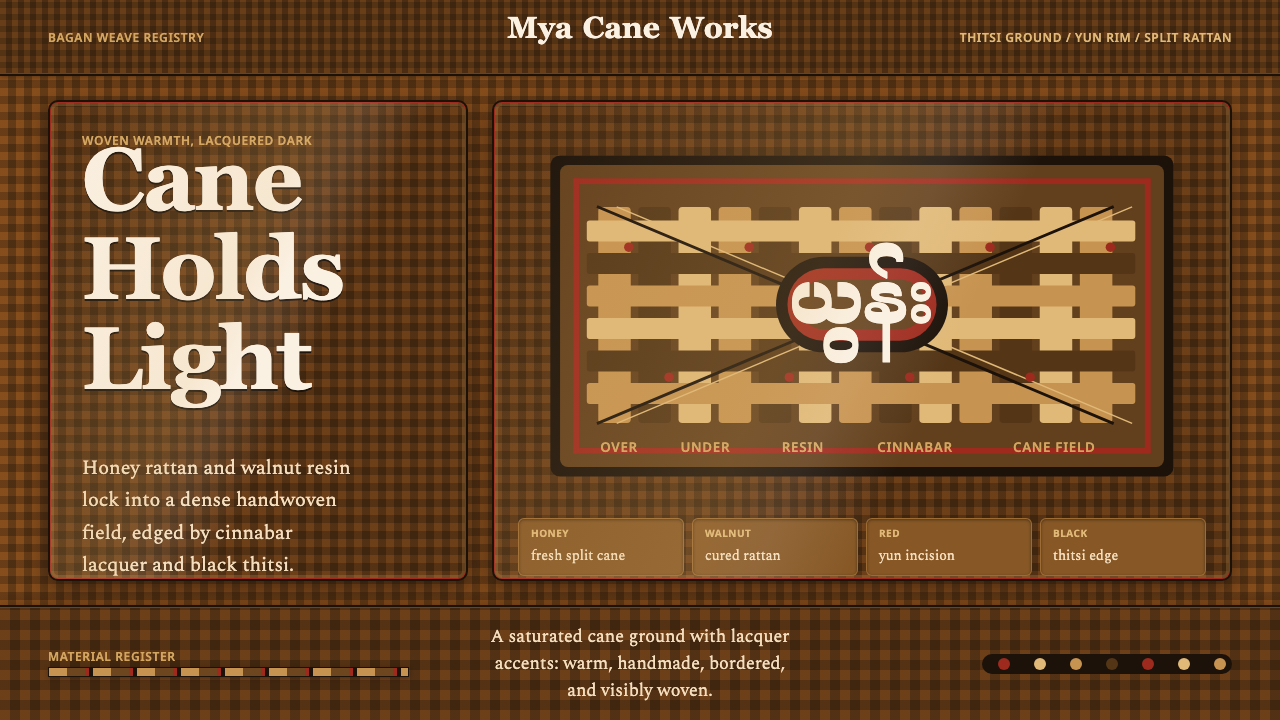 Burmese Cane RattanWoven warmth holds the page. Walnut cane lattice glows with cinnabar rim line…
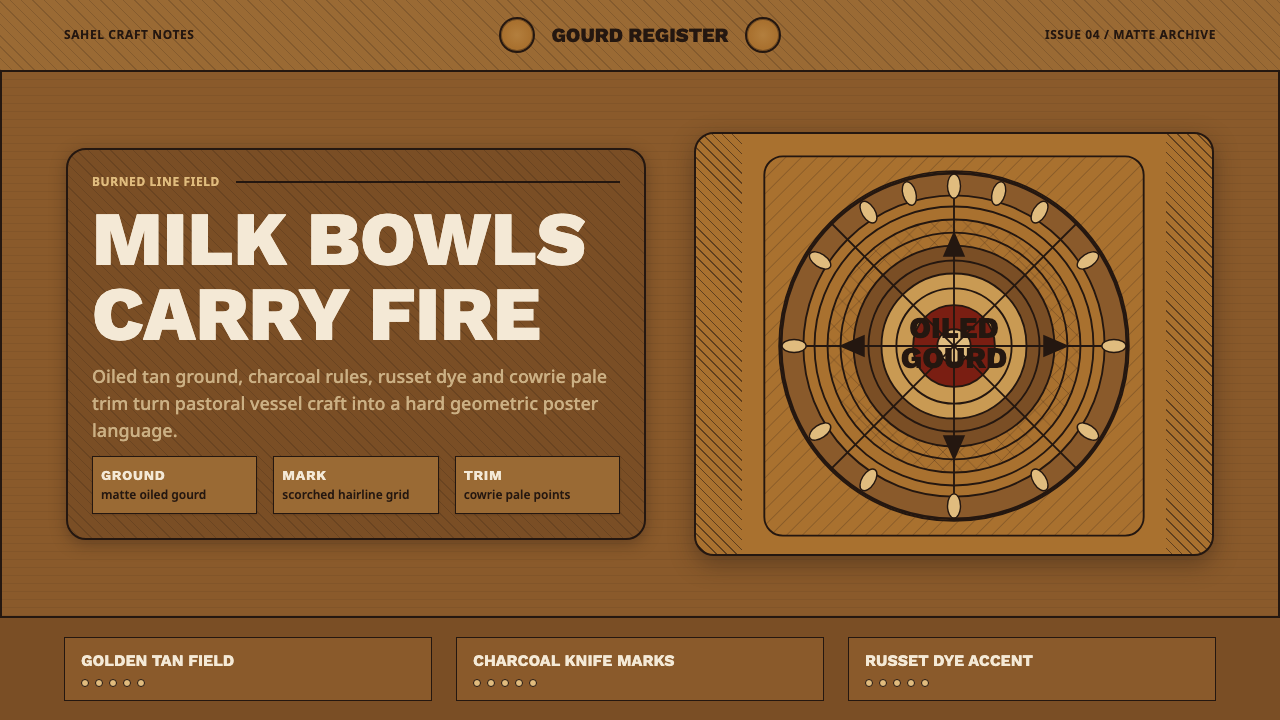 Fulani Milk CalabashMatte craft burns bright. Oiled gourd tan meets charred concentric linework.
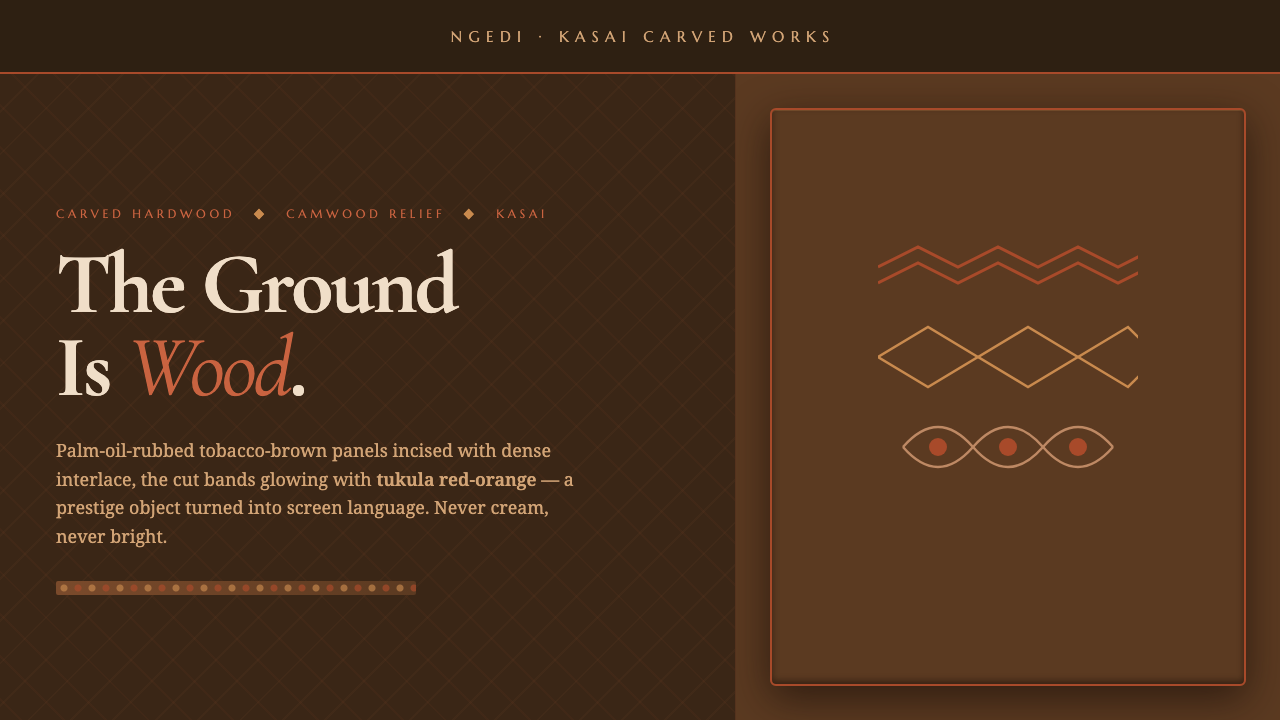 Kuba Calabash BrownPrestige in dark wood. Calabash brown ground, dense incisions, tukula red rel…
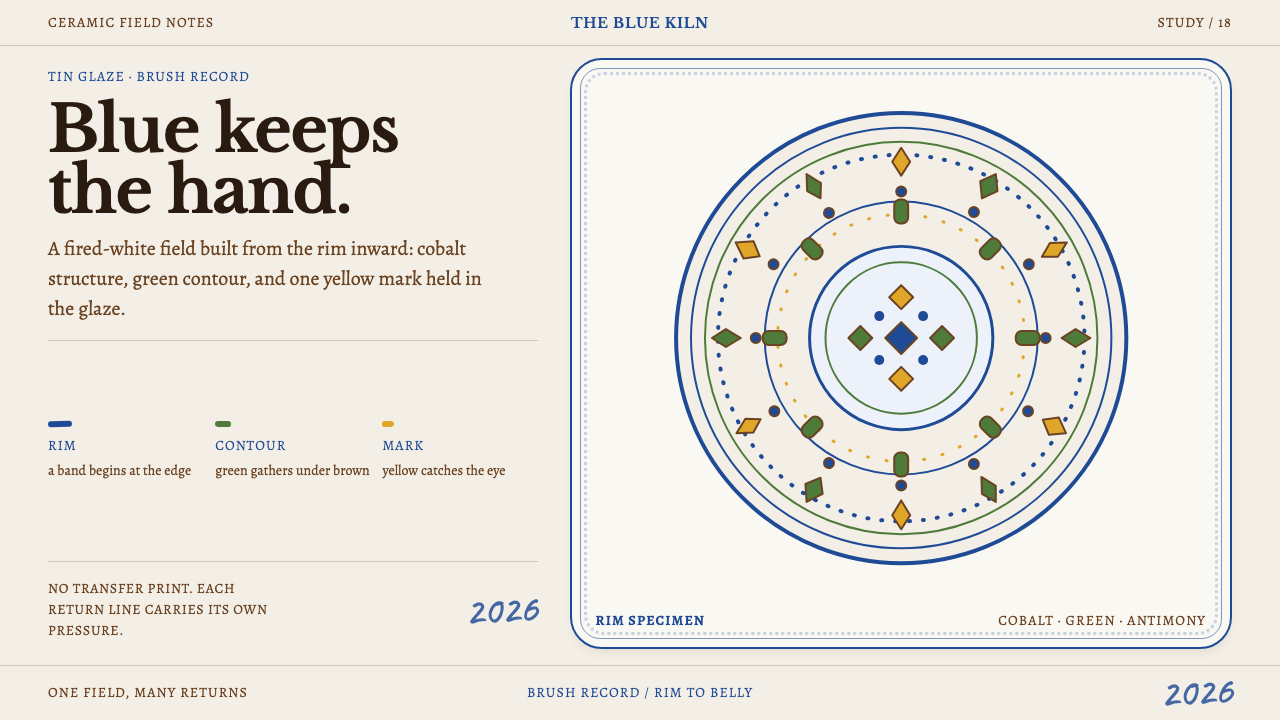 Modra MajolicaBlue keeps the hand. Cobalt rim bands and off-register pigment marks animate…
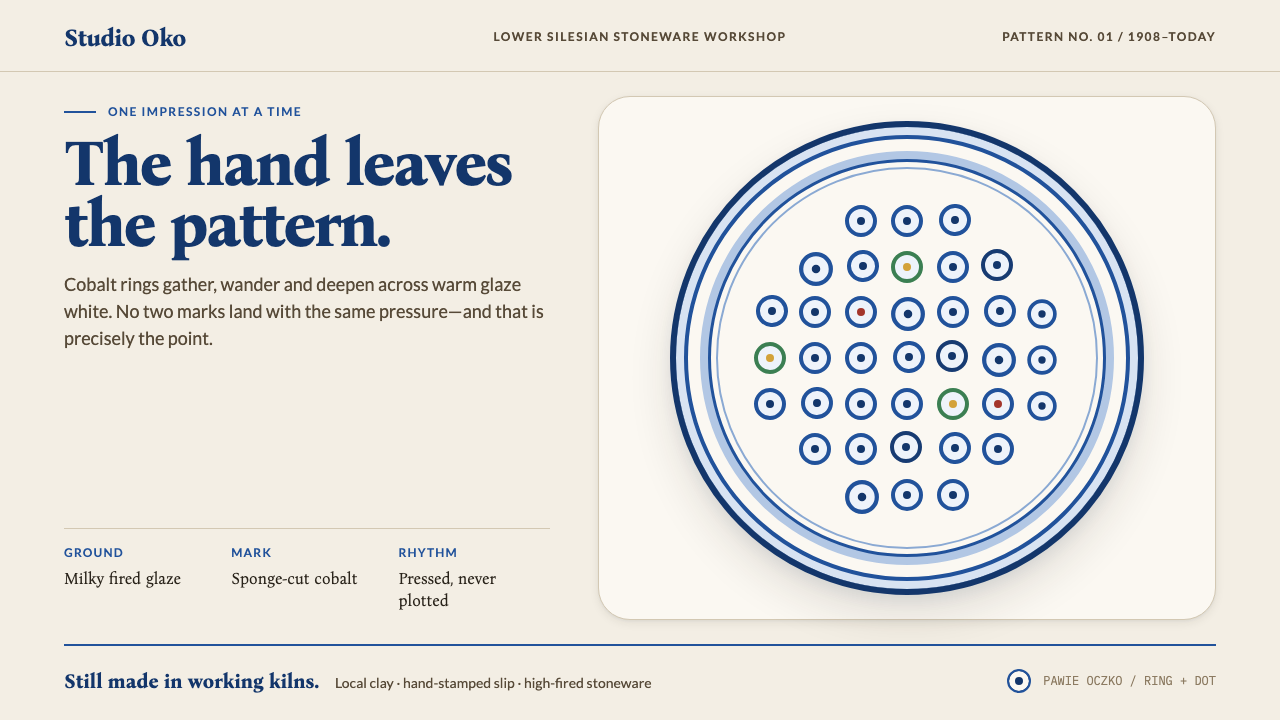 Bolesławiec PotteryThe hand stays visible. Cobalt ring-and-dot stamps drift across warm glaze wh…
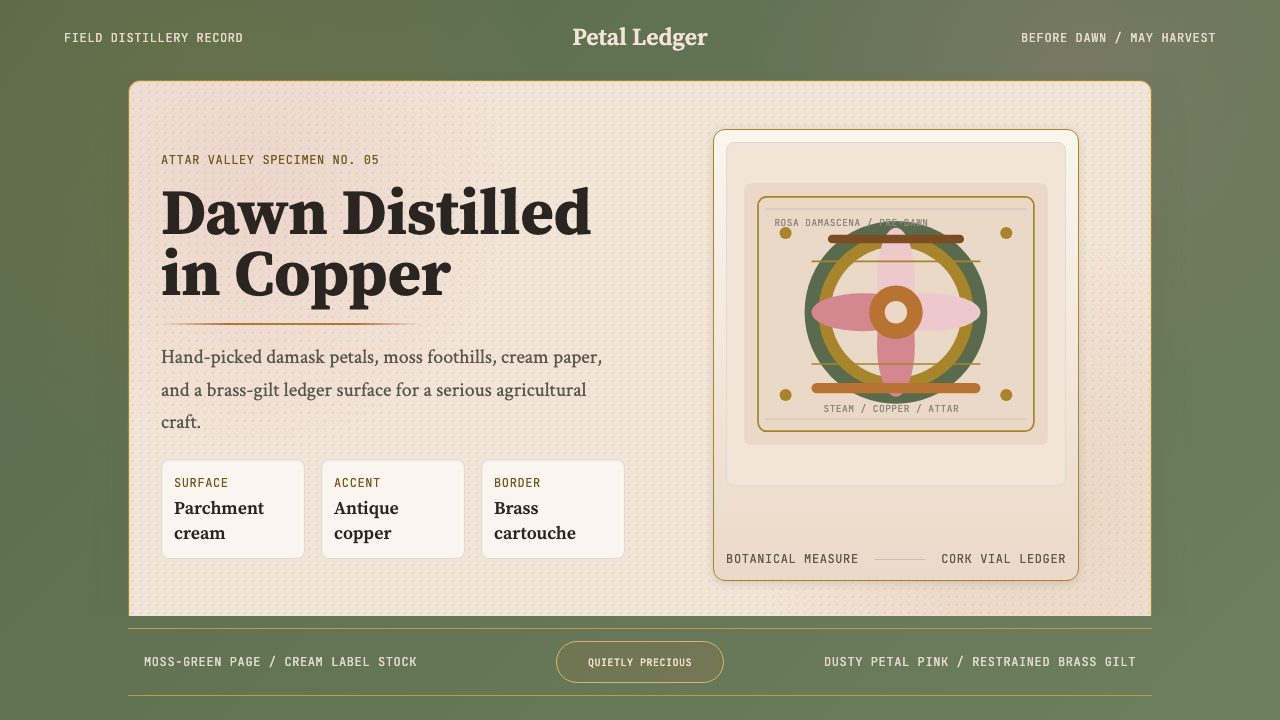 Bulgarian Rose Attar (Valley of Roses)Quietly precious craft. Moss green, dusty rose and brass borders frame a dawn…