What is Japanese Mon (Family Crest)?
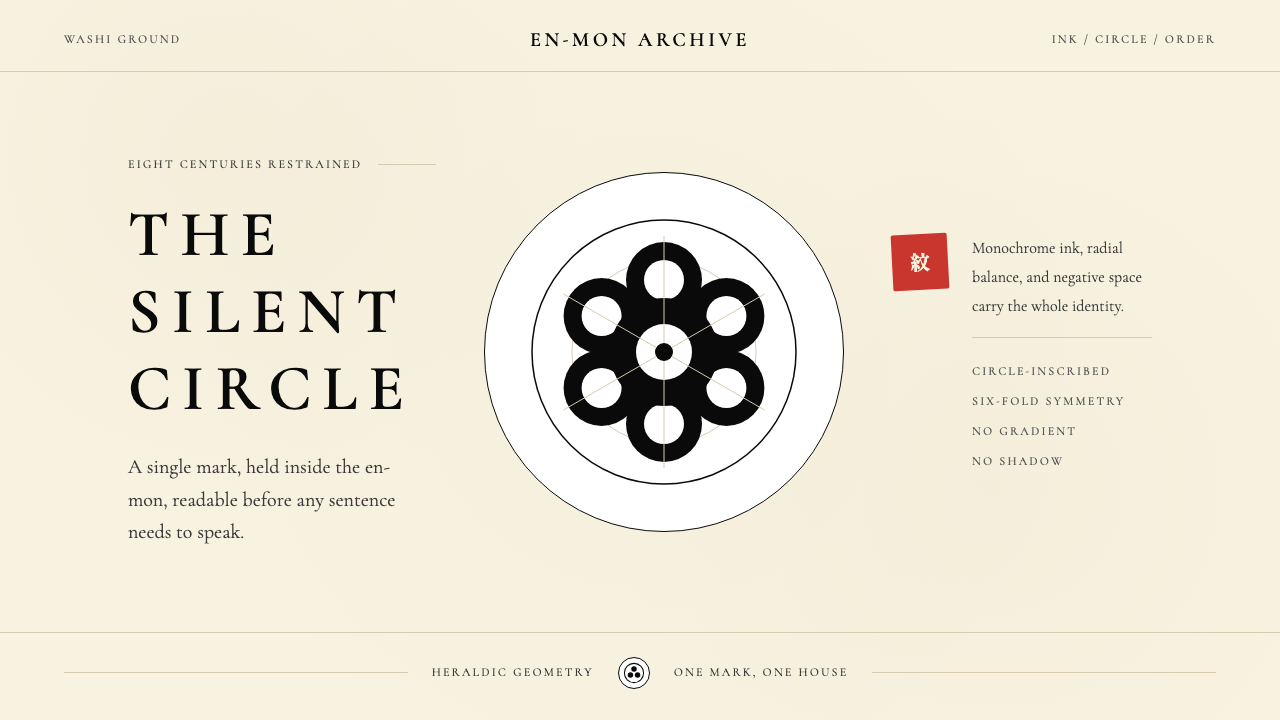
Kamon distills eight centuries of Japanese heraldic discipline into a single circle — monochrome ink, radial symmetry, and negative space that speaks louder than any mark.
Japanese Mon (Family Crest) in brief
Kamon — Japanese family crests, literally 'family pattern' — form one of the world's most rigorous pre-modern mark systems. Over twenty thousand individual crests were developed across eight centuries to identify samurai clans, noble houses, merchant families, and theater troupes. Every kamon operates inside an invisible bounding circle called the en-mon, and every element within that circle is constructed from arc segments, radially balanced, and rendered in a single tone. The result is a mark that reads instantly at a distance, reproduces cleanly in any medium, and carries meaning without explanation.
The design language inherited from kamon is built on three interlocking disciplines. First, monochrome commitment: the palette is ink black on washi-paper cream, with a vermilion seal red appearing only for ceremonial impressions and a deep indigo used for warrior banner grounds. No gradations, no tonal variations — the crest is either marked or unmarked. Second, the circle as grid: the en-mon is not decoration but the underlying structural constraint that forces every motif — pine needles, chrysanthemum petals, paulownia leaves, triple hollyhock — into radial symmetry. Third, silhouette legibility: shapes are built as filled contours, not line drawings, so they remain identifiable even at the scale of a helmet badge or a wax seal.
What distinguishes kamon from other heraldic traditions — European quarterings, Chinese seal characters, Ottoman tughra — is the completeness of the self-imposed constraint. European heraldry accumulated complexity over generations, adding charges, supporters, and mottoes. Kamon moved in the opposite direction: each generation refined, simplified, and geometricized the motif further. A mid-period crest of the Tokugawa clan's triple hollyhock is more abstract, more perfectly balanced, and more immediately recognizable than its early variants. The discipline is not reduction for its own sake but reduction as intensification.

Where does Japanese Mon (Family Crest) come from?
The earliest kamon emerged during the Heian period (794–1185) as decorative motifs on ox-cart curtains and court robes used by the Kyoto aristocracy. These were not yet heraldic marks in any martial sense — they were aesthetic preferences, particular floral or geometric patterns associated with a household by custom rather than law. The paulownia (kiri) motif appears in Heian-era textiles connected to the imperial family; the chrysanthemum (kiku) was used by the court for centuries before it became the formal imperial crest. The step from decorative preference to identifying emblem happened gradually across the twelfth century as warrior clans rose to political dominance.
The samurai adoption of kamon transformed the aesthetic object into a functional communications system. In the chaotic cavalry battles of the Genpei War (1180–1185) and the subsequent Kamakura period, identifying friend from enemy at a distance became a matter of survival. Clan symbols were applied to flags (hata-jirushi), curtains (maku), and eventually armor. The constraint of battlefield legibility drove the system toward simplicity: a kamon that could be misread at fifty paces was a liability. This pressure produced the defining formal properties — large-scale radial symmetry, high-contrast silhouette, containment within a circle — that remained stable for six centuries afterward.
The Edo period (1603–1868) under Tokugawa rule was kamon's golden age of codification. Political stability and the rigid hierarchies of the sankin-kotai system made visual identification of clan affiliation socially and legally significant. The shogunate assigned specific crests to daimyo houses and regulated their use. Simultaneously, the rising merchant class (chonin) — legally excluded from samurai status — adopted kamon for their own houses, shops, and theater troupes, producing an explosion of new motifs drawn from commerce, craft, and popular culture. By the late Edo period, specialist kamon designers and comprehensive encyclopedias (such as the Bukan compendiums of daimyo crests) had turned the tradition into a structured visual vocabulary with its own grammar of combination and variation.
The Meiji Restoration (1868) formally abolished the samurai class but accelerated kamon's influence on modern visual identity. The new government adopted the chrysanthemum crest for the imperial household and the paulownia for state instruments, giving kamon-derived marks a constitutional status. More broadly, the Meiji encounter with Western corporate branding revealed to Japanese designers that kamon had anticipated many principles that Western design theory was only beginning to articulate: the single-color mark, the contained geometric form, the abstraction of natural motifs into legible symbols. This recognition fed into the Showa-era logo design lineage, in which designers such as Yusaku Kamekura and Ikko Tanaka drew explicitly on kamon geometry to create corporate marks for brands including Nippon Design Center and the 1964 Tokyo Olympics.
Contemporary relevance extends beyond Japan. The formal properties of kamon — radial symmetry, circle containment, monochrome discipline, silhouette legibility — align precisely with the constraints of contemporary digital iconography. App icons, favicon-scale logos, and single-color brand marks face the same legibility demands that kamon solved eight centuries earlier. Several contemporary global brands have arrived at kamon-adjacent solutions independently; the formal logic is that universal.
What defines the Japanese Mon (Family Crest) look?
Palette
The kamon palette is one of the most restricted in design history: ink black and washi cream are the only working colors. Vermilion appears as a ceremonial accent — the stamped seal impression — and a deep warrior indigo surfaces occasionally for background fields. No tonal gradation exists within any element; a mark is fully inked or entirely open ground. This binary commitment gives every composition an absolute clarity that survives reproduction at any scale, in any medium, in any era.
Radial Symmetry
Every kamon is organized around a center point, with motif elements radiating outward in balanced intervals. The degree of rotational symmetry varies by crest type — a five-petal plum achieves five-fold symmetry, a triple-tomoe achieves three-fold — but asymmetric compositions are essentially absent from the tradition. This radial organization is not merely aesthetic: it encodes authority (the centered, balanced mark signals completeness and stability) and ensures that the crest reads identically from every approach angle.
Silhouette Construction
Kamon forms are built as filled silhouettes and open counter-forms, never as outline drawings. A chrysanthemum petal is rendered as a solid ink shape, not as two inked lines with open fill. This silhouette discipline ensures that the mark functions as a single unified shape rather than a collection of strokes — it can be stamped, embroidered, lacquered, or woven without any ambiguity about what is figure and what is ground. Counter-shapes (the spaces between ink) are as carefully designed as the inked areas themselves.
The En-Mon Circle
The en-mon — the invisible or lightly ruled outer circle — functions as the grid, the bleed line, and the compositional law simultaneously. Every motif must be legible within it and must relate harmoniously to its curvature. The circle itself is not merely a frame: it is a statement of completeness. A kamon that overflows its circle or leaves its interior compositionally unresolved is considered formally incorrect. This circle-as-constraint is the kamon tradition's single most transferable design principle.
Negative Space as Signal
In kamon design, the unprinted areas carry equal or greater communicative weight than the inked marks. Two crests built from identical motifs — say, three pine needles — can read as completely different marks depending on how their designers handled the counter-spaces between needles, between the motif and the circle edge, and at the geometric center. The tradition holds that a master designer can be recognized by the quality of the spaces, not the strokes. This principle runs directly counter to the Western instinct to define a mark by its positive form.
Motif Abstraction
Natural subjects — flowers, leaves, birds, crustaceans, celestial objects — are the raw material of kamon, but they are not rendered naturalistically. Each motif is abstracted to its essential geometric identity: a chrysanthemum becomes a radially perfect arrangement of identical petals, a crane becomes a silhouette whose wing geometry satisfies the circle constraint, a wave becomes a repeated arc pattern. The degree of abstraction increases over time within any given lineage. The most evolved kamon are so geometrically purified that their botanical or zoological origin is only recognizable to someone who already knows it.
Arc-Only Construction
Traditional kamon craftsmen worked with a compass and a ruling circle as their only drawing instruments — no freehand strokes. Every edge in a kamon is therefore either a segment of a circle or the meeting point of two arcs. Straight lines, where they appear, are the limiting case of an arc with an infinitely large radius. This construction method is not merely historical procedure: it is the reason kamon forms feel mathematically resolved rather than drawn. The arc-only discipline connects kamon directly to classical Japanese geometry (wasan) and gives its forms an internal consistency that distinguishes them from superficially similar heraldic traditions.

Who shaped Japanese Mon (Family Crest)?
Tokugawa Ieyasu unified Japan in 1603 and established the Edo shogunate that would govern for over two and a half centuries. His clan's crest — the mitsuba aoi, or triple hollyhock — became the most politically charged kamon in Japanese history, its use strictly regulated and its geometry refined over generations into a near-perfect radially symmetric form. The mitsuba aoi's evolution across the Edo period illustrates how political power drove formal refinement: each successive version is slightly more abstracted, more geometrically resolved, and more immediately identifiable than the last. The Tokugawa crest remains the canonical example used to teach kamon principles today.
Oda Nobunaga, the great unifier who preceded Tokugawa, employed the mokko — a four-lobed form derived from the Chinese quince flower — as his primary crest. The mokko is remarkable in kamon history for its formal economy: four identical lobes meeting at a center point, with the counter-spaces between them as carefully balanced as the lobes themselves. Nobunaga's aggressive use of visual identity — applying his crest to banners, armor, and architecture on a scale unprecedented in Japanese warfare — established kamon as a strategic communications tool and accelerated the tradition's formalization. His period also saw some of the earliest known kamon encyclopedias commissioned to track and regulate the growing inventory of marks.
Yoshioka was a prominent Kyoto dyer and textile house whose family crest became associated with a particular standard of formal elegance in kamon application to fabric. The Yoshioka lineage's work represents the merchant-class expansion of kamon into commercial branding — demonstrating that the same formal principles that governed samurai heraldry could produce marks of equal sophistication for civilian houses. Their crests appeared on noren (shop curtains), fabric bolts, and packaging, in each case adapted to the specific reproduction constraints of the material. Their practice influenced the subsequent development of kamon as applied commercial mark rather than purely heraldic emblem.
Niwa Motoji was a twentieth-century kamon researcher and cataloguer whose systematic documentation of the tradition produced some of the most comprehensive visual encyclopedias of Japanese family crests assembled in the modern era. His analytical work — which cross-referenced crests by geometric structure, motif category, and historical lineage — gave designers and historians a rigorous reference framework that had not previously existed in such organized form. Niwa's catalogues are a primary resource for contemporary designers working with kamon-derived visual systems, and his structural analysis of how crests are built from geometric primitives remains the standard framework for understanding the tradition's formal logic.
Ikko Tanaka (1930–2002) was one of the twentieth century's most important graphic designers and a central figure in the lineage connecting kamon to modern Japanese visual identity. His work synthesized traditional Japanese visual vocabulary — including kamon geometry, ukiyo-e color logic, and the compositional principles of classical textile design — with the graphic design language of his contemporaries. His poster work for Nihon Buyo and other cultural clients demonstrated how kamon-derived formal principles — the circle as organizing constraint, radical reduction to silhouette, the expressive power of a restricted palette — could generate contemporary marks of international visual authority. Tanaka's practice established a design genealogy that Japanese designers continue to reference.
How do you use Japanese Mon (Family Crest) today?
The kamon design system is among the most disciplined visual languages available to contemporary designers, and its transferability comes precisely from the specificity of its constraints. Applying it correctly means internalizing three non-negotiable conditions: monochrome commitment (one dark ink tone on a light ground, with the restricted palette functioning as an absolute structural rule, not a starting point for adjustment), circle containment (every compositional element oriented toward and resolved within a circular boundary), and silhouette logic (shapes defined by their filled area and counter-spaces, not by outline strokes). When these three conditions hold, the system produces work of immediate recognizability across any medium or scale.
For presentation slides, the kamon system works best when it is applied with restraint across the full deck rather than used decoratively on a single cover. A cover slide benefits from a single large circle-inscribed mark — original or adapted from kamon geometry — centered or quarter-positioned on a washi-cream field, with a title set in clean, light-weight type at significant scale contrast below or beside it. The simplicity must be genuine, not performed: a cover that deploys the circular motif but crowds it with subtitles and logos violates the system's logic. Content slides should carry the circle motif as a navigational element — section dividers, data point markers, or a recurring small circle anchoring the slide's identifying information in one corner. Data slides translate well: circular charts are literal applications of the en-mon principle, and bar or comparative data visualizations can be reduced to monochrome with a single vermilion accent for the highlighted value.
For web interfaces, the kamon system suits dashboards, portfolio pages, and brand identity sites where authority and precision are primary values. The structural approach: a cream or off-white background field, near-black for all text and primary UI elements, circle motifs used as avatar containers, icon backgrounds, or state indicators. Navigation elements should be typographic and spare, with circle-enclosed numerals or initial letters serving as markers. Pricing pages work particularly well: each tier differentiated by a circle-inscribed symbol rather than by color variation, with the single accent color (vermilion or indigo) reserved for the recommended tier call-to-action. The system does not accommodate soft shadows, rounded-corner cards with blur effects, or gradient backgrounds — these violate monochrome discipline and should be replaced by clean borders and hard-edge dividers.
For editorial design and marketing materials, kamon's strength is its poster-quality legibility and the ceremonial weight that its formal restraint conveys. An editorial spread using kamon-derived principles would deploy a large circle motif as a visual anchor — section heading enclosed in a ruled circle, or a full-bleed circle in the washi tone as background for a pull quote. Marketing pages benefit from the system's inherent hierarchy: a hero section with a single large enclosed mark and minimal type, followed by content sections that alternate between ink-dark and cream-ground fields. The vermilion accent should appear once and decisively — a single call-to-action, a featured price, a key data point — not scattered across the page as decoration. Print collateral (letterheads, packaging, event programs) is where the system reaches its full potential, since the single-color constraint was historically designed for production on limited-color media.
A common and fundamental mistake when working with kamon-derived aesthetics is treating the circle motif as a frame and filling it with unrelated decorative content — photography, gradients, or illustrative elements that break the silhouette discipline. The circle in kamon is not a container for other visuals; it is itself the visual. Equally damaging is the introduction of a second typeface or a third color in the name of hierarchy — in this system, all hierarchy is achieved through scale and weight within a single type treatment and a single ink color. Designers who have absorbed other minimalist traditions sometimes introduce generous white space and call it kamon; genuine kamon compositions are not sparse — they are precise. The difference is that every element, including every area of ground, is placed rather than left over.

Japanese Mon (Family Crest) — FAQ
How is kamon different from other heraldic traditions like European coats of arms?
The most fundamental difference is direction of development. European heraldry evolved toward increasing complexity — adding quarterings, charges, supporters, crests, and mottoes as families merged and alliances formed, until many coats of arms became visual catalogues of dynastic history. Kamon evolved in the opposite direction: toward greater simplicity, higher geometric abstraction, and more perfect radial symmetry. A kamon that has been in use for six centuries is typically more geometrically resolved than its earliest recorded form. European heraldry is cumulative and encyclopedic; kamon is reductive and purifying. The second major difference is medium: European heraldry was designed for polychrome reproduction on shields, banners, and seals, which made color a primary identifier. Kamon was designed for monochrome reproduction — lacquer, embroidery, textile weaving, ink stamping — which made shape and silhouette the only reliable identifiers.
Can the kamon system work in a dark-background version?
A dark inversion is historically authenticated: many kamon were rendered as white on black (known as kage-mon, or shadow crest), which reverses the ink-and-ground relationship while preserving the radial form and silhouette logic exactly. A contemporary dark-background application is therefore not a departure from the tradition but a known variant within it. The critical rule for the dark variant is that the inversion must be complete and binary: deep ink-dark background, near-white or cream mark, no intermediate tones. Introducing a warm cream background with a soft dark mark instead of a crisp near-white on deep black will produce something that looks neither authentically kamon nor authentically contemporary. The vermilion accent remains appropriate in dark versions — it was used on dark ground in warrior contexts — but indigo drops out since it becomes illegible against a dark field.
What motifs are most transferable to contemporary design contexts?
The most transferable kamon motifs are those with the highest degree of geometric abstraction — the tomoe (swirling comma forms), the kikko (tortoiseshell hexagonal lattice), and the shippo (interlocking circles) — because these are already non-representational and read as pure geometric pattern without requiring cultural knowledge of their origin. Botanical motifs (chrysanthemum, plum, paulownia) carry strong cultural associations within Japan that may not translate legibly in international contexts; used carefully, they signal sophistication and historical depth, but used carelessly, they risk reading as generic Asian decoration. The structural principle — a radially symmetric form contained within a circle, built from consistent arc-segment geometry — is always more transferable than any specific motif, and original marks derived from this principle tend to read more freshly than direct quotations of historical crests.
How does kamon handle typography, and what type approach fits the system?
Historical kamon does not incorporate letterforms — the mark system is entirely visual and non-verbal by design. When applying kamon principles to contemporary design that requires text, the guiding principle is that type should behave as a kamon element: structured, balanced, and making use of negative space. In practice, this means clean geometric or humanist sans-serif letterforms (not decorative, not calligraphic), set in a single weight and size hierarchy against the washi ground, with generous spatial intervals between elements. Japanese settings pair the kamon marks naturally with Mincho or geometric gothic type. Latin settings work with type that shares the arc-geometry sensibility — letterforms where the curves have architectural precision rather than calligraphic flow. Type should never compete with the circle mark for visual dominance; the mark is primary, the type is secondary.
Is kamon appropriate for Western or non-Japanese brands, or does it carry too much cultural specificity?
The question is whether a designer is applying the formal principles of kamon or appropriating specific historical crests. Applying kamon formal principles — radial symmetry, circle containment, monochrome discipline, silhouette logic — to original visual marks is a legitimate design act and one that produces results with universal legibility. The formal logic is not culturally proprietary; it is a set of geometric and compositional constraints that happen to have been developed to their highest refinement in Japan. Directly reproducing the Tokugawa triple-hollyhock or the imperial chrysanthemum for a non-Japanese brand, on the other hand, would be appropriative and likely to generate confusion or offense. The practical boundary is: derive from the system's logic, not from its specific historical marks. A brand that develops an original radially symmetric circle-inscribed mark using arc-only geometry is working in the kamon tradition; a brand that reproduces Tokugawa's specific crest is not.
Related design styles
 The Atlantic MonthlyAuthority slows down. Navy Garamond on warm cream, ruled like an essay page.
 Bucharest Interwar ModernismModernism gathers civic weight. Sooted plaster, strict glazing bands and one…
 Chinese Ink Wash 水墨A thousand years of restraint. Six tones of ink on rice-paper warmth, a singl…
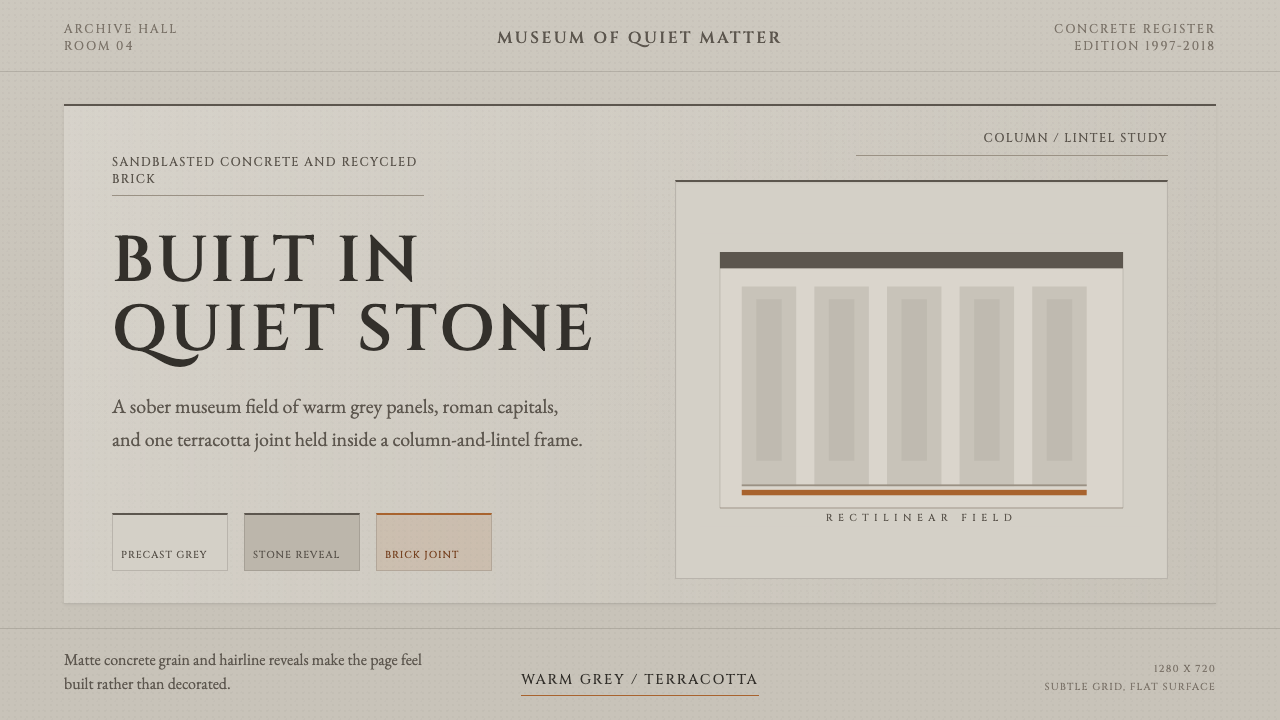 Chipperfield Museum GrayMuseum gravity, rendered quietly. Warm concrete grey, roman capitals, one ter…
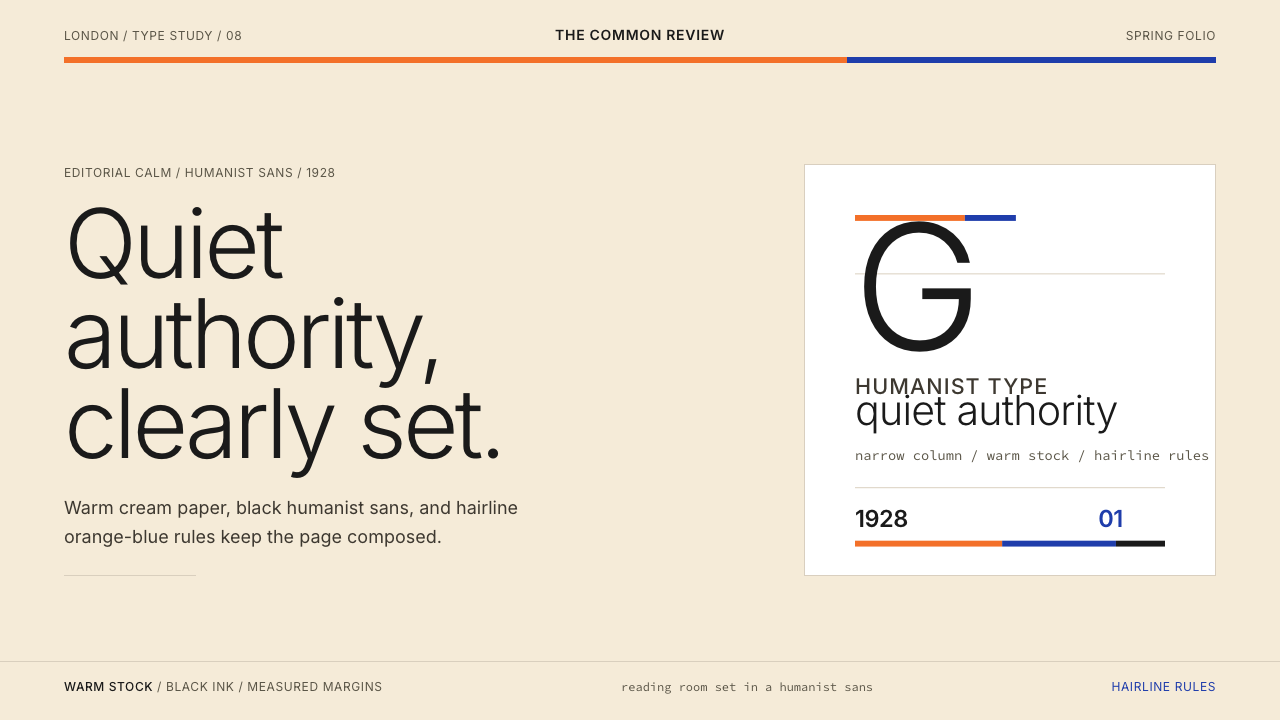 Gill Sans (BBC, 1928)Quiet authority, clearly set. Warm cream, black humanist sans, and hairline o…
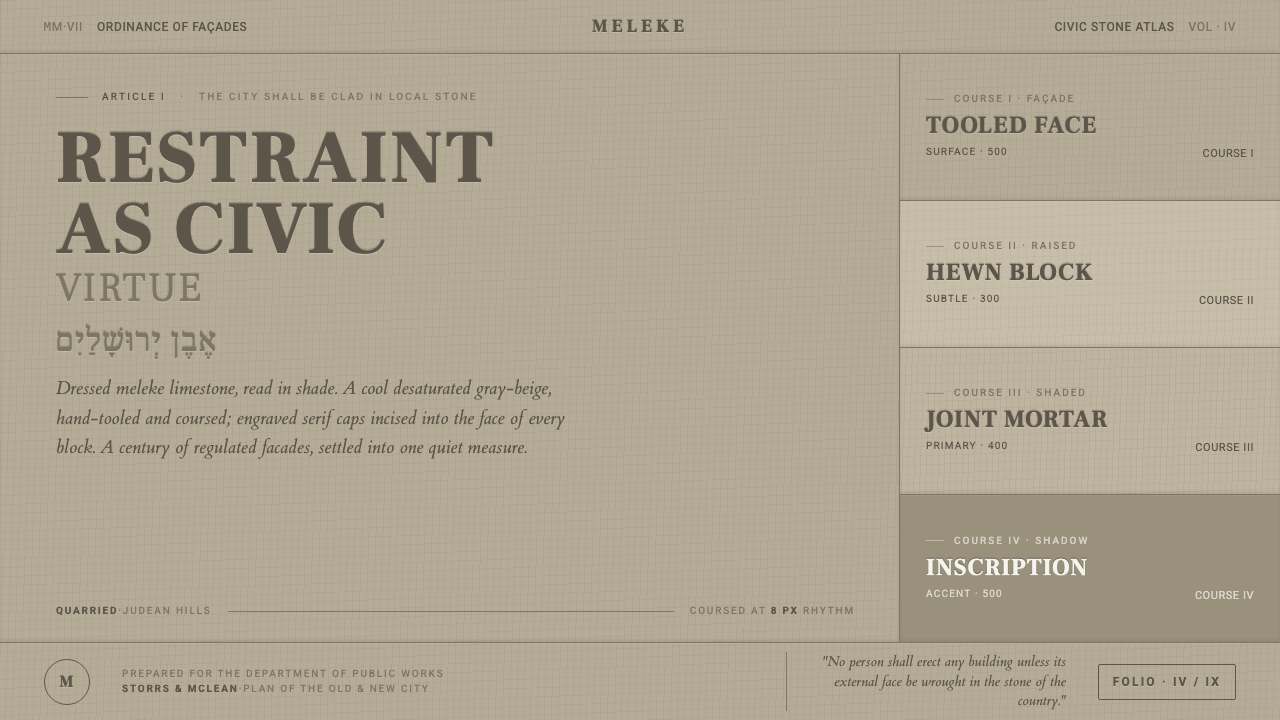 Jerusalem Stone GrayRestraint as civic virtue. Cool dressed-limestone gray-beige, ashlar coursing…