What is Kyoto Machiya Stay?
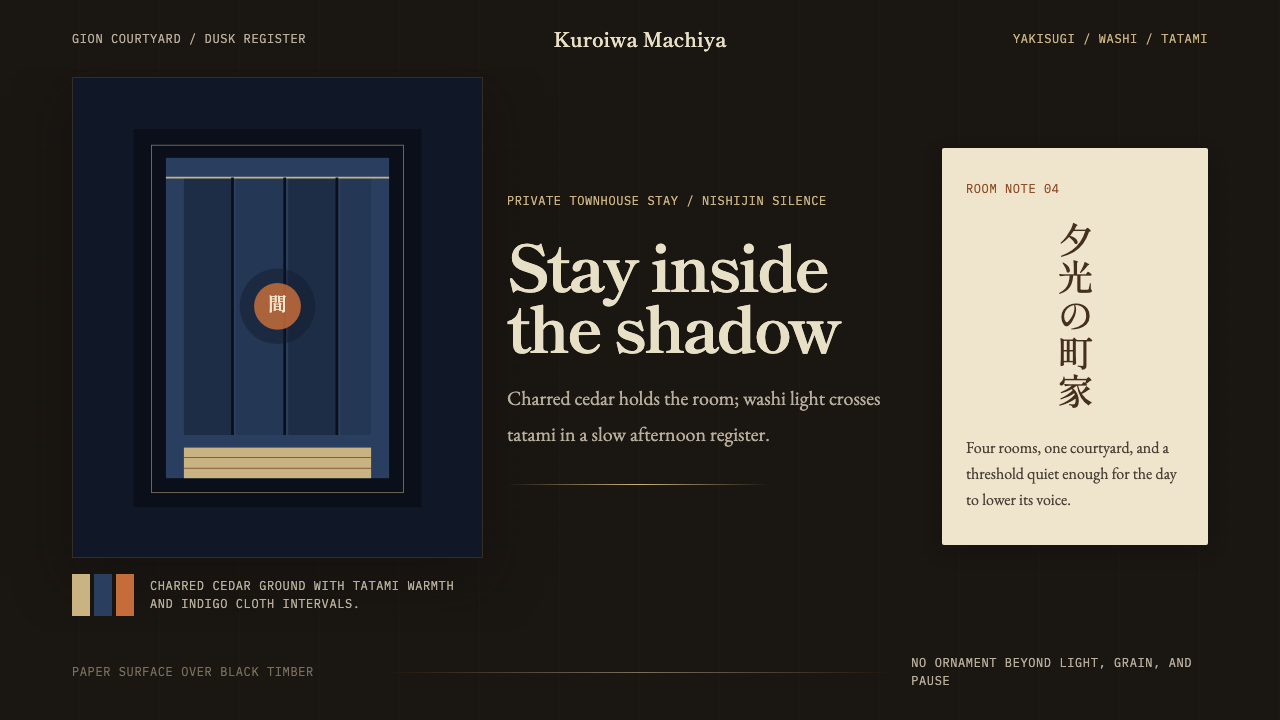
Charred cedar, washi cream, and a silence that belongs to 4 PM — Kyoto Machiya Stay distills the atmosphere of a Gion townhouse into a design language built on restraint, shadow, and the art of leaving space empty.
Kyoto Machiya Stay in brief
Kyoto Machiya Stay is a design style born from the boutique-hospitality renaissance that transformed Kyoto's aging wooden townhouses — machiya — into design-led short-stay accommodations from roughly 2014 onward. Its visual language is not a romanticized pastiche of traditional Japanese motifs but a precise, disciplined translation of a specific lived atmosphere: the particular quality of light inside a narrow townhouse at dusk, the weight of a charred cedar facade, the restraint imposed by a room whose beauty depends entirely on what is withheld.
The palette is anchored by shou sugi ban black — the deep, matte, almost mineral darkness of timber treated by controlled burning — held against washi-paper cream, a warm near-white with the slight irregularity of handmade paper. Against this two-tone ground, accents arrive rarely and specifically: indigo the color of a dyed noren curtain, persimmon the warmth of lacquerware in low light. No more than two accent tones appear in any composition, and they serve punctuation, not decoration.
At its core, this style is about ma — the Japanese concept of negative space, the interval between things, the silence that gives sound its meaning. Applied to design, ma means that emptiness is compositional material, not failure of content. A layout in this style breathes. A slide has one idea per surface. A web page resists the impulse to fill. The result is an aesthetic that feels genuinely quiet rather than merely sparse.

Where does Kyoto Machiya Stay come from?
The machiya — literally 'town house' — is a form of vernacular urban architecture that evolved in Kyoto across the Edo and Meiji periods, roughly from the 1600s through the early 1900s. Built incrementally by merchant families whose commerce occupied the street-facing ground floor while living quarters retreated through a long, narrow plot toward an interior garden, the machiya solved a specific urban problem: maximizing usable floor space on a narrow street frontage while maintaining airflow, natural light, and a graduated sequence from public to private. The result was a building type whose proportions — long, low, and layered — became inseparable from Kyoto's urban identity.
The exterior language of the machiya was shaped by craft traditions and practical necessity in equal measure. Cedar facades were treated with oil and weathered to dark silver-grey, or in some traditions subjected to shou sugi ban — controlled burning that carbonizes the surface, creating a durable, water-resistant, and distinctively matte-black cladding. Sliding lattice screens (koshi) filtered street light while maintaining privacy. Noren — fabric curtains in indigo, persimmon, or natural undyed hemp — hung at thresholds, marking the transition between outside and inside with color and texture rather than a hard door. Every exterior element was a functional decision that happened also to be beautiful.
Inside, the machiya interior was organized by the logic of the tokonoma — an alcove dedicated to a single seasonal object: a hanging scroll, a flower arrangement, a piece of ceramics. This practice of displaying one thing with intention, surrounded by deliberate emptiness, embedded the ma principle into the architecture itself. Tatami floors, shoji screens, and washi-paper surfaces created an interior that was warm in color temperature but almost entirely without pattern, ornament, or visual noise. Afternoon light entering through a rear garden transformed these surfaces into a composition of shifting shadow and warm cream that required nothing added.
The contemporary boutique-stay revival that gave rise to this design style began in earnest around 2014, as Kyoto's expanding international tourism drew architects and interior designers to the city's stock of rapidly deteriorating machiya. Preservation advocates, including the writer and restorer Alex Kerr — whose own work documenting the loss of traditional Japanese architecture gave the movement moral weight — had been sounding alarms for decades about the pace of demolition. The boutique-stay model offered an economic rationale for preservation: a sensitively restored machiya could function as a small inn or private rental, generating revenue that covered maintenance costs no ordinary resident could sustain. Designers including Atsushi Yokoyama and firms associated with Kengo Kuma's broader influence on Japanese vernacular modernism began translating the machiya interior vocabulary into a coherent visual system — one that could be applied not only to physical spaces but to the graphic communication surrounding them: brand identity, digital presence, printed materials, and eventually the wider design language that this style encodes.
Hana Tsukamoto and a generation of Kyoto-based designers played a key role in codifying what had previously been an atmospheric sensibility into a transferable visual grammar. The key insight was that the machiya's appeal was not its historical details — the joinery, the lattice patterns, the specific proportions — but its phenomenological character: the quality of shadow, the temperature of the palette, the discipline of restraint. Isolated from the building itself, these qualities could travel into any two-dimensional or digital medium, provided the discipline was maintained. The result is a design language that feels authentically rooted without being historicist, contemporary without being generic.
What defines the Kyoto Machiya Stay look?
Shou Sugi Ban Black Ground
The dominant tone is the deep, matte black of timber treated by controlled burning — shou sugi ban. Unlike ink black or graphic black, this darkness carries material memory: it is uneven at the microscopic level, slightly warm rather than cool, and absorbs light rather than reflecting it. In design application, this quality should be preserved: the black ground is matte and heavy, not glossy or digital. It functions as the surrounding darkness of a dim interior, not as a graphic device.
Washi Cream Surface
The secondary ground — used for text fields, content areas, and reading surfaces — is a warm cream that references the color of handmade washi paper: slightly yellowed, neither purely white nor noticeably beige, with a quality that suggests texture even when rendered flat. This tone is the visual equivalent of afternoon light on a shoji screen. It is never clinical white, never grey-shifted. When type or content sits on it, the combination reads as warm and considered rather than stark.
Indigo and Persimmon Accents
Accent color is used with the restraint of a dye applied to cloth — you use exactly as much as the cloth needs, and no more. Indigo references the noren curtain hung at the threshold: a color that is simultaneously natural, saturated, and quiet, never aggressive. Persimmon — the warm reddish-orange of lacquerware and autumn foliage — appears more sparingly still, used for singular moments of warmth or emphasis. The two accents are never deployed simultaneously at full strength; typically only one appears per composition, and only at points of genuine importance.
Ma — Compositional Emptiness
Negative space in this style is not simply the absence of content — it is an active compositional element, deliberately sized and placed. A margin is as considered as the text it frames. A pause between sections has visual weight. This discipline requires resisting every impulse to fill: to add a decorative rule, to pull a caption closer, to crowd a header with sub-information. The emptiness is the design. When executed correctly, a layout in this style feels as if it is breathing — as if silence between elements is itself a form of content.
Texture Over Flatness
Where contemporary flat design tends toward perfectly smooth, identical surfaces, this style preserves and celebrates material irregularity. Washi paper has grain. Charred cedar has fissures. Tatami has weave. In two-dimensional and digital application, this principle means preferring surfaces that carry the suggestion of material — a ground that is almost-but-not-quite uniform, a stroke that carries slight variation in weight, a photographic element that retains its textural information. The goal is warmth and specificity, not simulation of aging or distressing.
Horizontal Restraint and Vertical Rhythm
The machiya's proportions — a narrow street frontage extended into a long, low, retreating depth — inform the compositional logic of this style. Layouts favor horizontal stillness: wide, quiet fields interrupted by deliberate vertical elements (a column of text, a single image aligned to a grid edge, a noren-like band of color across the top third of a surface). Reading direction is unhurried. Section breaks are generously spaced. The overall effect is of moving through a space, not scanning a surface.
Craft Legibility in Typography
Type in this style occupies a middle ground between the impersonal precision of modernist sans-serif and the decorative richness of calligraphic brush script. For Latin text, the preferred register is a typeface with organic, slightly variable stroke qualities — something that carries the warmth of a drawn letter without being self-consciously handmade. For Japanese text, a high-quality mincho with classical proportions is preferred over mechanical gothic, honoring the brushwork origins of the characters. Both languages are set with generous line spacing and restrained hierarchy: two levels of type scale are sufficient; three is the maximum.

Who shaped Kyoto Machiya Stay?
The American writer and restorer Alex Kerr spent decades documenting the disappearance of traditional Japanese architecture and landscape, most notably in his books on the deterioration of rural Japan and the loss of Kyoto's historic built fabric. His own restoration of a traditional Japanese farmhouse gave his advocacy a lived authenticity. Kerr's work provided the cultural and moral framework within which the machiya preservation movement operated — articulating not just what was being lost but why the loss mattered aesthetically, spiritually, and culturally. His influence can be felt in the seriousness with which the boutique-stay generation approached the question of authenticity: not as a stylistic exercise but as a genuine act of cultural stewardship.
Yokoyama represents the generation of Japanese architects and designers who translated machiya preservation from a conservationist project into a design practice. Working within the constraints of narrow Kyoto plots and the preservation requirements of registered townhouses, Yokoyama developed an approach that honored the structural logic and material character of the machiya while making it habitable and functional for contemporary guests. His work demonstrates the central discipline of this style: that intervention must be legible but not loud, that new elements must earn their presence through usefulness rather than announce themselves through novelty.
The architect Kengo Kuma's broader influence on contemporary Japanese architecture — and particularly his sustained engagement with the question of how traditional Japanese material and spatial concepts can be translated into contemporary building and product design — created an intellectual environment in which the machiya revival could be understood as part of a serious architectural discourse rather than mere nostalgia tourism. Kuma's principle of 'erasing architecture' — making a building recede into its materials and site rather than asserting itself — echoes the ma principle central to this design style, and his prominence gave the broader movement cultural legitimacy.
Tsukamoto is among the Kyoto-based designers who worked to codify the visual language of the machiya boutique-stay movement into a transferable graphic and branding system. Her contribution lay in recognizing that the atmospheric qualities of a restored machiya — its palette, its proportions, its relationship to shadow and emptiness — could be abstracted from the physical space and applied consistently to printed materials, digital interfaces, and brand communications without losing their essential character. This translation is the foundation of the design style as it exists today in two-dimensional and screen-based form.
The broader institutional movement to preserve Kyoto's machiya stock — involving municipal government, academic researchers, civic organizations, and individual property owners — created the conditions within which the boutique-stay design language emerged. Kyoto's registered machiya numbered in the tens of thousands at the movement's peak engagement, but demolition rates remained high throughout the 1990s and 2000s. The preservation framework that eventually developed — combining tax incentives, design guidelines, and tourism infrastructure — gave designers both material to work with and a set of constraints that proved generative: you cannot fundamentally alter a registered structure, so every design decision must work within what already exists.
How do you use Kyoto Machiya Stay today?
Kyoto Machiya Stay is a style that transfers most successfully when the underlying principle of ma is understood and respected. The temptation when working with a rich atmospheric reference is to over-specify — to add too many texture layers, to use both accent colors simultaneously, to fill every available surface with content. This style demands the opposite discipline: start with emptiness and add only what the composition requires. Every element earns its place through necessity, not decoration.
For presentation slides, the style works best with a strict one-idea-per-slide discipline. A cover slide should establish the tonal ground immediately: shou sugi ban black as the full-bleed background, a single line of title text in washi cream set with generous tracking, and nothing else. An optional band of indigo or persimmon — the width of a noren curtain — can anchor the composition at the upper or lower third. Content slides should use the washi cream field as the primary reading surface, with black text at two hierarchical scales only. Data slides take on an almost meditative quality: a single chart or metric, placed with deliberate off-center asymmetry, surrounded by the kind of empty space that makes the number feel important rather than lonely.
For web interfaces and dashboards, the style suits products where the experience of calm and considered quality is part of the value proposition — hospitality brands, premium lifestyle services, artisanal product retail, and any context where the user should feel they have entered a curated space rather than a transactional one. The approach: a dark header in shou sugi ban black with cream navigation text, a washi cream body field for content, and persistent horizontal breathing room in all margins. Card components should have no rounded corners — the machiya's joinery is angular — and drop shadows, when used, are very slight and warm-toned rather than cool and diffuse. Interactive states use the indigo accent; calls to action use the persimmon.
For editorial and marketing work, the style supports a poster-like compositional confidence that serves well in high-end travel writing, interior design publications, cultural institution materials, and luxury brand communications. An editorial spread in this style might use the full-bleed dark ground for an image, bleed-printed to the edge with no border, followed by a cream spread of text set at a deliberately narrow measure with a generous right margin reserved for a single caption or pull-quote in a smaller scale. Marketing pages translate this into a vertical rhythm of alternating dark and cream full-width sections, with each section carrying no more than two typographic elements and one image or graphic. The overall impression should be of a building you walk through, not a document you read.
The most common mistake when applying this style is importing the palette without the discipline. The charcoal-black, cream, and indigo combination is visually striking, and it is tempting to deploy it with high contrast and full saturation everywhere — creating something that reads as bold and dramatic rather than quiet and refined. Authentic application requires that the black ground feel heavy and matte, not graphic; that the cream feel warm and slightly irregular, not clinical; that the indigo appear rarely and with restraint. A second common error is adding contemporary sans-serif type at aggressive tracking and scale, which produces a Nordic-minimalism aesthetic entirely at odds with the machiya's handcraft warmth. The typographic register must carry some quality of the made — variable weight, classical proportion, a suggestion of the brush — or the style's cultural rootedness is entirely lost.

Kyoto Machiya Stay — FAQ
Is this the same as wabi-sabi?
Wabi-sabi and Kyoto Machiya Stay share an origin culture and some overlapping values — both honor impermanence, imperfection, and the beauty of the incomplete. But wabi-sabi is a philosophical and aesthetic sensibility, not a design system, and its visual application tends toward extreme rusticity, visible deterioration, and earthy irregularity. Machiya Stay is a more precise, contemporary design language that draws on wabi-sabi as one of several influences — alongside the spatial philosophy of ma, the material discipline of traditional Japanese craft, and the contemporary hospitality design movement — but applies them within a system that can function in digital and commercial contexts. The palette is more controlled, the compositions are more considered, and the visual discipline is more consistent than wabi-sabi's open-ended embrace of accident.
Can this style work on a light or white background rather than the dark shou sugi ban ground?
Yes, and it is actually the more versatile application. The washi cream ground — used alone without the dark shou sugi ban — functions as the primary field for documents, web interfaces, editorial layouts, and any context where extended reading is required. In this light-ground variant, the black becomes the type and structural element, indigo and persimmon remain accents, and the shou sugi ban dark is reserved for feature sections, pull-quotes, or header bands. The critical discipline is to maintain the same restraint and ma in the light-ground version: washi cream with generous margins and unhurried hierarchy reads as Kyoto; washi cream crowded with content and decorative elements reads as nothing in particular.
How does Japanese text behave in this style — does it require different typographic treatment than Latin text?
Japanese text in this style benefits from a mincho (serif) rather than gothic (sans-serif) typeface — the former carries the brushwork origins of the characters and aligns with the style's preference for craft warmth over mechanical precision. Vertical typesetting (tategumi) is appropriate for display contexts and headings where a strong traditional register is desired; horizontal setting (yokogumi) is more practical for body text and interface labels. Line spacing for Japanese should be even more generous than for Latin text, given the visual complexity of the characters. A common error in mixed Japanese-Latin layouts is treating the two scripts as interchangeable — Japanese needs more breathing room, and the relative scale of Latin characters alongside full-width Japanese characters requires careful optical adjustment.
What kinds of imagery work best — photography, illustration, or graphic elements?
Photography is strongly preferred over illustration, and specifically photography that captures the material and atmospheric qualities the style encodes: the texture of charred wood, the diffusion of light through washi paper, the shadow of a koshi lattice on a tatami floor, the quietness of an interior in late afternoon. Images should be shot in ambient light rather than studio-lit, and the overall tone should be warm and slightly underexposed rather than bright and fully rendered. Graphic elements should be used sparingly and structurally — a horizontal rule as a section divider, a band of color marking a header zone — never as decorative fill. Abstract illustration is generally at odds with the style's commitment to material honesty; if imagery is needed beyond photography, it should be photographic in character.
Does this style suit products that are not related to Japan, hospitality, or interiors?
The style is transferable beyond its origin context, but the transfer requires judgment about values alignment. It works naturally for any product or service where quiet authority, handcraft quality, and a premium sense of restraint are desirable — certain financial or legal services, high-end consumer goods, artisanal food and beverage brands, cultural institutions, and architecture or design practices. It is poorly suited to contexts requiring high energy, broad accessibility, or visual assertiveness — sports brands, fast consumer products, entertainment platforms, or any context where the audience expects dynamism and volume. The test is not whether the product is Japanese or hospitality-related, but whether the user experience you want to create is one of entering a considered, curated space — because that is what this visual language, at its core, describes.
Related design styles
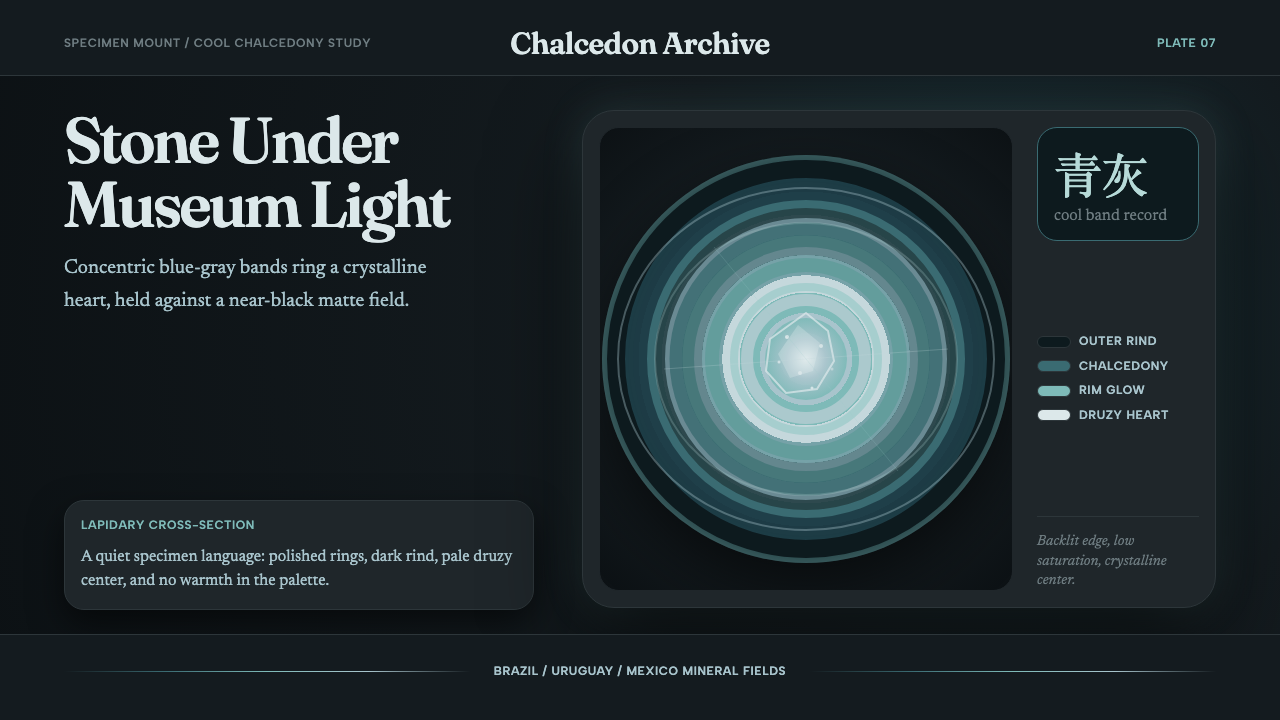 Agate Cross-SectionQuiet mineral glow. Fraunces type and cyan-gray rings shine on matte black.
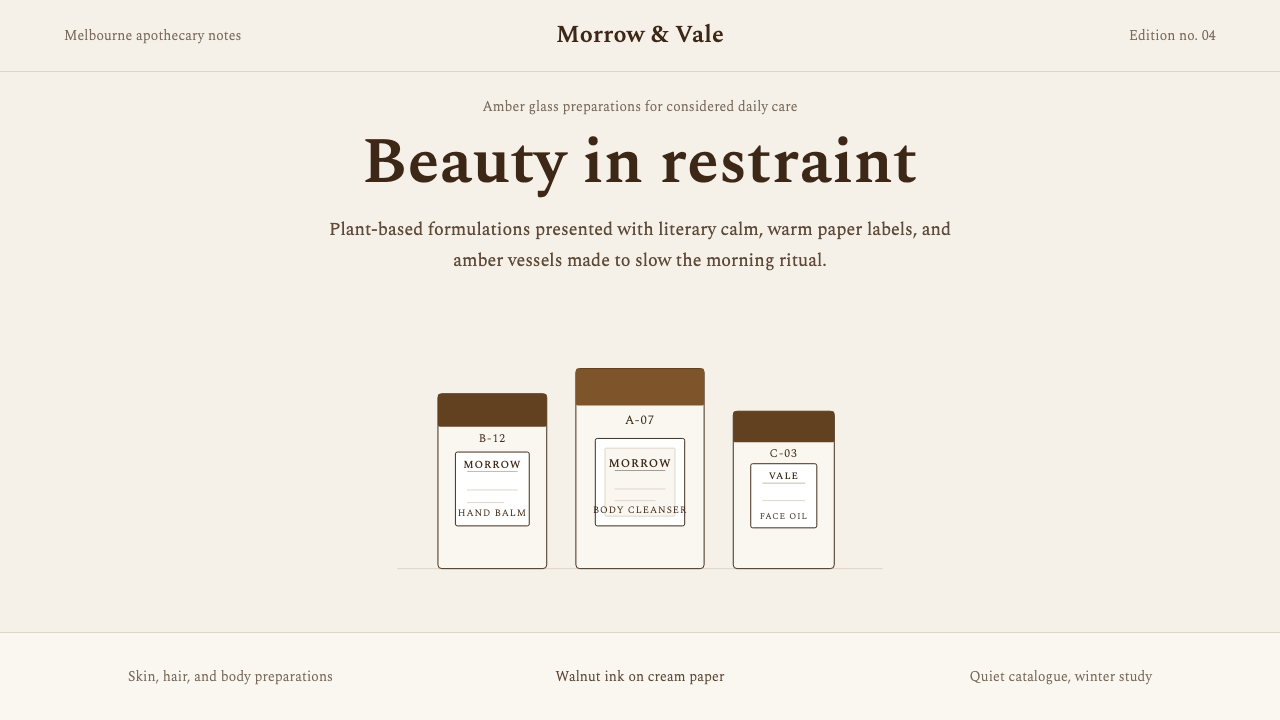 AesopRefuses urgency. Walnut serif on cream paper — every surface paced like a 19t…
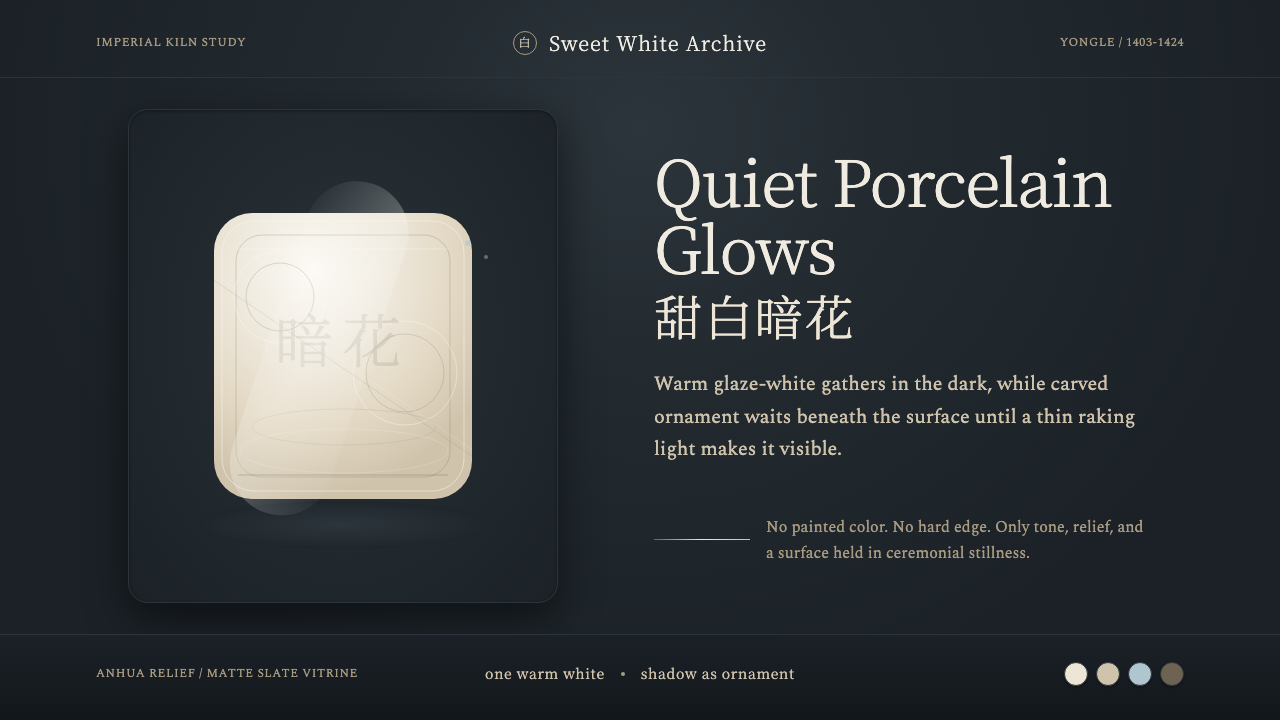 Jingdezhen BlancQuiet porcelain glows. Warm glaze-white on slate reveals hidden anhua incisio…
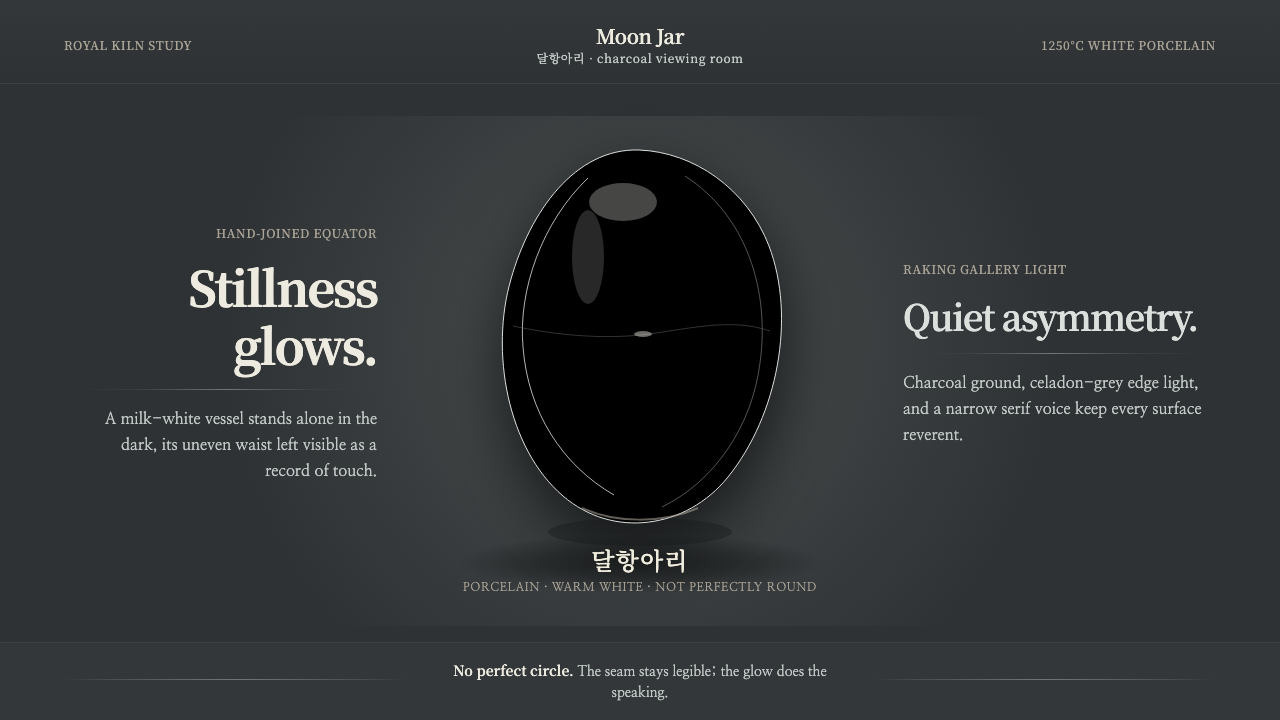 Joseon Moon JarQuiet imperfection glows. Milk-white porcelain floats on charcoal with a visi…
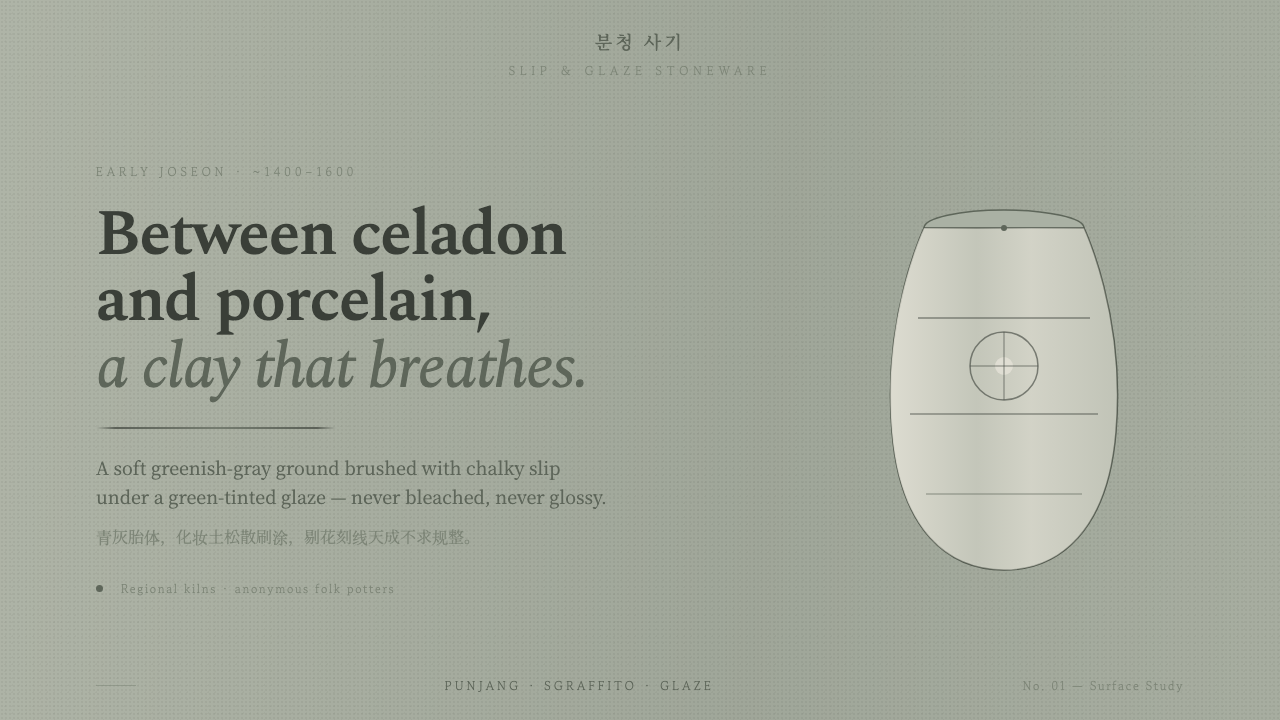 Buncheong Gray Slip WareBetween celadon and porcelain. Greenish-gray clay, chalky slip brushwork, dar…
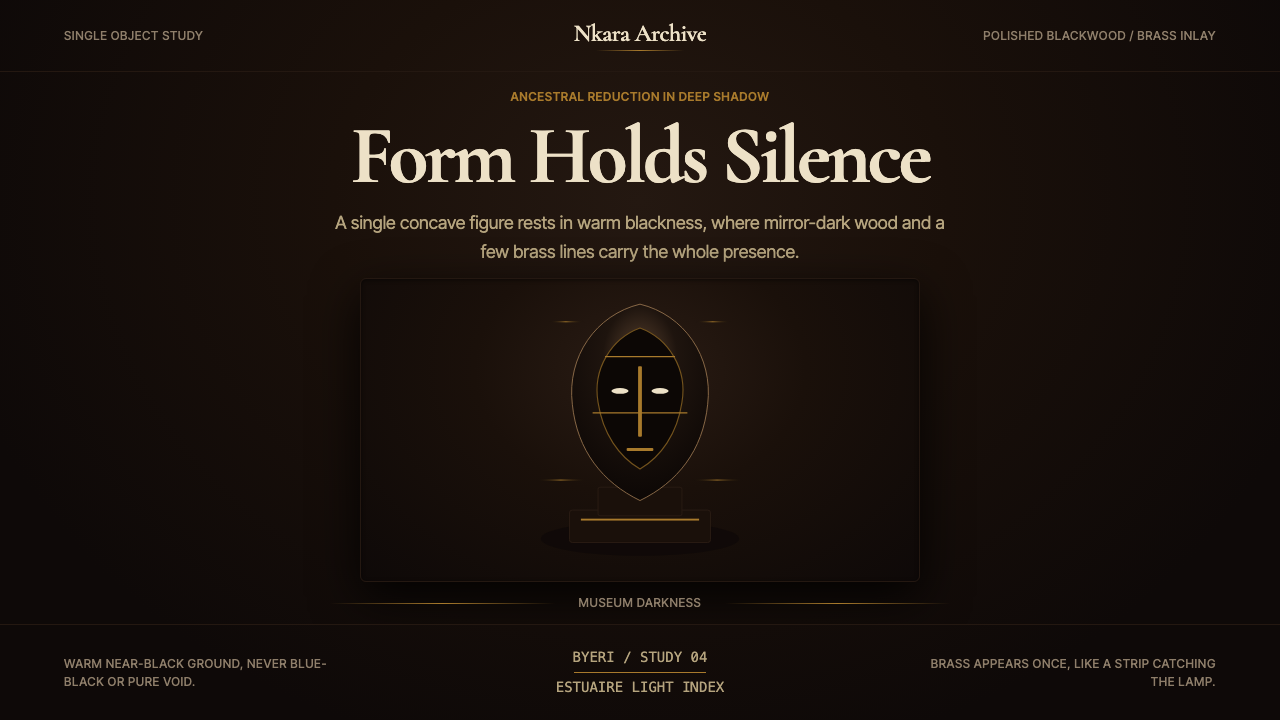 Gabonese Fang Mask & ByeriStillness has weight. Mirror-black forms, brass hairlines, and museum shadow…