What is Minangkabau Rumah Gadang?
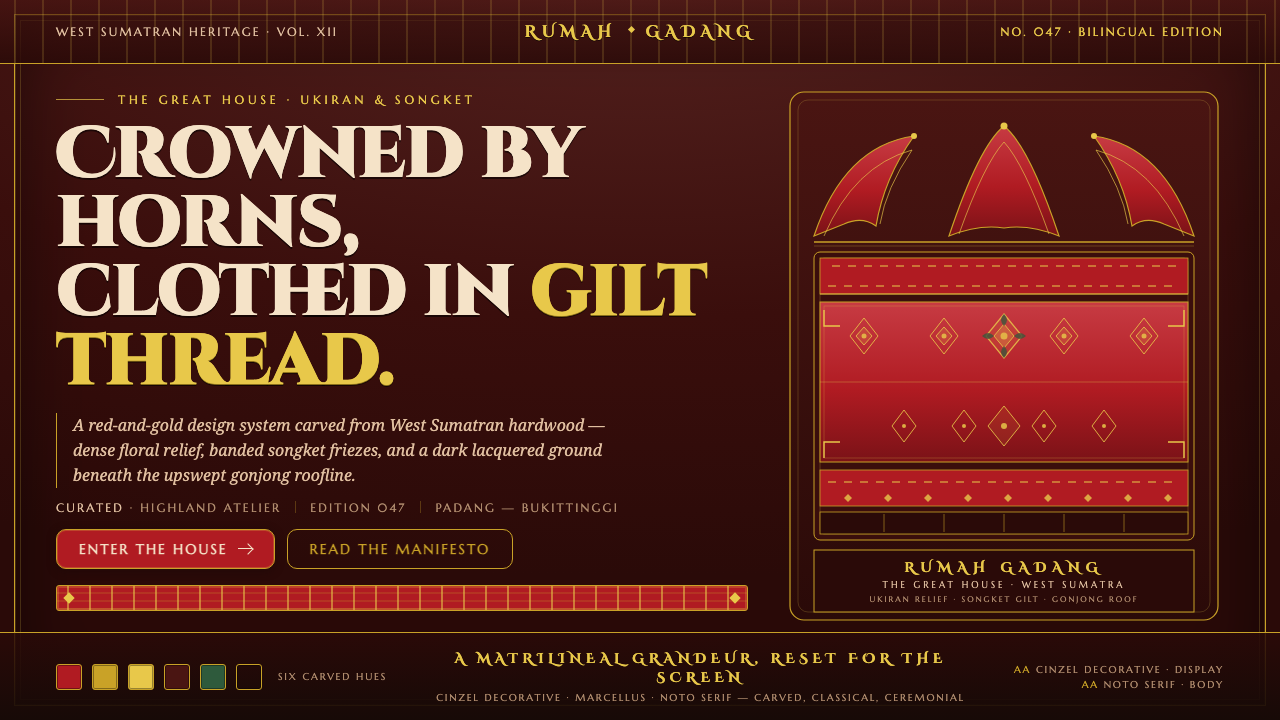
Minangkabau grandeur rises from dark carved wood: red and gilt ukiran relief beneath the sweeping buffalo-horn silhouette of the gonjong roof.
Minangkabau Rumah Gadang in brief
Minangkabau Rumah Gadang is the visual language of the great house of West Sumatra: dark lacquered hardwood, red-gilt carving, dense floral and geometric relief, and a dramatic roofline that sweeps upward like buffalo horns. Its character is neither rustic nor merely ornamental. It is architectural grandeur translated into surface, pattern, and silhouette.
The design system is built on contrast. Dark wood provides depth and gravity; red supplies warmth and ceremonial intensity; gilt details catch the eye like worked metal or gold thread. Ukiran relief fills the surface with continuous movement, while banded friezes and red-ground songket panels organize that abundance into legible fields. The result feels rich without becoming visually loose.
In digital form, Rumah Gadang should feel carved, layered, and proudly specific. Surfaces may be deep and lustrous, ornament should follow clear bands or panels, and the gonjong silhouette should act as a recognizable structural motif. The overall mood is matrilineal grandeur: formal, crafted, densely decorated, and anchored by the enduring vernacular architecture of the Minangkabau highlands.
Where does Minangkabau Rumah Gadang come from?
Rumah Gadang is an enduring vernacular form of the Minangkabau highlands in West Sumatra, Indonesia. Antique house models are documented from before 1900, while the architectural tradition remains living rather than purely historical. Its identity is therefore carried not by a single period style but by the persistence of a recognizable relationship between roof, carved wall, material, and ornament.
The most immediate architectural sign is the gonjong roof: sweeping, upward-curving peaks that evoke buffalo horns. Beneath this silhouette are carved hardwood gable walls, whose surfaces become fields for intricate relief. The roof establishes the vertical drama of the house; the gable carving supplies its visual density and tactile richness.
Ukiran relief is central to the system. Master woodcarvers, known as tukang ukir, work floral and geometric forms into dark lacquered wood, creating a surface where pattern is not applied as a separate image but integrated into the architectural body. Islamic-influenced floral motifs belong to this vocabulary, joining organic curves with a disciplined ornamental rhythm.
Songket weaving provides the textile counterpart to carved wood. Gilt thread on a red ground echoes the red-and-gold relationship of the ukiran while introducing a softer, woven surface. Together, Minangkabau matrilineal clans, woodcarvers, and songket weavers sustain a visual culture in which grandeur is expressed through the coordinated work of structure, carving, and textile.
What defines the Minangkabau Rumah Gadang look?
Dark Lacquered Wood
The ground is dark, lustrous, and substantial, giving every red and gilt detail a firm visual anchor. In a digital interpretation, this is a field of depth rather than a flat black background: the surface should suggest polished wood and carved relief without becoming photorealistic. Darkness creates the architectural gravity of the system.
Red and Gilt
Red carries warmth and presence, while gilt acts as the light-catching counterpoint. The relationship should feel deliberate and concentrated: red can occupy panels or larger ornamental fields, with gold reserved for relief edges, threads, highlights, and signs of emphasis. Together they produce richness through contrast rather than through a crowded palette.
Gonjong Silhouette
The buffalo-horn roof is the system's strongest silhouette. Its upward sweep creates a proud vertical gesture and gives the composition a clear crown. Used in headers, section markers, or framing devices, the form should remain recognizable and structural. It works best as an emphatic outline or carved crest, not as a repeated decorative clip-art shape.
Ukiran Relief
Ukiran should feel continuous, carved, and alive with curved movement. Floral and geometric forms can interlock within a panel or frieze, but the ornament needs an underlying rhythm. The digital equivalent is layered relief, controlled highlight, and clear edge definition. Ornament should appear to belong to the surface rather than float above it.
Banded Friezes
Dense ornament becomes readable when it is organized into horizontal or framed bands. Floral friezes can separate content zones, establish procession, or reinforce the base and crown of a composition. These bands provide the system's internal architecture: they turn abundance into sequence and keep carved detail from dissolving into visual noise.
Songket Counterpoint
Songket introduces the textile counterpart: gilt thread on a red ground. Its role is not to imitate wood carving, but to soften the system with woven richness while preserving the same red-and-gold logic. Use it as a panel, banner, inset, or patterned field beside harder carved surfaces, creating a tactile contrast between relief and fabric.
Who shaped Minangkabau Rumah Gadang?
The matrilineal clans are the cultural foundation of the Rumah Gadang identity. Their presence gives the great house its sense of collective continuity and explains why the style should feel grounded, inherited, and dignified rather than like a generic tropical ornament. In design terms, matrilineal grandeur is expressed through structure and continuity, not through random exotic decoration.
Tukang ukir are the master woodcarvers responsible for the carved hardwood language of Rumah Gadang. Their work turns the wall into an ornamental field where floral and geometric relief belongs to the architecture itself. A digital system inspired by them should treat ornament as crafted structure: carved edges, repeated rhythms, and surfaces with intentional hierarchy.
Songket weavers carry the red-and-gold language into cloth through gilt thread on a red ground. Their contribution gives the system a softer counterpart to carved wood and demonstrates how the same color relationship can move between hard relief and woven pattern. In applications, songket-inspired fields are especially useful for banners, panels, and moments of ceremonial emphasis.
How do you use Minangkabau Rumah Gadang today?
Rumah Gadang is most effective when its richness is organized. Begin with the dark carved-wood ground and the gonjong silhouette, then establish where red, gilt relief, floral bands, and songket-like panels carry emphasis. The style should communicate inherited grandeur through coordinated material cues, not through indiscriminate pattern coverage.
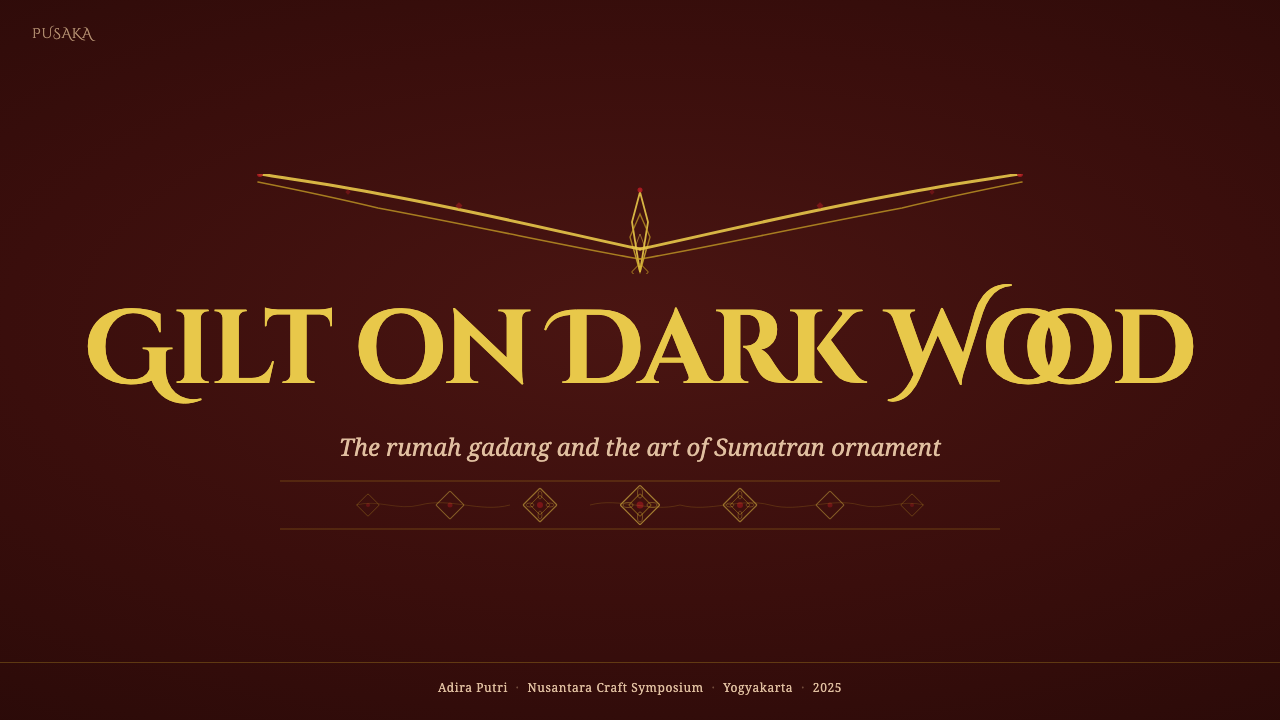
For presentation slides, use the gonjong gesture as a cover-page crown or framing silhouette, with the title set against a deep wood-like field and a concentrated red-and-gilt accent. Content slides should rely on carved bands or panel divisions to separate ideas. Data slides can treat charts as inset plaques or woven panels, using red for primary emphasis and gilt for highlights while preserving generous dark breathing room.
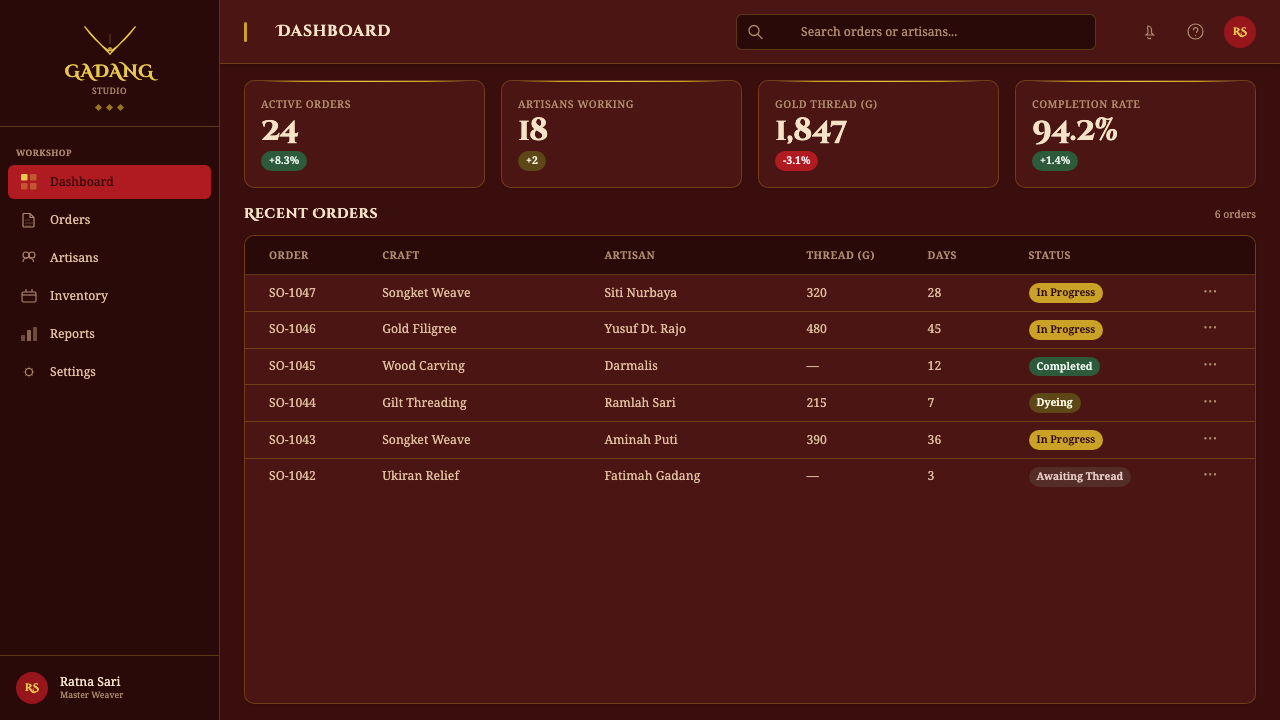
For web interfaces, the system suits dashboards and pricing pages that need to feel authoritative, crafted, and culturally specific. Use dark surfaces for the main environment, red for active states or important categories, and gilt sparingly for emphasis, selected values, or premium tiers. Cards can borrow the logic of carved panels, but their edges should remain readable; dense ukiran belongs to headers, dividers, or focal areas rather than every component.
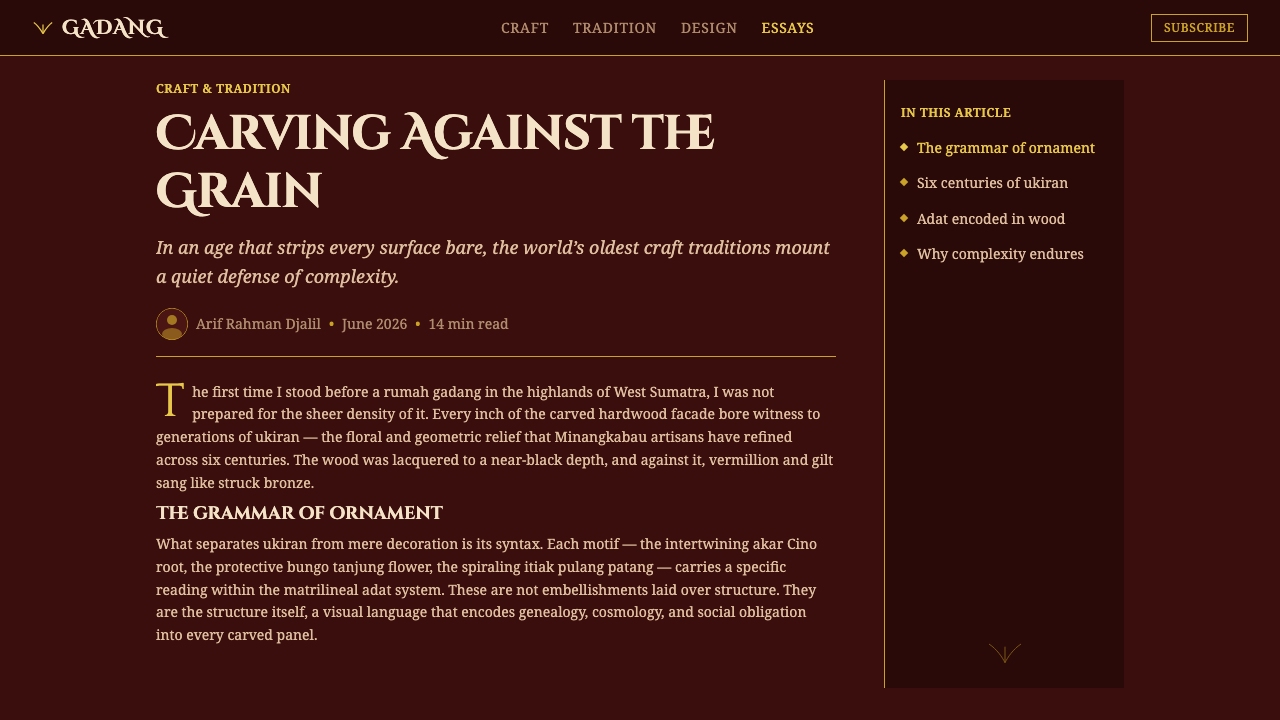
For editorial and marketing work, Rumah Gadang creates a strong frame for stories about heritage, craft, place, and collective identity. Article layouts can use horizontal floral friezes to mark sections, songket-inspired fields for pull quotes, and a gonjong crest to anchor the opening spread. Marketing pages benefit from the contrast between dark wood-like expanses and red-gilt feature panels, especially when the message calls for dignity and crafted distinction.
The common mistake is treating the style as a pile of exotic motifs. Repeating buffalo horns, flowers, red, and gold everywhere destroys the hierarchy that gives the system its power. Another error is making the wood surface uniformly glossy or the ornament perfectly flat. Rumah Gadang depends on the relationship between structure, carved relief, material depth, and controlled contrast; remove that relationship and only costume remains.
Minangkabau Rumah Gadang — FAQ
Is Rumah Gadang a dark theme?
Darkness is fundamental, but the style is more specific than a dark interface. Its identity comes from dark lacquered wood in dialogue with red, gilt relief, floral bands, and the gonjong silhouette. A plain black layout with red accents is not enough. The surface needs a sense of carved depth, and the ornament needs architectural organization.
What does the gonjong roof contribute to the design?
The gonjong roof provides the clearest silhouette and the strongest upward gesture. It gives the composition a crown-like finish and makes the style immediately recognizable. In digital work, it can frame a title, mark an opening, or appear as a crest. It should remain a structural sign rather than becoming a repeated decorative icon.
How should ukiran relief be translated into a digital interface?
Translate its logic rather than copying every motif. Use controlled relief, clear edge definition, curved floral movement, and organized bands or panels. The ornament should reinforce hierarchy or framing, while the dark surface gives it depth. If every area receives equal carving, the interface loses the distinction between structure and emphasis.
What is the role of songket in the visual system?
Songket is the textile counterpart to carved wood: gilt thread on a red ground carries the same red-and-gold relationship into a woven surface. It adds softness and pattern without abandoning grandeur. Use it for panels, banners, inset areas, or featured backgrounds where a fabric-like counterpoint can balance harder relief.
When does this style work best?
It works best when the experience needs grandeur, craft, place, and cultural specificity: heritage storytelling, cultural platforms, editorial features, premium presentations, and interfaces that benefit from a strong visual identity. It struggles when the product requires extreme neutrality or effortless visual lightness. The style asks for attention, because its meaning lives in material contrast and patterned detail.
Related design styles
 Deccan Basalt TempleMonumental shadow, carved. Near-black basalt, Cinzel capitals, and relief gri…
 Qajar PersiaOpulence commands. Lacquer red, gilt borders, pearl dots, and lapis geometry.
 Rajasthani Meenakari EnamelJewel-box intensity. Emerald enamel, cobalt cells, ruby sparks, and gold-wire…
 Babylonian Ishtar GateMonumental by procession. Lapis brick, gold registers, and carved capitals ho…
 Bhutanese Dzong (Fortress Red)Monumental red holds the page. Cobalt frames and gold bands lock the fortress…
 Gothic Rose WindowDarkness becomes light. Cobalt glass, ruby foils and black lead form a radial…