What is Deccan Basalt Temple?
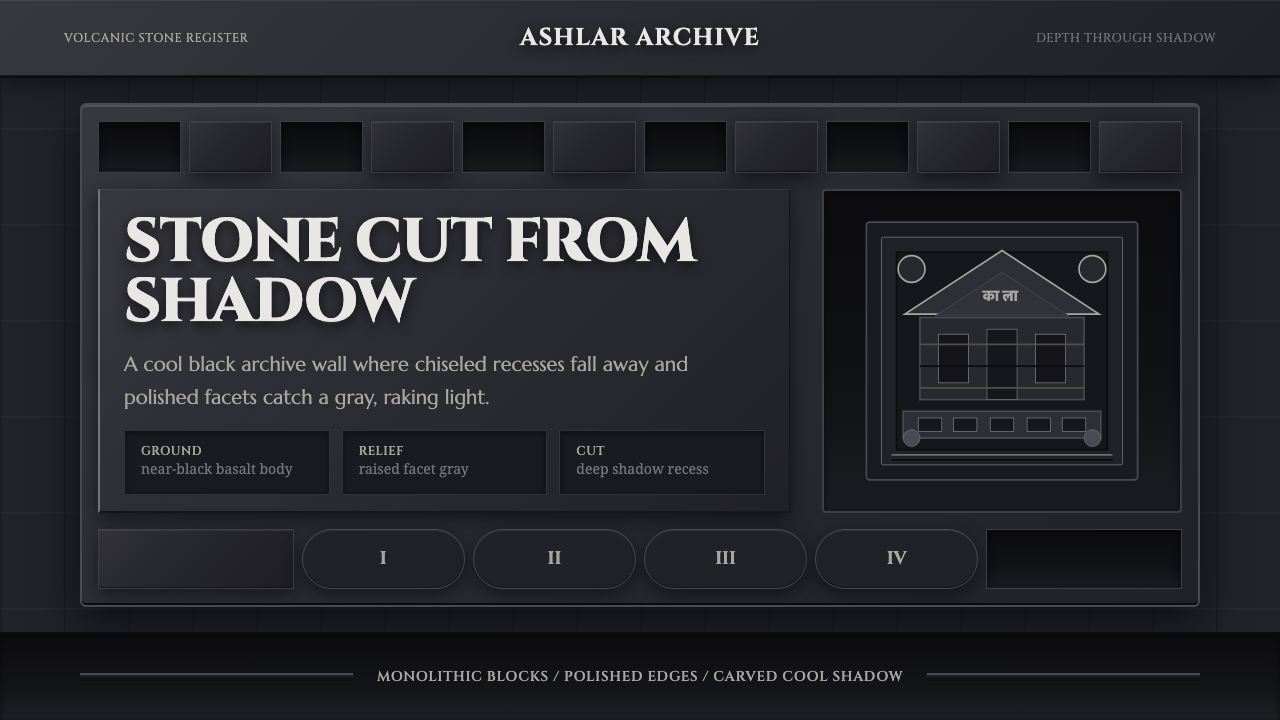
Deccan Basalt Temple turns volcanic darkness into architecture — monumental planes, carved relief, and cool gray light drawn across stone.
Deccan Basalt Temple in brief
Deccan Basalt Temple is a dark digital style distilled from the near-black volcanic trap rock associated with the Hoysala temples and the rock-cut monuments of Ellora on the Deccan Plateau. Its visual language combines dense stone surfaces, deeply recessed ornament, relief-based grids, and monumental capital lettering. Rather than relying on bright color, it establishes hierarchy through the contrast between shadowed cavities and edges that catch cool gray light.
The style treats a page or interface as a carved mass rather than a flat canvas. Panels resemble planes cut from one continuous body of stone; borders feel incised, headings feel engraved or raised, and repeated modules form architectural rhythms. Depth is dramatic but controlled. The darkest regions suggest recesses within the basalt, while polished facets and chiseled ridges provide restrained highlights that reveal the underlying structure.
Its defining quality is density without visual chaos. Ornament may be abundant, but it is organized into bands, grids, framed fields, and repeated relief motifs. The resulting atmosphere is solemn, enduring, and neutral-cool. Every visible plane derives its identity from carving, shadow, and reflected light, making the system especially suited to subjects that call for ceremony, permanence, historical weight, or disciplined grandeur.
Where does Deccan Basalt Temple come from?
The source landscape is the Deccan Plateau of southern India, where dark volcanic trap rock provided both material and visual character for monumental sacred architecture. Dense and fine-grained, the stone supports a language of forceful cutting and intricate relief. Its near-black body absorbs light, while polished planes, projecting ridges, and fresh-looking chisel edges catch cooler gray illumination. The contrast makes ornament legible through depth rather than applied color.
Ellora's rock-cut temples, developed between the sixth and tenth centuries, supply the style with its fundamental idea of architecture discovered inside stone. Their relevance here is not a catalog of individual motifs but a way of thinking about mass: enclosure, support, image, and ornament can appear to emerge from a continuous rocky body. Recesses become profound shadow fields, projecting forms become illuminated structure, and the boundary between construction and sculpture becomes deliberately difficult to separate.
The Rashtrakuta architects of the Kailasa temple represent the monolithic dimension of this inheritance. A monument conceived through the cutting of a single rock mass encourages a subtractive design logic: form is revealed by removing material. In the digital system, that logic becomes layered relief, inset panels, carved frames, and surfaces that appear excavated rather than assembled. Even an empty region retains the presence of stone, because emptiness reads as a deliberate recess within a larger mass.
Hoysala temple sculptors, working from the eleventh through the fourteenth centuries, provide the complementary language of concentrated ornamental carving. Their contribution to this theme is expressed through dense relief fields, rhythmic repetition, and the disciplined subdivision of broad surfaces into smaller sculptural zones. Combined with Ellora's monumental mass, this ornamental intensity produces the central tension of Deccan Basalt Temple: the whole remains immovable and architectonic, while its surface is alive with patient, closely ordered carving.
What defines the Deccan Basalt Temple look?
Basalt Palette
The palette remains close to the natural range of dark volcanic stone. Near-black establishes the continuous mass, charcoal separates major planes, and cooler grays mark polished facets, worn ridges, or edges struck by light. Pale tones are scarce and therefore powerful. They should reveal structure or guide attention, never behave like decorative color scattered across the composition.
Carved Typography
Cinzel capitals give headings an inscriptional presence suited to monumental stone. They work best when spaced with ceremony and surrounded by enough darkness to appear carved, raised, or set into an architectural band. Supporting text should be quieter and more compact, preserving legibility without competing with the title. Typographic hierarchy comes from scale, placement, casing, and perceived depth rather than multiple decorative families.
Relief Grid
The grid is not an invisible alignment aid; it is made physically apparent as a system of carved bays, recessed panels, horizontal bands, and repeated compartments. Modules may vary in prominence, but their edges remain related, creating the impression of a wall articulated by sculptural zones. Content feels housed inside the architecture rather than placed freely over it.
Shadow as Excavation
Shadow represents removed stone. Deep recesses descend toward near-black, while projecting forms interrupt that darkness with narrow planes of gray light. The transition should feel abrupt and mineral rather than misty. Depth is communicated by occlusion, carved edges, and successive relief levels, giving components the gravity of excavated forms instead of the softness of floating cards.
Ornamental Density
Ornament is abundant but never casual. Repetition, enclosure, and bilateral or serial rhythm keep carved detail subordinate to the larger mass. Dense passages should gather in deliberate fields and alternate with quieter stone planes, allowing the eye to register both labor and monumentality. Random filigree weakens the effect because it detaches decoration from architectural order.
Monumental Composition
Compositions favor firm axes, weighty framing, and a clear distinction between primary sanctum-like content and secondary surrounding information. Even when the layout is asymmetric, it should feel grounded rather than restless. Large dark masses establish permanence; concentrated highlights announce entrances, headings, or decisive actions. The page reads as a facade or chamber before it reads as a collection of widgets.
Chiseled Surface
Surface character comes from fine-grained stone, polished facets, cut grooves, and restrained signs of the chisel. Texture must reinforce the direction of planes and the labor of carving, not cover every area with uniform noise. Smooth and rough passages should alternate purposefully: polish gathers light, while the rougher recesses deepen shadow and preserve the impression of volcanic density.

Who shaped Deccan Basalt Temple?
The Hoysala temple sculptors represent the ornamental discipline within the theme. Their legacy is expressed through densely worked relief, repeated sculptural zones, and the patient organization of detail across architectural surfaces. For this digital style, they demonstrate that richness need not dissolve structure: ornament gains force when it follows bands, frames, and larger compositional rhythms.
The Rashtrakuta architects of the Kailasa temple embody the monolithic principle at the center of Deccan Basalt Temple. Their importance lies in conceiving monument, sculpture, and spatial mass through rock cutting rather than surface application. The corresponding design lesson is subtractive: panels, thresholds, and reliefs should appear released from a continuous body, preserving a sense of immense material weight.
Ellora's master carvers stand for the union of excavation and image-making. Their model allows void, wall, support, and figure to participate in one carved environment, with darkness functioning as active spatial material. In contemporary adaptation, this encourages interfaces whose empty areas feel recessed and intentional, while illuminated edges reveal form gradually, as though the viewer were reading a temple interior by limited gray light.
How do you use Deccan Basalt Temple today?
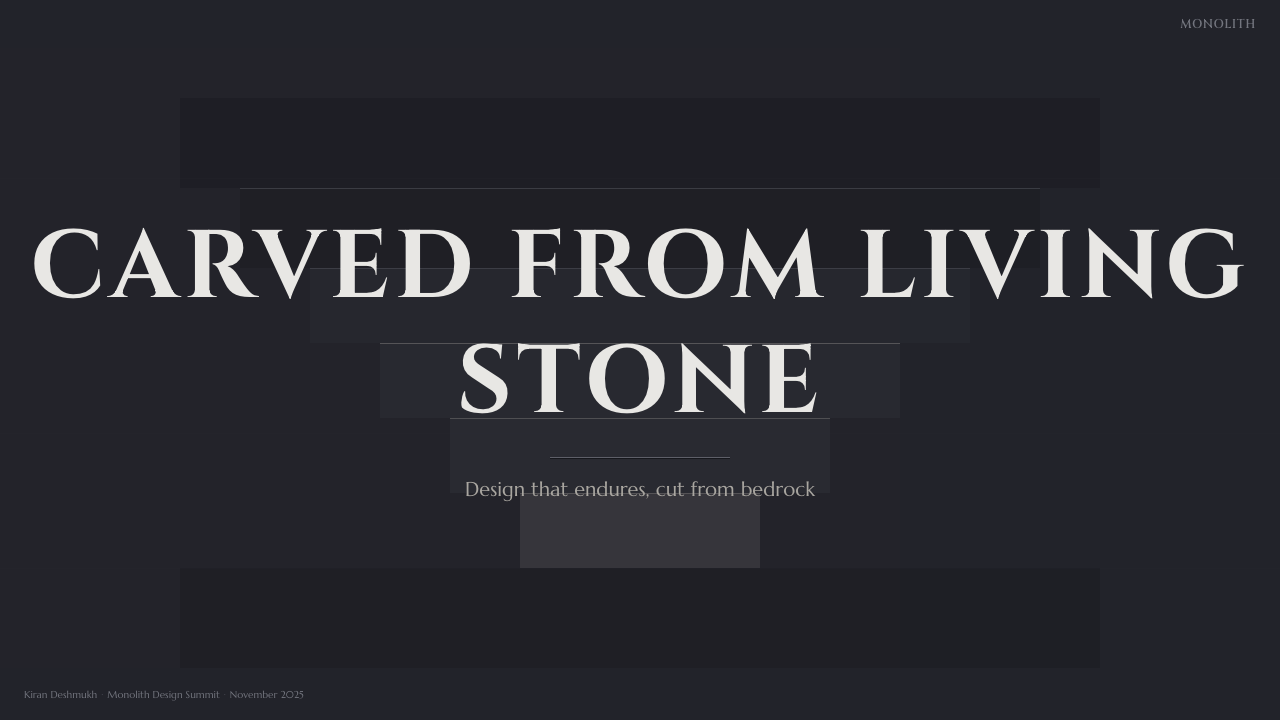
For presentation slides, the style is strongest when the deck is treated as a sequence of stone chambers. A cover can center a monumental Cinzel title within a carved frame, with a narrow band of cool light defining the inscription against a near-black field. Content slides should use relief grids: a dominant text or image panel occupies the principal bay, while smaller annotations sit in quieter recessed compartments. Data slides benefit from restrained dimensionality, with bars, bands, and comparison blocks rendered as cut or raised stone forms rather than brightly colored chart furniture.
In web interfaces, Deccan Basalt Temple suits dashboards, archives, cultural platforms, and premium tools that benefit from gravity and clear enclosure. Navigation can read as an inscribed architectural band, while the active section appears polished or slightly raised from the surrounding basalt. Dashboard modules should share a continuous stone ground and differ through recess depth, framing, and light exposure. Pricing pages can present plans as adjacent carved bays, reserving the strongest highlight and most elaborate frame for the recommended tier without introducing an unrelated accent color.
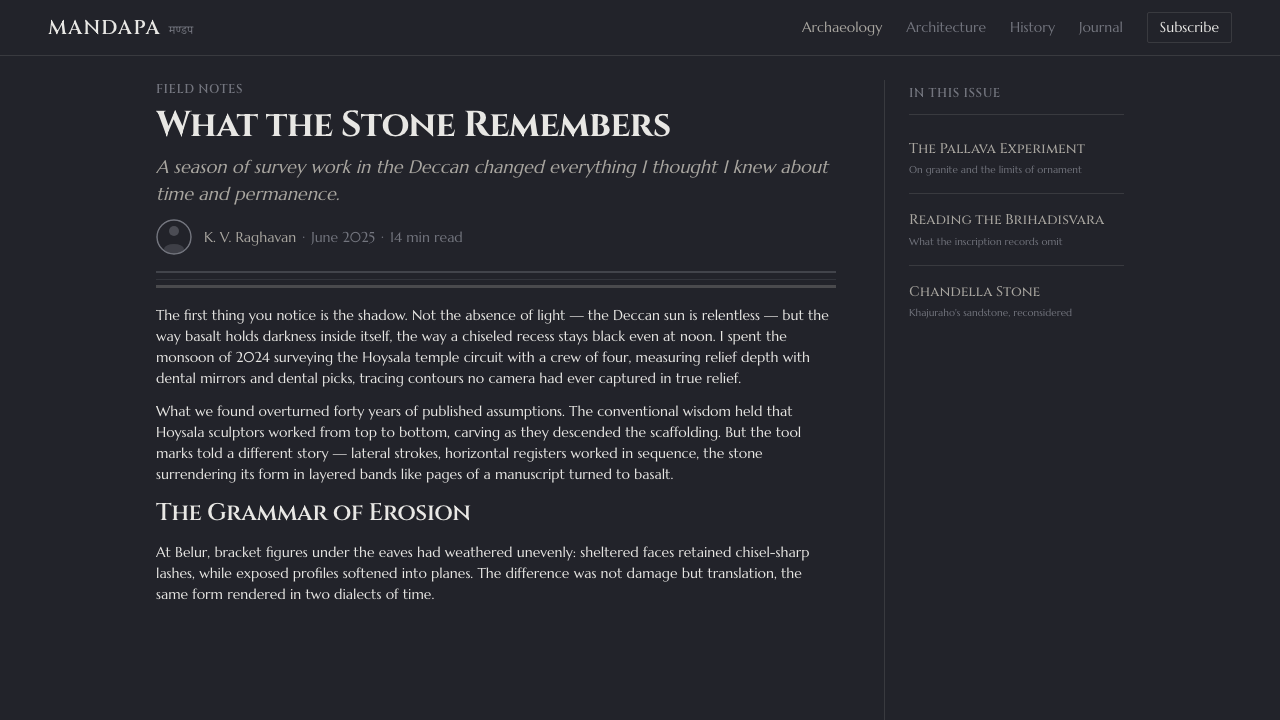
For editorial design, the system supports long-form historical, architectural, or cultural material when dense ornament is kept outside the main reading path. Titles, opening statements, captions, and section markers may carry the carved character, while body copy rests on calmer dark planes with generous internal breathing room. Pull quotations can resemble inscriptions set into relief panels. Images should emphasize stone, sculpture, shadow, or architectural mass and should be framed as integral openings in the page rather than casual floating rectangles.
Marketing applications should use monumentality as a narrative device. A hero section can behave like a facade, revealing one central proposition through an illuminated inscription and a limited number of deeply framed actions. Subsequent sections may alternate broad, nearly unbroken stone planes with densely carved proof areas for features, credentials, or comparisons. The style is most persuasive for products promising endurance, authority, craft, or cultural depth; its ceremonial gravity may overpower messages centered on spontaneity, softness, or everyday informality.
The most common mistake is to equate dark luxury with Deccan Basalt Temple and then add glossy gradients, metallic color, misty glows, or soft floating panels. Those devices replace carved stone with generalized cinematic darkness. Another error is distributing ornamental texture uniformly, which turns disciplined relief into visual noise. Authentic application begins with mass and excavation: establish the continuous basalt body, decide which areas are recessed or projecting, organize ornament into architectural fields, and let cool gray light reveal only the edges that matter.
Deccan Basalt Temple — FAQ
Is Deccan Basalt Temple simply a dark theme with ornamental borders?
No. Its central idea is not darkness but carved mass. The background, panels, borders, and ornament should appear to belong to one continuous basalt body, differentiated by excavation, projection, polish, and shadow. Decorative borders alone cannot create that relationship. If components seem placed on top of a dark canvas rather than released from stone, the essential architectural logic is missing.
How should color be introduced into this predominantly near-black system?
Color should remain subordinate to the natural basalt range. Cool grays can distinguish light exposure, surface finish, and hierarchy without breaking material continuity. If additional color is required for meaning, it should be rare, concentrated, and treated almost like an inserted object rather than ambient decoration. The system loses its identity when multiple vivid hues compete with the relief structure.
Can the style support dense information without becoming difficult to read?
Yes, provided ornamental density and informational density are separated. Carved detail can frame a section, identify a hierarchy, or enrich a transition, but extended reading areas need quieter stone planes and clearly grouped text. Repetition should clarify modules rather than fill every gap. The model is an ordered temple surface: elaborate zones gain meaning because they are balanced by areas where the eye can rest.
What distinguishes carved depth from ordinary interface shadow?
Ordinary interface shadow often suggests that a separate object is hovering above a surface. Carved depth describes relationships inside one material body. A recess darkens because stone has been removed; a ridge brightens because its edge catches light; a projecting panel remains visibly connected to the surrounding mass. The goal is not to make elements float, but to make their position within the stone physically intelligible.
Where does Deccan Basalt Temple work poorly?
It can struggle when a product depends on casual friendliness, visual lightness, rapid playfulness, or an atmosphere of softness. The near-black mass, capital inscriptions, and ceremonial framing naturally communicate gravity and permanence. They are powerful for archives, cultural narratives, premium tools, and authoritative presentations, but can make informal social products or cheerful everyday services feel unnecessarily severe. The style should be chosen when its material values reinforce the message.
Related design styles
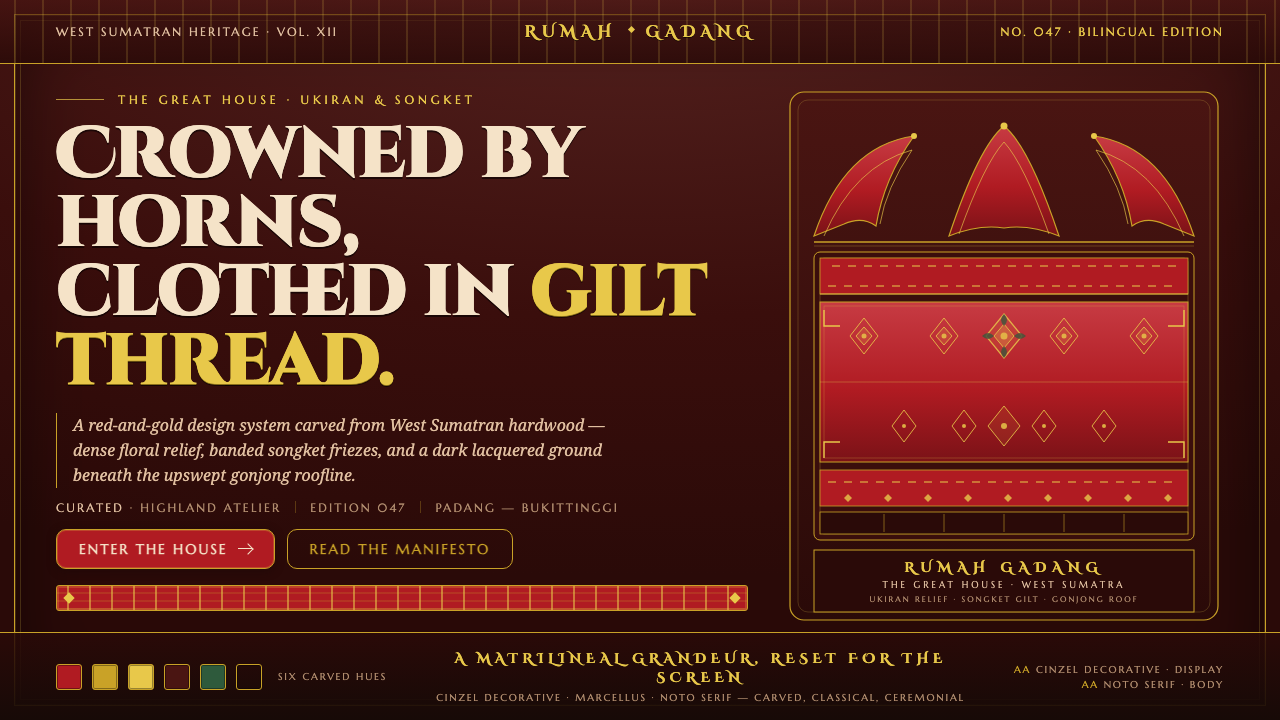 Minangkabau Rumah GadangMatrilineal grandeur, carved. Red-gilt ukiran relief on dark lacquered wood u…
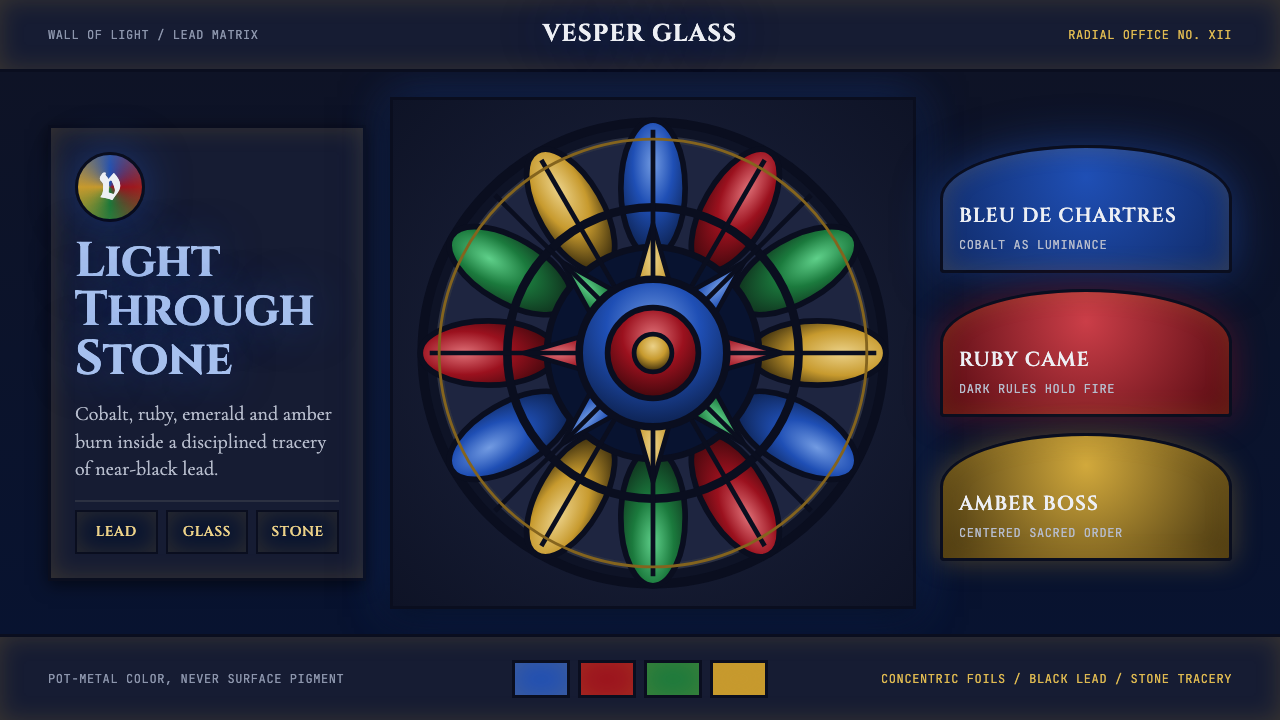 Gothic Rose WindowDarkness becomes light. Cobalt glass, ruby foils and black lead form a radial…
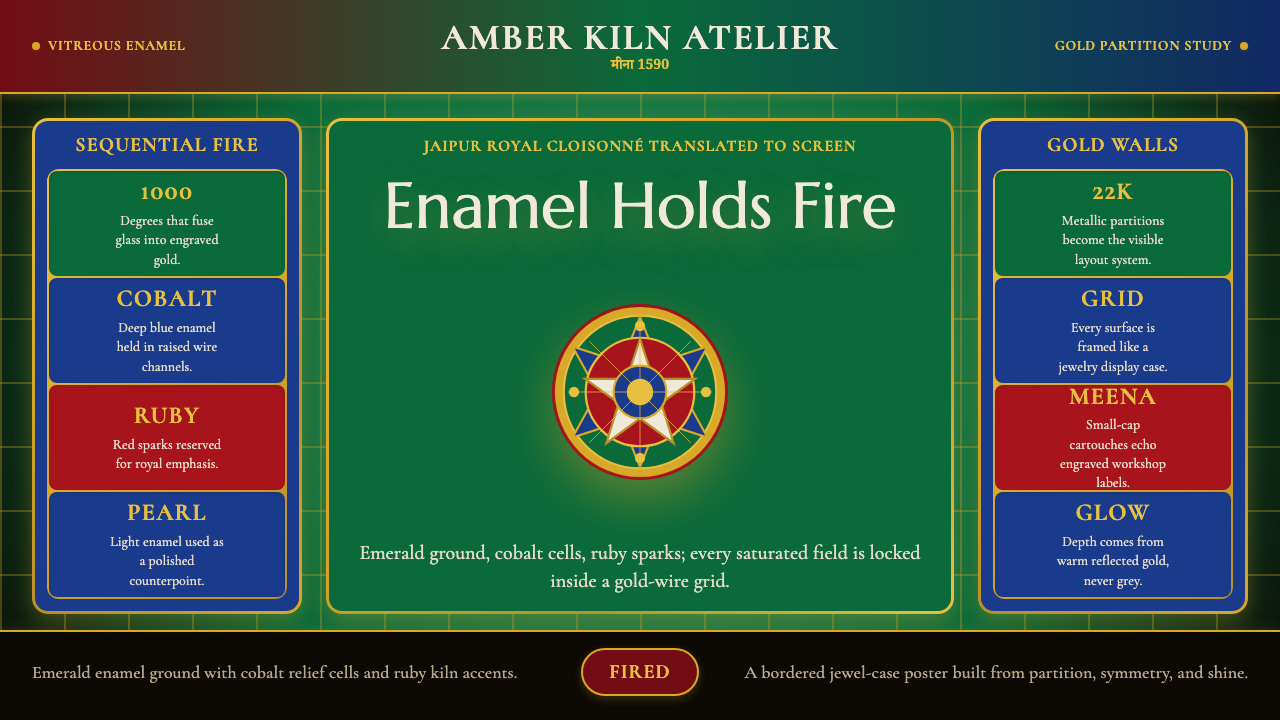 Rajasthani Meenakari EnamelJewel-box intensity. Emerald enamel, cobalt cells, ruby sparks, and gold-wire…
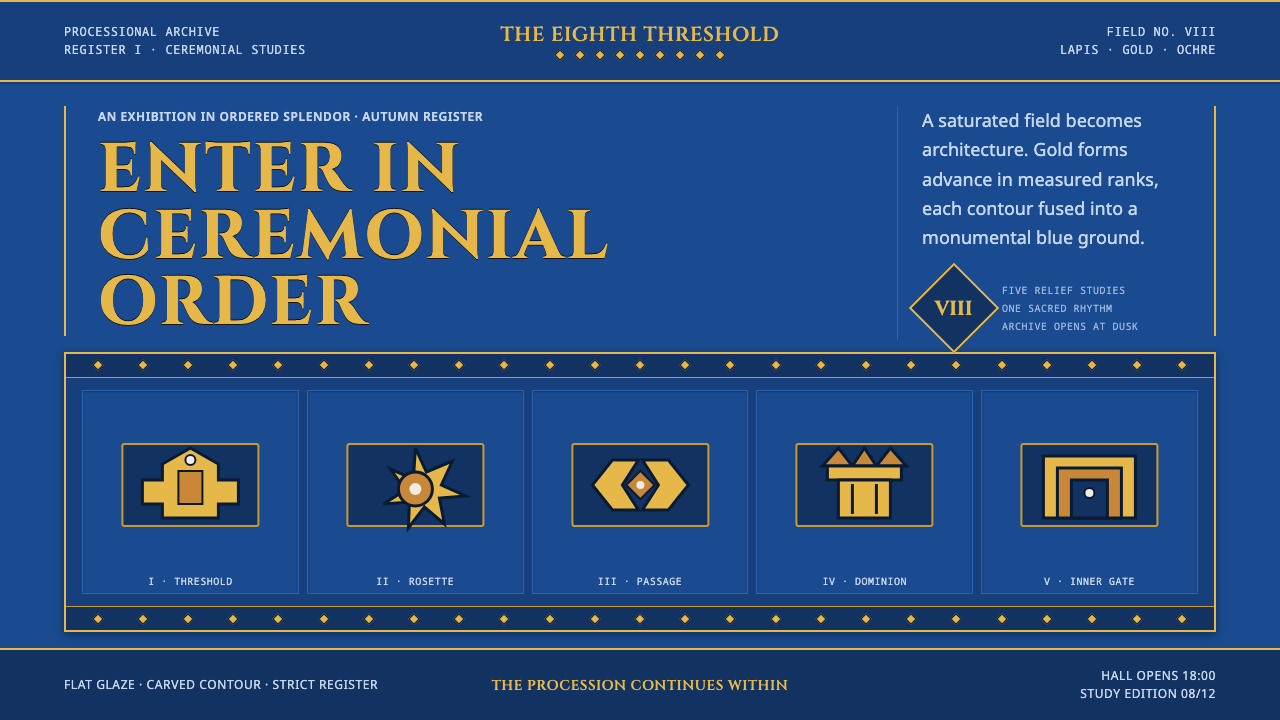 Babylonian Ishtar GateMonumental by procession. Lapis brick, gold registers, and carved capitals ho…
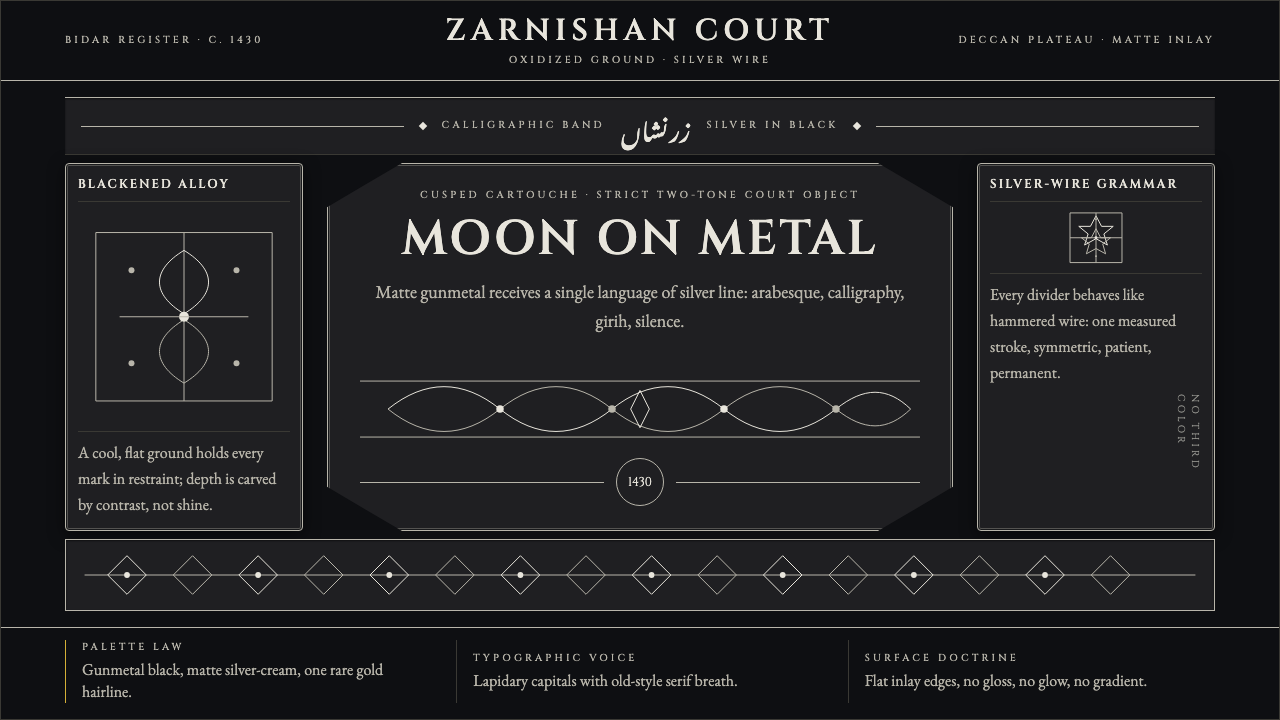 Bidri Deccan MetalworkCourtly darkness, tooled by silver. Cinzel caps and hairline arabesques cut g…
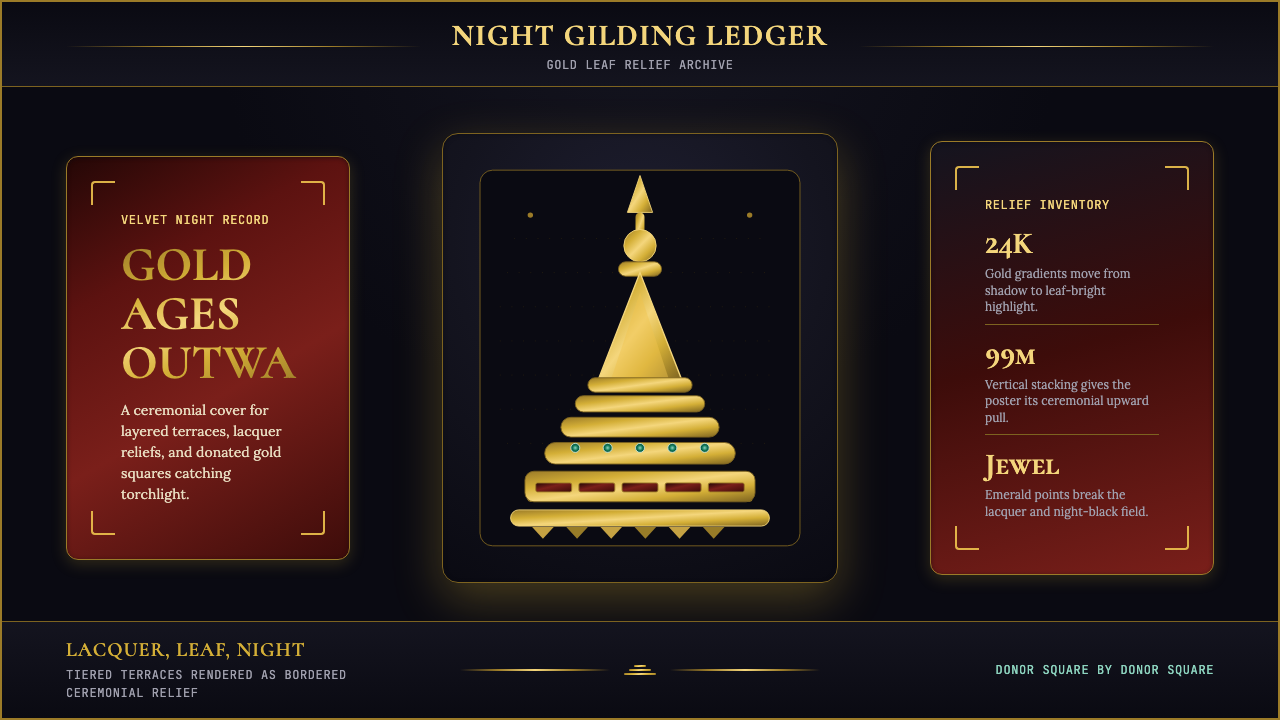 Burmese Shwedagon Stupa ReliefGold refuses restraint. Velvet black, teak-red lacquer, and tiered gradients…