What is Hausa Babban Riga?
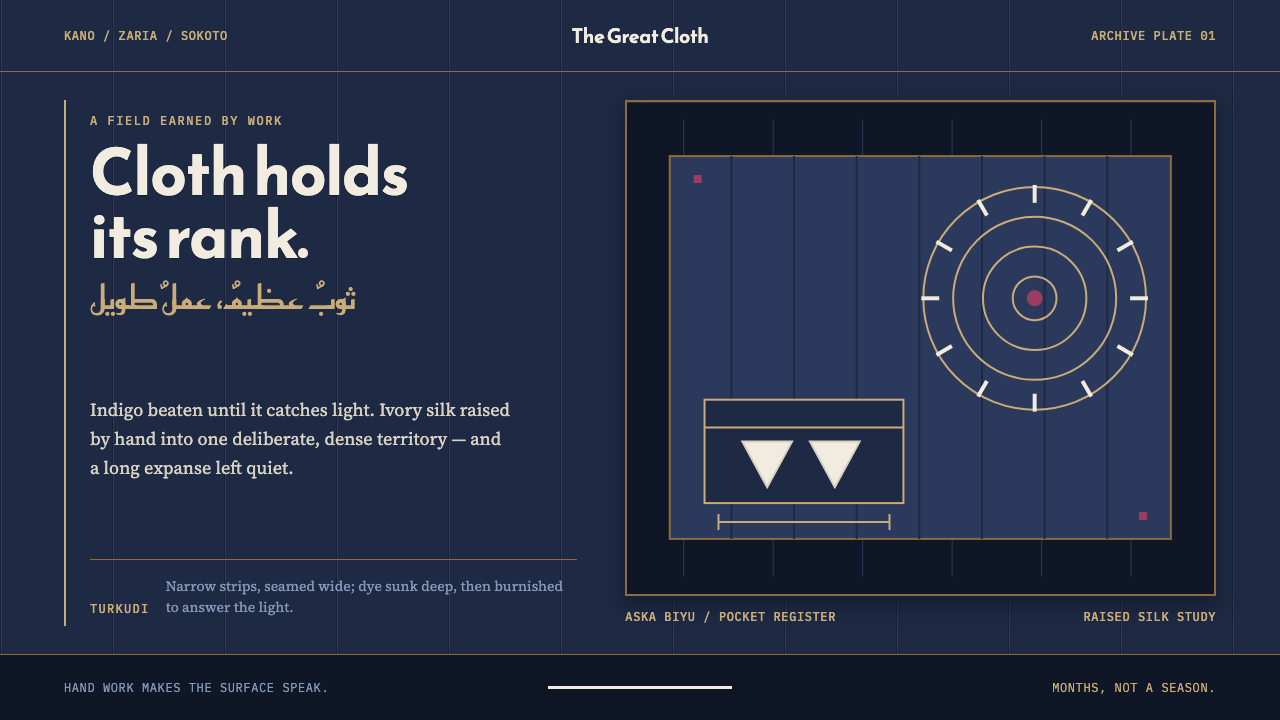
The Hausa babban riga puts all of its value into one dense field of raised ivory silk on a burnished indigo ground, and leaves the rest of the cloth quiet.
Hausa Babban Riga in brief
The babban riga is the great gown of Hausaland, the cultural region around Kano, Zaria and Sokoto that spans northern Nigeria and southern Niger. It is a cotton garment, woven by men in narrow strips on horizontal treadle looms and then seamed into a body more than two metres wide. The width alone is a statement: this is a robe cut generously, made to be seen from a distance.
Finishing begins in the dye pits of Kano. The cloth is sunk in indigo again and again until it will take no more, and is then beaten with a mallet until its surface answers light like hammered copper. The sheen is not wear or accident. It is the result of the process, built up deliberately, and it gives the cloth a dark, lustrous depth that shifts as light moves across it.
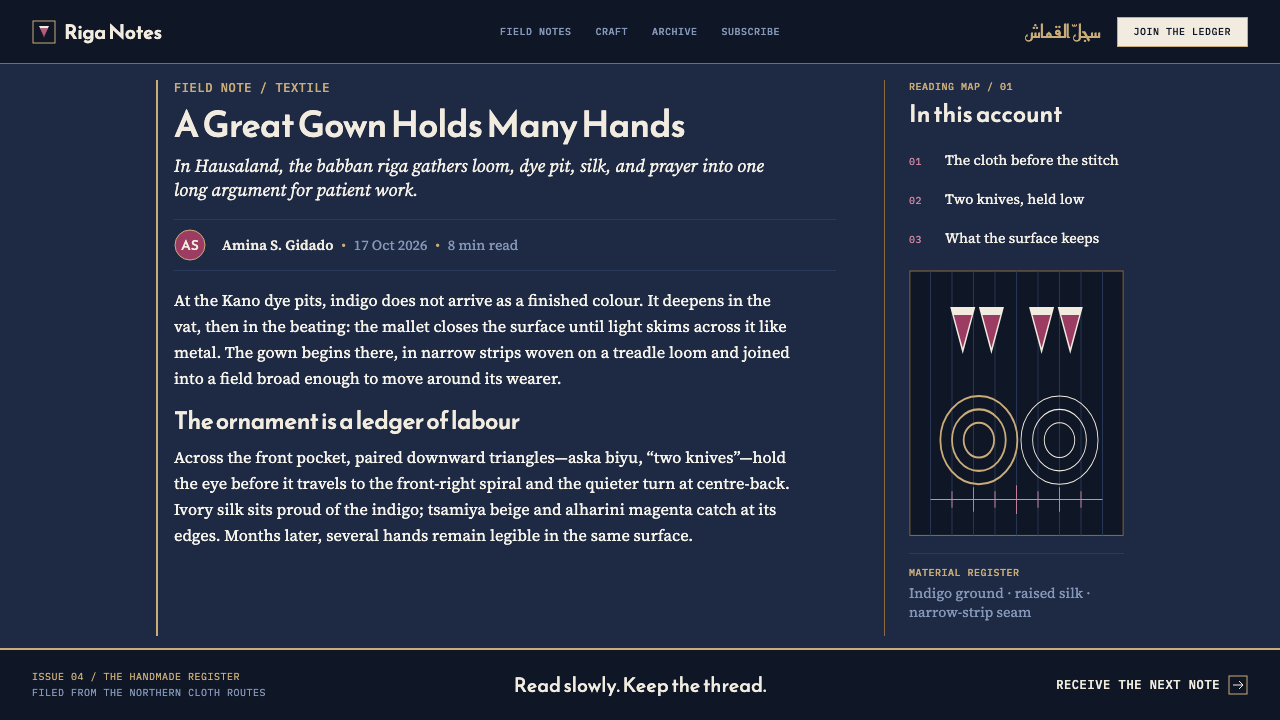
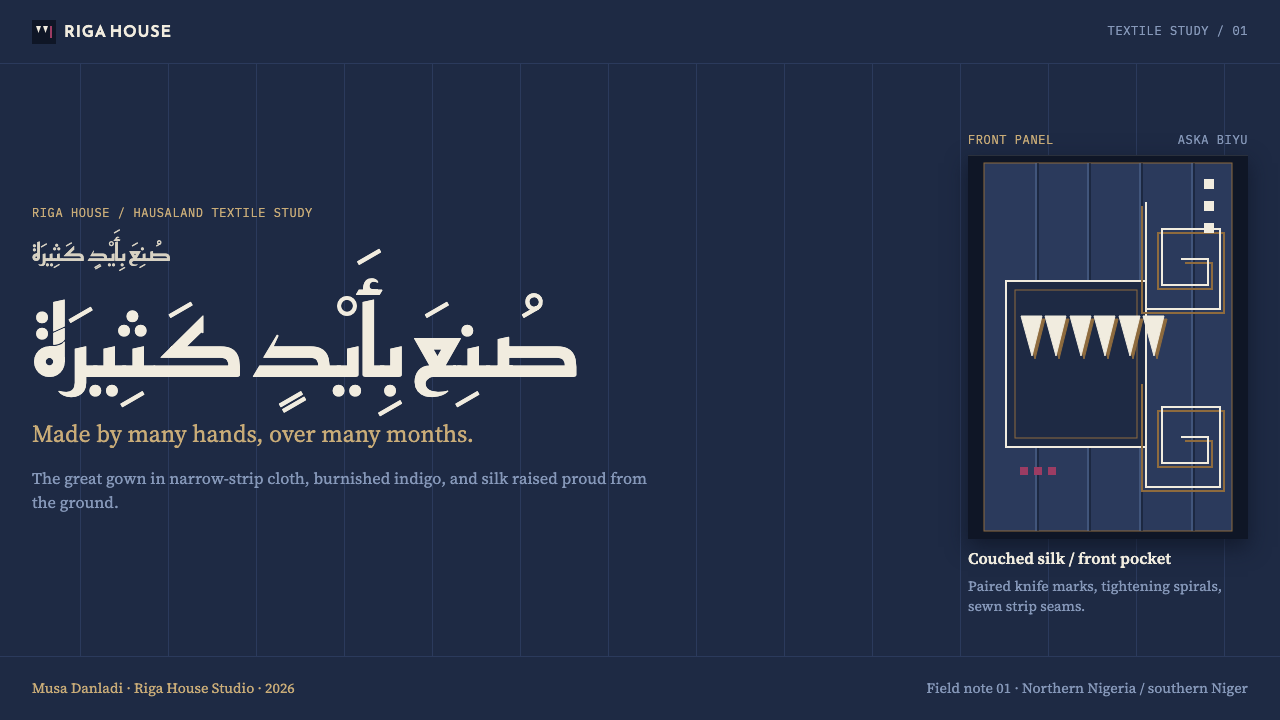
On that ground comes the embroidery. In the pattern called aska biyu, 'two knives', paired triangles point downward across the front pocket, and spirals that tighten as they turn sit at the front right and at the centre of the back. The silk is raised and couched by hand, a job for several people over several months. As a design system the babban riga keeps this order: a dark, burnished field, one dense worked zone, and long quiet cloth everywhere else. Rank is worked, not announced.
Where does Hausa Babban Riga come from?
Hausaland lies across northern Nigeria and southern Niger, with Kano, Zaria and Sokoto among its centres. The record dates the babban riga to the nineteenth century and into the middle of the twentieth, and notes that it sits on a much older Sudanic tradition, that is, on gown and cloth-making practices of the wider savanna belt south of the Sahara. The garment is therefore the late, refined form of something long established, not a sudden invention.
Three strands in the record explain the cloth. The first is Kano indigo pit-dyeing, the technique that gives the gown its deep, saturated ground; the dye pits are the physical heart of the process, and the repeated dipping and beating are what make the surface luminous. The second is the trans-Saharan silk trade, which the record connects with the silk used for embroidery, thread crossing the desert to finish cloth made in the savanna. The third is Sokoto Caliphate court dress, the setting in which a gown like this carried an association with rank and authority.
Two names from the caliphate anchor that third strand: Usman dan Fodio and Muhammadu Bello. The court dress of the caliphate is the context in which a garment like this acquired meaning, as an object of status made slowly and visibly at great cost. The style's own motto, that rank is worked and not announced, follows from this. The gown does not shout with colour or pattern across its whole surface; it concentrates effort in one place and trusts the viewer to understand what that concentration cost.
Outsiders documented the tradition too. The record lists Heinrich Barth, the nineteenth-century traveller, and Philip J. Shea, a scholar of Kano's cloth industry, among the key names for understanding it. The pocket on the front of the gown is not decorative: it is a working container that once held loose pages of the Quran. That fact is typical of the style, in which an ornamented zone is also a functional one, and the embroidery sits where the use is.
What defines the Hausa Babban Riga look?
Burnished Indigo Ground
The ground is indigo taken as far as it will go, then beaten until it carries a faint metallic sheen, like hammered copper answering light. It is dark but never flat: there is depth in it, and the sheen shifts with the angle of view. The sheen is craft, not wear. A digital version should be dark and slightly lustrous, with a quiet, controlled variation of tone, never a hard glossy highlight.
One Dense Worked Zone
All the elaboration is gathered into a single zone. The embroidery is packed tightly where it appears, and there is nothing comparable anywhere else on the gown. This asymmetry of density is the core compositional idea: the contrast between one intense area and a great deal of calm cloth is what makes the intense area read as valuable.
Raised Ivory Silk
The embroidery is silk in a warm ivory, raised and couched by hand so that it stands off the cloth and casts shadows of its own. It is light against dark, tactile and slightly soft in tone rather than stark white. In interface terms, this suggests ivory elements that sit on the dark ground with a gentle sense of elevation, not flat paint and not neon glare.
Aska Biyu, the Two Knives
The signature motif is aska biyu, two knives: paired triangles pointing down across the front pocket. The shape is sharp, simple and directional, a clear downward gesture that anchors the whole gown. As a visual device it is a pair of bold, mirrored wedges, readable at a distance and unmistakably deliberate. Used in a layout, it should be the one strong shape that everything else is quiet around.
Tightening Spirals
Spirals turn tighter and tighter at the front right and at the centre of the back. They give the dense zone movement without breaking its discipline: the eye is drawn inward, towards the centre of each coil. The spiral is the style's only curved gesture, and it is used sparingly, balanced by the angular knife motif. Together the two create the sense of controlled energy in the worked area.
Long Quiet Cloth
Most of the gown is plain, dark cloth. This is not emptiness but part of the design: the large quiet field is what gives the embroidered zone its weight, and what shows the quality of the dyeing and beating. A design in this style should be willing to leave most of the page nearly blank, with generous margins and few elements, trusting the dark field to do its work.
Functional Ornament and Time
The embroidery sits on the pocket, a real container that once held loose pages of the Quran, so ornament and use share the same place. The work took several people several months, and that time is part of the meaning. A design that uses this logic puts its richest detail where the user's action happens and treats effort as the signal of worth.

Who shaped Hausa Babban Riga?
Usman dan Fodio is associated with the founding of the Sokoto Caliphate, and the record lists him among the key figures behind its court dress. His name situates the babban riga in a political and religious world in which clothing communicated standing and piety. For the style it supplies a register of seriousness: dignity expressed through craft and restraint, not through display.
Muhammadu Bello is the second name from the Sokoto Caliphate in the record, listed beside Usman dan Fodio. Together they mark the court setting in which the gown flourished. The practical meaning for a designer is the context of use: a garment worn by people of rank, so the design must read as authoritative at a glance while remaining quiet in its means.
Heinrich Barth was a nineteenth-century traveller whose name the record lists among the outside observers of Hausaland. Records by visitors like him are part of why we can describe the cloth economy of Kano at all. For the design system he stands for the documentary side of the story: the tradition being seen, described and weighed from outside while the craft itself carried on inside.
Philip J. Shea is a scholar of Kano's cloth industry, listed in the record as a key reference for the indigo dyeing tradition. His work belongs to the modern scholarly record on how the pits, dyers and finishers of Kano functioned. The relevance to the style is the emphasis on process: the burnished ground is a product of an organised craft, and understanding it means understanding the labour behind it.
How do you use Hausa Babban Riga today?
The Hausa Babban Riga suits work that wants dignity, depth and restraint, and it is one of the strongest references for dark interfaces that avoid looking cold. Its central discipline is concentration: decide which single area deserves all the richness, and leave everything else quiet. Applied well, it makes a page feel valuable because most of it is calm.
On presentation slides, a cover should be a dark, softly lustrous field with a single dense cluster of ivory geometry in one zone, such as a lower corner, and a title set small and plain in ivory elsewhere. Content slides can stay mostly empty, with one worked element per slide. Data slides suit a single hero chart or table treated as the worked zone, with supporting numbers placed quietly around it on the dark ground.
For web interfaces, the style fits premium dark themes, luxury and heritage brands, finance and archival tools. Treat one component as the embroidered zone: the featured pricing tier, the hero module or the primary action area, given raised ivory detail and a faint sense of elevation. Navigation and body content should be calm and sparse. A pricing page can make its recommended plan the single dense zone and leave the other tiers as plain dark cloth.
In editorial and marketing work, the style supports stories about craft, labour, textiles, West African heritage and slow luxury. Use long quiet stretches of dark space, a single ornamental motif near the point of focus, and photography that shows hands, thread and cloth in warm, low light. Copy should be short and weighty, in the spirit of rank being worked and not announced.
The common mistake is spreading the ornament evenly. A page with small ivory motifs sprinkled everywhere has lost the idea; it reads as patterned wallpaper, not as a worked garment. The second mistake is faking the sheen with strong metallic gradients, which turns burnished indigo into cheap chrome. The third is making the ivory pure and glaring. Keep it warm and slightly soft, and keep the dense zone singular.
Hausa Babban Riga — FAQ
What is a babban riga?
The babban riga is the great gown of Hausaland, in northern Nigeria and southern Niger. It is a cotton robe woven in narrow strips on horizontal treadle looms, seamed into a body over two metres wide, dyed deep indigo in the pits of Kano, beaten to a sheen and embroidered in raised silk. The name means roughly the big gown.
What does aska biyu mean?
Aska biyu means two knives. It names the signature embroidery motif of paired triangles pointing downward across the front pocket. In the design system it stands for the single strong, directional shape around which the dense worked zone is organised, with tightening spirals elsewhere on the garment adding a second, curved gesture.
Why does the style leave so much of the page empty?
Because the emptiness is what gives the worked zone its weight. On the gown, long stretches of dark, burnished cloth surround one dense area of embroidery, and the contrast tells the viewer that the dense area took months of effort. On a page, the same relationship makes the one rich component read as valuable, while a page full of detail would make every detail cheap.
How do I get the burnished sheen without gradients?
Keep the dark ground close to a single deep tone and let any sheen be a very gentle, wide variation of that tone rather than a glossy highlight. The record describes the surface as answering light like hammered copper, which implies a soft, diffuse response. A restrained, subtle shift is enough; strong metallic effects work against the quiet dignity the style depends on.
Is the style only for dark designs?
The source system is dark, and the dark burnished field is central to its character. The underlying principle, one dense worked zone surrounded by long quiet space, can be carried to light layouts, but the effect will be different, because the dramatic contrast of ivory against indigo is lost. If you adapt it to a light palette, keep the concentration of detail and the restraint, and accept that you are making a cousin of the style rather than the style itself.
Related design styles
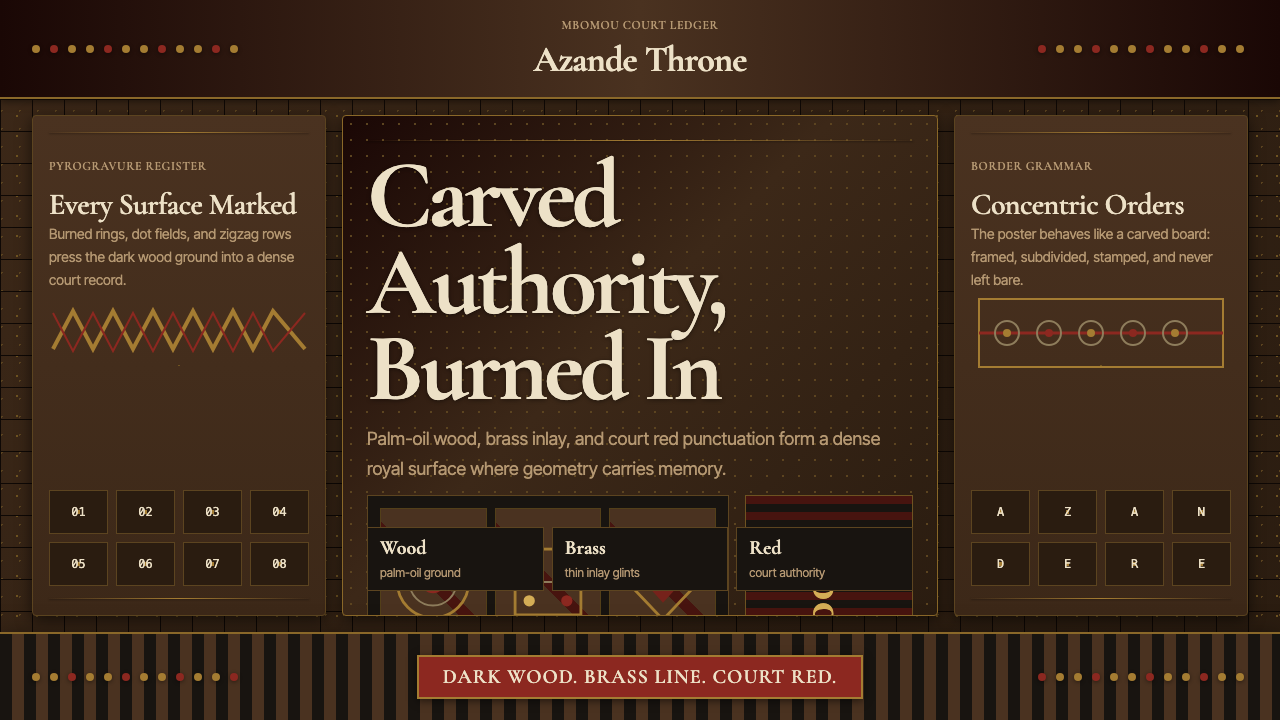 Central African Azande ThroneDense court gravity. Dark wood grids, brass dots, and court red cover every s…
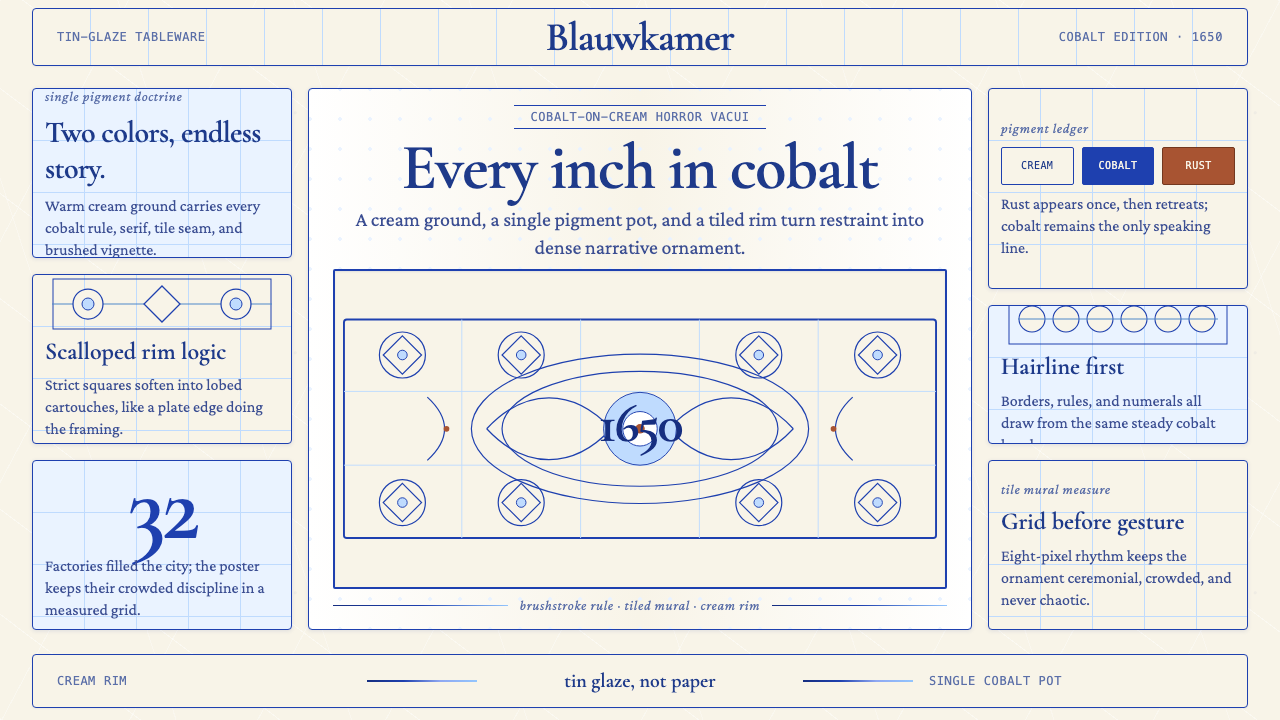 Delft Blue PotteryRestrained, yet every inch speaks. Cobalt hairlines crowd a cream tile grid.
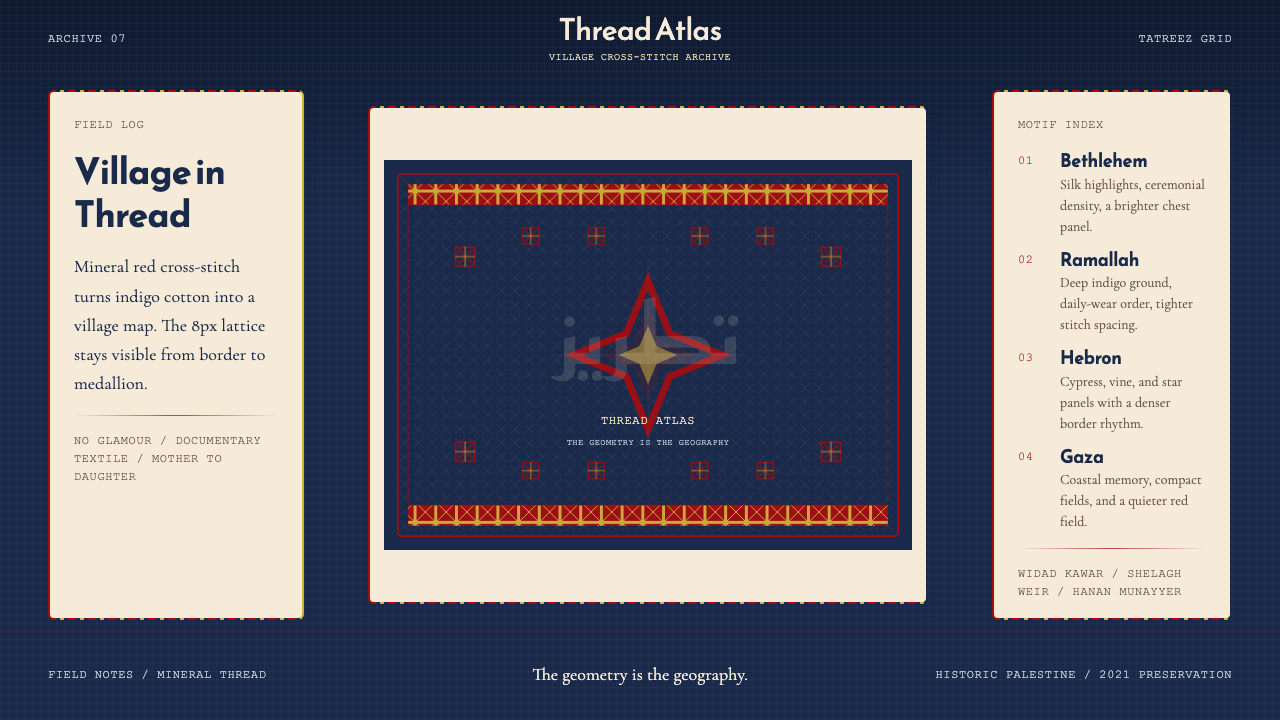 Palestinian Tatreez Cross-StitchMemory in thread. Red cross-stitch on indigo cotton, built on an 8px grid.
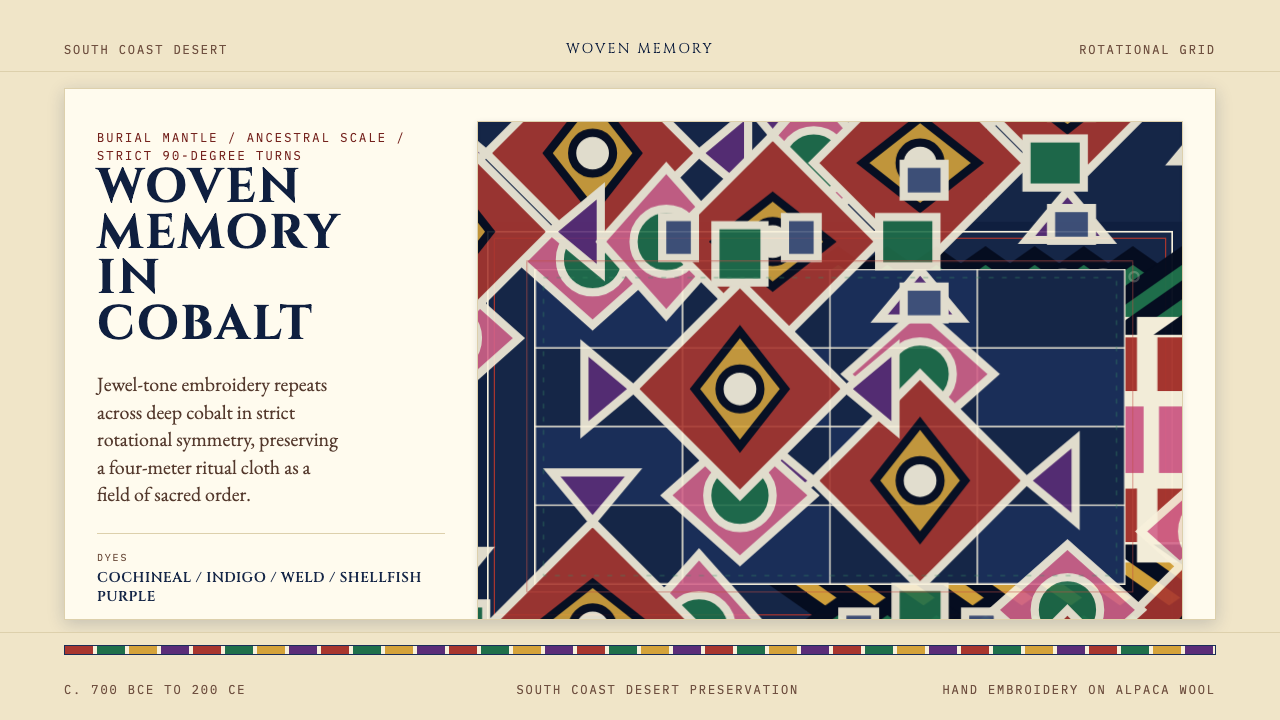 Paracas Andean TextileAncestral and exact. Jewel tones repeat on deep cobalt in strict 90° turns.
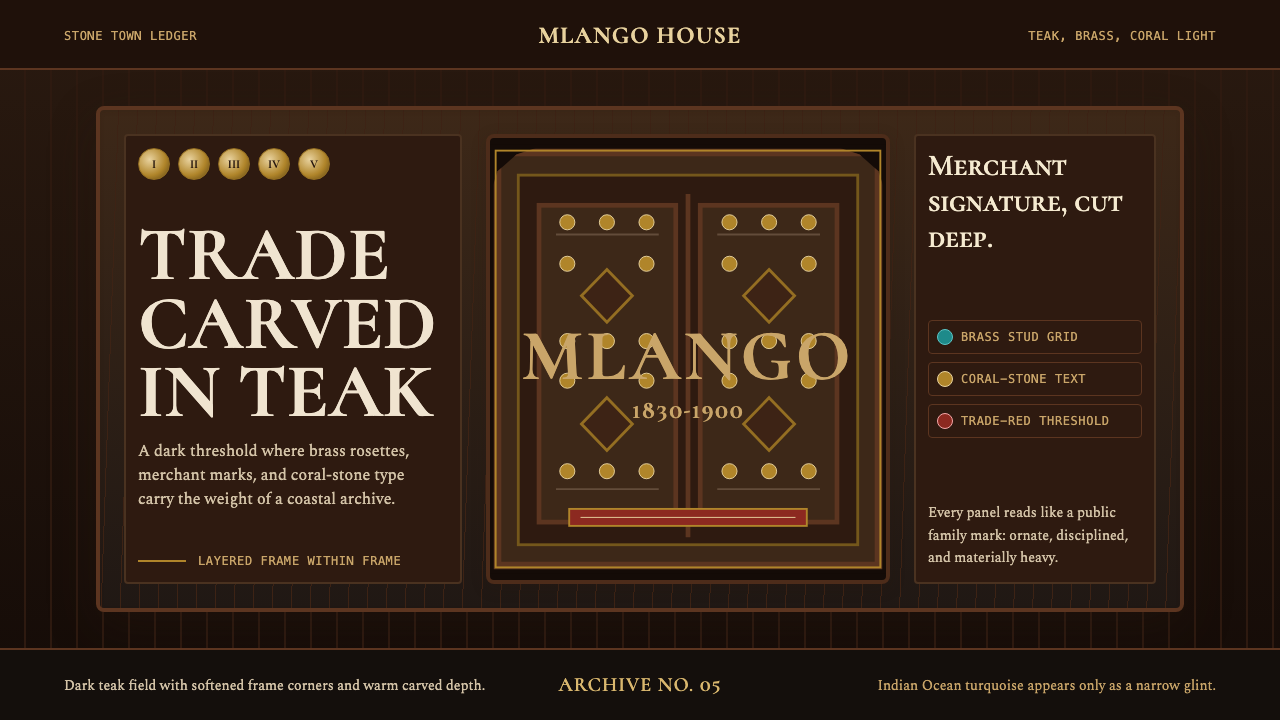 Swahili Stone Town DoorTeak darkness remembers. Brass studs and Cormorant small caps frame a carved…
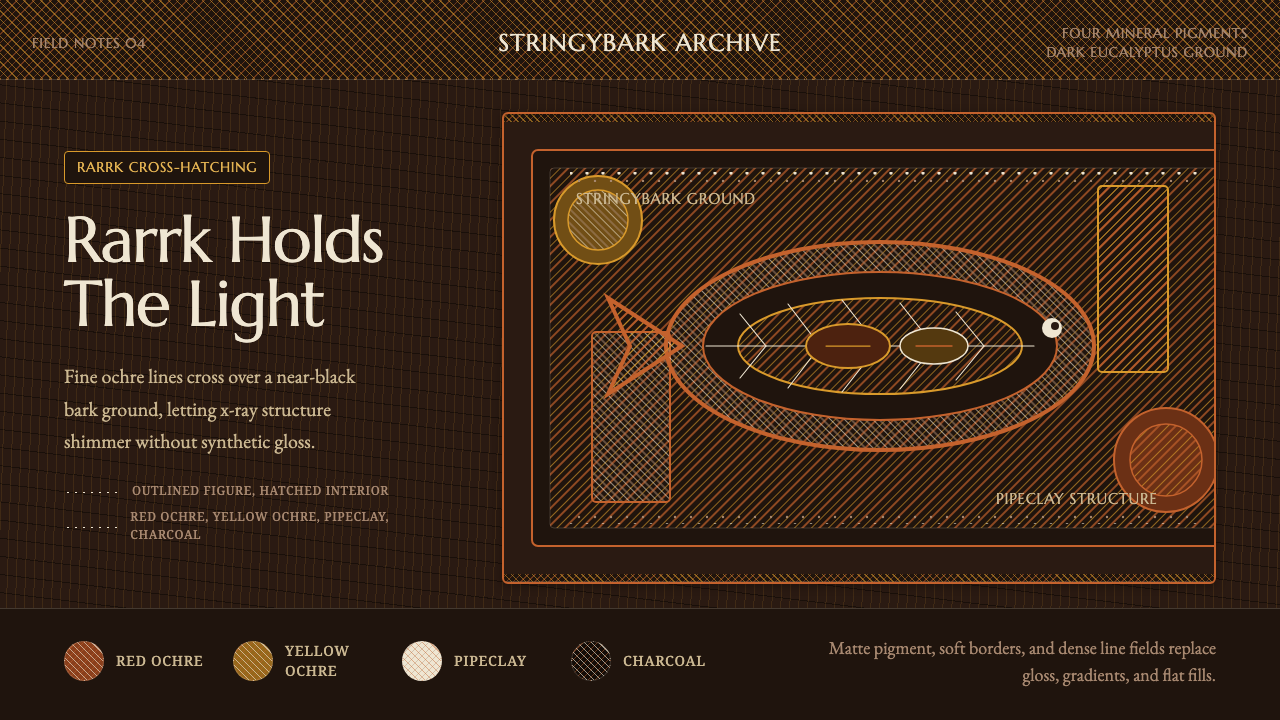 Arnhem X-Ray Bark PaintingShimmers without gloss. Ochre rarrk lines vibrate on dark stringybark.