What is Bissau Carnival Mask?
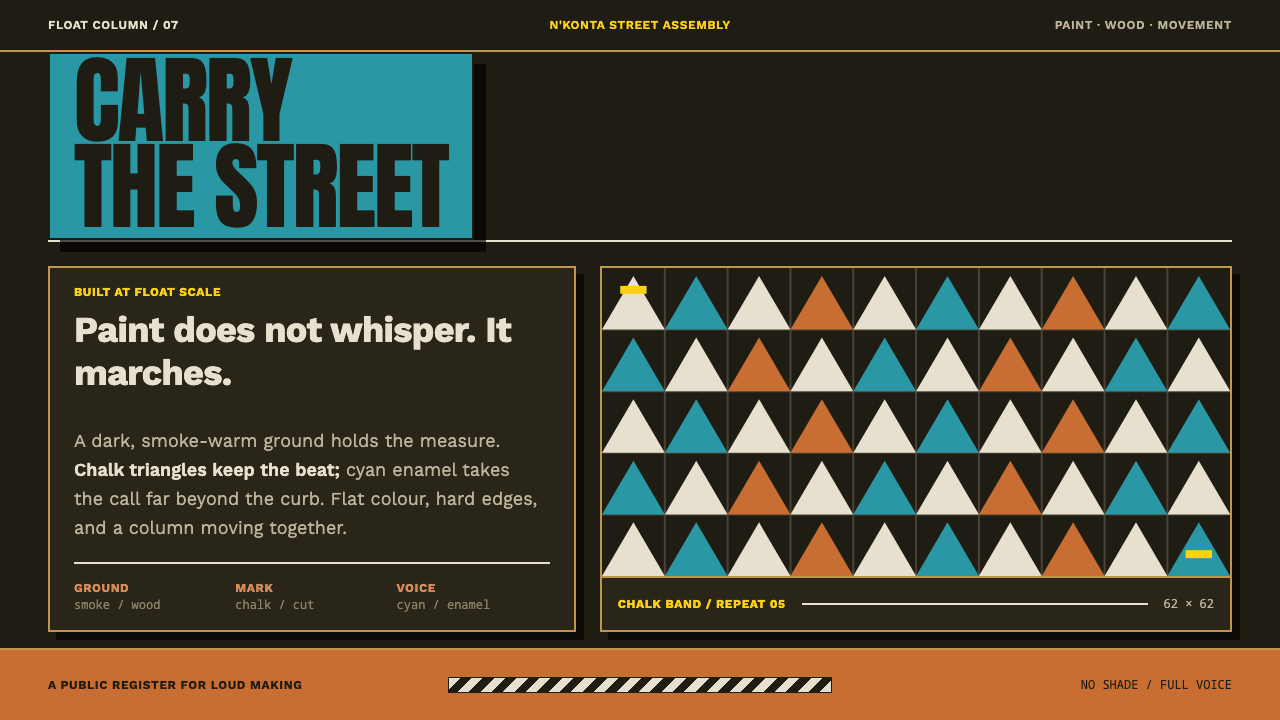
Bissau's carnival mask style keeps two registers legible at once: smoke-dark carved wood marked with chalk triangles, and enamel colour laid flat for the street.
Bissau Carnival Mask in brief
The Bissau carnival mask is a style drawn from two linked traditions in Guinea-Bissau, on the West African coast. One is the masquerade of the Bijagó people of the Bissagos Islands, who carve ox, shark and stingray heads to be worn across the head and shoulders. The other is the modern Carnaval de Bissau in the capital, where the same animals return on floats and in costume, scaled up to the size of the street. As a design style it is built from three things: a dark carved ground, flat white chalk geometry, and enamel colour applied without shading.
The older register is the Bijagó mask. The wood is smoked almost black. Flat white chalk triangles are marked across it, raffia hangs below in uneven bulk, and real horns are fitted so that they push forward and out. These objects belong to the fanado initiation and are made to be worn and carried, not hung on a wall. The younger register is the carnival float, where the same animals reappear in papier-mâché, finished in thick gloss enamel and painted by hand with the brushstrokes left showing, under banners lettered by hand at full arm's length. The red, green and yellow of the national flag go straight onto bodies and banners.
What the system keeps is the contrast between the two. A dark carved ground carries the weight. Chalk geometry acts as the measure and the ruler, with triangles cutting across the dark like teeth or rays. Colour is applied as flat enamel with no shadow modelling the form, because these masks are meant to be seen from a distance, in daylight, in a crowd and in motion. The result reads as bold, graphic and physical, and its energy comes from scale and silhouette far more than from fine detail.
Where does Bissau Carnival Mask come from?
Guinea-Bissau sits on the West African coast, and beyond the capital, Bissau, an archipelago of islands scatters offshore, the Bijagós, among them Formosa, Bubaque and Orango. The Bijagó zoomorphic masquerade is the older thread of this style. Masks take the forms of animals, such as ox, shark and stingray, and are worn on the head and shoulders as part of the fanado initiation cycle. What matters for design is that they are objects made for wearing and performing. They are not made for display, and everything about their proportion and bulk follows from the fact that a person has to carry them.
The British Museum holds a Bijagó buffalo mask from the island of Formosa, catalogued as Af1960,18.1. It is a useful reference point for the form language: a carved animal head made to be worn, not an abstract sculpture. A museum record like this is part of how the mask form became legible outside the islands, though it also lifts the object out of the performances that gave it meaning. A style that draws on such objects inherits both the visual information and the obligation not to forget where it came from.
The second thread is the modern Carnaval de Bissau, documented here for the period from 1990 to 2010, although the mask forms it draws on are far older. It belongs to the family of lusophone Atlantic carnivals, the street festivals of the Portuguese-speaking world, and in Bissau its makers are the neighbourhood carnival groups. On their floats the Bijagó animals come back in papier-mâché and gloss enamel. The surfaces are painted by hand with strokes left showing, banners are lettered at full arm's length, and the red, green and yellow of the national flag go straight onto bodies and banners.
The design system keeps both registers legible instead of merging them into a single generic 'African' pattern. The dark carved ground belongs to the older register, the flat enamel colour to the carnival, and the chalk geometry runs through both as a shared measure. Because the masks are tied to initiation, the style should be handled with some respect. It borrows structure, contrast and scale, and it does not treat the masks' faces as ornament to be scattered over a page.
What defines the Bissau Carnival Mask look?
Smoke-Dark Ground
The ground is wood smoked almost black, a warm and heavy darkness rather than a cold digital one. It carries the visual weight of the whole composition and makes every lighter or more saturated mark stand out. This is a dark-mode style by nature, and the darkness should feel absorbed into a material, not simply switched on.
Chalk Triangles
Flat white chalk triangles are marked across the dark surface, repeated and pointed like teeth or rays. They work as a ruler that measures the ground, not as a fill. The geometry is simple and hard-edged, and it is applied as a flat opaque white with no outline, glow or gradient.
Flat Enamel Colour
Colour arrives as enamel, strongly saturated and led by a cyan-blue that carries across a distance. In the real objects the paint is glossy; in the system it is rendered as flat colour with no modelling shadow. One or two enamel colours at a time against the dark ground do more work than a full range used at once.
Forward Silhouette
Real horns are fitted so that they push forward and out, and the whole mask has a thrusting, projecting outline. The silhouette is the first thing seen at a distance, so it has to be strong. In layout terms, that means shapes that lean, jut and break the frame, and compositions with a clear directional push rather than a centred, symmetrical calm.
Uneven Bulk
Raffia hangs from the mask in large, uneven quantities, so the lower edge is ragged and heavy, never trimmed to a neat line. The same irregularity belongs in the system: fringes, torn-looking edges and asymmetrical masses that sit beside the hard geometry of the chalk marks and balance it.
Visible Hand
Floats are painted by hand with the brushstrokes still showing, and banners are lettered at full arm's length. Lettering is large, confident and a little uneven, built to be read from far away. Keep that physicality: avoid finishes that hide the brush, and let display text feel painted rather than typeset.
Two Registers, One System
The carved, smoked, ritual-derived register and the painted, glossy, street-carnival register are both part of the style. Chalk geometry bridges them. Aim for a composition where a viewer can still tell which parts are dark carved ground and which are bright flat enamel, instead of blending everything into a single mid-tone mix.
Who shaped Bissau Carnival Mask?
The Bijagó carve the ox, shark and stingray masks that are the older source of this style. The masks are worn across the head and shoulders for the fanado initiation, and they are smoked dark, marked with chalk triangles, and hung with raffia and real horns. Every formal choice in the system, from the weight of the dark ground to the forward push of the silhouette, starts with their work, and any use of it should say so.
The British Museum's Bijagó buffalo mask from the island of Formosa, catalogued as Af1960,18.1, is a documented object that anchors the form language: a carved animal head made to be worn. It shows how museum collections preserve the mask as an object, and it is a reminder that the performance, the people and the initiation context are what the object was made for.
The neighbourhood carnival groups of Bissau are the makers of the modern Carnaval de Bissau, documented here from 1990 to 2010. On their floats the old animals return in papier-mâché and gloss enamel, with brushwork left visible, banners lettered by hand and the national red, green and yellow worn straight on bodies. They are the source of the system's loud, flat, hand-painted colour register.
How do you use Bissau Carnival Mask today?
The Bissau carnival mask style is loud, dark and physical, so it suits work that wants energy and presence: festivals, music, nightlife, cultural programmes, arts organisations, campaigns that mean to be noticed. It is a poor fit for quiet, clinical or reassurance-driven products such as medical, legal or formal financial services, where its volume would feel out of place.
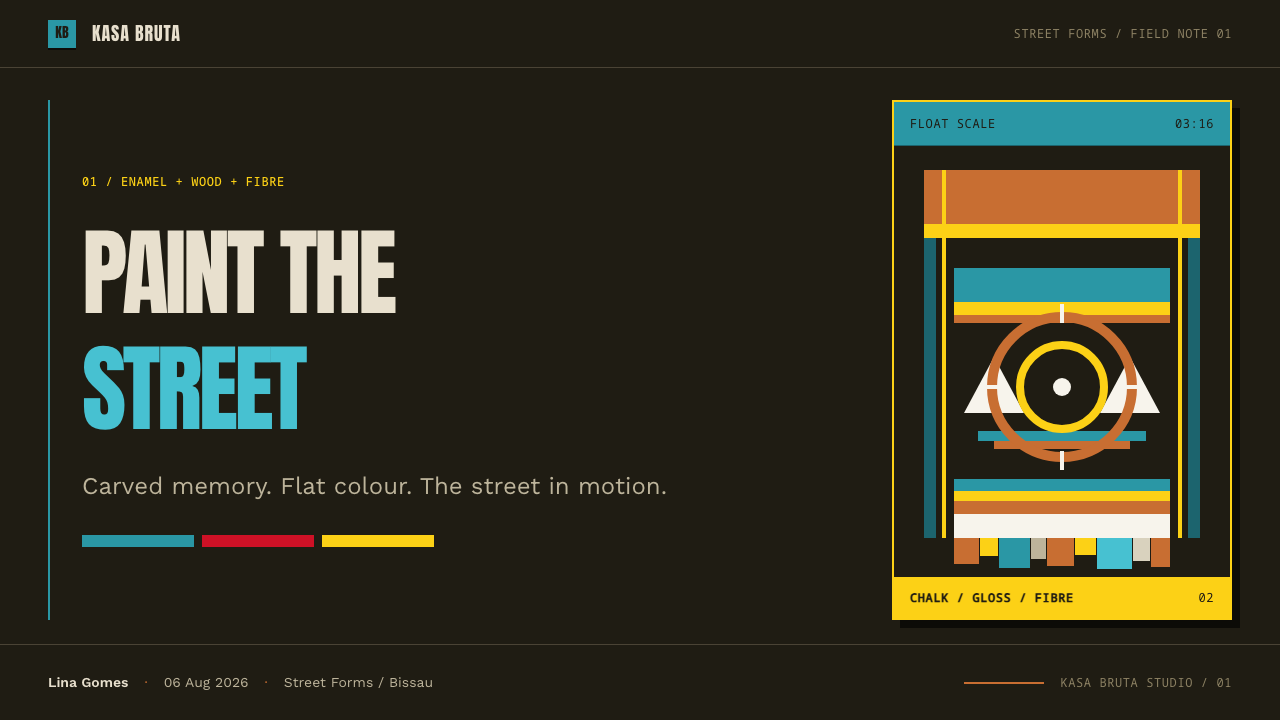
For presentation slides, a cover can be a smoke-dark field with a band of white triangles cutting across it and the title set large in a hand-lettered or loosely painted display style. Content slides keep the dark ground and use one flat enamel colour per slide as the focus, with chalk triangles as dividers. Data slides show bars and areas as flat enamel blocks on the dark, with no shadow or gloss, and a single chalk-white triangle can mark the value that matters most.
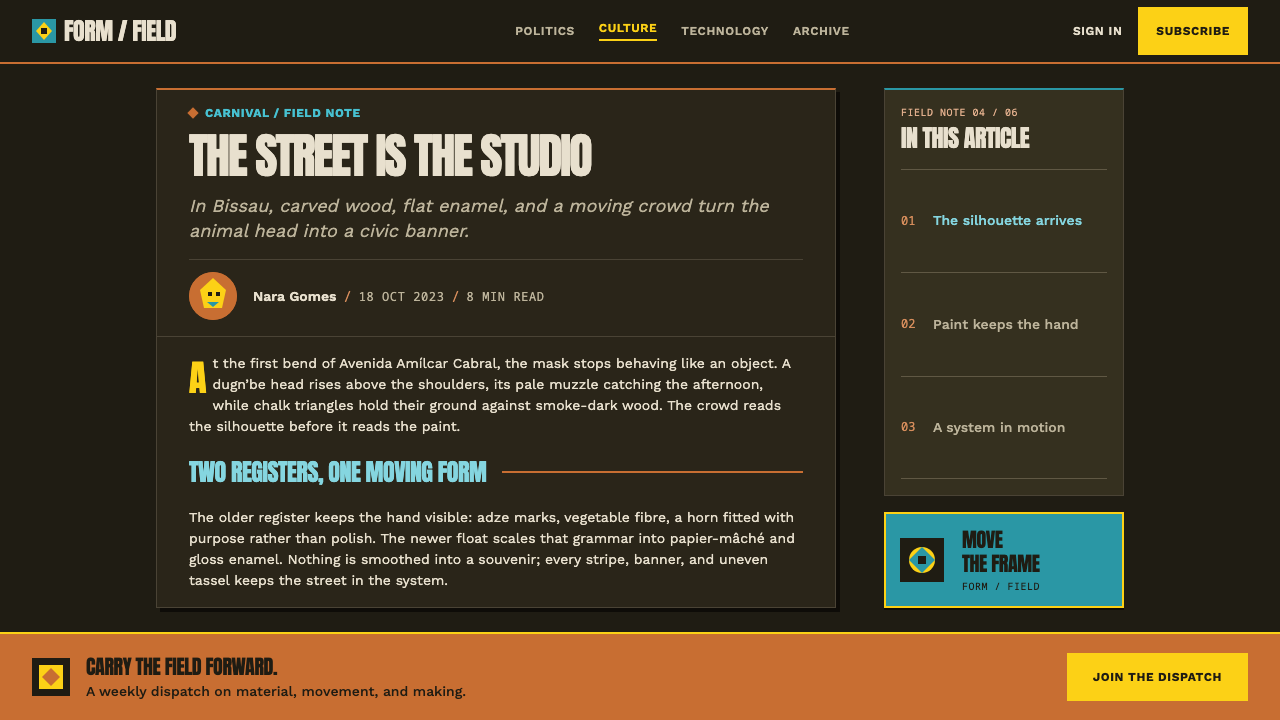
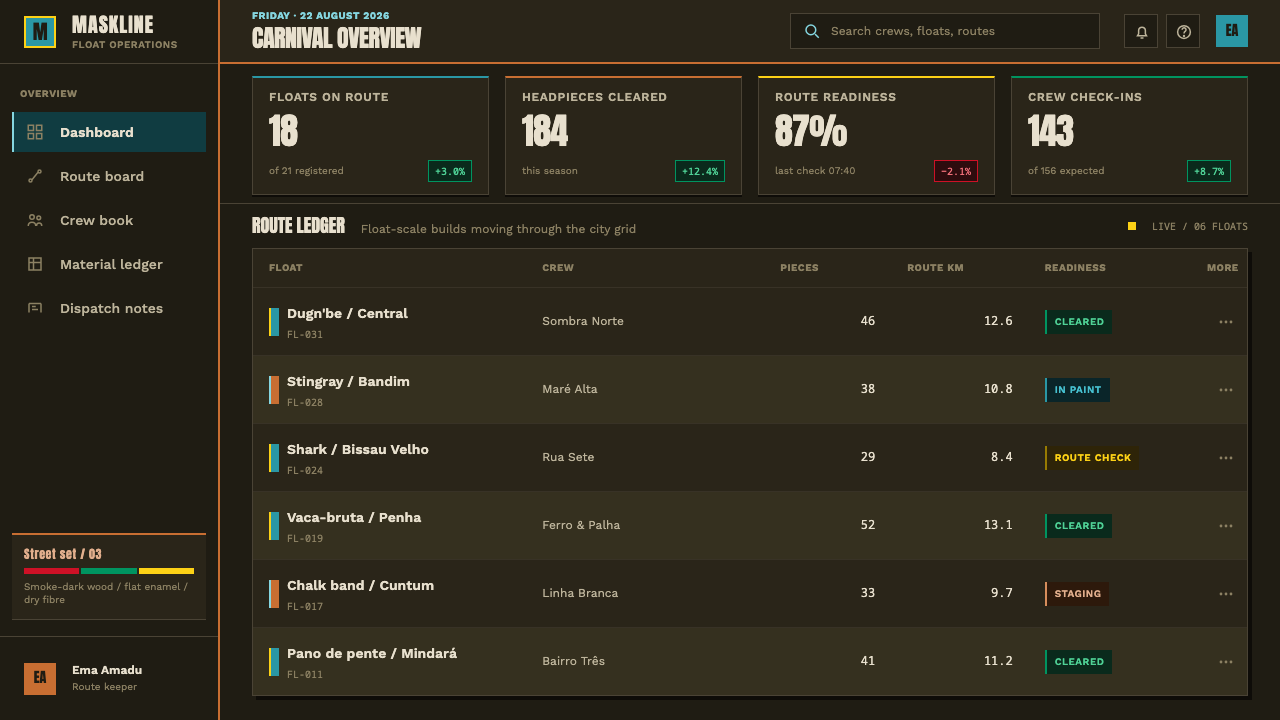
For web interfaces, the style is a natural dark theme. Set text in chalk white on the smoke-dark ground, reserve a single enamel colour for the primary action and a second for alerts, and draw cards as flat blocks without drop shadows or glossy gradients. Triangles work as dividers, indicators and focus markers. Dark dashboards also suit it, as long as the colour ration stays tight; pricing tiers can be flat blocks of different enamel colours that never blend into each other.
For editorial and marketing work, think festival posters, programmes, event pages and music campaigns. Headlines act like banners lettered at full arm's length, large enough to read across a street. Photography of crowds, costume and movement works better than studio shots, and layouts can tilt and jut with the confidence of a float turning a corner. Keep the hand visible in the lettering and let the dark ground do the quiet work between the loud elements.
The most common mistake is to treat the style as a generic 'African pattern' and scatter masks, triangles or borders across a layout as ornament. Others follow: using every enamel colour at once so the dark ground disappears, adding gloss gradients or drop shadows to the enamel, tidying the lettering into a neat typeface, or placing the masks' faces on commercial products as decoration. The style rests on contrast, scale and silhouette, and it should credit the Bijagó and the carnival makers who built that language.
Bissau Carnival Mask — FAQ
Is this one tradition or two?
Two linked ones, and the style keeps both. The older is the Bijagó masquerade of the Bissagos Islands, with carved animal heads smoked dark and marked with chalk. The younger is the Carnaval de Bissau in the capital, where the same animals return on floats in papier-mâché and gloss enamel. The dark carved ground belongs to the first, the flat enamel colour to the second, and the chalk geometry connects them.
Why is the ground so dark?
Because the wood is smoked almost black. The darkness is a material fact before it is a design choice, and it is what makes the chalk marks and enamel colours carry across a distance. In practice it gives you a ready-made dark theme with strong contrast, but the black should feel warm and absorbed, not like a flat digital void.
Should the enamel look glossy?
The real carnival paint is thick and glossy, but the system renders it as flat colour with no shading, gradient or highlight. That keeps the shapes graphic and legible from far away and avoids the soft, rendered look of most modern interfaces. Let the flatness and a trace of visible brushwork suggest the enamel, and skip any shine effect.
How should I use the red, green and yellow of the flag?
As flat colours applied directly to bodies, banners and large blocks, in the way the carnival groups use them. Use them in small quantities and with intent, since the dark ground and a single enamel colour already give the system its force. If all three appear at full strength on every screen, the layout starts to read as a flag rather than as a carved, painted object.
How do I use the style respectfully?
Borrow structure, contrast and scale, and name the sources, the Bijagó masquerade and the carnival groups of Bissau. The masks are tied to the fanado initiation and are made to be worn, so avoid placing their faces as decoration, avoid generic 'tribal' fills, and avoid implying that a product carries their meaning. Where the work speaks about Guinea-Bissau directly, involve people from there.
Related design styles
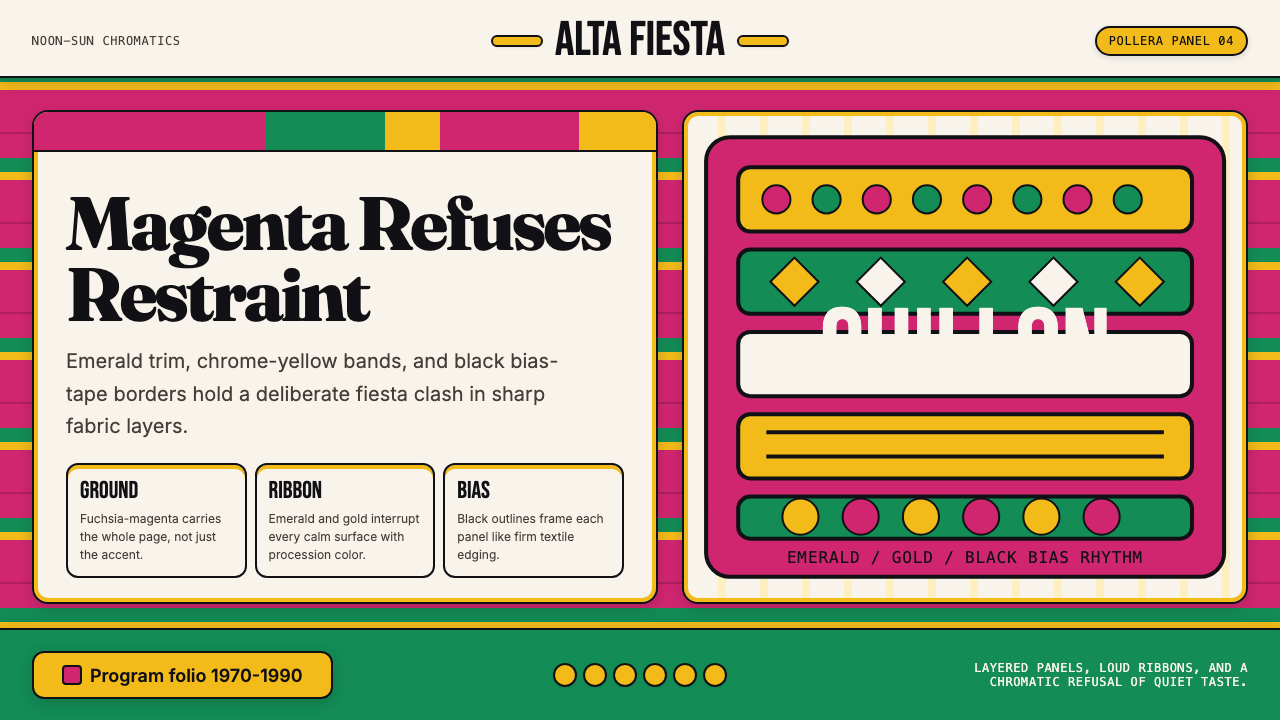 Bolivian Pollera Fiesta MagentaChromatic defiance. Magenta ground, emerald bands and black outlines clash li…
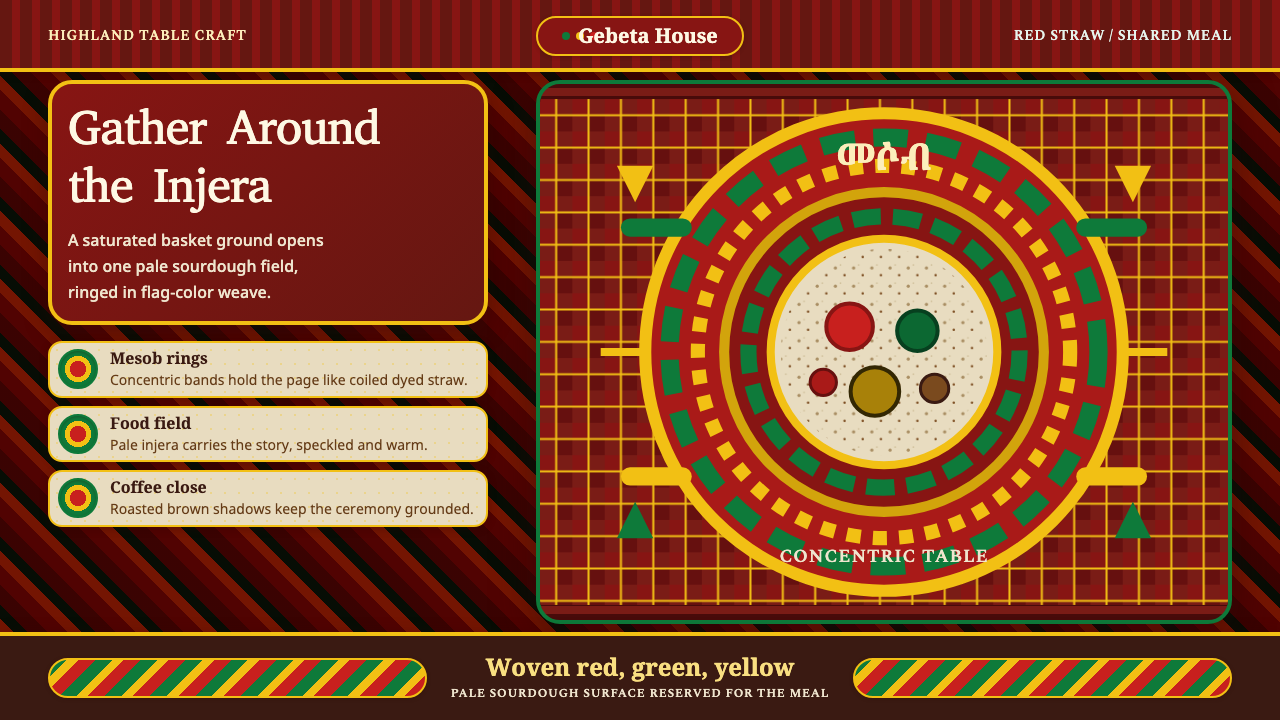 Ethiopian Injera Mesob SpreadHospitality is woven in. Berbere red, flag bands, and an injera field hold th…
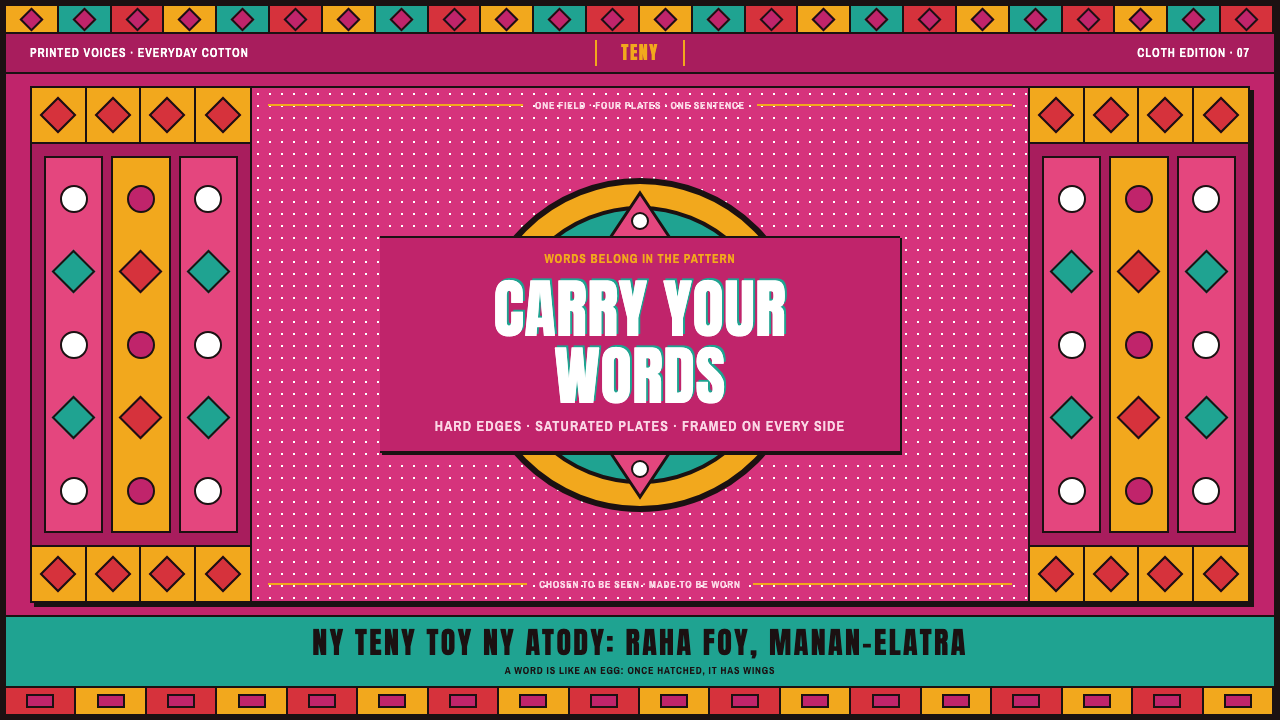 Malagasy Lamba HoanyWords become ornament. Hot fuchsia, saturated print plates and a border that…
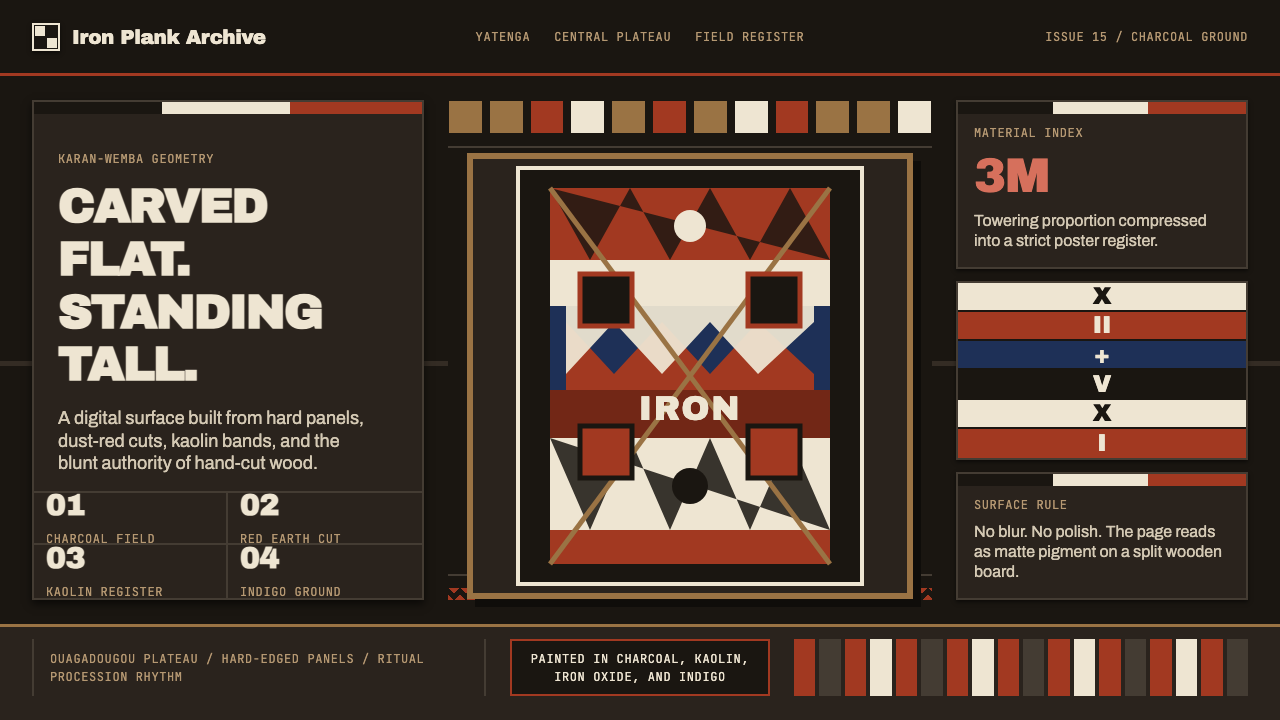 Mossi Burkina Plank MaskCarved, not rendered. Charcoal fields, dust-red cuts, and kaolin bands stack…
 Ndebele Geometric MuralSymmetry declares presence. Emerald, cobalt, crimson and citron lock into bla…
 Tingatinga PaintingJoy refuses blending. Enamel yellow, Bungee strokes, and black-outlined flat…