What is Gucci Double-G?
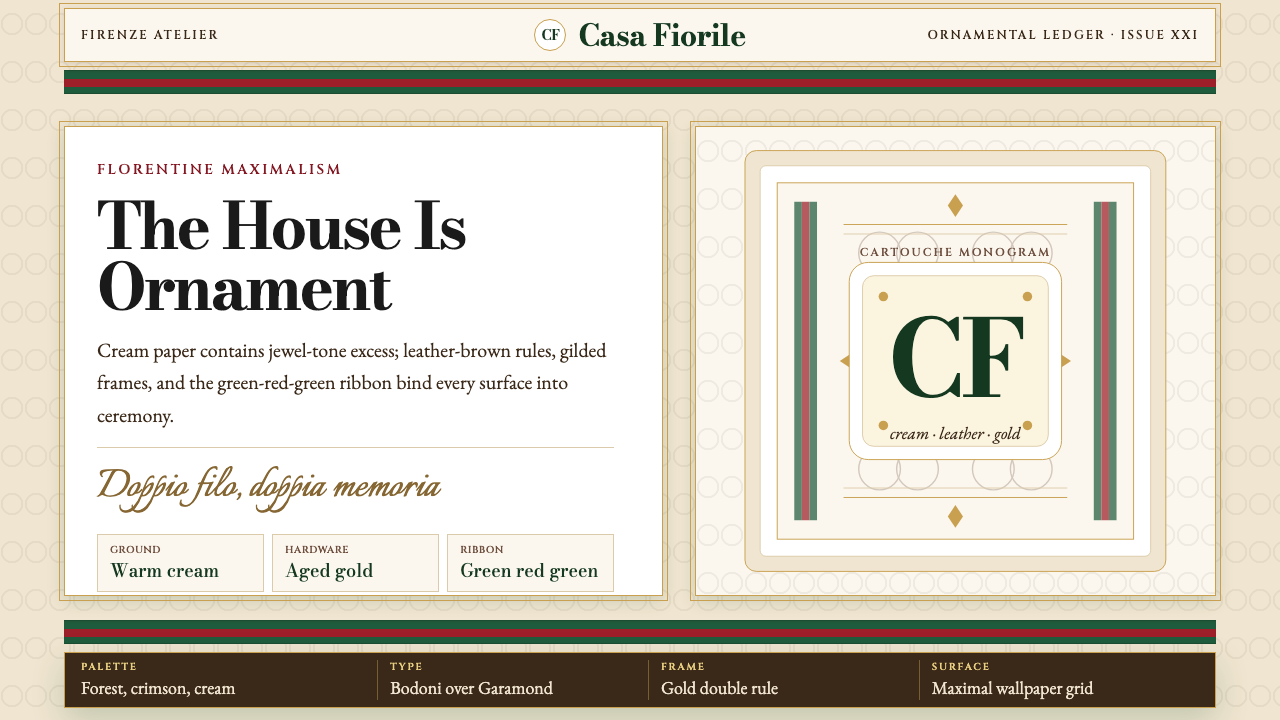
Since 1921, Gucci has proven that maximum ornament, handled with structural discipline, is its own form of luxury authority.
Gucci Double-G in brief
Gucci Double-G refers to the complete visual identity system assembled by the Florentine luxury house over its century-long history — centered on the interlocked-GG monogram, the green-red-green webbing stripe, horsebit hardware, and a typographic system anchored by high-contrast serif lettering on cream or forest-green grounds. It is maximalist in conviction: where most modern brand systems subtract until nothing can be removed, the Gucci system layers motif upon motif, trusting that saturation, when disciplined by a coherent palette and recurring symbols, produces grandeur rather than chaos.
The aesthetic draws on Florence's visual inheritance — Renaissance guild heraldry, Baroque gilt cartouche frames, the jewel-toned brocades of Medici-era textile workshops — and translates those references into a reproducible brand grammar. Cream grounds, deep forest green, and warm red are the structural colors; gold hardware and gilded type add a ceremonial register. The serif typeface used across Gucci communications is high-contrast in the classical Bodoni tradition, with razor-thin hairlines meeting broad strokes, giving even short labels a weighted, monumental quality.
Crucially, the system is not arbitrary abundance. The interlocked-GG monogram functions as a geometric anchor in every composition — a bilateral symbol that is both letter and ornamental medallion. The webbing stripe is always green-red-green at a fixed relative proportion, never reordered. These recurring constraints give the maximalism a structural spine, so the eye reads richness rather than noise.

Where does Gucci Double-G come from?
Guccio Gucci opened his leather goods shop in Florence in 1921, after working for years in London — most famously as a luggage porter and lift attendant at the Savoy Hotel, where he observed the traveling habits and material preferences of the European aristocracy at close range. He returned to Florence determined to produce luggage and equestrian accessories of equivalent quality, using the finest Tuscan leatherwork traditions. The earliest Gucci aesthetic was therefore grounded in the vocabulary of the stable and the saddle: the horsebit became the house's first iconic hardware motif, and equestrian browns, tans, and forest greens defined the initial palette.
The green-red-green webbing stripe appeared in the 1950s, when a postwar shortage of leather forced Gucci to experiment with canvas and fabric alternatives. Rather than treating this as a compromise, Aldo Gucci — Guccio's son, who was instrumental in expanding the brand internationally — codified the stripe as a signature element. The specific proportion of green flanking red, and the precise relationship between stripe and ground, became standardized across luggage, belts, and accessories. By the time the leather shortage resolved, the stripe had become so recognizable that removing it was unthinkable.
The interlocked-GG monogram was formalized in the 1960s as Gucci expanded into ready-to-wear and accessories beyond luggage. The device draws on a tradition of aristocratic monogramming — European royal households had long used interlaced ciphers as marks of ownership and status — and adapts it into a geometric module that tiles seamlessly as a surface pattern. The monogram canvas, typically rendered in warm tan against a darker ground or as a tone-on-tone pattern in cream, became one of the most widely recognized luxury surface treatments of the twentieth century.
The maximalist visual identity reached its most articulate and globally influential expression during Alessandro Michele's tenure as creative director from 2015 to 2022. Michele layered the existing Gucci grammar with additional historical references: Renaissance botanical illustration, Grecian mythology, medieval bestiaries, and 1970s Italian camp. He reintroduced the house's bee and snake motifs, expanded the typographic system to include elaborate gilt lettering, and styled campaigns as staged tableaux drawing on Italian Renaissance painting. The result was a visual system of almost theatrical density — one that revived Gucci's commercial fortunes dramatically and positioned maximalism as a legitimate counter-movement to the spare Scandinavian minimalism that had dominated luxury design for the prior decade. From 2023, Sabato De Sarno has steered the house toward a quieter expression of the same underlying grammar, reducing ornamental density while retaining the core palette and monogram.
What defines the Gucci Double-G look?
Palette
The canonical Gucci palette organizes itself around three structural colors: cream (the primary ground), forest green (the dominant brand color, used for backgrounds, type, and the outer bands of the webbing stripe), and warm red (used as an accent, most visibly as the center band of the stripe). Gold — present in hardware, type outlines, and pattern repeats — functions as the ceremonial register that elevates every other element. Jewel tones including deep burgundy, sapphire, and rust appear seasonally in product colorways but rarely displace the core three. The palette reads as inherently warm and southern European — saturated enough to feel opulent but never primary-bright.
Typography
Gucci's typographic identity is built on high-contrast classical serifs in the Bodoni tradition — letters characterized by an extreme difference between thick strokes and razor-thin hairlines, with perfectly circular bowls and ball terminals that give the letterform an almost sculptural quality. Type is most commonly set in cream against forest green or in forest green against cream, both combinations drawing maximum contrast from the core palette. All-caps settings are favored for brand marks, packaging labels, and editorial headers, where the uniform cap height creates a monumental register. The overall effect is of an engraver's plate brought into print — precise, weighted, aristocratic.
The Interlocked-GG Monogram
The interlocked-GG functions simultaneously as letter, ornament, and geometric module. Two uppercase G forms are mirrored and locked together so that each completes the other, producing a bilateral symbol with strong vertical and horizontal axes. As a surface pattern, it tiles seamlessly — the monogram canvas has the visual logic of a classical damask or heraldic repeat, where foreground and background are in constant dialogue. In brand applications the monogram may appear alone as a hardware detail, as an embossed leather texture, or as a large-scale graphic element in editorial layouts. Its bilateral symmetry gives it an inherent authority that makes it effective at both small and monumental scales.
The Green-Red-Green Webbing Stripe
The webbing stripe is Gucci's most immediately legible signal — a fixed sequence of forest green, warm red, and forest green bands at a precise and consistent relative width. It functions as a framing device on luggage and bags, as a standalone decorative band on belts and footwear, and as a graphic element in advertising layouts. The stripe's power comes from its rigidity: the proportions and color order are never varied, so even a narrow glimpse of the green-red-green sequence is sufficient for recognition. In layouts, the stripe typically appears as a horizontal or vertical rule that organizes the composition rather than merely decorates it.
Maximalist Layering
Where restrained systems remove elements until the composition is resolved, Gucci's visual logic adds until the field reaches a specific kind of saturation — one where every element reinforces every other. Floral illustration overlaps with monogram canvas; gilt cartouche frames enclose typeset labels; textile patterns appear behind hardware details. The system manages this density through a strict hierarchy: the monogram and stripe are always primary; secondary motifs (bees, snakes, florals, horsebit details) operate at a lower visual weight and never compete with the anchoring elements. The result is a composition that reads as lush rather than cluttered.
Gold as Ceremony
Gold in the Gucci system is not used for highlights or shimmer effects in the contemporary sense — it is structural and ceremonial. On physical products, polished brass and aged gold-tone hardware (the horsebit, buckles, chain links) serve as load-bearing connective elements. In print and digital applications, gold appears as border lines framing text blocks, as typographic outlines on logotype treatments, and as the ground color of certain label designs. The handling of gold throughout the system evokes guild-era gilding and Florentine manuscript illumination rather than contemporary metallics, grounding the brand in a specific historical register.
Equestrian Motif Vocabulary
The house's founding in saddlery and equestrian accessories established a motif vocabulary that persists across all eras of the brand: the horsebit, stirrups, bridle stitching patterns, the double-ring hardware detail. These motifs appear at multiple scales — as functioning hardware on bags and shoes, as embossed surface ornament on leather goods, and as decorative graphic elements in packaging and editorial design. The equestrian reference anchors the brand in a specific social history of European aristocratic leisure, lending the ornamental density a narrative legitimacy. The motifs do not simply decorate — they tell a story about the origin and intended audience of the objects they adorn.

Who shaped Gucci Double-G?
Guccio Gucci (1881–1953) founded the house in Florence in 1921 after years working in London's finest hotels, where proximity to aristocratic travelers shaped his understanding of what luxury luggage and leather goods should be. He established the commitment to Florentine craftsmanship, equestrian aesthetics, and restrained elegance that characterized the brand's first decades. Though he did not live to see the brand's global expansion, the equestrian motifs he introduced — the horsebit above all — remain central to the visual system a century later.
Aldo Gucci (1905–1990) was the principal architect of the brand's international expansion, opening stores in New York in 1953 and subsequently across major cities worldwide. He codified many of the visual signatures that had emerged organically in the postwar years — including the green-red-green webbing stripe and the GG monogram canvas — into consistent, reproducible brand elements. His tenure established Gucci as a global luxury shorthand and brought the interlocked-GG to international recognition across luggage, handbags, scarves, and accessories.
Tom Ford served as creative director from 1994 to 2004, rescuing the brand from near-bankruptcy and repositioning it as a vehicle for a very different kind of Italian luxury — sleek, sexually charged, and modernist rather than ornamental. Ford stripped back much of the heritage maximalism in favor of body-conscious silhouettes and a darker, more minimal palette. His decade at Gucci demonstrated the system's flexibility: even under radical aesthetic revision, the GG monogram and webbing stripe remained constant identifiers, proving their structural durability beyond any single creative vision.
Alessandro Michele's tenure as creative director from 2015 to 2022 represents the most complete and globally influential articulation of the Gucci maximalist identity. Michele drew on the full depth of Italian visual history — Renaissance paintings, Florentine goldsmithing, 1970s camp, classical mythology — and wove these references into a coherent visual ecosystem alongside the existing house signatures. He revived the bee and snake as recurring motifs, introduced elaborate gilt lettering into the typographic system, and styled brand imagery as dense, staged tableaux. His approach demonstrated that maximalism is not the absence of discipline but a different kind of discipline — one organized around accumulation, reference, and symbolic density rather than subtraction.
Sabato De Sarno joined Gucci as creative director in 2023, bringing a quieter and more focused interpretation of the house's codes. His direction has emphasized a deeper, more saturated version of Gucci red — quickly nicknamed 'Ancora' — and has reduced the ornamental density of the Michele era in favor of cleaner silhouettes and more restrained layering. De Sarno's approach represents not a rejection of the Gucci visual system but a recalibration: retaining the core palette, monogram, and equestrian motifs while resetting the ornamental register toward something closer to the house's pre-Michele character.
How do you use Gucci Double-G today?
Applying the Gucci Double-G system to designed work requires understanding its organizing logic before adding ornament. The system is not an invitation to combine everything at once — it is a disciplined hierarchy in which the monogram and stripe are primary anchors, secondary motifs fill without competing, and the palette holds everything together. The most common failure mode is decorating a layout before establishing its structural bones; the second most common is applying the ornamental density without respecting the palette constraints that keep the density legible.
For presentation slides, the Gucci system excels at creating a sense of occasion and institutional weight. Cover slides benefit from the deep forest-green ground with cream typeset in high-contrast classical serifs, framed by a narrow gold border rule. The webbing stripe, rendered as a thin horizontal band, can function as a divider between the title and subtitle zones. Content slides work best with cream grounds, forest-green headings, and black body text — using the stripe sparingly as a section marker rather than as decoration on every slide. Data slides should treat charts as architectural objects: warm-red bars against cream grounds, green axis lines, gold data labels. Avoid filling every chart with the full palette simultaneously; let one color lead per slide.
For web interfaces — dashboards, pricing pages, and brand-adjacent editorial — the system translates into a palette-strict component library. Backgrounds alternate between cream and forest green at the section level rather than the component level; cards sit on cream with green or gold border accents; interactive states use warm red as the signal color. The monogram can appear as a watermark-weight texture in background zones or as a prominent mark in hero sections, but it should not compete with content hierarchy. Navigation is typographic, set in a high-contrast serif in cream on green, with the webbing stripe as a bottom border on the top navigation bar.
For editorial layouts and marketing materials — print or digital — the Gucci system creates strong information hierarchy through its typographic contrasts. Feature headlines in large, tightly set classical serifs against full-bleed forest-green grounds; subheadings in cream at a smaller scale; body text in a readable complementary face at standard weight on a cream ground. The webbing stripe works as a column rule or footer divider. For marketing pages, the gilt cartouche frame — a rectangular border with corner ornaments — can enclose pullquotes or product callouts, grounding them in the brand's Florentine heritage without requiring photographic imagery.
A common mistake when working with this system is treating the gold as a fill color rather than a structural accent. Gold at large areas reads as gaudy rather than luxurious; its power comes from precision — a thin border rule, an outlined letterform, a small hardware motif. Similarly, the monogram pattern should be used at restrained opacity when deployed as a background texture; at full opacity it overwhelms rather than enriches. Finally, resist the temptation to substitute any green or any red for the specific warm, forest-leaning green and terra-cotta-adjacent red that define the stripe — approximations dissolve the brand signal instantly.

Gucci Double-G — FAQ
Is the Gucci system maximalist in the same way that more-is-more decoration is maximalist?
Not exactly. The Gucci system is maximalist in the sense that it deploys more visual elements than a restrained modern identity system, but it is not arbitrary in how it does so. The monogram and stripe are fixed anchors; the secondary motifs operate at lower visual weight and never displace the primaries; the palette is tightly constrained to four or five colors across all applications. This is disciplined layering — the visual equivalent of a well-composed Baroque composition, where abundance and structure coexist. True more-is-more decoration lacks this hierarchy: everything competes at equal weight, and the result is noise. The Gucci system avoids noise by insisting that ornament always serve the brand grammar.
Can the Gucci Double-G aesthetic work for brands outside the luxury sector?
With adaptation, yes — but the system's signals are deeply encoded with specific associations. The high-contrast Bodoni-tradition serif, forest green and cream palette, and monogram logic collectively communicate European luxury heritage, artisanal production, and premium pricing. Any brand borrowing these signals should do so deliberately: the system works for heritage hospitality, premium food and beverage, high-end publishing, or cultural institutions with a historical anchor. It struggles for technology products, health and wellness brands, and anything positioning around accessibility or democratic values — contexts where the aristocratic heritage register reads as exclusionary rather than aspirational.
How do you distinguish an authentic application of this style from a generic luxury pastiche?
The distinguishing test is whether the ornament has structural logic. In an authentic application, the monogram is a compositional anchor, not a fill texture applied indiscriminately; the stripe organizes the layout rather than merely appears on it; gold delineates rather than floods. In a pastiche, ornamental elements are applied as surface dressing over a layout that would be identical without them. The secondary test is palette precision: the specific warmth and depth of the forest green and the warmth of the red matter enormously — generic greens and reds produce a generic result. A third test is typographic — the high-contrast classical serif at appropriate scale and weight, not a display serif chosen for superficial similarity.
Does the system work in dark mode or on dark-ground layouts?
Yes — and in fact the forest-green-ground version of the Gucci palette is one of the canonical expressions of the system, not a dark inversion. When forest green is the ground, cream becomes the primary typographic color and warm red functions as accent. This version reads as particularly authoritative and ceremonial — closer to the atmosphere of a Florentine boutique interior than the cream-ground version. The challenge in dark-ground applications is gold: at low opacity, gold on green can muddy; it works best as a defined line or outlined form rather than a tonal fill. Black as a ground is less canonical and requires more care — it tends to flatten the warmth that defines the system.
What is the most important single principle for applying this style correctly?
Anchor before you ornament. Every Gucci composition — a bag, a campaign image, a packaging label, a slide — begins with a fixed structural element: the monogram, the stripe, or the high-contrast serif logotype. Once the anchor is placed and the ground color is decided, ornament can accumulate around it without producing chaos, because the eye always has a primary point of orientation. Designers who skip the anchor step and begin with decoration find that no amount of correct palette usage or motif selection will produce the system's characteristic sense of organized richness — the composition simply reads as busy. Set the anchor first; the rest will follow.
Related design styles
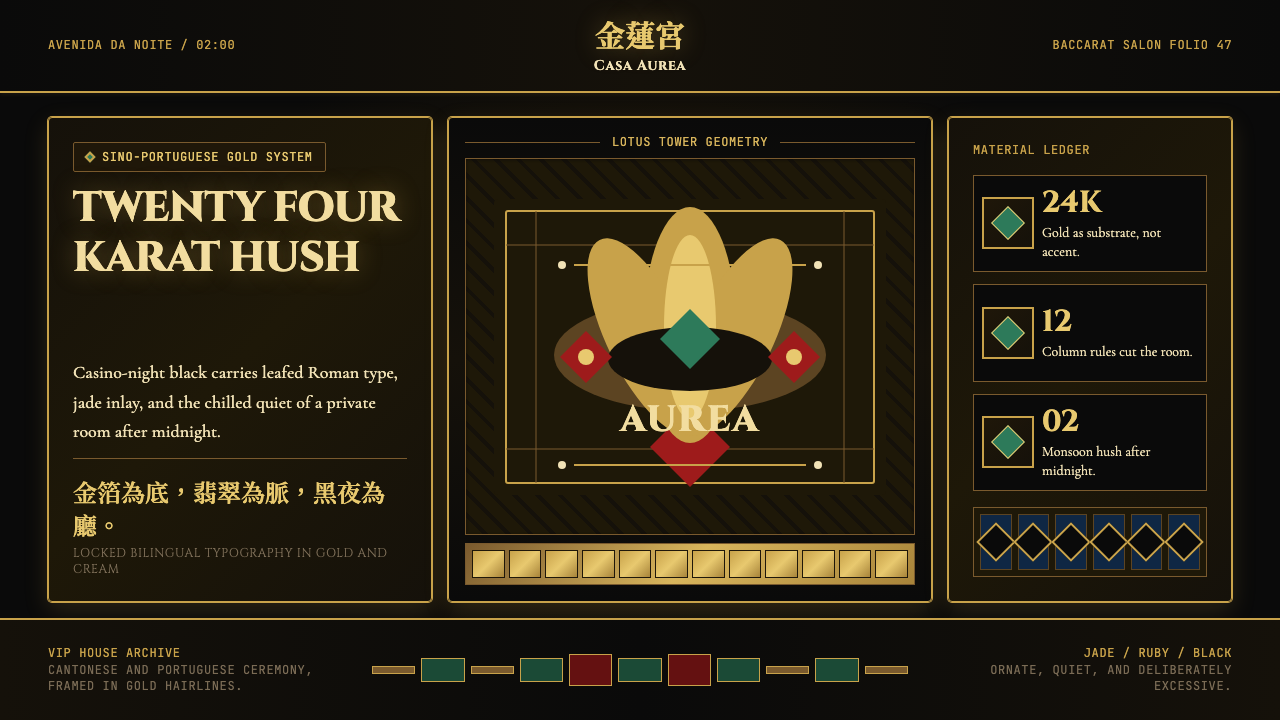 Macau Grand Lisboa Casino GoldGold is the atmosphere. Cinzel type, jade inlay, and 2px rules glow on casino…
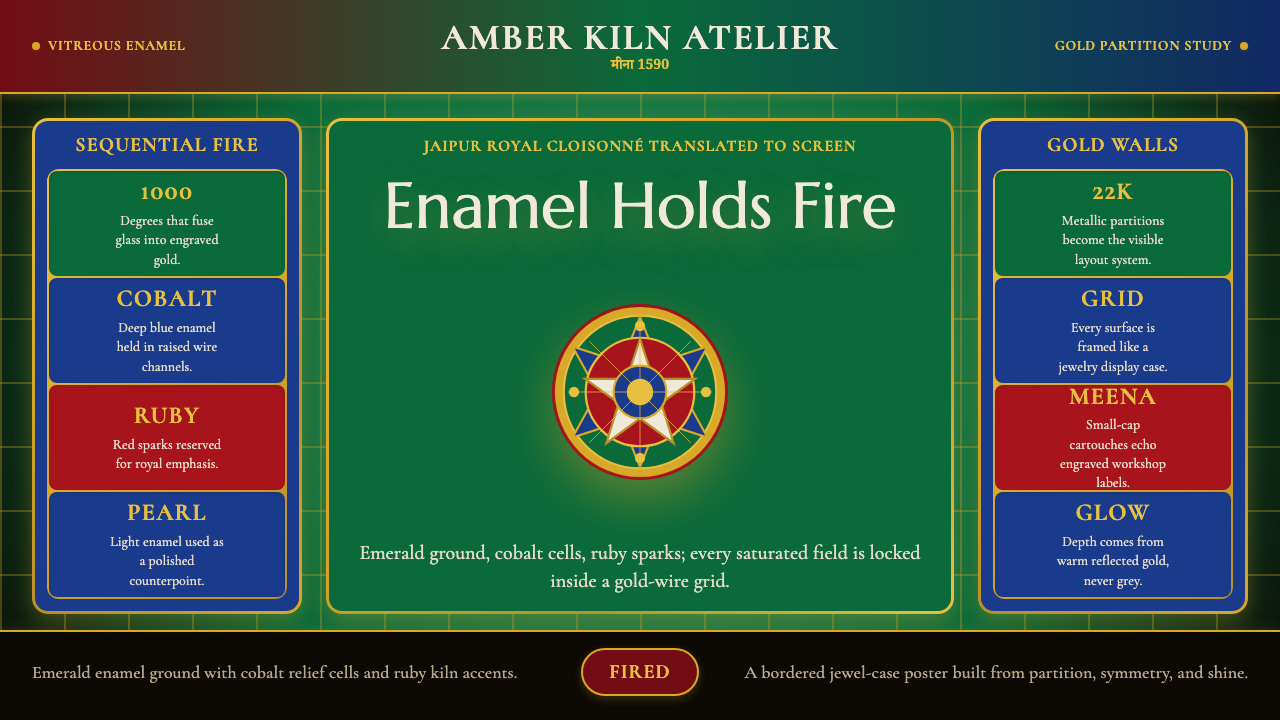 Rajasthani Meenakari EnamelJewel-box intensity. Emerald enamel, cobalt cells, ruby sparks, and gold-wire…
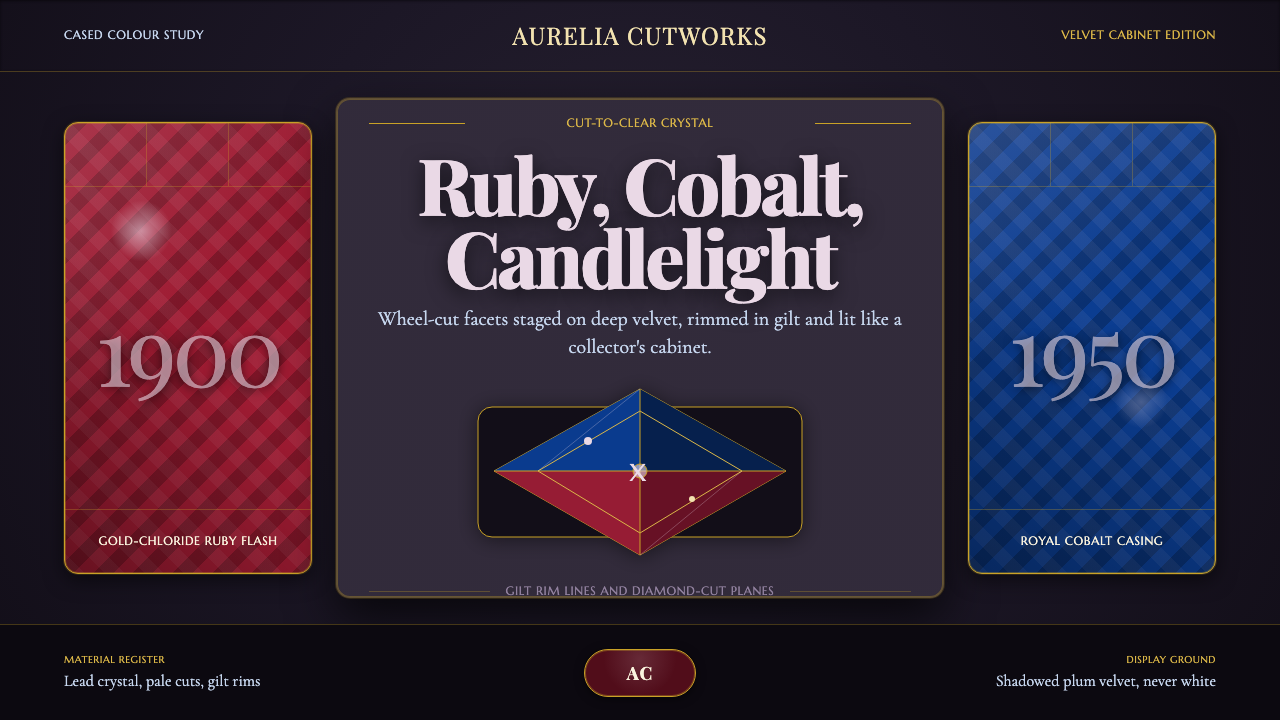 Bohemian Cut CrystalOpulence glows in shadow. Ruby and cobalt facets sit on velvet under gilt rim…
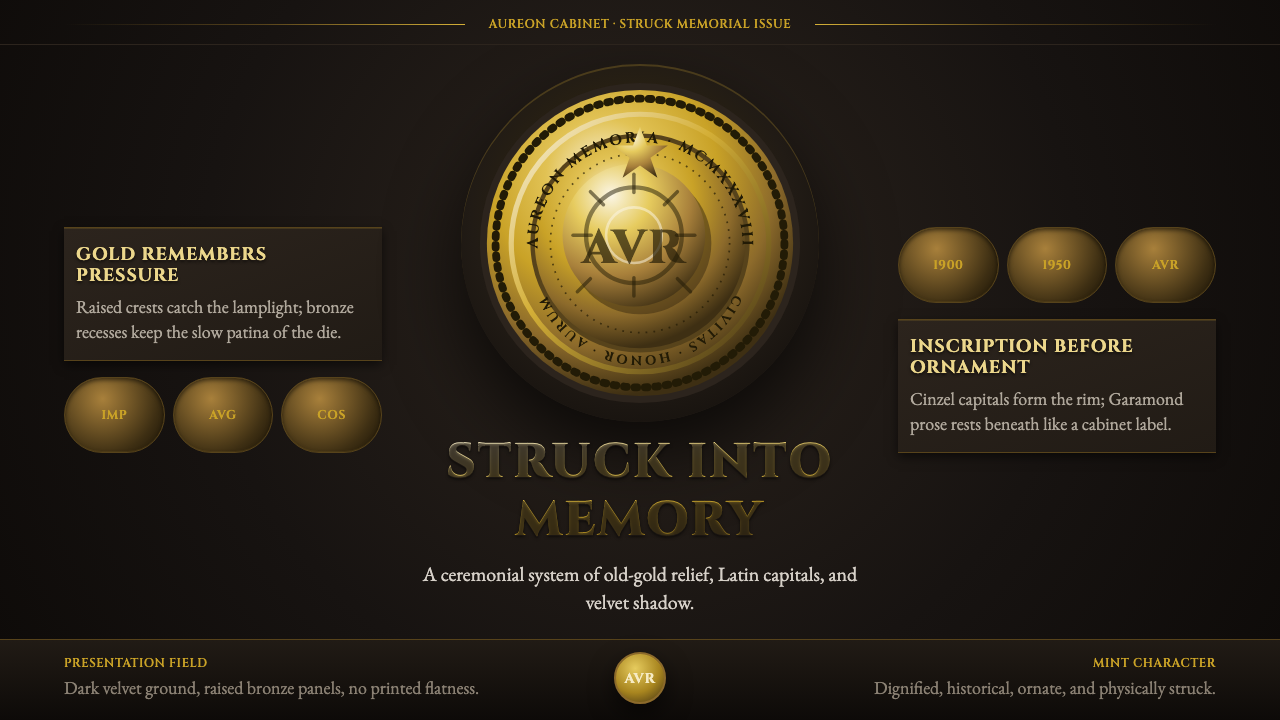 Commemorative CoinAuthority struck in metal. Old-gold relief, denticled rims, and Cinzel capita…
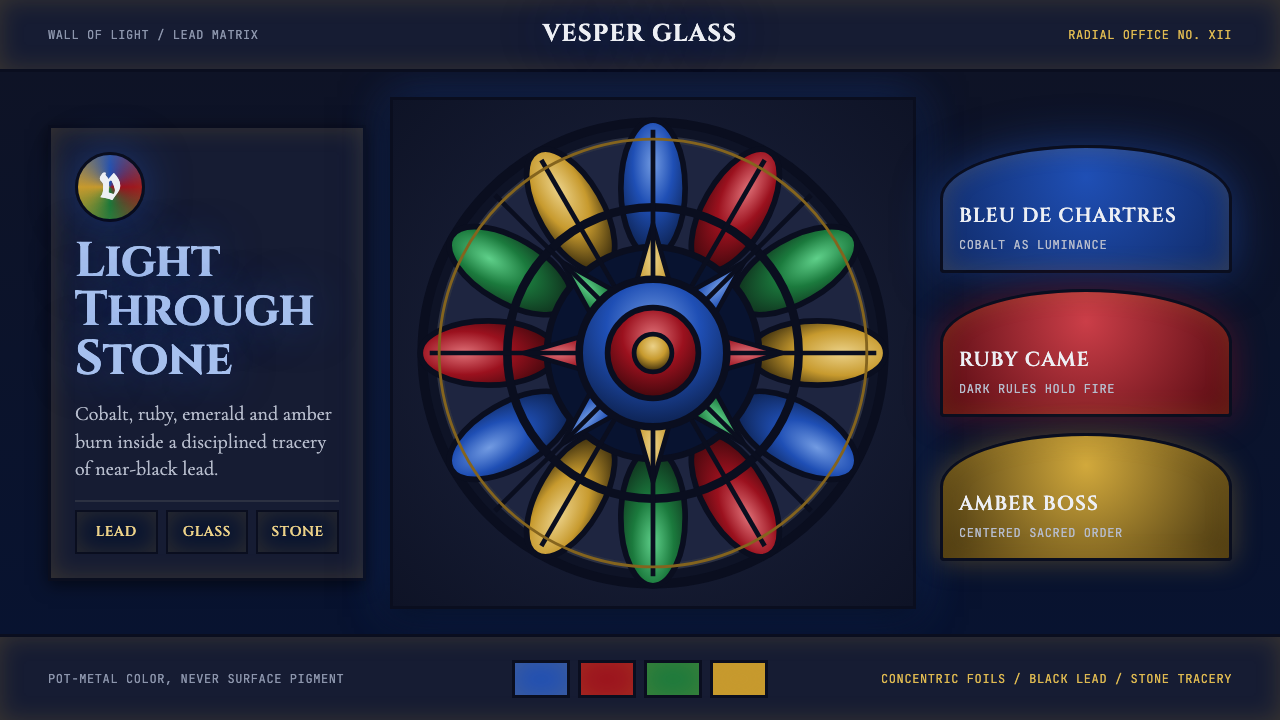 Gothic Rose WindowDarkness becomes light. Cobalt glass, ruby foils and black lead form a radial…
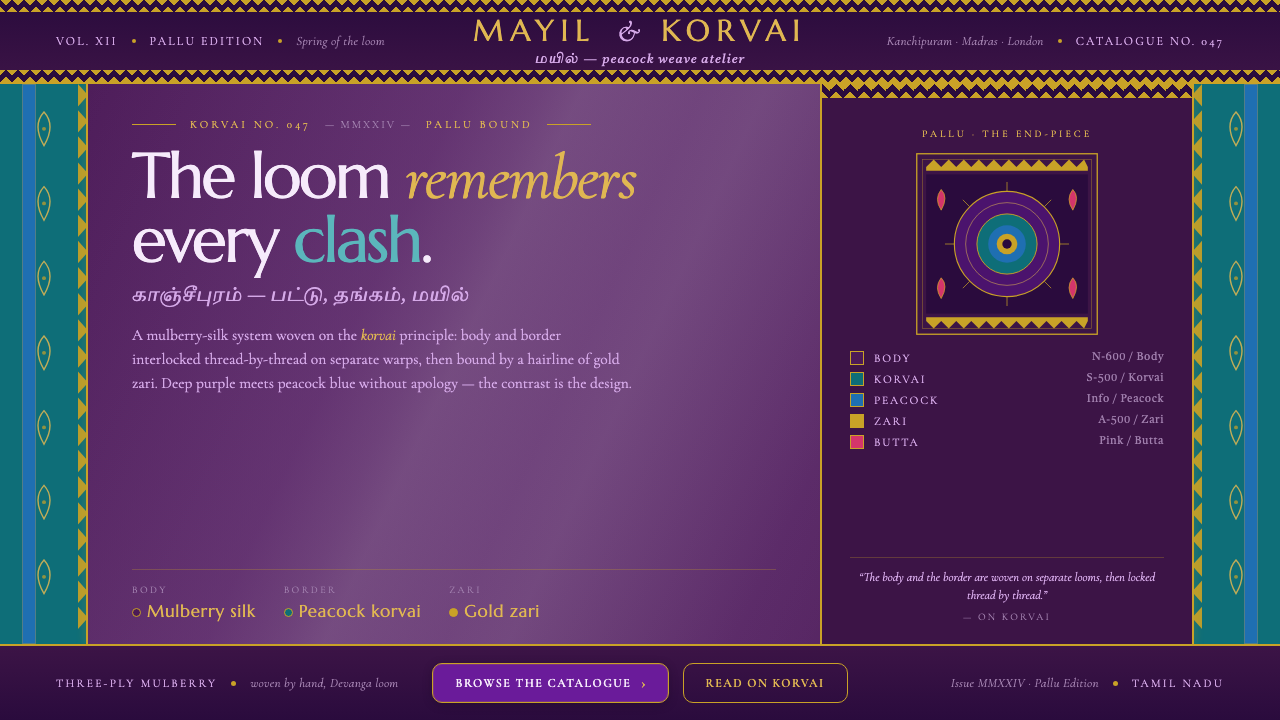 Kanchipuram Silk SareeRefuses to blend. Mulberry purple locked against peacock-blue korvai, every e…