What is Greenlandic Kalaallisuut?
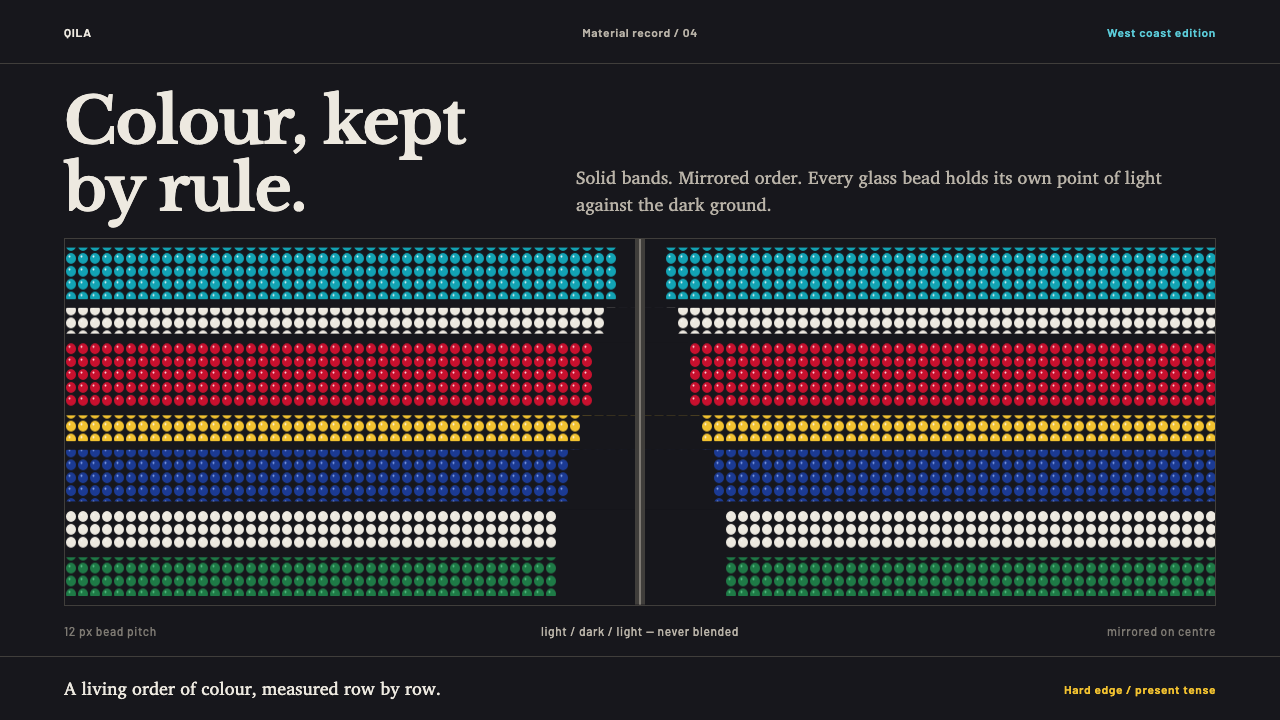
Kalaallisuut sets tens of thousands of glass beads in solid horizontal bands, mirrored about the neck and kept strictly to rule, on a ground as dark as sealskin.
Greenlandic Kalaallisuut in brief
Kalaallisuut is the national dress of West Greenland, and its centre is the nuilarmiut, a wide shoulder collar carrying tens of thousands of glass seed beads sewn on satin or on red woollen stroud thick enough to hold the weight. Beneath the collar sit black sealskin trim and dark trousers; below those, white kamiks, the soft boots. The outfit is built so that dense, many-coloured beadwork always sits against dark, matte material, like a bright collar held inside a quiet frame.
The beadwork is not a picture. It is made of horizontal bands of solid colour in varying widths, mirrored left and right about the neck opening, with light and dark alternating according to a rule the seamstress never breaks. There are no gradients and no blended passages. Each band is a row of beads in one colour, and where one band meets the next the change is abrupt, a clean cut, like one row of beads sitting hard against the next.
As a design style, Kalaallisuut combines a dark ground, hard-edged colour bands, strict symmetry and a rule of alternation. Hue and brightness are governed by rule rather than by feel, which is why even a vivid riot of colours reads as ordered. It is a style for people who want colour to be intense and controlled at the same time.
Where does Greenlandic Kalaallisuut come from?
Glass seed beads reached Greenland as trade goods, traded in from the eighteenth and nineteenth centuries. That fact matters to how the style should be understood. The material is imported and industrial, while the form is entirely local: Greenlandic seamstresses took a manufactured bead and made it obey their own logic of colour. The style's references call this Arctic trade-bead adoption, and the word adoption is the right one. The bead was not copied into someone else's design; it was absorbed into one that already existed.
That design comes out of a deeper tradition. The style's references place it within Inuit skin sewing and sapangat beadwork, and the outfit still shows the lineage: black sealskin trim, dark trousers and white kamiks accompany the beaded collar, so skin and thread remain part of the whole. The beads brought a new, brilliant material to an older craft of sewing, and the skills of cutting, stitching and finishing that craft required are what allow the collar to be both so dense and so precise.
The wide beaded collar takes its present form across the twentieth century and is worn today, so Kalaallisuut is a living dress rather than a museum relic. The style's references describe it also as Greenlandic cultural self-representation: a garment through which people present themselves, in recognisable terms, as Kalaallit. That sets the tone for how a designer should treat it, as a statement of identity and craft with its own rules, not a source of generic colourful pattern.
Three names anchor the reference list. Kalaallit seamstresses are the makers, who set and keep the rule of colour. The Greenland National Museum and Archives is the institutional memory in which such garments and their documentation are held. Preciosa Ornela, a glass-bead maker, names the supply side, a reminder that every bead is a small factory-made object turned into something particular by arrangement. Between maker, archive and material, the tradition is complete, and the design system takes its structure from all three.
What defines the Greenlandic Kalaallisuut look?
A Sealskin-Dark Ground
The ground is dark and matte, close in feeling to sealskin and dark cloth, and everything else is lit against it. The brilliance of the beadwork depends on that darkness, because strong colours need a quiet field to burn on. This is a dark-ground style by nature. The dark is a working material that gives the colour its power, not a mood or a theme applied afterwards.
Hard-Edged Colour Bands
Colour arrives only as whole horizontal bands of solid colour, each made of a single hue. There are no gradients, no tints within a band and no blended boundaries. Where two bands meet, the change is abrupt and cut square, like one row of beads against the next. The hard edge is the style's signature, and softening it with glows or transitions would remove the very thing that makes the collar look so decisive.
Mirror Symmetry About the Neck
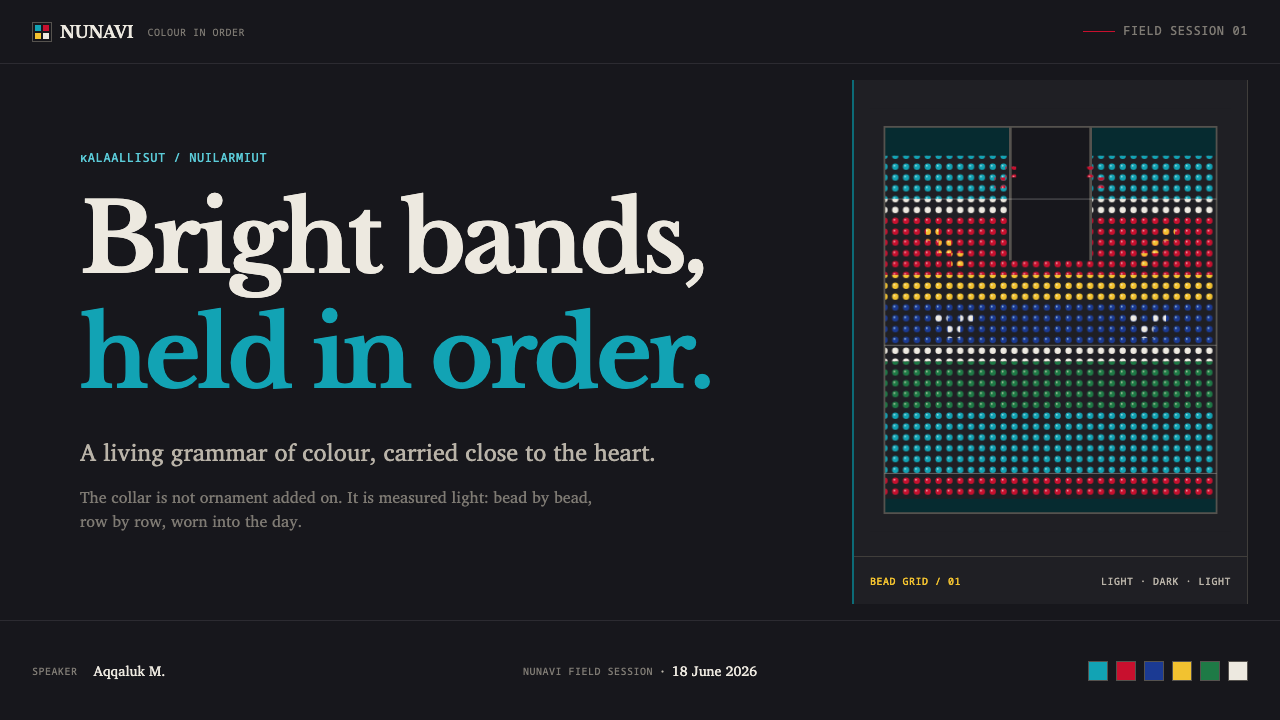
The bands are mirrored left and right about the neck opening, so the whole collar is symmetrical about a central axis. This gives the work a ceremonial stability: the eye is drawn to the centre and held there. In layout terms, the axis translates directly to a vertical centre line from which colour and structure are repeated on both sides, producing balance without any need for decoration.
Light and Dark in Alternation
Light and dark bands alternate according to a rule the seamstress never breaks. Brightness is as carefully ordered as hue: a pale band is followed by a dark one, a dark by a light one, which keeps neighbouring colours from merging and gives the whole collar its rhythmic clarity. The discipline of alternation is what allows many colours to share a surface without becoming noise.
Bands of Varying Width
The bands are not uniform. They come in different widths, so the rhythm of the collar comes from the relationship between wide and narrow rather than from repeating one unit. A thick band can feel like a bass note and a thin one like an accent, and their placement gives the pattern its character. This variation is also what stops the symmetry from feeling mechanical.
Built From Beads
Every band is made of rows of glass seed beads, tens of thousands of small, discrete units, each of one colour. The surface is therefore granular, with a built, modular logic: a band is as many rows as it takes, and an edge falls between one row and the next. Even when rendered on screen, the style benefits from hard, grid-like boundaries that suggest a countable structure rather than a smooth continuous field.
A Quiet Supporting Cast
Black sealskin trim, dark trousers and white kamiks surround the collar and say very little. They exist to hold the beadwork in place, to give the eye somewhere to rest, and to make the one colourful element feel even more important. In a layout, the same principle means colour is concentrated in one deliberate structure while everything else, navigation, body text and surrounds, stays dark, neutral and calm.
Who shaped Greenlandic Kalaallisuut?
The makers of kalaallisuut are the source of everything the style takes: the dense collar of tens of thousands of beads, the horizontal bands of solid colour, the mirror symmetry about the neck, and the alternation of light and dark that is never broken. Their rule, not an individual designer's taste, is the style's author. Applying the system faithfully means respecting that rule rather than treating the colours as free to rearrange.
Named in the style's references as an institution, the museum and archives are where garments of this kind and the knowledge around them are preserved. Its place in the list signals that kalaallisuut is treated as heritage with a documented form, and that the design system's description of it can be checked against real objects held in a public collection.
A glass-bead maker named in the references, representing the supply side of the tradition. Seed beads arrived in Greenland as trade goods from the eighteenth and nineteenth centuries, and Preciosa Ornela's presence on the list is a reminder that the bead itself is a manufactured object. What makes it distinctive here is not the bead but the order Greenlandic seamstresses impose on it, which is exactly the lesson the design system borrows.
How do you use Greenlandic Kalaallisuut today?
Kalaallisuut is a strongly dark-ground style, and it works best when you commit to its rules. Its logic is that colour is intense but governed: solid bands, hard edges, mirror symmetry, alternating light and dark. Applying it means ordering colour, not sprinkling it.
On a presentation cover, set the slide on a dark, matte ground and stack a few hard-edged colour bands in the upper or central part, mirrored about a vertical centre line, with the title set in a pale colour below or above. Content slides can use a narrow band stack as a header or a side marker and keep the remaining area dark and calm. For data slides, draw bars or segments as solid bands with square, abrupt boundaries, alternating light and dark values in sequence, and avoid gradients and translucency, which belong to a different aesthetic.
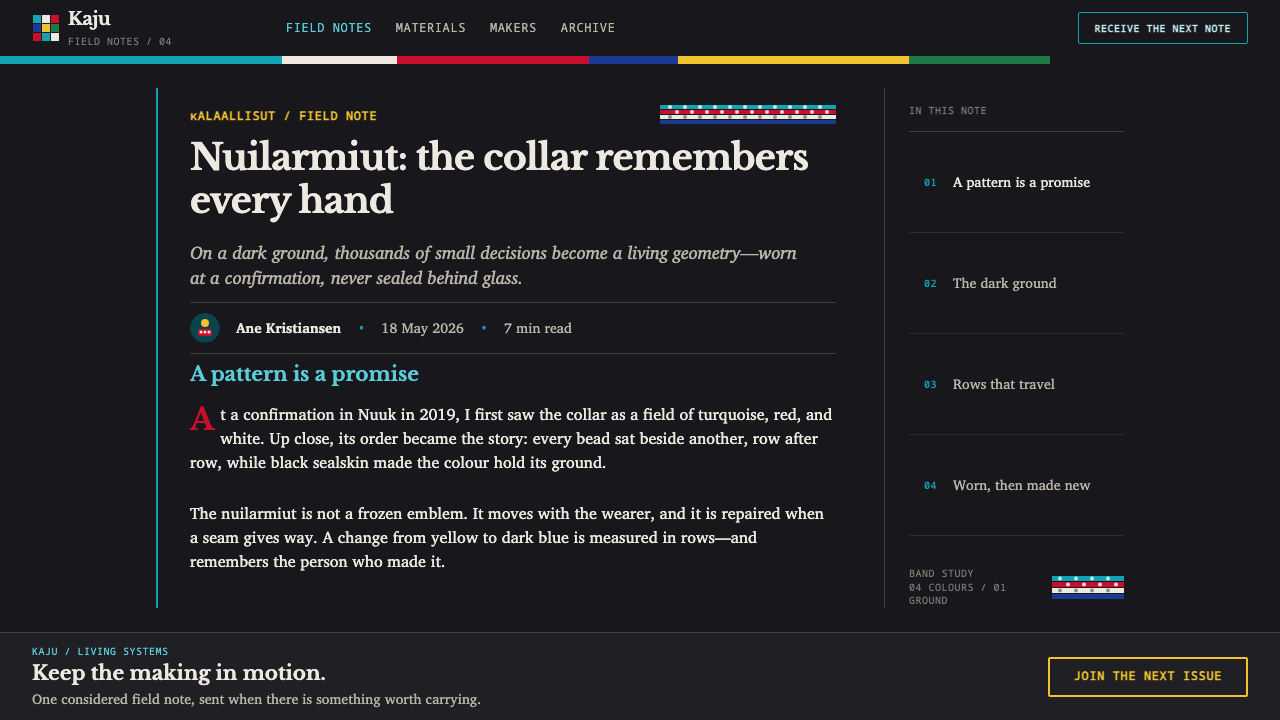
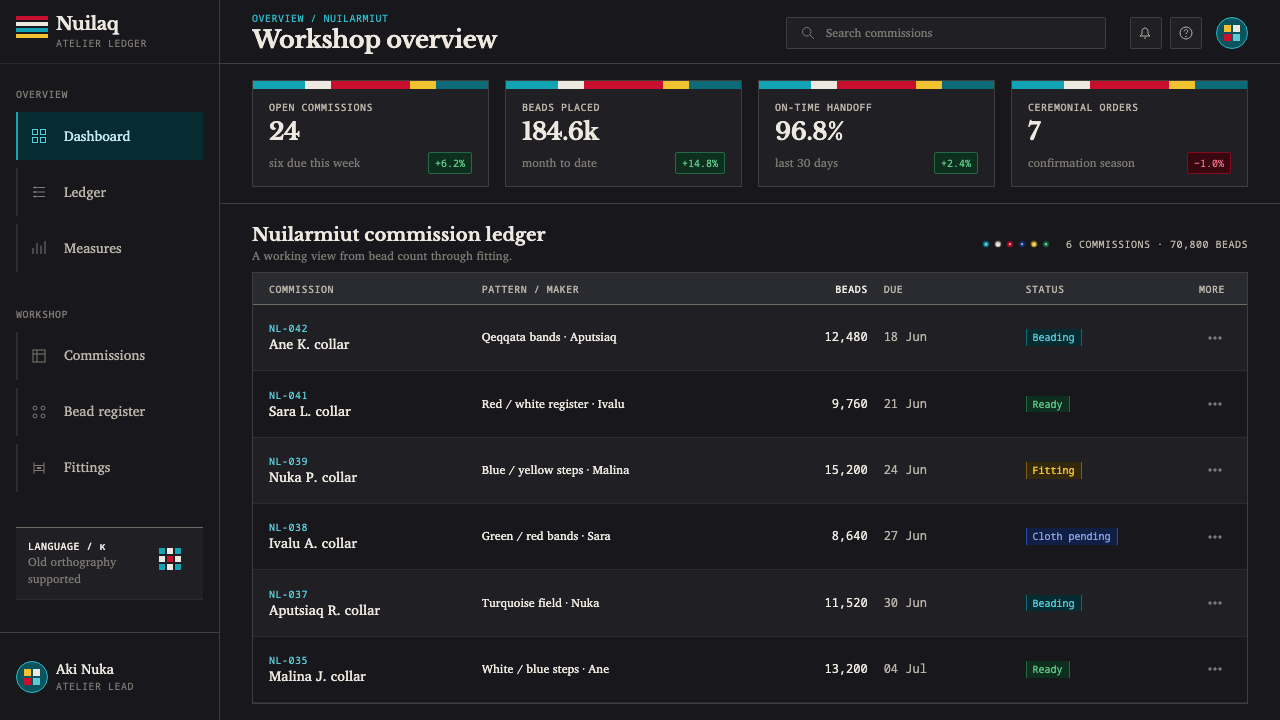
In interfaces, the style is a natural basis for dark-mode products: music and media apps, creative tools, dashboards that benefit from strongly coded categories, cultural and craft platforms. Use a dark, matte surface, and let colour appear as band-like elements such as headers, category stripes, progress bars and badges, each in a single solid colour with hard edges. Symmetrical layouts, such as a centred hero with mirrored decorative bands, sit well. Keep navigation and body text in quiet neutrals so the colour stays concentrated and the screen reads as ordered.
In editorial and marketing work, build a hero or poster around a symmetrical stack of bands, with a calm dark field around it and a short, confident line of type. Pair it with copy that talks about making, craft, identity or heritage. Photography should be treated with respect for the dark ground, sitting in panels with clean edges and not bleeding into glows. The strongest layouts are those where one structure carries all the colour and everything else steps back.
The most common mistake is softening the edges: adding gradients, neon glows, blur or translucency between bands, which dissolves the abrupt, bead-by-bead change that defines the style. A second is breaking the alternation by placing light bands beside light bands or colours in arbitrary order, so that the rule disappears and the surface becomes noise. A third is moving the style to a light background and expecting the colours to hold their power, when their intensity depends on the dark ground around them.
Greenlandic Kalaallisuut — FAQ
What is the nuilarmiut, and why is it the centre of the style?
The nuilarmiut is the wide shoulder collar of Kalaallisuut, the West Greenlandic national dress. It carries tens of thousands of glass seed beads on satin or red woollen stroud thick enough to hold their weight, arranged in horizontal bands of solid colour. It is the centre because every rule the style borrows, from dark ground to band structure to symmetry, is expressed in this one object.
Why must colour changes be abrupt?
Because the colour is made of beads, and a bead has exactly one colour. Each row is solid, so when one band ends and the next begins, the change falls cleanly between two rows with no blend between them. A gradient is physically impossible in the material and visually foreign to the style. Using one on screen replaces a countable, built structure with a smooth glow.
Why is the ground dark, and can the style work on a light background?
The outfit places dense, many-coloured beadwork against black sealskin trim and dark trousers, so the colour always burns against a quiet dark field. A light background weakens that contrast and makes the bands feel like a colourful sticker. If a light variant is unavoidable, keep a dark panel as the working ground for the band structure and let the page around it stay neutral, rather than flipping the whole logic.
How does the mirror symmetry translate to layouts?
The bands are mirrored left and right about the neck opening, so the translation is a vertical centre line from which colour and structure repeat on both sides. Heroes, headers and decorative band stacks can be built that way. Content itself does not have to be centred, but the colour structure gains authority from the axis, and the eye is drawn to the middle.
How should this style be borrowed with respect?
Kalaallisuut is a living national dress, not a costume or a generic pattern. Borrow the logic, which is solid bands, hard edges, mirror symmetry, alternating light and dark and a dark ground, and credit West Greenland and its seamstresses where the style is named. Avoid reproducing specific collars or presenting the look as decoration without context, and put your own content inside the discipline the dress teaches.
Related design styles
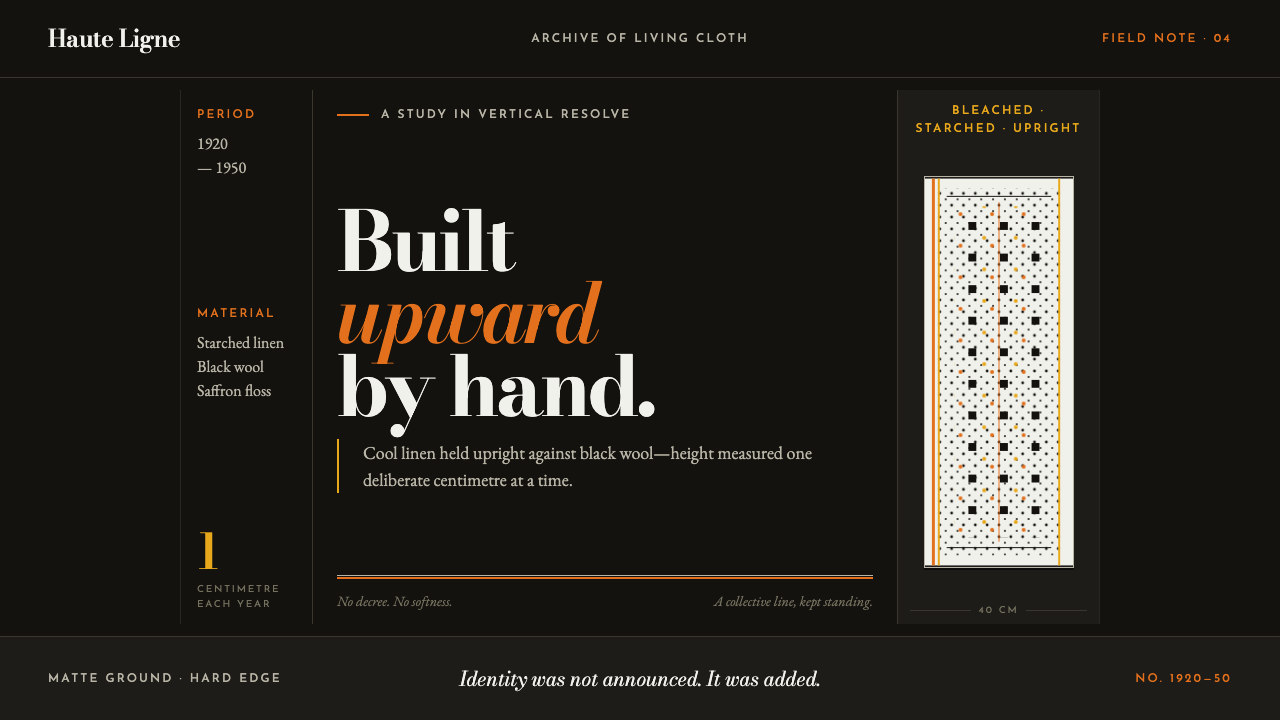 Bigouden CoiffeIdentity stands tall. Starched linen rises over matte black, edged in saffron…
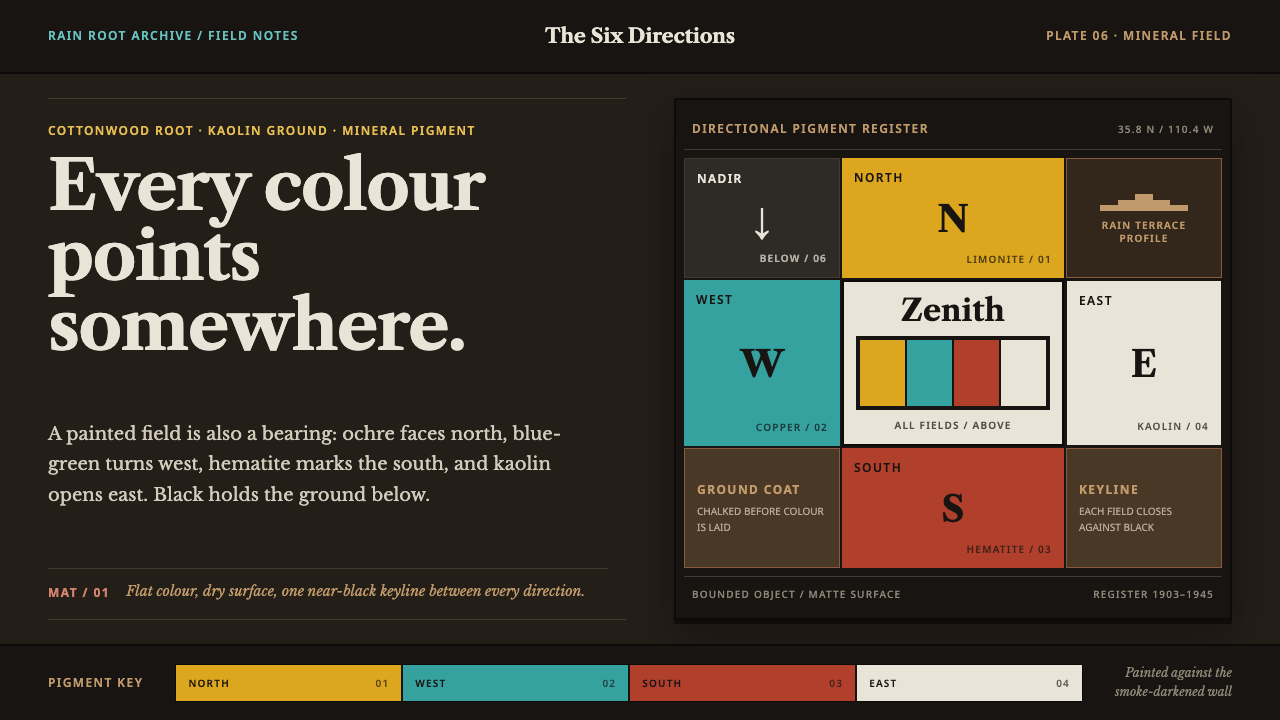 Hopi Katsina TihuEvery colour is a direction. Matte mineral fields meet in smoke-black keyline…
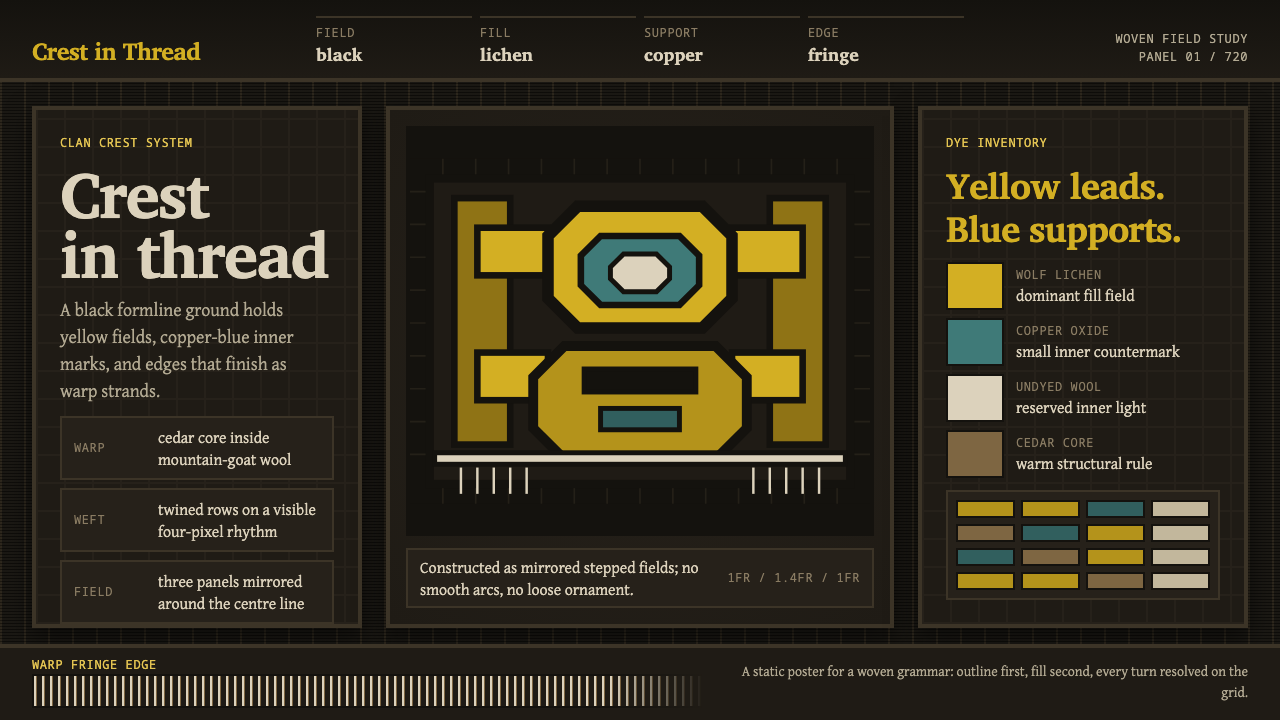 Tlingit Chilkat RobeCrest becomes thread. Black formline, lichen yellow fields, and stepped woven…
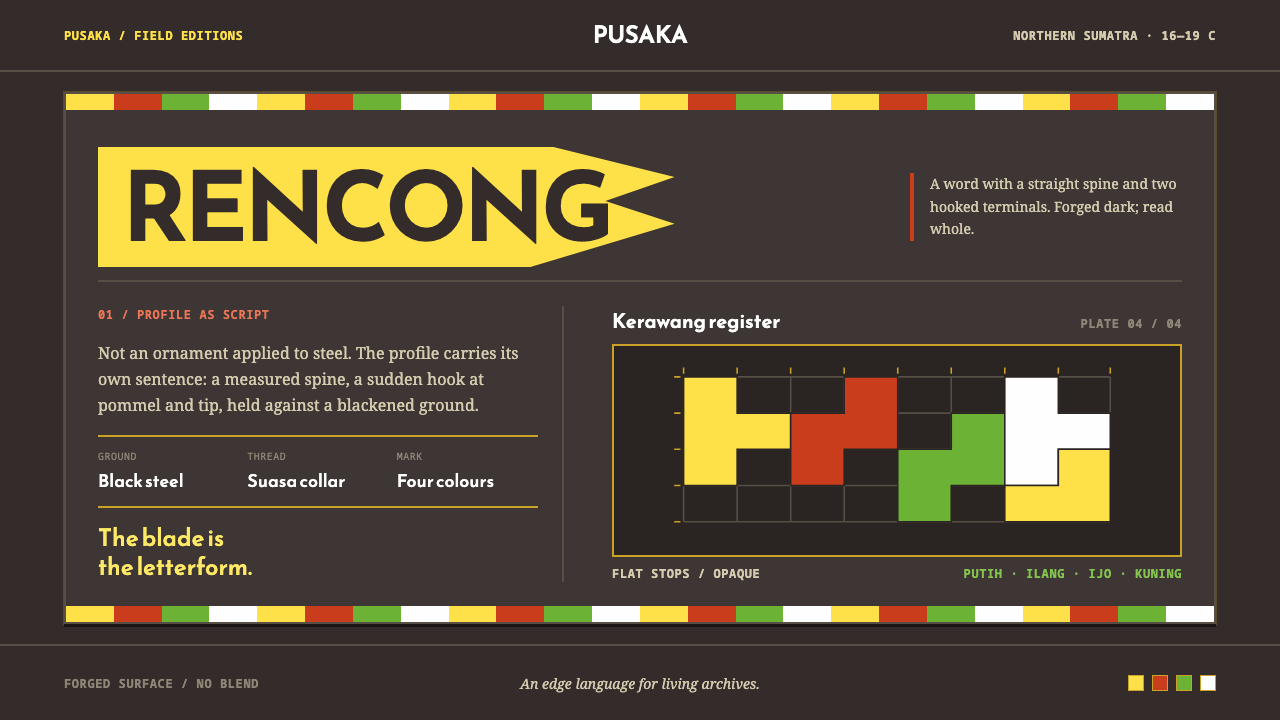 Acehnese Rencong MotifA blade that reads as a word. Flat kerawang red, white, green and yellow lock…
 Fijian Masi (Bark Stencil)Stencil memory stays sharp. Soot black and burnt coral strike bark-fibre band…
 Fon Applique Banner AbomeyRoyal cloth speaks plainly. Flat saffron, green and indigo silhouettes on bla…