What is Tlingit Chilkat Robe?
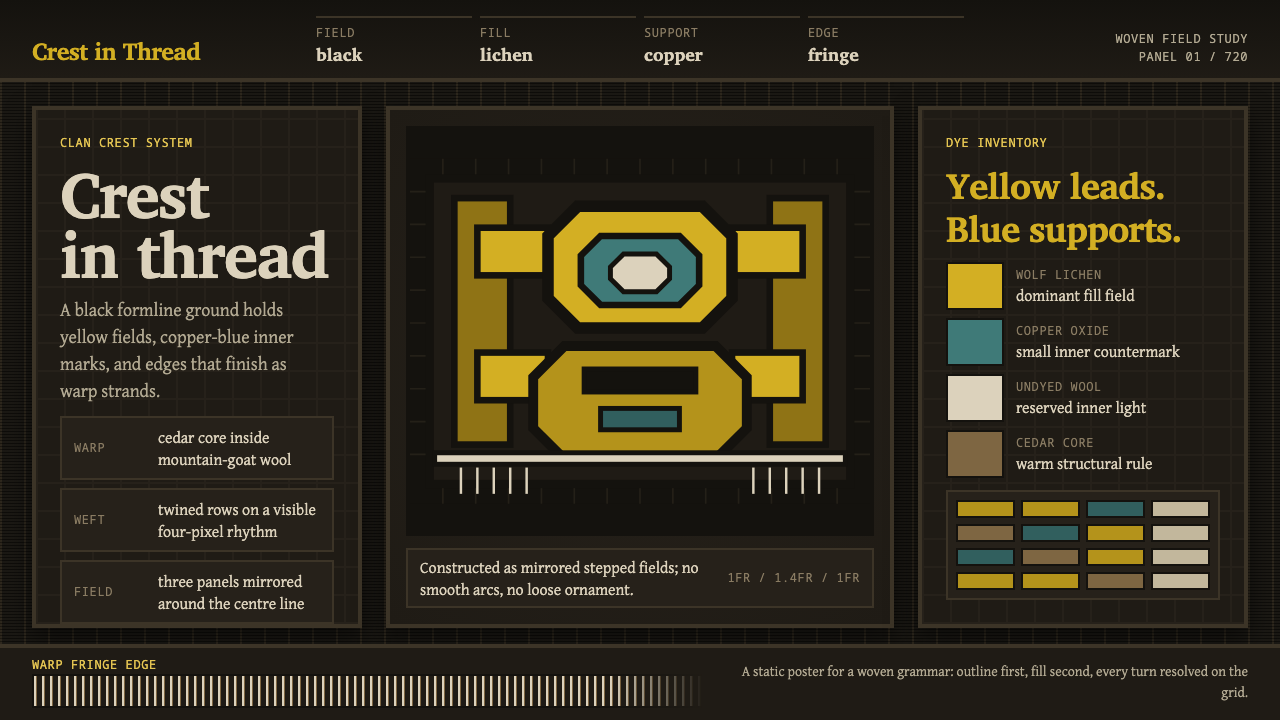
A Chilkat robe is a clan crest translated into thread: black formline, lichen-yellow fields, and curves that step because a weaver cannot draw an arc.
Tlingit Chilkat Robe in brief
The Tlingit Chilkat robe is a ceremonial textile from the Northwest Coast of North America, woven in the Lynn Canal country of southeast Alaska and still made today. As a visual language it is unmistakable: a near-black ground, broad fields of yellow, supporting passages of blue-green, and a crest animal built from outlined shapes whose lines swell and thin along a continuous formline.
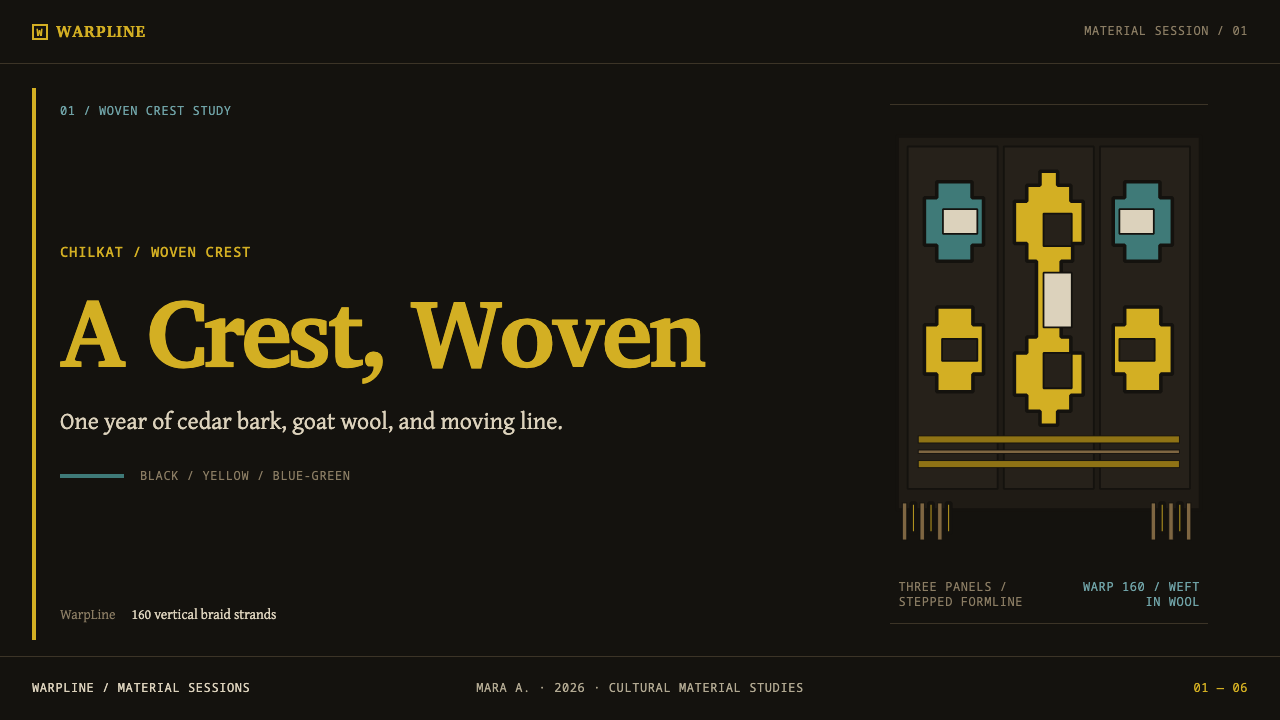
The idea underneath is that a crest is not a picture of something but a statement of belonging. Clan emblems, whether animals, ancestors or beings from the stories a family owns, are spread across the robe so that the wearer, in motion, becomes the crest. Every shape is outlined, nothing is shaded, and the composition is usually organised in two halves that answer each other across a central axis.
What separates this style from ordinary pattern work is that it is made by hand, strand by strand, in a technique called twining. Because the image is assembled from counted, stepped units of wool, curves are never true arcs and edges are never feathered. The look is crisp, outlined and faintly stair-stepped: a drawn design that has been disciplined by its material, and wears that discipline openly.
Where does Tlingit Chilkat Robe come from?
The form has deep roots. Its history is usually traced to Tsimshian weavers on the northern coast before 1900, and it reached its peak among the Tlingit of the Chilkat region, the Lynn Canal country of southeast Alaska, which is how a textile traded and worn across the coast came to carry the Chilkat name. It belongs to the wider Northwest Coast tradition of formline design, the shared drawing system of swelling and narrowing outline that also governs carved house fronts, painted chests and bentwood boxes.
The construction is remarkable. The warp is made of shredded cedar bark twisted inside mountain-goat wool; the weft is dyed goat wool. The documented palette is narrow: black from hemlock and iron, yellow from wolf lichen, blue-green from copper oxide, and white left undyed. A single robe can take a year to finish and can carry well over a hundred moving braid strands down its face, so the object is as much a piece of engineering as a picture.
A robe often passed through two minds before it passed through the weaver's fingers. In the traditional division of labour, the design was drawn by an artist on a pattern board, then interpreted by a weaver, who had to decide how each line and curve could be rendered in counted wool. The stair-stepped curve is the visible record of that translation: the image the artist drew, and the grid the weaver had to obey.
By the twentieth century the practice had narrowed to a small number of master weavers. Jennie Thlunaut was among those who held the technique and passed it on; later weavers such as Clarissa Rizal and Lily Hope have carried it forward, working in both Chilkat and the older, more geometric Ravenstail technique. The tradition is therefore not a historical style recovered from archives but a living practice, with robes still woven for dance and ceremony today.
What defines the Tlingit Chilkat Robe look?
Black Ground
The page is the hemlock-and-iron black of the formline field. Black is not a mood here; it is where the design lives. Outlines, pupils, joints and the heavy primary line of every figure are all drawn in it, so ground and drawing are the same material. A dark theme built on this style should feel dyed rather than switched off.
Wolf-Lichen Yellow
Yellow fills. It is the main colour of the fields inside the black outlines and carries most of the visual weight of the robe. It is a lichen yellow with a touch of green and a slight dryness, not a clean signal yellow, and it works because it sits directly against black with no mediating tone between them.
Copper-Oxide Blue-Green
Blue-green supports and never leads. It appears in smaller passages such as an inner field, an eye surround or a joint, and its job is to steady the black-and-yellow pair and to mark a secondary level of hierarchy. Cast in the leading role it would turn the robe into a different object.
Formline Outline
Every shape is outlined, and the outline is not a uniform stroke. The line swells where a form turns and thins where it releases, so the figure reads as one continuous, flowing structure instead of a heap of separate outlined parts. Drawing and colour fields lock together, leaving nothing loose to float in empty space.
Stepped Curves
A woven curve cannot be a true arc, so every curve steps. Where the design turns, the weft advances in small, countable increments, and the edge shows them. This is the signature of the whole style: round forms with a faintly stair-stepped silhouette. Smooth vector curves, soft rounded boxes and feathered blobs all read as foreign to it.
Undyed Wool as Inner Field
Undyed wool exists in the palette, but it stays a small inner field and is never the ground. It brings a pale, warm contrast inside a figure, the way one highlighted word is used in a line of type. Making it the dominant background inverts the logic of the robe: the page stops being a dark field that holds figures and becomes a light page carrying dark decoration.
Moving Fringe Edges
A robe is made to move. Long fringe hangs from the vertical edges and swings with the dancer, while a great many braid strands run down the face and shift as the body turns. The design takes the hint: edges are finished rather than cut off, and the boundary of a composition is treated as a place where the material is allowed to move.
Who shaped Tlingit Chilkat Robe?
A master Chilkat weaver of the twentieth century, widely regarded as one of the weavers who carried the full technique through a period when few people still practised it. Her robes are studied as reference examples of balanced composition, even tension and disciplined formline, and she is remembered as a teacher as much as a maker.
A Tlingit artist and weaver who worked in both Chilkat and Ravenstail and brought the tradition into contemporary exhibition and teaching. Her career is a reminder that this style is a living practice, one in which the traditional palette and the stepped, outlined grammar are used, extended and taught now rather than reconstructed from museum cases.
A contemporary Tlingit weaver who works in both Chilkat and Ravenstail and teaches the techniques to new weavers. She belongs to the generation that treats weaving as a discipline passed on in person, thread by thread, and she shows how current practitioners keep the old structure intact while making new work.
How do you use Tlingit Chilkat Robe today?
This style is best approached as a visual grammar rather than a source of images. The crest figures on a real robe belong to specific clans and carry meanings that are not a designer's to reassign, so the transferable parts are the structure: a dark ground, a lead yellow, a restrained supporting blue-green, outlined shapes, stepped curves and a finished, moving edge. Apply those with respect, and leave actual crest imagery to the people who own it.
For presentation slides, the cover works best as a dark field with one large outlined shape filled in yellow, with the title set in a plain, grotesque face against the black. Content slides keep the ground dark and let yellow do the emphasis, with blue-green reserved for secondary labels. Data slides suit the stepped logic well: bars filled in yellow and outlined in black, a second series in blue-green, and any trend line drawn as visible steps instead of a smooth curve.
For web interfaces, the style suits dashboards, archives and product pages that want weight and a sense of lineage. Keep the page dark, give primary actions the yellow, and use blue-green for secondary states and links. Cards should be outlined rather than shadowed, corners should step or stay square rather than softening into pills, and a long fringe-like border at the bottom or side of a layout can close a page instead of a plain hairline.
For editorial and marketing work, the style is a natural fit for craft, heritage, museum, cultural and storytelling content. Compose layouts in two mirrored halves around a central axis, let a single large outlined shape anchor each section, and show weaving itself through close-up photography of thread, twist and fringe. Long-form reading should sit on a restrained, dark panel with generous margins, so the colour stays a signal and not a background wash.
The most common mistake is to keep the colours and drop the construction. Smooth gradients, glows, soft drop shadows and perfectly round shapes all contradict a style whose whole character is outlines and counted steps. A close second is turning the undyed white into the page background, which flips the logic of the robe, and a third is giving yellow, blue-green and white equal weight, so that nothing leads. One dark ground, one lead yellow and one quiet supporting colour will outperform any busier mix.
Tlingit Chilkat Robe — FAQ
Is this the same thing as Northwest Coast formline art?
They are closely related but not identical. Formline is the drawing system: a vocabulary of continuous outline that swells and narrows, used on carved, painted and woven work across the coast. A Chilkat robe is a weaving that translates that drawing system into counted wool. This style borrows from the weaving specifically, so it adds stepped curves, a restricted dyed palette and a fringe edge to the outline logic that formline already supplies.
Why is the background black and not white?
Because black is the field in which the formline design lives, not a decorative choice. The strongest lines, the outlines and the joints are all black, so a black ground lets the drawing and the page share one material. Undyed wool does exist in the palette, but it is kept as a small inner field within a figure. A light version of this style is possible, but it behaves like a different system, since the robe's logic of a dark ground holding bright fields is lost.
Why do the curves step instead of flowing smoothly?
Because the original is woven. In twining, a form is built from counted units of weft that advance a little at a time, so a rounded shape can only be approximated by a sequence of small steps. The steps are not a flaw to be smoothed away; they are the evidence of how the thing was made. Keeping them in a digital version is what separates an authentic reading of the style from a generic dark theme with yellow accents.
Can I use real clan crests and figures as decoration?
It is better not to. Crests on Chilkat robes are statements of ownership and belonging within particular clans, and they are not generic ornament. The respectful and still effective route is to use the construction: the palette hierarchy, the outlining, the stepped geometry and the finished edge. If your project genuinely concerns Tlingit culture, work with Tlingit artists and weavers, who are active today, instead of reproducing their emblems from a catalogue.
What is the difference between Chilkat and Ravenstail weaving?
Both are twined Tlingit weaving traditions, and both are alive today, but they look different. Chilkat weaving is the curved, outlined formline robe with crest figures, worked in a narrow palette dominated by black and yellow. Ravenstail is an older and more geometric form, built from stepped and angular patterns that run in bands. Both rest on counted, stepped construction, which is why the stair-step quality in this style feels coherent across both.
Related design styles
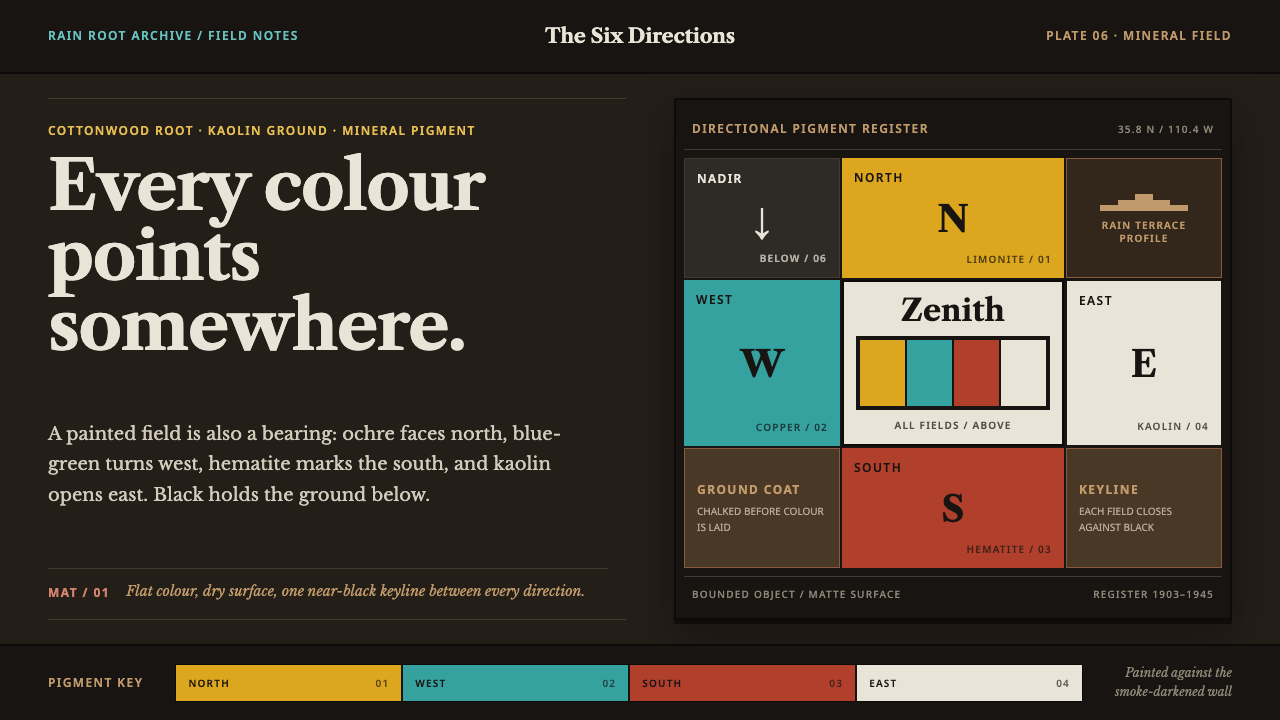 Hopi Katsina TihuEvery colour is a direction. Matte mineral fields meet in smoke-black keyline…
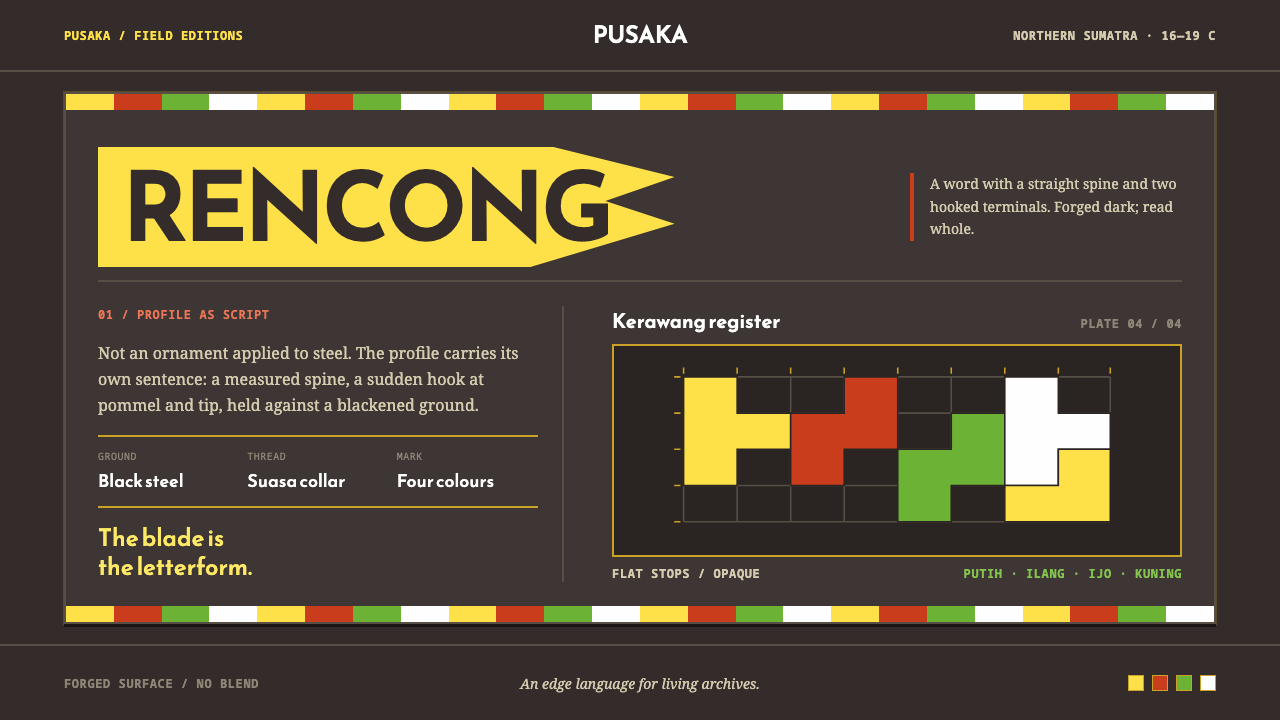 Acehnese Rencong MotifA blade that reads as a word. Flat kerawang red, white, green and yellow lock…
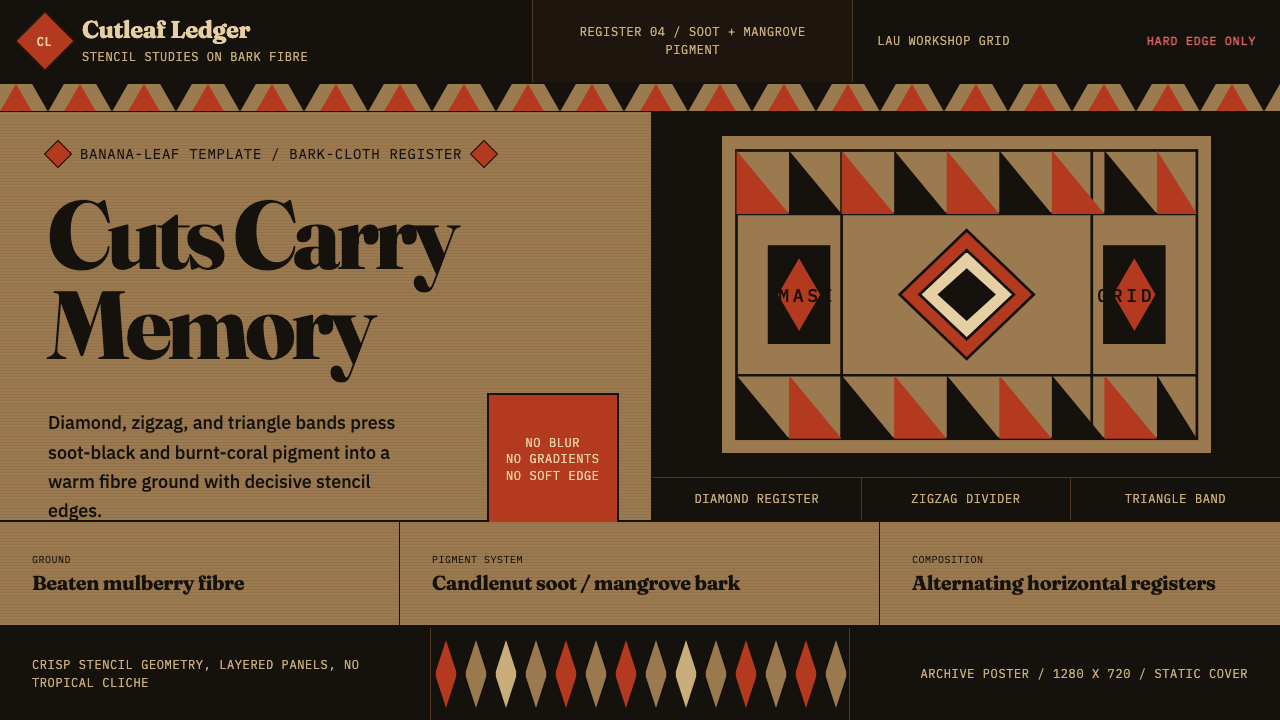 Fijian Masi (Bark Stencil)Stencil memory stays sharp. Soot black and burnt coral strike bark-fibre band…
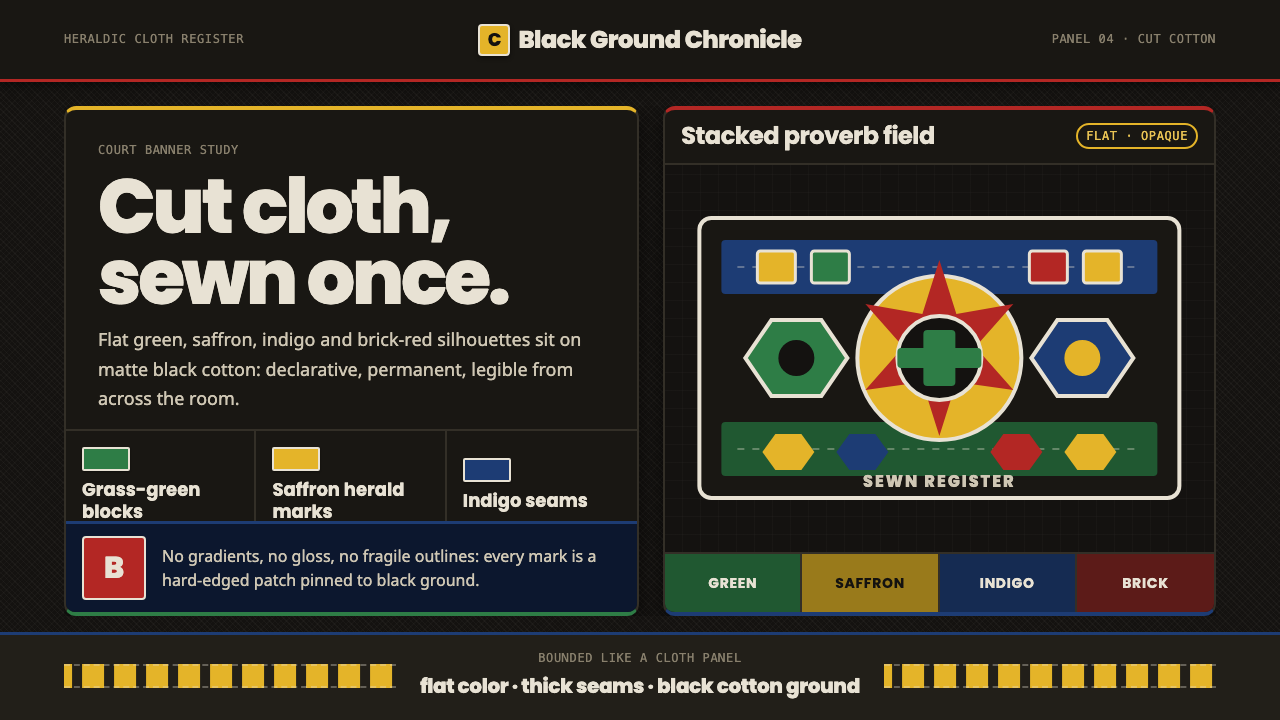 Fon Applique Banner AbomeyRoyal cloth speaks plainly. Flat saffron, green and indigo silhouettes on bla…
 Kongo Nkisi Nkondi FigurePower accumulates in darkness. Black wood, iron studs, and one mirror glint h…
 Marquesan Tatu PatternDensity as authority. Tiki and enata tessellation inked into blue-black, lit…