What is Gothic Blackletter Newspaper Masthead (1700)?
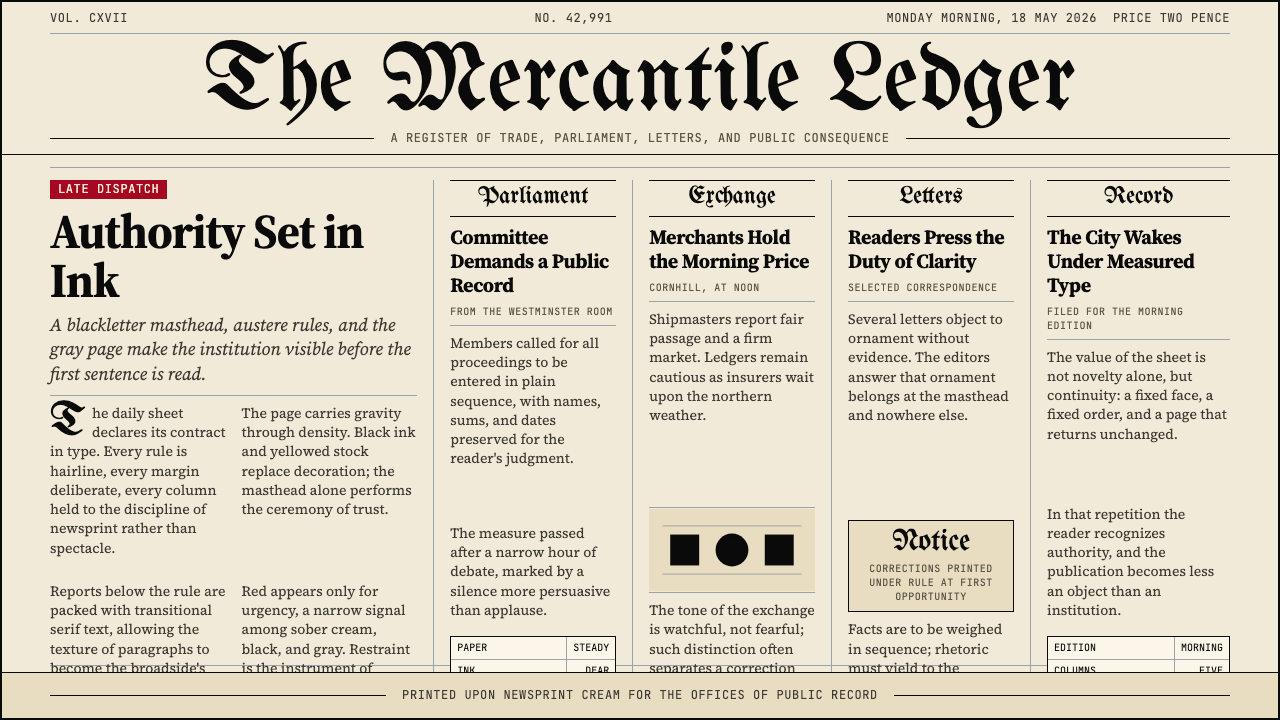
For over three centuries, the dense Gothic script crowning a newspaper's front page has been the most recognized signal of institutional authority in Western print.
Gothic Blackletter Newspaper Masthead (1700) in brief
The Gothic Blackletter Newspaper Masthead style draws from the long tradition of dense, angular letterforms used at the very top of broadsheet newspapers from the late seventeenth century onward. The masthead — that single line of towering display type above a fine hairline rule — functions not as decoration but as institutional declaration. The typeface is the institution's signature, its legal identity, and its contract with every reader who picks up the paper.
Below the masthead, the visual system operates on strict restraint. Tightly set columns of upright transitional serif body text produce what editors historically called the 'gray page': a dense, even field of ink that signals seriousness, thoroughness, and a refusal to pander to the eye. Column rules as fine as a strand of hair divide the page into measured vertical bands. No illustration competes with the text; white space is not a design decision but a consequence of information density.
The material palette reinforces the effect. Aged newsprint cream — neither white nor beige but somewhere between — grounds the page. Against it, pure black ink registers with absolute finality. There is no intermediate tone, no graduated wash, no softening. The entire visual world of this style consists of two elements: ink and paper, absence and presence, authority and silence.

See the Gothic Blackletter Newspaper Masthead (1700) design system
Where does Gothic Blackletter Newspaper Masthead (1700) come from?
The roots of blackletter in newspaper publishing stretch back to the handwritten manuscripts of medieval scriptoria, where German scribes developed the dense, compressed letterforms called textura quadrata — angular strokes packed tightly together to minimize the expensive parchment consumed per page. When Johannes Gutenberg cast his moveable type in the 1450s, he modeled his letterforms on this existing scribal tradition, ensuring that print would inherit the visual authority that blackletter already carried. The first major European newspapers of the early seventeenth century — including the Relation of Strasbourg (1605) and the various Dutch corantos — adopted blackletter display type for their mastheads as a matter of typographic convention, not deliberate stylistic choice.
In England, the tradition crystallized around the broadsheet format during the turbulent politics of the seventeenth century. John Walter founded The Times of London in 1785 (initially as The Daily Universal Register), and its Gothic masthead quickly became the visual benchmark against which all serious English-language papers measured themselves. The Times's masthead was not merely decorative; it was the public face of a paper that claimed to speak for the nation's informed classes. Readers recognized the letterforms before they read a single word, and that recognition carried with it all the accumulated authority of the paper's history.
In the United States, Henry Jarvis Raymond co-founded The New York Times in 1851. Under Adolph S. Ochs, who purchased the paper in 1896 and adopted the motto 'All the News That's Fit to Print,' the masthead became a deliberate instrument of positioning. Ochs understood that the blackletter masthead communicated permanence and gravity in a single glance — qualities essential for a paper attempting to distinguish itself from the sensationalist 'yellow journalism' of Hearst and Pulitzer. The Gothic script was, in effect, a typographic argument about what kind of newspaper the Times intended to be.
By the early twentieth century, the masthead convention had spread across continental Europe and throughout the British Commonwealth, each paper adapting the basic blackletter structure to its own national typographic traditions. German papers favored the most compressed and angular variants; British papers often introduced slight modulations in stroke weight; American papers tended toward slightly more open letterforms with generous descenders. What remained constant across all these variations was the fundamental visual grammar: dense dark letterforms against a light ground, a fine separating rule, and the implicit claim that this seriousness of presentation guaranteed seriousness of content.
What defines the Gothic Blackletter Newspaper Masthead (1700) look?
Blackletter Display Type
The masthead letterforms are dense, angular, and highly compressed — strokes packed close together with pronounced serifs that terminate in sharp diamond or wedge shapes. The overall texture of a blackletter word is closer to a woven pattern than to isolated letters; individual characters are almost subordinate to the collective visual weight of the word. This density is not a fault to be corrected but the core property that communicates permanence. A single word set in this manner carries more visual gravity than a full sentence set in any light or transitional face.
Cream Newsprint Ground
The background is not white. It carries the specific warm, slightly yellowed cast of aged newsprint — a tone that reads as earned rather than pristine. This distinction matters enormously: a pure white background would make the system feel clinical or digital; the newsprint cream gives it materiality and age. The warmth also softens the contrast with the black ink just enough to prevent harshness while preserving the fundamental legibility that the style depends upon.
Hairline Column Rules
Vertical rules between text columns are drawn at the absolute minimum weight that ink and paper can reproduce reliably — barely visible as lines, registered more as a slight interruption in the gray field of text than as a positive mark. Their function is organizational rather than decorative: they guide the eye down each column without asserting a visual presence of their own. Thickening these rules even slightly shifts the character of the layout from broadsheet authority toward something more illustrative or decorative.
Transitional Serif Body Text
Body text is set in a transitional serif — a category of letterform sitting between the calligraphic old-style faces of the seventeenth century and the high-contrast modern faces that followed. These types have moderate stroke contrast, bracketed serifs, and vertical stress axes that produce even, upright columns of text. Set tightly — minimal leading, tight but not touching letter-spacing — this body text produces the characteristic 'gray page' that is almost as much a texture as a reading surface. The page is designed to be inhabited, not skimmed.
Ink-on-Paper Contrast
The color relationship is binary: pure black ink against the warm cream ground. There are no grays, no halftones, no tonal gradations in the typographic elements of the system. Where rules appear, they are black. Where type appears, it is black. The entire communicative burden is carried by the presence or absence of ink, by letterform against open field, by compressed stroke against breathing margin. This constraint is not poverty but discipline — the same discipline that makes the masthead's authority legible from across a newsstand.
Formal Typographic Hierarchy
The hierarchy of the broadsheet page is absolute and visible at a glance. The masthead sits at the apex, commanding the full width of the page at a scale that dwarfs everything below. Below it, the dateline and issue information are set at a significantly reduced scale in spaced capitals. Section labels and headline decks step down again. Body text is the base. This strict scalar logic — each level substantially smaller than the one above — means that the reader's eye always knows exactly where it is in the document hierarchy without needing color, icons, or visual devices beyond scale and weight.
Structural Restraint
Everything in this visual system is earned by function rather than applied for effect. Rules exist because columns need separating. The masthead is large because it must be read first. Margins exist because the eye needs a clear boundary. No element is present for visual richness, personality, or warmth. The style's severity is not coldness — it is the visual equivalent of a formal declaration, where every word chosen is the right word and none is added for comfort. This discipline is what distinguishes authentic broadsheet aesthetics from pastiche that merely uses blackletter fonts.

See the Gothic Blackletter Newspaper Masthead (1700) design system
Who shaped Gothic Blackletter Newspaper Masthead (1700)?
John Walter founded The Daily Universal Register in London in 1785, which was renamed The Times of London in 1788. Under Walter and his descendants, the paper established the blackletter masthead as the visual standard for serious English-language journalism. The Times's Gothic masthead — its precise letterforms, the weight of its strokes, its relationship to the hairline rule beneath — became a template that newspapers across Britain, the United States, and the British Commonwealth referenced and adapted for generations. Walter's typographic choices were, in effect, the founding grammar of the broadsheet visual tradition.
Raymond co-founded The New York Times in 1851 with George Jones, bringing the broadsheet visual conventions established by the London press across the Atlantic. Raymond, who had trained as a journalist under Horace Greeley at the New York Tribune, understood that the Gothic masthead carried social meaning beyond mere identification — it signaled the paper's commitment to political moderation and factual reporting at a moment when American journalism was polarized between sensationalism and partisan advocacy. His editorial and typographic choices helped define the 'paper of record' model that the Times has maintained in various forms to the present day.
Ochs purchased the struggling New York Times in 1896 and transformed it into the authoritative national newspaper it remains today. His decision to maintain and formalize the Gothic blackletter masthead was deliberate and strategic: at a time when William Randolph Hearst and Joseph Pulitzer were deploying sensationalist headlines and dramatic illustrations to sell papers, Ochs used the masthead's visual severity as a competitive differentiator. The motto 'All the News That's Fit to Print' — which Ochs adopted in 1897 — was typeset in the same restrained voice as the masthead itself. Under Ochs, the Times's visual identity became inseparable from its editorial identity.
As a printer and publisher in colonial America, Franklin was instrumental in establishing the visual conventions of the American newspaper before the Revolution. His Pennsylvania Gazette, which he acquired in 1729, helped transplant the blackletter masthead tradition from English practice into the American context. Franklin's deep knowledge of typography — gained through his early career as a printer — meant that his editorial decisions were also typographic decisions. The Gazette's measured, legible layout, with its clear hierarchy and restrained use of display type, influenced the visual character of American broadsheet journalism for generations after his direct involvement ended.
How do you use Gothic Blackletter Newspaper Masthead (1700) today?
The Gothic Blackletter Newspaper Masthead style is one of the few historical visual systems that carries immediate legibility at the semantic level — before users read a single word, the style communicates age, authority, and institutional seriousness. This makes it exceptionally powerful when those associations align with the product's intended positioning, and actively counterproductive when they do not. The first question to ask when considering this style is not 'does this look good?' but 'does my product benefit from being perceived as a centuries-old institution?'
For presentation slides, the style excels on cover and section-break pages. A cover built in this aesthetic uses the full-width masthead treatment as its title: the presentation's name rendered in dense Gothic letterforms, centered or flush-left, above a thin separating rule, against a warm cream ground. Below the rule, in spaced transitional serif capitals at a fraction of the masthead size, sits the presenter's name, date, and organization. Content slides should abandon the Gothic for the body — blackletter at body text size becomes illegible — and instead use a restrained transitional serif for all running text, reserving the Gothic exclusively for slide titles or section headers where scale makes it readable. Data slides work especially well in this system when charts are rendered with thick black axis lines, no background fill, and labels in tight transitional serif rather than the rounded sans-serif faces that digital defaults tend to produce.
For web user interfaces, the style suits publishing platforms, archival databases, literary journals, and any product whose brand story involves historical depth or editorial authority. A newspaper-masthead-inspired dashboard uses a cream or warm off-white surface, all body text in a readable transitional serif, and the Gothic reserved exclusively for the product wordmark or primary navigation label. Card components should use fine ruled borders rather than soft-shadow elevation; dividing lines between content sections should be hairline weight. Pricing pages in this style work by presenting tiers as typographic columns — each tier headed by a Gothic display label, with features listed in tight serif below — rather than with the colored card grids that modern SaaS conventions favor.
For editorial and marketing work, the associations are most directly useful. A literary magazine, arts journal, independent newspaper, or heritage brand can use the full vocabulary: cream grounds, Gothic mastheads, hairline rules, and dense transitional serif body text. Marketing materials for law firms, financial institutions, universities, or any organization where longevity is a competitive asset benefit from selective deployment — a Gothic headline above a clean body of text, or a masthead-style lockup for a campaign that wants to signal considered, non-trend-driven values. Event posters for cultural institutions, conferences, and academic programs can use a full broadsheet layout as a graphic device, treating the poster surface as a miniature front page with a mock masthead at the top.
The most common mistake when applying this style is conflating 'blackletter' with 'decorative Gothic' and using the letterforms as ornament rather than as weight-bearing display type. Blackletter should appear only at large scales where its texture reads as authority rather than as illegible pattern. The second common mistake is applying the style to contexts that require warmth, approachability, or speed — a health application, a consumer e-commerce product, or any interface where users need to feel comfortable rather than impressed. The severity that gives the style its authority in one context is exactly what makes it alienating in another. The cream-and-black palette also carries specific cultural associations with old-media institutions that may clash with products positioning themselves as modern, digital-native, or globally inclusive.

See the Gothic Blackletter Newspaper Masthead (1700) design system
Gothic Blackletter Newspaper Masthead (1700) — FAQ
Can blackletter be used for body text, or only for mastheads and headlines?
Blackletter at body text size is effectively illegible for readers not trained in it, which means it should be reserved exclusively for large display applications — mastheads, section headers, and major headline treatments where the scale is sufficient for the texture to read as authority rather than as visual noise. Historically, German-speaking regions maintained blackletter as a body text standard well into the twentieth century, but this was a consequence of cultural familiarity rather than inherent readability. For any contemporary application targeting an international or even a general English-speaking audience, confine blackletter to display scale and use a transitional serif for all reading-length text.
How does this style differ from Victorian decorative typography?
Victorian decorative typography and blackletter newspaper mastheads were contemporaneous but philosophically opposite. Victorian display type — used in trade cards, circus posters, and commercial ephemera — celebrated ornament, novelty, and visual complexity. Letters were embellished with shadows, inline stripes, dimensional effects, and decorative flourishes. The blackletter newspaper masthead was anti-ornamental by definition: its density was inherited from manuscript tradition, not added for visual interest, and its authority came precisely from its refusal to compete with the decorated commercial culture around it. If Victorian type shouts for attention, the broadsheet masthead simply declares its presence with calm finality. This distinction is critical for application: using a decorated or shadowed blackletter face produces Victorian pastiche rather than editorial authority.
Is the cream background essential, or can the style work on white or dark grounds?
The cream ground is not a rigid requirement, but it carries significant meaning that white and dark grounds do not. Pure white makes the system feel contemporary and clinical, losing the material specificity that connects the style to the print tradition it references. A dark ground — black or very deep charcoal — can work for inverted applications, but it fundamentally changes the visual logic: the blackletter masthead, which reads as dense darkness against a warm light field, becomes a reversed element that requires careful weight adjustment to maintain legibility. Dark-ground versions of this aesthetic are more commonly found in entertainment, nightlife, and editorial contexts than in the institutional publishing applications where the style's full authority is most clearly expressed. If the cream is abandoned, the transitional serif body text and hairline rules become more important, not less, in maintaining the recognizable broadsheet grammar.
How should white space be handled in this style?
In authentic broadsheet design, white space is a consequence rather than a design tool. The page is dense by default; margins exist to prevent text from running to the physical edge of the paper, not to create breathing room as a deliberate aesthetic gesture. This is the opposite of most contemporary design thinking, where generous white space is treated as a premium signal. When applying this style in digital or presentation contexts, resist the temptation to open up the layout with large empty areas — this immediately reads as contemporary minimalism and drains the style of its authority. Instead, keep text blocks dense, allow columns to run close to dividing rules, and use scale contrast rather than open space as the primary organizing tool. When white space does appear — as it inevitably does between the masthead and the first headline, for example — it should be narrow, purposeful, and measured.
Does this style work for digital products, or is it inherently a print style?
The style translates to digital with some adaptation, but it requires confronting an inherent tension: broadsheet design was optimized for a very specific physical format — a large sheet viewed at arm's length, in good light, by a reader who has already decided to engage. Digital interfaces are used at multiple screen sizes, often in variable lighting, by users whose attention is competed for by many other applications. The elements that work best in digital translation are the typographic hierarchy (which scales well), the cream background (which is easy on screens and reduces eye strain relative to pure white), and the hairline rule dividers (which are sharper on high-resolution screens than they ever were on newsprint). The blackletter masthead works on large screens and desktop web but should be treated with great care on mobile, where the density of the letterforms can collapse into illegibility. Fully responsive implementations of this style typically convert the Gothic display type to a slightly more open transitional serif at smaller viewport sizes, preserving the authority of the hierarchy while ensuring legibility.
Related design styles
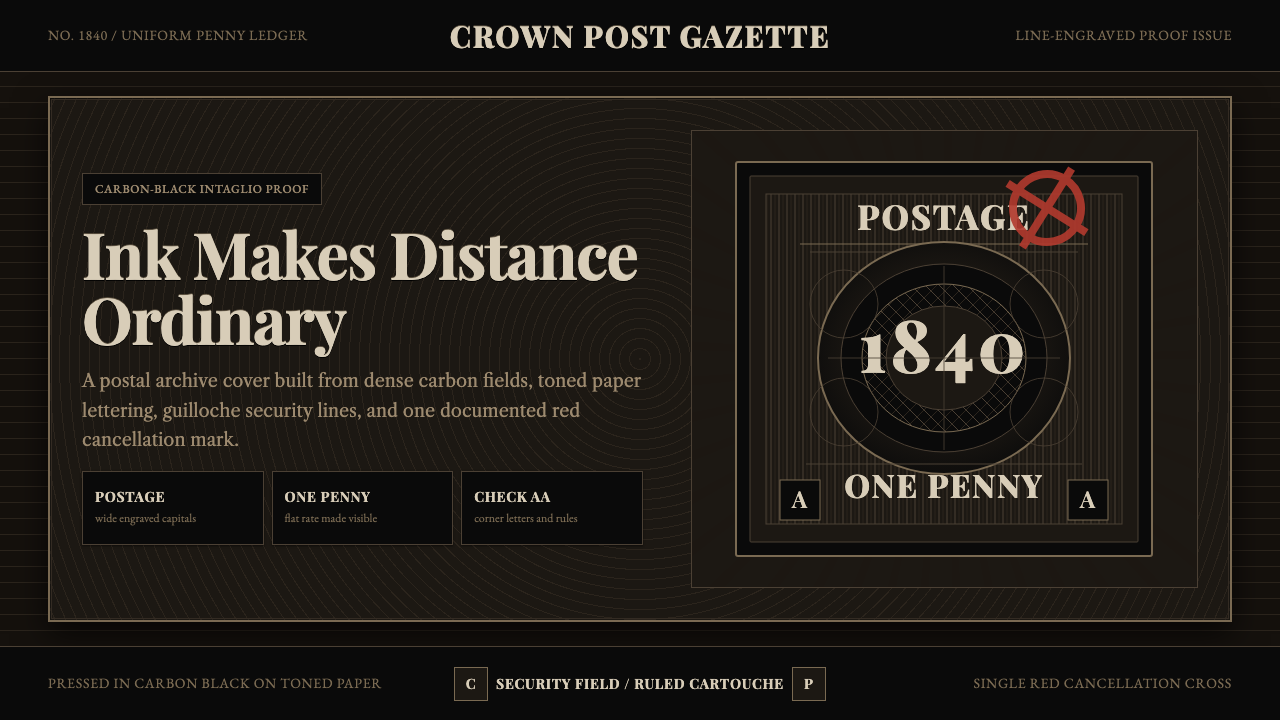 Penny Black StampBlack carries authority. Guilloche lines, Victorian serifs, and one red cross…
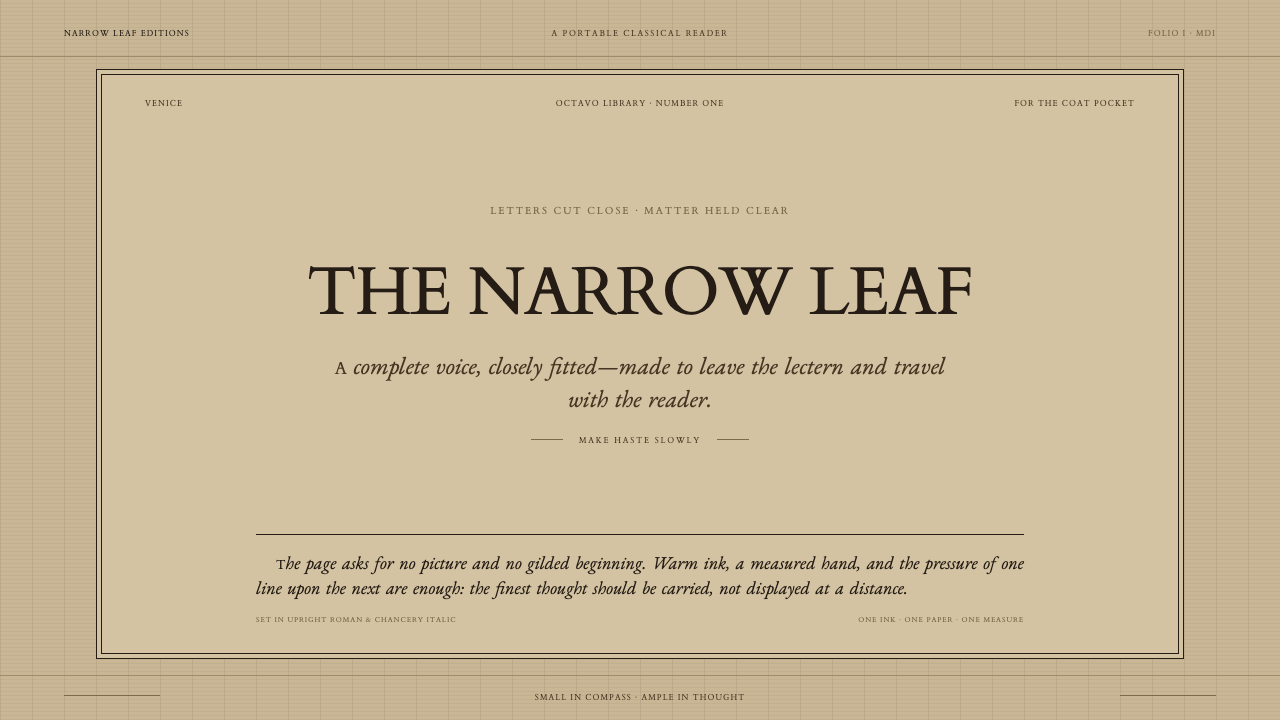 Aldine Press ItalicText needs nothing added. Tight chancery italic meets upright roman caps on m…
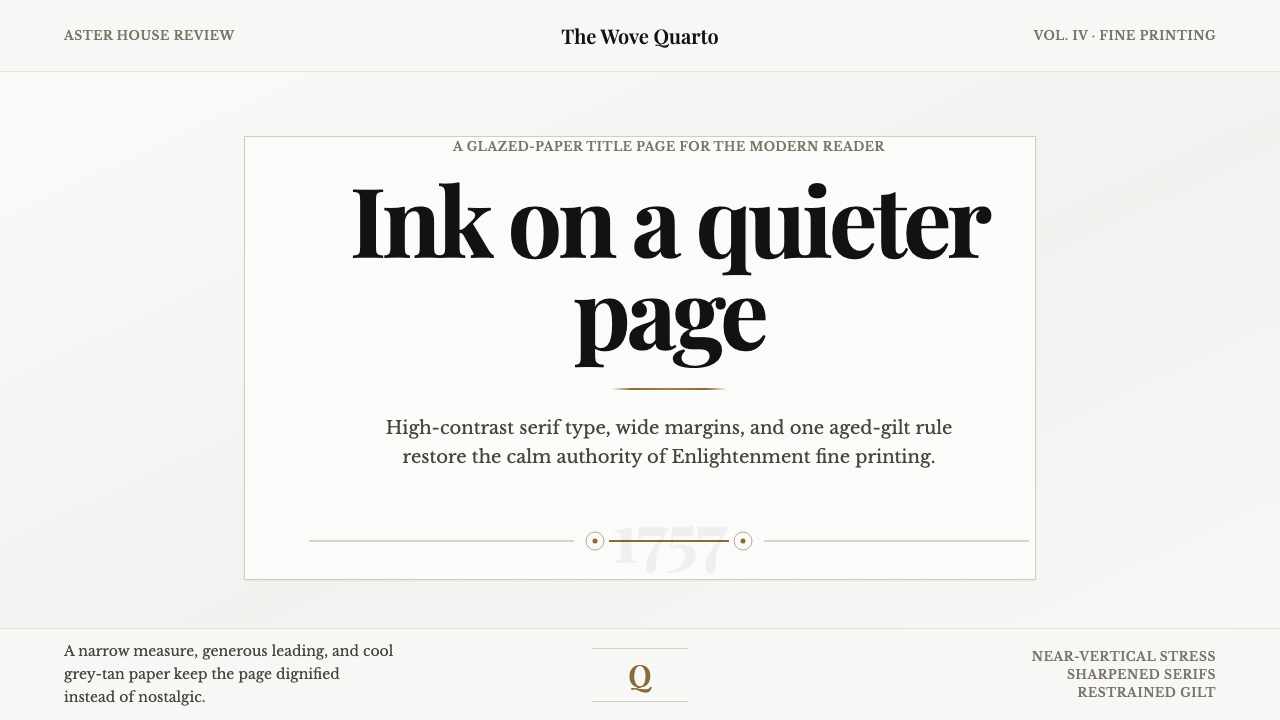 Baskerville Transitional SerifCalm authority in print. Glazed grey-tan paper, sharp serif contrast, one age…
 Budapest Millennium LineChestnut glaze turns transit into a room. Fired slab type and flat yellow run…
 Caspar David FriedrichSilence becomes vast. Prussian blue depth, pearl mist, and parchment framing…
 Degas Ballet PastelsBackstage glamour is labor. Jade walls, rose footlights, cropped serifs on cr…