What is Ghost in the Shell 1995 Cyber?
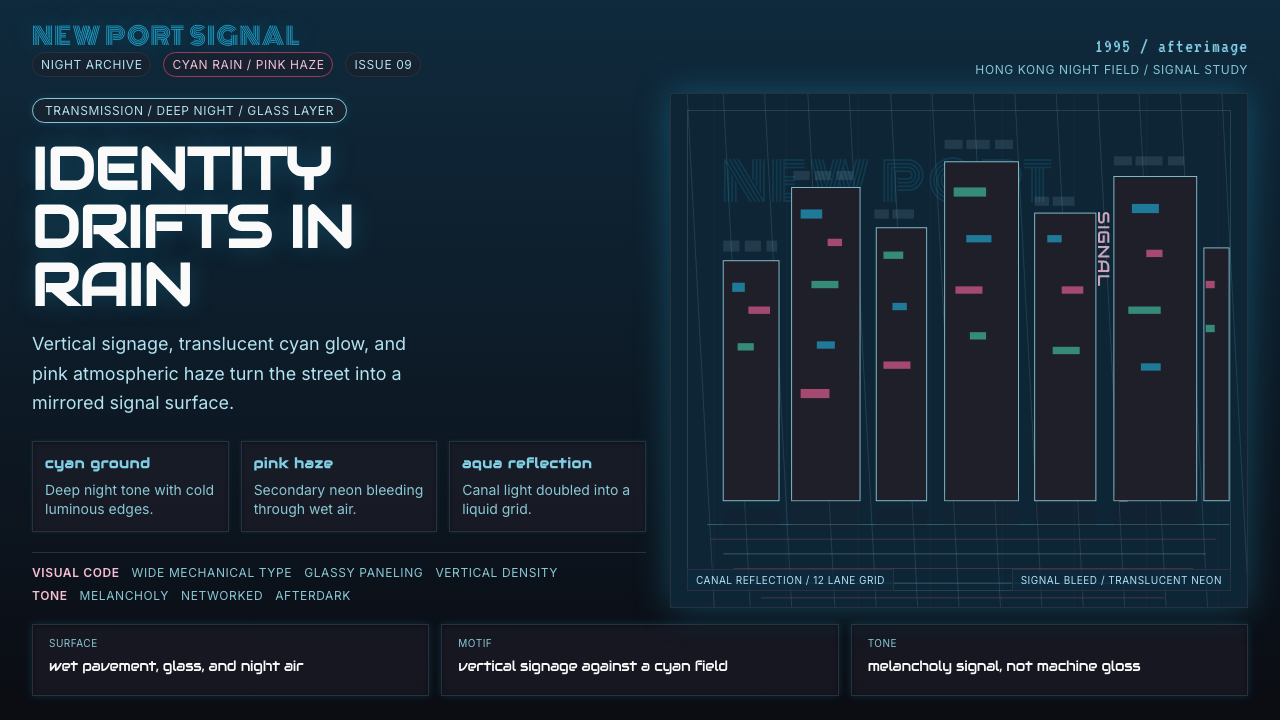
Rain-soaked neon, translucent layers, and the melancholy of a city that never sleeps — Ghost in the Shell 1995 distilled cyberpunk cinema into a visual language still defining how we imagine the digital future.
Ghost in the Shell 1995 Cyber in brief
Ghost in the Shell 1995 Cyber is a design aesthetic drawn directly from Mamoru Oshii's landmark 1995 animated film, itself adapted from Masamune Shirow's 1989 manga. The visual system is built on a deep cyan night sky, hot-pink and magenta neon accents, aqua water-reflection shimmer, and the dense vertical rhythms of kanji signage stacked high above rain-slicked streets. It is the defining look of what became known as Asian-future cyberpunk — dystopian density rendered in jewel-toned saturated light.
Unlike the raw, gritty punk texture of earlier Western cyberpunk, the 1995 film introduced a distinctly melancholic beauty. Translucent overlays, glowing atmospheric haze, and the doubling of every light source in canal water give the world an almost impressionistic softness beneath its hard technological surface. The aesthetic holds two opposing moods simultaneously: the cold geometry of surveillance infrastructure and the warm, humid blur of a monsoon city alive with human density.
The system extends beyond color into typography and hardware design. Geometric-futuristic letterforms — forms that suggest machine origin while remaining legible — sit alongside angular terminal interfaces, sharp-edged mechanical chassis, and scanline overlays that evoke cathode-ray display technology. The result is a design language that feels simultaneously ancient and post-human, rooted in mid-century Hong Kong street life and reaching toward a networked future where the boundary between person and system has dissolved.

Where does Ghost in the Shell 1995 Cyber come from?
The visual origins of the 1995 film begin with Masamune Shirow's original manga, serialized in Japan from 1989. Shirow's drawings were already dense with technological speculation — cyborg bodies, networked consciousness, overlapping jurisdictions of government and corporate power — but it was Oshii's film adaptation that transformed this material into a sustained cinematic visual argument. Where the manga was kinetic and expository, the film was slow, atmospheric, and philosophical. Oshii spent entire sequences on the city itself: canal reflections, market crowds, rain on windows, the hum of infrastructure.
Art director Hiromasa Ogura was central to building the film's visual world. The setting, called New Port City, was explicitly modeled on Hong Kong — specifically the dense urban fabric of Kowloon, Yau Ma Tei, and Sham Shui Po as they existed in the early 1990s, just before the handover. Ogura and the Production I.G team conducted reference photography in Hong Kong and translated that visual data into a painted, hand-animated world where the neon language of Cantonese commercial signage became the dominant typographic texture. The choice was not incidental: Hong Kong at that moment was itself a city living under the sign of transition, its identity in question, its future uncertain — a perfect mirror for the film's philosophical themes about consciousness and continuity.
The film's color palette emerged from a specific cinematic decision: to grade the entire world toward cyan and deep blue, pushing the visual temperature of the city into an almost submarine cool, then breaking that coolness with sudden bursts of hot pink and magenta neon. This approach drew on the actual night-lighting conditions of dense Asian commercial districts, where sodium vapor, fluorescent, and neon sources combine into complex chromatic fog, but Ogura and the animation team pushed that naturalistic source material into heightened, saturated territory. The water — the canals, the rain, the harbor — became a compositional device, doubling every light source and turning street-level geometry into shimmering abstraction from above.
Kenji Kawai's score contributed to the aesthetic in ways that are worth noting even in a visual design context: the Buddhist chant that opens the film, the sense of ancient ritual encountering technological modernity, shaped the emotional register that the visual system had to match. The film's aesthetics are inseparable from that philosophical mood — a city ancient enough to have a spiritual weight, technological enough to dissolve the self. This tension between the archaic and the networked remains the core emotional signature of the style, and it is this quality that distinguishes it from purely decorative cyberpunk aesthetics that borrow the neon palette without the melancholy.
What defines the Ghost in the Shell 1995 Cyber look?
Color Ground
The dominant ground is a very deep, desaturated cyan-blue — not quite black, not quite navy, but the specific darkness of a rainy night sky over a lit city. Against this ground, all other colors operate as light sources rather than pigments. The palette reads as luminous rather than printed: colors glow from within rather than sitting on a surface.
Neon Accent System
Hot pink and magenta serve as the primary accent, used for signage, highlights, and interface elements that demand immediate attention. A cooler aqua or teal provides a secondary accent, reserved for water reflections, atmospheric glow, and secondary interface layers. The two accent colors rarely appear at equal weight; the composition always establishes a dominant neon hue and a recessive one.
Translucency and Layering
Transparency is not a technical trick but a philosophical statement in this aesthetic — the dissolution of solid boundaries mirrors the film's themes about identity and the permeable self. Interface panels, overlay text, and atmospheric fog are all rendered as partially transparent, allowing the layers beneath to bleed through. The result is a visual depth that feels less like 3D space and more like looking through multiple panes of rain-fogged glass.
Vertical Typographic Density
Kanji, katakana, and dense vertical signage stacked in multiple languages create a typographic environment of extraordinary richness. Text is treated as texture and atmosphere rather than pure communication — signs overlap, scale wildly between foreground and background, and read as an urban visual field rather than discrete readable units. Geometric-futuristic letterforms for Latin characters echo machine terminals and early digital display aesthetics.
Reflective Surfaces and Water
Rain-slicked streets, canal water, and polished hardware surfaces are not incidental environmental details — they are structural compositional elements. Every light source is doubled by its reflection, creating vertical symmetry that is then broken by ripple and motion. This mirroring device generates compositional richness without adding new visual elements: it multiplies what is already present.
Angular Hardware Aesthetic
Mechanical and technological objects in this world are characterized by sharp angles, visible seams, exposed bolt patterns, and the suggestion of modular assembly rather than seamless consumer finish. Interface screens have visible scanlines or raster artifacts. Chassis are segmented and angular. The aesthetic treats technology as industrial infrastructure rather than consumer product — it is meant to be operated, not admired.
Atmospheric Glow and Bloom
Light sources in this aesthetic do not end cleanly at their edges. Every neon sign, every street lamp, every illuminated panel bleeds outward into the surrounding darkness with a soft chromatic bloom — the visual signature of light passing through humid, particulate-laden urban air. This atmospheric diffusion is what distinguishes the palette from flat neon illustration: it gives the world weight, climate, and a sense of genuine nocturnal atmosphere.

Who shaped Ghost in the Shell 1995 Cyber?
Director of the 1995 film, Oshii transformed Shirow's action-oriented manga into a philosophical meditation on consciousness, identity, and the boundary between human and machine. His signature approach — long, wordless sequences dwelling on the city's surfaces, rain, and water — established the contemplative visual rhythm that defines the aesthetic. Oshii had previously directed Patlabor 2 (1993), where he began developing the rain-city visual vocabulary he would refine in Ghost in the Shell. His influence on subsequent cyberpunk visual culture — from The Matrix to Blade Runner 2049 — is direct and acknowledged.
As art director, Ogura was responsible for translating Oshii's atmospheric intentions into specific painted backgrounds and color decisions. He led reference trips to Hong Kong and supervised the Production I.G background art team in building the film's visual world frame by frame. His choice to ground the futuristic city in actual, photographically observed Hong Kong urban fabric — rather than generic science fiction architecture — is what gives the aesthetic its specific density and documentary credibility. Ogura's backgrounds are themselves works of extraordinary craft, with each frame containing layered signage, reflected light, and atmospheric perspective handled through color temperature rather than value.
The manga-ka behind the original 1989 Ghost in the Shell source material, Shirow created the technological and philosophical world that Oshii's film visualized. His manga had already established many of the hardware aesthetics — angular cyborg bodies, dense interface overlays, hybrid human-machine forms — that the film translated into cinematic terms. Shirow's visual approach to technology was always densely annotated and encyclopedic, treating the machinery of the future as something to be understood rather than merely feared or admired, and this intellectual attitude toward technological design persists in the design aesthetic.
Composer Kawai's score for the 1995 film is inseparable from its visual identity. His use of Bulgarian vocal techniques and Buddhist chant traditions — ancient forms layered over synthesized textures — created the specific emotional register of the film: something ancient confronting something radically new. In design terms, Kawai's contribution is a reminder that the Ghost in the Shell aesthetic is not purely visual; it carries a mood of contemplative melancholy that resists pure spectacle. Designs inspired by this aesthetic should carry that same emotional weight rather than simply reproducing the neon color palette.
Production I.G, the animation studio behind the film, developed techniques for the 1995 production that were technically pioneering for their moment — combining hand-drawn cel animation with early digital compositing to achieve the translucent layering effects that define the film's visual depth. The studio's willingness to treat digital tools as a means of achieving atmosphere rather than simply adding effects is what made the compositing feel organic rather than grafted on. This integration of analog and digital techniques, where the seam is deliberately obscured, remains a core principle of the aesthetic.
How do you use Ghost in the Shell 1995 Cyber today?
Ghost in the Shell 1995 Cyber is a dark-mode aesthetic by nature — its deep cyan-night ground requires dark interface or document backgrounds to read correctly. Before applying it, confirm that the context supports darkness: this is the right call for a data dashboard, a film industry pitch deck, a cybersecurity product landing page, or a conference presentation on technology futures. It reads as misaligned in bright consumer contexts, health and wellness applications, or anything that requires a sense of openness and daylight.
For presentation slides, the style excels at cover pages built around a single dramatic visual moment: a dark ground, a large translucent typographic element or abstract glow shape occupying most of the canvas, and a tight cluster of information in the lower third. Content slides should maintain the dark ground and use the neon accent colors strictly for hierarchy — one color for primary callouts, a cooler hue for secondary labels, white or near-white for body text. Data slides take on a readout quality reminiscent of terminal displays: sparse, monospaced-feeling type, minimal grid lines, and data points colored to match the neon accent palette. Avoid filling every slide with full visual density; the aesthetic needs breathing room between its atmospheric moments.
For web interfaces and dashboards, the style maps cleanly onto dark-mode component systems. Background layers should be tiered from the deepest near-black through mid-dark panels to surface elements — each tier lighter and slightly more cyan-tinted, creating depth through color temperature rather than shadow alone. Interactive elements, alerts, and primary actions use the hot-pink or magenta accent; secondary information uses the aqua or teal. Typography should feel technical and precise: moderate tracking on headlines, tight line-height on body text. Pricing pages benefit from the style's implicit hierarchy of tiers: a dark-ground base tier, a highlighted featured tier with neon border glow, and a premium tier in the deepest dark with the most saturated accent.
For editorial and marketing applications, the aesthetic supports strong narrative content where mystery and technological sophistication are desired brand values. Feature story layouts can use full-bleed dark-ground sections with large translucent pull-quotes as atmospheric elements. Marketing campaign materials — social cards, email headers, event graphics — work well with the compositional approach of centering a single glow-source in the frame and letting the surrounding darkness create drama. The vertical typographic rhythm of stacked signage can inform section headers and category labels that use tight vertical letter-spacing to echo the aesthetic's Hong Kong signage origin.
The most common mistake when applying this aesthetic is treating it as a neon-on-black illustration style — adding bright pink and cyan graphic elements over a flat black background and calling it done. The real system depends on atmospheric quality: the glow that bleeds beyond edges, the layered translucency that creates depth, the sense that light is passing through humid air rather than sitting on a screen. A second common error is using the full neon palette simultaneously at maximum saturation, which destroys the hierarchy the style depends on. In authentic applications of this aesthetic, most of the canvas is very dark and relatively desaturated; neon appears in small, precise applications that feel like discovered light rather than applied decoration.

Ghost in the Shell 1995 Cyber — FAQ
Is this aesthetic the same as general cyberpunk?
Ghost in the Shell 1995 Cyber is a specific subset of the broader cyberpunk visual tradition, and knowing the differences matters for applying it accurately. General cyberpunk visual language — descended from Ridley Scott's Blade Runner (1982) and the American science fiction tradition — tends toward orange and amber neon, dry industrial grit, and a rawer, more chaotic composition. The 1995 film's aesthetic is distinctly more melancholic, more atmospheric, and more specifically Asian in its visual references. The cyan-dominant palette, the water and rain as compositional elements, the Buddhist-influenced philosophical undercurrent, and the Hong Kong street density are all specific to this film's visual world and distinguish it from generic neon-on-black design.
Can this aesthetic work in a light-mode or white-background context?
With significant modification, yes — but the result will be a loose interpretation rather than an authentic application. The glow effects and atmospheric translucency that define the aesthetic depend on darkness to read as luminous; on a white background, neon colors simply become saturated graphic accents without the sense of light in darkness. A light-mode interpretation might retain the color palette — cyan, pink, aqua — and the geometric-futuristic typographic approach while abandoning the atmospheric and translucency qualities. This produces something closer to a flat graphic style that references the film without capturing its mood. For most applications, if you need a light-mode version, a different aesthetic will serve you better.
How do I use typography correctly within this aesthetic?
Typography in this aesthetic operates at two registers simultaneously. The first is the ambient register: dense, overlapping text used as visual texture — kanji, multiple scripts, stacked labels — which functions as atmosphere rather than readable communication. The second is the functional register: precise, technical-feeling type used for actual hierarchy and navigation. For the functional register, choose geometric or monospaced-leaning typefaces that suggest machine output — clean, deliberate, with no humanist warmth. Headlines benefit from wide, generous spacing that feels like a terminal display; body text should be tight and efficient. Avoid typefaces with organic hand quality or strong calligraphic influence, which undermine the machine-world register.
What kinds of imagery work well in this aesthetic?
Photographic imagery works best when it is heavily color-graded toward the aesthetic's palette — pulling blues and cyans into prominence, crushing the shadows toward a deep cyan-black, and adding a slight atmospheric haze. High-angle urban photography, especially of dense Asian cityscapes at night, integrates naturally. Close-up photography of mechanical or electronic hardware — circuit boards, cable runs, server infrastructure — reads well when color-graded and treated as texture. What to avoid: warm-toned photography, daylight-lit scenes, natural landscapes, and any imagery that brings visible human warmth or organic texture into the frame without significant treatment.
How does this aesthetic age — will it feel dated quickly?
The 1995 film itself has aged remarkably well as a visual artifact, now nearly three decades old and still cited as a reference by contemporary designers and directors. The aesthetic has proven durable because its visual logic is grounded in something real — actual urban light physics, actual Hong Kong street density, actual philosophical and emotional content — rather than in trend-driven surface novelty. That said, the period of 2015–2025 saw heavy commercial adoption of cyberpunk visual cues across gaming, streaming, and marketing, and some surface applications — flat neon gradients, synthwave color palettes — have accumulated associations with a specific cultural moment that may date quickly. The distinction is between applying the aesthetic's underlying logic (atmosphere, translucency, luminosity, melancholy) and simply borrowing its surface palette. The former ages well; the latter ages with the trend cycle.
Related design styles
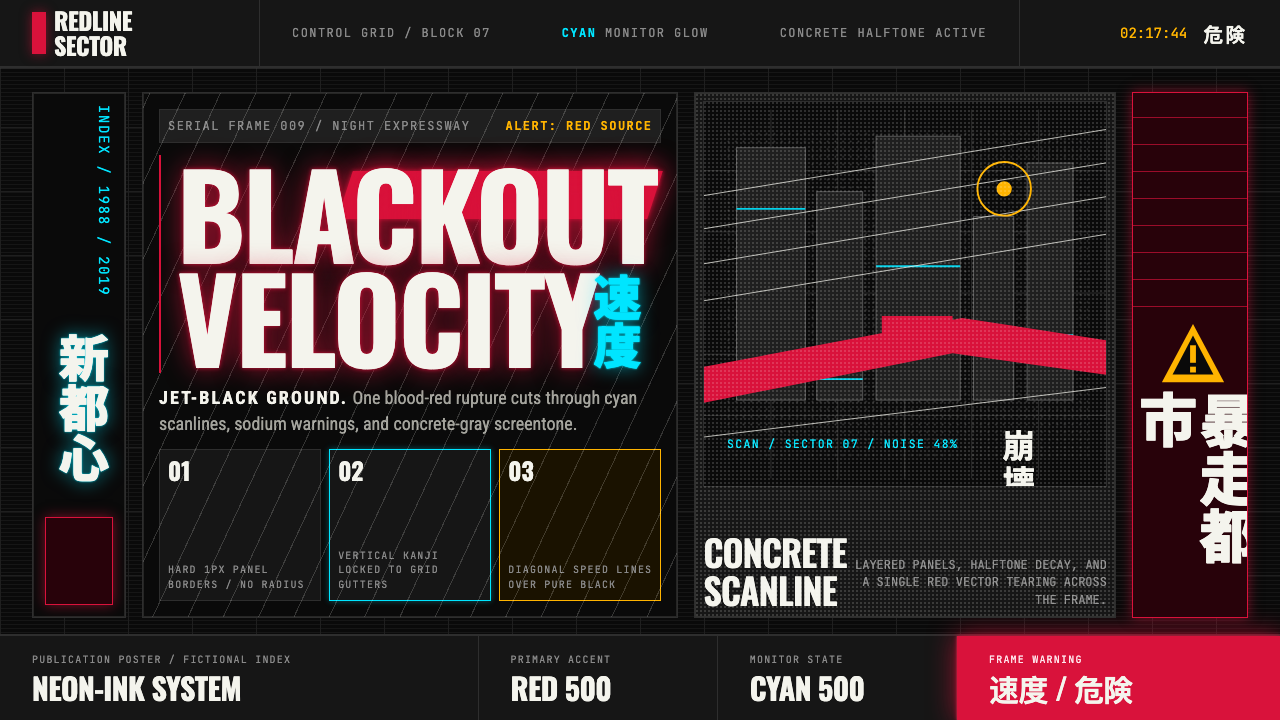 Akira (Otomo)Cyberpunk at impact. Kaneda red, cyan kanji, halftone concrete, and diagonal…
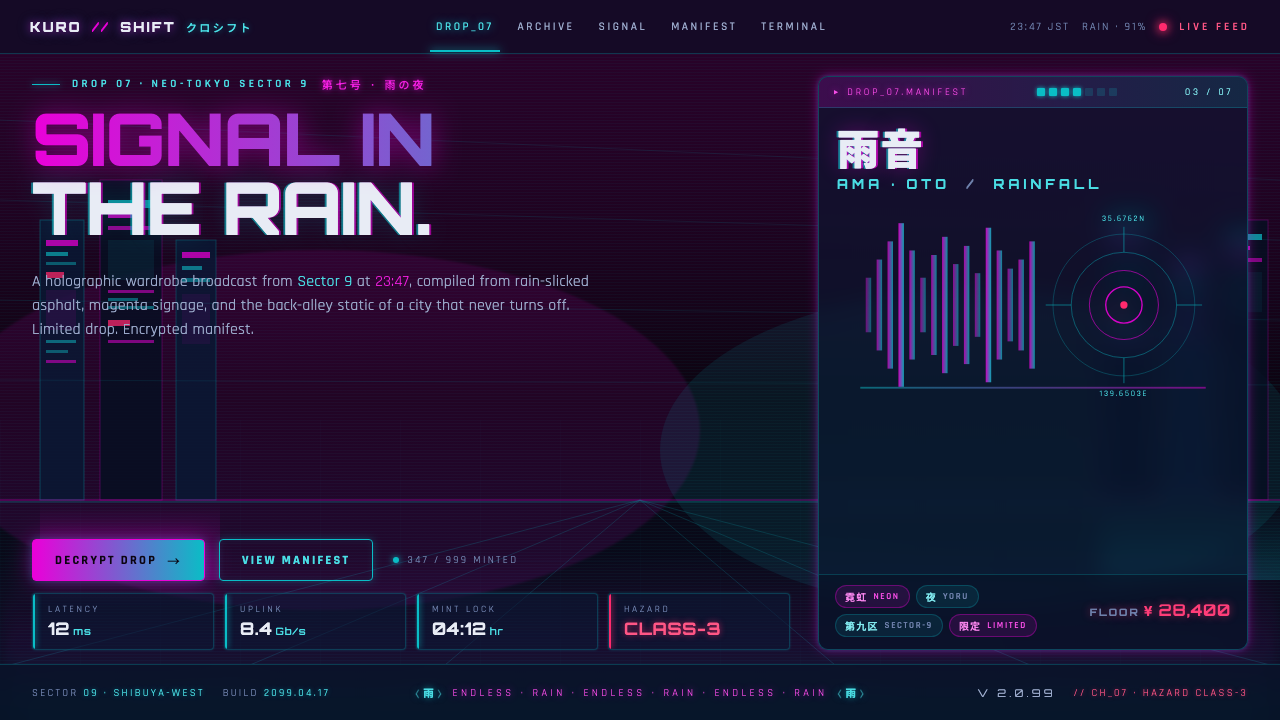 Neo-Tokyo 2099Endless rain, a thousand signs. Magenta vs cyan on near-black asphalt, kana b…
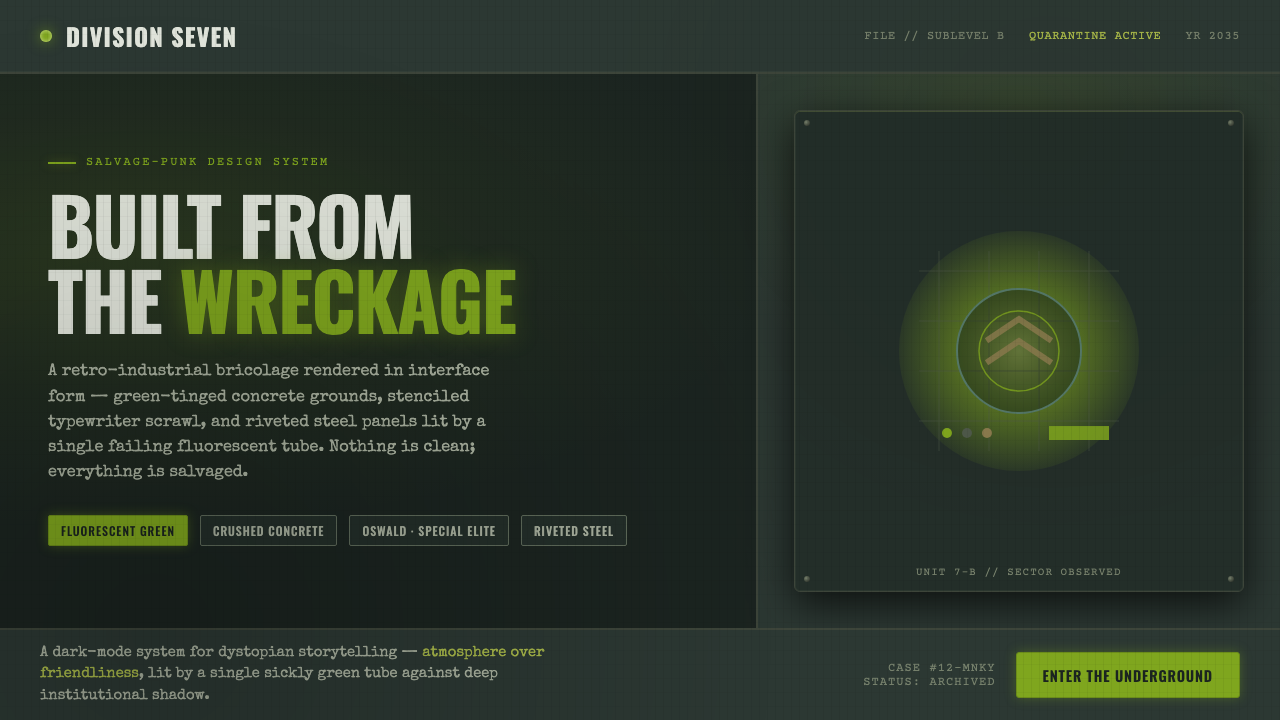 12 MonkeysBuilt from the wreckage. Sickly fluorescent green on crushed-black concrete,…
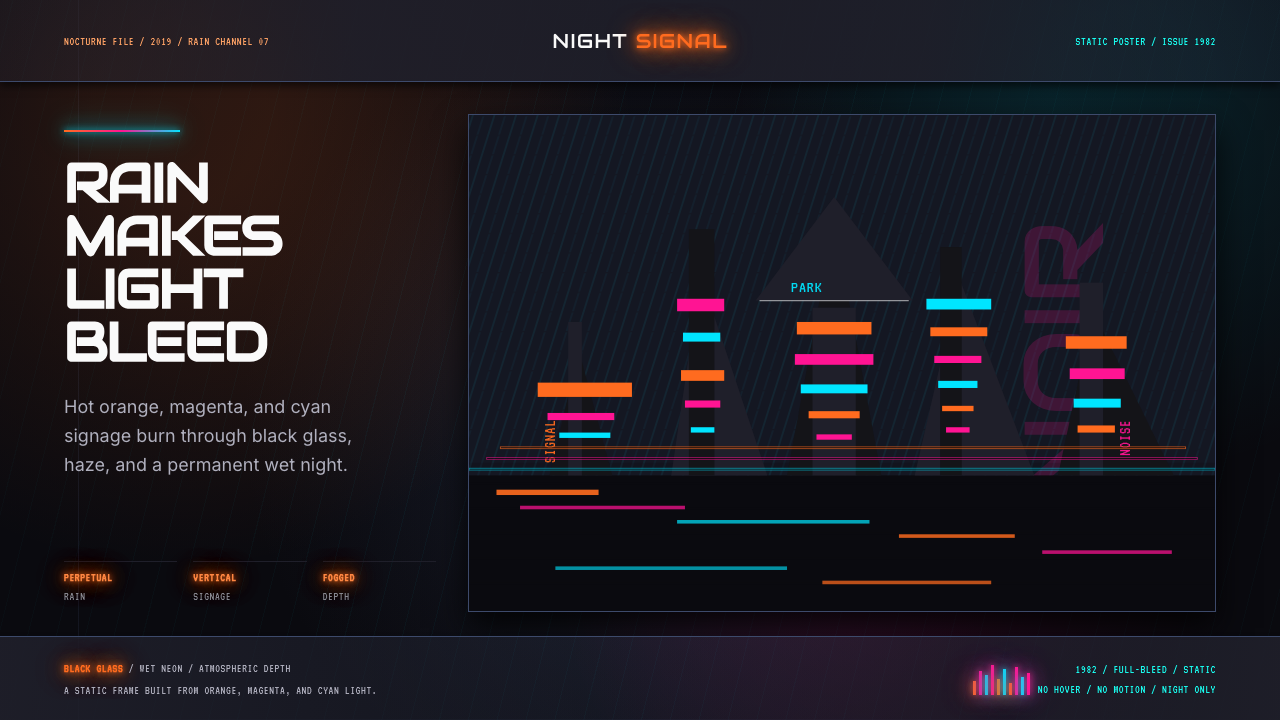 Blade Runner 1982 Neon NoirRain-soaked noir. Orange, magenta, and cyan neon cut black glass.
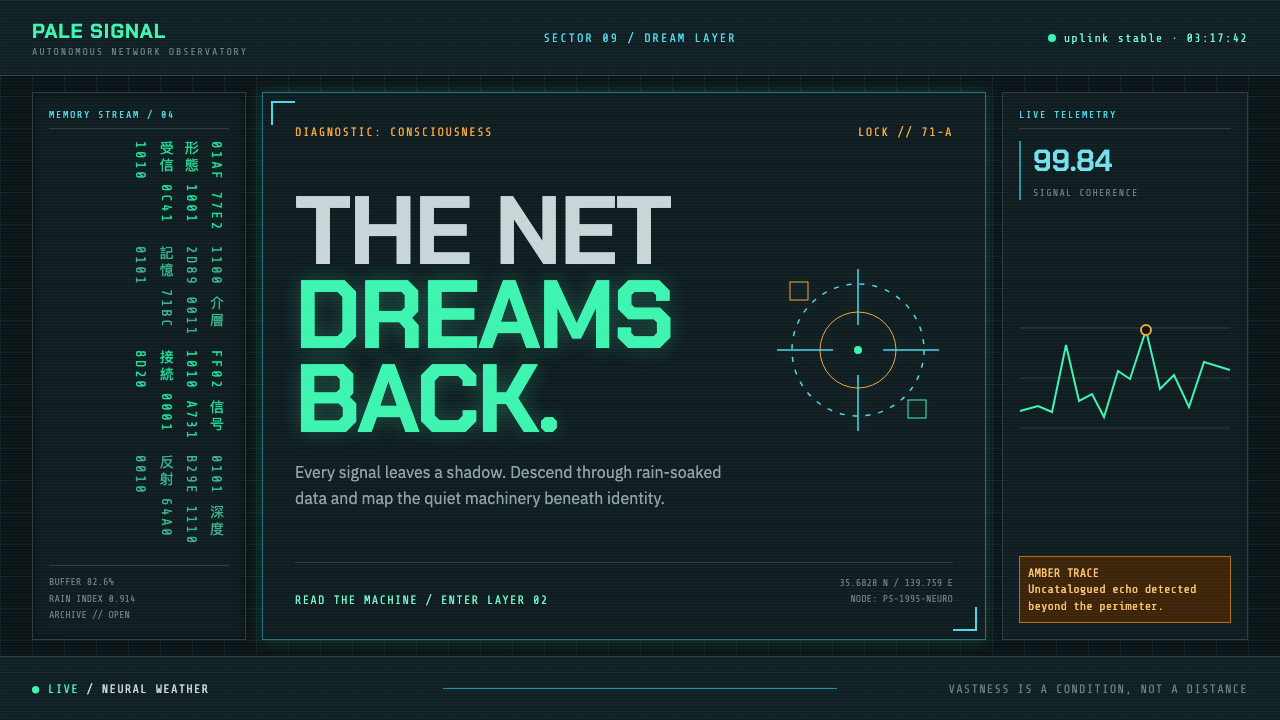 Ghost in the Shell (1995)A machine dreams in the rain. Phosphor green code burns through black-teal gl…
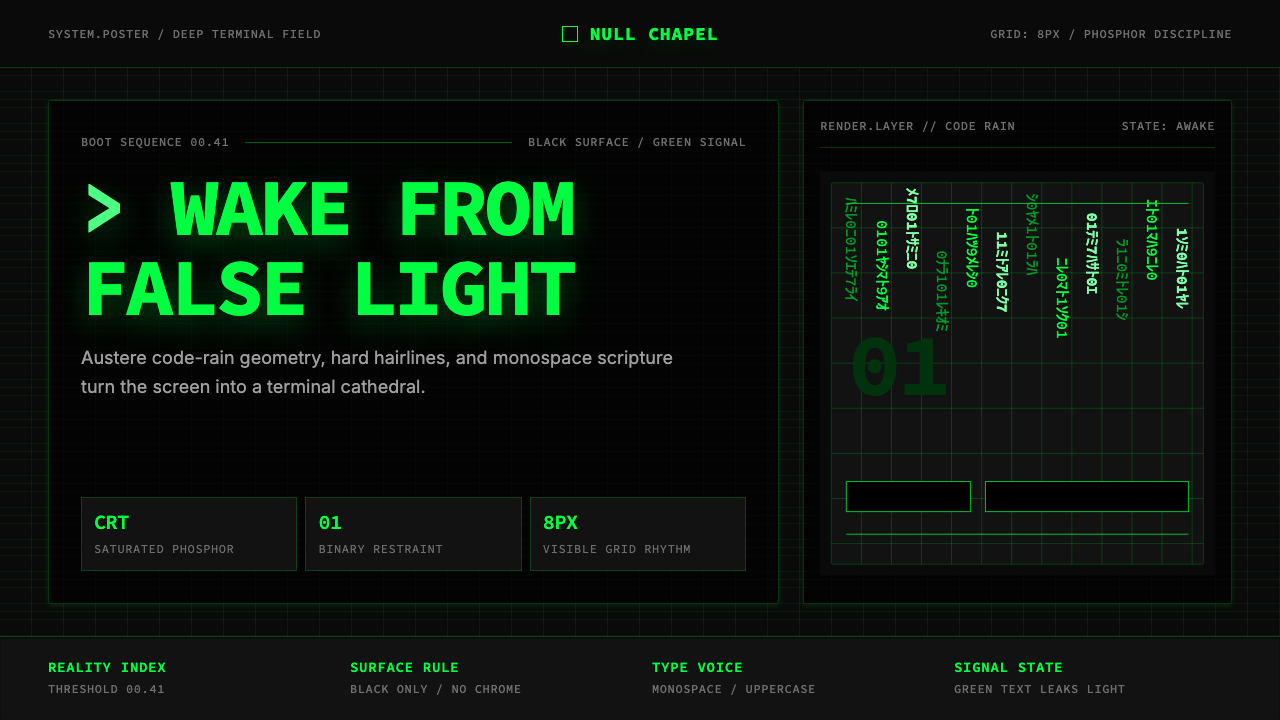 The Matrix (Green-Code)Terminal myth, disciplined. CRT green code rain, black grid, monospace script…