What is ASCII Art BBS (1992)?
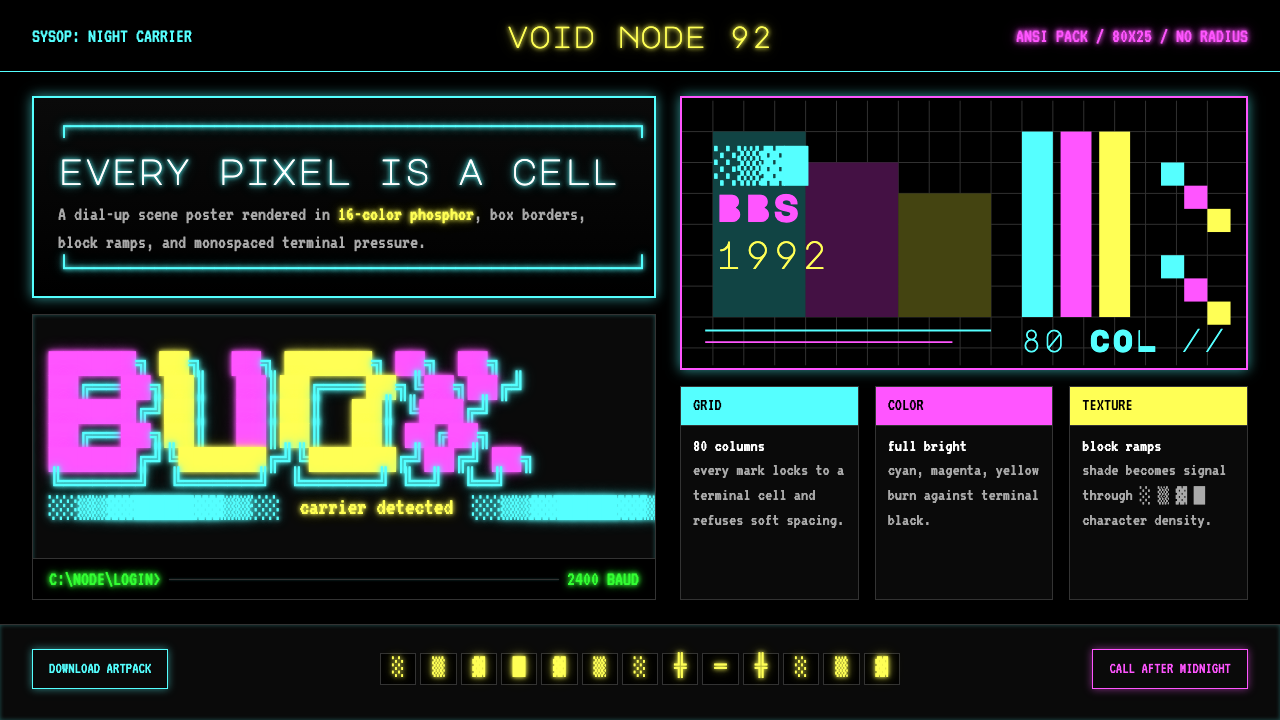
Before the web existed, underground artists turned the humble terminal grid into a neon-soaked canvas — one character cell at a time.
ASCII Art BBS (1992) in brief
ASCII Art BBS (1992) is a design aesthetic distilled from the ANSI/ASCII art scene that flourished on dial-up bulletin board systems between roughly 1987 and 1996. The style encodes the visual language of that era: pure terminal black as the only background, saturated neon cyan, magenta, and yellow as primary expressive colors, monospaced letterforms at every scale, box-drawing characters used as structural frames, and the characteristic glow of phosphor-on-glass rendered as a scanline shimmer across every surface.
What sets this aesthetic apart is its constraint-born creativity. Artists worked within a fixed grid of eighty columns by twenty-five rows, a palette of sixteen colors drawn from the CGA and VGA standards, and a character set of two hundred fifty-six code points — including the block-shade ramp of characters that produce graduated density from solid fill to near-transparency. Within those limits, crews produced intricate logos, menu screens, and illustrated headers that read as bold graphic design, not primitive workarounds. The block-shade technique, in particular, generates smooth-seeming gradients and dimensional forms without a single pixel of actual bitmap data.
Visually, authentic BBS-era work is instantly legible by its density and its darkness. There is no whitespace in the modernist sense — negative space is terminal black, and it reads as void rather than breathing room. Color is saturated to the edge of its technical limit, because the palette offered no midtones and no transparency. Type is always monospaced, always grid-aligned, and often built character by character rather than set from a font menu. The result is an aesthetic that feels simultaneously raw, precise, and paradoxically luminous.

Where does ASCII Art BBS (1992) come from?
The story begins not with art but with infrastructure. ANSI escape codes — control sequences defined by the American National Standards Institute in 1979 — gave terminal emulators the ability to position the cursor anywhere on the screen, change foreground and background colors, and move the cursor without clearing the screen. When the IBM PC popularized the personal computer in the early 1980s, terminal software like ANSI.SYS on DOS systems brought this capability to millions of home users. The character set encoded in the original IBM PC firmware included, alongside alphanumerics and punctuation, a suite of box-drawing characters and block-shade glyphs that would become the raw material of an entire art form.
Bulletin board systems — software running on home computers connected to the public telephone network via modem — became the social infrastructure of the pre-Internet computing underground. By the late 1980s, major metropolitan areas in the United States supported dozens or hundreds of BBSes, each with its own culture, user base, and aesthetic identity. Sysops (system operators) commissioned artists to create elaborate ANSI welcome screens, menu interfaces, and file-area headers that would greet callers over connections as slow as two thousand, four hundred, or nine thousand, six hundred bits per second. The art had to work at those speeds — downloading character by character, revealing itself line by line.
Organized crews emerged to meet this demand. ACiD Productions, founded in 1990 in the United States, became the most prominent: it issued monthly artpacks — ZIP archives distributed across the BBS network — that collected the work of dozens of affiliated artists. iCE Advertisements formed as a rival group in 1990, followed by the ANSI Outlaws, Oderus Urungus's group Dark, and many others. These crews operated across national lines: ACiD and iCE had members in the United States, Canada, and across northern Europe, with particularly active nodes in Sweden, the Netherlands, and Germany. The scene's geography followed the modem infrastructure and the cultural overlap between the American hacker underground and the European demoscene.
The peak years ran from roughly 1991 to 1995. Monthly artpack releases were anticipated events; ANSI art was reviewed in text-format zines distributed on the same BBS networks that hosted the art. As Internet access became broadly available from 1994 onward, the BBS model declined — graphical web browsers rendered the terminal aesthetic obsolete for most users. Many scene artists migrated to early web graphics and later to pixel art. But the aesthetic never entirely disappeared: Jason Scott's archival project at textfiles.com preserved tens of thousands of ANSI files beginning in the early 2000s, and the archive at 16colo.rs maintains an ongoing collection of both historical and contemporary ANSI art. A small but committed revival community continues to produce new work in the classic style using modern tools that emulate the original terminal environment precisely.
What defines the ASCII Art BBS (1992) look?
Color
The palette is hardcoded by hardware: sixteen colors drawn from the CGA and VGA standards, ranging from the eight base colors — black, blue, green, cyan, red, magenta, brown/dark yellow, and light gray — to their eight brightened variants. In practice, BBS artists built a vocabulary around the most visually striking combinations: bright cyan and bright magenta against pure black produce the characteristic phosphor glow; bright yellow functions as the sharpest highlight; dark blue or dark green become structural shadows. No custom color mixing is possible — every hue is one of sixteen fixed positions, and the aesthetic gains its coherence from working that constraint consciously rather than fighting it.
Typography
All text is monospaced by definition — the terminal renders every character in an identical cell, so proportional spacing is architecturally impossible. BBS artists exploited this constraint rather than working around it: large display lettering was built by filling character cells with block shapes to form oversized letterforms many rows tall, while body text ran in the standard terminal font at its natural size. The effect produces a radical scale contrast between headline and body that no proportional typeface system could replicate exactly. Character choice extends beyond alphanumerics: ANSI art headlines frequently incorporate box-drawing corners, half-blocks, and shade characters as structural elements within the letterforms themselves.
Block-Shade Ramps
The block-shade characters — full block, dark shade, medium shade, light shade, and space — form a density ramp that BBS artists used to simulate gradients, model three-dimensional surfaces, and create the illusion of anti-aliased edges between color regions. A skilled artist could produce forms that appear to curve or recede in space using nothing but these four density values arranged across color transitions. This technique is the most technically distinctive feature of the style, and its mastery separates accomplished ANSI artists from beginners. When applied to backgrounds, the shade ramp produces the characteristic nebula-like depth fields that appear behind logos and title screens.
Grid Discipline
Every element in a BBS composition is locked to the eighty-column, twenty-five-row character grid — there is no sub-cell positioning. This produces a visual rhythm that is simultaneously rigid and expressive: shapes align in ways that feel architectural rather than freehand. Artists developed conventions for how to handle diagonals (using alternating half-blocks at shallow angles), curves (approximated through step-wise transitions between shade values), and compositional balance (filling edge zones with low-density shade to create perceived margins within the fixed frame). The grid does not constrain the composition — it is the composition.
Phosphor Glow and CRT Reference
The aesthetic carries an implicit reference to the physical display technology that originally rendered it: the cathode-ray tube monitor with its characteristic scanlines, slight bloom around bright elements, and the slight fuzziness where high-contrast edges meet. Contemporary applications of the style often make this reference explicit through a faint horizontal scanline overlay and a subtle bloom or outer-glow treatment on the brightest color regions — particularly cyan and yellow, which on actual phosphor monitors produced the most visible halation. The CRT reference grounds the aesthetic in a specific technological moment and distinguishes it from generic dark-mode design.
Absence of Border Radius
Every shape in a character-cell grid is rectilinear by default. Curves require explicit approximation through the block-shade step technique, and even the most skillful approximation retains visible stairstepping at close range. Contemporary design applications derived from this aesthetic treat zero border-radius as a philosophical commitment, not a limitation: all containers, cards, buttons, and frames carry perfectly square corners. This rectilinear absolute distinguishes the style from both generic flat design (which freely uses moderate rounding) and neobrutalist design (which may use sharp corners but does not share the terminal color vocabulary or the monospaced type system).
Dense Composition
BBS art fills the screen. Practical necessity drove this — a welcome screen that left large areas empty wasted the caller's download time and failed to signal the system operator's investment in the BBS's identity. Contemporary applications of the style inherit this density: information hierarchies are compressed, contrast is high, and the overall impression is one of controlled abundance rather than curated restraint. This makes the style unusually well-suited to data-heavy interfaces where the modernist prescription of aggressive whitespace would waste screen real estate. The density is not clutter — it is a deliberate signal that every character cell is accounted for.

Who shaped ASCII Art BBS (1992)?
RaD Man was a founding member and the primary organizational force behind ACiD Productions, the group that effectively defined the institutional structure of the ANSI art scene. Under his coordination, ACiD issued monthly artpacks from 1990 onward, establishing the pack release as the scene's primary distribution and quality-control mechanism. His own art set a benchmark for technically complex compositions that combined logographic letterforms with elaborate background fields, and his networking across the BBS community created the competitive but collaborative culture that drove the scene's output to its highest levels.
Force Ten was a co-founder of iCE Advertisements, the group that formed in 1990 as ACiD's principal rival and maintained a comparable standard of technical and artistic quality throughout the scene's peak years. iCE distinguished itself from ACiD partly through aesthetic temperament: iCE artists tended toward a denser, more illustrative approach with more emphasis on shaded figure work, while ACiD's style leaned toward bold logographic design. The rivalry between the two groups drove competitive improvement across the scene and established the artpack release cycle as the primary measure of a crew's standing.
Spear founded and led the ANSI Outlaws, one of the smaller but critically regarded crews of the peak scene era. Where ACiD and iCE operated as large multi-artist collectives, the Outlaws maintained a tighter roster and a more consistent individual voice across releases. Spear's own work was noted for its compositional economy — achieving complex illusionistic depth with fewer shade transitions than comparable work by larger crews — and for typographic innovation in display lettering, particularly in the construction of three-dimensional-appearing block letterforms.
Jason Scott is not a scene artist but an archivist and historian whose work ensured the scene's survival. Beginning in the late 1990s, he systematically collected and published thousands of textfiles, artpacks, and BBS-related documents at textfiles.com, then produced the documentary film BBS: The Documentary (2005), which remains the definitive historical account of the bulletin board era. His archival practice rescued materials that would otherwise have been lost to bit rot and hardware obsolescence, and his public advocacy established the ANSI art scene as a culturally significant episode in computing history rather than a curiosity.
The European demoscene — centered in Sweden, Finland, Norway, the Netherlands, and Germany — formed a parallel and partially overlapping community to the North American BBS art scene. While the demoscene focused primarily on real-time procedural graphics in executable files rather than static ANSI compositions, its aesthetic values — technical virtuosity within extreme hardware constraints, competitive display through organized party events, and the elevation of the program or composition as an artistic statement — were deeply congruent with BBS art culture. Many European ANSI artists participated in both scenes, and the stylistic cross-pollination is visible in the more elaborate background rendering and the tighter integration of typographic and illustrative elements that characterizes European-affiliated artpacks of the mid-1990s.
How do you use ASCII Art BBS (1992) today?
ASCII Art BBS (1992) is among the most immediately recognizable revival aesthetics in contemporary design, but its distinctiveness comes with a corresponding risk of caricature. Applying it well requires understanding which features are structurally generative — the constraint-driven density, the hardcoded palette, the monospaced grid — and which are merely surface signals. Surface-only application produces costume rather than coherent design: a terminal font and a scanline overlay do not constitute the style if the underlying compositional logic is not present.
For presentation slides, the style works exceptionally well on cover and section-break pages, where the full-bleed dark background and phosphor-glow headline treatment create an immediate visual statement. Cover compositions should treat the title as a constructed ANSI logotype — oversized, built from block characters, positioned in the upper or lower third of the frame — with a secondary tagline in standard monospaced terminal type at much smaller scale. Content slides should preserve the grid logic: information is organized in columns that respect the implied character-cell structure, and data visualizations — bar charts, progress indicators, tables — are styled as if rendered in a terminal environment. Avoid proportional typefaces on content slides; they break the monospaced contract that holds the style together.
For web interfaces, the aesthetic is particularly well-suited to dashboards, developer tools, pricing pages, and any product that communicates technical authority. The approach establishes a near-black or pure-black background as the base, uses a bright accent color — typically cyan or a vivid green reminiscent of classic monochrome phosphor — for interactive states and primary calls to action, and restricts all container shapes to right-angle forms with no rounding. Borders should be visible and structural: a single-pixel or two-pixel border in a muted version of the accent color around cards and input fields reads as a terminal-frame reference. Navigation bars work best as horizontal sequences of monospaced label text; icon-only navigation breaks the text-primary logic of the style.
For editorial and marketing work, the style provides strong visual distinctiveness in contexts where surrounding materials tend toward soft gradients and rounded shapes. A marketing page built on this aesthetic uses alternating full-bleed sections — dark background with bright type, then bright background (typically a near-white or pale cyan) with dark type — with section breaks marked by a horizontal rule styled as a box-drawing character sequence. Pull quotes and callouts gain maximum impact when set in oversized monospaced type with a block-shade character used as a decorative prefix rather than a conventional quotation mark. Email designs can use the style effectively in header sections while defaulting to readable light-background layouts for body content.
The most common failure mode when applying this style is confusing darkness with authenticity. A layout that uses a dark background and a monospaced font but applies rounded corners, soft drop shadows, smooth gradients, and proportional spacing between elements has borrowed the surface signal while abandoning the structural principles. Authentic application means committing to the hard constraints: right angles everywhere, no smooth gradients (shade transitions must step through discrete values as in the original block-shade technique), borders that are visible rather than decorative, and monospaced type throughout — not only in code blocks. A second common mistake is overloading color: using cyan, magenta, yellow, and multiple bright accents simultaneously at full saturation produces visual noise rather than the controlled neon luminosity of genuine BBS work. The original sixteen-color palette achieved its effects by choosing one or two dominant hues per composition and using the rest sparingly as structural contrast.

ASCII Art BBS (1992) — FAQ
Is this style the same as pixel art?
They are related but distinct. Pixel art works at the level of individual bitmap pixels and can use any color from a chosen palette at any screen position. ANSI/ASCII art is constrained to the character cell: each position on the grid displays one of two hundred fifty-six characters in one of sixteen foreground colors on one of eight background colors. The block-shade technique produces effects that superficially resemble pixel art, but the underlying encoding is entirely different — you are specifying characters and color attributes, not pixel values. Contemporary designers sometimes treat them interchangeably, but the constraint systems are genuinely different, and work produced under the character-cell constraint has a visual character — particularly the stepped diagonal and the density of the shade ramp — that pixel art in arbitrary resolutions does not share.
Can this style work on a light background?
Historically, no — the BBS aesthetic was defined by the terminal's default black background, and the palette's saturated colors were calibrated to glow against that void. A light-background inversion is technically possible in contemporary applications, but it requires significant adaptation. The bright cyan and yellow that produce phosphor glow against black become garish or illegible against cream or white. A practical light-mode variant might restrict the accent palette to darker, more saturated versions of the core hues, drop the scanline and bloom effects entirely, and treat the box-drawing structural frames as the primary visual anchor. The result will be readable and recognizably related to the source aesthetic, but it will not carry the luminous intensity that makes the style distinctive — that quality is inseparable from the dark ground.
How does this style differ from cyberpunk or vaporwave aesthetics?
All three share a dark background, neon color palette, and retro-technological reference, which causes them to be confused in casual usage. The distinctions are meaningful. Cyberpunk aesthetic typically incorporates photographic or illustrative imagery, references to corporate dystopia, and a color vocabulary weighted toward red and acid green alongside blue; it is not constrained to monospaced type or character-cell grids. Vaporwave foregrounds pastel midtones — particularly pink, lavender, and seafoam — against white or gradient backgrounds, incorporates marble textures and classical sculpture, and has a dreamy, slow quality antithetical to the BBS scene's tightly-wound technical competitive energy. ASCII Art BBS is more austere, more typographic, more rigorously grid-constrained, and more historically specific — it references a real technical artifact and a real subculture, not a generalized fantasy of technological nostalgia.
Why does the style use such saturated colors if the original hardware had a limited palette?
Because the sixteen-color CGA and VGA palettes contained no midtones and no pastels — only fully saturated versions of each hue at two brightness levels. The artists had no choice about saturation; it was an immutable property of the hardware. This forced constraint turned out to produce an aesthetic effect that is now recognized as the style's most distinctive quality: the phosphor-glow intensity that makes BBS art look like it is lit from within. When contemporary designers apply the style, preserving that full saturation is not maximalism — it is fidelity to the original constraint. Desaturating the palette to make it more conventionally tasteful produces something that resembles the style superficially but loses the core visual energy.
Is there a contemporary community still making ANSI art in the original format?
Yes, though it is small and specialized. The 16colo.rs archive serves as the primary hub for contemporary ANSI art production, hosting both historical packs and new work submitted by active artists. Tools like PabloDraw and Moebius allow artists to work in the original character-cell format with accurate color rendering, and active crews continue to release packs through the archive. Annual events — particularly blocktronics releases and the ongoing contributions of groups like Mistigris — maintain the pack-release tradition. The scene has also developed a community around the Summer of ANSI and similar themed events. The contemporary revival is notable for including artists who never experienced the original BBS era, working in the historical format purely for its aesthetic and technical interest rather than its original functional context.
Related design styles
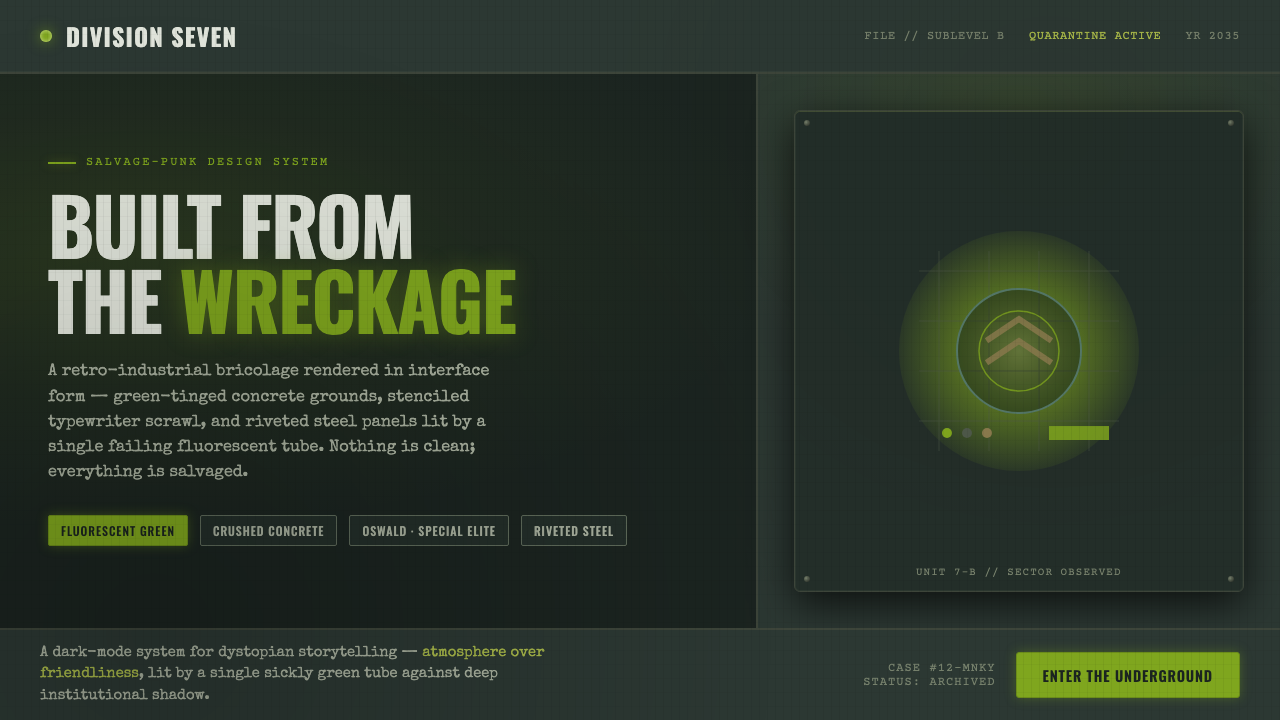 12 MonkeysBuilt from the wreckage. Sickly fluorescent green on crushed-black concrete,…
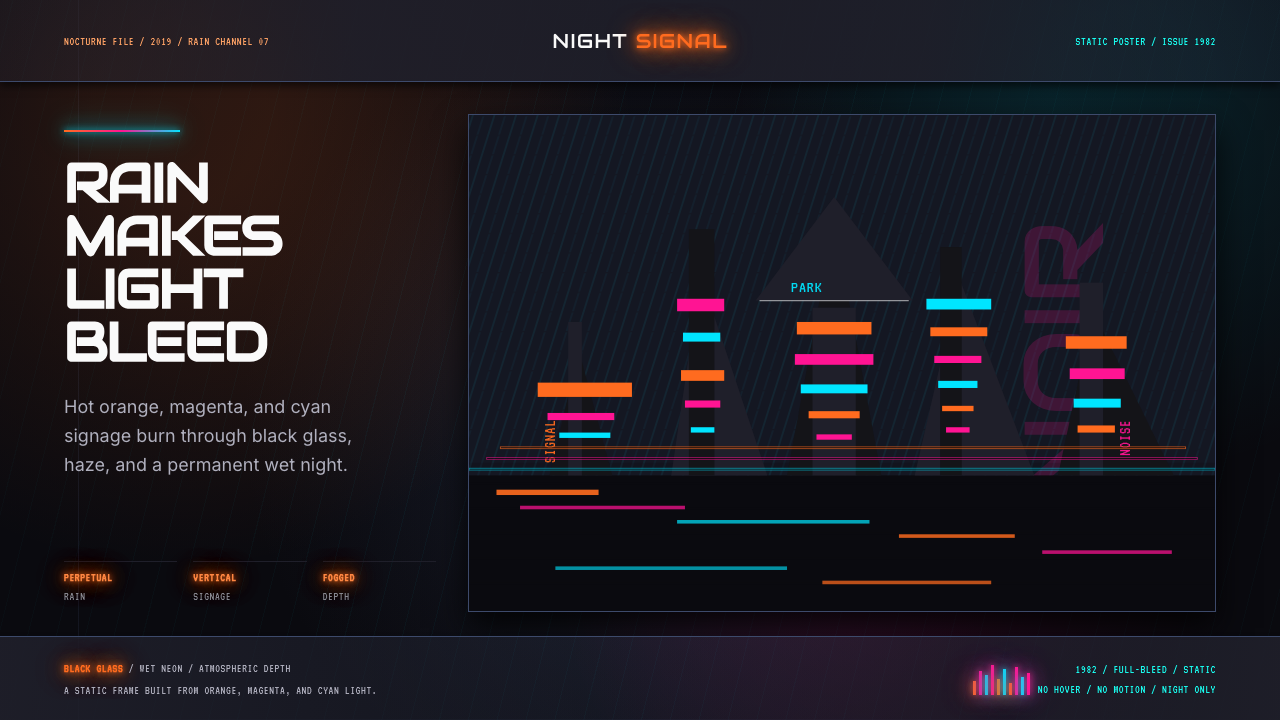 Blade Runner 1982 Neon NoirRain-soaked noir. Orange, magenta, and cyan neon cut black glass.
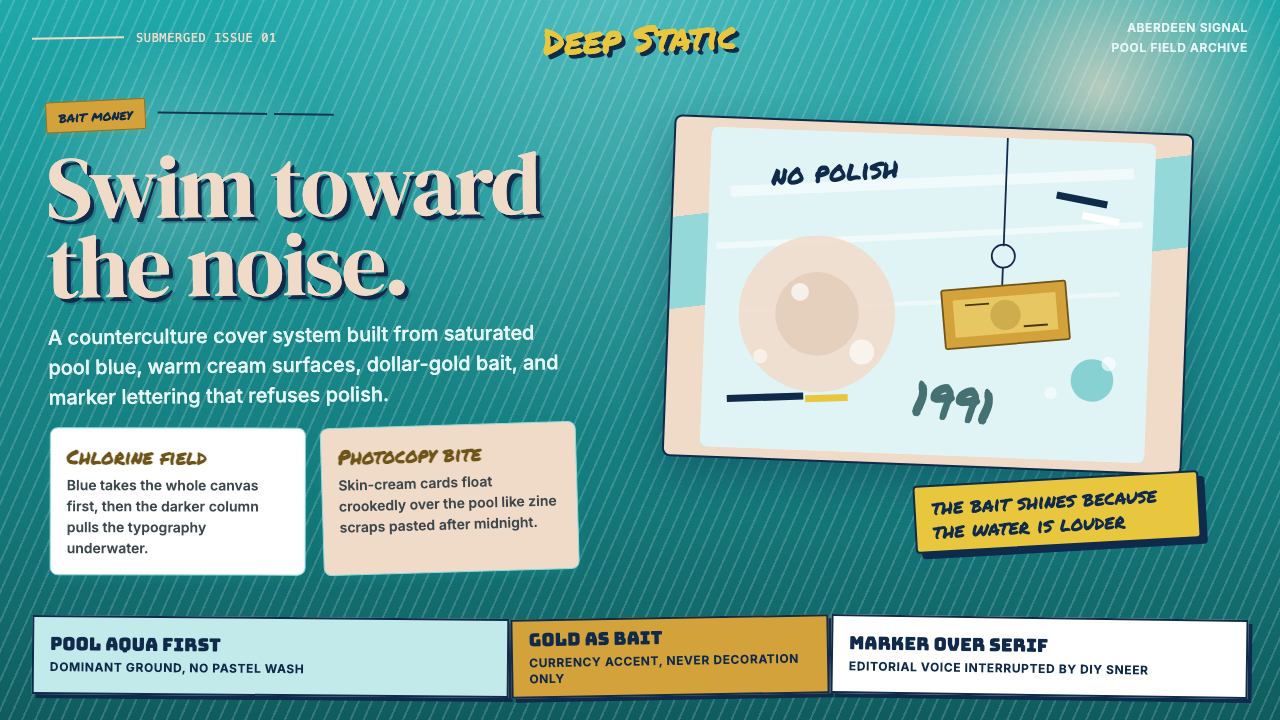 Nirvana — NevermindAnti-pop in pool blue. Cream cards, dollar-gold accents, and marker type roug…
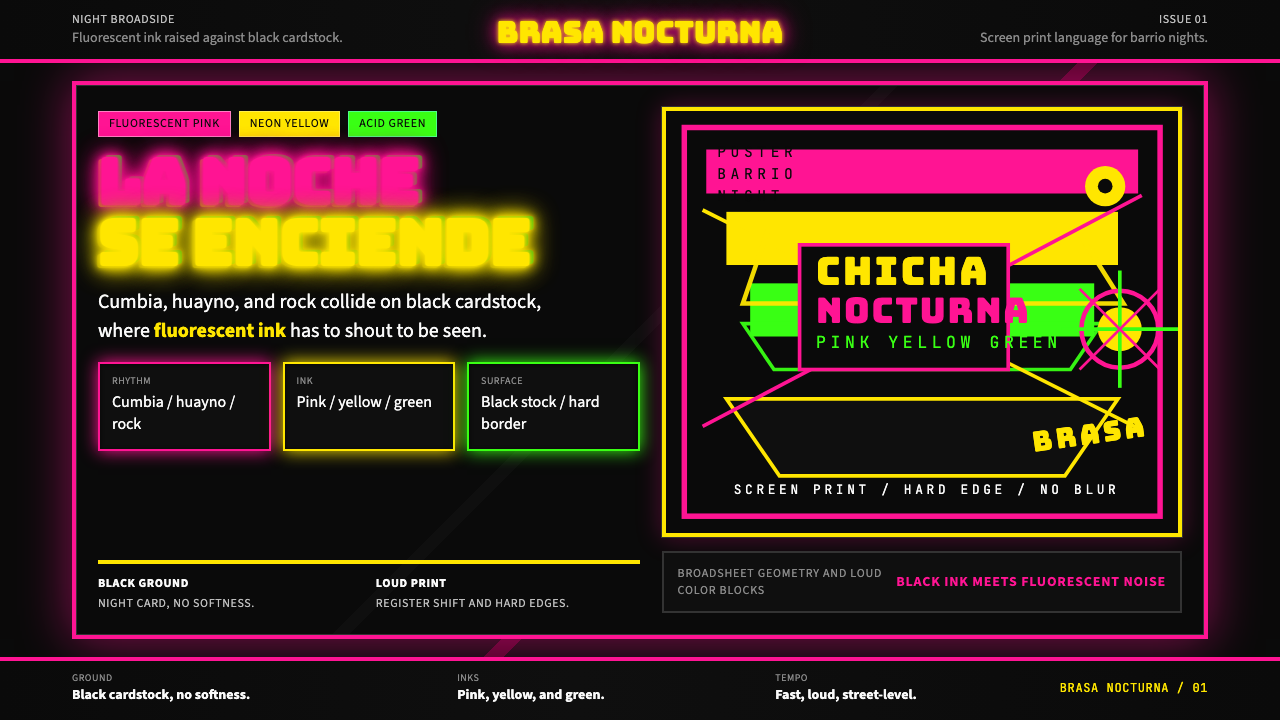 Peruvian Chicha Fluorescent PosterStreet-night fury. Pink, yellow, and green stack on black cardstock in hard b…
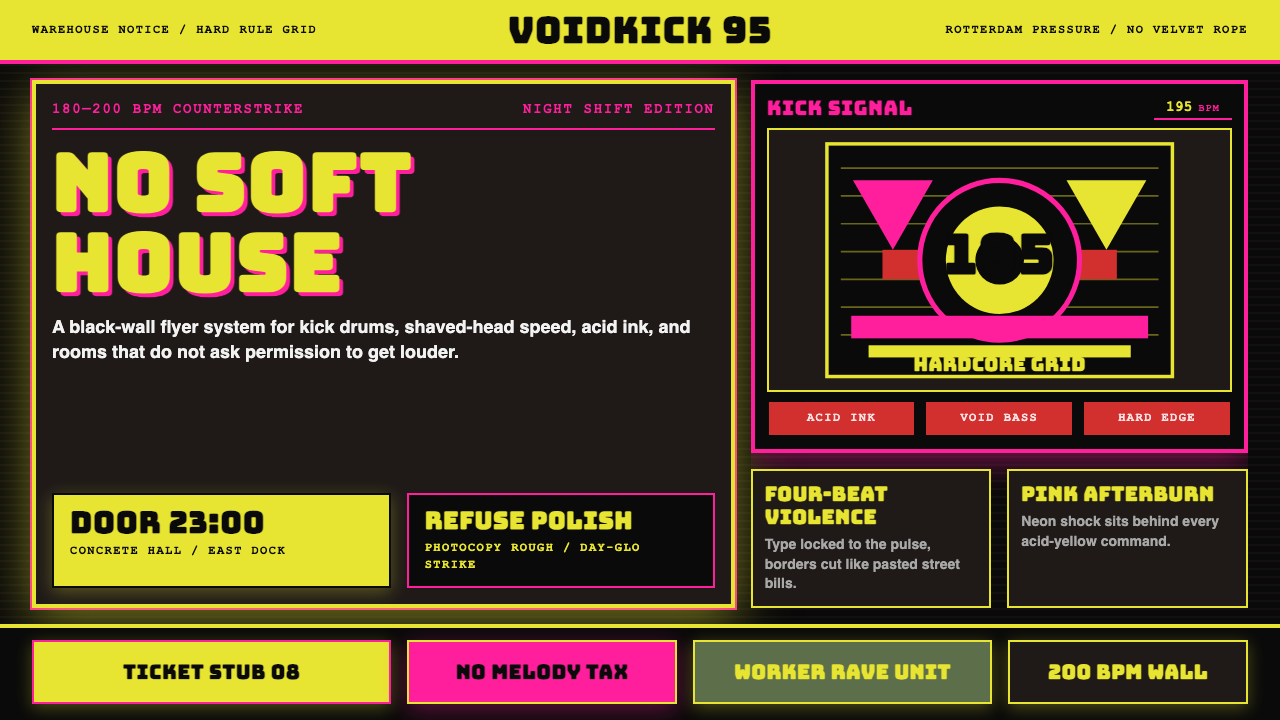 Rotterdam Gabber HardcoreHardcore refuses polish. Acid yellow, neon pink, black grid, and brutal Bunge…
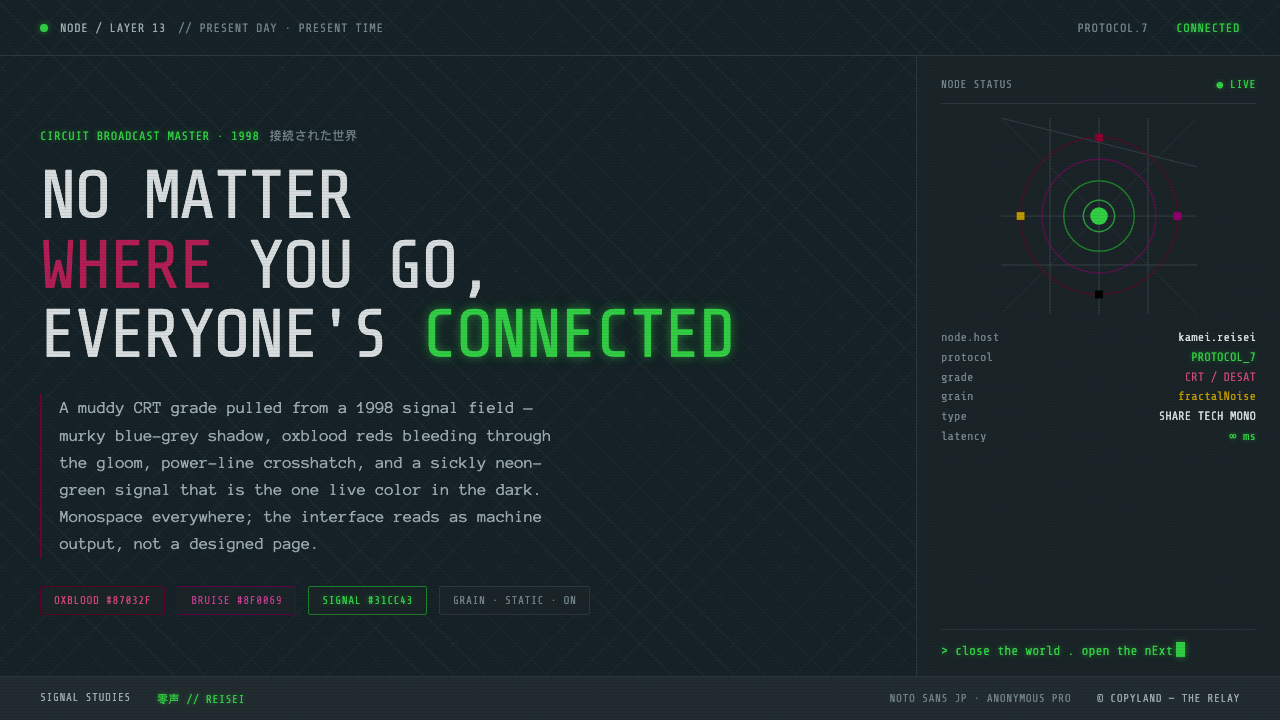 Serial Experiments LainMuddy CRT dread from the 1998 Wired. Blue-grey murk, oxblood reds, one sickly…