What is Galician Hórreo?
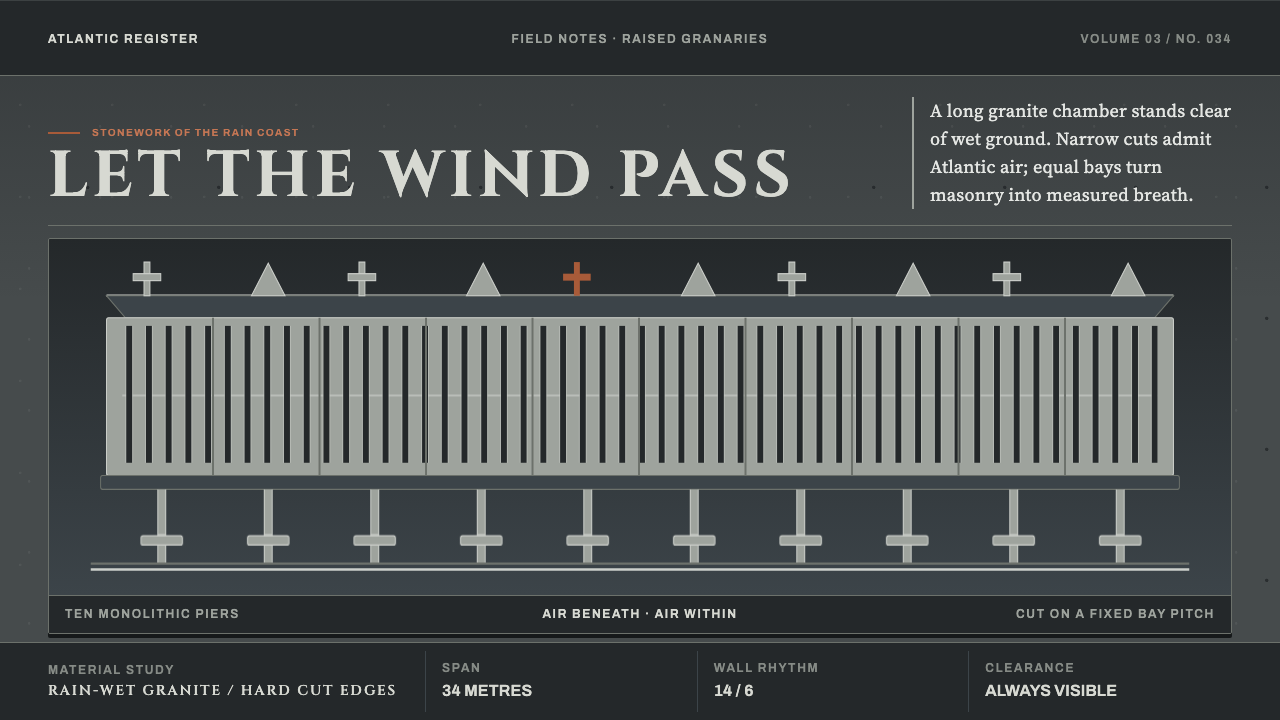
A hórreo is a granary that learned to breathe — a granite body lifted clear of the ground, walled in slots instead of solid stone, so Atlantic wind does the drying.
Galician Hórreo in brief
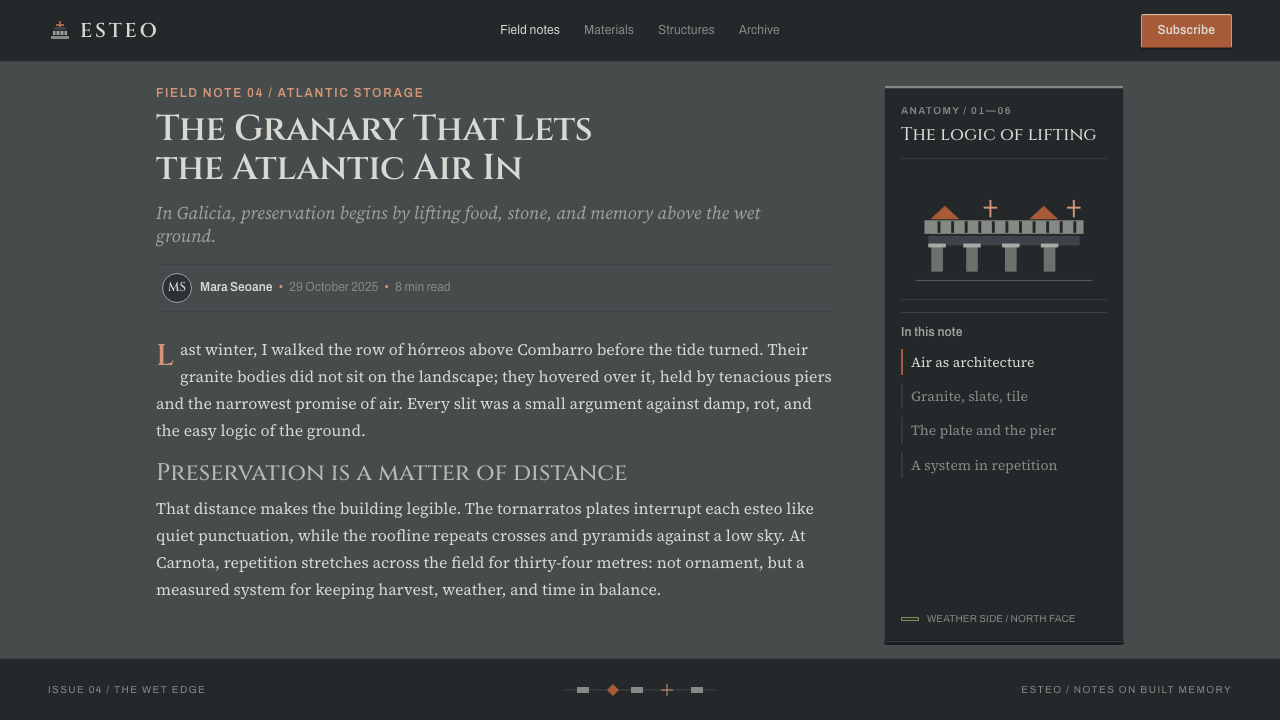
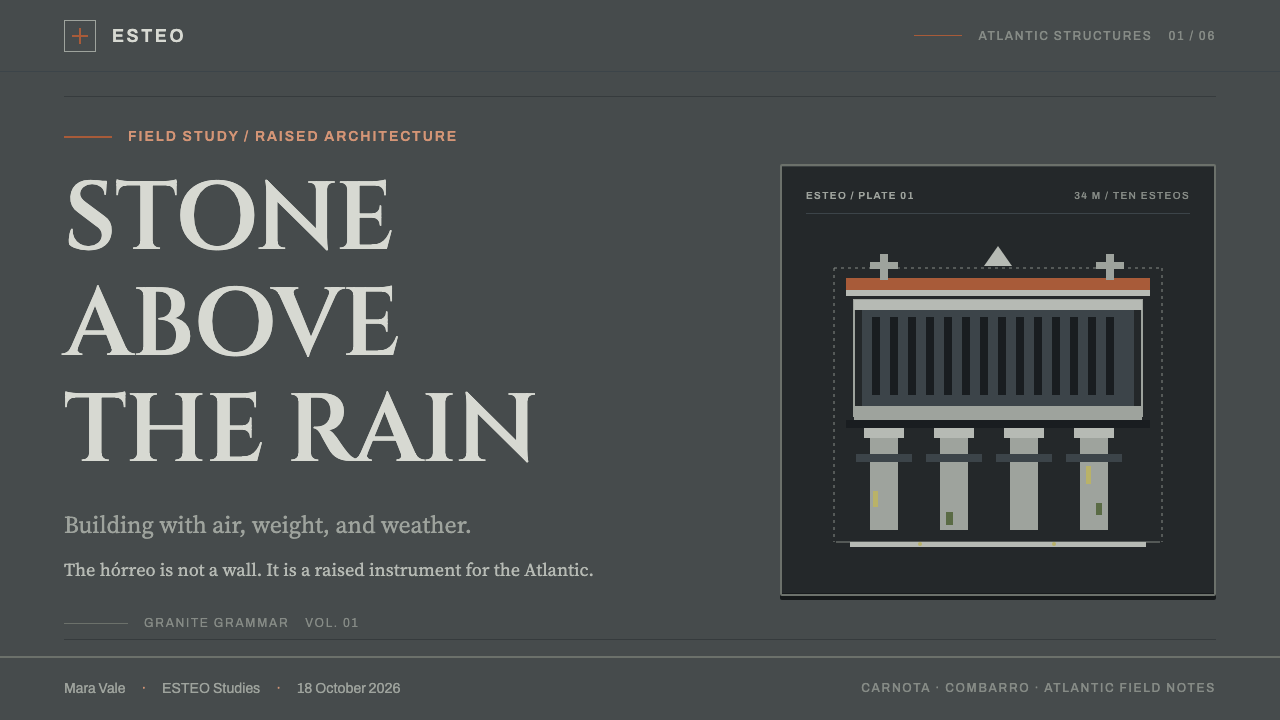
A hórreo is a traditional Galician granary, raised entirely clear of the ground on monolithic granite legs. Each leg is capped with a flat, projecting stone plate whose sole job is to stop rodents from climbing up into the stored grain — a purely functional detail that also happens to be one of the structure's most distinctive silhouettes. Above the legs sits a long, narrow rectangular body, walled not in solid stone but in ranks of narrow vertical slits, so that the constant wind off the Atlantic can move freely through the interior and dry the maize stored inside.
Scale and proportion vary by place but follow the same underlying logic. The hórreo at Carnota runs to roughly 34 meters in length, carried on ten pairs of stone legs — an extreme, almost architectural extension of a typology that, elsewhere, might be a much shorter single-bay structure. At Combarro, the granaries stand in a row directly above the tideline, positioned so the sea air itself becomes part of the drying mechanism.
Every visible feature of a hórreo comes from that same functional demand: a body divided into equal bays, each bay carrying its own rank of narrow vertical slits, a roofline marked by alternating stone crosses and pyramids, and — non-negotiably — a clear layer of open air between the ground and the granary floor. Remove any one of these and the structure stops being a hórreo and becomes an ordinary stone shed; the ventilation logic is the whole point, not a decorative afterthought.
Where does Galician Hórreo come from?
The hórreo belongs to a wider European tradition of raised granary typologies, structures found across regions where grain or maize needed to be stored off the ground and protected from both damp and rodents, but Galicia developed its own regional variant in stone rather than timber, shaped by the specific climate of Spain's rainy northwest coast.
The surviving canonical examples — the structures that define the type today — date from the seventeenth through nineteenth centuries. Carnota's hórreo, one of the longest and most extended examples of the typology, is an eighteenth-century structure; it was later granted protected-monument status in 1973, formal recognition that the building represented a regional architectural achievement worth preserving rather than an ordinary agricultural outbuilding.
The hórreo's construction was the specialized work of the canteiros, the village stonemason guilds of Galicia, whose knowledge of working the region's granite — a hard, double-mica stone flecked with biotite and amphibole within its quartz and feldspar — made possible the precise legwork, capstones, and ventilation slits the structure depends on. This was not general building work but a distinct craft tradition, passed down through the same guild structures that shaped much of Galicia's vernacular stone architecture more broadly.
Scholarship on Galician rural architecture and folk culture, notably the work of Xaquín Lorenzo Fernández — known by the byname 'Xocas' — helped document and situate the hórreo within the broader field of Galician stone craft and Atlantic vernacular building, connecting a working agricultural structure to the region's recognized cultural and architectural heritage.
What defines the Galician Hórreo look?
Material — Galician Granite
The stone is a double-mica granite, its quartz and feldspar matrix flecked with dark biotite and amphibole. Galicia's persistent Atlantic rain keeps it darker and damper-looking year-round than a granite used in a drier climate, and lichen tends to colonize the leeward faces of the stone. A faithful rendering keeps that weathered, mineral-flecked darkness rather than presenting a bright, uniformly pale stone surface.
Structure — Raised Legs
The granary body sits entirely clear of the ground on monolithic stone legs, each capped with a flat projecting plate that blocks rodents from climbing up. This raised structure is not optional or decorative — it is the mechanism that keeps stored grain dry and pest-free, and any design drawing on the hórreo must preserve real visual separation between ground and body rather than implying a structure that sits flush on the earth.
Rhythm — Bays and Slits
The long body is divided into equal bays, and each bay carries its own rank of narrow vertical slits rather than a single continuous opening. This produces a steady, repeating rhythm along the entire length of the structure — a visual beat that reads clearly even from a distance, and one that should not be collapsed into a single undifferentiated slatted surface.
Roofline — Crosses and Pyramids
The ridgeline is marked by stone finials that alternate between cross forms and pyramid forms, a punctuation device that breaks the long horizontal run of the roof into a readable sequence. These finials sit at the very top of the silhouette and should read as distinct, separated marks rather than a continuous decorative strip.
Scale Variation
The typology tolerates real extremes of scale while keeping its logic intact: Carnota's hórreo extends to roughly 34 meters on ten pairs of legs, an almost architectural elongation of the type, while other examples are far shorter, single-bay structures. What stays constant across this range is the bay-and-slit rhythm and the raised, ventilated body, not any fixed proportion or length.
Siting — Tideline and Terrain
Placement is functional, not incidental. Combarro's granaries stand in a row directly above the tideline, positioned to catch sea air; other examples sit inland on sloped village ground. A design system drawn from the hórreo should treat siting relative to wind and moisture as part of the structure's logic, not merely as a scenic backdrop.

Who shaped Galician Hórreo?
Known by the byname Xocas, Xaquín Lorenzo Fernández contributed to the documentation and study of Galician rural architecture and folk culture, situating the hórreo within the region's broader tradition of vernacular stone building rather than treating it as an isolated agricultural curiosity.
The canteiros are Galicia's village stonemason guilds, the specialized craftsmen whose knowledge of working the region's hard, double-mica granite made the hórreo's precise legwork, capstones, and ventilation slits possible. Their skill sits within a broader tradition of Galician stone craft that produced much of the region's vernacular building beyond granaries alone.
The hórreo at Carnota is one of the type's most extreme expressions: roughly 34 meters long, carried on ten pairs of stone legs, an eighteenth-century structure that was later granted protected-monument status in 1973. It demonstrates how far the bay-and-slit typology can be stretched while keeping its ventilation logic intact.
The row of hórreos at Combarro stands directly above the tideline, positioned so sea air moves through the ventilation slits and does the work of drying stored grain. Their siting shows that placement relative to wind and moisture is as much a part of the design as the stonework itself.
How do you use Galician Hórreo today?
The hórreo's logic — a raised, ventilated body with a repeating bay rhythm — translates well into any design context that wants to communicate durability, functional honesty, and a connection to a specific regional climate rather than a generic rustic look. It suits hospitality, real estate, and heritage-tourism branding for Atlantic or coastal regions particularly well.
For presentation slides, a cover can borrow the raised-and-slotted silhouette directly: a horizontal content block visually separated from the base of the slide by a thin gap, echoing the air layer beneath the granary floor, with a repeating vertical-line texture standing in for the ventilation slits. Content slides should divide information into equal bay-like columns rather than a single continuous block of text.
In web interfaces, the bay-and-slit rhythm suits repeating card grids, table rows, or navigation structures where equal, evenly spaced units need to read as a coherent sequence. A persistent visual gap between a header or hero section and the content below it — echoing the air layer beneath the hórreo — reinforces the sense of a structure lifted clear of its ground, rather than everything sitting flush against the page edge.
For editorial and marketing use, the alternating cross-and-pyramid roofline motif makes a strong, restrained divider or bullet device between article sections, and the weathered, mineral-flecked stone coloring — rather than a bright, clean gray — gives marketing materials about heritage, craft, or coastal regions a sense of real material history rather than a generic rustic filter.
The most common mistake is rendering the hórreo as a single solid stone block sitting on the ground — removing the legs, the air gap, and the slit rhythm collapses the entire logic of the structure into an ordinary shed. A second common error is treating the granite as a flat, uniform gray rather than the darker, damp-toned, lichen-touched material that Galicia's climate actually produces.
Galician Hórreo — FAQ
Why does the granary need to be raised on legs at all?
The raised legs, each capped with a flat projecting plate, exist specifically to stop rodents from climbing up into the stored grain, while the open air gap beneath the floor keeps ground moisture away from the structure. Both are functional necessities rather than stylistic choices, which is why removing the legs and the air gap changes what the building actually does, not just how it looks.
Why do the ventilation slits matter more than the overall shape?
Because the slits are what actually dry the stored maize — they let the constant Atlantic wind move through the interior. A hórreo-inspired design that gets the long rectangular silhouette right but fills the walls in solid has reproduced the shape without the mechanism, which is the part of the structure that gives it its name and purpose.
Does every hórreo look the same size and proportion?
No — scale varies considerably by location. Carnota's hórreo extends to roughly 34 meters on ten pairs of legs, an unusually long example of the type, while other hórreos are much shorter, single-bay structures. What stays consistent across this range is not a fixed length but the underlying logic: raised legs, bay-and-slit rhythm, and an alternating cross-and-pyramid roofline.
Why does the stone look dark and weathered rather than clean gray?
Galicia's granite is a double-mica stone flecked with dark biotite and amphibole, and the region's persistent Atlantic rain keeps its surfaces darker and damper-looking year-round, with lichen often colonizing the leeward faces. A hórreo rendered in bright, uniform gray stone misrepresents the actual material conditions of the climate the structure was built to survive.
Is the hórreo purely a historical structure, or is it still relevant today?
The surviving canonical examples date from the seventeenth through nineteenth centuries, and structures like Carnota's have since been granted protected-monument status — the 1973 designation recognizing it as heritage worth preserving. The typology is no longer being built for its original agricultural purpose at scale, but its logic of raised, ventilated, climate-responsive structure remains a genuinely useful reference for contemporary design in wet, coastal environments.
Related design styles
 Faroese KvæðiThe room sings as one. Silver type and red refrain bands rule a tar-black man…
 Welsh SlateCool blue-charcoal riven stone, lifted by one chalk-white mark. Stacked cours…
 Anglerfish Lure BioluminescenceLight is scarce. Old serifs and hairline rules frame one cold green-cyan lure.
 Anna Atkins CyanotypeScience turns spectral. Prussian blue ground, white reserves, Victorian serif…
 Fern CyanotypeStillness turns scientific. Prussian blue field, white photograms, Victorian…
 Golgi Neuron Silver StainA century-darkened specimen. Near-black dendrites branch across an aged amber…