What is Dhokra Bastar Bronze?
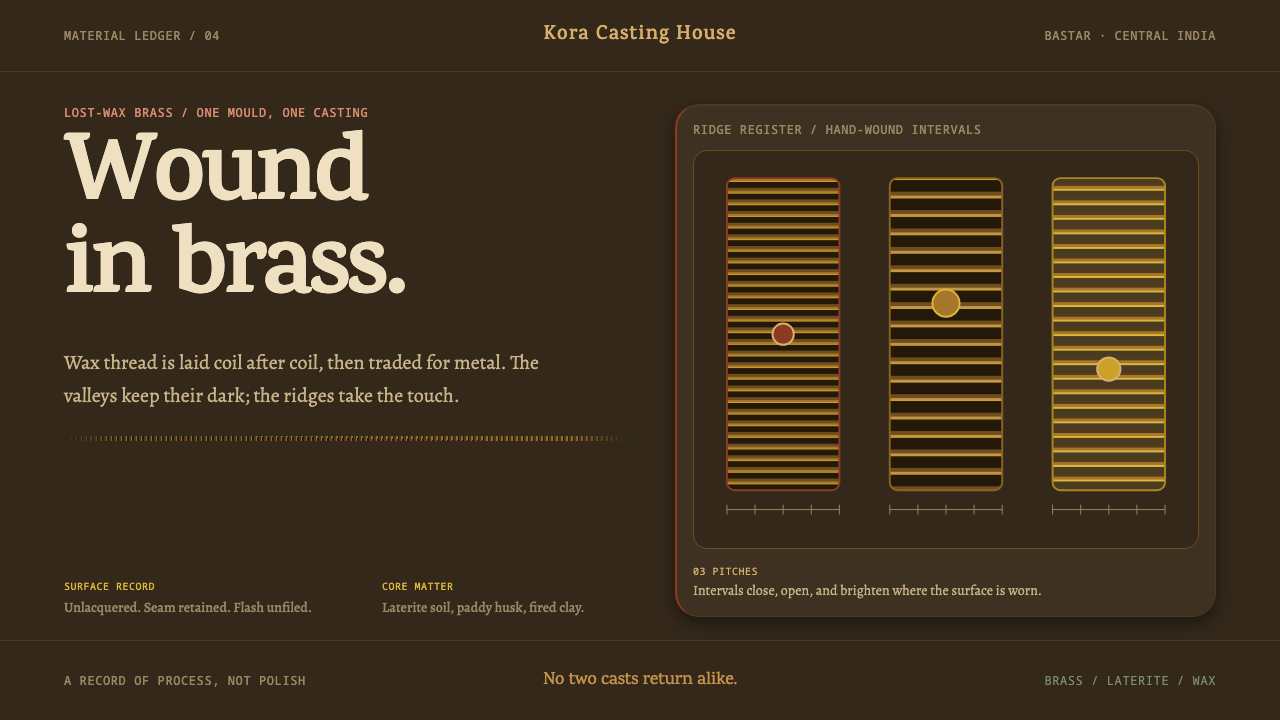
Bastar Dhokra is lost-wax casting that never smooths its wax, so the finished metal keeps every coil, ridge and seam as the evidence of how it was made.
Dhokra Bastar Bronze in brief
Bastar Dhokra is a form of lost-wax casting from the Bastar region of central India, and its defining feature is a refusal to smooth. The wax model is not carved or polished. It is rolled into thin threads and wound coil after coil around a core of red soil, cow dung and paddy husk, and when the wax is melted away and replaced by molten brass or bell metal, the metal inherits the winding exactly. The finished piece keeps every ridge that the caster's fingers laid down.
The figures that emerge are stretched. Limbs are drawn out to wire-like thinness and the weight of the body is carried in the head, an intentional departure from realism rather than a lack of skill. Unlacquered, the metal reads as a dull, brownish bronze: dark in the valleys between the coils and rubbed to a brassy gleam on the crests where hands and cloth have touched it. Flash, seams and sprue stubs, the marks of the pouring and the mould, are not ground away.
As a design language, the style is built from that surface rather than from statuary. It is dark, coiled, tactile and rough-edged, with highlights that sit on ridges and shadows that pool in valleys. Nothing is mirror-polished and nothing repeats exactly, because each mould is broken to free the cast. The visual proposition is that process need not be hidden. The marks of making are the ornament.
Where does Dhokra Bastar Bronze come from?
The technique behind Dhokra is lost-wax casting, known in French as cire perdue, and the source dates its use in South Asia to roughly four thousand years ago. The principle is old and elegant: a model is made in wax, enclosed in clay to form a mould, and heated so that the wax runs out, leaving a hollow shape that is filled with molten metal. When the metal has cooled, the mould is broken and the casting is freed. Because the mould cannot be reused, every piece made this way is unique.
Bastar is a district in Chhattisgarh in central India, and Bastar Dhokra is the version of the technique practised by the Ghadwa metalsmith families of that region. Their method fixes the look of the craft: a core of red soil, cow dung and paddy husk, around which a thread of wax is wound coil after coil. The source describes Bastar workshops as documented through the twentieth century, which means that this style is not an archaeological reconstruction but a living workshop tradition with a continuous practice.
Bastar is not the only home of the technique. The source also names the Dhokra Damar, itinerant casters of Bengal and Odisha, among the key figures of the tradition, and the name Dhokra is commonly connected with them. Their movement across eastern India helps explain why the craft appears in several regions under related names. For design purposes, it shows that Dhokra is a family of practices with a shared logic, and that the Bastar version is distinguished by its coil-wound wax and by the strong sense of place attached to it.
In the modern period Bastar Dhokra has been registered under a geographical indication, a legal mark that ties the craft's name to its place of origin. That registration and the broader revival of Indian tribal metalcraft belong to the same story: a craft that was long made for ritual and household use has been recognised as heritage, protected against imitation, and brought to wider audiences. The style should be read in that context, as a living craft that deserves attribution, not as a decorative texture to be borrowed without reference.
What defines the Dhokra Bastar Bronze look?
Dark Valleys, Brassy Ridges
The tonal logic of the style is simple and strong: dark in the recesses, bright on the crests. Unlacquered metal reads as a dull, brownish bronze, and the places hands and cloth have touched are rubbed to a warm brass. The result is a dark palette with highlights that are earned by contact, not applied. In design, light belongs on edges, ridges and raised surfaces, while hollows and backgrounds stay deep.
Coiled Surface
Because the wax is wound thread over thread, the whole surface is organised by coils: parallel ridges that curve around forms, double back and bunch where the maker's hand paused. This gives the style a distinct rhythm, repeated yet irregular, like a fingerprint. Patterns that mimic this should follow form rather than tile flat across it, and should never be perfectly even. Regularity with small deviations is the signature.
Stretched Figures
Dhokra figures are drawn out: limbs as thin as wire, bodies attenuated, and the weight concentrated in the head. This is a deliberate non-realism, an expressive proportion in which the head is the focus and the rest of the body is a delicate armature. For layout, the lesson is to allow asymmetry of weight, with one heavy mass counterbalanced by long thin lines, instead of balancing everything with even, bulky shapes.
Process Left Visible
Flash, seams and sprue stubs, the residue of pouring and moulding, stay on the piece. A conventional foundry would grind them away; in Dhokra they are the testimony of how the object came to exist. In design terms this is permission for visible construction: seams between sections, visible joins, slightly imperfect edges. The style rewards honesty about how a thing is made and punishes surfaces that pretend to have no history.
Singular, Never Repeated
Each clay mould is broken to free the cast, so no two pieces are identical. The style therefore resists perfect repetition: components that recur should vary slightly in spacing, ridge density or edge character. A design that uses identical cards, icons or illustrations in a rigid grid will look wrong here. The ideal is a set of related but individually shaped elements, each recognisably from the same hand and none exactly like the last.
Unlacquered, Matte Metal
The metal is never lacquered, so it has no glossy skin. It is dull, warm, slightly rough and quietly reflective only where it has been handled. Digital surfaces that borrow this should avoid chrome gradients, bevels and high-gloss highlights. Matte fills, soft grain and highlights confined to ridges give the right feeling of weight, age and touch, while mirror finishes contradict the whole premise.
Who shaped Dhokra Bastar Bronze?
The Ghadwa families are the named makers of Bastar Dhokra and the keepers of its workshop method: the core of red soil, cow dung and paddy husk, the wax wound thread by thread, the pour of brass or bell metal, and the breaking of the mould. Their practice, documented through the twentieth century, is the source of the style's coiled surface and its singular pieces. They matter to a design reading because the style's visual rules are simply a record of their hands at work.
The Dhokra Damar are the travelling casters of Bengal and Odisha whom the source lists among the tradition's key figures, and the craft's name is commonly connected with them. Their itinerant practice helps explain how a lost-wax technique with a shared logic appears in several regions under related names. In this style they represent the wider family around Bastar: a reminder that the craft is bigger than one district and that its identity lies in method, not in a single place.
The casters who work in the modern period carry the craft through its geographical-indication registration and the wider revival of Indian tribal metalcraft. They are the ones who have kept the tradition in active use while it became recognised as heritage. For design, they are a reminder that this is a current practice with living makers, and that any use of the style should credit the craft and its region and avoid treating it as generic decoration.
How do you use Dhokra Bastar Bronze today?
Bastar Dhokra suits subjects that value craft, provenance and touch: artisan marketplaces, heritage and museum publishing, jewellery and homeware, cultural storytelling, premium food and drink with an artisanal narrative, and any brand that wants warmth and gravity without gloss. It is a poor fit for sterile, glossy or hyper-precise products. Applying it well means translating process into surface, dark recesses, ridged highlights, honest seams, rather than decorating a layout with tribal motifs.
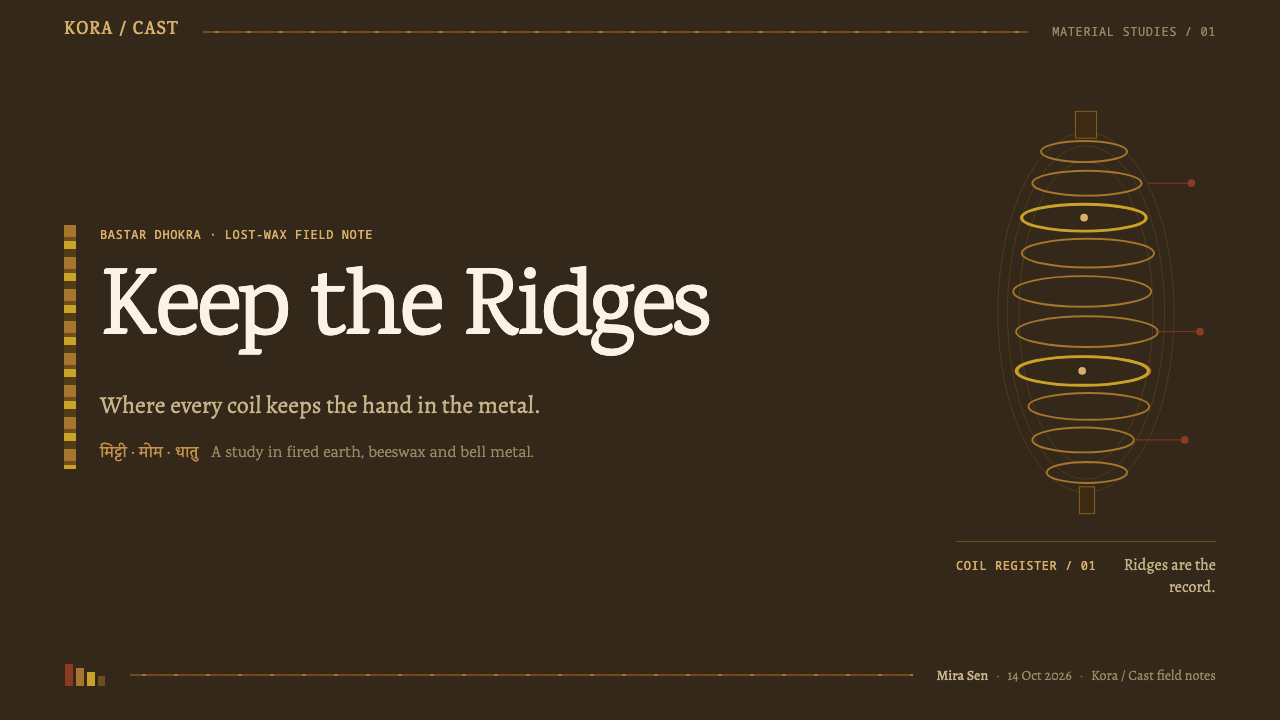
For presentation slides, a cover works as a deep, dark field with a title lit like brass, warm and slightly rough rather than reflective, and one coiled motif following a form at the edge. Content slides can use ridge-like rules and slightly irregular dividers, with light confined to headings and key figures. Data slides should hold their emphasis on edges and outlines: bars with a brassy top edge, lines with a warm highlight, and backgrounds that stay dark and quiet.
For web interfaces, the style is natural for storefronts, galleries, maker profiles and long-form story pages. Sections can be separated by seams rather than by clean lines, and cards can have slightly irregular, hand-made edges while still remaining legible. Interactive states can echo wear: a control that grows brassy where it is touched. Dense dashboards are a poor match, so use the style for hero areas, product pages and narrative sections, and keep functional screens calm.
For editorial and marketing work, tell the story of making. Macro photography of surfaces, coil patterns and seams is the strongest imagery, and captions should name the craft, the region and the process. Layouts can allow asymmetry, with a heavy block of image or text balanced by long, thin lines. Copy should be concrete and sensory, about hands, heat, wax and metal. A call to action should feel like a warm highlight on a ridge: contained, deliberate, and set against a dark ground.
The most common mistake is to polish. Mirror gloss, chrome gradients, perfect symmetry and clean flat vector shapes all erase the evidence of process that gives the style its meaning. A second mistake is uniform texture: a seamless repeating metal pattern used as wallpaper has none of the irregularity of real coils. A third is cultural flattening, using the style as generic ethnic decoration without naming the craft, its region or its makers. Specific, credited, process-led use is always stronger.
Dhokra Bastar Bronze — FAQ
What is lost-wax casting, and why is Dhokra different from statuary?
Lost-wax casting means making a model in wax, enclosing it in clay, melting the wax out and pouring metal into the hollow. Statuary usually treats the cast as a starting point and then chases, files and polishes it into a smooth, idealised surface. Dhokra stops at the cast. The wax is wound thread by thread, so the metal keeps every coil, and the seams and pouring marks are left in place. The surface is the record of process rather than a perfected image.
Why are the figures so elongated?
The elongation is an expressive choice, not a limitation. Limbs are drawn out to wire-like thinness and the weight of the body is carried in the head, which concentrates attention at the point of greatest meaning. The source describes this as a deliberate non-realism. In design the equivalent is asymmetrical balance: strong, compact masses counterweighted by long, slender lines, and a clear focal point.
Why leave seams, flash and sprue stubs on the surface?
Because in Dhokra they are not defects but testimony. They show where the mould closed, where the metal entered, and how the piece was made. Removing them would imply that the object had no history, which contradicts the craft's character. For design, the equivalent is to let construction show: honest joins, slightly uneven edges, and visible structure, as long as the result remains legible and usable.
Is this a dark-only style?
Dark is its native condition: the metal is dark in the valleys between coils and bright only where it has been touched, so the natural interface is a dark ground with edge highlights. A light variant is possible, for example for print or for a product page that needs a pale field, but it works best when the dark recesses remain present as shadowed grooves and the brassy tone stays confined to ridges. A bright, flat version loses the sense of depth that defines the surface.
How can I use this style respectfully?
Treat it as a living craft, not a generic texture. Name the craft, Bastar Dhokra, and its region when you refer to it; remember that it is registered under a geographical indication and made by working families; and borrow the logic of the process, dark recesses, ridged highlights and visible seams, rather than copying figures or motifs outright. Where possible, credit the makers or point to them. Specific, informed use reads as respect and also as better design.
Related design styles
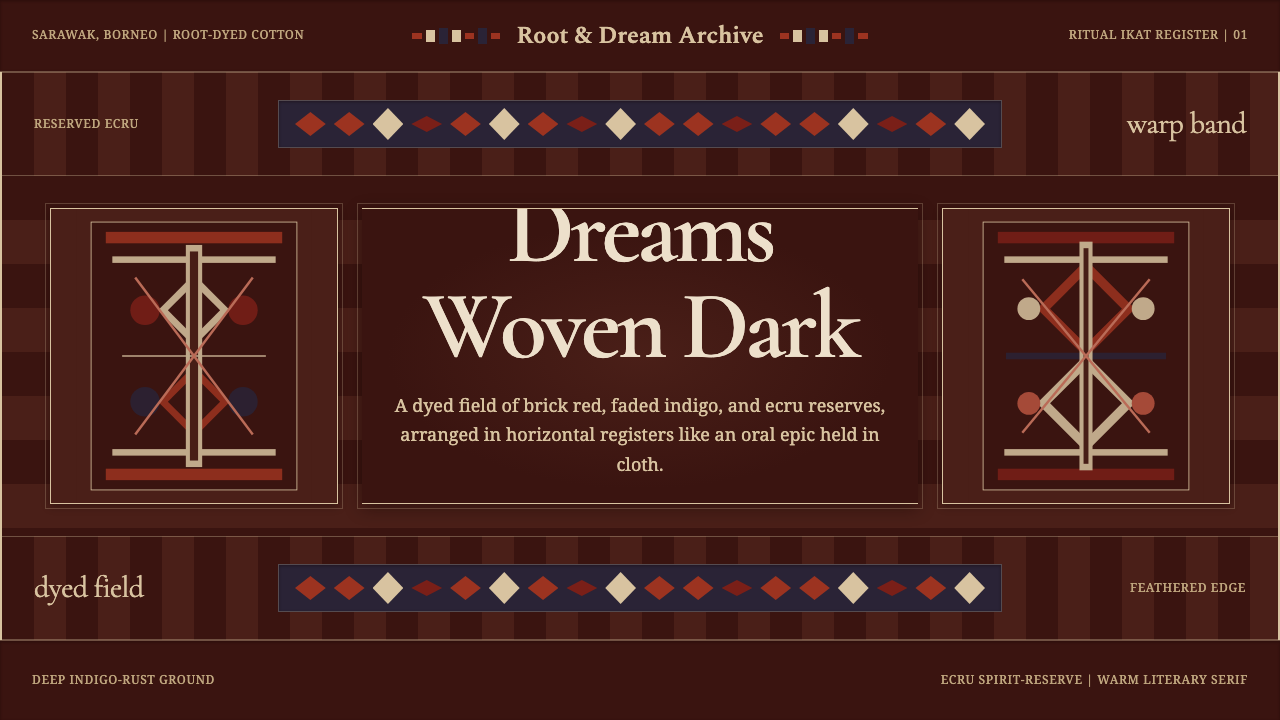 Iban Pua KumbuSacred cloth logic. Indigo-rust bands, ecru reserves, and blurred ikat edges…
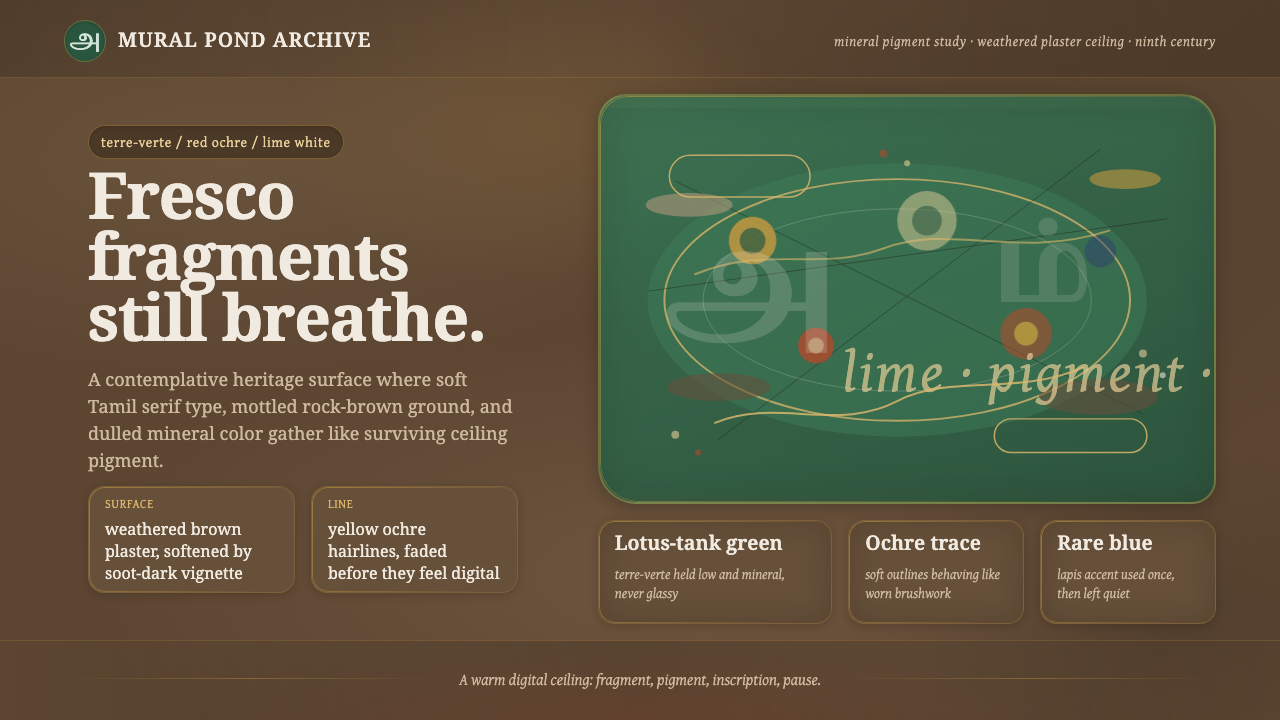 Sittanavasal Jain Cave FrescoBreathes through age. Terre-verte green and ochre lines fade into brown plast…
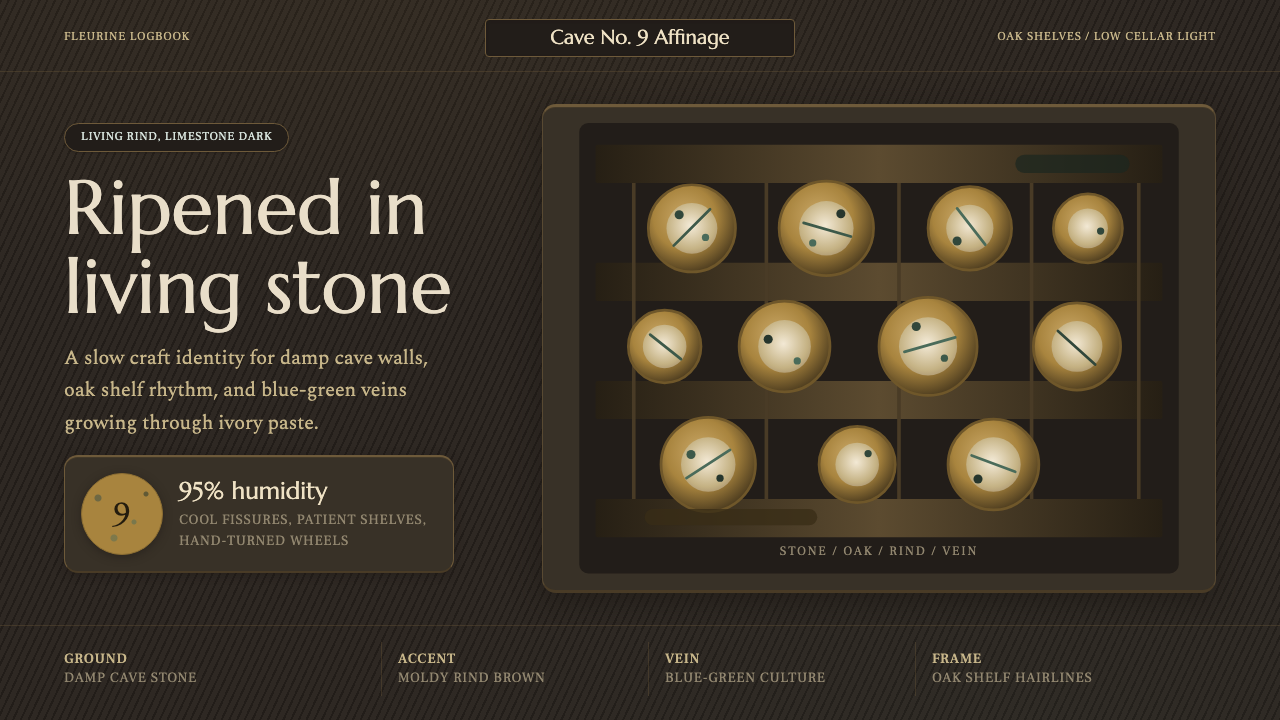 Cheese Affinage CavePatience reads as stone. Rind brown, mold green, and oak shelf grids glow in…
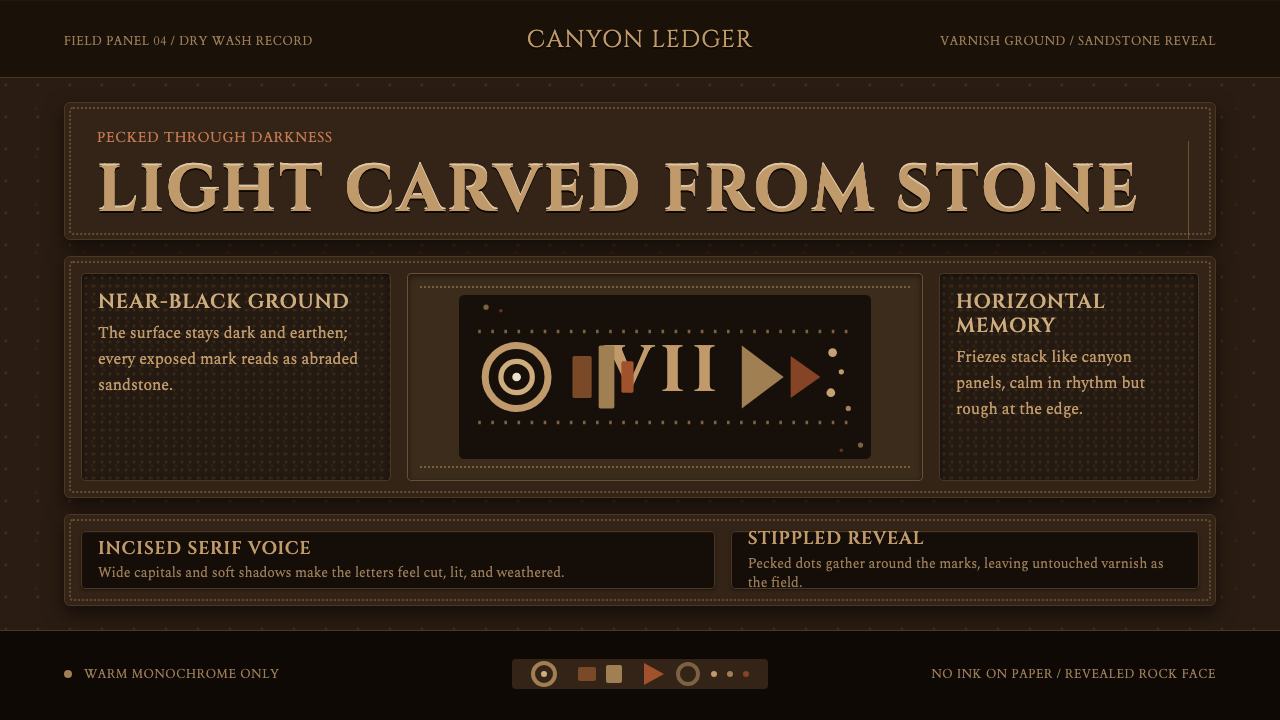 Desert VarnishStone remembers. Sandstone glyphs cut through near-black varnish in stacked f…
 Dogon Toguna Shelter MaliGravity made visible. Deep umber ground, low roof band, chestnut posts in sha…
 Hawaiian Hula Pahu DrumSacred weight, hand-marked. ʻAlaea red, kapa texture, and stacked carved regi…