What is Desert Solar Megafield?
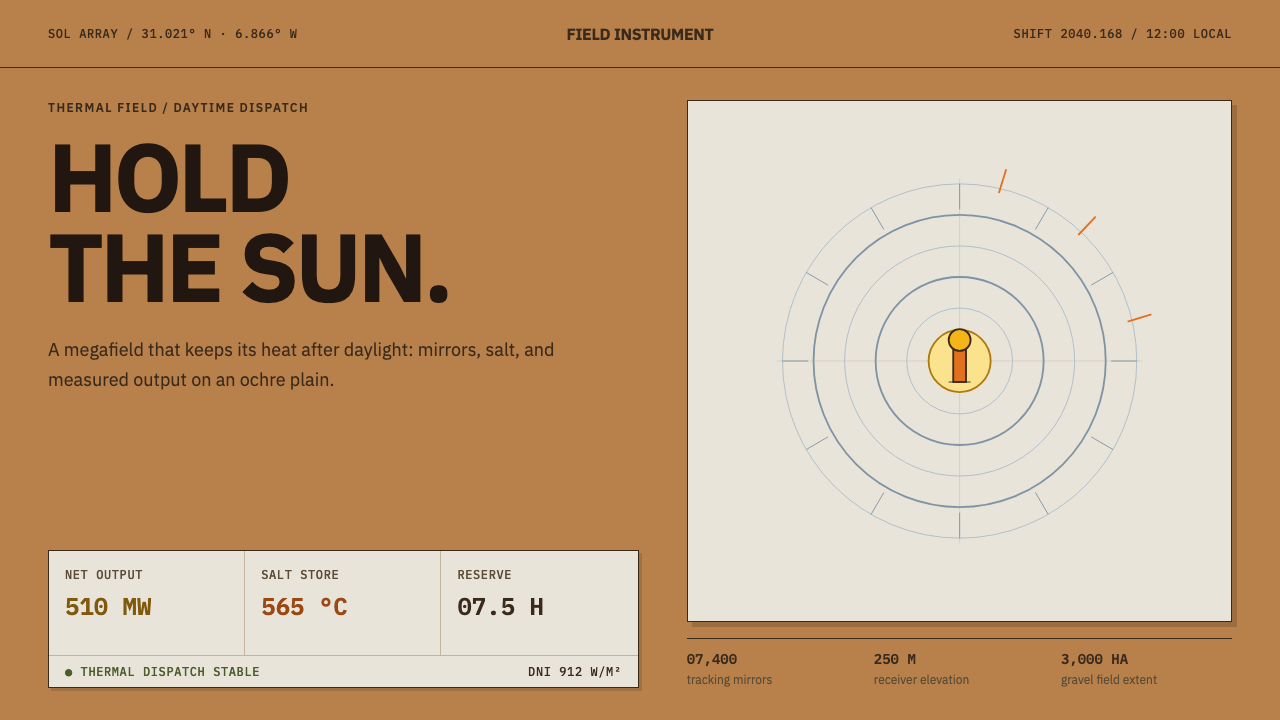
Desert Solar Megafield reads a Moroccan solar plant the way an operator's screen does: ochre ground, ruled glare-white panels, monospaced numbers and hard, single-direction shadows.
Desert Solar Megafield in brief
Desert Solar Megafield is a design style drawn from Noor Ouarzazate, the concentrated solar power complex at the gate of the Sahara in Morocco. Its look is an ochre ground, glare-white panels drawn with thin rules rather than filled, blue-grey mirror rings, monospaced numerals, and shadows that fall hard and to one side, like those of a mirror field at noon.
The style treats the site as data. The plant is 510 MW spread over 3,000 hectares of iron-rich gravel plain, and the design takes the position of the operator watching it from a control room: everything is a reading, a bounded panel, a line on a schematic. The result feels like telemetry laid over a landscape photograph. It is technical without being cold, because the ground colour belongs to the earth the plant stands on. Panels, readouts and rings sit on that ground the way instruments sit on a control desk, each one labelled, each one bounded, and none of them competing with the landscape beneath.
Its blurb, 'sun held past dusk', points at the plant's key engineering fact: heat stored in molten salt keeps the power going after sunset. The style carries that idea visually by keeping the day's warmth in the ground colour, even in data-heavy views, so the interface feels charged with stored light instead of merely lit by a screen.
Where does Desert Solar Megafield come from?
Noor Ouarzazate sits in the Ouarzazate basin of Drâa-Tafilalet, in Morocco, on a plain of iron-rich gravel at the edge of the Sahara. The source gives the building and commissioning phase as 2016 to 2026, and the style frames the site forward to 2040 as a mature operating megafield. That forward frame is what the name signals: the plant is no longer a new project but a settled piece of infrastructure, read through the dashboards of those who run it. The long time span matters to the design. It suggests a system that has been tuned, repaired and extended over years, so interfaces in this style feel calm and settled rather than novel.
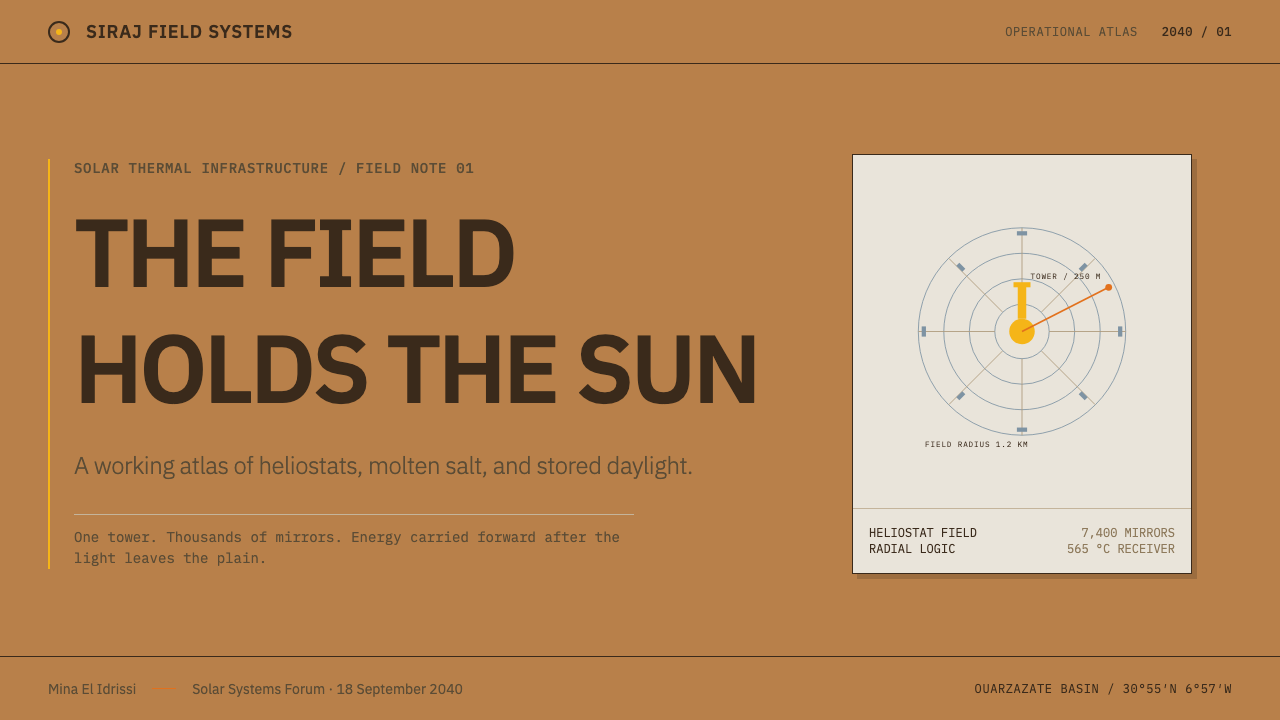
Two different technologies share the site. Noor I and II use parabolic troughs: curved mirrors twelve metres across, arranged in long parallel rows that follow the plain. Noor III is a central receiver: 7,400 tracking heliostats set in concentric arcs around a tower 250 m high, with molten salt heated to 565 °C and kept in storage for seven and a half hours. The two layouts give the style its two geometries. One is the straight rule of the parallel row, and the other is the arc around a single point.
The institutions behind the project are the Moroccan agency MASEN, the Spanish engineering group SENER and the developer ACWA Power. They appear in the source as the key figures of the movement, and they place the style in the world of concentrated solar power engineering and North African energy infrastructure. This is design drawn from the working vocabulary of an industry: schematics, readouts and status panels rather than from art history.
The ground colour comes from the region itself. Ouarzazate is a land of pisé kasbahs, earth buildings rammed from local ochre earth, and the style takes its ochre from them. The visual language of documentary landscape photography of industrial sites supplies the point of view: large infrastructure seen in hard light, often from above, treated as a subject with its own austere beauty. Together these make a style that is rooted in a place and not just a technology.
What defines the Desert Solar Megafield look?
Ochre Ground
The page ground is the ochre of rammed-earth kasbahs and iron-rich gravel: warm, dusty and slightly orange-brown. It is the colour of the site itself, and it keeps data-heavy pages from feeling clinical. Other colours are read against it, so the ochre acts like a map base for everything on top.
Glare-White Ruled Panels
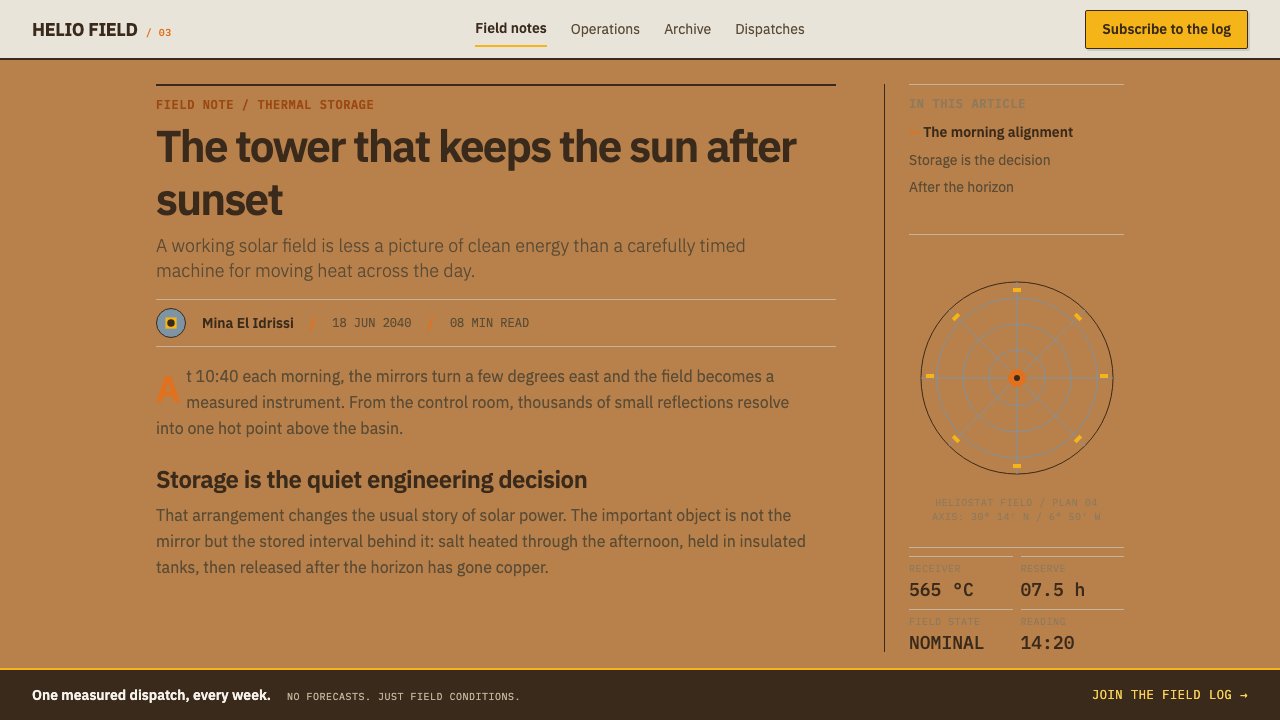
Panels are the pale, near-white of the receiver tower's glare. They are defined by thin rules and carry no fill of their own. Cards are outlines over the ochre ground rather than solid blocks, so the panel reads as a frame on a screen, and nothing hides the ground colour.
Blue-Grey Mirror Rings
Seen from above, the mirrors read as a blue-grey, and the heliostats gather in rings. This is the one cool colour in the system, used for mirror arrays, ring shapes and data series, so it contrasts cleanly with the warm ground. It signals the field of mirrors, not general decoration.
Monospaced Readouts
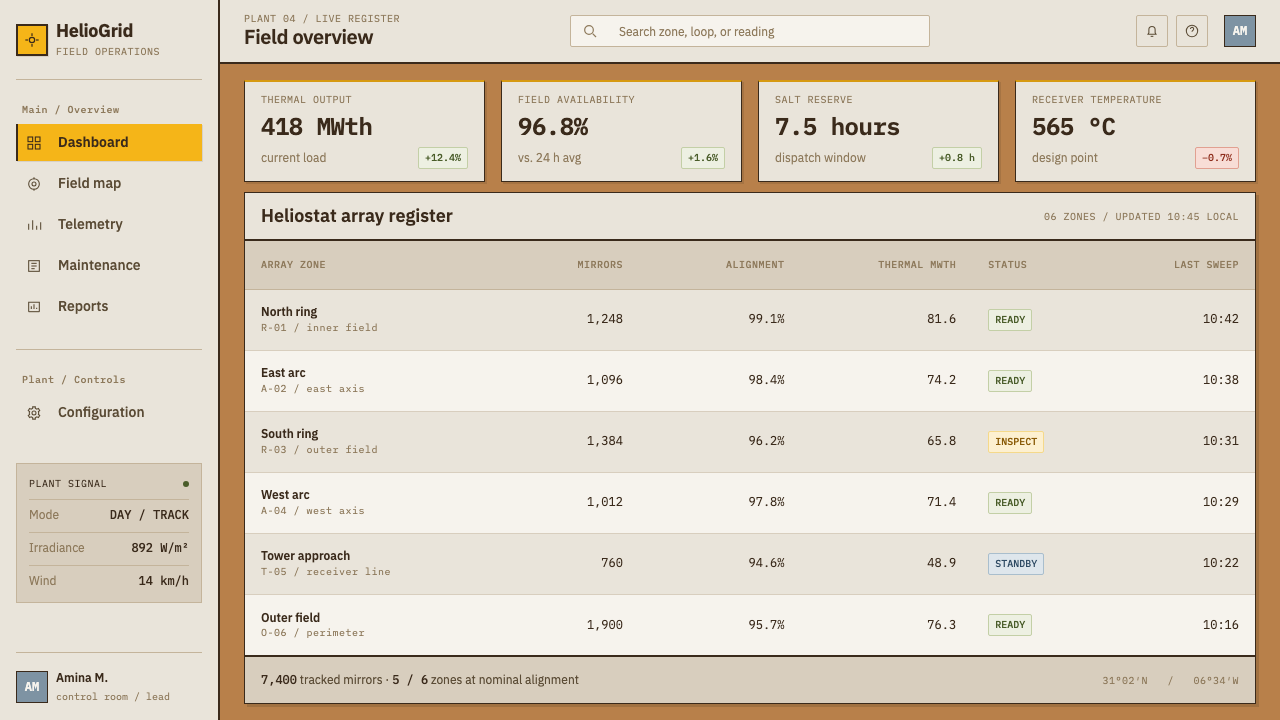
Numbers are monospaced throughout: output, temperature, storage hours, counts of mirrors. Fixed-width digits make values line up and keep updating figures from jittering. The effect is that the interface feels like instrumentation, and numbers carry the authority that headlines carry elsewhere.
Hard, Single-Direction Shadows
Shadows are sharp-edged and fall to one side only, as a mirror array casts at noon. They are used to lift panels off the ground and to give the page a consistent sun. There is no diffuse glow and no shadow in two directions, because the system has exactly one light source.
Rows and Concentric Arcs
The two plant layouts supply the geometry: long parallel rows from the trough fields, and concentric arcs from the heliostats around the tower. Layouts lean on strict rows for lists and tables, and on arcs or rings for focal diagrams and gauges. Both are ordered, and both point towards a centre of attention.
Telemetry Voice
Copy and labelling are brief, factual and instrument-like: a value, a unit, a status. Descriptions sound like an operator's log, not a brochure. This brevity is not coldness. It lets the scale of the site, with its megawatts, hectares and hours of storage, speak for itself.
Who shaped Desert Solar Megafield?
The Moroccan agency behind the Noor programme, named in the source as a key figure. It represents the public ownership and national ambition of the project, which is why the style speaks the language of infrastructure and operation, not of consumer technology. Its presence is also a cue to stay sober, factual and public-minded in tone, and to describe the plant as infrastructure rather than as a gadget.
The Spanish engineering group associated with the plant's design and construction. It stands for the engineering side of the style: parabolic troughs, a central receiver, and the molten-salt storage that gives the system its idea of sun held past dusk.
The developer that appears alongside MASEN and SENER as a key figure. It represents the commercial and operating side of the project, a reminder that the design language of this style is that of a working plant, with output, uptime and storage to report.
How do you use Desert Solar Megafield today?
Desert Solar Megafield suits products that monitor, explain or sell energy, infrastructure and large physical systems. It is a style for people who read numbers for a living and for audiences who want a technical subject to feel warm and credible. Applying it well means keeping the ground warm, the panels ruled, the digits fixed-width and the light single-sourced. It also helps teams that have to explain very large things to non-specialists, because the mirror rings and parallel rows give a simple picture of scale.
On slides, a cover can show a warm ochre field with a pale ruled panel carrying the title and one monospaced readout, plus a ring of blue-grey arcs as the only decorative motif. Content slides use thin-ruled panels in rows. Data slides are where the style shines: line and bar charts in blue-grey on the ochre ground, labels in monospaced digits, and shadows that fall in one direction only. Keep one idea per slide, let the number be the headline, and follow it with a single line naming the unit and the site.
In web interfaces it is an obvious fit for energy dashboards, monitoring and operations tools, fleet and asset views, climate-tech products and utility portals. Panels are outlines, not solid cards. Status can be shown as small monospaced labels, gauges as concentric arcs, and tables as strict rows. Pricing pages can present plans as ruled panels with one highlighted by a hard shadow. Avoid soft glows and floating translucent layers, which suggest a different light. A chart of output across a day should leave a visible tail after sunset, so that the idea of stored heat shows in the data itself.
For editorial and marketing work, the style supports sustainability reports, investor material, project case studies and infrastructure explainers. Pair it with documentary photographs of the site shot from above or in hard light, with captions that read like log entries. Keep headings brief and factual, and let a figure such as megawatts or hours of storage do the persuading. Tables of specifications deserve the same care as hero images here, because in this style the numbers are the pictures.
The most common mistake is going dark and neon. The system is a daylight system, and a black interface with glowing blue lines throws away the ochre ground that anchors it to a real place. A second mistake is filling the panels with colour or adding soft shadows, which erases the ruled, instrument-like look. A third is leaving the numbers in a proportional face, since the fixed-width digits are central to the telemetry feeling.
Desert Solar Megafield — FAQ
Why is the ground ochre instead of white or grey?
The ochre is taken from the rammed-earth kasbahs of the Ouarzazate region, which are rammed from local ochre earth. It ties the interface to a real place and keeps technical content warm. White is kept for the panels, where it reads as the glare of the receiver tower.
Why are the panels outlined rather than filled?
Because the style imitates an operator's screen, where panels are frames around readings. Thin rules keep the ochre ground visible and keep the page flat and instrument-like. A filled card would turn the page into a consumer interface and bury the colour that holds the whole system together.
What is 'sun held past dusk' about?
It refers to thermal storage. Noor III heats molten salt to 565 °C and can hold seven and a half hours of heat, so the plant keeps producing after the sun has gone. In the style it is a visual idea: the warmth of the ground colour persists through the page, even in the darkest data views.
Does it need a dark mode?
The system is designed as a daylight style, with a warm light ground and a single sun. A dark mode would require a different light logic, and it would likely lose the ochre that gives the style its identity. If a dark view is unavoidable, keep a strip of ochre in the layout and keep shadows hard.
Is it only for energy products?
No. Energy gives the source material, but the underlying approach, which is a warm ground, ruled panels, fixed-width figures and one hard light, works for logistics, climate data, mapping, operations software and any product that watches a large physical system. It is less suited to playful consumer products or highly decorative brands.
Related design styles
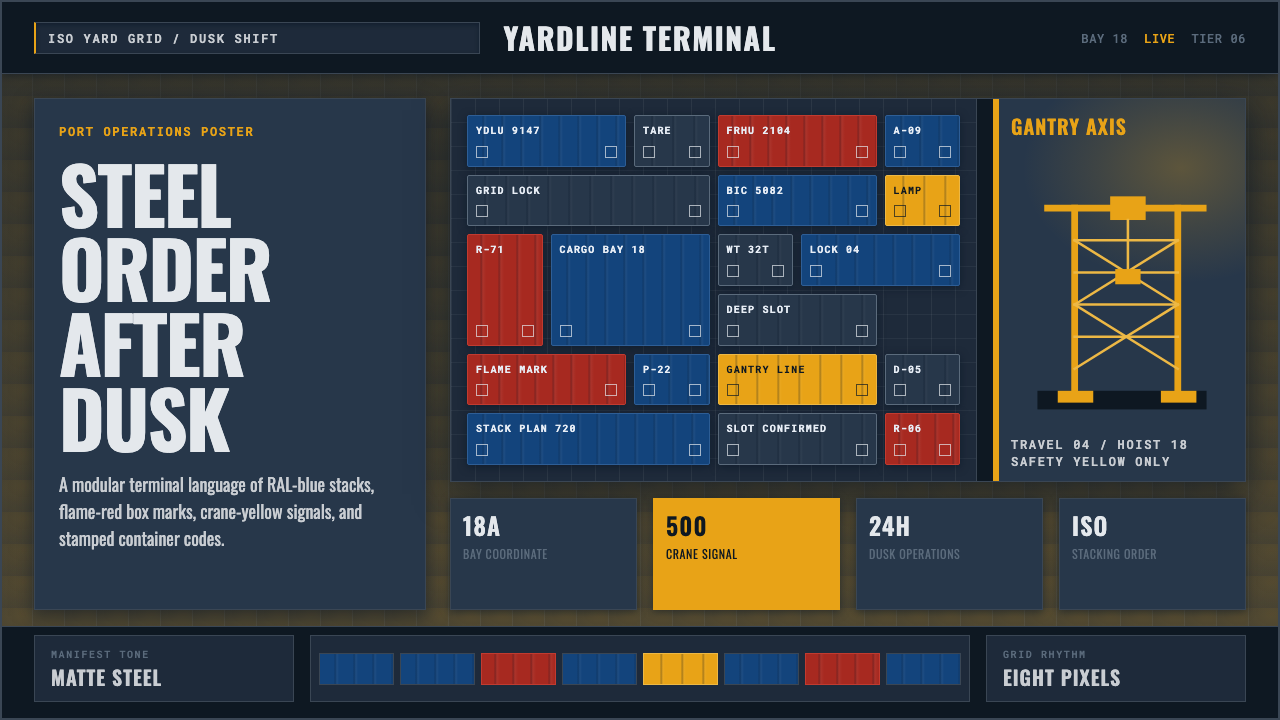 Container PortIndustrial dusk, standardized. Slate grid, RAL-blue stacks, and crane-yellow…
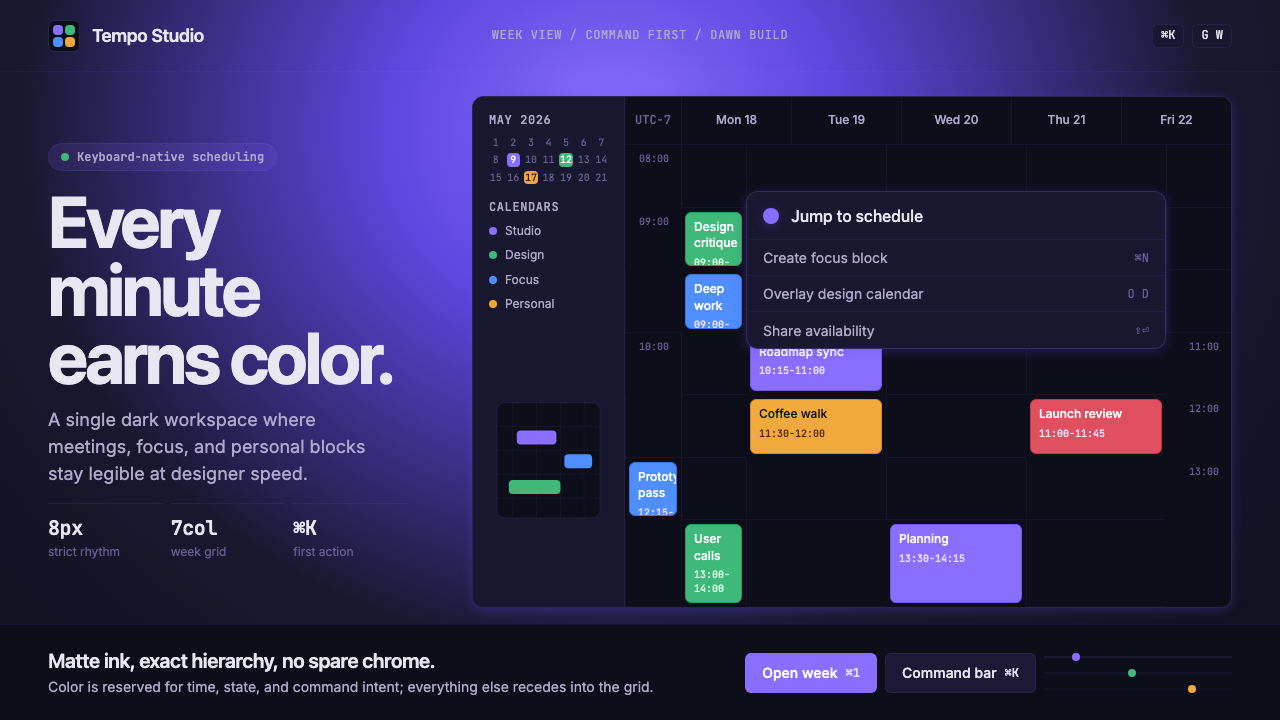 Cron CalendarDesigner-tech restraint. Purple wash, ink grid, mono shortcuts, surgical even…
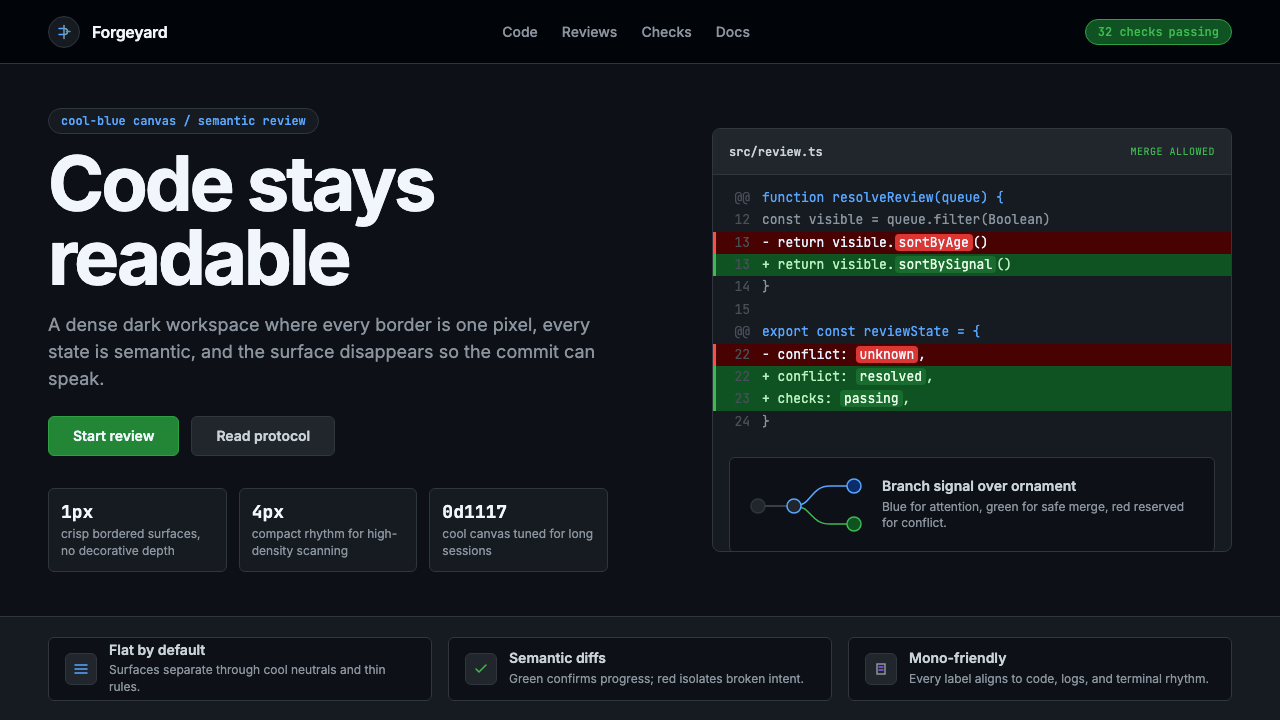 GitHub DarkCode-first darkness. Cool-blue canvas, 1px borders, green/red diff lines.
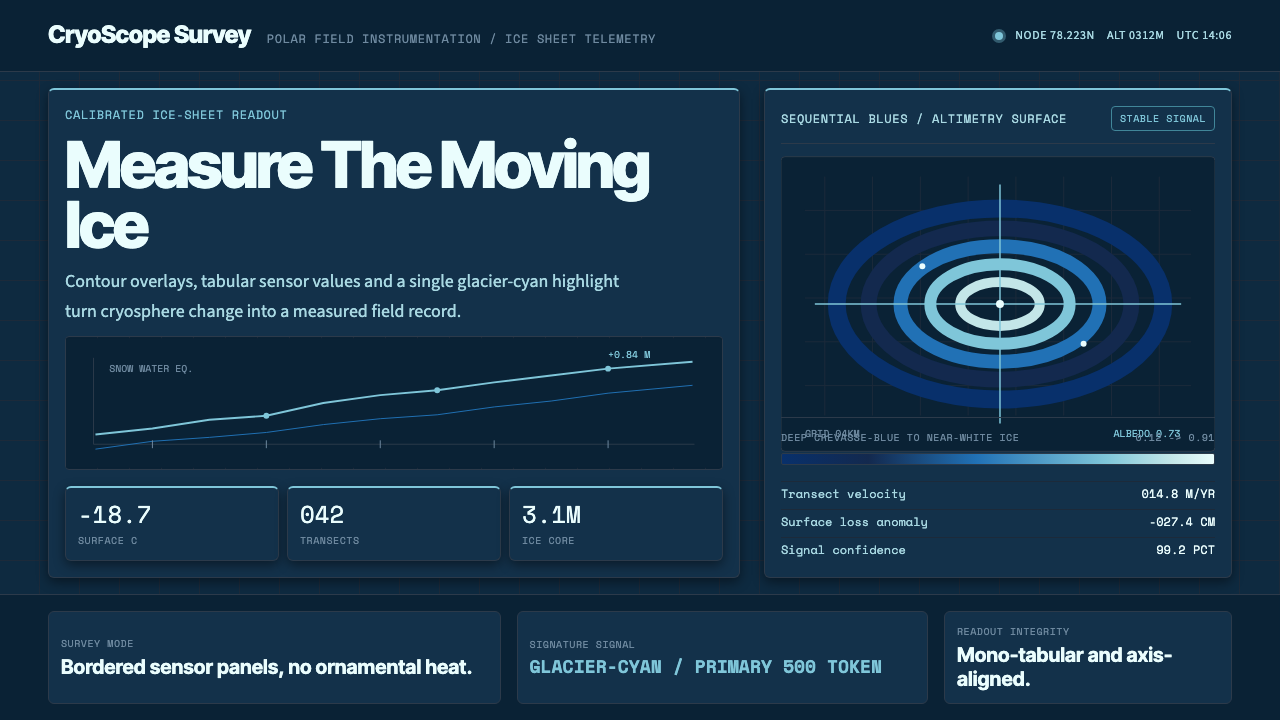 Glacier Arctic SurveyCold precision. Crevasse-blue panels, cyan readouts and contour grids calibra…
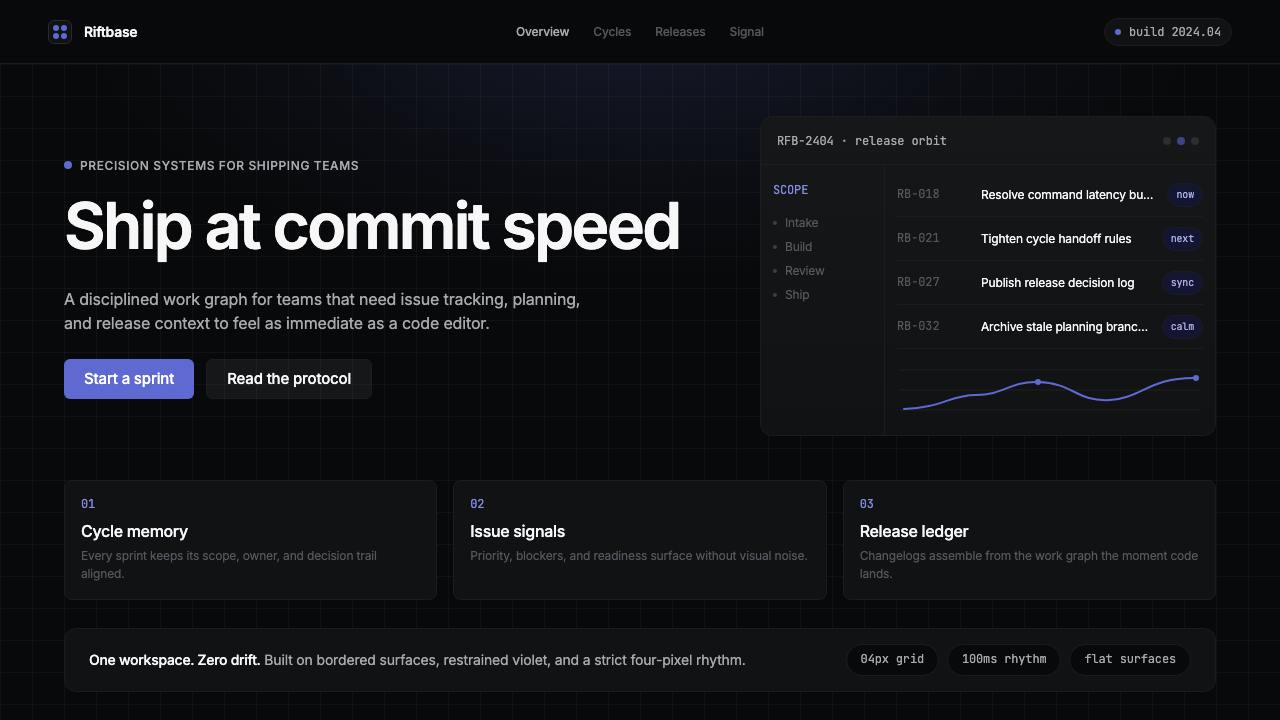 Linear 2024Precision down to the millisecond. Near-black, indigo-violet accents, Inter D…
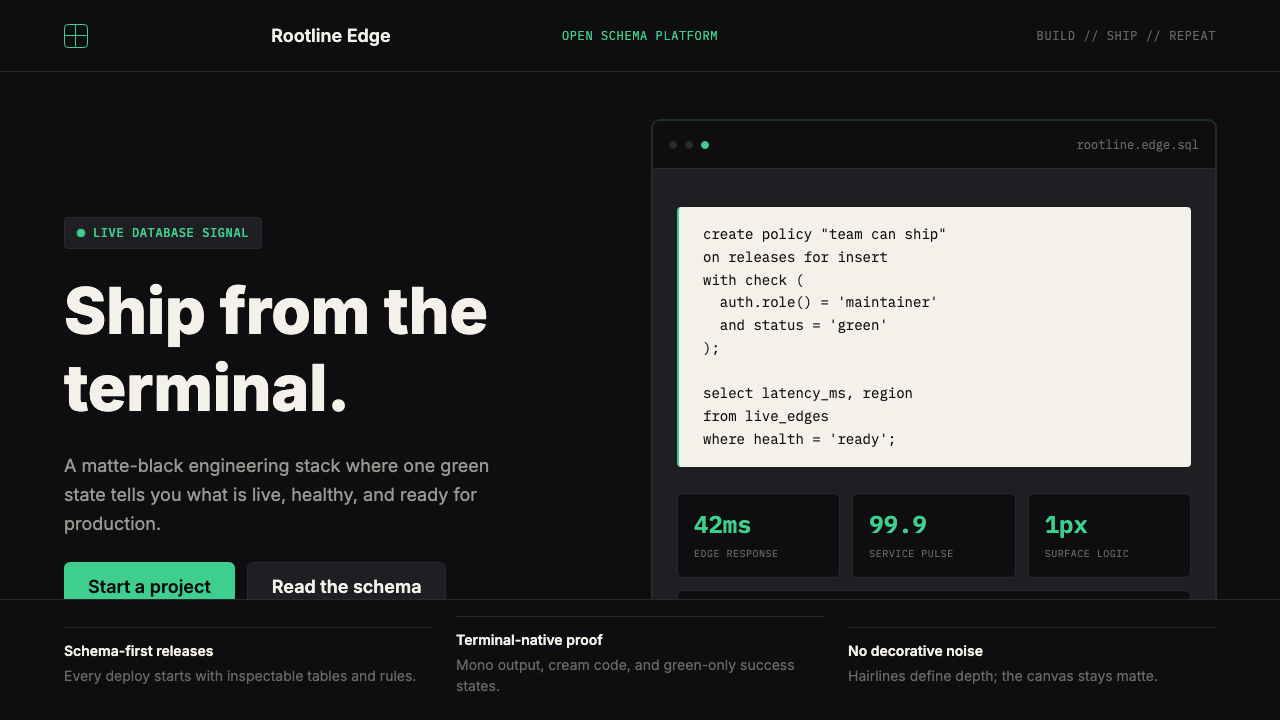 Supabase Postgres Green (2024)Midnight-terminal confidence. Matte black, Inter, mono code, and one electric…