What is Shang-Zhou Ritual Bronze?
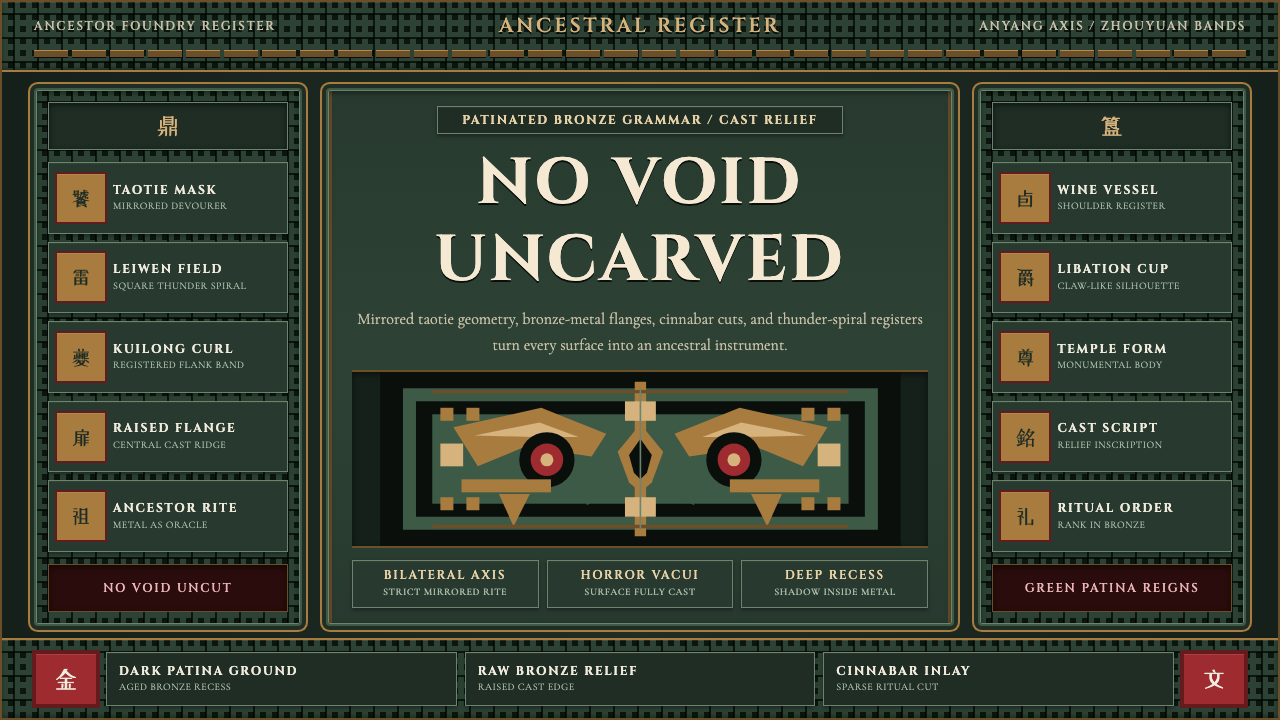
Three thousand years before the modern grid, Shang bronze-casters packed every square millimeter of sacred vessels with terrifying zoomorphic ornament — and invented a visual grammar still powerful enough to stop a room.
Shang-Zhou Ritual Bronze in brief
Shang-Zhou ritual bronze is the foundational visual language of Chinese ornament — cast in metal at royal foundries during the late Shang dynasty (c. 1300–1046 BCE) and refined through the Western Zhou period (1046–771 BCE). The aesthetic is defined by a single overriding principle: horror vacui, the terror of empty space. Every surface of a ritual vessel — its body, its handles, its foot ring, its lid — must bear layered ornament. Bare metal is unfinished metal.
The vocabulary of motifs is narrow, precise, and cosmologically loaded. The taotie — a frontal beast mask, bilaterally symmetrical, with bulging eyes and no lower jaw — dominates the central registers of almost every vessel type. Flanking it are the leiwen, a thunder-spiral built from square hook-and-return lines, which fills the background field at dense, nearly mechanical regularity. Secondary registers carry the kuilong, a one-legged dragon in profile, and the cicada, a symbol of resurrection. Together these motifs construct a visual world that is simultaneously abstract and zoomorphic — you can read it as pure pattern or as a crowd of watching eyes.
The aesthetic differs from all later Chinese ornament in character as much as in form. Tang and Song dynasty decoration — lacquerwork, silk, ceramics — moves toward calligraphic fluency, organic curves, and decorative warmth. Bronze Age ornament is the opposite: angular, compressed, cast in rigid metal rather than painted or woven, and charged with ritual rather than aesthetic intent. These vessels were not made to be looked at. They were made to be used in ancestral sacrifice, to hold food and wine for the dead, to communicate between the human world and the numinous. Their terrifying density is a feature, not a style choice.

Where does Shang-Zhou Ritual Bronze come from?
The Shang dynasty bronze industry was centered at Anyang in present-day Henan province, where archaeologists have excavated the royal capital known as Yinxu — the Ruins of Yin. The foundries there operated at an industrial scale unprecedented in the ancient world: workshops covering hectares, organized teams of specialized craftsmen, and a piece-mold casting process of extraordinary technical sophistication. Bronze was not merely a material; it was the medium through which royal power and ancestral legitimacy were made visible and permanent.
The production method — called piece-mold casting — shaped the aesthetic as decisively as any artistic intention. Craftsmen carved ornament into clay section molds before casting; the metal simply filled the carved impressions. This means the taotie, the leiwen, and the flanges were not added to vessels but were integral to the casting itself, inseparable from the vessel's form. The raised flanges that bisect many Shang vessels along their vertical axes are registration guides — alignment features that held the clay molds in position during casting — that were absorbed into the aesthetic as structural ornament.
The Western Zhou dynasty (1046–771 BCE), which succeeded the Shang after King Wu's conquest, inherited the bronze tradition and gradually transformed it. Early Western Zhou vessels retain the horror-vacui density and zoomorphic vocabulary of their Shang predecessors, but the taotie progressively dissolves — its features pulled apart, the eyes drifting into isolated spirals, the body disarticulating into abstract bands. By the middle and late Western Zhou, long inscriptions cast in relief on vessel interiors record political appointments, military victories, and ritual gifts, transforming vessels from mute containers of numinous power into documents of historical record.
The Eastern Zhou period (770–476 BCE) saw the aesthetic soften and regionalize. Competing states developed their own bronze traditions — the Chu culture of the south produced elongated, almost surrealist forms, while the northern states continued more conservative vessel typologies. The Sanxingdui culture in present-day Sichuan, contemporaneous with the late Shang but geographically isolated, produced monumental bronze sculptures — standing human figures nearly two meters tall, masks with protruding eyes — that share the Shang horror-vacui intensity while operating in an entirely different formal register. Together, these regional variants define the outer boundaries of what Shang-Zhou ritual bronze can mean as a design tradition.
What defines the Shang-Zhou Ritual Bronze look?
Horror Vacui — The Filled Surface
The defining structural principle is the absolute refusal of empty ground. Background areas are filled with the leiwen thunder-spiral at such density that the primary motif — the taotie or kuilong — appears to emerge from a field of controlled visual noise rather than from bare metal. This layering creates a figure-ground ambiguity: the more you look, the more forms resolve and dissolve. The filled surface is not horror vacui as pathology but as cosmological statement — void is absence of the sacred.
Bilateral Symmetry and the Taotie Axis
Every primary motif is organized along a strict vertical axis of bilateral symmetry. The taotie mask is the most extreme expression: two profile dragons face each other across a central axis, their bodies merging into a single frontal face with shared eyes, shared horns, shared — but absent — lower jaw. This is not decorative symmetry but structural cosmology: the vessel's vertical axis is a world-axis, and the mirrored beasts are guardians of the passage between worlds. Deviation from bilateral symmetry in a Shang vessel is almost always a signal of regional or period variation.
Registered Bands and Vertical Flanges
Vessel surfaces are divided into horizontal registers — decorative bands of fixed height — by sharp raised ridges. These bands impose a strict typographic-like hierarchy: a dominant central band carries the primary zoomorphic motif at maximum size; narrower upper and lower bands carry secondary motifs at reduced scale. Vertical flanges bisect the vessel at cardinal axes, acting as visual caesuras that divide the composition into discrete panels while also reinforcing the bilateral symmetry of each. The grid they create is rigid and load-bearing — not a decorative afterthought but the armature on which all ornament is mounted.
Deep Relief and Cast Shadow
Primary motifs are cast in high relief against a deeply recessed ground, producing shadow wells of considerable depth. In strong side-lighting — the kind produced by oil lamps in an ancestral hall — these shadows animate: the taotie's face appears to shift expression as the light source moves. This is not a happy accident but a designed property. The relief depth is calibrated to the ritual lighting conditions in which the vessels were used. Contemporary applications of this aesthetic translate the relief-and-shadow relationship into flat visual contrasts: dark backgrounds against which ornamental elements appear to float at a distinct elevation.
Patina as Visual Ground
The color we associate with ritual bronzes — the mottled blue-green of archaeological patina — was not the original surface. Fresh-cast bronze is a warm, almost golden copper-orange. The green-blue patina is two to three millennia of oxidation layered onto the original metal surface, varying from vessel to vessel depending on burial conditions, soil chemistry, and bronze alloy composition. In contemporary design applications, this patina palette — deep verdigris, oxidized teal, malachite green, bronze gold — functions as a chromatic signature for the style. It is aged, legible from a distance, and carries weight without brightness.
Zoomorphic Abstraction
Shang-Zhou ornament occupies an unusual position on the spectrum from representation to abstraction. The taotie is recognizably a face — eyes, brows, horns, claws are legible — but it is also a geometric system: the whole composes from repeated angular hooks and spirals that could be read as pure pattern if you defocus your gaze. The leiwen is purely abstract — a recursive square spiral — but in context it vibrates with animal energy borrowed from the zoomorphic motifs it surrounds. This dual legibility, the simultaneous animal and geometric reading, is the most sophisticated property of the aesthetic and the most difficult to reproduce in digital application.
Hierarchical Vessel Typology
The ritual bronze system was not a single aesthetic but a ranked typology: the ding tripod cauldron for cooking meat sacrifices, the gui bowl for grain, the jue and zun goblets for wine, the you bucket for carrying wine. Each vessel type had a prescribed form, a prescribed scale, and a prescribed ornamental program. A ruler might be buried with nine ding; a minister with seven; a grand officer with five. The number and type of vessels present at a burial was the most legible statement of social rank in ancient Chinese aristocratic culture. Contemporary applications can echo this hierarchical thinking — treating different visual elements with graduated weight and density to signal importance.

Who shaped Shang-Zhou Ritual Bronze?
Fu Hao was a consort of the Shang king Wu Ding (reigned c. 1250–1192 BCE), a military commander who led armies of tens of thousands, and one of the most important ritual figures in the Shang court. Her tomb, discovered at Yinxu in 1976 and uniquely intact, contained over 460 bronze vessels — the largest cache of inscribed Shang bronzes ever recovered from a single burial. The vessels in her tomb span the full Shang repertoire of forms and represent the mature Anyang style at its densest and most accomplished. Fu Hao's burial is the single richest dataset for understanding what Shang ritual bronze looked like in active ceremonial use.
The Duke of Zhou, younger brother of King Wu and regent during the early reign of King Cheng (early Western Zhou, c. 1042–1036 BCE), is credited in the historical tradition with codifying the Zhou ritual system — the elaborate protocol of ceremonies, music, vessels, and court arrangements that organized aristocratic life for the next five centuries. Whether or not the attribution is fully accurate, the Western Zhou bronze tradition that flourished under his regency and its immediate aftermath shows a decisive shift: vessels become more varied in form, inscriptions become longer and more politically complex, and the ornamental program begins the long process of loosening from the Shang model toward the more abstract aesthetic of the later Zhou.
The craftsmen who operated the Yinxu foundries are anonymous by the standards of art history — no individual names are recorded — but their collective technical achievement is extraordinary. Archaeological excavation has revealed workshop areas with intact clay mold fragments, casting pits, and bronze slag that allow reconstruction of the piece-mold process in detail. These craftsmen developed the technique of casting assembled multi-section molds to produce seamless, complex three-dimensional forms at a scale — some ding cauldrons weigh over eight hundred kilograms — that required coordinated teams, precisely calibrated alloy ratios, and multiple simultaneous pours. Their anonymous genius is embedded in every vessel surface.
The Sanxingdui culture of present-day Sichuan province, which flourished contemporaneously with the late Shang (c. 1200–1000 BCE) but in geographic isolation from the central plains, produced bronze works that share the Shang horror-vacui intensity while operating in a completely different formal vocabulary. The standing bronze figures — up to 1.8 meters tall, with elongated bodies, oversized hands, and faces of otherworldly remoteness — and the massive face masks with bulging cylindrical eyes that project far beyond the face plane are unlike anything in the Shang canon. They suggest that the bronze age in China was not one tradition but a family of related experiments in using cast metal to materialize supernatural presence, each regional tradition finding its own grammar for the unspeakable.
Wu Ding (reigned c. 1250–1192 BCE) presided over what historians regard as the high point of Shang civilization — a period of military expansion, intensive oracle-bone divination, and unprecedented bronze production. His reign correlates with the most technically accomplished and ornamentally dense vessels in the archaeological record. The oracle-bone inscriptions from his reign — questions posed to ancestral spirits and answered by reading cracks in heated bones — provide the earliest substantial body of written Chinese and reveal a court in which bronze vessels, ancestral ritual, and political authority were entirely intertwined. The vessels produced for his consort Fu Hao and his court remain the defining examples of the Anyang mature style.
How do you use Shang-Zhou Ritual Bronze today?
Shang-Zhou ritual bronze is an extreme aesthetic — dense, dark, zoomorphic, and charged with cosmological menace — which means it is both powerful and narrow in its appropriate applications. The designer's first task is to understand what the style actually communicates: antiquity of the deepest kind, sacred authority, the weight of ritual, and a beauty that is inseparable from terror. Products and presentations that align with those values can use the style with full intensity. Those that need warmth, accessibility, or approachability should look elsewhere.
For presentation slides, the style is best deployed on high-stakes cover pages and ceremonial moments — an annual report opener, an institutional milestone announcement, a cultural heritage showcase. A cover built in this aesthetic centers a single taotie-derived motif or angular symmetrical device on a deep verdigris or near-black ground, with the title set in a typeface of appropriate weight — substantial, with strong stroke contrast — positioned in a designated clear zone within the composition. Content slides should observe strict typographic hierarchy against a dark ground, using the bronze-gold register for primary headings and muted verdigris tones for secondary content. Data visualizations translate naturally: the registered-band logic of bronze vessels maps onto stacked bar charts and banded table rows, with the primary color used to mark the dominant data category.
For web interfaces, the style suits institutional contexts with high gravitas requirements: museum collection portals, cultural institution homepages, luxury heritage brand websites, and financial platforms positioning themselves as multi-generational and trustworthy. The approach: deep near-black or dark teal background, bronze-gold for primary interactive elements and headings, muted blue-green for secondary labels and borders. Navigation can borrow the registered-band logic — horizontal rules of varying thickness dividing content zones, with motif-derived icon treatments for categorical markers. Pricing pages and feature-comparison tables work particularly well: the style's intrinsic hierarchy and visual weight make it easy to communicate tier differentiation without oversimplification.
For editorial and marketing work, the style supports a specific kind of gravitas that pure minimalism cannot provide. A publication or brand communication in this aesthetic positions itself as custodian of something ancient and significant. Full-spread image treatments work when the imagery itself has archaeological or ceremonial resonance — rubbing prints of bronze surfaces, close-up texture studies, museum photography with dramatic raking light. Marketing headlines set in large, high-contrast type against dark grounds with a dense border treatment derived from leiwen thunder-spirals create immediate visual authority. The style is particularly effective for cultural tourism, museum retail, auction house communications, and any editorial context covering Chinese history, archaeology, or material culture.
A common mistake is treating the style as simply a dark color theme with some Chinese motifs applied as surface decoration. Authentic application requires internalizing the underlying logic: the filled surface, the bilateral axis, the layered hierarchy of registers, the figure-ground ambiguity of zoomorphic-geometric ornament. Using a single taotie illustration on an otherwise standard dark-mode layout is pastiche. The style coheres only when the structural principles — density, symmetry, registered bands, deep tonal contrast — govern the entire layout rather than appearing as applied ornament. Similarly, mixing this aesthetic with soft, rounded, or calligraphic Chinese visual traditions produces incoherence; the bronze age and the Tang dynasty are not interchangeable.

Shang-Zhou Ritual Bronze — FAQ
How is this style different from general 'Chinese traditional' or 'oriental' design?
The difference is enormous and historically important. 'Chinese traditional design' as popularly understood typically draws from Tang dynasty floral scrolls, Song dynasty ink-wash painting, Ming dynasty porcelain blue-and-white, or Qing dynasty lacquerwork — all of which are roughly one to two millennia younger than Shang bronze, far more decorative in the Western sense, and associated with elegant courtly aesthetics rather than sacred terror. Shang-Zhou ritual bronze predates Chinese writing as a full literary system, predates Confucianism, predates Buddhism's arrival in China. It is China's oldest surviving design tradition, rooted in a world-view — ancestor worship, cosmological hierarchy, the vessel as divine medium — that later Chinese culture preserved in memory but did not practice. Applying this style signals depth and antiquity of a specific, archaeologically grounded kind, not generic 'Chinese-ness'.
Can this style work in light or white-background contexts?
It can, but it requires significant adaptation. The original aesthetic is inseparable from the dark, verdigris-and-bronze palette produced by patination; the depth of the recessed shadows depends on a dark ground to read correctly. A light-ground application of this style works best when the motifs are rendered as dark ink or bronze-line drawings on cream or pale paper — a format with historical precedent in bronze rubbings, where collectors pressed paper into vessel surfaces and rubbed ink across them to capture the ornament. This rubbing tradition produces a reversed image: dark ground ornament becomes white lines on black, or conversely, fine dark lines on ivory. Either version is authentic to the bronze visual culture; neither is the vessel itself.
What is the taotie, and should I use it literally in contemporary design?
The taotie is a frontal zoomorphic mask — two confronted profile creatures sharing a central axis, producing a face with prominent eyes, brow ridges, horns or ears, and typically no lower jaw. Its exact zoological identity was debated even in ancient China, and no consensus exists: proposals include buffalo, owl, tiger, dragon, and composite supernatural creature. As a design element in contemporary work, the taotie can be used literally — as an illustrative motif — or abstracted into its structural logic: bilateral symmetry around a vertical axis, concentric framing of a focal point, the filled-surface principle applied to a bounded form. Literal use is most appropriate in cultural, heritage, and institutional contexts. Abstracted structural use is more versatile and less likely to risk misappropriation. In either case, understanding what the motif means — sacred, terrifying, hierarchical — should inform how it is deployed.
Is this style appropriate for digital products targeting a global audience, or is it too culturally specific?
Cultural specificity is not automatically a liability; it can be a precise competitive advantage when the product's identity benefits from anchoring in a deep, legible cultural tradition. The Shang-Zhou aesthetic is specific, but its expressive register — monumental, authoritative, ancient, terrifying in the sublime sense — translates across cultures because those are universal human responses to scale, density, and ritual. The aesthetic is more culturally specific in its motifs than in its structural logic, which means a global-audience product can apply the structural principles — bilateral symmetry, registered bands, horror vacui, dark tonal palette — while keeping literal zoomorphic motifs to moments of deliberate cultural statement. The risk to avoid is decontextualized surface ornament: taotie patterns applied as wallpaper texture with no structural intent communicate 'vaguely Asian decoration' rather than 'Bronze Age cosmological authority'.
How does this aesthetic relate to contemporary Chinese design movements?
Since approximately 2010, a design movement variously called guochao (national tide) or xinzhongshi (new Chinese style) has drawn heavily on historical Chinese visual traditions as a source of contemporary identity and commercial appeal. Within this movement, Shang-Zhou bronze references tend to appear in luxury goods packaging, museum brand identity, and cultural tourism, where the depth and severity of the aesthetic signals authenticity and historical rootedness. Contemporary Chinese designers working in this space tend to be more restrained in their literal use of motifs than earlier revival periods — the preference is for structural principles and chromatic signatures rather than direct copying of vessel ornament. The global luxury market's appetite for Chinese cultural depth has accelerated this trend, and brands from high-end baijiu to auction houses to automotive marques have deployed bronze-age visual references as markers of civilizational prestige.
Related design styles
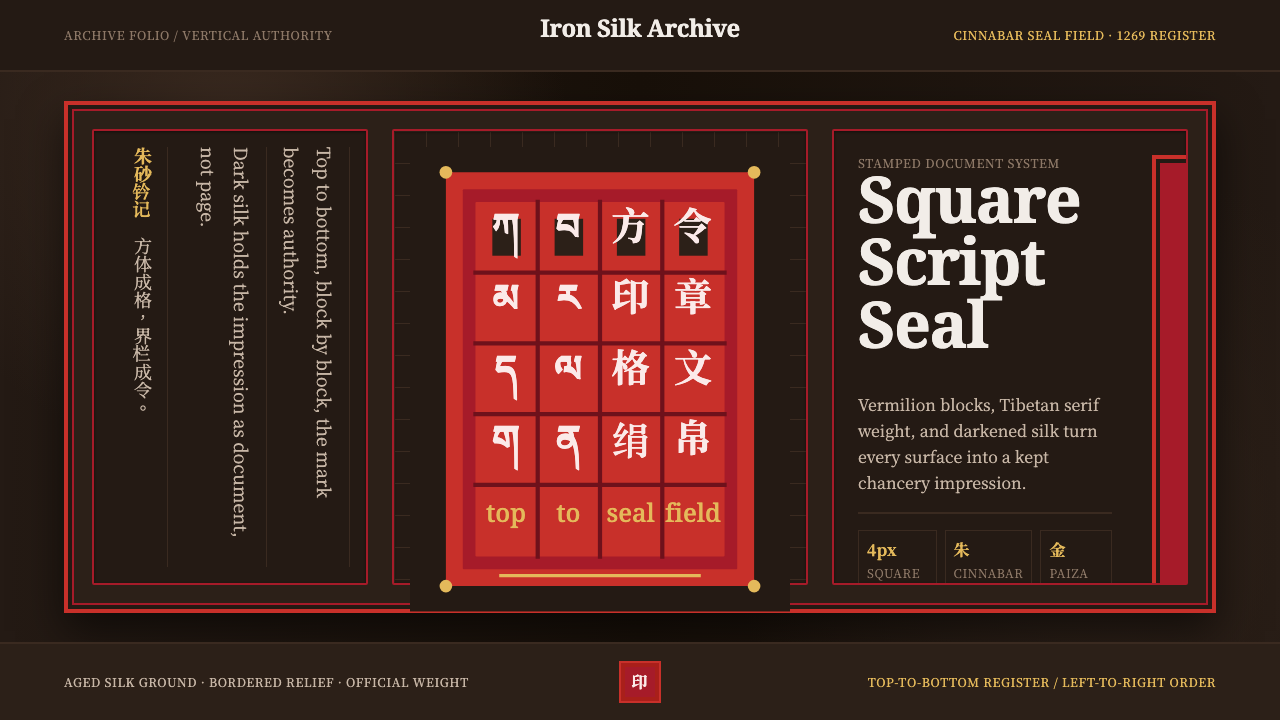 Phags-pa Seal ScriptAuthority, stamped vertical. Cinnabar borders press Tibetan serif blocks into…
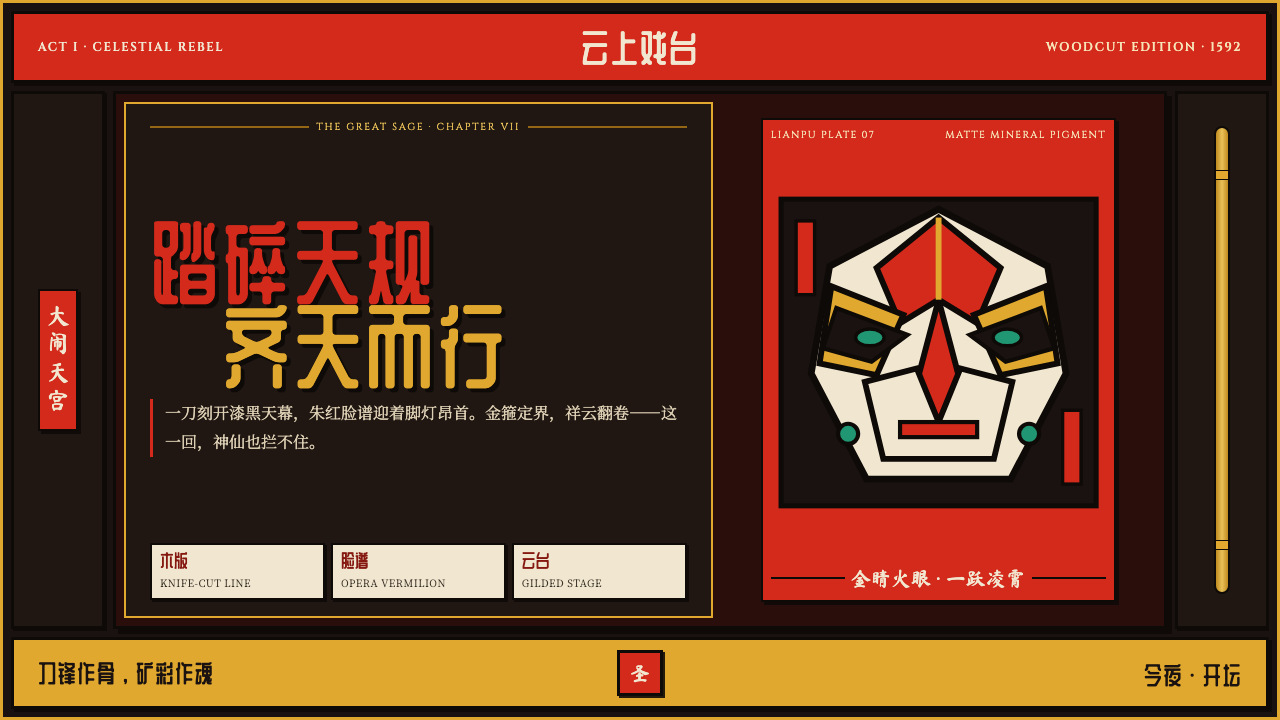 Journey to the West (Monkey King)A god roars off the block. Vermilion opera paint and gilt rules ignite a lacq…
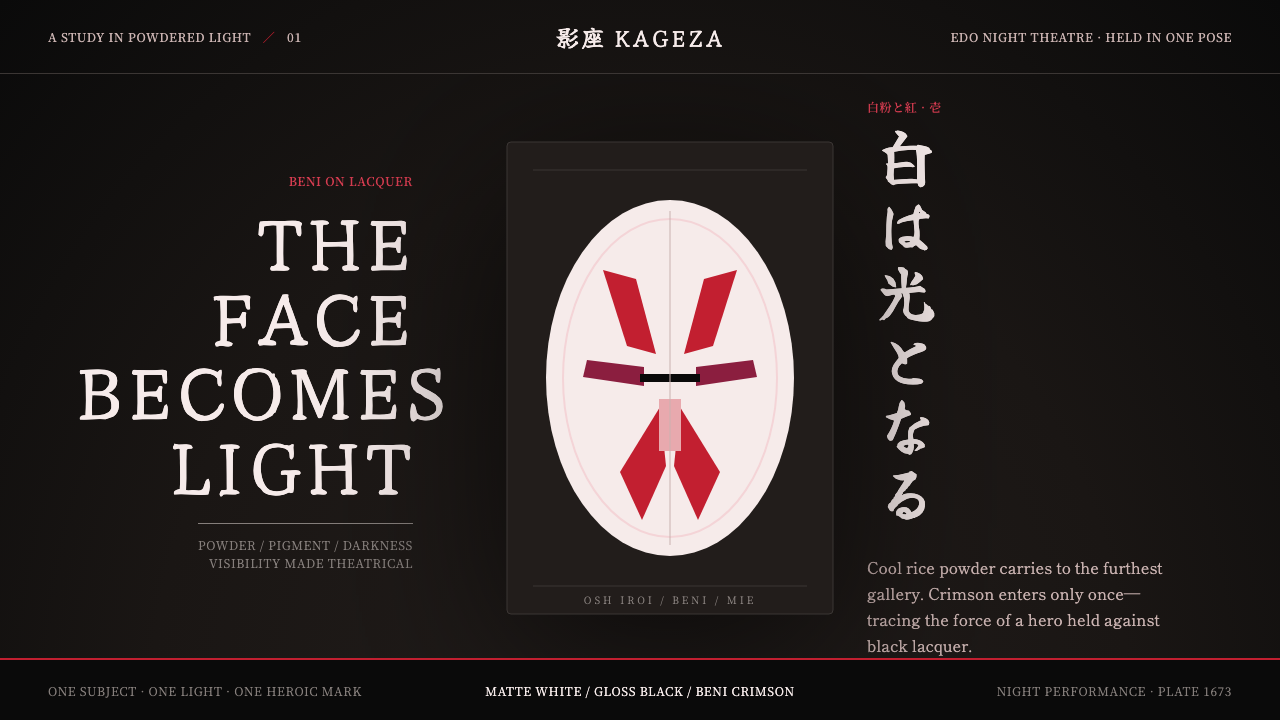 Kabuki Oshiroi WhitefacePowder becomes stage light. Cool white cuts through black lacquer with one he…
 Kerala Kathakali (Pacha Green Makeup)Fierce ceremonial night. Pacha green, vermilion, and oil-gold frame monumenta…
 Mewar Rajput MiniatureThe ground is the painting. Vermilion fields, cobalt, gold-leaf rules, profil…
 Sri Lankan Kandyan Mask & DanceRitual carries weight. Gold serif type and ruby-emerald filigree burn on blac…