What is Sri Lankan Kandyan Mask & Dance?
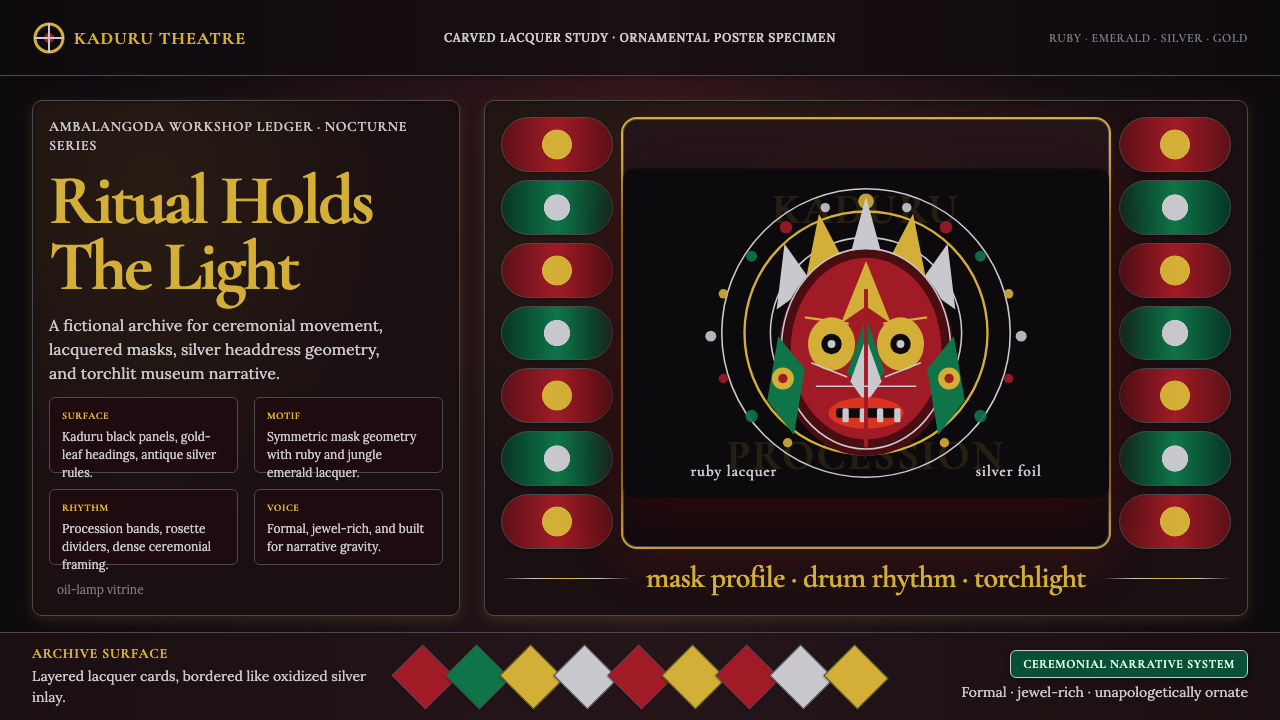
Sri Lanka's Kandyan dance and lacquer mask tradition fuse ritual gravity with jewel-bright ornament — a visual language of ruby, emerald, and antique silver burning against lacquered black.
Sri Lankan Kandyan Mask & Dance in brief
Sri Lankan Kandyan Mask and Dance is a design aesthetic drawn from two intertwined ceremonial arts: the Kandyan classical dance tradition (uda rata natum) performed at the Esala Perahera festival in Kandy, and the carved lacquer masks produced by workshops in Ambalangoda on the southwestern coast. Together, these traditions produce a visual world of extreme chromatic richness — deep black grounds layered with ruby reds, jewel greens, and oxidized silver — organized by the logic of ritual theatre rather than everyday decoration.
The aesthetic is fundamentally ornamental, but not arbitrary. Every element — the stacked silver headdress of the Kandyan dancer, the bulging eyes and bared fangs of the kolam mask, the filigree metalwork of ceremonial costume — carries codified symbolic weight accumulated over centuries of performance and devotion. This is a system in which surface richness is not excess but precision: each color, each pattern, each material choice signals something specific within the ritual economy of the tradition.
As a design language, it occupies a register that is rare in contemporary visual culture: unapologetically ceremonial, jewel-saturated, and built for narrative gravity. It shares none of the restraint of minimalist or modernist schools; instead it operates like a museum vitrine lit by torchlight, where every surface competes for attention and the cumulative effect is one of theatrical weight and cultural density.
Where does Sri Lankan Kandyan Mask & Dance come from?
The roots of Kandyan dance extend deep into Sri Lankan history. Legendary accounts trace the tradition to the 4th century BCE, connecting it to the story of King Gemunu and the god Kohomba, whose healing ceremony — the Kohomba Kankariya — is considered the ritual origin of the dance form. Whether or not these founding myths are historical, what is certain is that by the 14th through 18th centuries, under the Kandyan Kingdom, the tradition was formally codified and institutionalized under royal patronage. The Esala Perahera — the great procession that carries the Tooth Relic of the Buddha through the streets of Kandy — became the central showcase for the dance tradition, embedding it in the devotional calendar of the city and the nation.
The Ambalangoda mask-carving tradition followed its own trajectory, emerging as a distinct craft in the 18th century onward, though its roots lie in much older ritual practices. The masks served three main functions: kolam masks for satirical folk theatre performances, sanni masks for healing rituals (thovil) in which a masked performer embodied the demon of a specific illness, and raksha masks for procession and protection. The carving material was kaduru wood — lightweight, easy to work, and capable of taking the lacquer finishes in the deep blacks and vivid reds that define the tradition. Ambalangoda became the recognized center of this craft, with knowledge passing through extended family workshops over generations.
The visual vocabulary of both traditions shares a common symbolic core. Red and black signify power, danger, and the supernatural. Green and silver signal divine abundance and ceremonial status. Gold — or its more accessible approximation in gilded lacquer — marks the sacred and the royal. These are not decorative choices but iconographic conventions with the weight of centuries of ritual use behind them. The grimacing faces of the sanni masks, for example, are not simply dramatic; each demon of the thovil pantheon has a specific physiognomy, specific color conventions, and specific ritual context that the carver must reproduce faithfully.
The 20th century brought both crisis and renewal. Colonial rule and the expansion of commercial tourism created pressures that pushed the traditions toward commodification. But it also produced figures who insisted on treating Kandyan dance as a high art form. Chitrasena, who trained under the legendary Ariyapala Gurunnanse, founded the Chitrasena Kalayatanaya school in Colombo, which formalized the pedagogy of Kandyan dance and elevated its status in post-independence Sri Lankan culture. His daughter Vajira Chitrasena and subsequent generations carried this work forward, ensuring that the tradition remained a living practice and not merely a tourist spectacle. Anuradha Wickramasinghe and other contemporary practitioners continue to expand the tradition's vocabulary while maintaining its ceremonial foundations.
What defines the Sri Lankan Kandyan Mask & Dance look?
Color — Lacquer and Jewel
The palette is built around three dominant hues — deep black, ruby red, and jewel green — with antique silver and warm gold as metallic accents. Black functions as the foundation ground, not as an absence but as a rich lacquered depth. Red carries the force of ritual power and supernatural intensity. Green suggests the abundance of the jungle and the wealth of ceremony. Silver approximates the hammered metalwork of ceremonial costume and headdress. The overall effect is one of extreme chromatic density: saturated, weighted, and luminous rather than bright.
Surface — Carved Lacquer and Oxidized Metal
Texture in this system evokes two primary material references: carved lacquer, which has a depth and sheen that catches light selectively and creates an impression of layers beneath layers; and oxidized or hammered silver, which has a matte-bright duality that suggests age and ritual handling. Neither surface is smooth in the digital sense — both carry the evidence of making. In design applications, surfaces should suggest accumulated craft rather than pristine finish.
Form — Theatrical and Symbolic
Forms in this tradition are exaggerated for legibility at distance and theatrical effect: the stacked tiers of a Kandyan headdress, the bulging eyes and protruding fangs of a demon mask, the layered skirts of ceremonial costume. Scale and proportion serve theatrical purpose rather than naturalistic accuracy. In design applications, this translates to compositions that use bold silhouetting, strong contrast between foreground ornament and dark ground, and a preference for shapes that read clearly as symbolic objects rather than literal representations.
Ornament — Filigree and Layering
Ornament in this system is not applied to surfaces but is constitutive of them. Filigree patterns — the intricate metalwork of Kandyan ceremonial jewelry, the engraved borders of mask headdresses, the embroidered trim of dance costumes — exist as systems of interlocking detail that reward close attention while remaining legible as a whole from a distance. Layering is the structural principle: colors, patterns, and materials are stacked, not juxtaposed side by side. The richness comes from depth, not breadth.
Expression — Ritual Intensity
The mask tradition in particular is defined by extreme facial expression: widened eyes, bared teeth, exaggerated emotion coded as supernatural. This expressiveness is not for individual emotional communication but for ritual function — to invoke, to ward off, to embody a specific supernatural force. In design applications, this principle translates to compositions that do not hedge or soften: imagery should be confrontational rather than pleasant, compositions should make strong claims rather than gentle suggestions, and hierarchy should be unambiguous.
Composition — Bilateral Symmetry and Vertical Hierarchy
Where Bauhaus used asymmetric tension and modernism favored gridded rationality, the Kandyan mask tradition operates through bilateral symmetry and vertical stacking. Masks are symmetrical faces; headdresses build upward in tiers; ceremonial arrangements radiate outward from a central axis. This is the compositional logic of shrine, altar, and procession rather than of page or screen. In design applications, symmetrical compositions centered on strong vertical axes feel most authentic to the tradition's structural intuitions.
Darkness — Black as Foundation
This is a fundamentally dark aesthetic: black is not a background choice but the defining material ground from which all other elements emerge. The darkness is the lacquered wood of the mask, the night sky of the Esala Perahera procession, the charged ceremonial atmosphere in which ritual objects gain their weight. Colors read differently against deep black than they do against white or neutral grounds — they become luminous, jewel-like, more intense. The system's entire chromatic logic depends on this dark foundation.

Who shaped Sri Lankan Kandyan Mask & Dance?
Ariyapala Gurunnanse was the pre-eminent master of the Ambalangoda mask carving tradition in the twentieth century, and the figure most responsible for elevating kolam and raksha mask craft from folk practice to museum-quality high craft. His family workshop established the formal vocabulary that defines the tradition today: explosive frontal expression, extreme precision in the relief carving of faces and headdresses, and a strict color discipline that reinforced each mask type's specific ritual identity. The Ariyapala and Sons workshop continues to operate in Ambalangoda, transmitting this vocabulary into the present while remaining resistant to the simplifications that commercial tourism demands.
Chitrasena was the foundational figure of modern Kandyan dance as a performance and educational institution. By founding the Chitrasena Kalayatanaya school in Colombo in 1944, he opened the tradition to non-hereditary students and brought it to theatrical stages, collaborating with composers and visual designers in ways that required the aesthetic to be articulated and documented rather than simply transmitted through embodied practice. His stage productions substantially shaped the silver-and-gold visual register associated with Kandyan dance in the global imagination, and his insistence on the tradition's status as classical art — not folk spectacle — defined the institutional frame through which the tradition is transmitted today.
Daughter of Chitrasena and principal inheritor of the Kalayatanaya school, Vajira Chitrasena continued the school's pedagogical mission while adding her own choreographic perspective. Her significance lies in her role as guardian of the visual tradition's integrity across generations: under her direction, the school maintained the discipline of the silver headdress, the layered costume, and the precise geometric hand positions that give Kandyan dance its visual distinctiveness. She resisted the simplifications and popularizations that commercial pressures demanded, ensuring that the aesthetic system remained internally coherent rather than drifting toward a diluted tourist version of itself.
Anuradha Wickramasinghe represents the contemporary generation of scholars and practitioners who have sought to document both the Kandyan dance and Ambalangoda mask traditions with academic rigor, contributing to their recognition within international frameworks of intangible cultural heritage. His work matters for design application because it established a formal vocabulary for describing the visual and structural principles of the tradition — the categories of mask type, the grammar of costume construction, the symbolic content of ornament — that makes systematic design reference possible without reducing the source material to superficial pastiche.
How do you use Sri Lankan Kandyan Mask & Dance today?
Applying the Kandyan Mask and Dance aesthetic in contemporary design work requires accepting that it is a fundamentally ceremonial register — one that communicates weight, permanence, and ritual seriousness rather than accessibility, friendliness, or playful novelty. Used correctly, it produces work of extraordinary visual authority. Used incorrectly, it produces pastiche that borrows the surface richness while losing the underlying logic of symmetry, layering, and material depth.
For presentation slides, this aesthetic works best when the subject matter itself carries genuine gravity: cultural heritage projects, theatrical or performance-related presentations, high-stakes institutional communications, or any context where the audience is expected to bring reverence rather than casual attention. Cover slides benefit from centered, symmetrical compositions on deep black grounds, with a single richly colored title element that reads as an offering rather than a headline. Content slides should maintain the dark foundation and use jewel-toned accent colors sparingly to signal hierarchy; the temptation to use all colors simultaneously should be resisted, since the power of each depends on contrast with the dark ground and with each other. Data visualizations in this palette become almost mandala-like — circular or radial arrangements read better than standard horizontal bar charts in a context this ornamental.
For web interfaces, this aesthetic is suited to a narrow range of applications: cultural organizations presenting traditional arts, luxury or heritage brands where ceremony is the intended emotional register, entertainment platforms for theatrical or ritual content, or editorial contexts where the subject matter — history, mythology, ceremony — justifies the visual density. Dashboard and productivity applications are almost never well-served by this style; the ornamental weight that gives it authority in ceremonial contexts becomes an obstacle to information processing in utilitarian ones. When used for web, the dark background must be fully committed to — half-measures that lighten it toward gray lose the lacquer-depth effect entirely.
For editorial and marketing design, the style supports long-form narrative contexts where the reader is invited to slow down and engage deeply. A feature article in this aesthetic uses full-bleed dark backgrounds for section openers, ornamental borders derived from filigree patterns to mark transitions, and portrait or object photography treated with high contrast and warm color grading rather than naturalistic neutrality. Marketing campaigns work best when the product or event has genuine ceremonial associations — a museum exhibition, a cultural festival, a theatrical production, or a luxury product with authentic heritage credentials. Campaigns that borrow the aesthetic for products with no such associations will read as hollow or culturally appropriative.
A common mistake when applying this aesthetic is treating it as simply a dark-background style with jewel tones, ignoring the structural logic of bilateral symmetry, layering, and ornamental density that gives it coherence. A layout with scattered color accents on a dark background is not Kandyan-inspired — it is just dark. The authentic logic requires centered compositions, vertical stacking, filigree-like detail at the edges and borders of primary elements, and a commitment to the black ground as a rich material rather than an empty field. Similarly, mixing this aesthetic with modern sans-serif typography, flat icons, or neutral photography will produce incoherent results — the style demands typefaces and imagery that share its ornamental register.
Sri Lankan Kandyan Mask & Dance — FAQ
Is this aesthetic appropriate for non-Sri-Lankan or non-ceremonial contexts?
It can be, but only when the borrowing is purposeful and the aesthetic logic is genuinely followed rather than superficially imitated. The Kandyan tradition is a living cultural practice, not an archived historical style, which means that borrowing it casually carries risks of cultural insensitivity that more distanced historical styles do not. Used with seriousness — for a high-gravity, ceremonial, or heritage-adjacent product — the aesthetic can operate authentically outside its original cultural context. Used as a surface treatment for products with no genuine connection to ceremony, ritual, or cultural heritage, it tends to read as costume rather than identity.
How is this different from other South and Southeast Asian ornamental styles?
Sri Lankan Kandyan aesthetics share a broad ornamental tradition with other South and Southeast Asian visual cultures — Balinese ceremonial aesthetics, Bharatanatyam costume design, Burmese lacquerware, Thai royal regalia — but differ in their specific color logic, material references, and compositional conventions. The most distinctive feature is the lacquered black ground, which is specific to Ambalangoda woodcraft. The combination of ruby red and jewel green against deep black is more pronounced here than in the more gold-saturated traditions of Thai or Burmese ceremony. Kandyan dance headdress in particular has a stacked, towering verticality that differs from the broader or more radiating headgear of Balinese or Thai traditions.
Can this style work in light-background or minimal contexts?
With great difficulty. The entire chromatic and material logic of this aesthetic is built around the dark lacquered ground — the jewel colors only achieve their intensity against deep black, and the sense of ornamental depth that defines the tradition disappears entirely on light or neutral backgrounds. An attempt to apply this style on white or light gray will produce decorative motifs borrowed out of context rather than a coherent application of the tradition. If a light-ground application is required by project constraints, it is more productive to choose a different aesthetic entirely and use Kandyan references as decorative elements within it, rather than as the governing system.
What role do the masks play relative to the dance tradition?
The mask and dance traditions are related but distinct, and understanding their difference matters for design application. Kandyan classical dance as performed at the Esala Perahera is a refined court art performed by unmasked dancers whose costume — headdress, jewelry, layered skirts — is the visual focus. The mask traditions (kolam and thovil) are folk and ritual practices serving specific community functions: entertainment and social satire in kolam, healing and exorcism in thovil. Masks are not worn in classical Kandyan dance performance. The two traditions share a visual vocabulary of color, material, and ornamental intensity, but they represent different social registers — court art versus village ritual — that in design translate to slightly different tonal registers as well.
How should typography be chosen for designs in this aesthetic?
Typography in this aesthetic should share the tradition's ornamental weight rather than contrasting with it. Highly geometric modern sans-serif typefaces will read as jarring against the ceremonial richness of the visual system — they belong to a different cultural logic entirely. More appropriate choices are serif typefaces with historical authority and visual density, calligraphic display faces that carry ink weight, or decorative letterforms with their own internal ornamental logic. The key test is whether the chosen typeface can hold its own against the background richness without either disappearing into it or clashing against it. Type set in warm metallic tones — gold or silver — against the dark ground performs most authentically to the tradition's own treatment of text in ritual inscriptions and ceremonial objects.
Related design styles
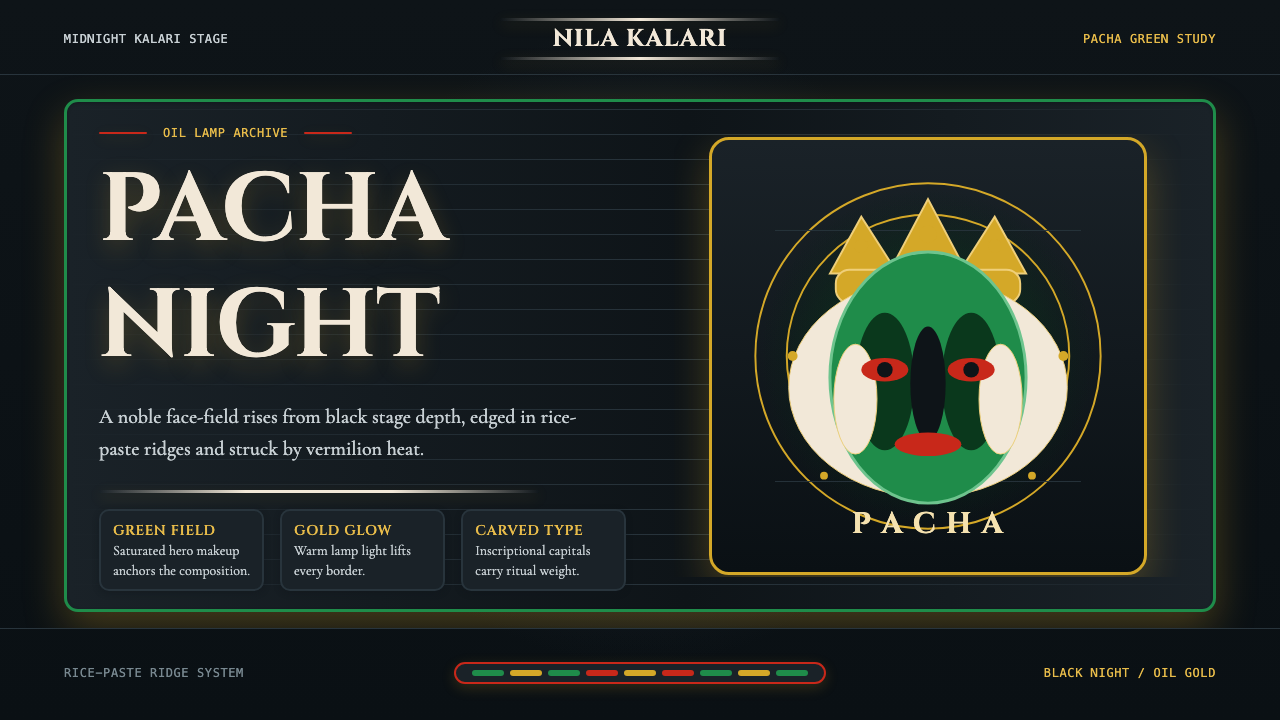 Kerala Kathakali (Pacha Green Makeup)Fierce ceremonial night. Pacha green, vermilion, and oil-gold frame monumenta…
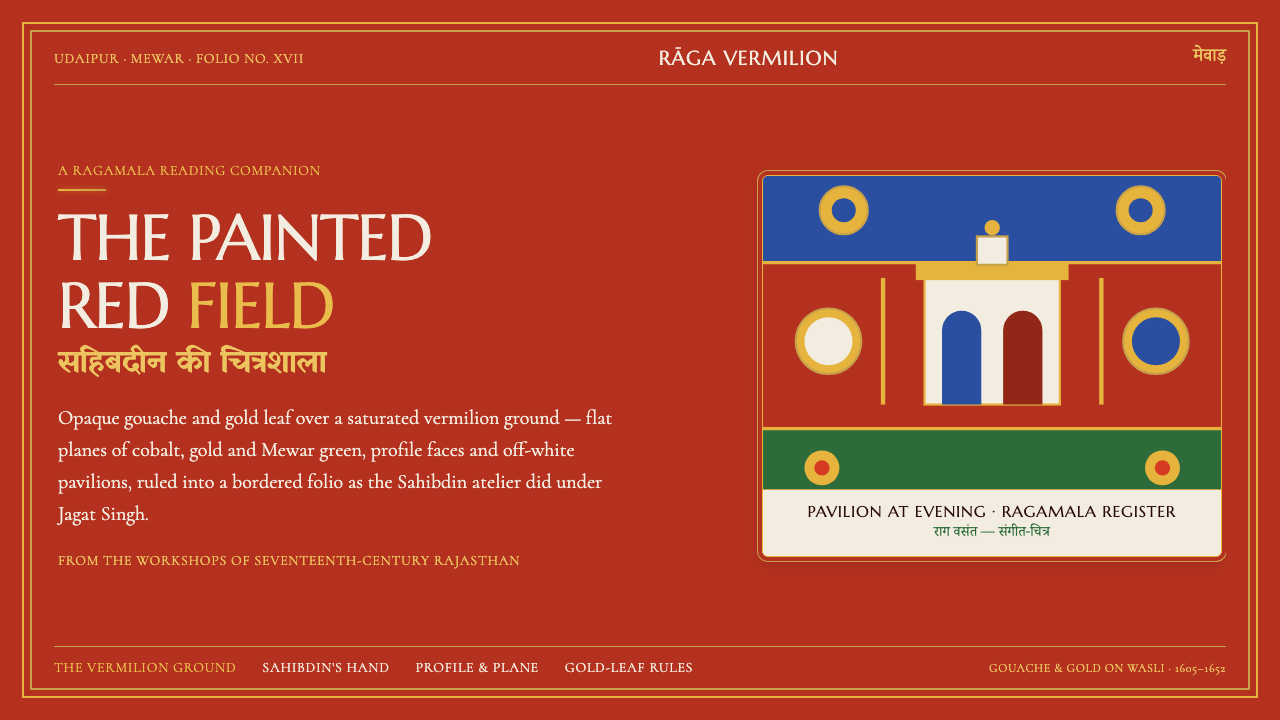 Mewar Rajput MiniatureThe ground is the painting. Vermilion fields, cobalt, gold-leaf rules, profil…
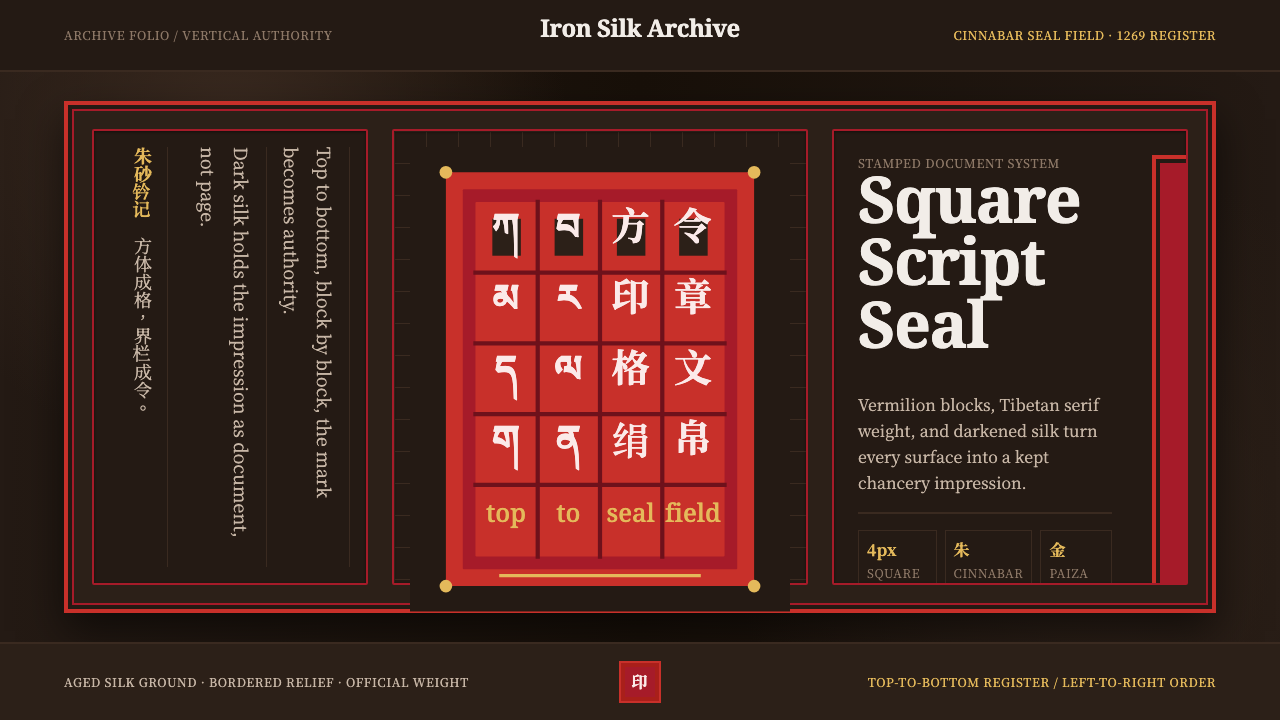 Phags-pa Seal ScriptAuthority, stamped vertical. Cinnabar borders press Tibetan serif blocks into…
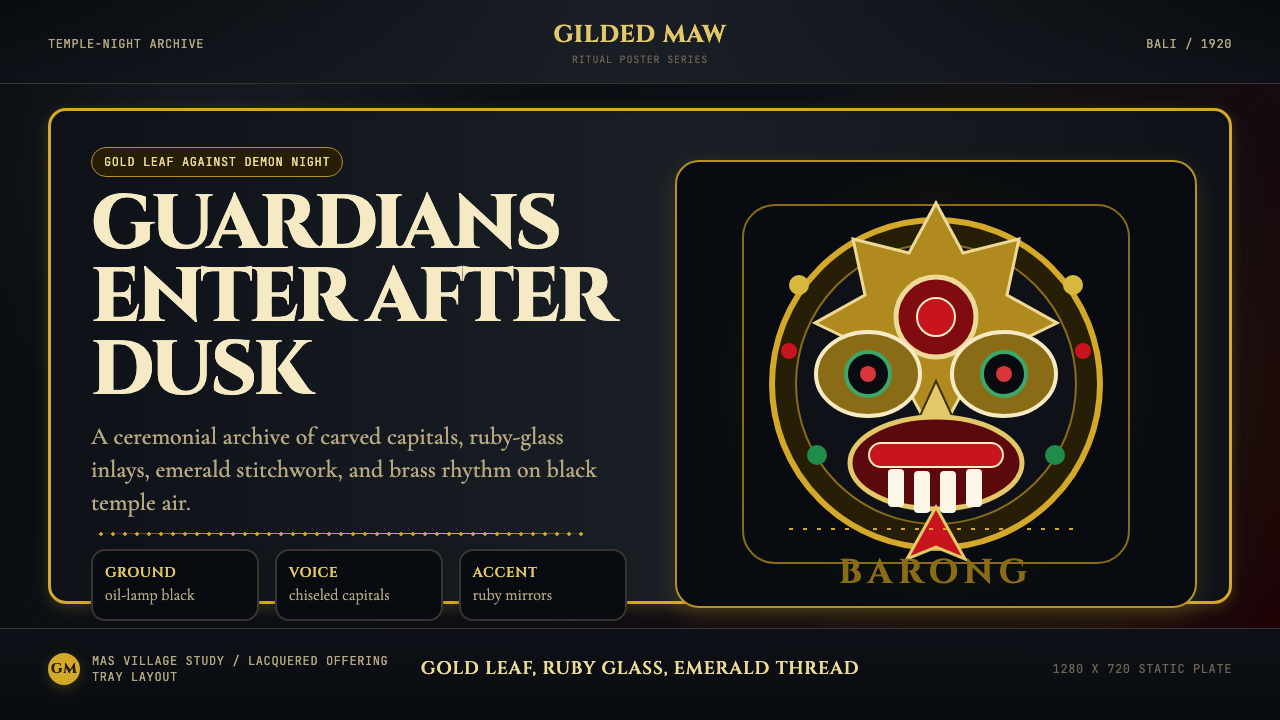 Balinese Barong Mask (1920)Protection glows after dark. Cinzel capitals frame gold, ruby, and emerald ge…
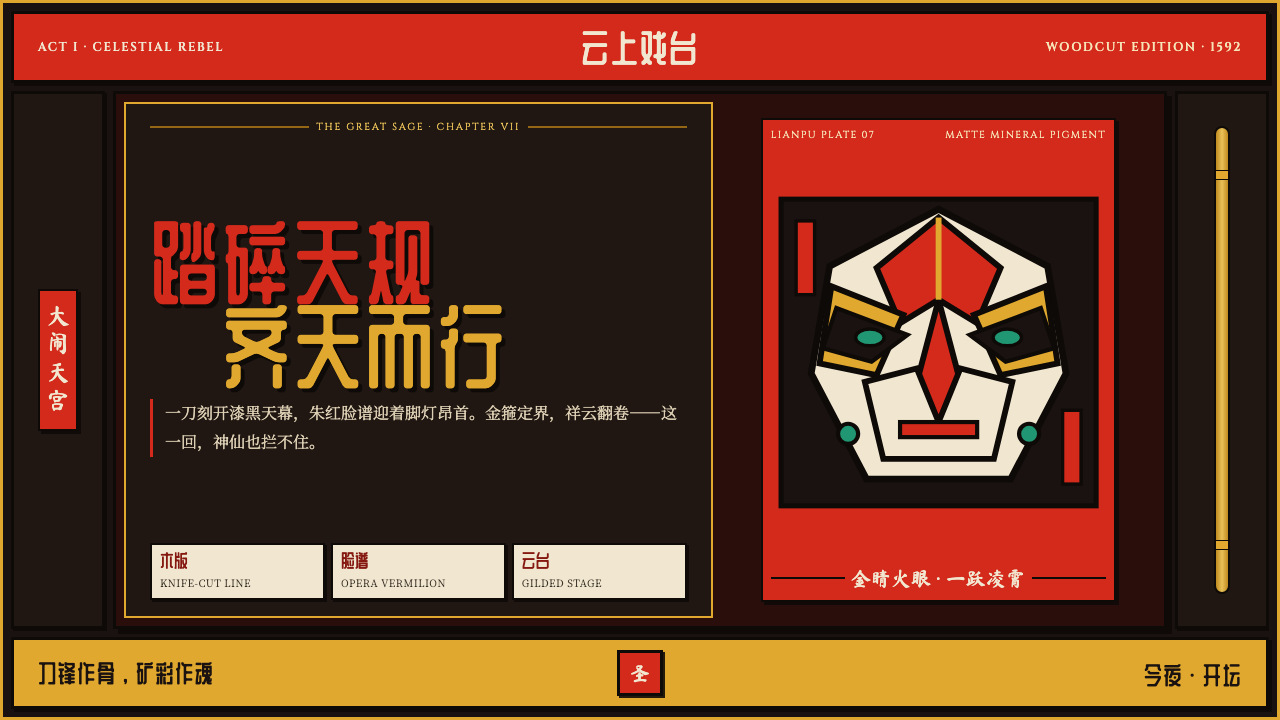 Journey to the West (Monkey King)A god roars off the block. Vermilion opera paint and gilt rules ignite a lacq…
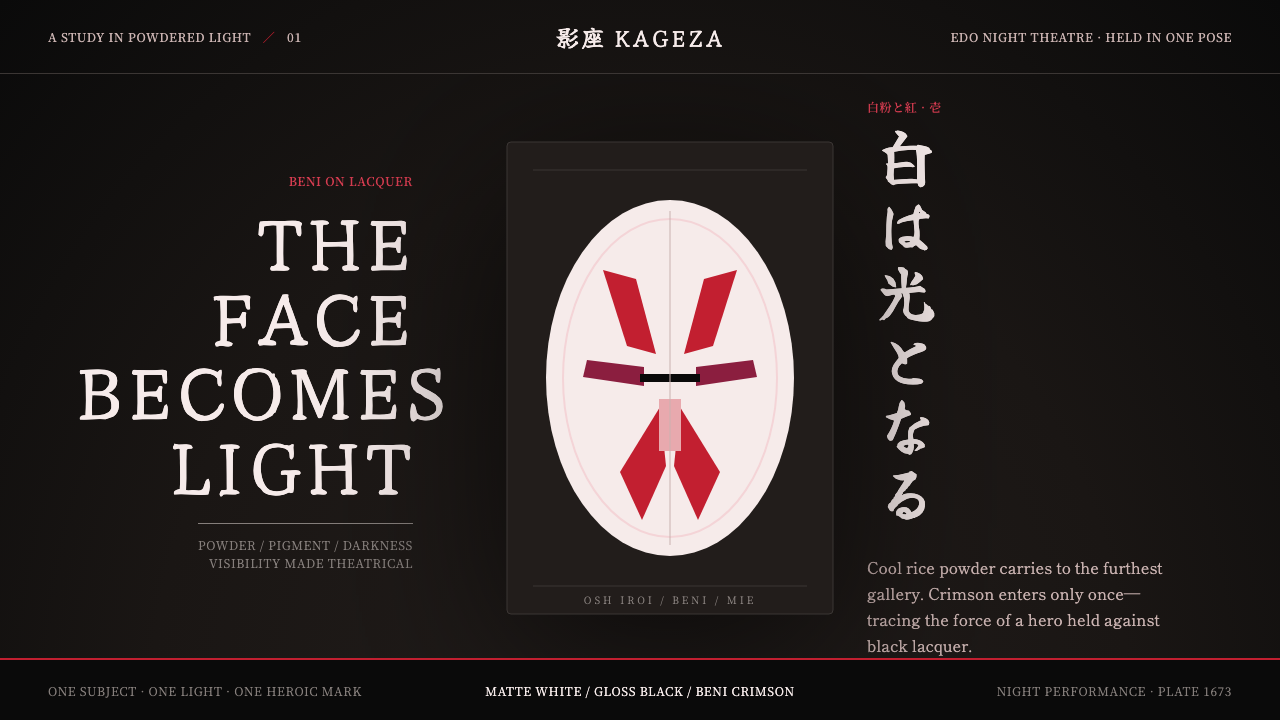 Kabuki Oshiroi WhitefacePowder becomes stage light. Cool white cuts through black lacquer with one he…