What is Kerala Kathakali (Pacha Green Makeup)?
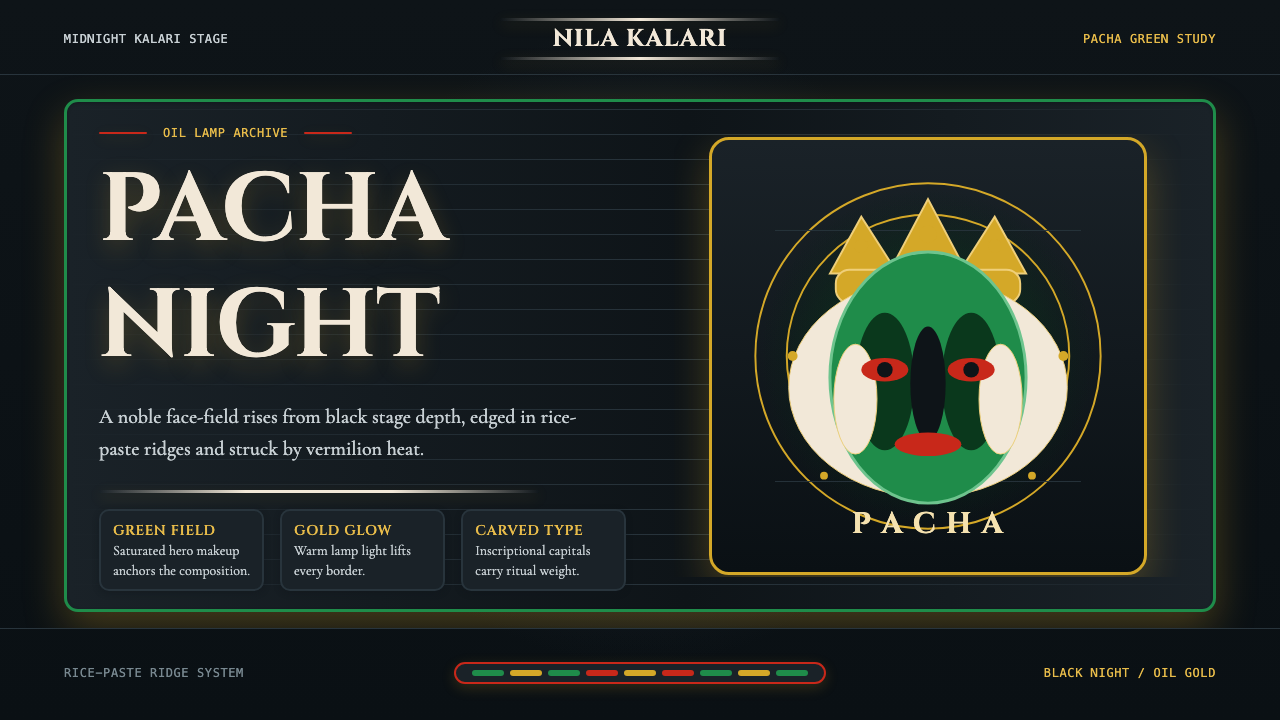
Kerala Kathakali's pacha makeup transforms the face into a living temple sculpture — a visual language of saturated green, flickering vermilion, and oil-lamp gold that has disciplined artists for over four centuries.
Kerala Kathakali (Pacha Green Makeup) in brief
Kerala Kathakali (Pacha Green Makeup) is a design system rooted in the ancient dance-drama tradition of Kerala, India, where performers spend hours applying layers of rice paste, natural pigments, and mineral compounds to transform their faces into elaborate character masks. The pacha — meaning green in Malayalam — face is the highest register of this visual grammar, reserved exclusively for noble heroes and divine kings. Against a stage illuminated only by the warm, unsteady glow of oil lamps, the pacha face radiates with an almost supernatural intensity: deep saturated green fields framed by stark white chutti reliefs, fiery vermilion accents, and gold details that catch and amplify lamplight.
As a design language, Kathakali translates this ceremonial intensity into a structured visual system. The governing logic is darkness-as-ground: a near-black background that functions less as emptiness and more as the night sky of a sacred performance space, a canvas that makes every color simultaneously more luminous and more weighted. Against this ground, the pacha green is not decorative but declarative — it announces presence, nobility, and otherness. Vermilion and ochre gold do not soften the composition but sharpen it, functioning as controlled fire within an otherwise monumental and solemn field.
The typography that complements this system draws from Kerala's stone-carving tradition: forms that are grand, deliberate, and carved rather than drawn. Serifs are not delicate or humanist; they are architectural, echoing the stepped gopuram towers and intricately carved pillars of Keralan temple complexes. The result is a design vocabulary that feels simultaneously ancient and theatrically urgent — impossible to overlook, impossible to mistake for anything else.

Where does Kerala Kathakali (Pacha Green Makeup) come from?
Kathakali as a codified performance form emerged in Kerala around the mid-seventeenth century, with its systematization traditionally credited to Kottarakkara Thampuran, a royal patron who reputedly composed some of the earliest Kathakali performance pieces. The form synthesized several older traditions — including Krishnanattam, the devotional dance-drama performed in honor of Krishna at Guruvayur temple, and Ramanattam, an earlier narrative dance form — into a new theatrical language that placed the elaborately costumed and made-up performer at the center of the dramatic experience.
The makeup system itself draws from a much deeper well. The practice of applying rice-paste reliefs and natural-pigment colorings to the face has roots in Kerala's ancient ritual arts, including the Theyyam possession rituals of northern Kerala and the Koodiyattam Sanskrit theater tradition, which UNESCO recognizes as among the oldest continuously performed theater forms in the world. What Kathakali's codifiers did was systematize these practices into a legible character grammar: the pacha face for heroes, the kathi (knife) face for complex antiheroes, the thadi (beard) variants for demons and forest spirits, and the minukku face for women and sages. Each face type maps directly to a moral and dramatic category.
The modern revival and international visibility of Kathakali owes a great deal to Vallathol Narayana Menon, the poet and cultural reformer who founded Kerala Kalamandalam in 1930 — now a deemed university and the primary institution for training in Kathakali and other classical Kerala performance arts. Vallathol recognized that Kathakali was at risk of dying out as a living practice: its traditional patron system had collapsed with the decline of the old aristocratic order, and the elaborate training required — a minimum of twelve years of intensive, full-body physical conditioning and makeup study — meant few families could afford to dedicate a child to the art. Kalamandalam created an institutional framework that preserved and formalized the tradition, producing generations of master performers including Kalamandalam Krishnan Nair, who was awarded the Padma Bhushan and remained one of the defining male dancers of the form, and Kalamandalam Gopi, whose interpretations of noble-hero roles became benchmarks for the pacha makeup register.
The design philosophy embedded in Kathakali makeup reflects the Hindu cosmological framework within which the tradition operates. Color in this system is not aesthetic preference but ontological category: green is the color of divine heroism and cosmic order, red signals aggression and moral ambiguity, black marks demonic forces, and white the spiritually elevated or the pure. The rice-paste chutti borders that frame the face are not ornamental additions but load-bearing structural elements — they enlarge the performer's apparent facial surface area to fill the vast open-air performance spaces where Kathakali was traditionally staged, functioning like architectural molding that gives scale and legibility to the face at a distance. Every element of the makeup system serves a communicative function legible to a traditionally informed audience without any verbal explanation.
What defines the Kerala Kathakali (Pacha Green Makeup) look?
Color Field
The pacha system operates on a strict color hierarchy with darkness as its foundation. A near-black ground — the ceremonial night of the stage — anchors the entire composition. Against it, the dominant saturated green occupies the broadest fields, declaring heroic presence without competition. Vermilion enters as a focused accent, concentrated at dramatic facial features to signal intensity and vitality. Ochre gold appears at the highest points of detail, functioning like lamplight caught on carved temple surfaces. White is structural rather than neutral: the rice-paste relief borders define the face's outer boundary and create negative-space channels between color fields.
Darkness as Ground
Unlike design systems built on light or neutral backgrounds, the Kathakali visual language treats extreme darkness as a generative field rather than an absence. The black background does not recede behind the composition — it actively amplifies every color placed against it. This governing principle means the system is constitutionally unsuited for pale or washed-out contexts; it requires commitment to depth. The payoff is a visual intensity that cannot be achieved on lighter grounds: colors appear to radiate rather than reflect, giving the design an almost three-dimensional luminosity.
Monumental Typography
The typefaces that serve this visual system are drawn from Kerala's stone-carving tradition: serifs that are structural and architectural rather than humanist or calligraphic. They share qualities with inscriptional letterforms — weight distributed for visual authority at scale, with details that reward proximity but do not require it to read. These letterforms carry historical gravity without becoming archaic; they assert permanence without stiffness. Large-scale display type in this system functions as a carved declaration, not a typeset sentence.
Geometric Ornamentation
Though intense in its decorative richness, Kathakali's visual vocabulary is governed by geometric discipline. The chutti border systems, the concentric arcs and angular extensions that frame the performer's face, follow rule-based patterning derived from temple architectural ornamentation. Repeated chevrons, interlocking stepped forms, and radially symmetrical accents reflect the same formal logic found in Kerala's wooden ceiling carvings and copper-plate manuscript borders. Ornament is never improvisational; it is always structural — a language of pattern that could theoretically extend infinitely following the same generative rule.
Lamplight and Flicker
Traditional Kathakali was performed by lamplight — the kalivilakku, a tall bronze oil lamp — which gave all colors a warmth, variability, and directional specificity impossible to replicate with fixed electric light. The design system honors this by incorporating gold and ochre tones not as flat accent colors but as evocations of that living, shifting luminosity. Gradients in this context are not the smooth digital gradients of contemporary UI; they are the organic luminance variations of oil-lamp reflection — subtle, warm, and directional.
Bilateral Symmetry
Kathakali makeup and its design derivatives operate on strict bilateral symmetry as the default compositional principle — a reflection of the tradition's roots in ritual and temple art, where symmetry signals divine order and cosmic balance. Unlike the dynamic asymmetry of Western modernist design, Kathakali-derived layouts tend toward centered, mirrored structures that communicate stability and authority. Asymmetry is the exception, deployed deliberately to signal disruption or transition rather than as a baseline compositional preference.
Ritual Layering
The Kathakali makeup process requires between four and eight hours of careful, sequential layering — each stage chemically and formally prerequisite to the next. This logic of ritual layering translates into design as compositional depth: backgrounds, mid-ground structural elements, and foreground details occupy distinct planes, each legible in isolation but collectively producing an effect of density and intricacy that no single-plane composition can achieve. The depth is not illusionistic; it is structural, readable as distinct layers even at a glance.

Who shaped Kerala Kathakali (Pacha Green Makeup)?
A seventeenth-century Kerala prince and patron credited with foundational contributions to codifying Kathakali as a distinct performance form. He is traditionally regarded as the composer of the Ramanatham, an early narrative cycle that helped establish the dramatic structures and character typology — including the pacha hero archetype — that would define Kathakali for subsequent centuries. His patronage represented the aristocratic support system without which the tradition's elaborate training and costuming demands could not have been met.
The poet and cultural reformer who founded Kerala Kalamandalam in 1930, saving Kathakali from near-extinction by creating an institutional training framework to replace the collapsed traditional gurukula patronage system. Vallathol recognized that Kathakali's survival required both institutional support and cultural reframing — presenting it not as folk entertainment but as a classical art form worthy of serious study and international attention. His advocacy directly led to Kathakali's recognition as a major Indian classical art and to its international touring visibility in the mid-twentieth century.
One of the twentieth century's defining Kathakali performers, particularly celebrated for his portrayal of heroic pacha-makeup roles. A product of the Kalamandalam training system, he was awarded the Padma Bhushan — one of India's highest civilian honors — in recognition of his contributions to the form. His interpretations set technical and expressive standards that subsequent generations of performers trained against, and his decades of performance consolidated the visual and gestural vocabulary of the pacha hero as it is understood today.
A Kalamandalam-trained master performer whose interpretations of noble-hero roles — particularly figures from the Mahabharata and Ramayana — became benchmark readings of the pacha makeup's expressive possibilities. His performances are noted for the precision with which he uses the elaborately made-up face's limited range of visible movement — the eyes, eyebrows, and cheek muscles — to convey complex emotional and dramatic states. His work demonstrates the design logic of the pacha system at its most refined: constraint producing intensity rather than limiting it.
How do you use Kerala Kathakali (Pacha Green Makeup) today?
Applying the Kathakali pacha system requires genuine commitment to its core inversion: darkness is the ground, not the figure. This is not a style that works at half-measure on a white or light background. The system's full visual logic only activates when the foundation is deep and absorptive — a near-black or very deep navy that makes the saturated green feel luminous rather than heavy, and lets gold accents register as light rather than decoration. Designers who attempt to port the color palette onto a pale background will find the system's distinctive intensity dissolves into something merely colorful.
For presentation slides, the Kathakali system is ideally suited to cover slides that need to command a room — keynote openers, section dividers, executive briefings where immediate authority matters. A cover built on this system uses the full dark ground, places the title in monumental serif type at substantial scale, and reserves the saturated green for a single structural element — a framing block, a geometric border, or a category label — that anchors the composition without competing with the text. Content slides should be handled with greater restraint: dark background maintained, but color reduced to a single accent tier (green or gold, not both simultaneously), with body text in a warm near-white that reads cleanly against the dark ground. Data slides work exceptionally well when chart elements are rendered in the pacha palette against a dark field, creating a visual quality reminiscent of illuminated manuscript illustration.
For web interfaces and dashboards, the Kathakali system is best deployed in contexts where gravitas and cultural distinctiveness are deliberate signals — premium product showcases, cultural institution websites, portfolio sites for performance or visual arts, heritage brand identities. Dashboard implementations should maintain the dark ground as the primary surface, using the saturated green for active states and primary data series, vermilion for alerts or high-priority indicators, and gold for completion states or success signals. Navigation elements should be typographically bold and architecturally structured — the system does not accommodate light or ghost UI elements without losing its essential character. Pricing pages can use the color hierarchy to create tier differentiation: the highest tier rendered in the full pacha combination, lower tiers in progressively reduced color intensity.
For editorial and marketing work, the Kathakali system is a powerful vehicle for cultural storytelling and premium positioning. Long-form editorial layouts should treat the dark ground as a canvas, using pull quotes set in monumental serif type at large scale as visual anchors, with the green reserved for thematic callouts and the gold for ornamental section markers. Marketing materials benefit from the system's inherent poster-logic: high contrast, immediate legibility at distance, and a visual temperature that reads as both ancient and contemporary — particularly effective for festival promotion, performing arts marketing, luxury cultural tourism, and any brand that wants to communicate heritage without nostalgia. The style's bilateral symmetry makes it especially well-suited to cover designs and hero-section layouts where centered composition signals formality and ceremony.
A common mistake when working with this system is treating the saturated green as a background color rather than a foreground declaration. Authentic pacha-system compositions use the green at full saturation only in contained fields — a header block, a category badge, a structural panel — never as a full-page wallpaper. Similarly, the gold and vermilion accents are most powerful when used sparingly; filling large areas with either color dilutes the lamplight-flicker logic that gives them their intensity. The visual system is built on scarcity and contrast: the more restraint applied to the accent colors, the more luminous each appearance becomes.
Kerala Kathakali (Pacha Green Makeup) — FAQ
Does this system work for products with Western audiences unfamiliar with Kathakali?
The visual system communicates independently of Kathakali knowledge — the dark-ground, saturated-green, gold-accent logic reads as ceremonial, premium, and theatrically intense to any viewer, regardless of cultural background. What changes between culturally informed and uninformed audiences is depth of resonance, not basic legibility. A viewer who knows Kathakali will read the green as specifically heroic and divinely ordered; a viewer who does not will read it as dramatically bold and richly storied. Both readings are valid, and both produce the intended emotional register of authority and intensity. The system is therefore cross-cultural in its application, though its specific references reward cultural proximity.
How does this style differ from other dark-background, jewel-tone design systems?
The key differentiators are the structural role of white and the geometric discipline of ornamentation. Many dark-background jewel-tone systems use rich colors as decorative wallpaper against a dark void. The Kathakali system is more architecturally precise: white functions as a load-bearing structural element (the chutti-border logic), creating channels and boundaries between color fields rather than appearing as text-on-dark. The geometric ornamentation follows rule-based, repeating systems derived from temple architecture — not organic, flowing, or freely expressive decoration. And the bilateral symmetry preference distinguishes it sharply from the dynamic asymmetry of most contemporary dark-mode UI systems.
Can this system accommodate color-blind users or accessibility requirements?
The system's reliance on the green-red contrast between pacha green and vermilion presents challenges for users with red-green color blindness, which is the most common form. The standard mitigation is to ensure that the pacha green and vermilion never carry meaning as the sole differentiator — any distinction conveyed by color should also be conveyed by form, pattern, or typographic weight. The system's dark ground provides strong luminance contrast for text legibility, which actually aids accessibility. The gold tones are the most universally legible accent in the palette, as they contrast sharply with both the dark ground and the saturated green across most color-vision variations.
Is this style appropriate for light or playful brand contexts?
This is among the more ceremonially weighted design systems in the Curio library — its emotional register is gravity, intensity, and formal authority rather than warmth, playfulness, or accessibility. It is well-suited to contexts where the product wants to signal heritage, craft mastery, cultural depth, or premium positioning. It is poorly suited to children's products, casual consumer apps, food and beverage brands seeking approachability, or any context where lightness and friendliness are the primary emotional targets. Attempting to soften the system — introducing pastel variants, reducing contrast, adding informal typefaces — will typically produce incoherence rather than adaptation, because the system's logic depends on its extremes.
How should this style handle motion and animation?
The Kathakali tradition has a deep relationship with deliberate, controlled movement — every gesture in classical Kathakali performance is codified and carries specific meaning, and rapid or improvised movement is antithetical to the form. This logic translates into animation principles: transitions should be measured, weighted, and intentional rather than quick, bouncy, or playful. Reveals should feel like curtains drawing back or lamps being lit — slow enough to build anticipation, weighted enough to feel consequential. Micro-interactions should be precise and minimal: a state change is a declaration, not an animation opportunity. The system does not accommodate kinetic playfulness; it rewards dignified restraint.
Related design styles
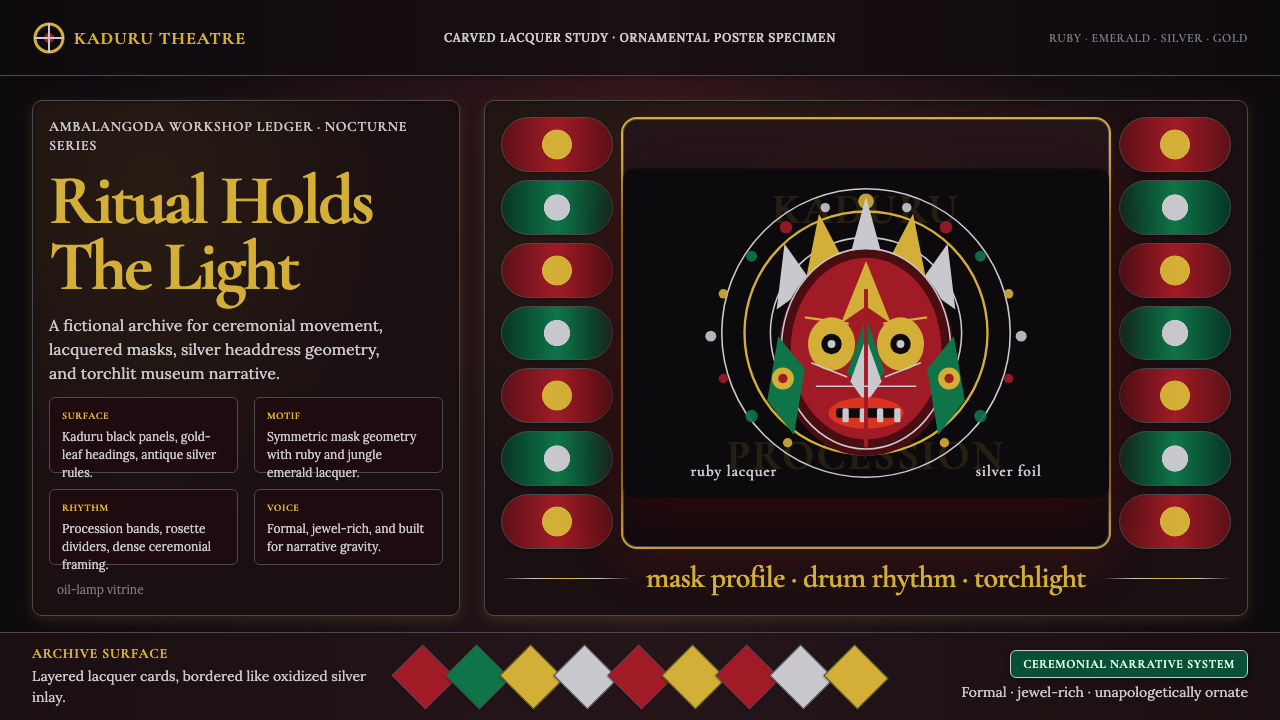 Sri Lankan Kandyan Mask & DanceRitual carries weight. Gold serif type and ruby-emerald filigree burn on blac…
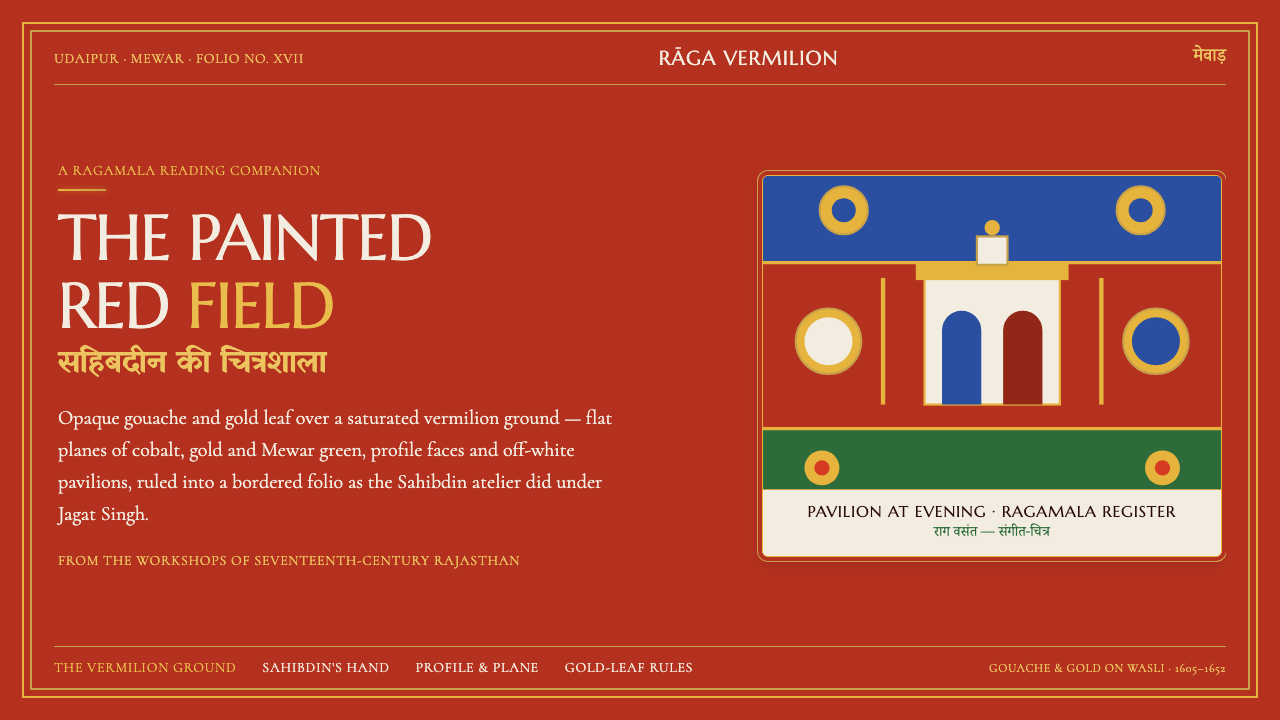 Mewar Rajput MiniatureThe ground is the painting. Vermilion fields, cobalt, gold-leaf rules, profil…
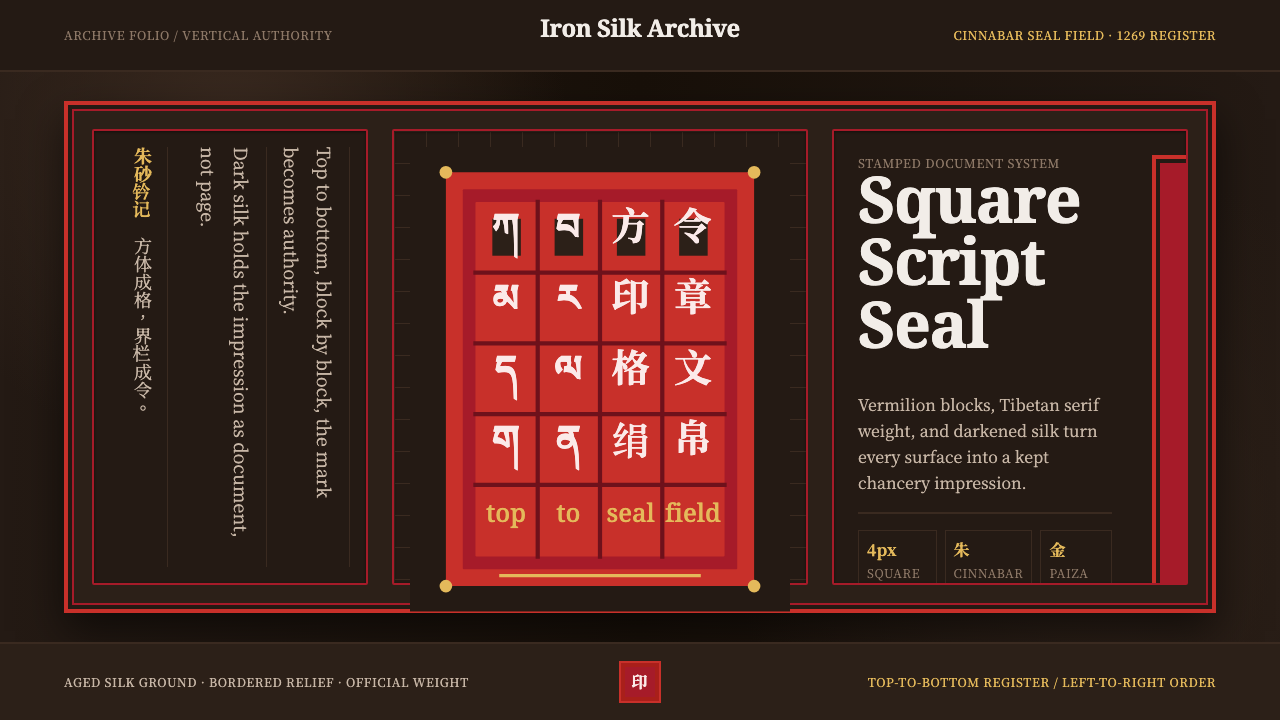 Phags-pa Seal ScriptAuthority, stamped vertical. Cinnabar borders press Tibetan serif blocks into…
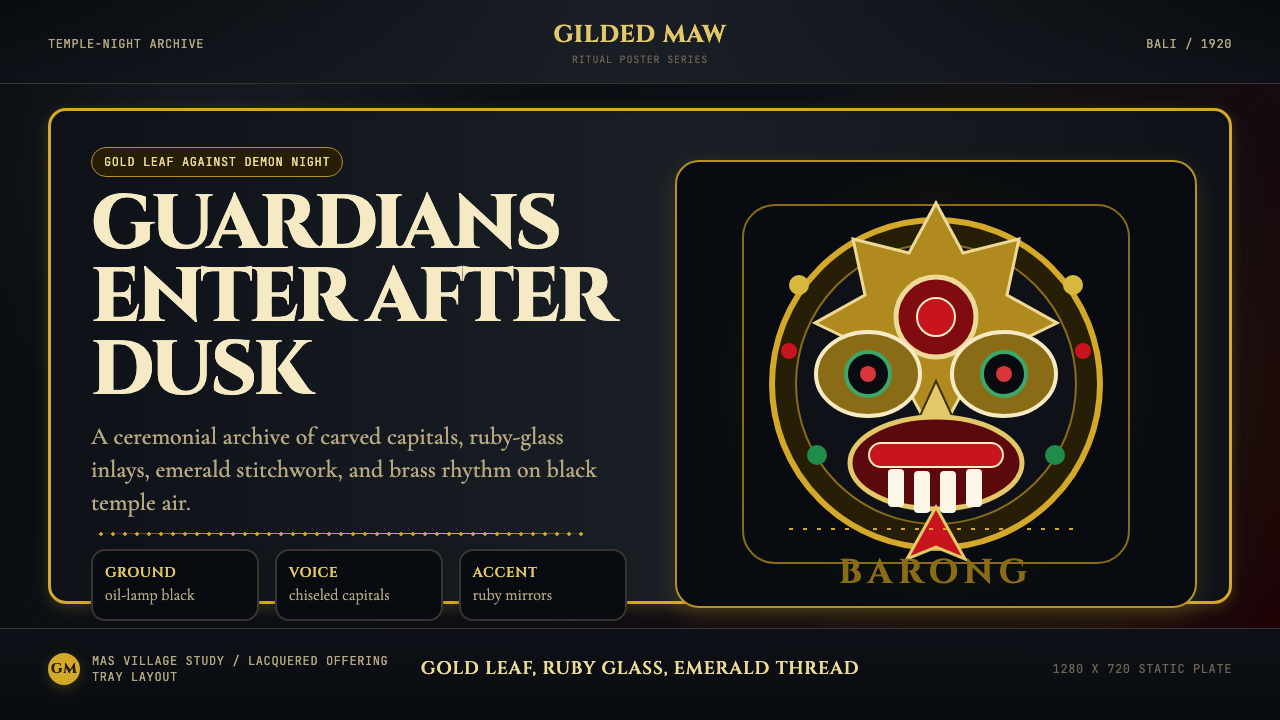 Balinese Barong Mask (1920)Protection glows after dark. Cinzel capitals frame gold, ruby, and emerald ge…
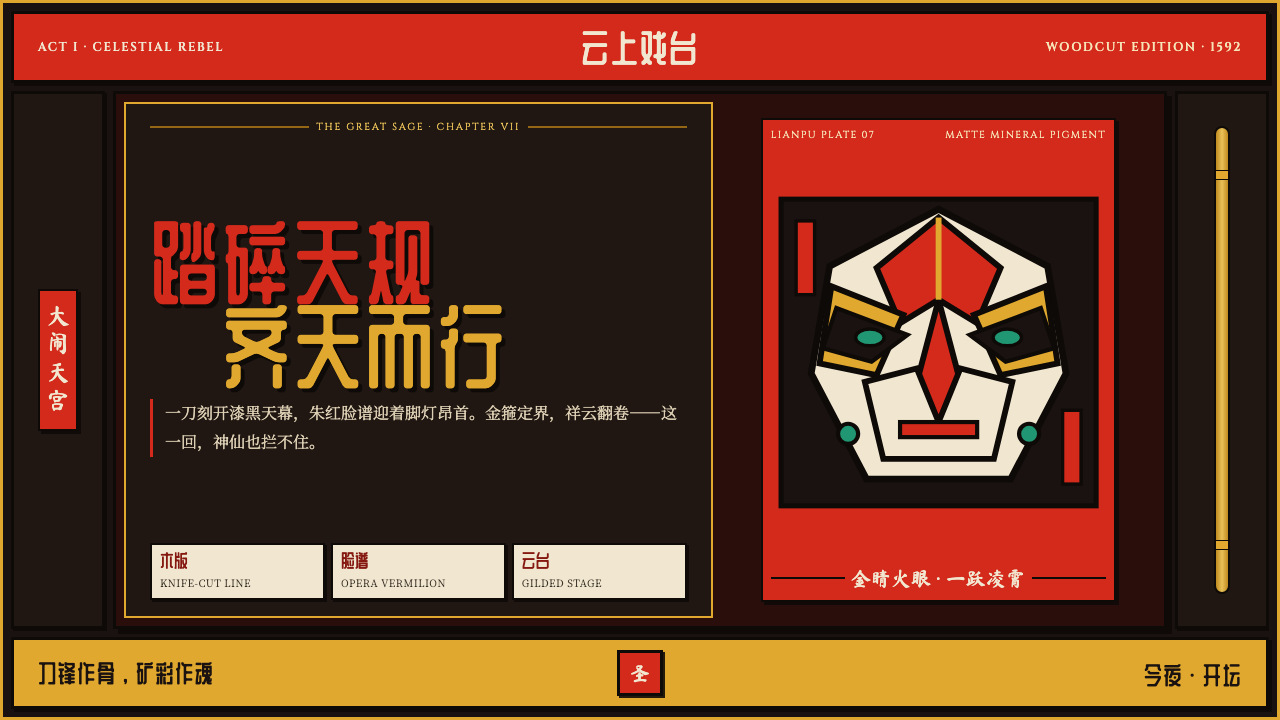 Journey to the West (Monkey King)A god roars off the block. Vermilion opera paint and gilt rules ignite a lacq…
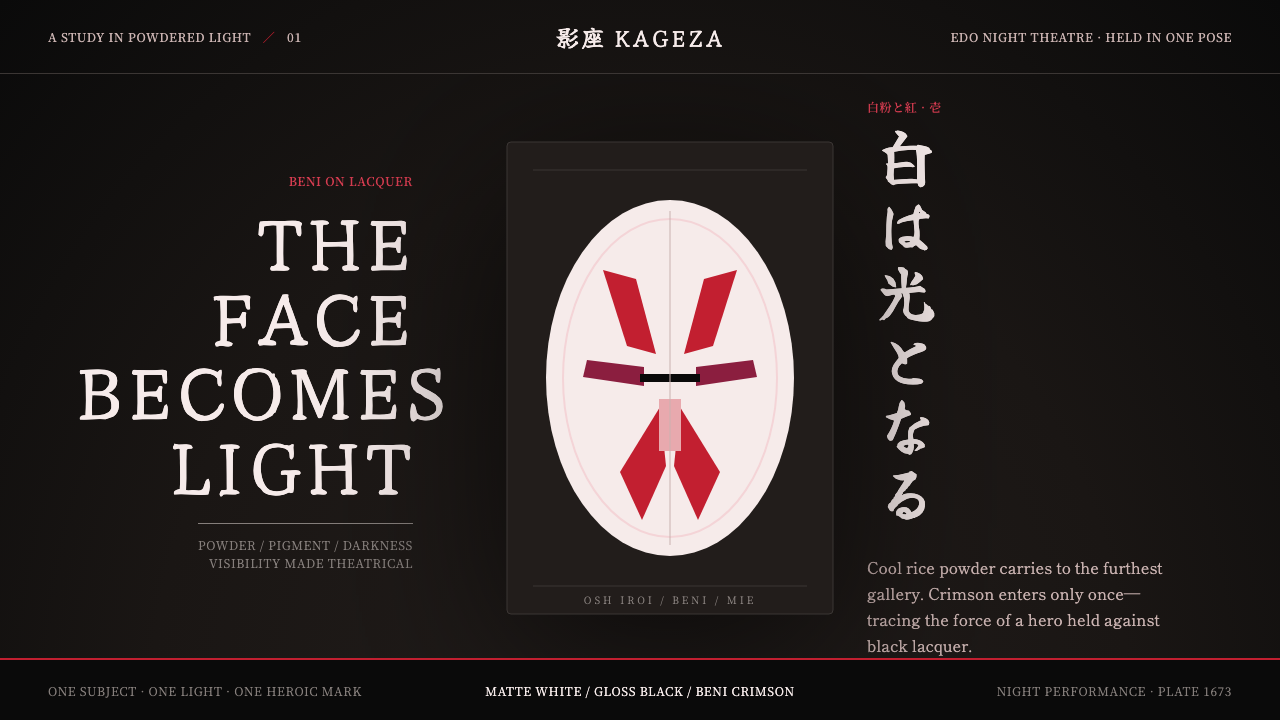 Kabuki Oshiroi WhitefacePowder becomes stage light. Cool white cuts through black lacquer with one he…