What is Victorian Circus Poster (1880)?
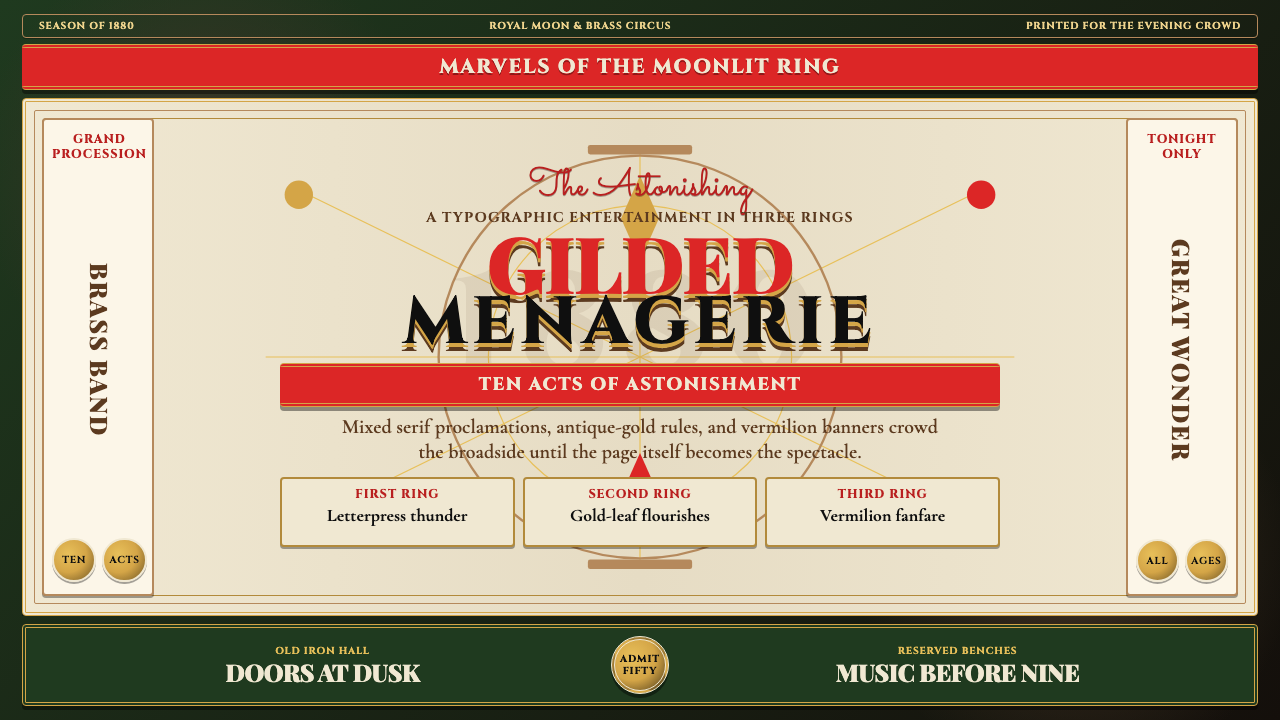
Victorian circus posters from the 1880s packed every square inch with layered type, gold-leaf flourishes, and ink-saturated color — turning the street corner into a theatre.
Victorian Circus Poster (1880) in brief
Victorian Circus Poster (1880) is a design language drawn from the broadside lithography tradition that dominated American and British popular entertainment advertising between roughly 1860 and 1900. Its visual hallmarks are deep, jewel-saturated grounds — forest green, midnight blue, or burgundy — overlaid with antique gold ornamental borders, stacked headline type in mixed serif weights, and bold vermilion or scarlet sash banners that cut diagonally or horizontally across the composition. Everything competes for attention, and that competition is precisely the point.
Unlike austere modernist traditions that prize silence and negative space, the Victorian circus poster treats every blank area as a missed opportunity. Woodcut display faces alternate with swash italics and condensed slab serifs within a single headline; ornamental rules and corner flourishes frame interior panels; tiny woodcut vignettes of acrobats or exotic animals fill gaps between text columns. The result is maximalist in the purest sense — not chaotic, but orchestrated cacophony. There is a visual hierarchy, but it is theatrical rather than rational: the most spectacular claim commands the largest type.
This aesthetic carries unmistakable emotional associations. It signals spectacle, rarity, and the promise of something genuinely extraordinary. Applied today, it evokes nostalgia, craftsmanship, and an almost defiant exuberance — the sense that the thing being advertised is worth shouting about. In digital contexts, the style translates through layered texture, hard drop shadows reminiscent of letterpress impression, aged paper or canvas ground tones, and ornamental framing devices that echo Victorian engraving.

Where does Victorian Circus Poster (1880) come from?
The Victorian circus poster emerged from the collision of two technologies: the steam-powered press and chromolithography. Before the 1840s, theatrical bills were single-color letterpress productions, largely typographic and modest in scale. The introduction of steam printing dramatically increased output capacity, while chromolithography — the technique of building a color image from multiple separately inked stones — made it possible to produce posters with six, twelve, or even thirty-six colors at commercial scale. The result was a visual arms race among competing circuses and variety halls: each season's bills had to be louder, more colorful, and more compositionally extravagant than the last.
The dominant force in American circus lithography was the Strobridge Lithographing Company, founded in Cincinnati, Ohio, in 1867 by Hines Strobridge. From their factory on the north side of Cincinnati, Strobridge's craftsmen produced the broadsides for nearly every major American circus over the following four decades, including Barnum and Bailey's Greatest Show on Earth, Adam Forepaugh and Sells Brothers, and the Ringling Bros. Circus. At their peak, Strobridge employed hundreds of stone grinders, color-separation artists, and press operators; a single large-format poster might require thirty-six stones, one for each color layer, with each stone hand-drawn by a specialized lithographic artist. The company's output defined what a circus poster looked like for an entire generation.
In Britain and Europe, a parallel tradition developed through London's leading theatrical lithographers and, later, Parisian ateliers. British bills tended toward denser typographic composition, influenced by the woodcut broadside tradition, while French posters — particularly those produced for the Cirque Fernando and later the Cirque d'Hiver — began incorporating the looser, more illustrative sensibility that would eventually flow into Art Nouveau. Buffalo Bill Cody's Wild West Show, which toured Europe extensively in the late 1880s and 1890s, brought American-style maximalist lithography to British and Continental audiences, cross-pollinating the two traditions.
The posters were designed to be pasted in stacks — a single wall might carry six or eight sheets tiled together to form an image several feet wide. This pasting tradition shaped the design logic: each individual sheet had to read as a complete unit from a distance, while also contributing to the larger composite image. Colors were chosen for maximum legibility at distance and in low light, which explains the preference for deep, high-contrast grounds with bright metallic and warm accent colors. The bills were typically replaced weekly during a circus's run, meaning designers and printers operated under intense production pressure and developed a vocabulary of reusable ornamental elements — stock borders, standard vignettes, interchangeable headline blocks — that could be rapidly assembled and varied.
What defines the Victorian Circus Poster (1880) look?
Color Palette
The ground is typically a saturated dark tone — deep forest green, oxblood red, midnight blue, or a warm near-black — chosen to make the overprinted colors sing with maximum brilliance. Against this ground, antique gold and bright warm yellow carry the ornamental layer; vermilion or scarlet red commands the most urgent call-to-action banners; cream and off-white handle legible body text. The overall effect is of saturated, slightly aged richness rather than the clean brightness of modern primary palettes. Every color is pushed toward warmth and density.
Typography
Mixed serif hierarchy is the defining typographic characteristic. A single poster might deploy three or four distinct display typefaces within the headline alone — a condensed slab for the name of the act, a swash italic for the descriptive subtitle, a bold woodcut face for the location and date. The type is stacked vertically in descending size, with each line occupying its own band of the composition. Type size is used as a direct index of importance: the main attraction gets the largest letters, often several times the height of everything else. Letter-spacing is generous on the widest lines and tight on the narrowest, creating a banner-like fill of each horizontal register.
Ornamental Framing
Every compositional unit — the main headline, the secondary acts list, the venue information block — is enclosed within an ornamental frame. These frames are drawn from Victorian engraving conventions: double-rule borders with corner rosettes, rope-and-tassel motifs, acanthus scroll edges, or geometric interlace panels. The frames serve two purposes simultaneously: they establish clear hierarchy by separating content zones, and they carry the aesthetic register of the craft tradition, signaling that the object in your hands is produced with care and authority. Gold is the dominant color for these frames, reinforcing associations with wealth and spectacle.
Illustration and Vignette
Large dramatic illustrations — a lion mid-leap, an aerialist suspended above a crowd, an elephant in parade regalia — anchor the upper or central portion of the composition and provide the emotional spectacle that type alone cannot deliver. These central images are typically rendered in a highly detailed, naturalistic style influenced by woodcut and engraving traditions, with strong tonal contrast and minimal background detail. Surrounding them, smaller woodcut vignettes fill any compositional gap: a clown's face, a heraldic crest, a banner-carrying herald. The vignettes are often stock elements reused across multiple posters, giving the tradition a recognizable visual vocabulary.
Diagonal Sash and Banner
A key compositional device is the sash or banner — a broad ribbon of saturated vermilion or scarlet that cuts across the poster at a diagonal or sweeps horizontally through the middle of the composition. Text set within these sashes is typically reversed out in cream or gold, creating maximum contrast. The sash provides visual dynamism in an otherwise heavily vertical and symmetrical layout, and it signals urgency — these are the words the printer most wants you to read: 'Two Weeks Only,' 'The World's Greatest,' 'Positively Last Performance.'
Texture and Impression
Victorian lithographs carry the texture of their making: the slight grain of the stone, the imprecise registration where two color layers do not align perfectly, the visible impression where a heavy woodblock meets paper. In digital interpretations, this quality is reproduced through subtle noise overlays on ground colors, slight misregistration effects on drop shadows, and a general preference for slightly warm, aged tones rather than pure saturated digitally clean colors. The texture is not decoration — it is a signal of physical craft and materiality, the reminder that something was actually made rather than simply rendered.
Symmetry and Central Axis
Unlike the asymmetric dynamism of Bauhaus or Swiss design, Victorian circus posters are typically organized around a strong central vertical axis. Headlines are centered, decorative frames are mirrored, and the overall composition reads as formally balanced even when individual elements are asymmetric at the detail level. This centering tradition derives from both the broadside typographic heritage and the practical reality that posters were pasted side by side — a centered composition reads well whether it is the leftmost or rightmost sheet in a run. The symmetry also carries cultural weight: it communicates official grandeur, as if the poster itself were a heraldic proclamation.

Who shaped Victorian Circus Poster (1880)?
Founded in Cincinnati in 1867, Strobridge Lithographing became the preeminent producer of American circus and theatrical advertising for over four decades. Under Hines Strobridge and later his successors, the company developed the visual conventions that defined the genre — multi-color stone lithography, mixed serif display typography, ornamental gold-rule framing — and produced work for Barnum and Bailey, Ringling Bros., Buffalo Bill, and virtually every major entertainment touring act of the era. At their production peak, Strobridge operated multiple large-format presses capable of printing sheets several feet across, and their craftsmen were specialists in the exacting art of color registration across dozens of stone layers. The company's archive, now held by the Cincinnati Art Museum, documents one of the most technically ambitious commercial printing operations in American history.
Phineas Taylor Barnum was the era's supreme showman and, indirectly, one of the most consequential patrons of commercial graphic art in American history. His understanding that spectacle must be promised before it can be delivered drove the escalating visual ambition of circus advertising from the 1840s onward. Barnum's partnership with James Bailey from 1881 — producing the Greatest Show on Earth — represented the commercial and promotional peak of the Victorian circus era. The bills produced for their joint enterprise by Strobridge set the graphic template that competitors spent the next two decades trying to match or surpass. Barnum's instinct that advertising should itself be an act of showmanship made Victorian circus posters something more than commercial communication: they were performances in print.
William Frederick Cody — Buffalo Bill — brought the maximalist circus poster tradition to European audiences through his Wild West Show's extensive tours of Britain, France, Germany, and Italy in the late 1880s and 1890s. The bills produced for these tours were among the most ambitious lithographic productions of the era, with large-format chromolithographs depicting charging cavalry, roping cowboys, and dramatic Native American scenes. Their reception across Europe helped spread the conventions of American commercial lithography — the rich ground colors, the mixed display type, the central dramatic illustration — into markets that had previously known only the denser, more typographic British and Continental broadside traditions.
Adam Forepaugh ran one of Barnum and Bailey's most aggressive competitors through the 1870s and 1880s, and his circus's advertising campaigns were instrumental in pushing the visual stakes of the genre ever higher. The rivalry between Forepaugh and Barnum drove both operations to commission increasingly elaborate poster campaigns, each attempting to out-spectacle the other on the street corner before a single performance had taken place. Forepaugh's use of exaggerated claims — billing his attractions as the largest, the fastest, the most dangerous in the world — established a rhetoric of superlatives that Victorian circus poster typography was uniquely suited to express, with each claim assigned its own headline block and ornamental treatment.
The five Ringling brothers — Albert, Otto, Alfred, Charles, and John — built their circus empire from a small Wisconsin touring show in the 1880s into one of the largest entertainment operations in the world by the turn of the century. Their poster campaigns, produced predominantly by Strobridge, exemplified the late Victorian maximalist aesthetic at its most refined: the compositions grew larger, the color count higher, and the illustrative quality more ambitious through the 1890s as the brothers invested in their visual presentation as a direct competitive asset. The Ringling organization eventually acquired Barnum and Bailey in 1907, consolidating the greatest archive of Victorian circus lithography under one roof and preserving the tradition well into the twentieth century.
How do you use Victorian Circus Poster (1880) today?
Victorian Circus Poster (1880) is a style that announces itself immediately and without apology. Its correct application begins with accepting that restraint is not the goal — but that restraint in service of intentionality still matters. Every element must earn its presence not by being quiet, but by contributing to the theatrical whole. A layout that simply piles ornament without compositional logic produces clutter rather than spectacle. The discipline of the original tradition was precisely in how much was packed into how legible a hierarchy.
For presentation slides, this style works with exceptional force on cover and section opener pages. A cover built in this mode pairs a deep jewel-toned ground with a centered title stack in contrasting serif weights, bordered by an ornamental rule frame and anchored by a sash or banner element carrying the event name or date. The effect is immediately communicative of occasion and significance. Content slides require more restraint: limit ornamental elements to a consistent header rule and corner marks, use the rich ground color as a sidebar or accent band rather than the full background, and rely on high contrast between the ground tone and a cream or gold text layer to maintain legibility across projector variation.
For web interfaces, the style is most appropriate for landing pages promoting events, special campaigns, limited-time offers, or brand launches that genuinely benefit from a sense of spectacle and occasion. Dashboard and product interfaces are generally not suited to this treatment — the ornamental density competes with information legibility. Where it is applied to web contexts, key decisions are: a dark jewel ground for the hero section with gold or cream type, a sash-style banner element for the primary call to action, and restrained use of the full palette (gold for ornamental layer, vermilion for the single most urgent action, cream for readable body text). Pricing or tier differentiation pages can use the style's native habit of assigning each headline block its own ornamental frame to visually separate tier columns.
For editorial and marketing work — event posters, brand campaigns, packaging, social cards — Victorian Circus Poster is perhaps most naturally at home. The style's origins are in print advertising at the largest physical scale, and it translates directly to formats where impact and recall are the primary objectives. An event poster built in this mode should use the full compositional toolkit: centered headline stack, dramatic central illustration or large decorative initial, ornamental frame, and a sash carrying the date and location. Marketing collateral benefits from maintaining a consistent ground color across a campaign, varying only the headline type arrangement and central illustration, so that individual pieces read as a coherent series while each retains the tradition's signature compositional energy.
A common mistake when applying this style is substituting visual noise for visual richness. The original posters were compositionally controlled despite their surface density — every ornamental element served to frame, separate, or emphasize a specific piece of information. A contemporary application that scatters textures, gradients, and decorative elements without this underlying structural logic produces work that reads as messy rather than theatrical. Equally common is misreading the color palette as an invitation to use many colors simultaneously at equal intensity; the originals almost always organized color hierarchically, with the ground tone, the gold ornamental layer, and a single warm accent (vermilion or scarlet) doing most of the work, and every other color used sparingly and purposefully.

Victorian Circus Poster (1880) — FAQ
How is Victorian Circus Poster different from Art Nouveau, which comes from a similar era?
They share a historical moment but differ in almost every visual value. Art Nouveau, emerging in the 1890s through artists like Alphonse Mucha and Jules Chéret, prized organic line, flowing curves, natural motifs — the vine, the female figure, the peacock feather — and an overall sinuousness that felt contemporary and forward-looking. Victorian circus posters look backward to engraving heritage: symmetry, geometric ornament, woodcut letterforms, the authority of centered composition. Art Nouveau typography is typically singular and elegant; circus poster typography is aggressively mixed and hierarchical. Both are maximalist, but one is a sinuous whisper and the other is a brass band.
Can this style work for digital products that are not events or entertainment?
It can, but the emotional associations of the style create natural friction in certain product categories. Victorian circus poster aesthetics communicate spectacle, exclusivity, and occasion — which suits launch moments, premium product reveals, limited collections, and heritage brand identities very well. It is far less suited to utility-first products where the user needs to focus on data or task completion rather than be impressed by the interface. The most successful non-entertainment applications of this style tend to be ones where the product itself is positioned as a performance or an event — a conference, a whisky brand, a high-end restaurant, a bespoke service — rather than a tool.
Is the dark ground essential, or can this style work on a light background?
The dark ground is historically characteristic but not definitively required. Many original Victorian posters used cream or light buff grounds, particularly for typography-dominated bills where the primary goal was legibility at distance rather than atmospheric richness. A light-ground interpretation of this style retains the mixed serif display typography, the ornamental border framing, and the sash elements, but shifts the emotional register from theatrical darkness toward something closer to a printed broadside or handbill — slightly less dramatic, slightly more legible. Both variants are historically grounded; the choice depends on whether spectacle or information clarity is the primary goal of the specific application.
How should illustration be handled when professional lithographic artwork is not available?
The original illustrations were the work of highly specialized stone lithographers, and replicating their technical qualities directly is not realistic for most contemporary projects. Effective substitutes include high-contrast engravings and etchings from public domain archives (many are available through institutions like the Library of Congress and the British Museum), vintage photography treated with strong contrast and duotone color processing to approximate a woodcut quality, and contemporary illustration in a deliberately woodcut-influenced style with strong black outlines and limited flat color areas. The key quality to preserve is the tonal contrast and the sense that the image was constructed from marks rather than photographically captured — the illustration should look like it was made by hand, even if it was not.
What is the single most important thing to get right when applying this style?
Typographic hierarchy. Everything else — the ground color, the ornamental borders, the sash elements, the illustration — exists to support and frame the type. Victorian circus posters are, at their core, persuasion machines built around a very clear verbal argument: here is the thing, here is why it is extraordinary, here is when and where to find it. Each of those three messages is assigned its own typographic treatment, its own size, its own weight, its own level of ornamental emphasis. If the type hierarchy is clear and legible, the decorative elements can be rich without becoming confusing. If the hierarchy is muddled, no amount of ornamental richness will save the composition. Start with a clear verbal hierarchy, assign a distinct typographic treatment to each level, and let the ornament frame what the type has already established.
Related design styles
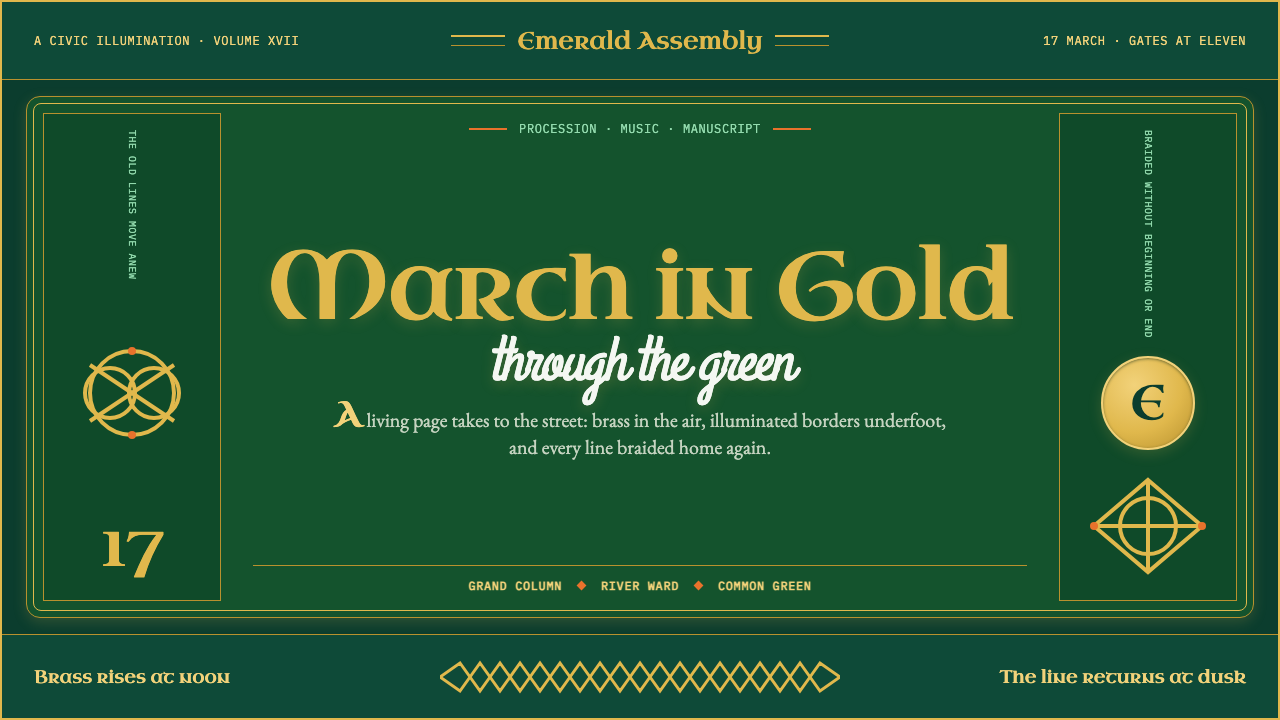 St. Patrick's Day ParadeParade energy, manuscript discipline. Bottle green, gold uncials, and closed-…
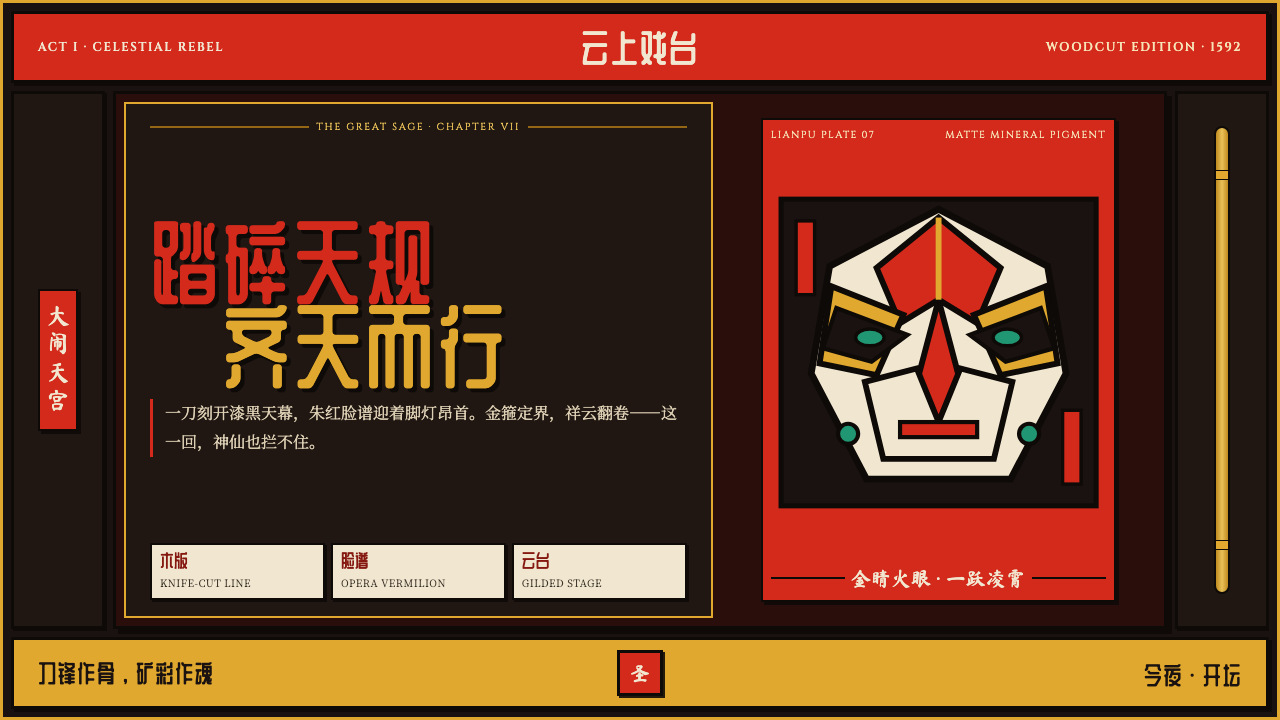 Journey to the West (Monkey King)A god roars off the block. Vermilion opera paint and gilt rules ignite a lacq…
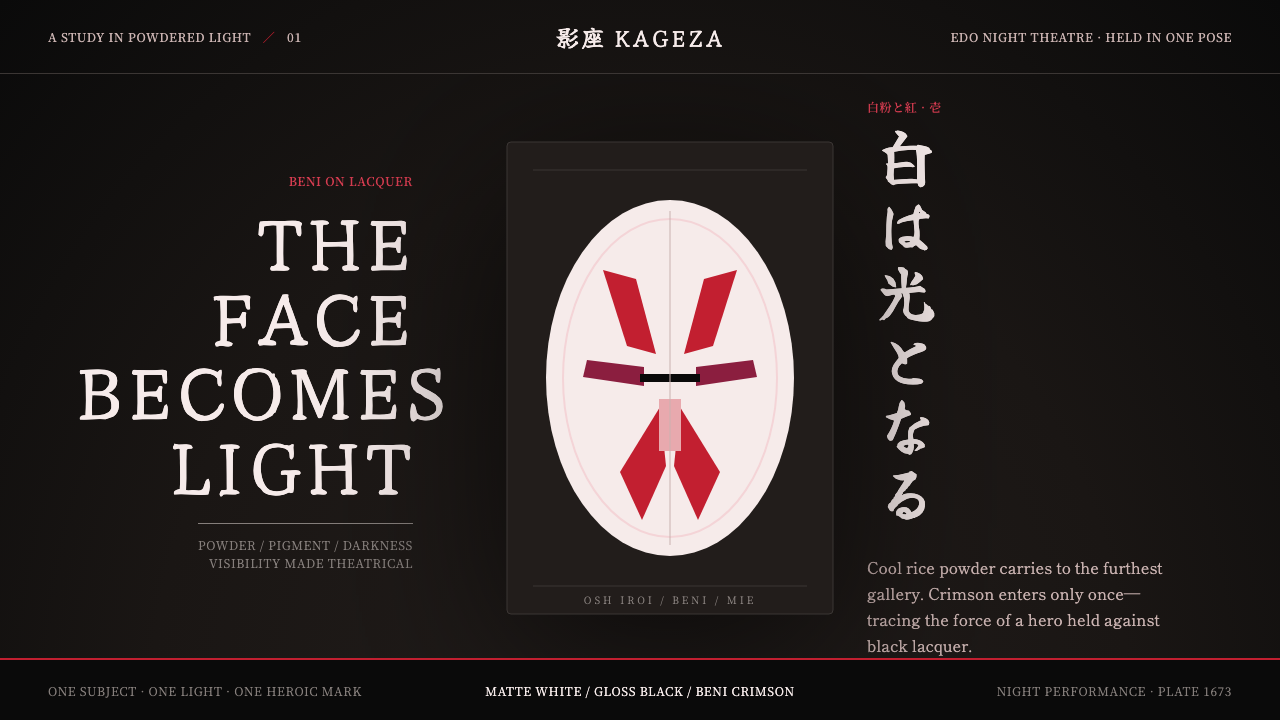 Kabuki Oshiroi WhitefacePowder becomes stage light. Cool white cuts through black lacquer with one he…
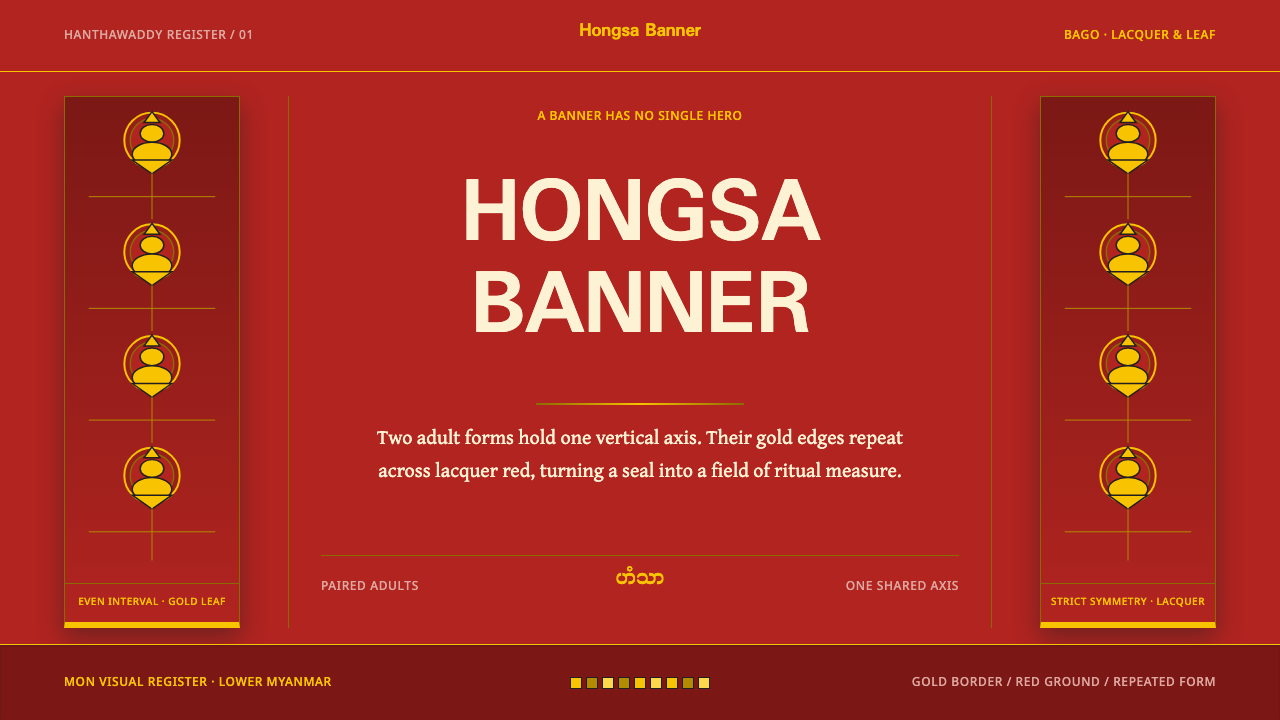 Mon Hongsa EmblemRepetition outranks the hero. Gold paired emblems tile down a lacquer-red ban…
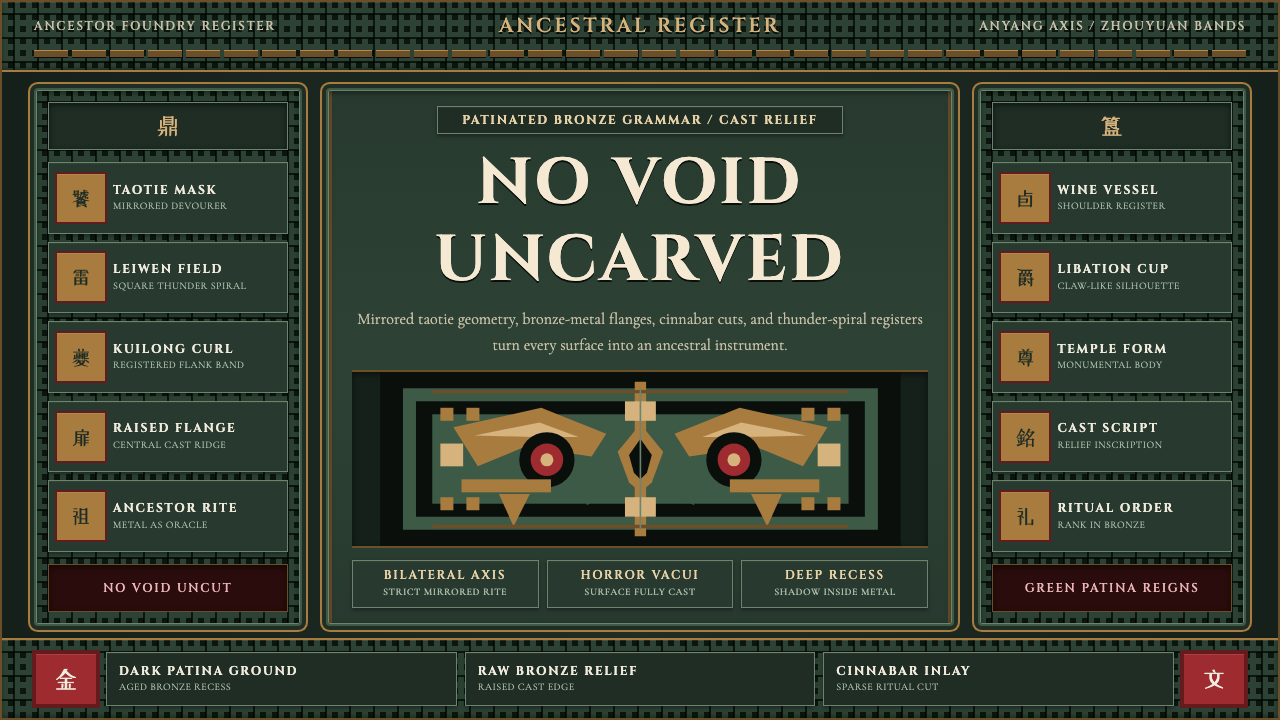 Shang-Zhou Ritual BronzeAncient terror fills every surface. Patina green, bronze relief, mirrored tao…
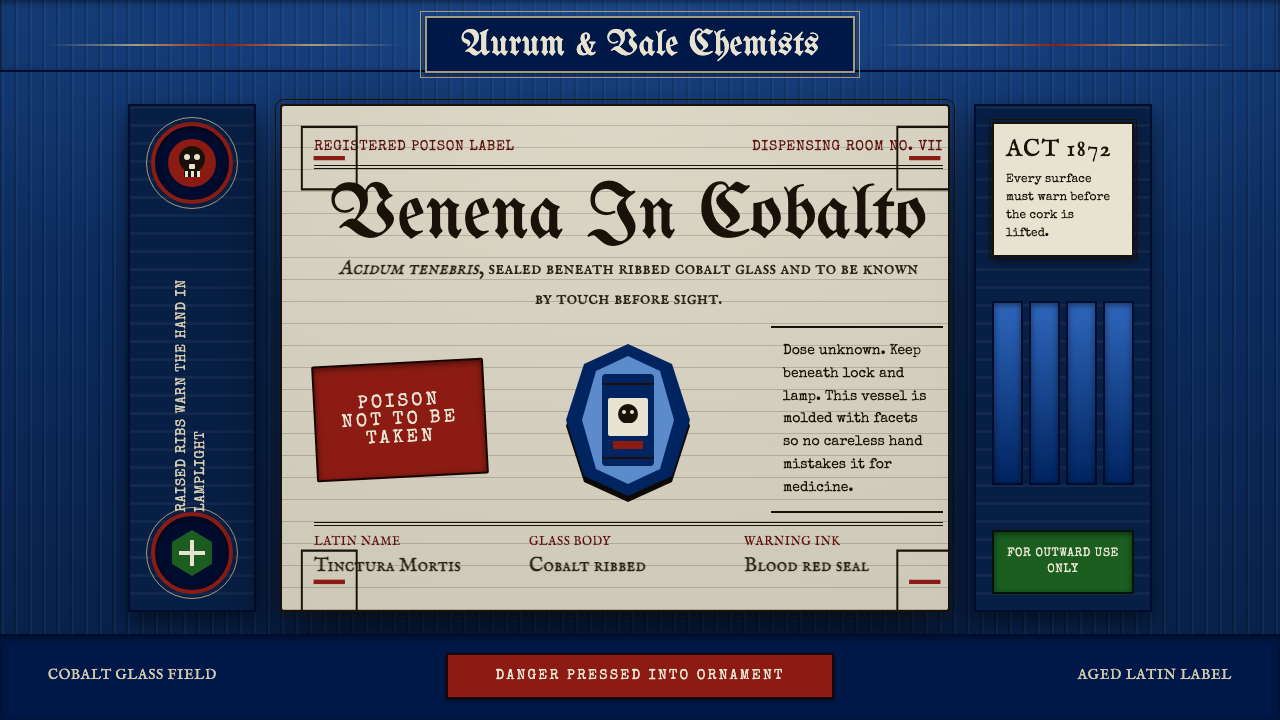 Apothecary Poison LabelDanger made ornate. Cobalt ribs, aged paper, and red POISON rules make fear t…